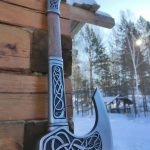
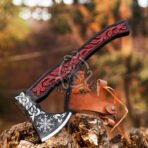
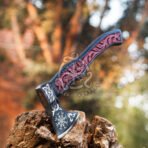
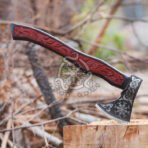
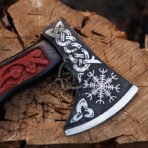
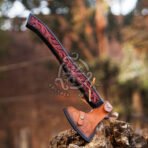
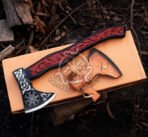
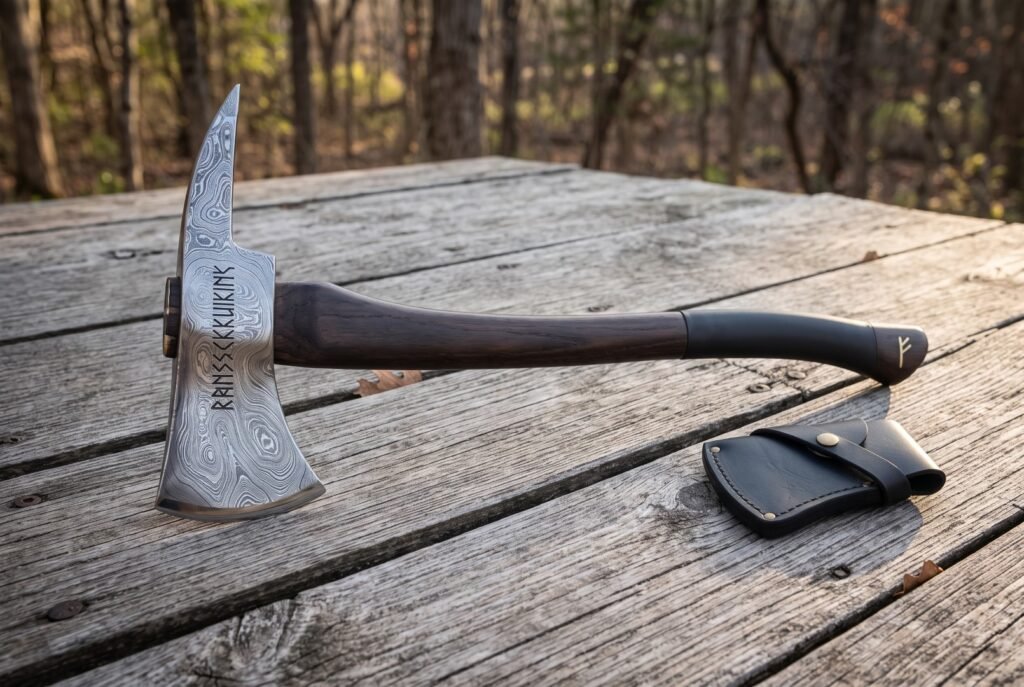
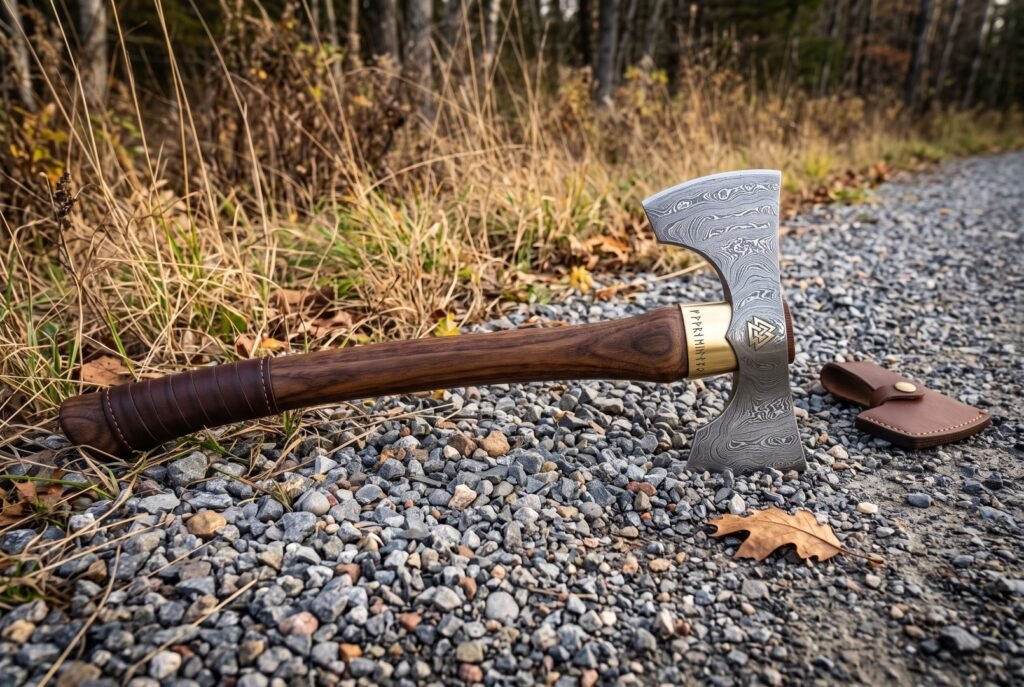
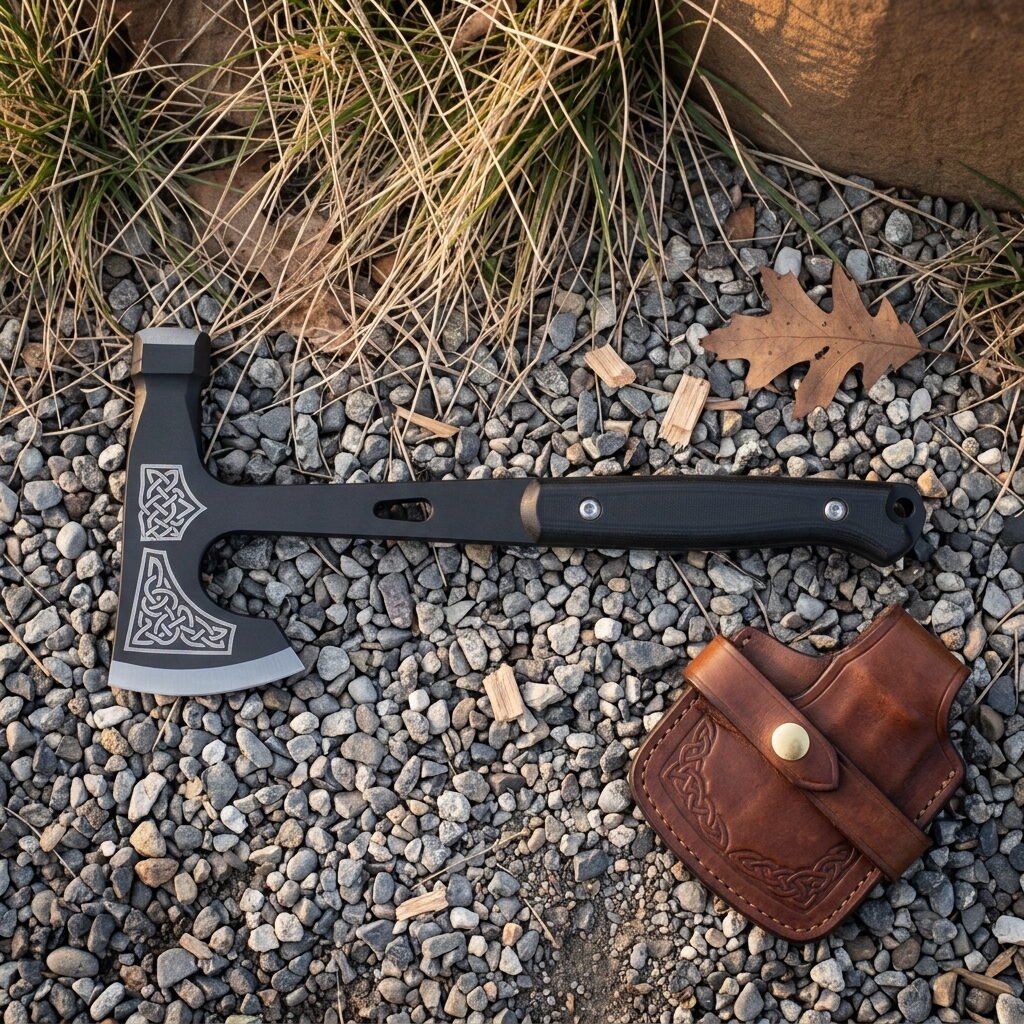
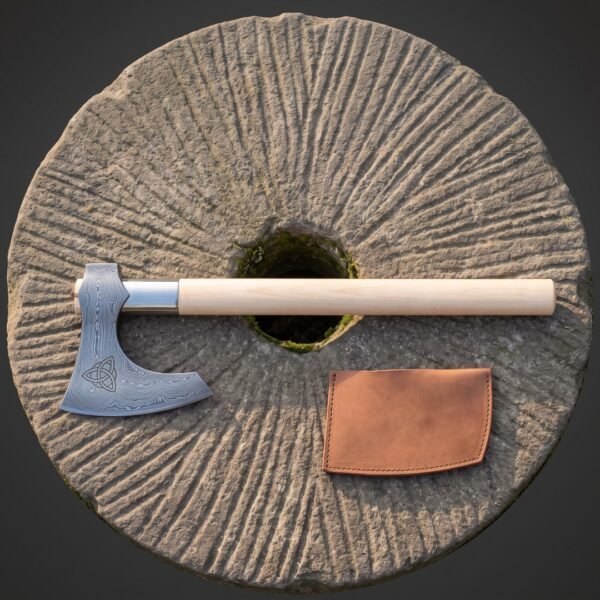
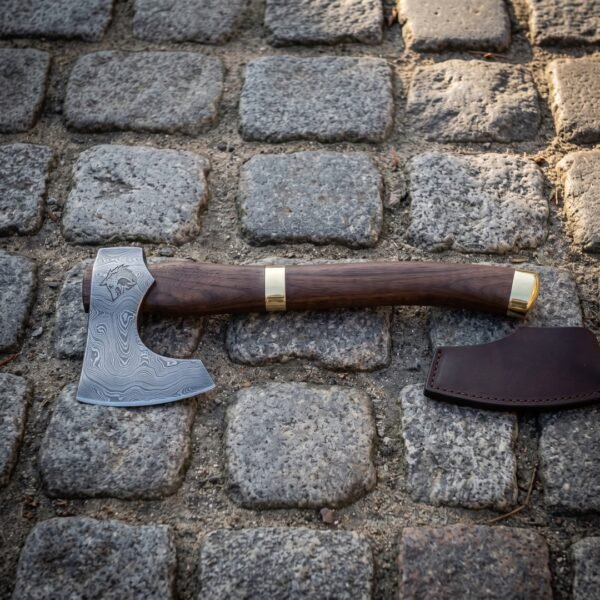
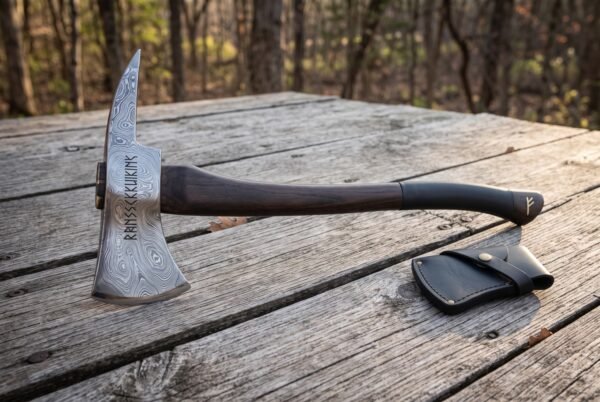
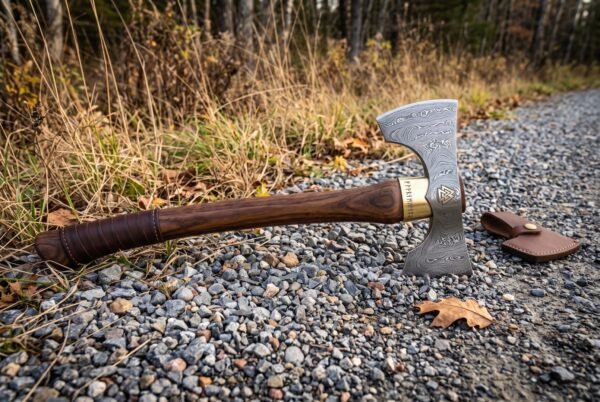
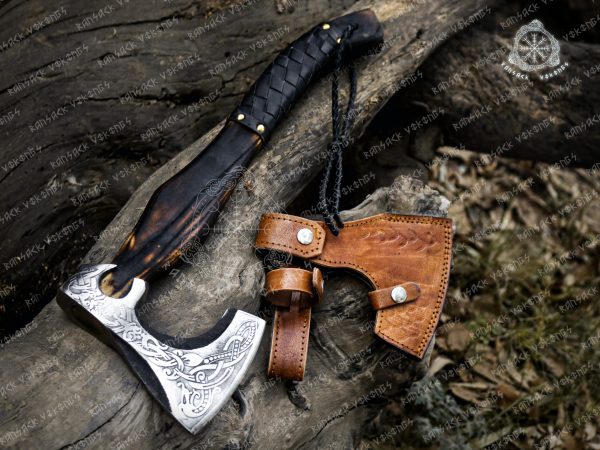
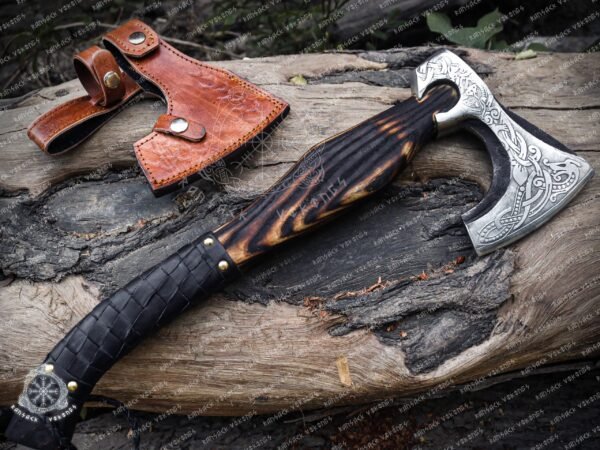
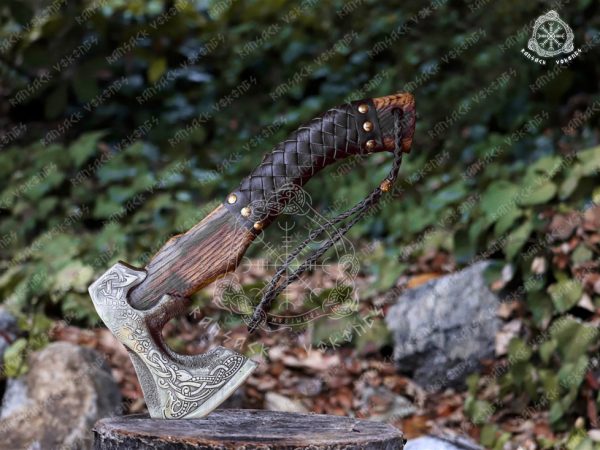
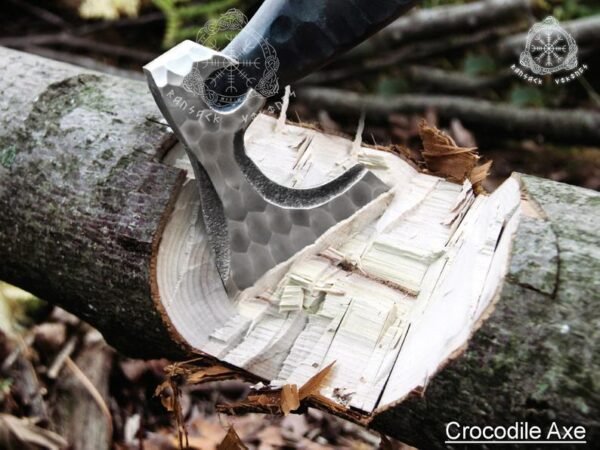
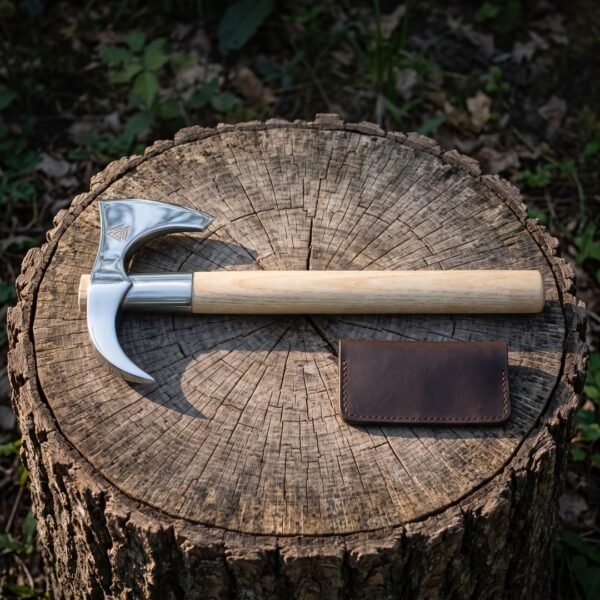
There is no cast head on the Ashgrim. The Damascus billet is welded, drawn out and shaped under the hammer, then hung on a wood haft and wedged tight. It runs 18 inches overall with a 5 inch cutting edge, weighs 1.23 kilograms, and comes with a leather blade cover and a gift box. The shape has a job in the hand, and the bearded axe shape explains what it does.
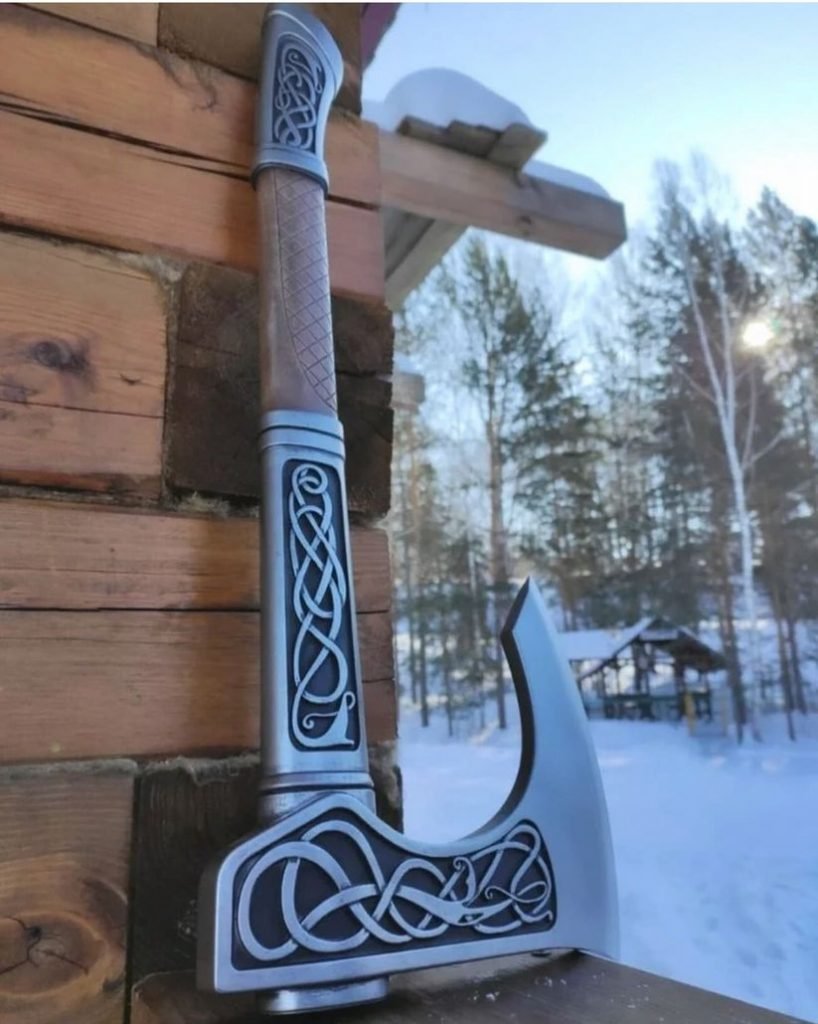
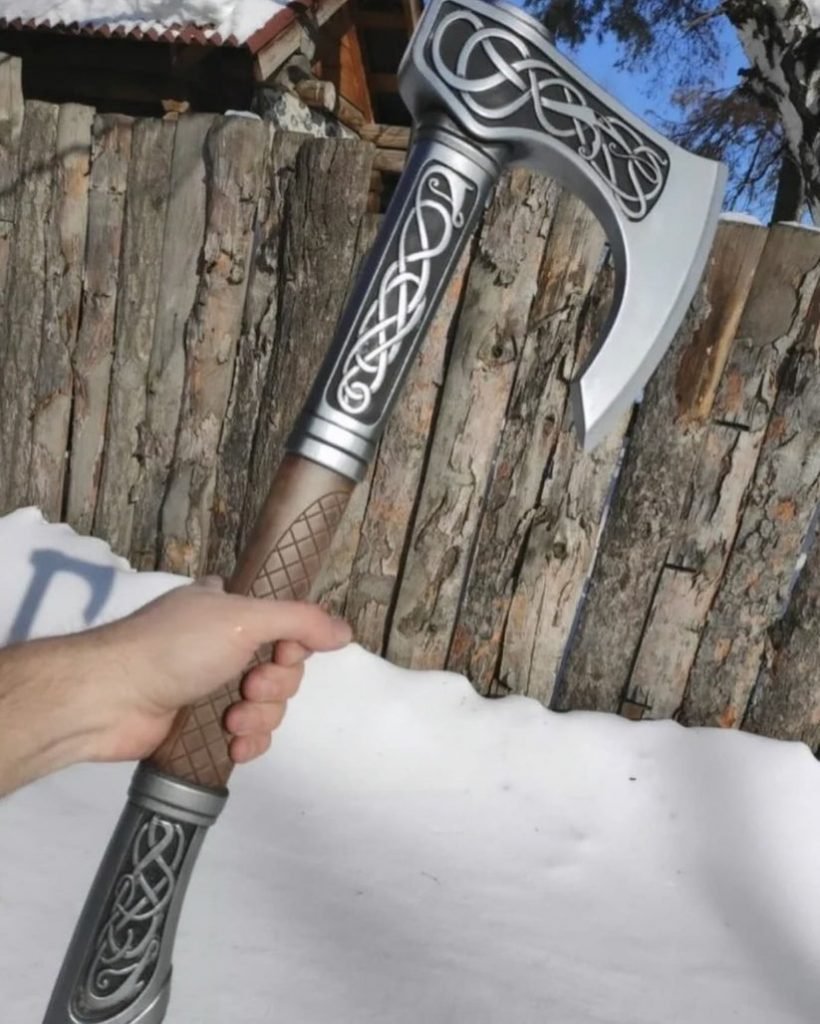
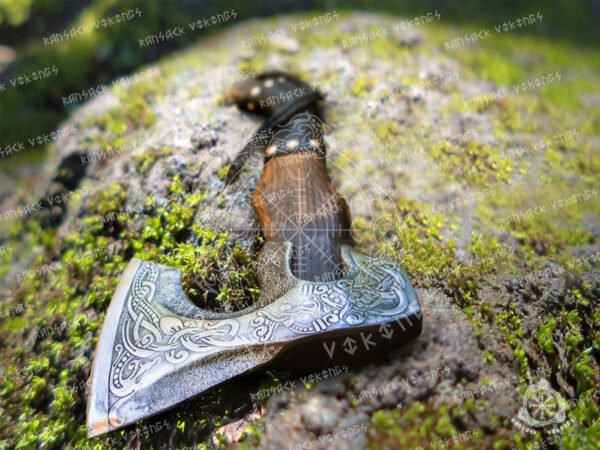
The word for this shape in Old Norse is skeggox, literally beard axe, and the beard is the long lower lobe of the bit that hangs down below the eye. It is easy to read that as decoration and it is not. Extending the cutting edge downward rather than forward gives you a longer edge without moving any weight further from your hand, which means the axe keeps its balance while gaining reach along the cut. It also opens a gap between the beard and the haft, and that gap is a handhold. You can slide your fist right up behind the head, put your fingers into that space, and use the axe as a drawknife or a carving tool with the edge only two inches from your knuckles. Scandinavian carpenters were still using bearded axes for exactly that on timber framing and boat building centuries after the Viking Age ended, and Norwegian and Swedish makers still build them today.
Each Ashgrim is forge welded, ground, heat treated, hafted and finished in the Czech Republic. Shipping in the United States is free, processing takes one to two weeks, and returns are accepted within seven days.
Specifications
| Steel | Hand forged Damascus, 1095 and 15N20 |
|---|
| Hardness | 58 to 60 HRC |
|---|
| Overall length | 18 inches |
|---|
| Cutting edge | 5 inches |
|---|
| Weight | 1.23 kg |
|---|
| Handle | Wood |
|---|
| Included | Leather blade cover and gift box |
|---|
| SKU | RK-634 |
|---|
The beard, and the three grips it gives you
An axe with a beard is really three tools depending on where your hands are, and understanding that is the whole point of owning one.
Held at the very end of the haft, all 18 inches of it, you get the full arc and the full force. This is the chopping grip, for camp wood, kindling and limbing. The head at 1.23 kilograms carries enough mass to bite properly without needing a two handed swing.
Slide your hand halfway up and the axe becomes a controlled hatchet. You lose power and gain precision, which is the grip for splitting kindling on a block, cutting notches and trimming a shelter pole to length. The forward balance of a bearded head helps here because the weight stays ahead of your hand rather than behind it.
Choke right up so your fingers sit in the hollow of the beard and you are holding a carving tool. The beard shields your knuckles from the workpiece, and the edge is close enough to your hand that you can feel exactly where it is going. This is how you shape a tent peg, take the bark off a stave or carve a spoon blank. Very few axe shapes let you do this safely, and it is the single practical reason the bearded profile survived so long.
There is a fighting use as well, and the sagas are clear about it. The lower point of the beard hooks. It catches the rim of a shield and pulls it down, it catches an ankle, and it catches the shaft of a spear. A straight bit cannot do any of that.
Why Damascus and not stainless
This head is forge welded Damascus, built from two carbon steels bonded at welding heat and then worked down together as a single bar. 1095 supplies the carbon that lets it harden and hold an edge. 15N20 carries nickel, which makes it tougher and makes it resist the etching acid, which is where the bright bands in the pattern come from. Heat treated, the finished head sits at 58 to 60 HRC.
Stainless steel would be a poor choice for an axe bit and it is worth being specific about why. The high chromium content that stops it rusting also forms hard chromium carbides in the steel structure, and in the thin cross section of an axe edge those carbides make the steel more likely to chip when it hits a knot at speed. Stainless is also stubborn under a file, which matters because a file is what you fix a damaged axe edge with, in a field, without electricity. Damascus asks you to dry it and oil it. That is the entire cost, and it buys a better edge and a tougher head. The honest version of the argument is in Damascus versus stainless.
The wooden haft
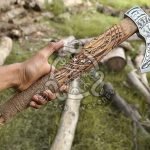
The haft is wood, shaped and sanded by hand and finished with oil rather than lacquer. That distinction is worth more than it sounds. A lacquered handle looks perfect in a photograph and then chips, and once it chips it has to be stripped back before it can be repaired. An oiled handle can be topped up in five minutes with a rag whenever it starts to look dry, which is a job you can do forever.
Wood is still the best haft material for an axe for one reason above all others. Its long fibres absorb the shock of the impact instead of passing it straight into your wrist and elbow, which is something no steel or composite handle does as well. Give it a light wipe of oil once or twice a year, more if the axe lives in a heated dry house through a winter, and check the wedge at the eye each time. A haft that dries out shrinks, and a shrunk haft is how heads come loose. The method is in wooden handle care.
Engraving, runes and your own design
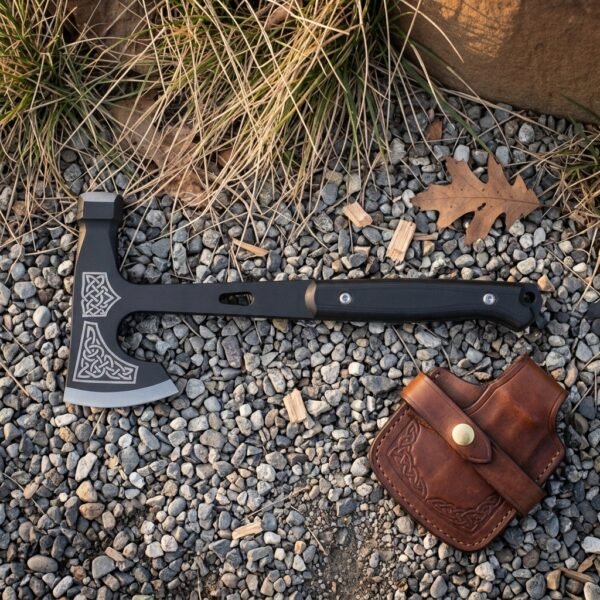
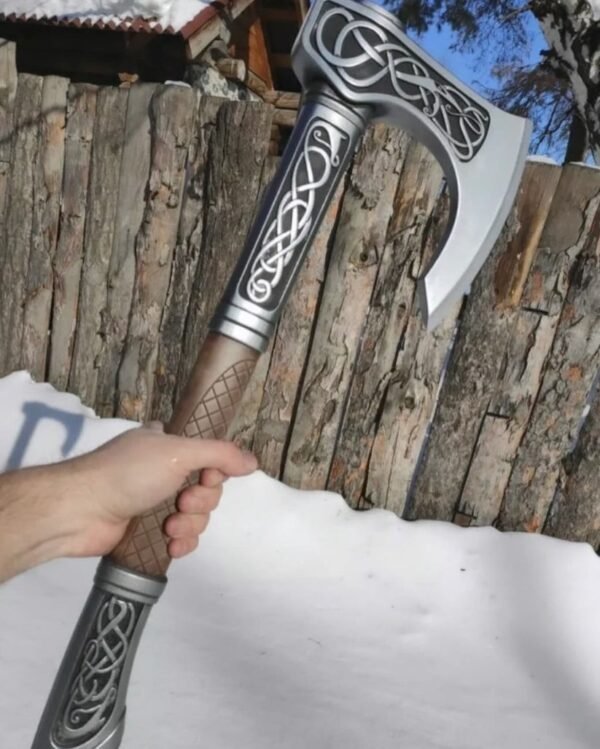
Use the rune converter on this page to turn a name, a date or a short phrase into Elder Futhark and we will cut it into the steel or the handle. If you would rather have a Viking pattern than a rune line, choose your own design in the engraving option above the add to cart button and tell us whether it goes on the blade or the handle. Where a piece already carries an engraved design, your chosen engraving replaces it rather than sitting alongside it. On a bearded head the flat above the beard takes a short rune line neatly, and the haft takes longer inscriptions. Full detail on the engraving page.
Care and sharpening
Dry the head every time it gets wet and rub a thin film of oil over the steel before storage. Leave the leather cover off during long storage so damp leather is not sitting against the bit. Do not scrub an etched Damascus head with an abrasive pad, because it will flatten the contrast in the pattern. The routine is in steel care.
Reset an axe edge with a file, not a stone. Two or three passes following the existing bevel will bring back a rolled edge faster than twenty minutes of stone work. Then refine on a coarse stone and finish on a fine one, holding the same angle throughout, as described in sharpening with a whetstone. Keep the axe away from powered grinders. Blueing at the edge means the temper has gone and no amount of stone work will bring it back.
Made in the Czech Republic
The work behind this piece happens in a Czech Republic workshop that has kept to the old methods. Steel is forged and heat treated by hand, the grind is taken down by eye rather than by machine, and the handle, fittings and sheath are cut and finished one at a time. Because of that, every piece carries small marks of the hand that made it.
Ransack Viking is a United States company. We import direct, check each piece when it reaches us, and ship from our Memphis, Tennessee warehouse. Engraving is added here in the United States after arrival, so the piece you receive is finished to your order.
A note on handmade variation
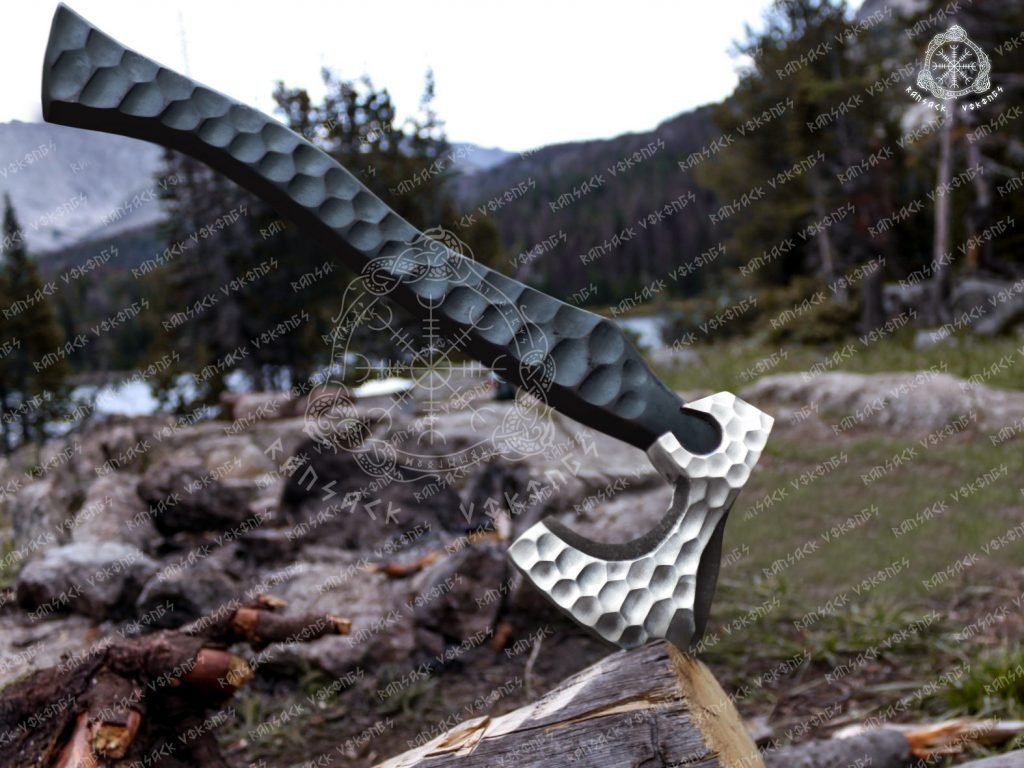
This axe is hand forged. It is not machine made and it is not bulk produced, so what arrives will not be a pixel for pixel copy of the photograph. The Damascus figure is decided by how that particular billet moved under the hammer, the etch bites slightly differently on every head, and the haft has its own grain and tone. Pattern, colour, figure and the exact profile of the beard vary from one axe to the next because each is worked by hand from natural materials. The dimensions, the steel, the hardness and the build are the same every time. The character is not.
Frequently asked questions
What is the beard actually for?
Three things. It adds cutting edge without adding forward weight, it creates a hollow you can put your hand into for carving work close to the head, and its lower point hooks a shield rim or a shaft.
Is it safe to hold it up behind the head like that?
That grip is what the shape was designed for, and the beard itself shields your fingers from the work. Keep your hand behind the beard rather than beside the edge, and cut away from yourself.
Will mine have the same Damascus pattern as the photo?
No. The pattern comes out of the billet and no two are alike. Yours will be in the same family of layered figure and it will be unique to your axe.
How does this compare to your 22 inch broad axe?
The broad axe has a 9 inch straight bit and four more inches of haft, so it carries more edge and more reach and suits chopping and display. This one is shorter, bearded, and far better for close carving and one handed work.
What kind of wood is the handle?
It is a hardwood haft shaped and oiled by hand. Because each is worked from a different piece of timber, the grain and colour differ between axes.
How long before it arrives?
Processing is one to two weeks because every head is forged to order, then shipping inside the United States is free. Engraving is done in the same window in most cases.
What is in the box
- One Ashgrim Damascus Viking bearded axe, 18 inches with a 5 inch edge
- Leather blade cover
- Gift box
- Forged and finished in the Czech Republic
Explore the range
Related collections: Viking Axes, Viking Seax, Viking Hammers and Viking Knives. The steel and the sharpening notes are in the guides.







Reviews
There are no reviews yet