
Blog
Famous Vikings: The People Behind the Sagas

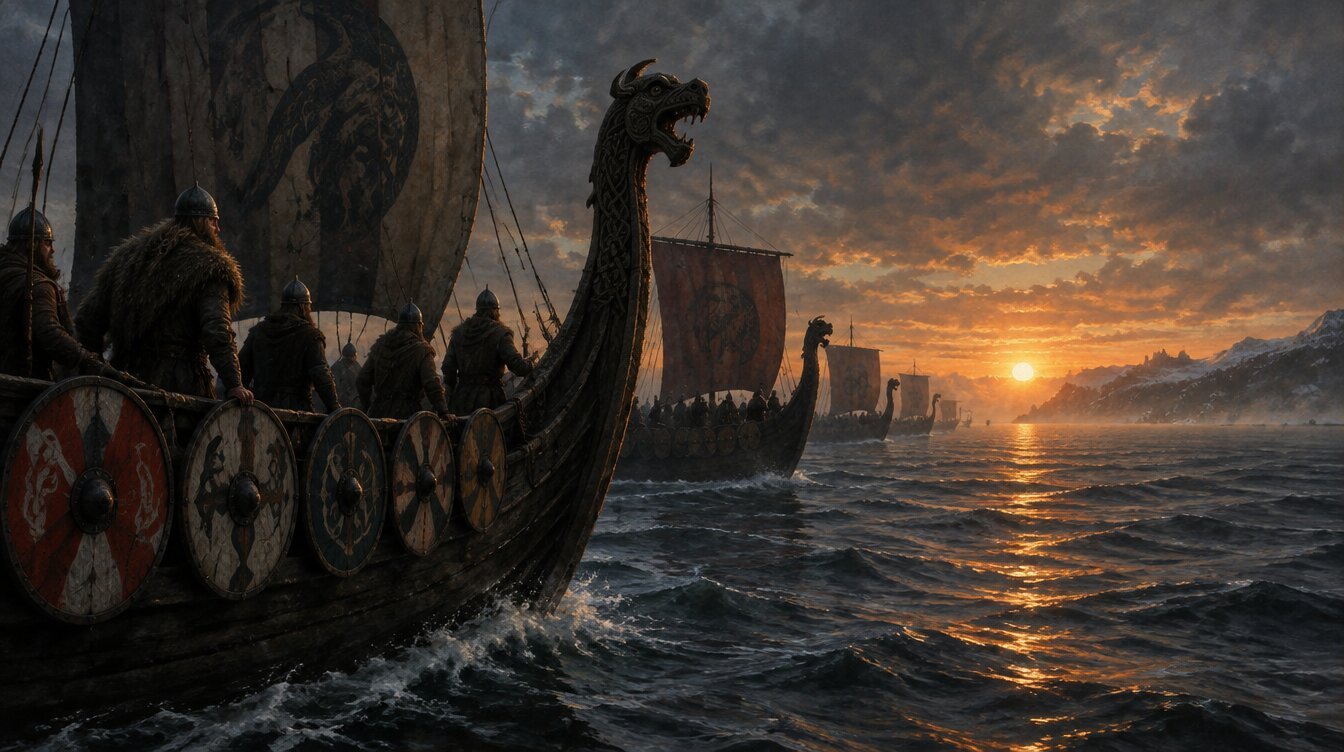
Most of the famous Vikings are half evidence and half literature. Some appear in annals written within a year of what they did. Others appear only in sagas set down two or three centuries later by Christian Icelanders who were writing history and entertainment at the same time and did not always mark the boundary. A few are almost certainly composites of several real people wearing one name.
This page takes them one at a time and says, for each, what is recorded and what is story. Where the two disagree, the disagreement is the interesting part.
Ragnar Lothbrok
The most famous of them and the least documented. No contemporary source names a Ragnar Lothbrok. Frankish annals record a Viking leader called Reginheri who attacked Paris in 845 and whose force was afterwards wrecked by disease, and that man is the usual candidate for a historical seed. Everything else comes from thirteenth century Icelandic sagas and from Saxo Grammaticus, which give him a career across half of Europe, several wives, a set of famous sons and a death in a pit of snakes at the hands of King Aella of Northumbria.
Most historians treat him as a legendary figure assembled from more than one real leader, partly to give the sons of the Great Heathen Army a single distinguished father. The byname means shaggy breeches, and even that is explained by a story rather than a source. What he carries on screen, and what the period actually used, is picked apart in the axe Ragnar carries.
Ivar the Boneless
Here the ground is firmer. The Anglo-Saxon Chronicle records the arrival of a great heathen army in East Anglia in 865, and names Ivar among its leaders. York fell in 866. King Edmund of East Anglia was killed in 869. This was not a raid; it was an invasion that reshaped England and left the Danelaw behind it.
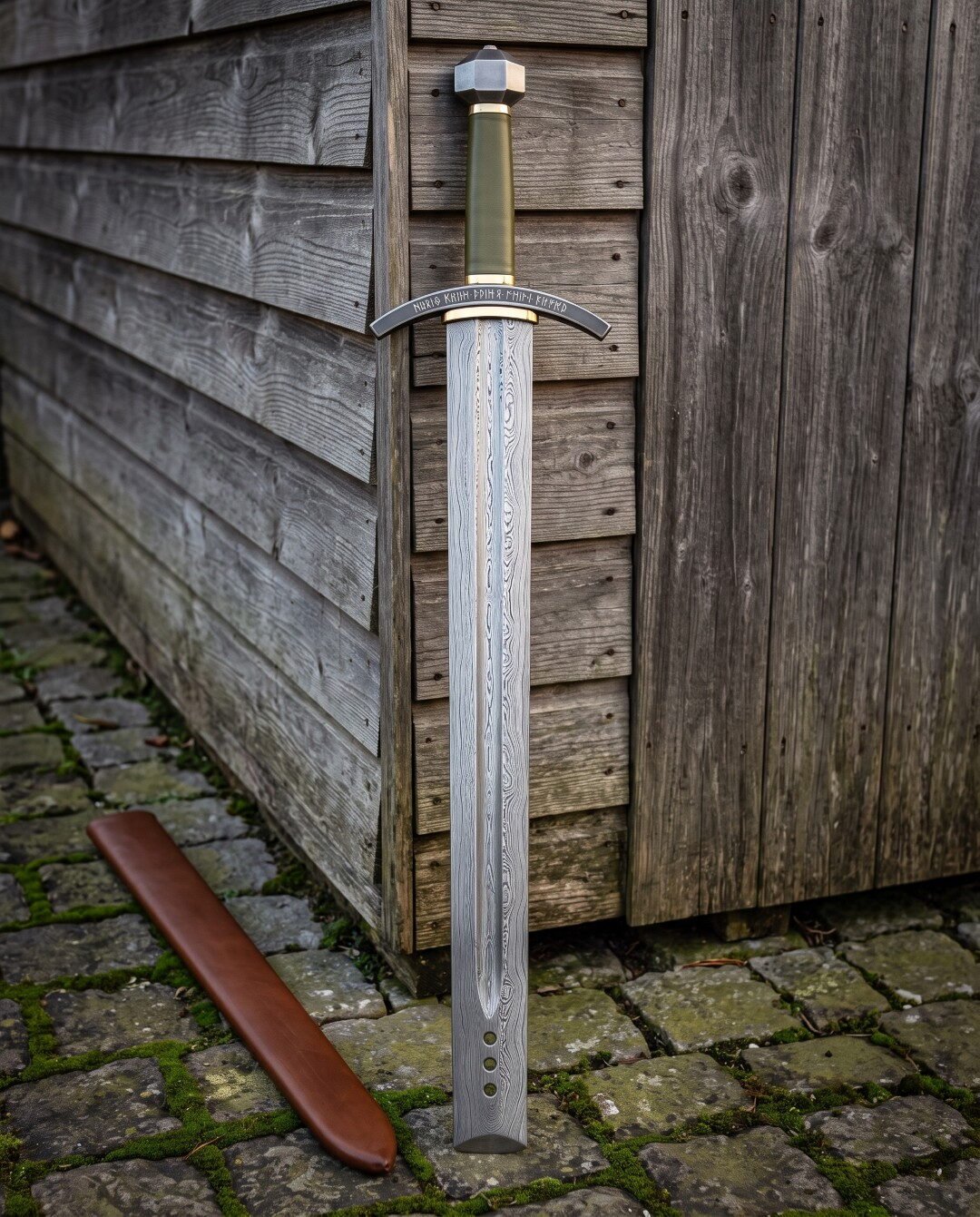
 Staveholm Hand Forged Damascus Viking Sword | 35 Inch Overall with 29 Inch Blade | Runic Arched Guard and Olive Leather Grip and Brown Scabbard | Norse Collector Gift | RK-2120
 Hammerlight Hand Forged High Carbon Steel Viking Arming Sword | 36 Inch Overall Length | Brass Hilt with Oxblood Leather Grip | Mjolnir Etched Gift | RK-2150
 Valkbraid Hand Forged Damascus Viking Sword with Valknut Lobed Pommel | Vegvisir Etched Blade | Brown Leather Grip and Steel Mounted Scabbard | Norse Collector Gift | RK-2054
Many historians identify him with Imar, a king of the Norse in Dublin whose death the Irish annals record in 873, which would make him a figure operating across the Irish Sea rather than only in England. The byname is genuinely unexplained. Suggestions have ranged from a physical condition affecting his bones or his legs to a figurative reading about being difficult to pin down, and none of them can be shown to be right.
Bjorn Ironside
Saga tradition makes him a son of Ragnar and the founder of a Swedish royal line. Frankish sources record a leader active on the Seine in the 850s whose name is written Berno, and they describe a spectacular expedition of 859 to 861 that took a Viking fleet through the Strait of Gibraltar, along the coasts of Iberia and North Africa, to the Balearics, up the Rhone and into Italy, where the town of Luni was sacked in a raid later retold as a failed attempt on Rome.
That the expedition happened is not in doubt. Whether its leader is the same man the sagas call Bjorn Ironside, and whether he was Ragnar’s son, cannot be established. The byname presumably refers to surviving wounds that should have finished him.
Erik the Red
Eirik Thorvaldsson, exiled from Norway with his father over a killing, then outlawed from Iceland for three years around 982 after a feud of his own that ran to more killings. He used the exile to sail west and explore the coast the sagas say he named Greenland, a piece of marketing that has been admired ever since.
He returned, recruited settlers and led a fleet out around 985 or 986, establishing the Eastern Settlement and taking the estate at Brattahlid himself. The Norse presence in Greenland lasted roughly five centuries before it failed. Erik appears in two sagas and in Ari Thorgilsson’s Book of the Icelanders, and the outline of his career is accepted as broadly historical.
Leif Erikson
Erik’s son, and the one with the strongest claim to reaching North America. The two Vinland sagas do not agree on how it happened. One has Leif deliberately following up a coast sighted by a lost merchant named Bjarni Herjolfsson. The other has him blown off course on the way back from Norway. Both name three lands to the west: Helluland, Markland and Vinland.
The argument stopped being literary in 1960, when Helge Ingstad and the archaeologist Anne Stine Ingstad identified a Norse site at L’Anse aux Meadows in northern Newfoundland. It is unambiguously Norse, with turf buildings and iron working. In 2021 a study using a known cosmic ray event visible in tree rings dated wood cut at the site to exactly the year 1021, which is the single firmest date in the whole story. Whether that site is Leif’s own camp is a separate and unresolved question.
Harald Fairhair
Traditionally the first king of a unified Norway, victorious at the sea battle of Hafrsfjord and the reason, in saga logic, that so many Norwegians left for Iceland. He is a real figure, but the later Norwegian kings who traced their legitimacy to him had every reason to enlarge him, and modern historians generally think his actual kingdom was smaller and less unified than Snorri’s account suggests. Even the date of Hafrsfjord is uncertain by a couple of decades. The byname refers to a vow not to cut his hair until the job was done, which is a good story regardless of its truth.
Harald Bluetooth
Harald Gormsson, king of Denmark, who left his own account of himself carved in granite. The larger of the two Jelling stones was raised by Harald in memory of his parents and states that he won all Denmark and Norway for himself and made the Danes Christian. It is a piece of royal advertising, and it is also one of the very few Viking Age political statements we can read in the words of the man who commissioned it.
He was deposed by his own son and died in the mid 980s. His byname, most likely describing a dark or dead tooth, was borrowed a thousand years later for a short range radio standard, which is why a technology used by billions carries the initials of a Danish king in its logo.
Sweyn Forkbeard
Harald’s son, and the man who actually conquered England. A campaign that had run for years culminated in the submission of the country at the end of 1013, with Aethelred fleeing to Normandy. Sweyn then died in February 1014, having ruled for a matter of weeks, which is one of history’s less satisfying punchlines. His son finished the job.
Cnut the Great
King of England from 1016, of Denmark from 1018 and of Norway from 1028, ruling a North Sea empire from a country his father had taken by force. He governed England largely through existing English institutions, issued law codes, went on pilgrimage to Rome in 1027 and negotiated terms for English and Danish travellers on the way.
The tide story attached to him is worth correcting, since it is usually told backwards. In the earliest version he sets his throne at the water’s edge specifically to demonstrate to flattering courtiers that royal power is nothing next to God’s. He was making the opposite point to the one he is now mocked for.
Rollo
A Norse leader who ended up with a large piece of northern France. The traditional account has Charles the Simple granting him land around Rouen in 911 in exchange for defending the river against other Vikings and accepting baptism. His descendants became the dukes of Normandy, and one of them, six generations later, took England in 1066.
Whether Rollo was Danish or Norwegian was argued over for centuries and is still not settled. The name is a Latinised form of Hrolf, and the linguistic trail is discussed in Viking names and what they meant.
Harald Hardrada
The most travelled of the lot. Harald Sigurdsson fled Norway as a teenager after the battle where his half brother Olaf was killed, made his way east, and served in the Varangian Guard in Constantinople, campaigning in the Mediterranean and the Middle East. He came home rich, bought and fought his way to the Norwegian throne in 1046, and spent much of his reign in an inconclusive war with Denmark.
In 1066 he invaded England, won at Fulford, and was killed at Stamford Bridge on 25 September, three weeks before Hastings. His death is the conventional end point of the Viking Age, which is tidy history but a real turning point all the same. What his army actually carried is set out in Viking armour and the Viking spear.
Aud the Deep Minded
Daughter of Ketil Flatnose and widow of Olaf the White, a Norse king in Dublin. After the deaths of her husband and her son she had a ship built in secret in Scotland, gathered her household and grandchildren, and sailed to Iceland, where she claimed a large territory in Breidafjord and distributed land among her followers. Landnamabok records that she freed slaves who had travelled with her and gave them holdings of their own. She was a Christian in a largely heathen settlement and, by the account of Laxdaela saga, ran her affairs entirely on her own authority.
Gudrid the Far Travelled
Gudrid Thorbjarnardottir appears in both Vinland sagas. She sailed to Greenland, then to Vinland with her husband Thorfinn Karlsefni, and gave birth there to a son named Snorri, described as the first child born to European parents in North America. Later, having returned to Iceland, she is said to have travelled to Rome as a pilgrim. If even the outline is true she covered more of the known world than almost any man in the sagas.
Egil Skallagrimsson
Icelandic poet, farmer and killer of people, and the subject of one of the best sagas. Egil composed a ransom poem in a night to save his own head from Erik Bloodaxe in York, and later wrote Sonatorrek, a lament for a drowned son that argues furiously with the gods and is one of the few pieces of Norse verse that reads as personal grief rather than performance. The saga’s description of his skull, thick enough to resist an axe, has led more than one modern writer to suggest he had a bone disease, which is a strange and rather human footnote to a legend.
What They Actually Carried
The kit is better documented than most of the people. Spear and shield were the standard, an axe was common and cheap, a sword marked status, and mail or a helmet marked real wealth. None of them wore horns, for reasons set out in the horned helmet myth. The best blades of the age carry an inlaid maker’s name, and the story of those is in the Ulfberht swords. Screen versions are graded for accuracy in the arms of Vikings and The Last Kingdom.
Ransack Viking is a US company in Chicago, Illinois. The pieces are made by hand in the Czech Republic, then imported, inspected and shipped from Chicago, where engraving is cut after they arrive. US orders ship free and tracked with no duty, and the lifetime warranty against defects has no end date. The relevant ranges are Viking swords, Viking axes and Viking armor. The rest of the writing is in the guides.
Questions people ask
Was Ragnar Lothbrok a real person?
Probably not as a single man. No contemporary source names him, and everything detailed about him comes from sagas written three or four centuries later. A Viking leader called Reginheri who attacked Paris in 845 is the usual historical candidate, and the saga figure looks like several leaders combined into one convenient father.
Who was the most successful Viking?
By results, Cnut the Great. He ruled England, Denmark and Norway at once, governed through existing institutions rather than by occupation, and died in his bed in 1035. Rollo has a claim too, since his grant of land in Normandy led to the conquest of England six generations later.
Did Leif Erikson really reach America?
Norse people certainly did. The site at L’Anse aux Meadows in Newfoundland is unambiguously Norse, and wood cut there has been dated to exactly 1021 using a cosmic ray event recorded in tree rings. Whether that particular camp was Leif’s own is not established, and the sagas disagree about how he got there.
Why was Ivar called the Boneless?
Nobody knows. Explanations range from a medical condition affecting his legs or bones to a figurative sense of being slippery or ungraspable, and none can be demonstrated from the sources. The name appears only in later material, which does not help.
Were there real Viking women who led?
Yes, and Aud the Deep Minded is the clearest case. She had a ship built, moved her whole household from Scotland to Iceland, claimed and distributed a large territory, and freed the slaves who came with her. Gudrid the Far Travelled crossed the Atlantic twice and is said to have reached Rome.
When did the Viking Age end?
The conventional date is 1066, when Harald Hardrada was killed at Stamford Bridge. That is a historian’s convenience rather than a real break, since Norse activity continued in Ireland, the Isles and the north for generations. It marks the end of large scale Scandinavian attempts on the English throne.
Is Bluetooth named after a Viking?
It is. The wireless standard is named for Harald Bluetooth, the Danish king who united territories under one rule, and its logo combines the runes for his initials. He left his own account of his reign carved on the larger Jelling stone.
How much of the sagas can be trusted?
They are literature built on tradition, written down two to three centuries after the events by Christian authors with their own interests. Where a saga can be checked against annals, charters or archaeology it is often broadly right about people and places and unreliable about speeches, motives and numbers.
What the shop carries
On the shelf in the same spirit, the Ragnar Viking sword and the Ragnar Viking bearded axe. Next to those, the Ragnar warlord Viking axe and the Ravenskegg Viking bearded axe.
Shop the range
Staveholm Hand Forged Damascus Viking Sword | 35 Inch Overall with 29 Inch Blade | Runic Arched Guard and Olive Leather Grip and Brown Scabbard | Norse Collector Gift | RK-2120Hammerlight Hand Forged High Carbon Steel Viking Arming Sword | 36 Inch Overall Length | Brass Hilt with Oxblood Leather Grip | Mjolnir Etched Gift | RK-2150Valkbraid Hand Forged Damascus Viking Sword with Valknut Lobed Pommel | Vegvisir Etched Blade | Brown Leather Grip and Steel Mounted Scabbard | Norse Collector Gift | RK-2054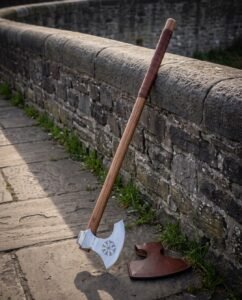 Wayfarrow Hand Forged Long Handled Viking Axe with Bearded Head & Etched Vegvisir | About 35 Inch Haft | Leather Grip Wrap and Fitted Leather Blade Cover | Norse Gift | RK-2204
 Runeleaf Hand Forged Elder Futhark Spear | 44 Inch Overall with 11 Inch Head | Ash Haft, Red Leather Grip and Brown Leather Head Sheath | Norse Reenactment Gift | RK-1981
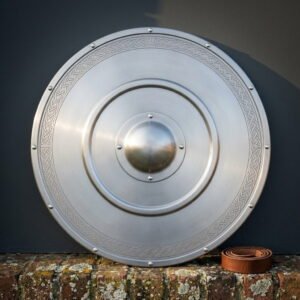 Ringward Hand Made Steel Viking Round Shield | Domed Centre Boss and Riveted Rim | Engraved Norse Knotwork Band with Leather Arm Strap | Norse Display Gift | RK-1797