
Blog
Viking Names and What They Meant

Norse names are not decoration. They are made of parts, and the parts mean things. Once you can see the joins, a name stops being a sound and becomes a small statement about war, gods, animals or family, chosen by parents who expected the child to grow into it.
What follows is a working guide to how the names were built, what the common ones actually mean, and which popular ones are modern inventions wearing an old costume. The spellings here are anglicised, with the Old Norse forms given where the difference matters.
How a Norse Name Was Built
The standard pattern is two elements joined together. Sig, victory, plus urd, guardian, gives Sigurd. Thor plus stein, stone, gives Thorstein. Ragn, the ruling powers, plus hild, battle, gives Ragnhild. The elements come from a fixed pool, and a family would recycle them across generations so that a son carried half his grandfather’s name.
Single element names also exist and are often older. Ulf is simply wolf. Bjorn is bear. Hild is battle. Aud is wealth. These are not shortened versions of anything; they are complete names in their own right.
Alliteration ran in families. A man named Halfdan might have sons called Harald and Hrolf, and the pattern is visible enough in the genealogies that historians use it as weak evidence for family links. Combining elements did not have to produce a sensible phrase. Gunnhild is battle plus battle. Nobody minded.
The Patronymic
There were no surnames. A person was identified as the child of their father, occasionally their mother, using son or dottir. Erik Thorvaldsson is Erik the son of Thorvald. Freydis Eiriksdottir is Freydis the daughter of Erik. The name changes every generation, which is why Norse genealogies read as chains rather than as family trees with a shared label at the top.
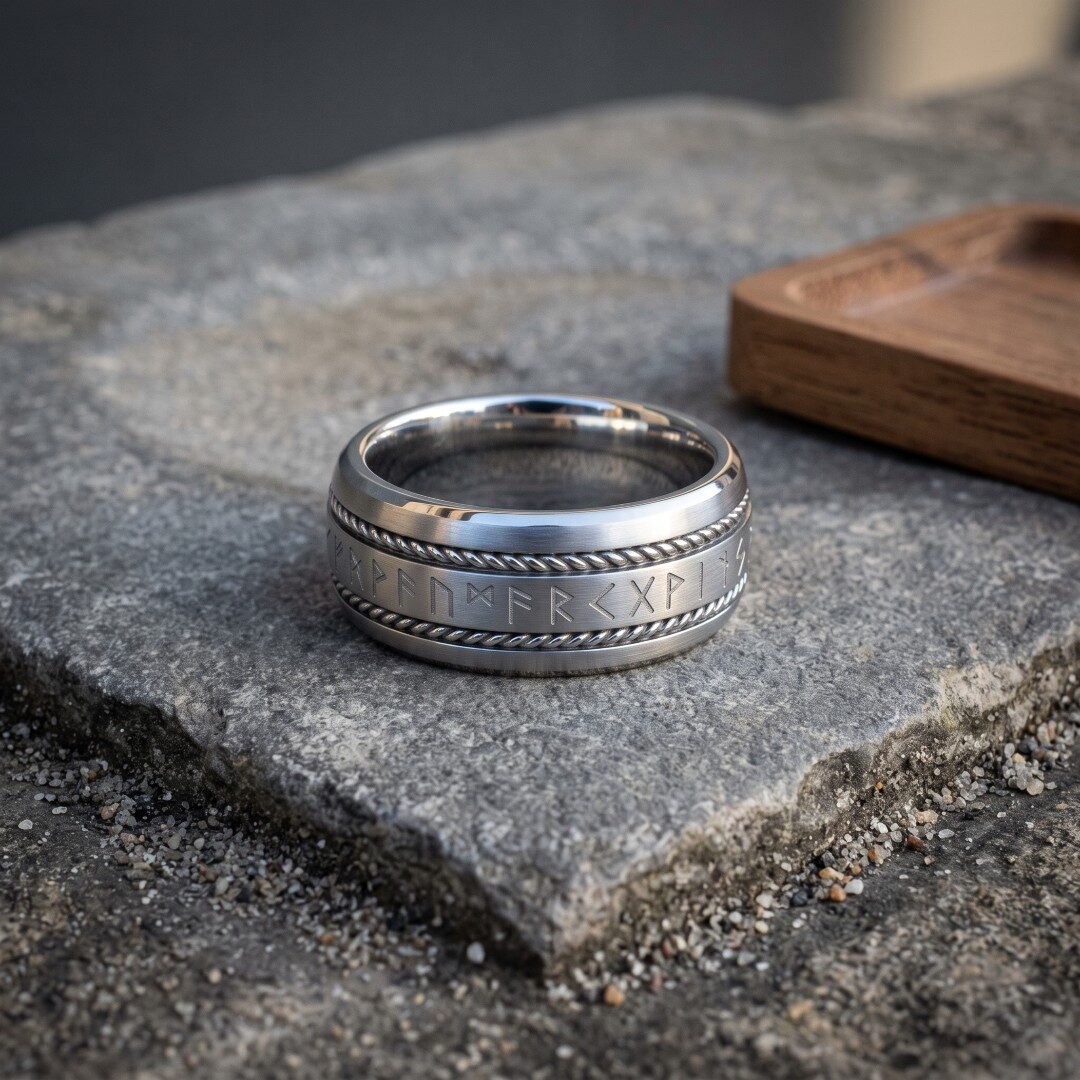
 Ropewind Hand Made Norse Rune Ring with Twisted Rope Borders & Elder Futhark Centre Band | 9mm Wide | Groomsmen Gift | RK-1604
 Everrune Hand Made Viking Rune Ring with Elder Futhark Band & Bevelled Polished Edges | 6mm Wide | Norse Wedding Gift | RK-1603
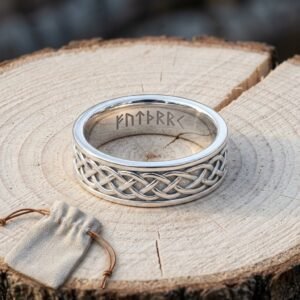 Knotvow Hand Made Viking Rune Ring with a Celtic Knotwork Band & Elder Futhark Cut Inside | Norse Wedding Gift | RK-1658
Iceland still works this way. An Icelandic phone directory is alphabetised by first name, because the second name is a relationship rather than a family.
The Bynames
Where the system gets entertaining. Since half the district was called Thorstein, people acquired descriptive tags, and those tags were not chosen to flatter. They stuck hard enough that some of them are the only part of a name that survived.
| Byname | Old Norse | What it means |
|---|---|---|
| the Red | inn raudi | Red haired or red bearded, as in Erik the Red |
| Fairhair | harfagri | Fine or beautiful hair, applied to Harald of Norway |
| Hardrada | hardradi | Hard in counsel, stern ruler |
| Bluetooth | blaton | Dark or discoloured tooth, applied to Harald Gormsson |
| Forkbeard | tjuguskegg | A beard parted into two points |
| Lothbrok | lodbrok | Shaggy or hairy breeches |
| the Deep Minded | djupudga | Deeply wise, applied to Aud, a settler of Iceland |
| the Boneless | beinlausi | Unexplained and much argued over |
| Ironside | jarnsida | Iron flank, presumably for surviving wounds |
| Tree-foot | trefotr | A wooden leg |
| the Stout | inn digri | Heavy or thickset, applied to Olaf Haraldsson |
The people carrying most of these are covered in famous Vikings.
Men’s Names and What They Meant
| Name | Old Norse | Meaning |
|---|---|---|
| Bjorn | Bjorn | Bear |
| Ulf | Ulfr | Wolf |
| Arnbjorn | Arnbjorn | Eagle plus bear |
| Sigurd | Sigurdr | Victory plus guardian |
| Gunnar | Gunnarr | Built on gunnr, battle |
| Ragnar | Ragnarr | The ruling powers plus army |
| Harald | Haraldr | Army plus ruler |
| Erik | Eirikr | Sole or ever, plus ruler |
| Ivar | Ivarr | Yew plus warrior |
| Halfdan | Halfdan | Half Dane, a name for mixed parentage |
| Thorstein | Thorsteinn | Thor plus stone |
| Thorbjorn | Thorbjorn | Thor plus bear |
| Thorkell | Thorkell | Thor plus kettle or helmet |
| Asgeir | Asgeirr | God plus spear |
| Gudmund | Gudmundr | God plus protection |
| Leif | Leifr | Heir, the one left behind |
| Olaf | Olafr | Ancestor plus heir |
| Knut | Knutr | Knot |
| Svein | Sveinn | Young man, retainer |
| Hrolf | Hrolfr | Fame plus wolf |
| Ketil | Ketill | Cauldron, and by extension a helmet |
| Steinar | Steinarr | Stone plus warrior |
Women’s Names and What They Meant
| Name | Old Norse | Meaning |
|---|---|---|
| Astrid | Astridr | God plus beautiful or beloved |
| Gudrun | Gudrun | God plus rune, secret knowledge |
| Ingrid | Ingiridr | The god Ing plus beautiful |
| Hild | Hildr | Battle |
| Brynhild | Brynhildr | Mail coat plus battle |
| Ragnhild | Ragnhildr | The ruling powers plus battle |
| Gunnhild | Gunnhildr | Battle plus battle |
| Sigrid | Sigridr | Victory plus beautiful |
| Sigrun | Sigrun | Victory plus secret knowledge |
| Thora | Thora | Formed from the god Thor |
| Thorgerd | Thorgerdr | Thor plus enclosure or protection |
| Thorunn | Thorunn | Thor plus to love |
| Freydis | Freydis | Freyr or Freyja plus dis, lady |
| Helga | Helga | Holy, hallowed |
| Aud | Audr | Wealth, prosperity |
| Asa | Asa | Formed from ass, a god of the Aesir |
| Halldora | Halldora | Rock plus the feminine of Thor |
| Yngvild | Yngvildr | Yngvi, a name of Freyr, plus battle |
| Ingibjorg | Ingibjorg | The god Ing plus help or protection |
| Solveig | Solveig | Sun plus strength |
The Building Blocks
Learn about fifteen elements and you can decode most Norse names you meet.
| Element | Meaning | Seen in |
|---|---|---|
| As- | A god of the Aesir | Asgeir, Astrid, Asa |
| Thor- | The god Thor | Thorstein, Thorbjorn, Thorgerd |
| Sig- | Victory | Sigurd, Sigrid, Sigrun |
| Ragn- | The ruling powers | Ragnar, Ragnhild |
| Gunn- | Battle | Gunnar, Gunnhild |
| Ing- | The god Freyr under his other name | Ingrid, Ingibjorg |
| -hild | Battle | Brynhild, Ragnhild |
| -frid | Beautiful, beloved | Astrid, Sigrid |
| -dis | Lady, divine woman | Freydis, Thordis |
| -rik | Ruler, mighty | Erik, Alfrik |
| -vald | Ruler, one who wields | Harald, Thorvald |
| -geir | Spear | Asgeir, Holmgeir |
| -stein | Stone | Thorstein, Hallstein |
| -mund | Protection | Gudmund, Sigmund |
| -bjorn | Bear | Thorbjorn, Arnbjorn |
| -ulf | Wolf | Hrolf, Thorolf |
Names That Are Not Actually Viking Names
A god’s name was not handed to a child outright. Thor supplies the first element of dozens of names, but nobody in the sagas is simply called Thor, and nobody at all is called Odin. The element was borrowed; the name itself was not. Freyja as a given name is a modern revival rather than a Viking Age personal name, however well it suits a daughter.
Several names people expect to find are bynames rather than names. Lothbrok is a nickname meaning shaggy breeches, attached to a legendary figure whose given name was Ragnar. Ironside and Bluetooth are the same kind of thing. Kraken is a much later Norwegian word for a sea monster and was never anyone’s name.
Screen Norse has also invented freely, which is fine as drama and unreliable as evidence. If a name has no entry in the runic and saga name catalogues, that is usually because it was never used. Which gods people actually named their children after is a separate question, and the answer is set out in the Norse gods guide.
Where the Evidence Comes From
Three bodies of material carry most of it. Runic inscriptions, of which several thousand survive from Scandinavia, name real people in their own lifetimes and are catalogued in specialist name lexicons built for exactly this purpose. The Icelandic sagas and Landnamabok, the book of settlements, name several thousand more, though written down centuries later. And English place names in the old Danelaw preserve Norse personal names fossilised in the ground: Grimsby is the settlement of Grim, and dozens of villages ending in by carry a Norse name in front.
Runestones are the most direct of the three, since the person paying for the carving usually named themselves as well as the dead. Who raised them and what they say is covered in runestones explained, and the alphabet they used is set out rune by rune in the Elder Futhark.
Names That Travelled
Norse names did not stay in Scandinavia, and tracing where they landed is one of the better ways to see how far the period reached. In England they survive in personal names and in place names right across the old Danelaw, and a fair number of ordinary English surnames descend from them. Rollo, the Viking leader granted land on the Seine, carried a Latinised form of Hrolf, and his descendants in Normandy shed the Norse names within a couple of generations while keeping the power.
In the east the Slavic form Rurik comes from Hrarekr, famous ruler, and Ingvar and Oleg are the Slavic forms of Ingvar and Helgi. Igor is Ingvar again, worn down by several centuries of a different language. In Ireland, Norse settlers left names such as Magnus and Olaf embedded in Gaelic families, which is why Olaf turns up as Amlaib in Irish annals. The names outlived the people who brought them, which is generally what names do.
Choosing One Now
If you are picking a Norse name for a child, a character or a piece of engraving, the useful test is whether the name appears in the runic and saga record rather than whether it sounds right. Plenty of authentic names are also easy to say in English: Bjorn, Erik, Leif, Astrid, Helga, Sigrid and Gunnar all pass without needing to be explained at a school gate.
Watch out for two traps. The first is picking a byname by mistake, which is how people end up named after a pair of trousers. The second is picking a modern Scandinavian name and assuming age, since names such as Kristina and Marius arrived with Christianity and are perfectly Scandinavian and not remotely Viking. Names carrying the Thor element are the safest ground of all, because there are more of them attested than of anything else.
Putting a Name on Something
A name cut into steel is the oldest use of writing there is. If you are having a name engraved in runes rather than in Latin letters, transliterate the sounds rather than the spelling: the runic alphabets do not have a letter for every English sound, and forcing one in produces something that looks right and reads as nonsense. There is no C, no Q and no W in the Elder Futhark, and the K rune covers both hard C and K.
Engraving is cut in Chicago after the pieces arrive from the Czech Republic, and the options are in custom engraving. Names are the most common request on wedding pieces and on groomsmen axes and blades. For jewellery, the Viking rings and bracelets and runestones and rune sets ranges carry the rune cut pieces.
Ransack Viking is a US company in Chicago, Illinois. Everything is handmade in the Czech Republic, then imported, inspected and shipped from Chicago. US orders ship free and tracked with no duty, and the lifetime warranty against defects never expires. The rest of the writing is in the guides.
Questions people ask
What were the most common Viking names?
Names built on Thor dominate the record, with Thorstein, Thorbjorn, Thorkell and Thorgerd appearing constantly in runic inscriptions and in the sagas. Beyond those, Bjorn, Ulf, Sigurd, Gunnar, Helga, Gudrun and Astrid are all very well attested.
Did Vikings have surnames?
No. They used a patronymic, formed from the father’s name plus son or dottir, so Erik the son of Thorvald was Erik Thorvaldsson. The name changed with each generation. Iceland still uses the system, which is why Icelandic directories are ordered by first name.
What does the name Ragnar mean?
It combines regin, the ruling powers or gods, with an element meaning army or warrior, so something close to counsel of the powers or army of the gods. Lothbrok is not part of the name; it is a byname meaning shaggy or hairy breeches.
Were any Vikings named Odin or Thor?
Not directly. The gods’ names supplied elements for human names rather than being given whole, so Thor appears at the start of dozens of names while nobody is simply called Thor. Odin does not appear as a personal name element in the same way at all.
What is a Viking byname?
A descriptive nickname added to distinguish people who shared a given name, and they were rarely polite. The Red, the Stout, Forkbeard, Bluetooth and Tree-foot are all recorded, and in several cases the byname is better remembered than the name it was attached to.
Can I write my name in runes?
You can, but transliterate the sounds rather than the letters. The Elder Futhark has no C, Q or W, and the Younger Futhark used in the Viking Age has fewer letters still, with one rune covering several sounds. Copying English spelling letter by letter produces something that looks convincing and says nothing.
Is Freya a real Viking name?
Not as a given name in the period. Freyja is the goddess, and her name functions as a title meaning lady. Its use as a personal name is a modern revival. Freydis, which combines the divine element with dis, lady, is genuinely attested.
How do we know what these names meant?
From comparison with related Germanic languages and from the elements themselves, which appear as ordinary words elsewhere in Old Norse. Some are certain, such as bjorn for bear. Others, including the byname Boneless, remain genuinely unexplained, and any confident answer you read about those is a guess.
If you are buying
Carried in the shop, the Runeclasp Viking rune ring and the Runestrap leather rune belt. The Runemarch Viking sword and the Oakhoard Viking storage chest sit with them.
Shop the range
Ropewind Hand Made Norse Rune Ring with Twisted Rope Borders & Elder Futhark Centre Band | 9mm Wide | Groomsmen Gift | RK-1604Everrune Hand Made Viking Rune Ring with Elder Futhark Band & Bevelled Polished Edges | 6mm Wide | Norse Wedding Gift | RK-1603Knotvow Hand Made Viking Rune Ring with a Celtic Knotwork Band & Elder Futhark Cut Inside | Norse Wedding Gift | RK-1658 Runeclasp Hand Made Polished Steel Viking Rune Ring with Engraved Elder Futhark Band & Applied Mjolnir Motif | Wedding Gift | RK-1637
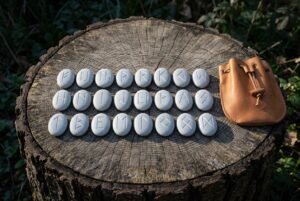 Stonecast Hand Made Elder Futhark Rune Set | 24 Engraved Casting Stones | Tumbled Stone with Tan Leather Drawstring Pouch | Norse Divination Gift | RK-1780
 Slatestave Hand Made Engraved Pale Grey Rune Stone with Full Elder Futhark Row & Knotwork Arch | 10 Inch Standing Height | Solid Oak Display Base | Norse Home Decor Gift | RK-1705