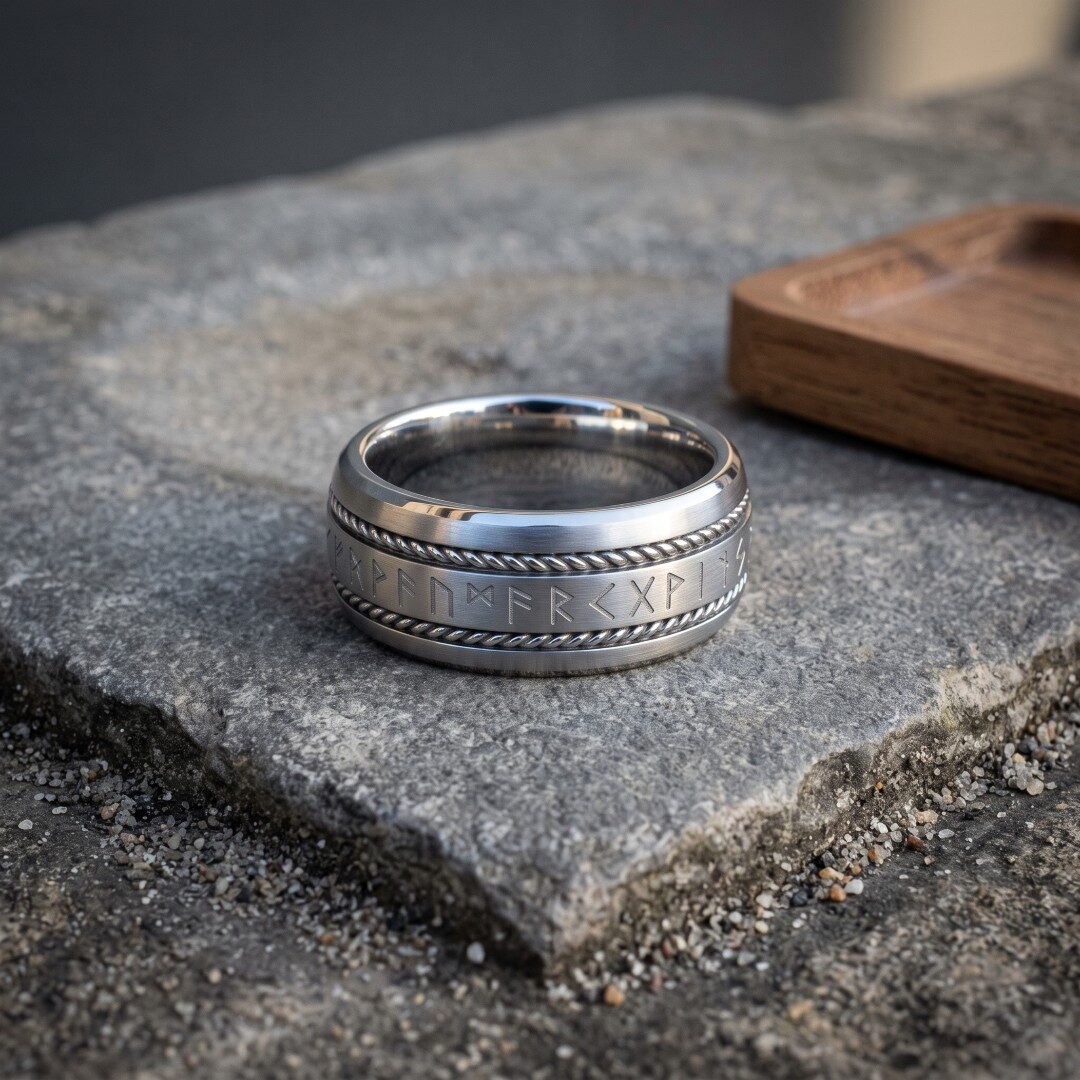
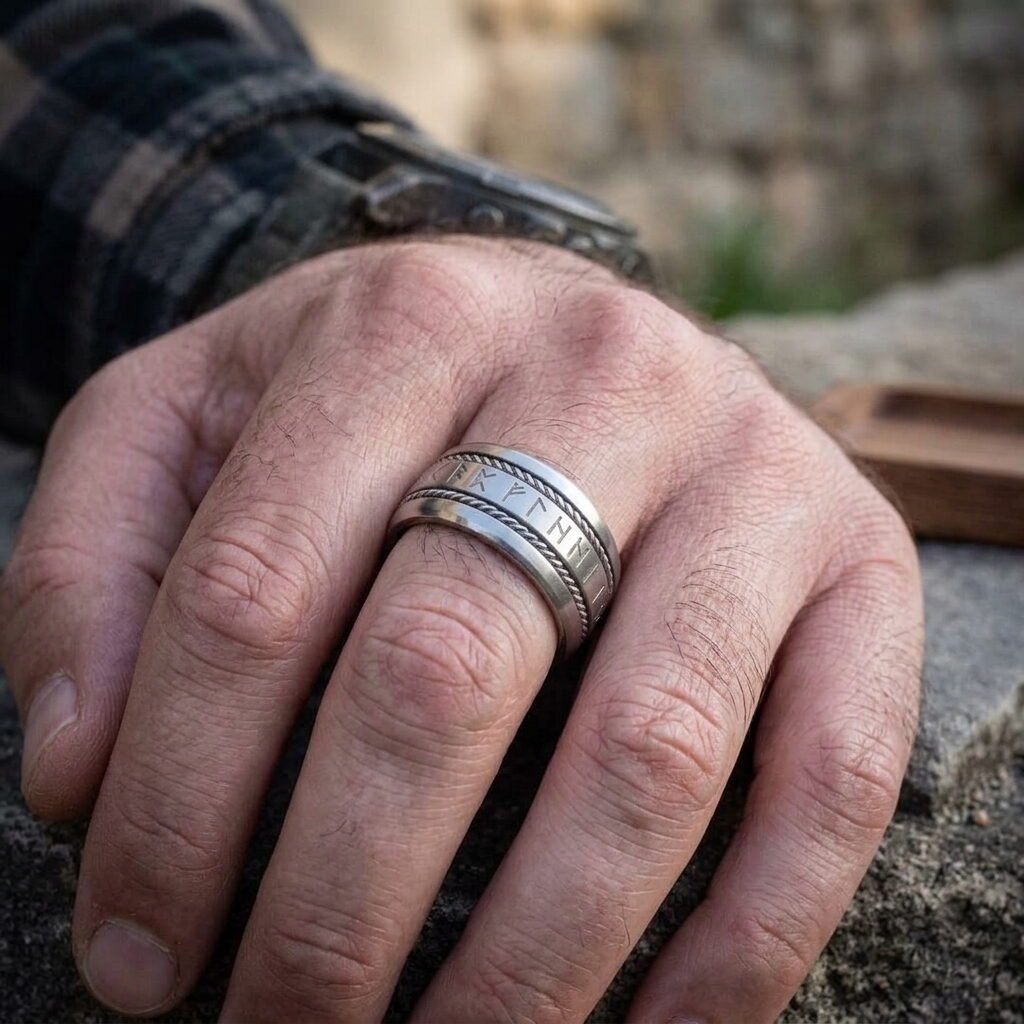
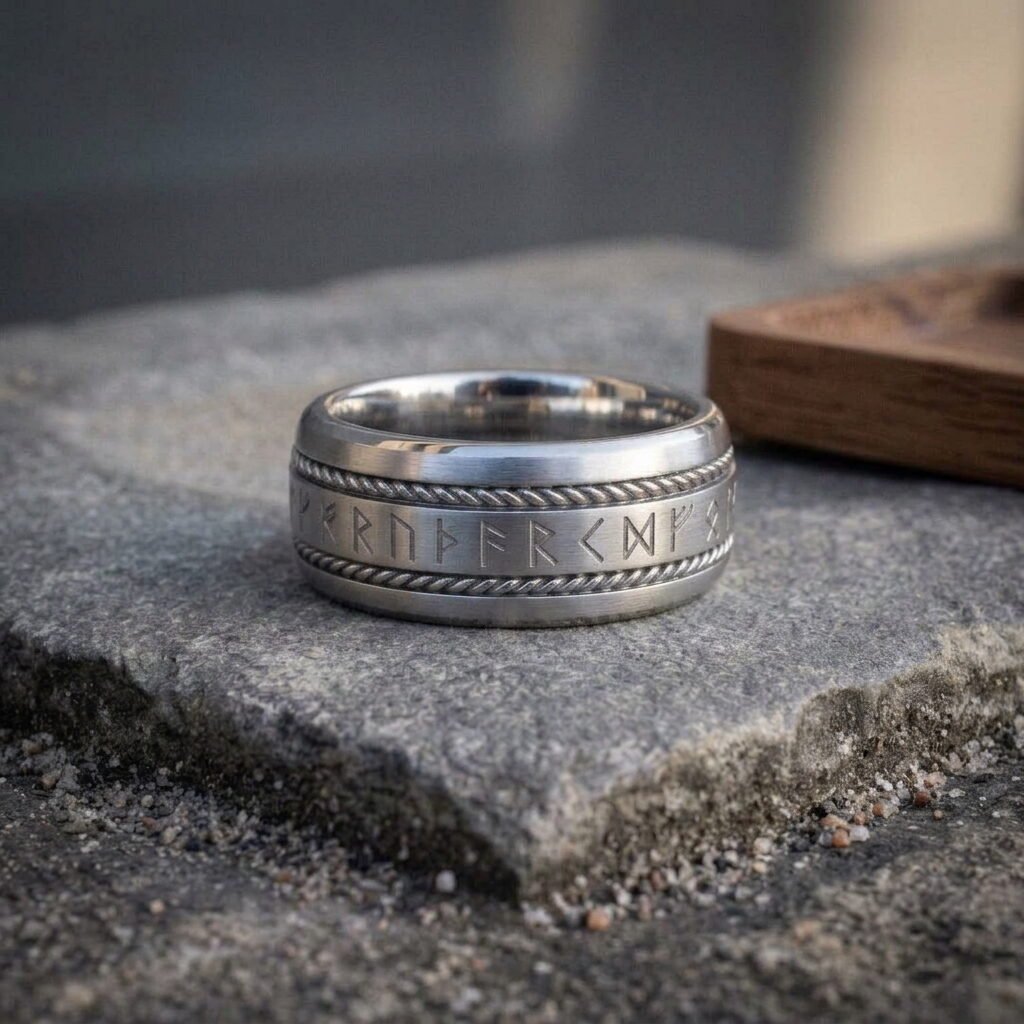
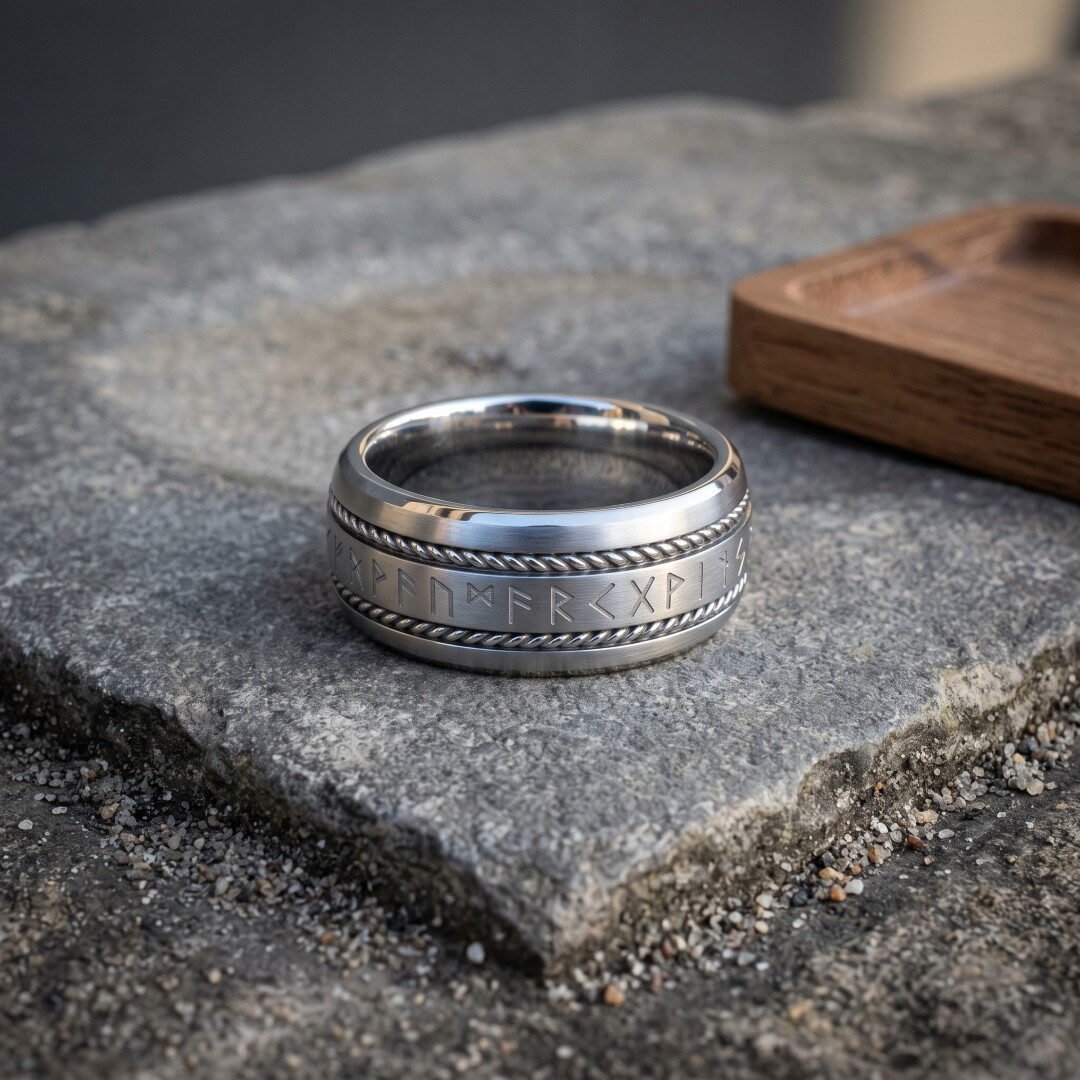
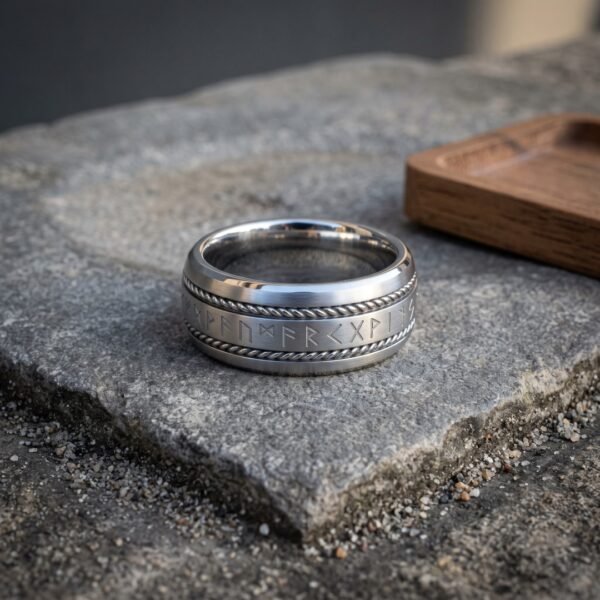
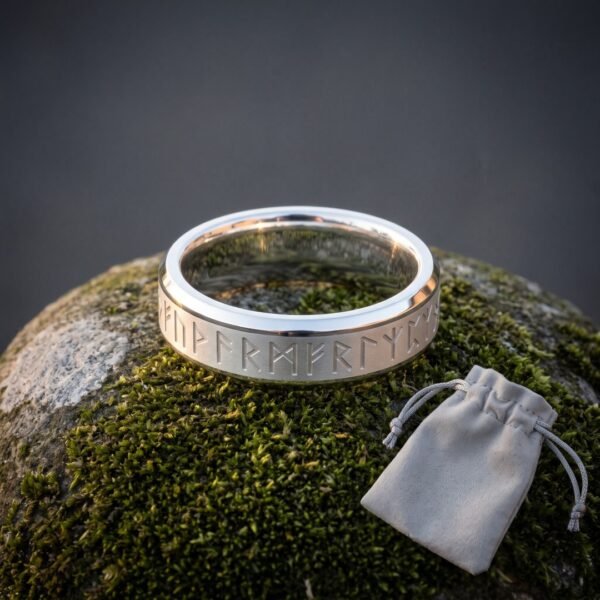
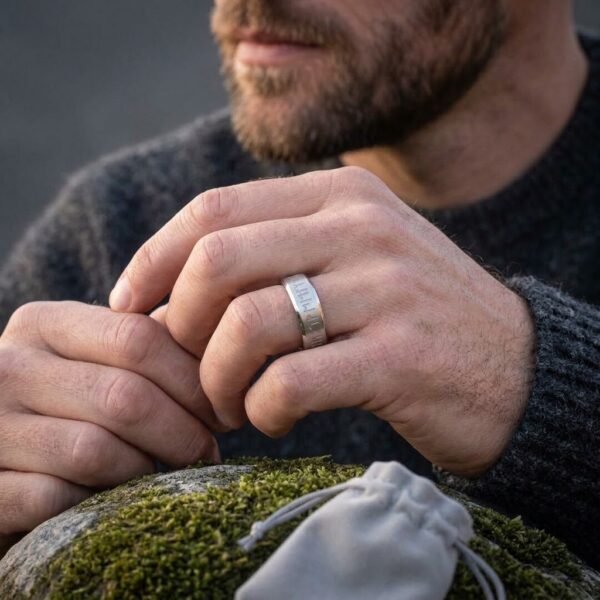
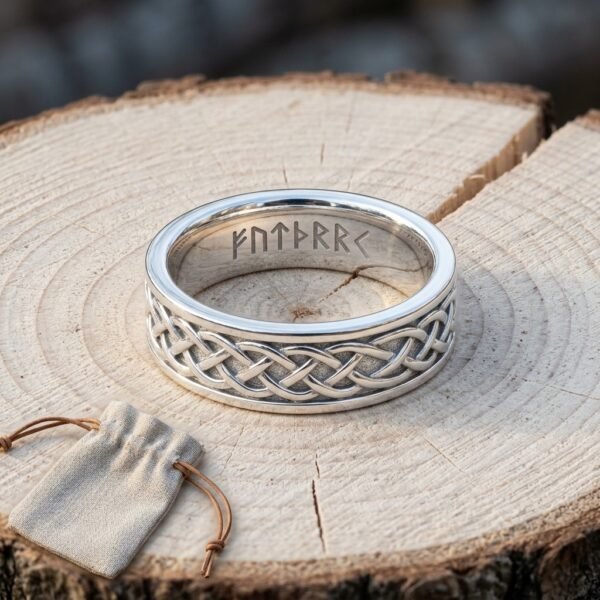
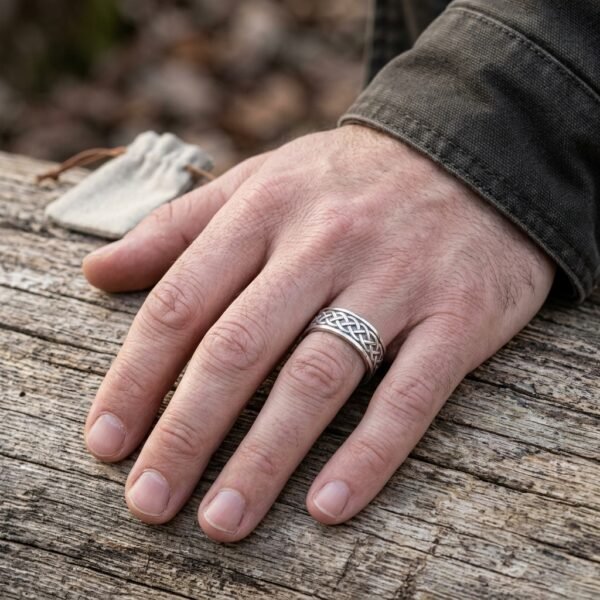
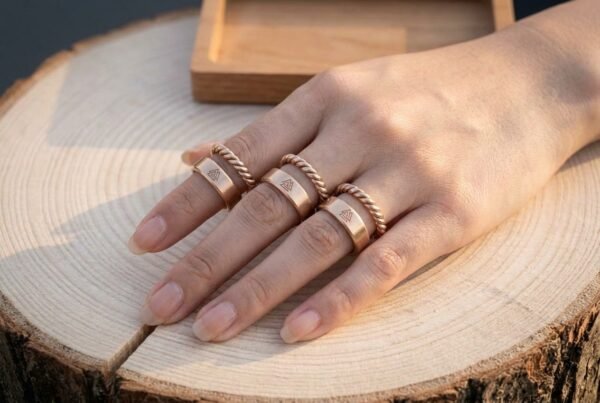
The Ropewind is a nine millimetre Norse rune ring built in three registers. A wide brushed centre band carries a line of Elder Futhark, and above and below it runs a twisted rope border, each one a continuous cable of worked metal encircling the ring. Outside those, the band steps down to two polished shoulders that catch the light. It is a substantial ring, thicker and wider than most, and it arrives in a soft pouch.
The rope border is not decoration borrowed from somewhere else. Twisted wire is one of the defining techniques of Norse metalwork, and it shows up on almost everything the period produced in silver. The Hiddensee hoard from the Baltic, the Silverdale hoard from Lancashire and dozens of arm rings from Gotland all use twisted or plaited rods and applied cable borders as their central visual language. Every Ropewind is cut, worked, engraved, brushed and polished in the Czech Republic, and carries our lifetime warranty against defects in the making, with no end date and no receipt needed. Kept with the Viking rings and bracelets, and worth setting against the Norse pendants before you decide.
Specifications
| Material | Solid silver tone band, brushed and polished, not sterling silver |
|---|
| Band width | 9mm across the face |
|---|
| Band thickness | Approximately 2.6mm |
|---|
| Profile | Polished stepped shoulders at both edges, recessed brushed centre, rounded comfort fit inside |
|---|
| Borders | Two twisted rope cables running the full circumference either side of the centre |
|---|
| Engraving | Elder Futhark line cut into the brushed centre register |
|---|
| Sizes | US 7 through 15, including half sizes |
|---|
| Included | Drawstring pouch |
|---|
| SKU | RK-1604 |
|---|
Twisted rope borders and why Norse smiths used them
Take two lengths of drawn wire, hold one end fixed, and twist them together. What you get is a cable with a helical groove running down it, and a Viking age silversmith could produce that at the bench in seconds with nothing more complicated than a vice and a hand drill. That simplicity is exactly why the technique is everywhere in the archaeology.
It also solves a real problem. Silver is soft, and a plain wire soldered round the edge of a piece dents the first time it is knocked. A twisted cable is stiffer than the same amount of metal drawn straight, because the helix distributes a blow along the twist instead of concentrating it at one point. Norse smiths applied cable borders to brooch rims, to the arms of Thor’s hammers, to the terminals of arm rings and to the edges of mounts, and the reason is as much structural as visual.
The visual reason is not trivial either. A twisted cable produces a repeating rhythm of light and shadow that reads from several feet away, which is more than can be said for most fine detail. It also frames. Put a cable on both sides of a flat register and the eye is forced into the middle, which is precisely what makes the rune line on the Ropewind readable rather than lost.
On this ring the cables are worked into the band itself rather than soldered on as separate wires, which means there is no joint to fail and nothing that can lift away from the surface after a few years of daily wear.
The band, the registers and the finish
Nine millimetres is a wide ring by any standard, and the stepped construction is what keeps it from looking like a slab. Two polished shoulders, two rope cables, one recessed brushed centre. Five distinct surfaces across the face means the light does something different in each one, and the ring reads as built rather than cut from a tube.
The metal is a solid silver tone chosen for hardness. It is not sterling silver and we do not describe it as such, because a nine millimetre sterling band would mark and deform under normal use and would need constant polishing. If you want this design in sterling or gold, contact us and we will quote it as a bench made piece.
The interior is a rounded comfort fit, which matters far more on a wide band than a narrow one. Nine millimetres of flat interior grips the whole width of the finger and drags across the knuckle. A domed interior contacts along a much narrower line, goes on and off cleanly, and leaves room for air and moisture to escape, which is what stops a wide ring from getting clammy underneath.
Engraving, runes and your own design
Use the rune converter on this page to turn a name, a date or a short phrase into Elder Futhark and we will cut it into the steel, the leather or the wood. If you would rather have a Viking pattern than a rune line, choose your own design in the engraving option above the add to cart button and tell us where it goes. Where a piece already carries an engraved design, your chosen engraving replaces it rather than sitting alongside it. On the Ropewind your runes take the place of the stock futhark in the centre register. The recessed band is deep enough and wide enough to carry about sixteen to eighteen runes without crowding, which is more than the narrow ring in our range will take. The inner face can be engraved separately with a date. See the engraving page.
Fit and sizing
Wide rings do not fit like narrow ones and this is the single most common sizing mistake we see. A nine millimetre band contacts far more of the finger than a four millimetre band does, so at the same nominal size it feels noticeably tighter and is harder to get over the knuckle. As a rule, order a half size up from your usual ring size, and a full size up if your usual ring is under about four millimetres wide.
To measure, wrap a paper strip round the base of the finger, mark the overlap and read the length in millimetres. That is your circumference. A US 10 is roughly 61.6mm and each full size adds about 2.6mm. Measure late in the day in a warm room, because fingers are at their smallest in the cold and first thing in the morning.
If the knuckle is much larger than the finger below it, size to the knuckle. A wide band that will not pass the knuckle is useless, and a slightly loose fit at the base is easy to live with. An engraved ring cannot be resized afterwards without cutting through the rune line, so if you are buying this as a surprise, borrow an existing ring of theirs and measure that instead of guessing.
Care
Warm water, a drop of washing up liquid and a soft brush is the whole routine, and the brush matters here because the rope grooves collect soap and skin oil in a way a flat band does not. Dry it properly afterwards. The brushed centre will pick up fine scratches over time, which is normal for a brushed finish, and it can be refreshed with a grey abrasive pad worked along the band rather than across it. Leave the rope borders alone when you do that, since an abrasive pad will flatten the twist. No silver dips, no pastes, no ultrasonic cleaners. Take it off for lifting, gardening and any work around machinery.
Made in the Czech Republic
This piece is made by hand in the Czech Republic, in a workshop that still works the old way. The steel is forged, ground, heat treated and finished by smiths who learned the trade from the people before them, and the wood, horn and leather are cut and fitted by hand rather than pressed out on a line. That is also why no two pieces come out exactly the same.
Ransack Viking is a United States company. We import these pieces ourselves, check every one when it lands and ship from our warehouse in Chicago, Illinois. Engraving is done here in the United States after the piece arrives, so your runes or your own design go on before it leaves for you.
A note on handmade variation
This is hand made, not machine made or bulk produced, so what arrives will not be a pixel for pixel copy of the photograph. The point where the rope border closes on itself sits in a slightly different place on every ring. The brushed grain in the centre register is worked by hand and varies in direction and depth. Rune spacing adapts to the length of your text, so a long name sits closer than a short one. The dimensions, the material and the build are the same every time. The character is not. We wrote up the Elder Futhark separately, and there is a piece on Yggdrasil as well.
Frequently asked questions
Is this the same as your narrower rune ring
No. That one is a six millimetre flat band with plain bevels. This is nine millimetres with twisted rope borders and a recessed centre, and it takes several more runes.
What size should I order
Half a size up from your usual, or a full size up if you normally wear a narrow band. Wide rings fit tighter at the same nominal size.
Is it solid silver
No. It is a solid silver tone metal picked for hardness. Sterling at this width would deform and need constant polishing. We can quote a sterling or gold build separately.
How many runes will fit
About sixteen to eighteen before the spacing starts to look crowded. Most first names and a short date fit comfortably.
Can it be resized
An unengraved band can be resized by a jeweller. An engraved one cannot, because the cut would go through the rune line and the rope borders.
Will the rope borders wear flat
They are worked into the band rather than applied as separate wire, so they wear at the same rate as the rest of the ring, which on a hard metal like this is very slowly.
What is in the box
- One Ropewind 9mm Norse rune ring in your chosen size
- One drawstring pouch and a care card
- Sizing and engraving notes
- Made and finished in the Czech Republic
Explore the range
See the Viking rings and bracelets, the arm rings and torcs, the wedding and groomsmen gifts, or read the guides.
Close to this one
In the same category sits the Knotvow bracelet. A near match for this one is the Everrune bracelet. Closest to this in the range is the Runeclasp bracelet.
Fitting out further, the Stonecross Norse pendant belongs with it. Nothing here exactly right, build one to your own spec on the design your own page.

Nice piece for the price. Good detail work. Just wish the finish were a touch more polished. Nice that it ships from a US warehouse even though the craftsmanship is Czech. Would buy from this shop again.
Feels way more premium than the price suggests. Gets compliments every time I wear it. Ransack Viking is quickly becoming my go to shop for anything Norse themed. Chain is sturdy and the clasp feels secure. Made overseas in the Czech Republic yet shipped from a US location so no long customs wait. If you’re on the fence just get it. You won’t regret it.
Nice piece for the price. Nice that it ships from a US warehouse even though the craftsmanship is Czech. Nice piece though the chain is a little shorter than I expected. Glad I made this purchase.
Knew this piece was special the second I opened the box. Detail on this is incredibly crisp for something handmade. Exactly the weight and finish I wanted. Feels substantial without being bulky. Already planning my next purchase from this shop.
Feels way more premium than the price suggests. Exactly the weight and finish I wanted. Feels substantial without being bulky. Chain is sturdy and the clasp feels secure. Already planning my next purchase from this shop.