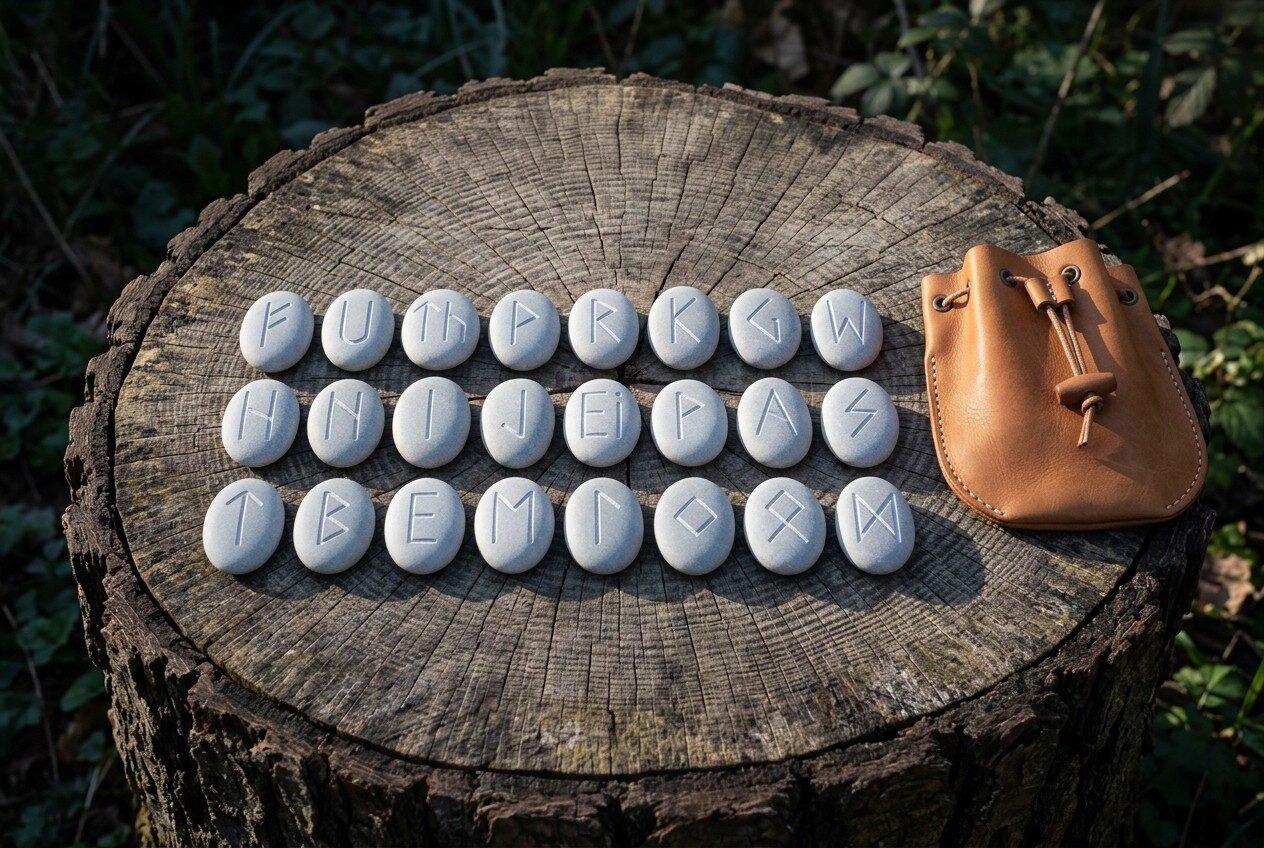
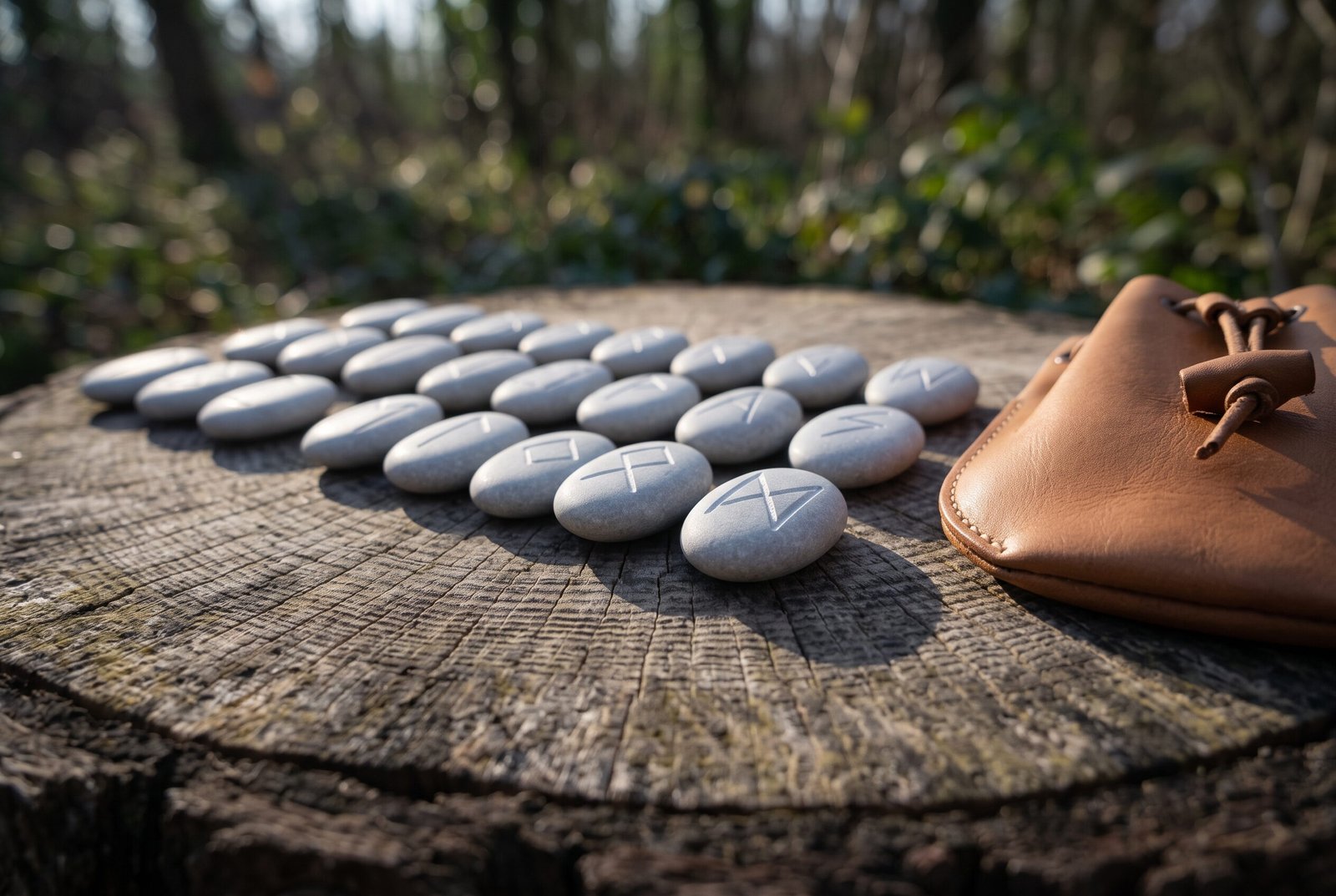
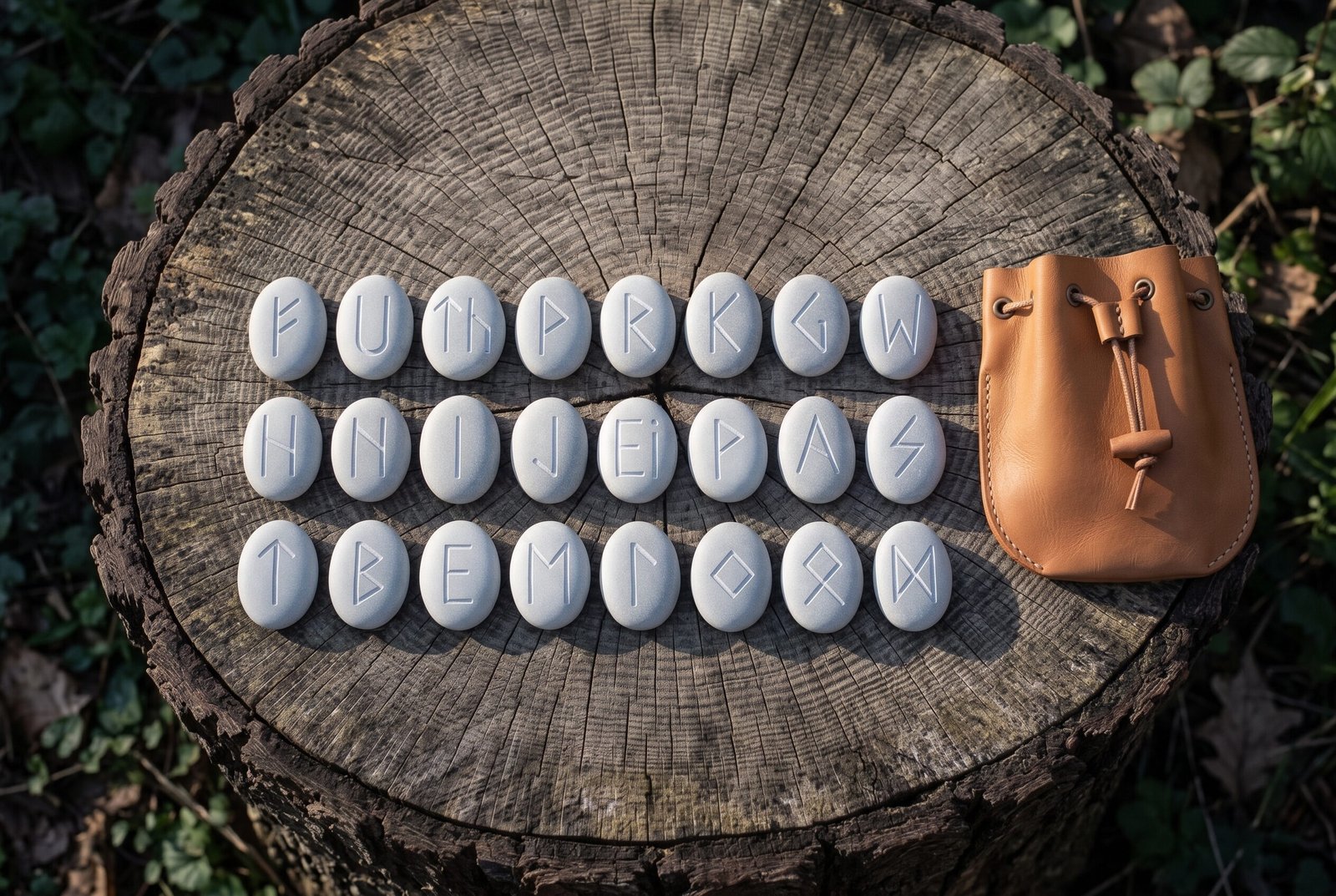
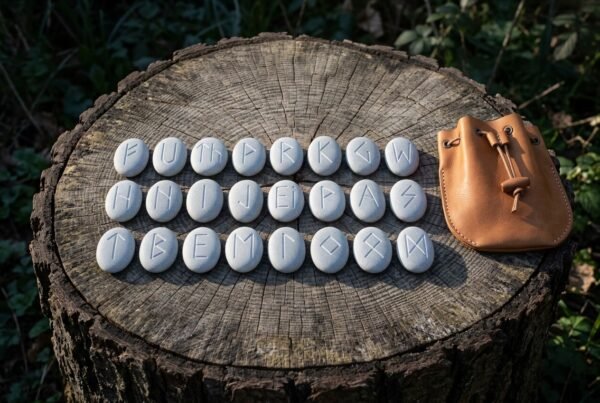
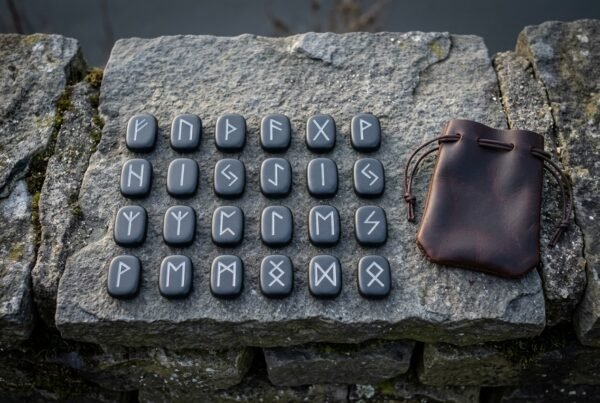
This is a full Elder Futhark rune set, twenty four tumbled stones with one rune cut into the face of each and filled so it reads clearly in any light. The stones are a pale grey, smooth on both faces and rounded at the edges, sized to sit comfortably in a closed hand. They come in a tan leather drawstring pouch with a sliding toggle, which is what you draw from and what you keep them in.
Twenty four is the whole alphabet, not a selection. The Elder Futhark was in use across Scandinavia and the Germanic world from roughly the second century to the eighth, and it is divided into three groups of eight called aettir. The first is Freyr’s aett, the second Hagalaz or Heimdall’s, the third Tyr’s. Those groupings are on the inscriptions themselves, on the Kylver stone from Gotland and the Vadstena bracteate, which both list the alphabet in order and mark the divisions. Whoever cut those was not writing a message. They were recording the sequence, which suggests the order mattered to them.
Made, cut, filled and finished by hand in the Czech Republic, and shipped in its pouch with a printed casting and meaning card. Filed under the rune stones and rune sets, and the Viking games are the other half of that shelf.
Specifications
| Material | Tumbled stone, very pale grey to off white, smooth faced |
|---|
| Set | 24 stones, the complete Elder Futhark in three aettir of eight |
|---|
| Engraving | One rune cut into the face of each stone and filled for contrast |
|---|
| Shape | Rounded oval, flat enough to lie still when cast |
|---|
| Pouch | Tan leather with a drawstring and a sliding leather toggle |
|---|
| Finish | Natural tumbled stone surface, unsealed |
|---|
| Included | Leather pouch and a printed casting and meaning card |
|---|
| SKU | RK-1780 |
|---|
How a rune set is cast and read
Start with the honest part. There is no surviving Norse manual of rune divination. What there is, is a passage in Tacitus writing about the Germanic peoples in the first century, describing a practice of cutting a fruit tree branch into strips, marking them, scattering them on a white cloth, and a priest or the head of a household taking up three at random and reading the marks. That is the oldest description we have of anything like this, and every modern method descends from it rather than from a text the Norse left behind. Anyone who tells you otherwise is selling you certainty they do not have.
What people actually do with a set like this is straightforward. The simplest method is the single draw. You hold a question, put your hand in the pouch without looking, and take one stone. That is the answer, and it is deliberately blunt.
The three rune draw is the most common. Three stones laid left to right, usually read as the situation, the action and the outcome, or the past, the present and what follows. Some readers use the position rather than the sequence.
The cast is the closest to Tacitus. Take a handful, scatter them onto a cloth, and read only the stones that land face up, giving more weight to the ones nearest the centre or nearest you. Some readers also treat a reversed rune as a shadow reading of the same idea, and some ignore reversals entirely, which is worth deciding before you start rather than after you see what you drew.
The card that ships with the set gives all twenty four rune names, their sounds and the meanings most widely used, so you are not left guessing on the first evening.
The stone and the cut
Stone is used for a rune set for the same reason it was used for a rune stone. It takes a cut cleanly, it does not warp, and it has weight, which matters more than people expect. A light rune bounces and rolls when it is cast. A stone with mass lands, settles and stays where it fell, which is the whole point of casting rather than dealing.
Each rune is cut into the face rather than printed on it, then filled so the character stands out against the pale ground. A printed rune wears off a stone that is handled every week. A cut one does not, and it will still be legible after years in a pouch rubbing against twenty three others.
The faces are left unsealed. A sealed stone feels like plastic in the hand and defeats the reason for choosing stone in the first place. These have the slightly cool, slightly dry feel of the material itself.
Engraving, runes and your own design
Use the rune converter on this page to turn a name, a date or a short phrase into Elder Futhark and we will cut it into the steel, the leather or the wood. If you would rather have a Viking pattern than a rune line, choose your own design in the engraving option above the add to cart button and tell us where it goes. Where a piece already carries an engraved design, your chosen engraving replaces it rather than sitting alongside it.
On this set the stones themselves stay as they are, because they need to be the standard twenty four to be usable. What we personalise is the leather pouch, which will take a name, a set of initials or a short rune line stamped into the face. Many people order the pouch with the owner’s name in Elder Futhark. See the engraving page.
Keeping and displaying the set
Most people keep the set in its pouch and that is the right answer. Stones stored loose in a drawer chip against each other and get lost one at a time, and a set of twenty three is a set of nothing.
If you want to display them, they lay out well in three rows of eight in aett order, which is how they are shown in the photograph, on a shelf or in a shallow tray. A dark tray gives the best contrast against the pale stone. Do not glue them down. A rune set that cannot be picked up and used is an ornament with a costume on.
Some readers keep a dedicated cloth to cast onto, which serves a practical purpose as well as a ceremonial one. It stops the stones skidding off a table and it defines the edge of the reading, so a stone that rolls off the cloth is simply not part of it.
Care
Wipe the stones with a dry cloth when they start to feel dusty. If they need more, warm water and nothing else, then dry them thoroughly before they go back in the pouch. Do not use soap, oil or any polish. All three will get into the filled engraving and dull the contrast that makes the runes readable.
The leather pouch wants a little conditioner once or twice a year, worked in with a fingertip and buffed off. Keep it out of direct sun, which fades tan leather faster than anything else, and do not put it away damp.
If a stone chips, tell us. We keep the moulds and the cutting patterns and we would rather replace one stone than have you retire a whole set.
Made in the Czech Republic
The work behind this piece happens in a Czech Republic workshop that has kept to the old methods. Steel is forged and heat treated by hand, the grind is taken down by eye rather than by machine, and the handle, fittings and sheath are cut and finished one at a time. Because of that, every piece carries small marks of the hand that made it.
Ransack Viking is a United States company. We import direct, check each piece when it reaches us, and ship from our Chicago, Illinois warehouse. Engraving is added here in the United States after arrival, so the piece you receive is finished to your order.
A note on handmade variation
This set is hand made rather than machine made or bulk produced, so what arrives will not be a pixel for pixel copy of the photograph. Stone is a natural material and every piece is a slightly different oval, a slightly different thickness and a slightly different shade of grey. Some will carry faint natural mottling. The runes are cut by hand, so the stroke weight varies a little from stone to stone across the set.
The count, the alphabet, the material and the build are the same every time. The character is not, and a set where every stone was identical would tell you it had been made by a machine. There is a longer piece on the Elder Futhark, and another on the Norse gods.
Frequently asked questions
How many stones are in the set?
Twenty four, the complete Elder Futhark. There is no blank stone. The blank, sometimes called Wyrd or Odin’s rune, is a twentieth century addition and we leave it out.
Is the pouch included?
Yes. The tan leather drawstring pouch shown ships with the set and is large enough to hold all twenty four stones and to draw from comfortably.
Do I need to know anything before I start?
No. The card that ships with the set lists every rune, its name, its sound and the meanings most commonly used, along with three casting methods. That is enough for a first reading.
Will mine look like the photograph?
Close, but not identical. The stones are natural, so the exact oval, thickness and shade vary. The runes and the count are the same in every set.
Can I get my name on the pouch?
Yes. Use the rune converter on this page and we will stamp your name or a short phrase into the leather in Elder Futhark before it ships.
How long does shipping take?
Processing is one to two weeks because the set is cut after you order it. Shipping within the United States is free.
What is in the box
- 24 engraved Elder Futhark casting stones
- Tan leather drawstring pouch with toggle
- Printed casting and rune meaning card
- Leather care note
- Made and finished in the Czech Republic
Explore the range
Browse the rest of the rune stones and rune sets, the Viking home decor, the Hnefatafl and Viking games, and the guides.
Compare it with these
Closest to this in the range is the Thundermark rune set. If this one is not quite right, there is the Fatecast rune set. Also in this group is the Slatestave rune set.
If you are putting a set together, the Meadhorn Viking beer mug sits alongside it. Pick the steel, the length and the fittings yourself on the design your own page.







My husband was speechless when he opened this. Exactly as described and clearly made with care. Packaging was excellent and it arrived in perfect condition. So worth it.
Been eyeing this piece for months and it did not disappoint. Shipping was fast and everything arrived well packaged.
So happy I finally pulled the trigger on this one. Feels way more premium in person than the listing photos. Ordered from Ransack Viking before and the quality stays consistent every time. Can’t recommend this enough.