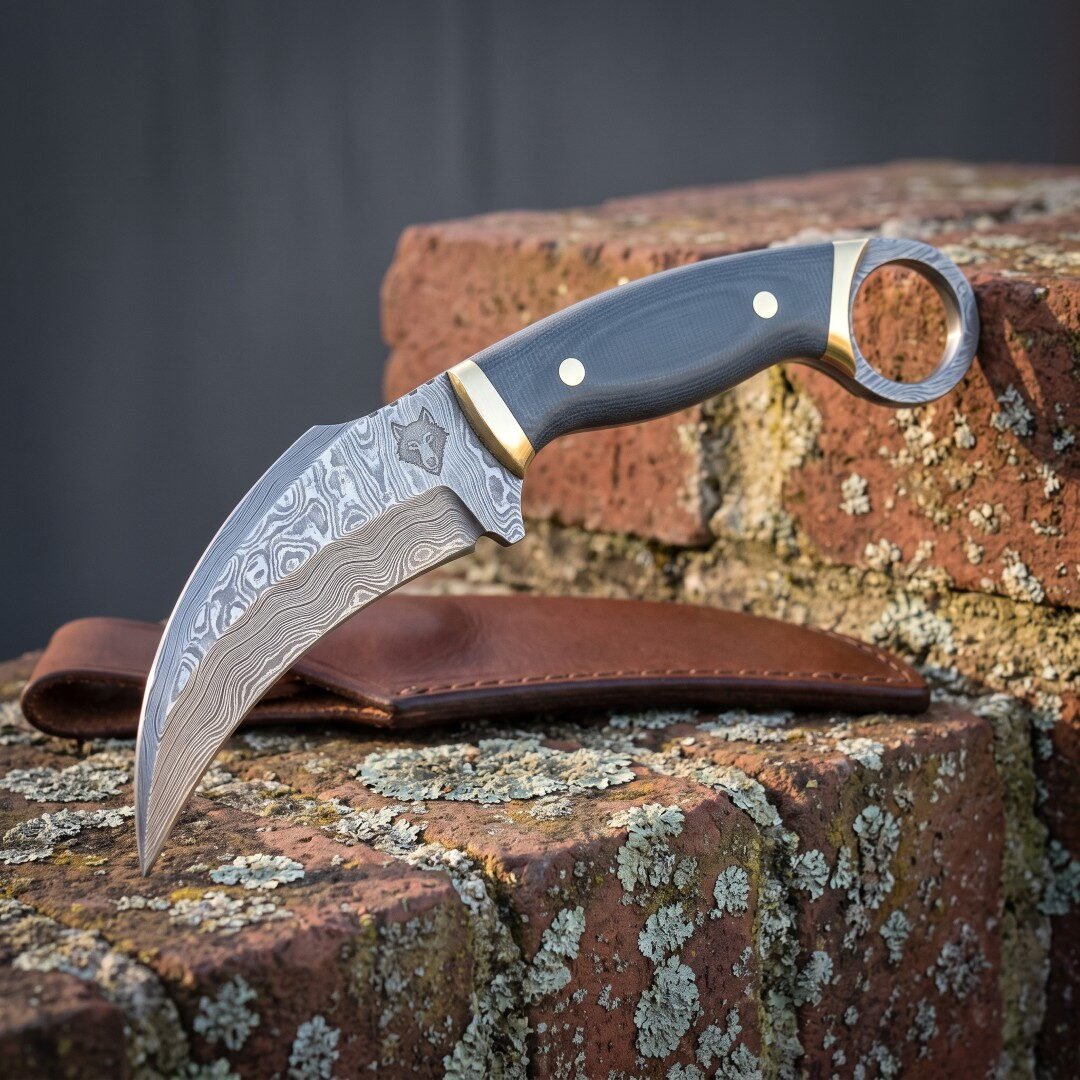
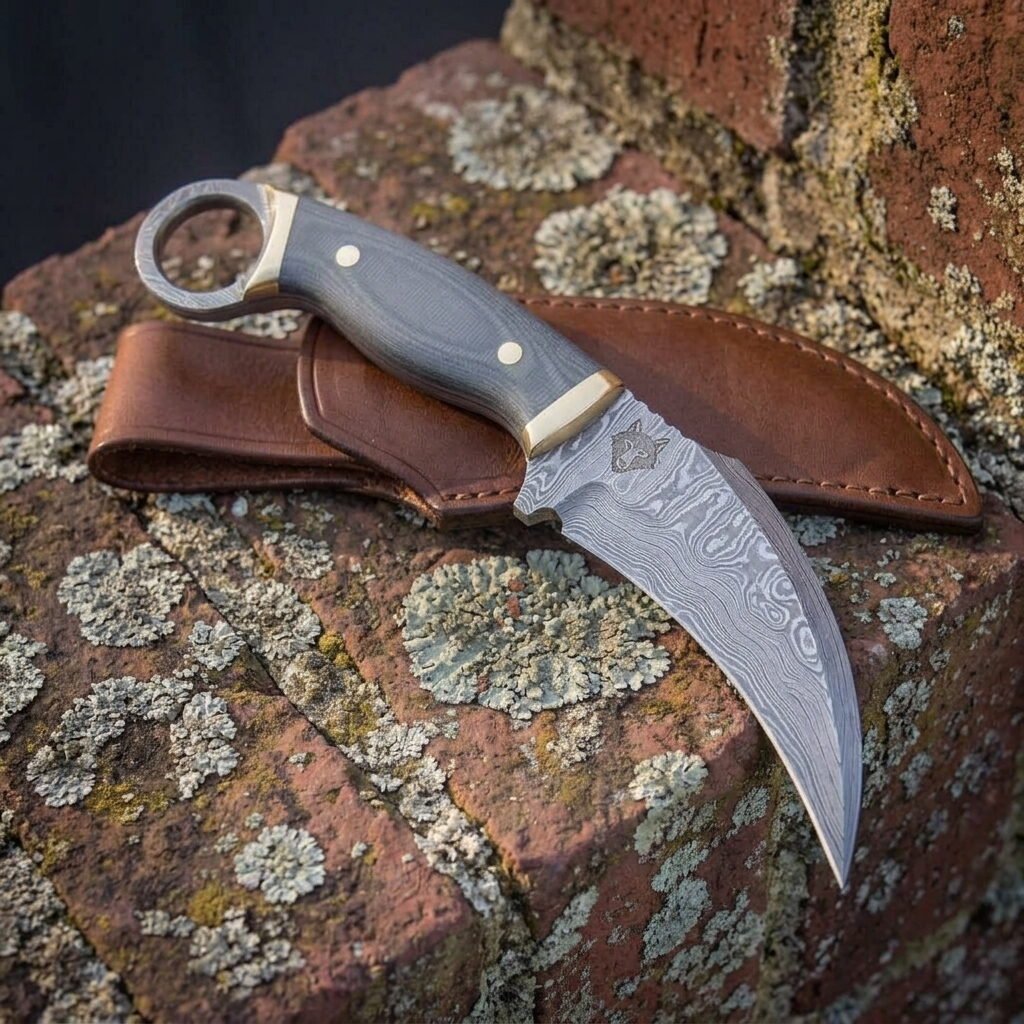
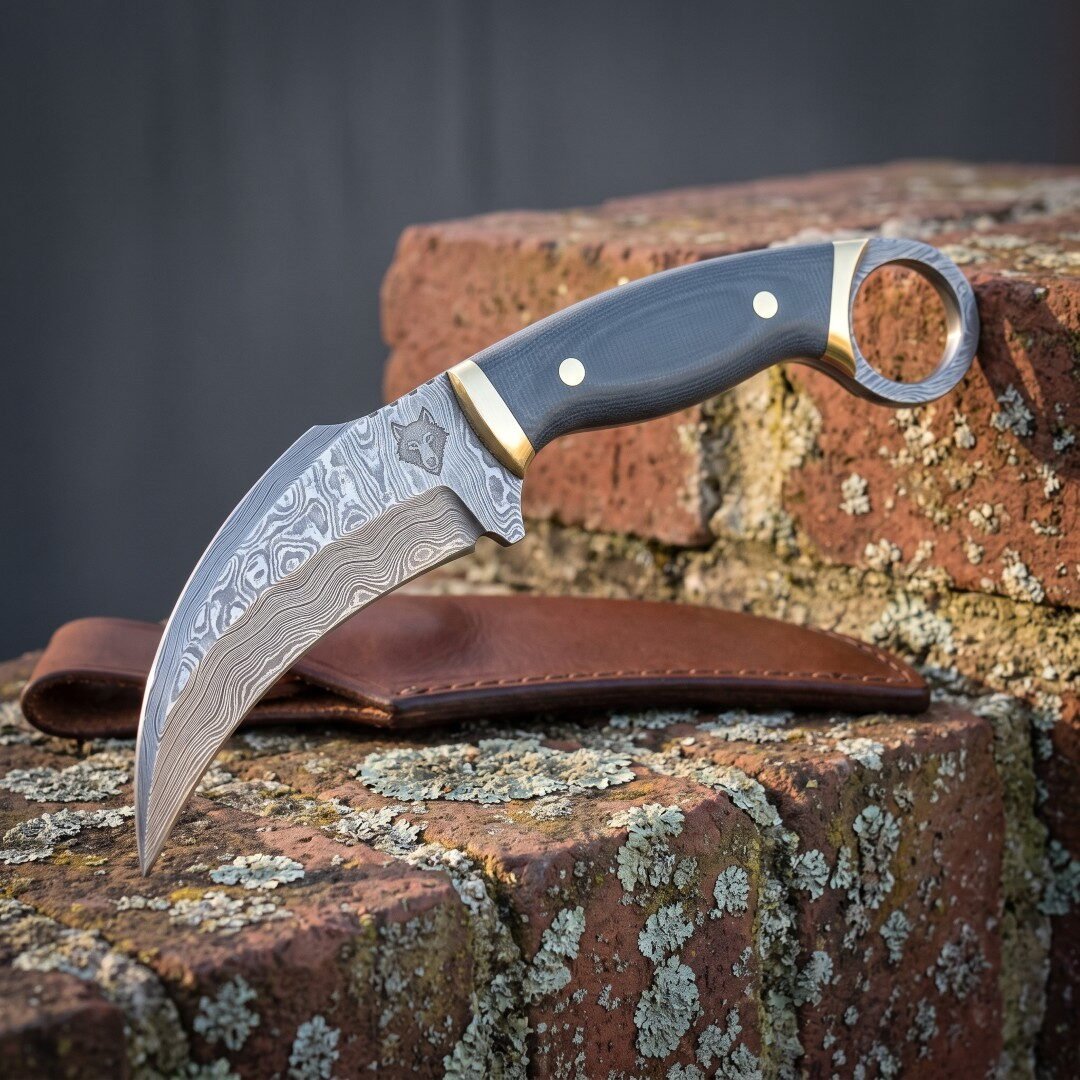
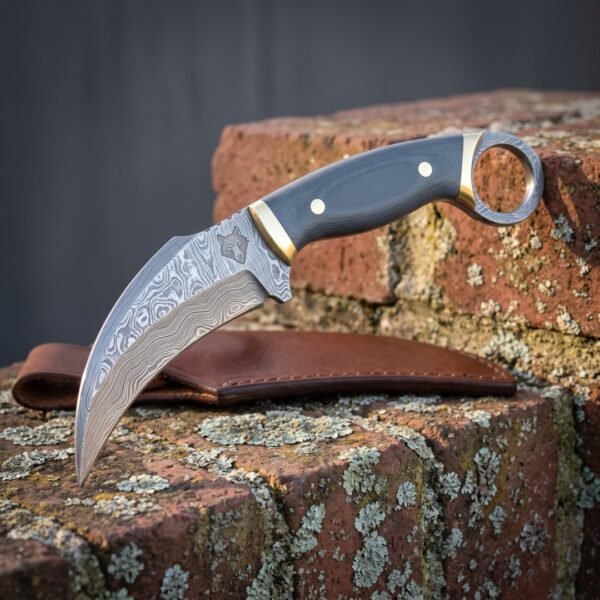
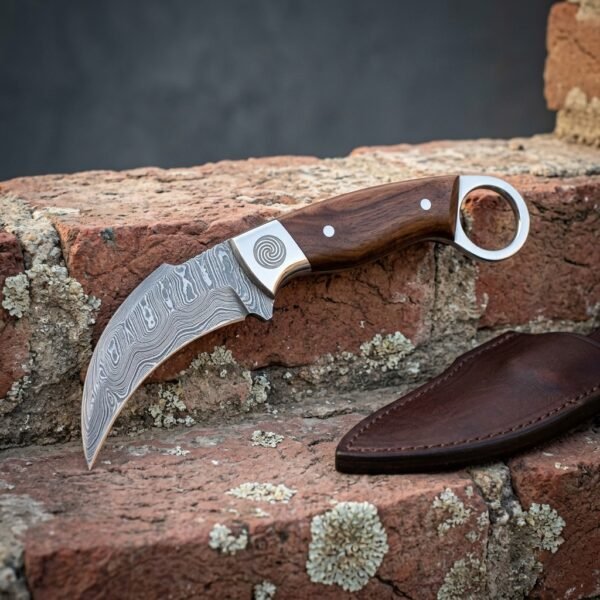
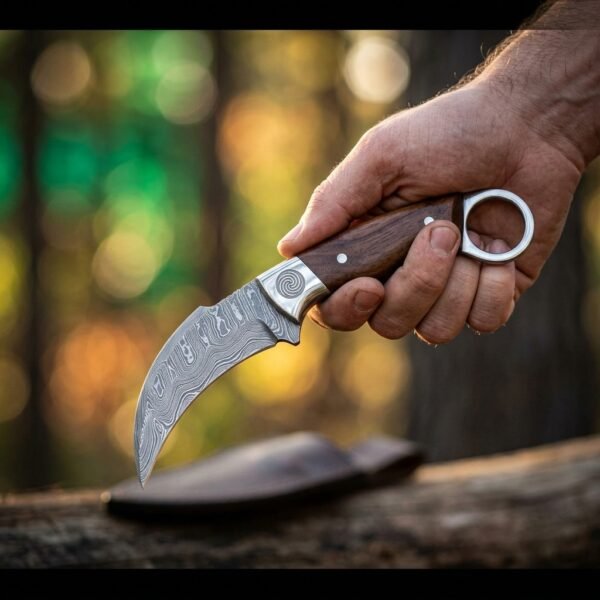
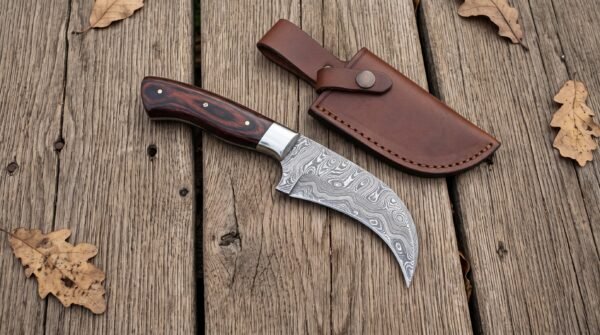
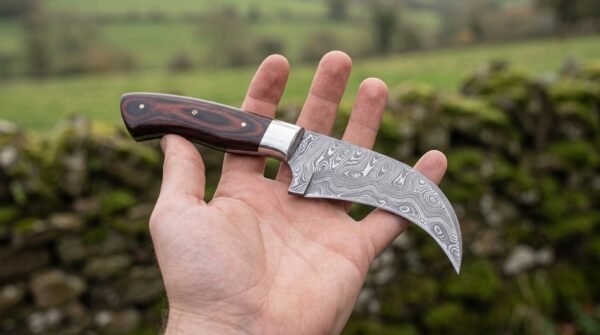
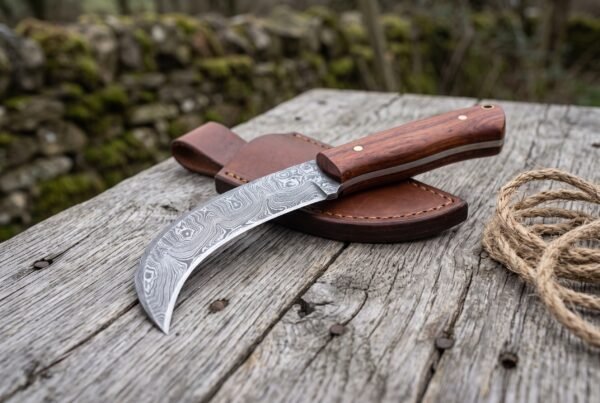
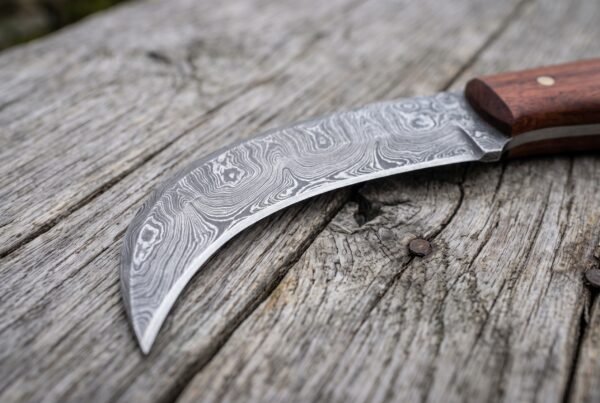
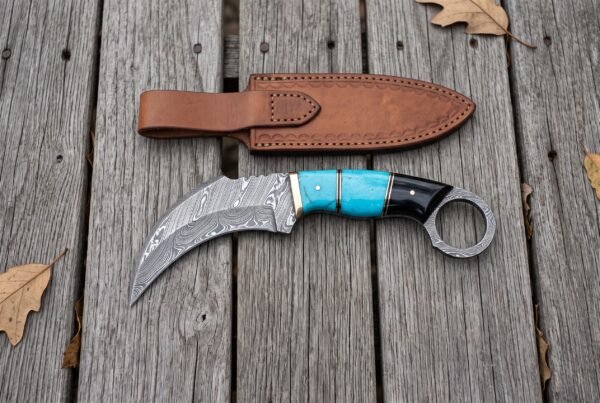
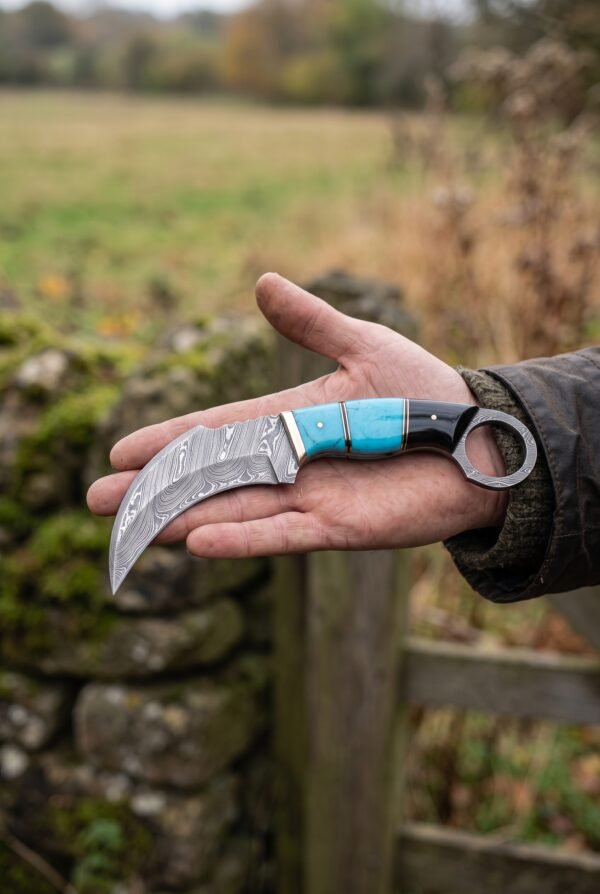
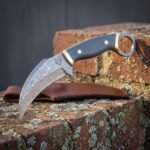
This is a hand forged karambit with a deeply curved single edged blade in layered 1095 and 15N20 Damascus, dark grey micarta scales held with brass pins between two brass bolsters, and a full Damascus finger ring at the butt. It comes with a fitted brown leather sheath. The pattern in the blade is real forge welded layering, which is why it follows the curve rather than sitting flat and uniform the way a surface etch does.
The karambit comes from the Malay archipelago, and the usual claim is that it started as an agricultural tool for raking roots and harvesting rice, which is probably true and is certainly how the curve makes sense. A hooked blade drawn toward you is a very efficient shape for cutting fibrous material at ground level. Dutch colonial accounts from the seventeenth century onward describe it in Sumatra and Java as both a farming implement and a fighting knife, and the shape has been essentially unchanged since. What is genuinely unusual about it is that it is one of very few knife designs where the primary cutting direction is toward the user rather than away.
Each karambit is forged, ground, etched, heat treated and handled in a Czech Republic workshop, and the sheath is cut and stitched here. It ships in the sheath with blade oil and a care card. It lands in the karambit knives, with the Damascus knives close enough that people usually look at both.
Specifications
| Blade material | 1095 and 15N20 Damascus, hand forged and acid etched, 58 to 60 HRC |
|---|
| Blade | Deeply curved single edged karambit blade with a visible Damascus pattern and a small etched wolf head near the bolster |
|---|
| Overall length | Approximately 9 inches including the ring |
|---|
| Blade length | Approximately 4 inches measured along the curve |
|---|
| Handle | Dark grey micarta scales over a full tang |
|---|
| Bolsters | Two brass bolsters, one at the blade end and one in front of the ring |
|---|
| Pins | Two brass pins |
|---|
| Ring | Integral Damascus finger ring at the butt, sized for an index finger |
|---|
| Finish | Etched Damascus blade with a polished edge bevel, polished brass, matt micarta |
|---|
| Weight | Approximately 6 oz |
|---|
| Sheath | Fitted brown stitched leather sheath |
|---|
| Included | Karambit, fitted leather sheath, blade oil, care card |
|---|
| SKU | RK-1701 |
|---|
What the ring is actually for
The ring is the feature everybody asks about and almost everybody explains wrong. It is not primarily for spinning the knife, whatever social media suggests. It does three real things. First, retention. Your index finger goes through it, and the knife cannot be pulled or knocked out of your hand, which matters enormously for a tool used with wet or muddy hands in a field. Second, it fixes the knife’s orientation relative to your hand permanently, so you always know which way the edge is facing without looking, in the dark, by feel alone. Third, it acts as a pivot. Because the knife is anchored at the finger rather than gripped in the palm, the whole hand can open and the blade stays under control, which is what allows the drawing cut the shape is built for.
The ring also completely changes how the knife is drawn from a sheath. You hook the ring with your index finger and pull, and the knife arrives in your hand already in grip, with no fumbling for the handle. That is why karambit sheaths are made deep and simple, as this one is, rather than with a strap over the handle.
One practical note. Ring size is fixed. If you have unusually large hands the ring may sit tight on the index finger, in which case use the middle finger instead, which is a perfectly normal alternative grip.
The steel and the handle material
The blade is forge welded from alternating layers of 1095 high carbon steel and 15N20 nickel alloy steel. The two harden together but etch differently, so an acid bath leaves 1095 dark and 15N20 bright, and the light and dark bands you see are actual layer boundaries running through the thickness of the steel. On a curved blade this is particularly satisfying, because grinding the curve cuts the layers at a changing angle and the pattern stretches and compresses along the belly. That effect cannot be faked with a printed or etched surface pattern, which is the simplest way to tell real Damascus from decoration.
It is hardened and tempered to 58 to 60 HRC. On a short blade that is the right place to be, hard enough for excellent edge retention with a section short enough that brittleness is not a practical risk the way it would be on a sword.
The scales are micarta, which is linen or canvas cloth saturated with resin and cured under pressure. It is dimensionally stable, it does not swell or shrink with humidity the way wood does, and crucially it becomes grippier when wet rather than more slippery, because the fabric texture at the surface is exposed as the resin wears. For a knife with a curved blade used in a pulling motion, that is the correct handle material.
Engraving, runes and your own design
Use the rune converter on this page to turn a name, a date or a short phrase into Elder Futhark and we will cut it into the steel, the leather or the wood. If you would rather have a Viking pattern than a rune line, choose your own design in the engraving option above the add to cart button and tell us where it goes. Where a piece already carries an engraved design, your chosen engraving replaces it rather than sitting alongside it.
On this knife the best placements are the front brass bolster, which is small but takes initials or a short date crisply, and the face of the leather sheath, which will take a full name or a phrase. Cutting into an etched Damascus blade is possible but the pattern fights the lettering, so we usually steer people to the brass or the leather. See the engraving page for options and lead time.
Handling and balance
The balance sits right at the ring, which is what makes a karambit feel almost weightless once your finger is through it. It is not a knife you push with. The cutting motion is a pull, hooking the point into material and drawing back, and the curve means the edge stays engaged through the whole stroke instead of skating off the way a straight edge does.
It is a genuinely capable cutting tool for cordage, webbing, cardboard, tape and general utility work, and it is very good at all of them. Check your local law before carrying one. Fixed blade and ringed knives are restricted in some states and many countries, and the rules are not consistent. We sell this as a collection and utility piece and it is on the buyer to know what is legal where they live.
Care
Wipe the blade and oil it after use, every time. An etched Damascus surface shows neglect faster than a plain polish because the dark layers rust preferentially and leave a speckled look. Mineral oil, food safe oil or a purpose made blade oil all work. If surface rust appears, lift it with a rust eraser or a brass brush rather than sandpaper, because sanding cuts through the etch and leaves a bright flat patch in the pattern. There is more in steel care.
Micarta needs nothing beyond soap and water. If it gets shiny with hand oil over the years, a scrub with a nylon brush brings the texture back. Feed the leather sheath with a neutral balm once or twice a year, and do not store the knife in the sheath long term, because leather holds moisture against carbon steel.
Made in the Czech Republic
Every piece we sell is made by hand in the Czech Republic. The smiths there work the way the trade has been worked for a long time, heating and hammering the steel, taking the bevels down by eye, and fitting the handle and the leather one at a time. There is no automated line anywhere in it, so small differences from one piece to the next are normal and expected.
Ransack Viking is a United States company based in Chicago, Illinois. We bring the pieces in ourselves, inspect them on arrival and ship them from our own warehouse. If you add engraving, that is carried out here in the United States before your order goes out.
A note on handmade variation
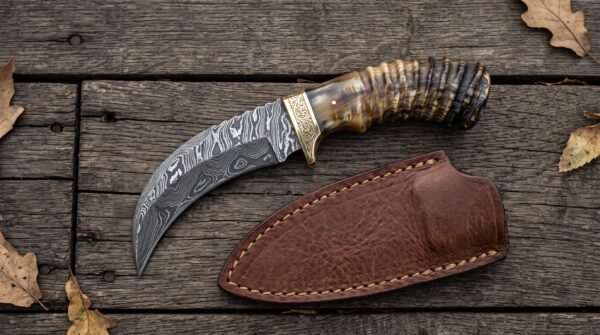
Every karambit is hand made rather than machine made or bulk produced, so what arrives will not be a pixel for pixel copy of the photograph. Damascus is the clearest example. No two billets etch alike, so the swirl and band pattern across your blade will run differently from the one photographed, and the way the pattern stretches around the curve depends on where in the billet that blade came from. Micarta is made from woven cloth, so the grey varies in depth and the cut edges show their own layer lines. Brass polishes to a slightly different warmth. The dimensions, the steel, the heat treat and the build are the same every time. The character is not. For the detail behind that, see what a karambit is, and the knife laws by state alongside it.
Frequently asked questions
Is it sharp out of the box?
Yes, very. A short hard blade takes a keen edge and this one arrives cutting. Open the sheath carefully and keep your finger clear of the inside of the curve.
Is this real Damascus?
Yes, forge welded 1095 and 15N20. The pattern runs through the steel, which is why it stretches and compresses along the curve rather than repeating uniformly.
What is the ring for?
Retention, orientation and pivot. Your index finger goes through it so the knife cannot be pulled from your hand, and you always know which way the edge faces without looking.
Can I carry it?
That depends entirely on where you live. Fixed blade and ringed knives are restricted in some states and countries. Check your local law before carrying it.
Is the sheath included?
Yes. A fitted brown leather sheath ships with the knife and is formed to that specific blade.
How long does shipping take?
Making time is one to two weeks and United States shipping is free. Custom engraving on the bolster or the sheath adds a few days.
What is in the box
- One hand forged Damascus karambit with dark grey micarta scales and brass bolsters
- Fitted brown leather sheath
- Bottle of blade oil
- Care card covering oiling, rust removal and micarta cleaning
- Lifetime warranty against defects in forging, grind, heat treat and fittings
- Forged and finished in the Czech Republic
Explore the range
Browse the rest of the karambit knives, the hunting knives and the wider Norse arms range, or read the guides for more on Damascus pattern, micarta and edge geometry.
Near neighbours in the shop
Sitting beside it in the catalogue is the Clawfold karambit knife, 8 inches overall. Another in the same line is the Clawshade karambit knife, pattern welded Damascus. Next along the rack is the Talonvalk karambit knife, 11 inches overall.
Fitting out further, the Stagwarden Viking seax belongs with it. You can have this made your way instead on the custom Damascus knife page.

Photos don’t do this knife justice at all. Ransack Viking is quickly becoming my go to shop for anything Norse themed. The wood handle feels amazing and the balance is perfect. Great buy overall.
Perfect gift. Perfect quality. No complaints. Fit and finish is museum quality. You can tell real craftsmen made this by hand. Great buy overall.
Photos don’t do this knife justice at all. Ransack Viking is quickly becoming my go to shop for anything Norse themed.