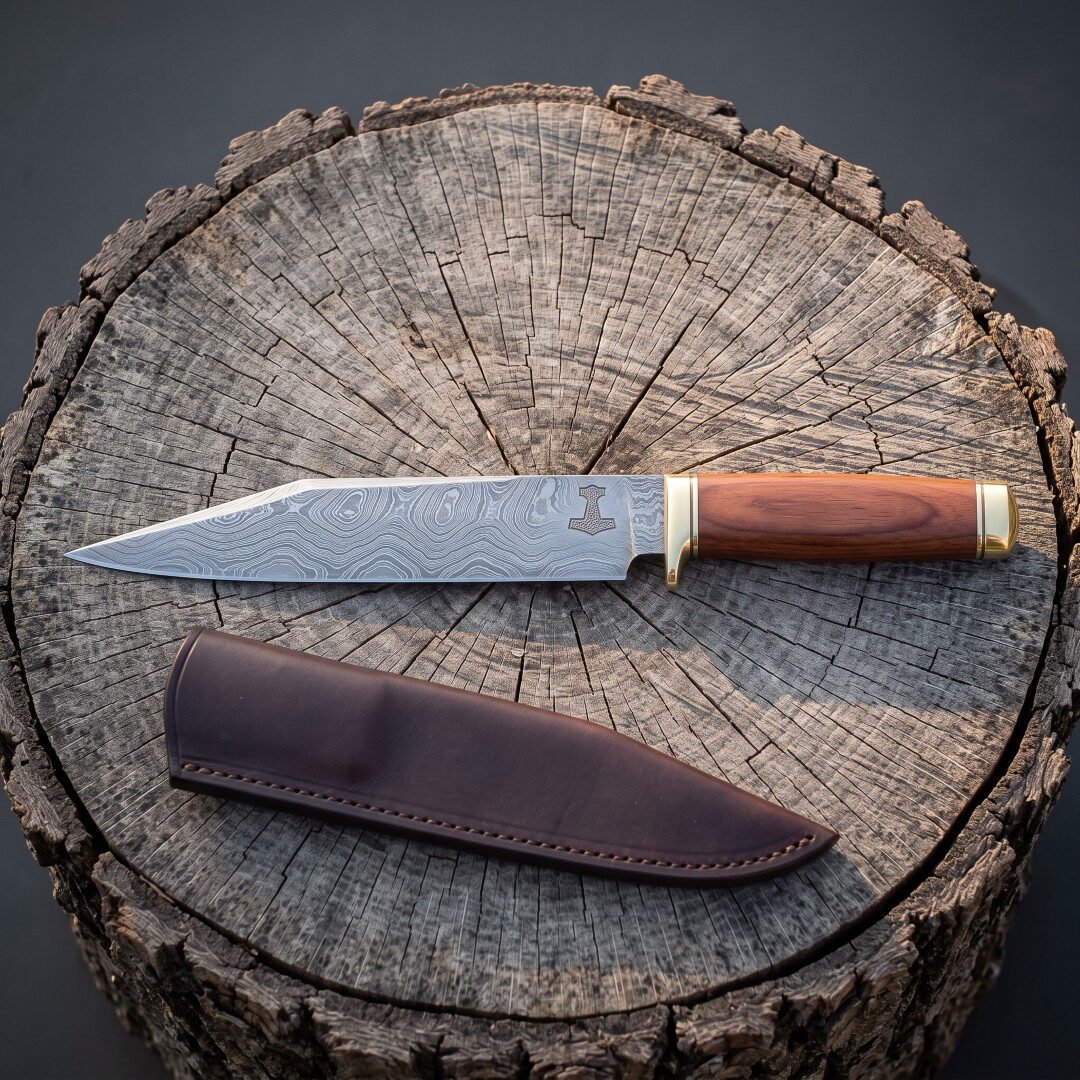
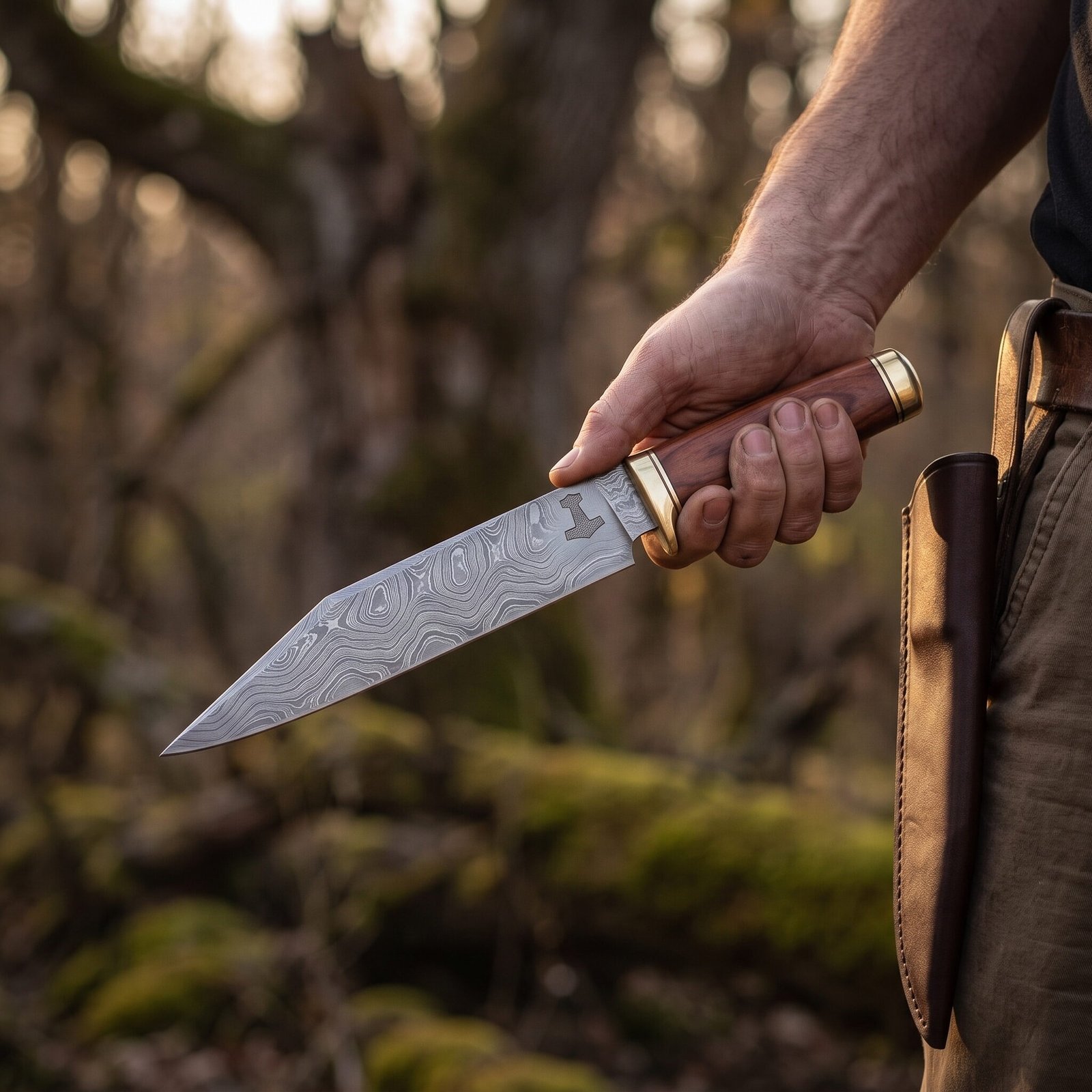
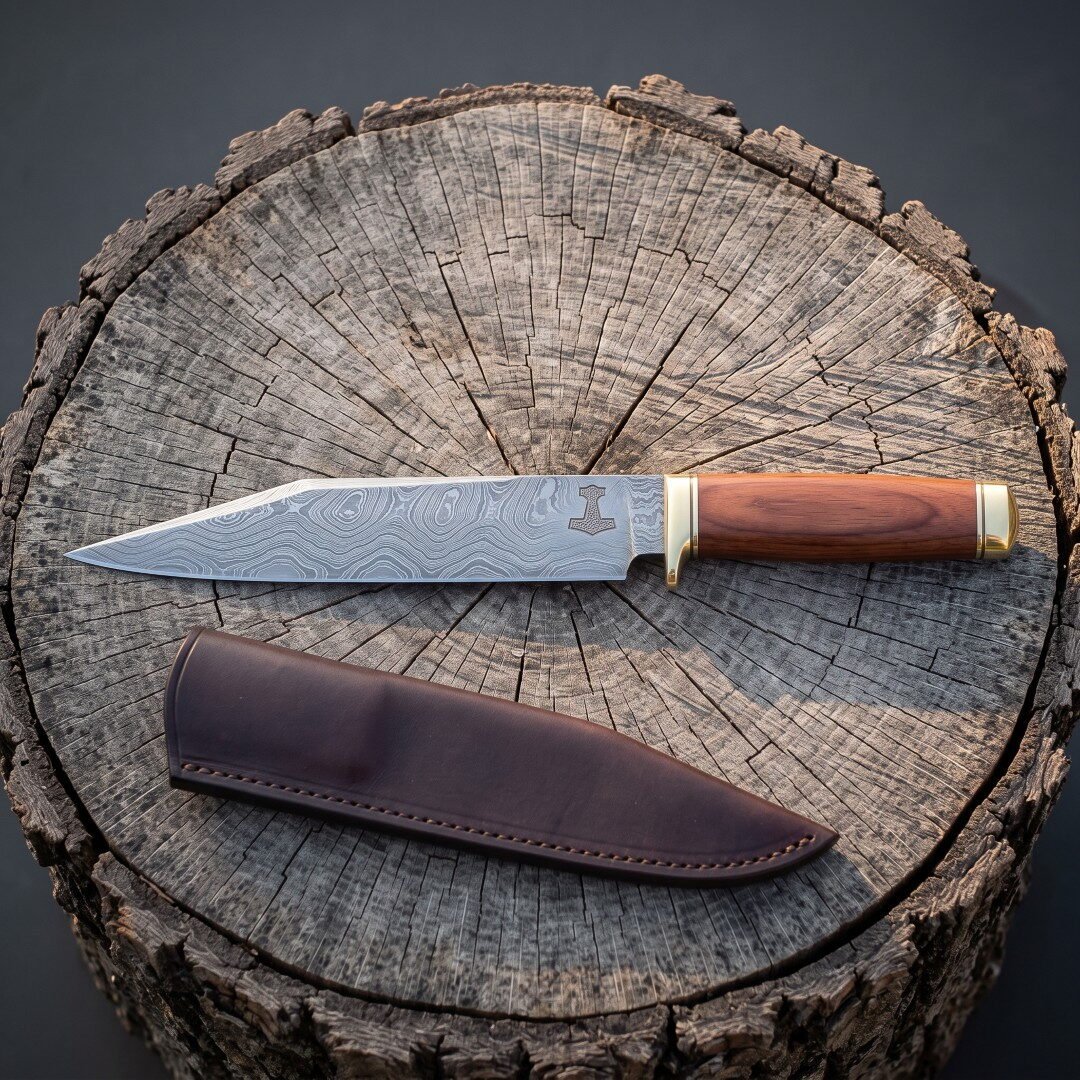
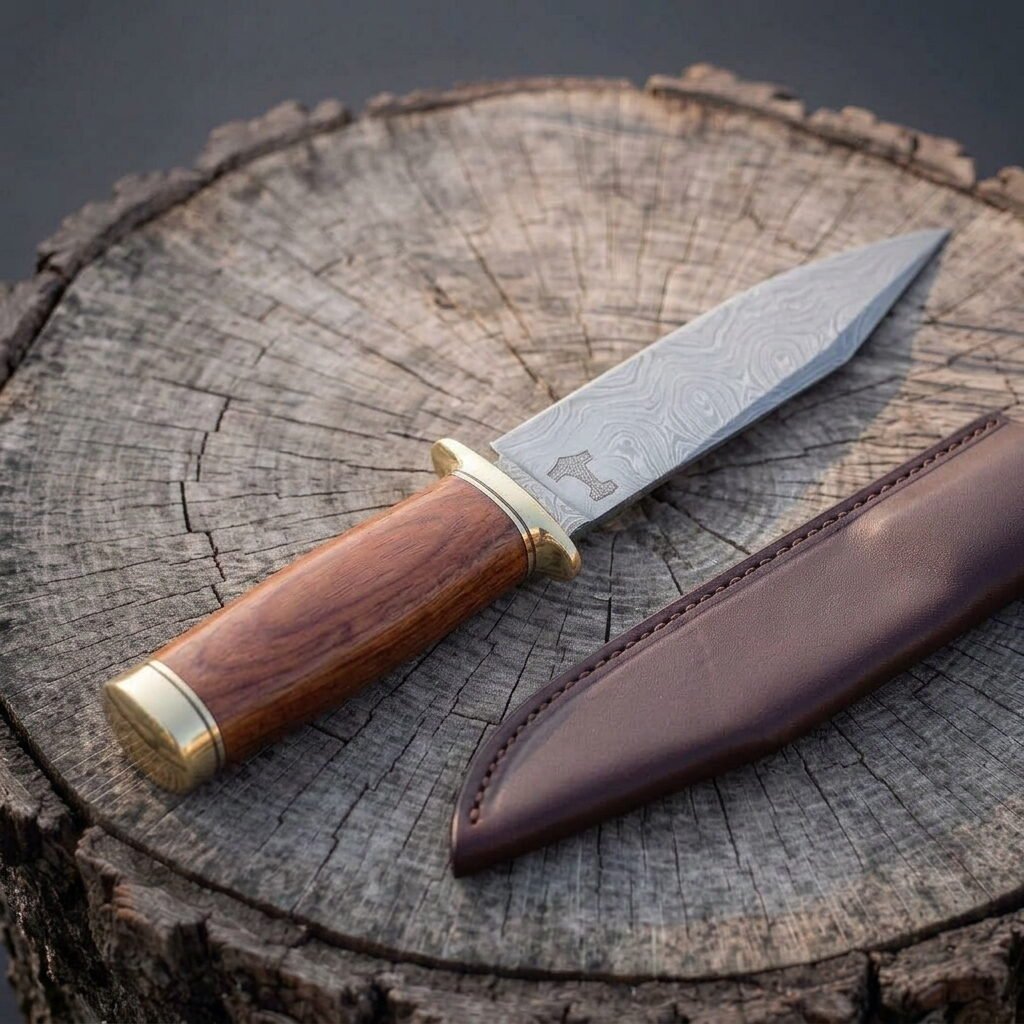
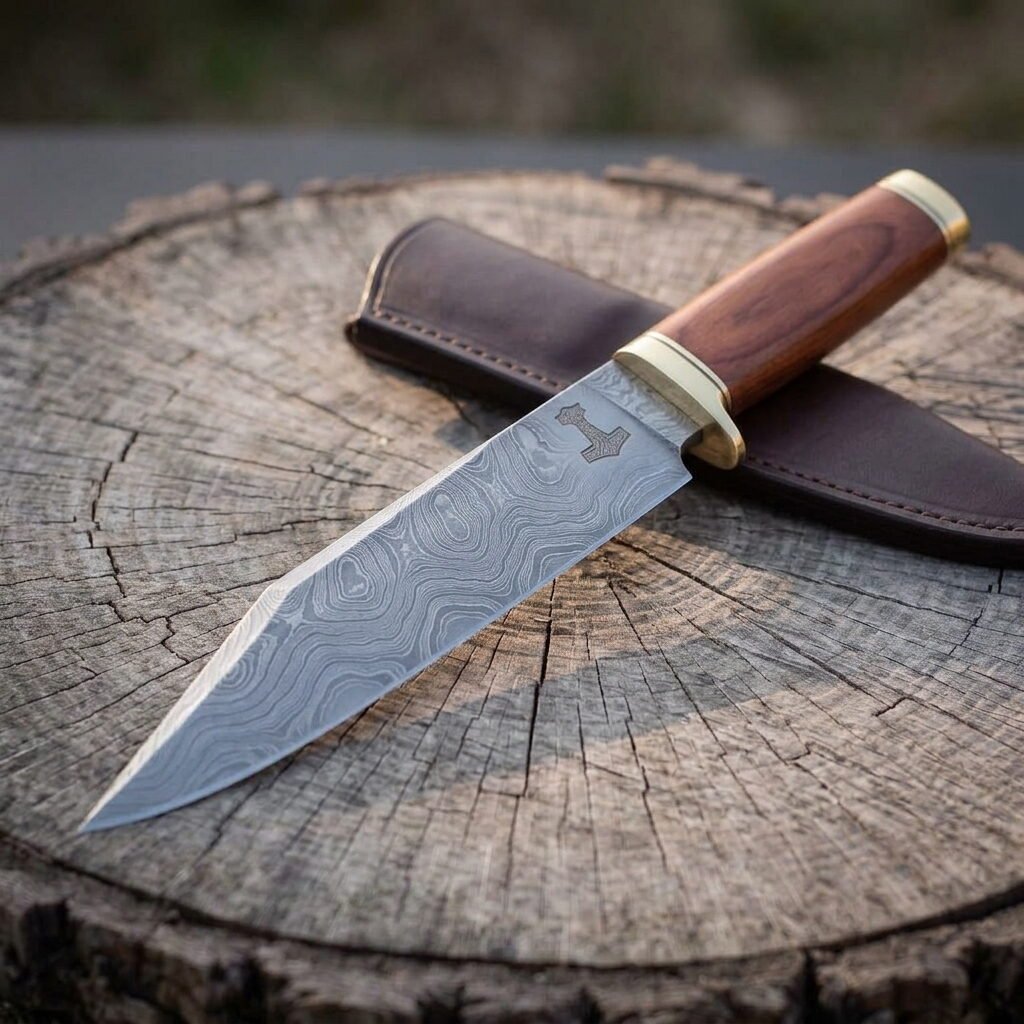
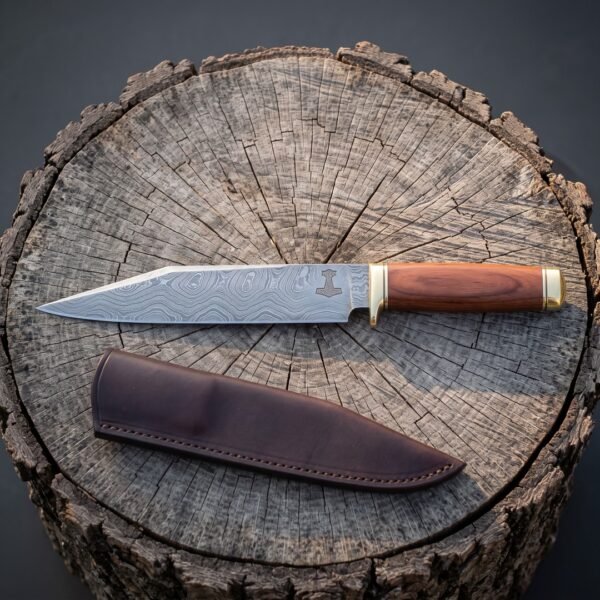
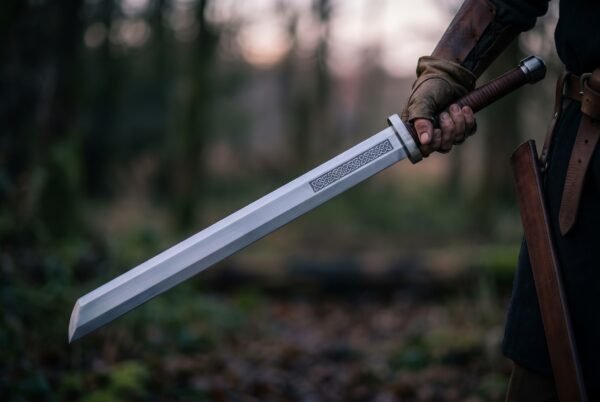
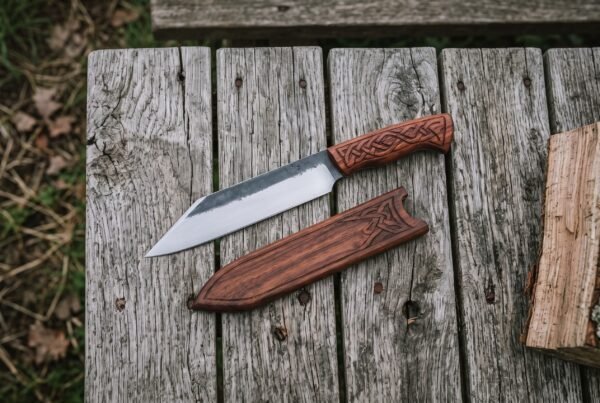
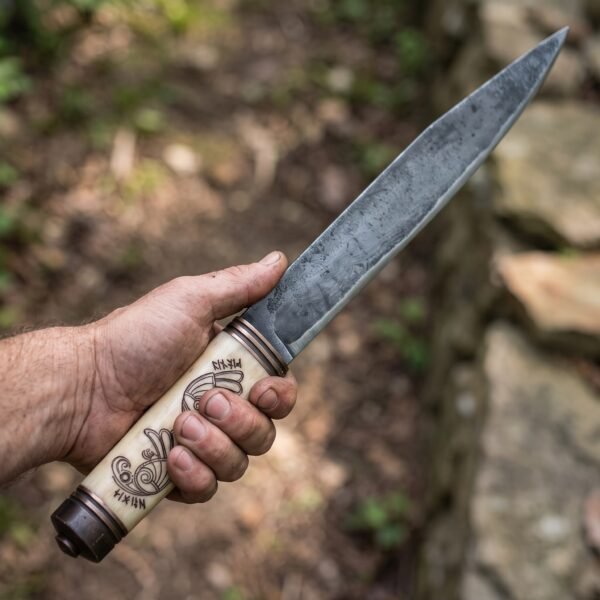
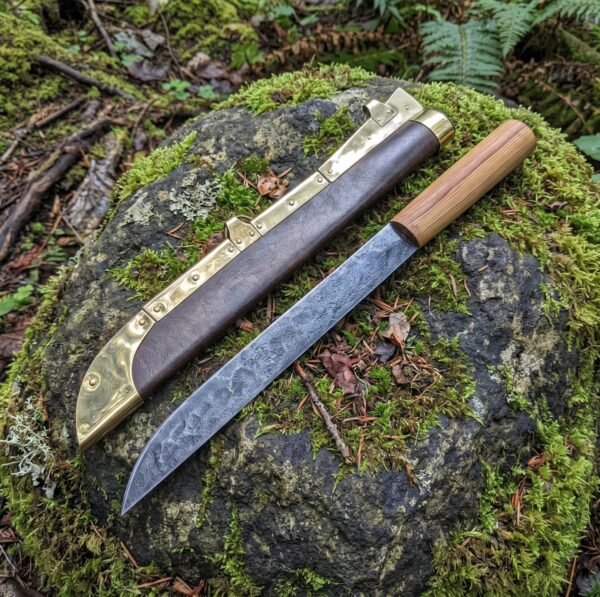
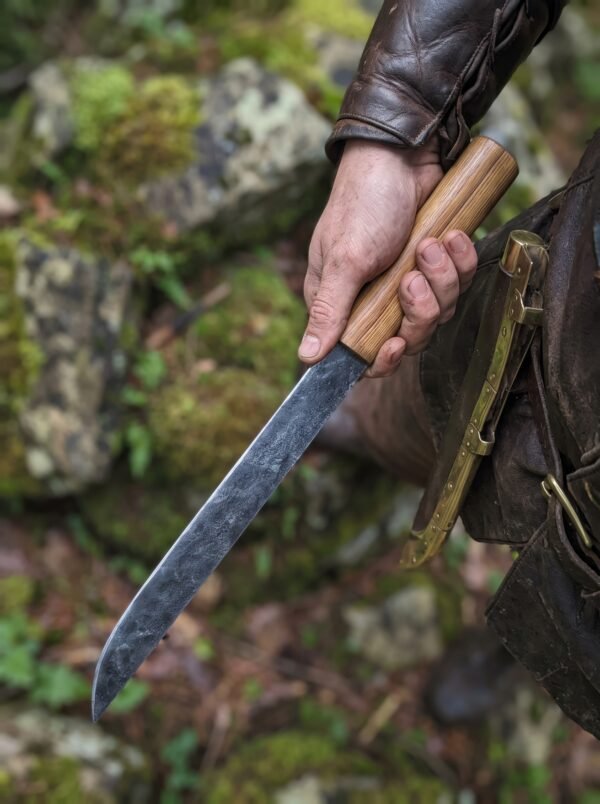
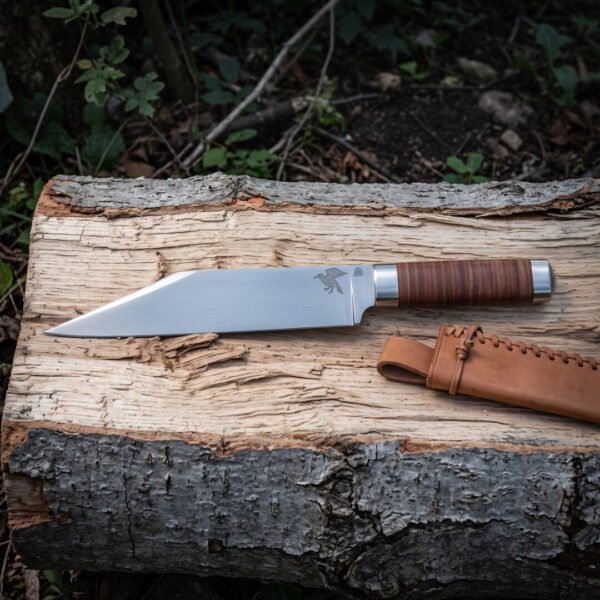
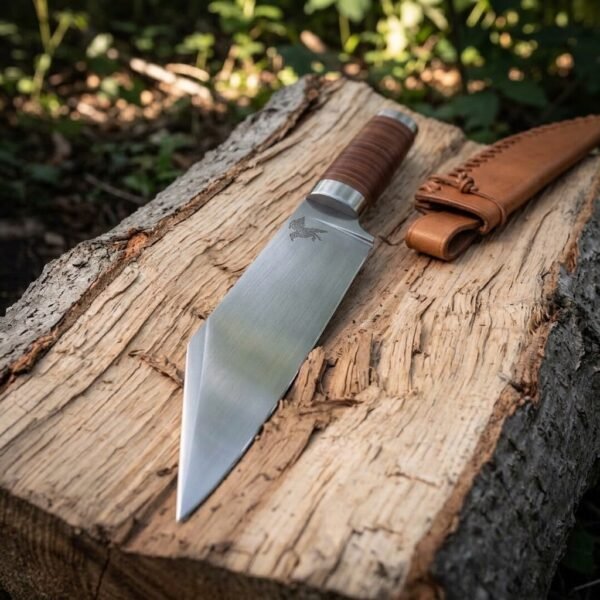
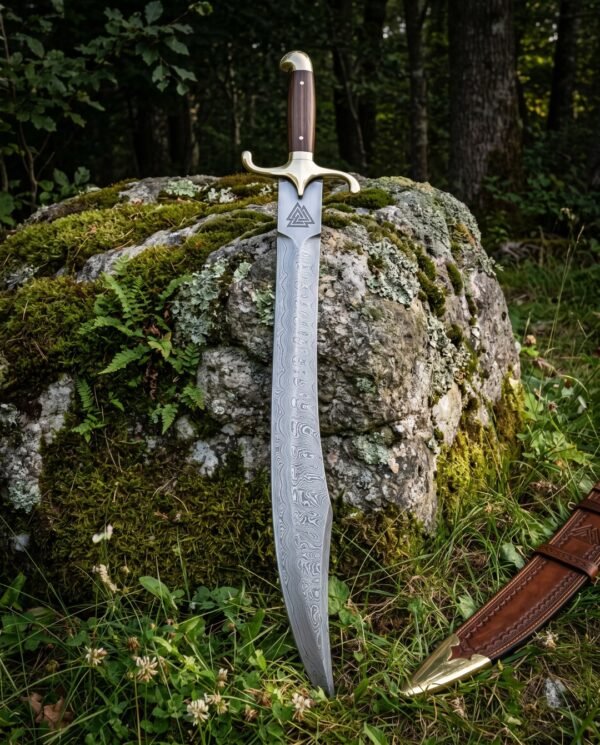
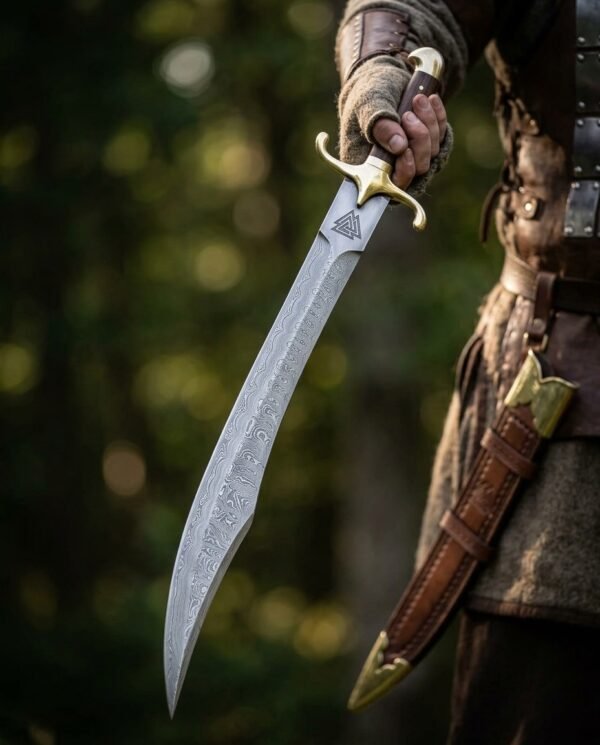
A seax in 1095 and 15N20 pattern welded steel, cut to the broken back profile: a straight spine running most of the length of the blade and then falling away in one clean angle to bring the point down onto the centre line. The handle is rosewood between a brass finger guard and a brass butt cap, the flat carries a stamped Mjolnir, and it comes with a stitched brown leather sheath.
The seax is the knife the Saxons were named after. It was the one edged thing almost every free person in the Germanic north carried, used for eating, working wood, cutting rope and settling arguments, and it turns up in graves far more often than swords do. The most famous single example is the Seax of Beagnoth, dredged out of the Thames near Battersea and now in the British Museum. Along its blade someone inlaid the entire Anglo Saxon futhorc in wire, twenty eight runes in order, and then the name Beagnoth. It is the only complete futhorc we have on an object. This seax is forged, ground, heat treated, etched and fitted in the Czech Republic. Look for it with the seax knives, and take in the short swords on the way past.
Specifications
| Blade steel | 1095 and 15N20 pattern welded damascus, hardened to 58 to 60 HRC |
|---|
| Overall length | Approximately 13 inches |
|---|
| Blade length | Approximately 8 inches, broken back profile, single edged |
|---|
| Guard | Brass guard with a short finger quillon on the edge side |
|---|
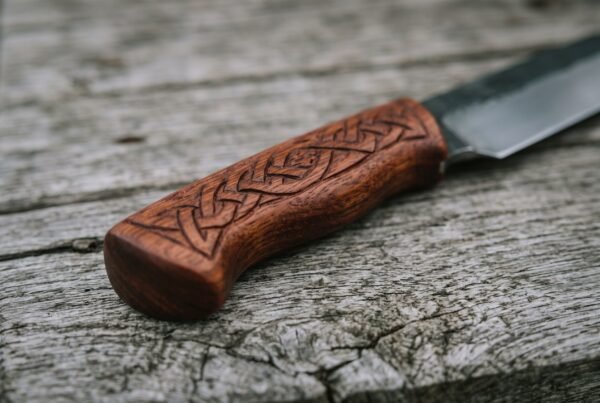
| Handle | Rosewood, round in section, with brass spacer rings |
|---|
| Butt | Brass butt cap |
|---|
| Mark | Stamped Mjolnir on the blade flat |
|---|
| Grind | Flat ground with a distal taper towards the point |
|---|
| Finish | Etched damascus with a hand polished edge bevel |
|---|
| Sheath | Dark brown stitched full grain leather with a welted seam |
|---|
| Edge | Sharpened and ready to use |
|---|
| SKU | RK-1739 |
|---|
Why a seax has that broken back
Look at the spine. It runs dead straight from the guard and then, about two thirds of the way along, it breaks downward in a single angle and runs on to meet the edge at the point. That is the broken back, and it is one of the cleverest bits of knife design in the early medieval world.
The problem it solves is this. On a knife with a straight spine and a straight edge, the point sits at the top of the blade, high above the line your hand pushes along, which makes it awkward for piercing and easy to snap. The usual fix is to curve the edge upward, but that shortens the useful straight cutting section, which is exactly the part you want for whittling and food work. The broken back does the opposite. It drops the spine instead of lifting the edge, so the point comes down to roughly the centre line where you can drive it, and the whole edge stays straight and long.
There is a second benefit. Because the angle is cut rather than curved, the blade keeps its full width and its full thickness almost all the way to the break, so mass stays out towards the front. A broken back seax chops much better than a knife of the same length with a delicate tapered tip, and it is still a fine carver. That combination is why the shape survived for six hundred years and why bushcraft knives keep rediscovering it.
Pattern welded 1095 and 15N20
The layers are real, not printed. Bars of 1095 and 15N20 are stacked, brought to welding heat and hammered until they fuse into one billet, then drawn out, cut, folded and welded again. Each cycle doubles the layer count, so it takes surprisingly few folds to get into the hundreds.
The thing most people do not know is that carbon migrates. At forging temperature carbon moves out of the higher carbon 1095 into the lower carbon 15N20 across every weld line, and after enough cycles the two steels end up much closer in carbon content than they started. What does not migrate is the nickel in the 15N20, and that is why the pattern survives: the etch attacks the nickel poor layers and leaves the nickel rich ones standing bright. It also means that a very high layer count is not automatically better, because the visual contrast comes from nickel, not from carbon, and past a point you are just making the pattern finer.
Heat treated together the blade lands at 58 to 60 HRC, which is a working hardness for a knife. It will take a shaving edge and hold it through real use, and it is tough enough for the batoning and light chopping a blade this size gets asked to do.
Engraving, runes and your own design
Use the rune converter on this page to turn a name, a date or a short phrase into Elder Futhark and we will cut it into the steel, the leather or the wood. If you would rather have a Viking pattern than a rune line, choose your own design in the engraving option above the add to cart button and tell us where it goes. Where a piece already carries an engraved design, your chosen engraving replaces it rather than sitting alongside it. On this seax the stamped Mjolnir gives way to your text, and the sheath face will take a tooled line as well if you would rather have it on the leather. See the engraving page.
Handling and balance
The brass butt cap and the brass guard together pull the balance back into the hand, which is what stops a broad seax from feeling nose heavy. The pivot sits just ahead of the guard, so the tip is easy to place for fine work but there is still enough mass forward for the blade to bite when you swing it.
The straight section of the edge is the part you will use most. For carving, hold the knife with your thumb on the spine behind the break and take long pulling cuts using the middle of the edge rather than the tip. For splitting kindling, put the edge across the end grain and tap the spine with a stick. The spine on this blade is left square and flat at the break, which gives a baton something to hit and also throws a spark off a ferrocerium rod.
The sheath carries the knife on a belt with a welt in the seam. That welt, a strip of leather between the two faces along the edge side, is what stops the blade from cutting the stitching from inside. It is the single thing that separates a sheath that lasts twenty years from one that opens up in a season.
Care
This is carbon steel and it will rust. Wipe the blade dry after every use, especially after cutting anything wet or acidic, and keep a thin film of mineral oil on it. Fingerprints left on an etched damascus flat will ghost themselves into the surface within a couple of days. More detail on steel care.
Do not store the seax in the sheath for long stretches. Vegetable tanned leather is mildly acidic and holds moisture against steel. Feed the sheath with a leather balm two or three times a year and let it dry naturally if it gets soaked, never on a radiator, which cooks the fibres and makes the leather brittle. Sharpen at the angle the bevel already has, work both sides evenly, and finish on a strop. Rosewood needs nothing but a wipe of oil once a year.
Made in the Czech Republic
This piece is made by hand in the Czech Republic, in a workshop that still works the old way. The steel is forged, ground, heat treated and finished by smiths who learned the trade from the people before them, and the wood, horn and leather are cut and fitted by hand rather than pressed out on a line. That is also why no two pieces come out exactly the same.
Ransack Viking is a United States company. We import these pieces ourselves, check every one when it lands and ship from our warehouse in Chicago, Illinois. Engraving is done here in the United States after the piece arrives, so your runes or your own design go on before it leaves for you.
A note on handmade variation
This seax is hand made, not machine made and not bulk produced, so what arrives will not be a pixel for pixel copy of the photograph. Every damascus billet moves its own way, so the swirls and the tight knots in your blade will land in their own places and will not repeat the ones in the picture. Rosewood runs from deep red to nearly black and the grain across the handle will be its own. The leather takes dye at its own depth. The dimensions, the steel and the build are the same every time. The character is not. You can carry on with the knife care guide, or look at where the seax came from while you are there.
Frequently asked questions
What is a seax
A single edged Germanic and Norse knife, carried by nearly everyone in the early medieval north as a tool as much as a blade. This one uses the broken back profile, where the spine angles down to bring the point onto the centre line.
Is it sharp out of the box
Yes. It comes with a working edge off the stone and the strop.
Can I use it for bushcraft or is it a display knife
Use it. The heat treat, the grind and the welted sheath are all built for work, and the square spine will throw sparks off a ferro rod.
Is the sheath included
Yes. The stitched full grain leather sheath comes with the knife.
Will the pattern come off if I sharpen it
No. The pattern is the layered structure of the steel all the way through. Sharpening exposes new pattern rather than removing it.
Can I replace the Mjolnir stamp with my own runes
Yes. Your chosen engraving takes the place of the stamp rather than sitting beside it. Use the rune converter above for Elder Futhark.
What is in the box
- Emberfang hand forged damascus broken back seax
- Stitched full grain leather sheath with a welted seam
- Blade wiped and oiled for transit
- Lifetime warranty against defects in the forging, the grind, the heat treat and the fittings, with no end date and no receipt needed
- Forged and finished in the Czech Republic
Explore the range
See the rest of the Viking seaxes, the Viking knives, the scabbards and sheaths and the guides.
Close to this one
In the same category sits the Wolfmark Viking seax, pattern welded Damascus. A near match for this one is the Wolfnotch Viking seax, pattern welded Damascus. Closest to this in the range is the Knotbolster Viking seax, 15 inches overall.
Fitting out further, the Greyfang kukri knife belongs with it. Nothing here exactly right, build one to your own spec on the custom Damascus knife page.

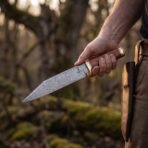
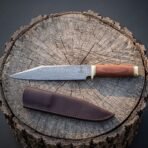
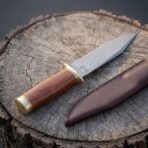
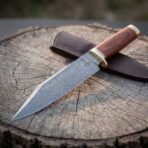
Kind of regret ordering this if I’m honest. Build quality felt cheaper than the pictures suggested. Doubt I’ll be ordering from here again.
Knew this knife was special the second I opened the box. Even the small engravings are crisp and clean. Can’t recommend this enough.
Bought this on a whim and it turned out to be one of my favorite purchases this year. Weight and balance make it feel like a real functional piece not some cheap replica. Highly recommend this one.