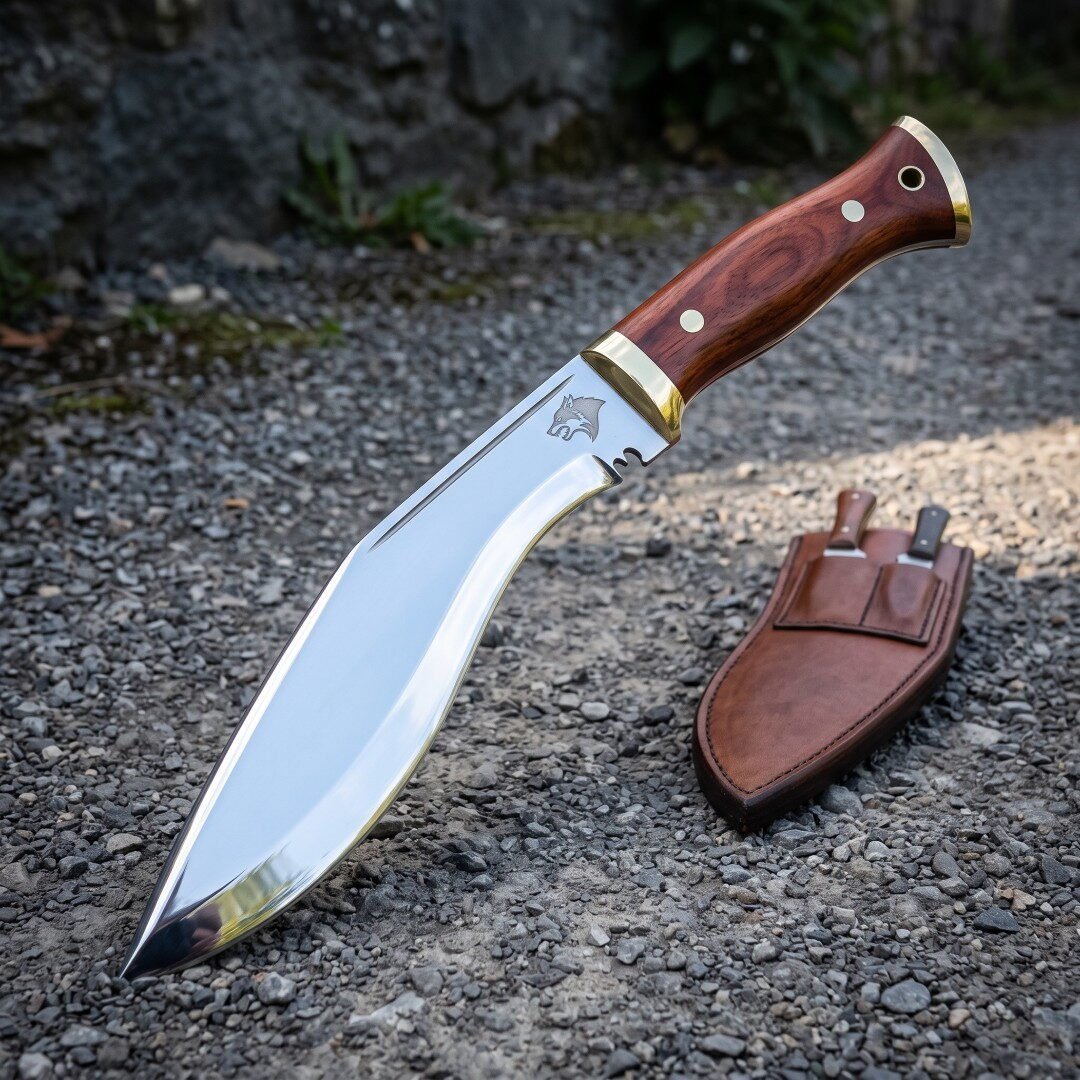
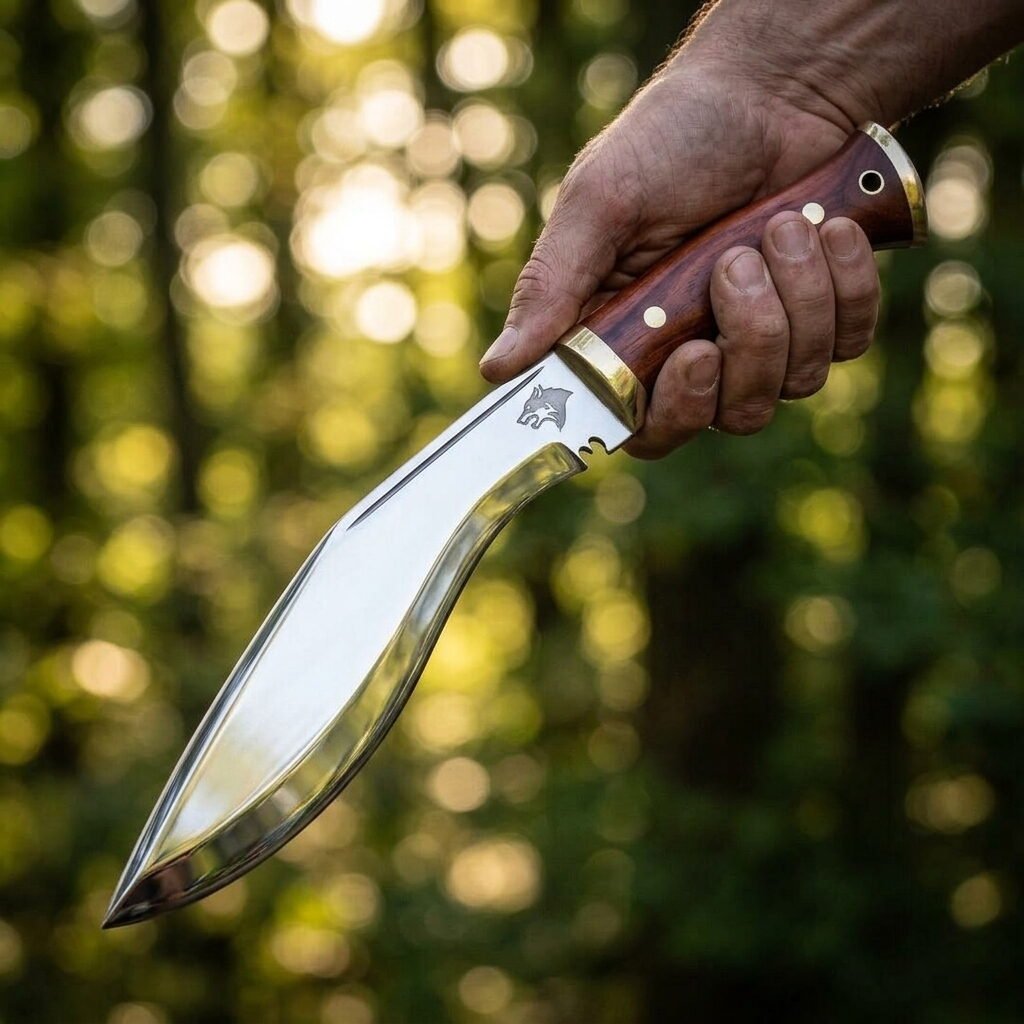
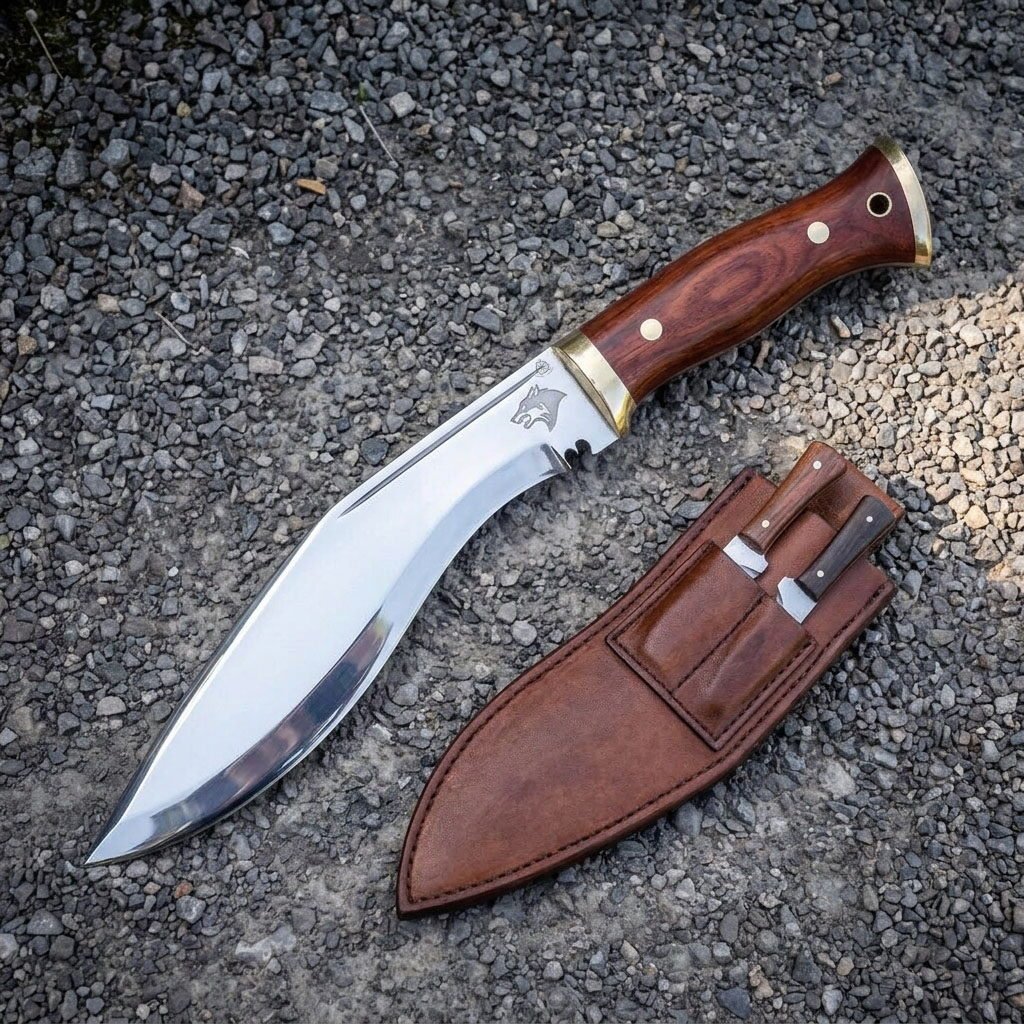
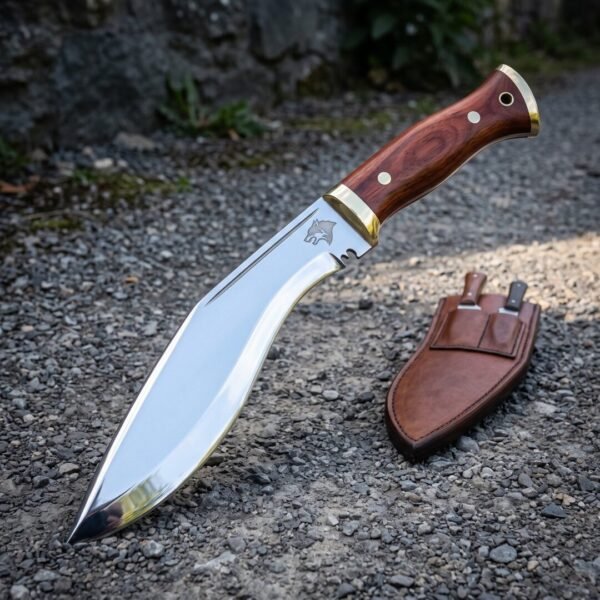
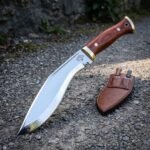
The Greyfang is a mirror polished kukri in the classic Gurkha service pattern, with rosewood scales, brass fittings and a wolf head etched into the flat behind the bolster. The kukri became famous in the wider world because it was carried by Nepali soldiers in British and Indian service from 1815 onward, but it was a household tool in Nepal long before that. Every hill farm had one, and the same blade that split kindling in the morning was the one a man took with him when he enlisted. That double life as tool and sidearm is why the shape never had to be redesigned.
This one is ground from 1095 carbon steel and polished bright, with a long narrow fuller running from the bolster into the belly and a full sized cho notch at the base of the edge. The scales are rosewood, pinned through a full tang, with a polished brass bolster at the front and a brass butt cap at the back. Every piece is made by hand in the Czech Republic. Ransack Viking imports them, checks the polish, the edge and the sheath fit at our Chicago, Illinois warehouse, and ships from there. It comes in a leather belt sheath with a front pouch holding the two traditional companion knives.
The forward angle is the whole point of a kukri, and what a kukri is actually for goes through where the shape came from. The wolf in Norse myth is Fenrir, and the children of Loki covers him along with the serpent and Hel. If you want a shorter belly for dressing game, the skinner knives cover that job.
Specifications
| Material | 1095 high carbon steel, hardened to 54 to 58 HRC |
|---|
| Overall length | About 16 inches, hand made so it varies a little piece to piece |
|---|
| Blade length | About 11 inches measured along the spine |
|---|
| Blade style | Forward angled kukri recurve with a narrow fuller and a cho notch |
|---|
| Handle | Rosewood scales, full tang |
|---|
| Pins | Two brass pins and a lined lanyard hole |
|---|
| Bolster | Single polished brass bolster at the blade |
|---|
| Butt cap | Polished brass |
|---|
| Engraving | Wolf head etched into the flat behind the bolster |
|---|
| Finish | Mirror polished blade |
|---|
| Edge | Sharpened and ready to use out of the box |
|---|
| Included | Brown leather belt sheath with a front pouch, karda utility knife, chakmak burnisher |
|---|
| SKU | RK-2202 |
|---|
The service pattern and the two little knives
Open the pouch on the front of the sheath and there are two small blades in it. Almost every listing calls them accessories. They are not. The larger of the two is the karda, a plain little utility knife for the fiddly jobs you would never attempt with eleven inches of chopper, from cutting cord to trimming a splinter out of a haft. The smaller one, the chakmak, has no edge at all and never had one. Its back is used as a steel to straighten and burnish the working edge of the main blade between proper sharpenings, and in the old days its hardened spine was also struck against flint to make fire. A kukri sold without them is a kukri missing two thirds of the kit.
The cho notch at the base of the edge is the other thing worth understanding. It is the small cut out where the sharpened edge stops and the ricasso begins. Symbolically it is read all sorts of ways. Mechanically it does something very specific. The end of a sharpened edge is a stress concentration, and a crack that starts there will run backwards into the tang. Rounding that stopping point into a notch gives the crack nowhere to begin. That is why it appears on genuine patterns and is usually missing on cheap copies.
1095 steel, mirror polish and rosewood
The blade is 1095, roughly one percent carbon and nothing exotic, hardened and drawn back to 54 to 58 HRC. That is a slightly softer temper than a small knife would take and it is the right call on a chopper. When a heavy blade hits a knot, a slightly softer edge rolls where a harder one chips, and a rolled edge comes back with two minutes on a steel while a chip means a trip to the stones.
The mirror polish is achieved by working through successively finer abrasives and finishing on a buff. It looks superb and it has one genuine advantage, which is that a truly smooth surface gives corrosion fewer places to start. The trade off is that it shows every fingerprint and every scratch. Treat the finish as something that will age. Rosewood is dense, oily by nature and stable, which is why it has been used for tool handles for centuries. It needs very little care and it darkens with age and handling.
Engraving, runes and your own design
Use the rune converter on this page to turn a name, a date or a short phrase into Elder Futhark and we will cut it into the steel, the leather or the wood. If you would rather have a Viking pattern than a rune line, choose your own design in the engraving option above the add to cart button and tell us where it goes. Where a piece already carries an engraved design, your chosen engraving replaces it rather than sitting alongside it. On this kukri the polished flat behind the bolster is the obvious spot, and the leather sheath can be stamped as well. See the engraving page.
Handling and balance
The brass butt cap keeps this from being a purely nose heavy chopper, but the mass still sits well forward in the belly where it belongs. Let the weight do the work. A relaxed grip and a loose wrist will out chop a tight grip and a stiff arm every time, and it is far less tiring over a long session. The rosewood is shaped with a swell in the middle and a flare at the butt, so the hand has something to hook against without needing to squeeze.
Choke up behind the bolster for detail work and the knife turns into something you can carve with, using the last three inches before the point. Do not use the cho notch as a wire stripper or a can opener, which is a habit that turns up online. It is a stress relief feature, not a tool.
Care
A mirror polished carbon steel blade is the highest maintenance finish we sell and it is worth knowing that before you buy. Wipe it dry after every use, always oil it before it goes back in the sheath, and never leave it in leather for months on end, because tanned hide holds moisture and salts that will spot a polish. Mineral oil or camellia oil is fine. Fingerprints will etch a mirror finish if they are left for weeks, so handle it and then wipe it. The rosewood wants a rub of boiled linseed or a wood oil once a year, and the leather wants a neutral cream two or three times a year. There is more on stones, angles and rust prevention in our knife care guide.
A curve like this does not sharpen the way a straight edge does, and sharpening a curved blade works through the stroke.
Made in the Czech Republic
Made by hand in the Czech Republic and imported by Ransack Viking. Nothing is drop shipped out of an importer catalogue to a customer’s door. Every piece comes to our Chicago warehouse, is unpacked, has the edge, the handle and the sheath checked, and only then goes live as in stock. That is why processing takes one to two weeks rather than a day. Shipping in the United States is free, returns run for seven days, and the lifetime warranty against defects in forging, grind, heat treat and fittings has no end date and needs no receipt.
A note on handmade variation
This is hand made, not machine made or bulk produced, so what arrives will not be a pixel for pixel copy of the photograph. Rosewood is a natural material and its grain runs from deep red brown through to nearly purple, so no two pairs of scales match. Hand polishing leaves its own faint directional character, and the fuller and the sweep of the recurve shift slightly between blades because a person ground them. The etched wolf head varies a little in depth and contrast. The dimensions, the steel and the build are identical every time. The character is not.
Frequently asked questions
Is it sharp when it arrives
Yes. It has a working chopping edge from the moment you unwrap it, ground at an angle suited to splitting and clearing rather than to slicing paper.
What are the two small knives for
The karda is a small utility knife and the chakmak is an unsharpened burnisher used to straighten the main edge between sharpenings. Both are traditional to the pattern and both are included in the sheath pouch.
Will the mirror polish stay perfect
No, and no polished carbon blade will. It will pick up fine scratches and eventually a patina with use. Keep it wiped and oiled and it will age gracefully rather than corrode.
Is this the same as a Damascus kukri
No. This is single steel 1095 with a mirror polish. The Damascus versions are folded 1095 and 15N20 with a visible layered pattern, and they are priced higher because the billet takes far more work.
Can you put my name on it in runes
Yes. Use the rune converter on this page and choose the engraving option. If you want the engraving on the blade flat it replaces the etched wolf head rather than sitting next to it.
How long does delivery take
Processing takes one to two weeks because each piece is checked at the Chicago warehouse before it leaves, then standard United States shipping. Engraved pieces take a few days longer.
What is in the box
- Greyfang Gurkha pattern kukri
- Leather belt sheath with a front pouch
- Karda utility knife
- Chakmak burnisher
- Care and warranty card
- Hand made in the Czech Republic, shipped from our Chicago, Illinois warehouse
Explore the range
See more in kukri knives, Viking knives, Norse arms and engraved and personalised pieces, or read the guides.
Close to this one
For a straight comparison, see the Runecurve kukri knife, 16 inches overall. Worth putting side by side with this is the Thundercurve kukri knife, 16 inches overall. In the same category sits the Foldcurve kukri knife, pattern welded Damascus.
From the same corner of the shop, there is the Emberfang Viking seax. Nothing here exactly right, build one to your own spec on the custom hunting knife page.


I collect stuff like this and this knife is on another level. The rosewood handle feels amazing and the balance is perfect. Worth every penny.
Was nervous ordering something like this online but so glad I did. Leather sheath is thick and well stitched. Not the cheap stuff you usually get. Edge retention has been great even after regular use. Even the small engravings are crisp and clean. This shop clearly takes pride in their work.
Can’t stop showing this off to everyone who comes over. The rosewood handle feels amazing and the balance is perfect. Already planning my next purchase from this shop.