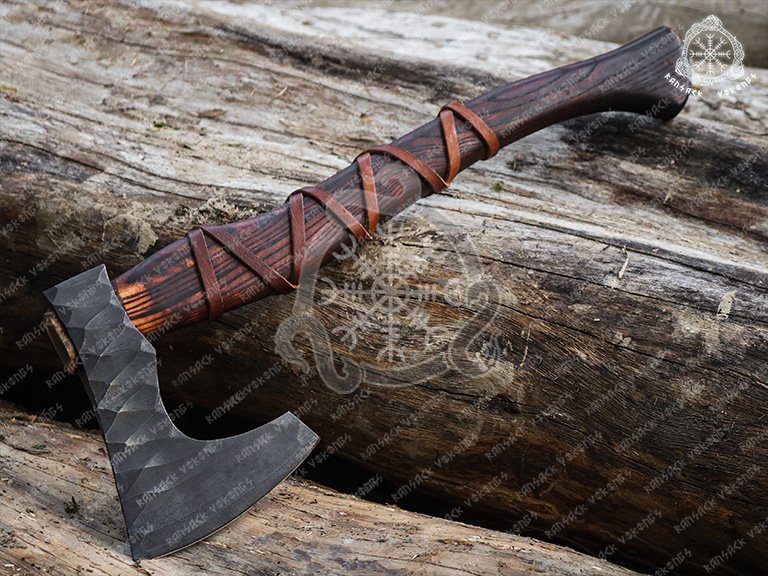
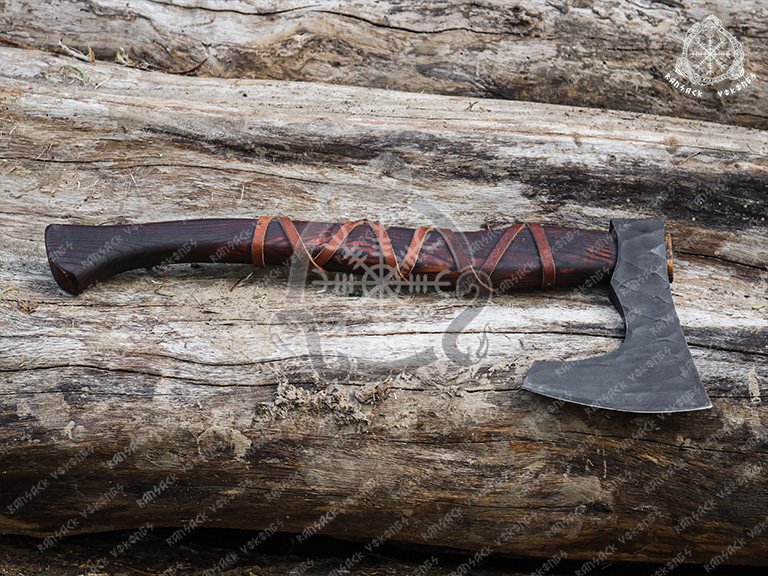
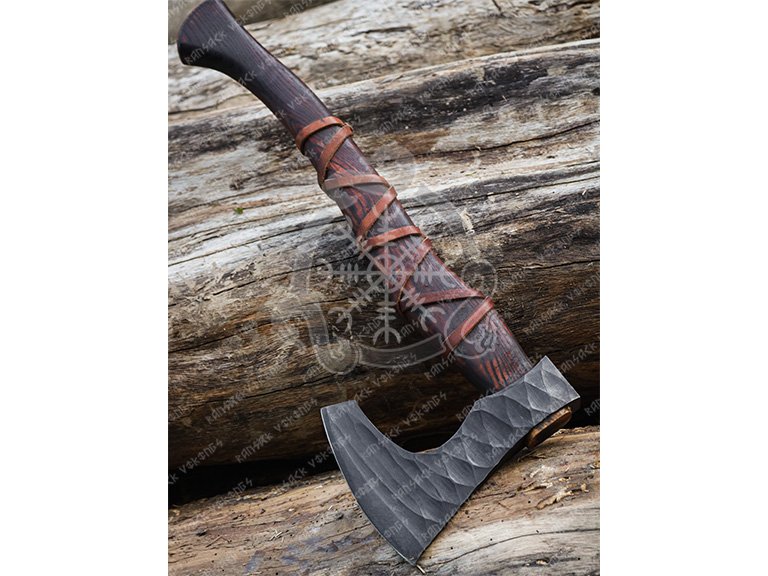
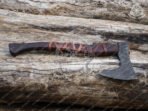
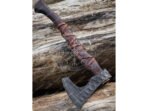
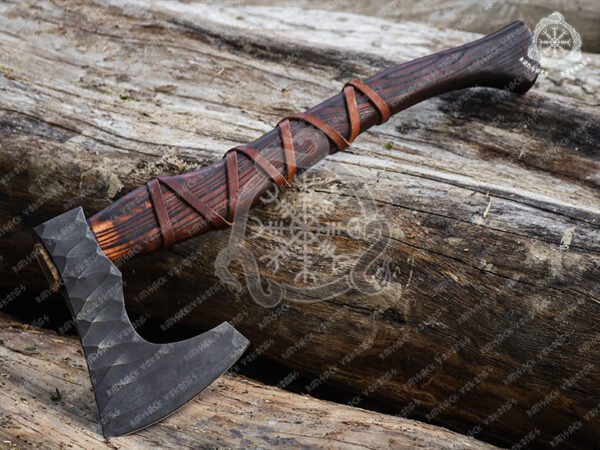
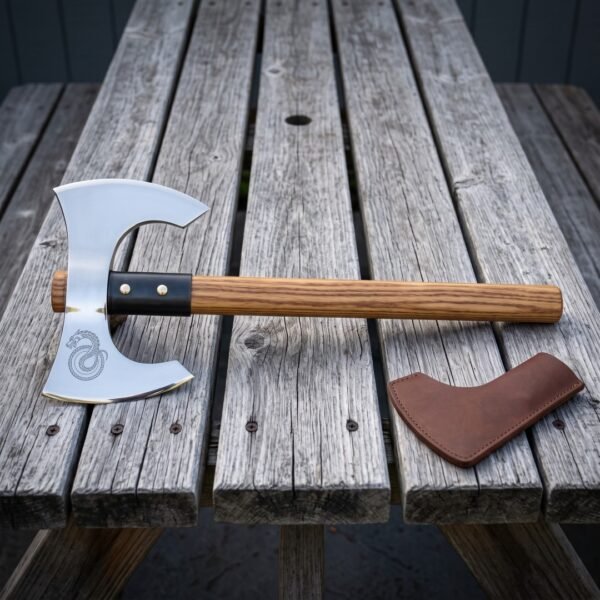
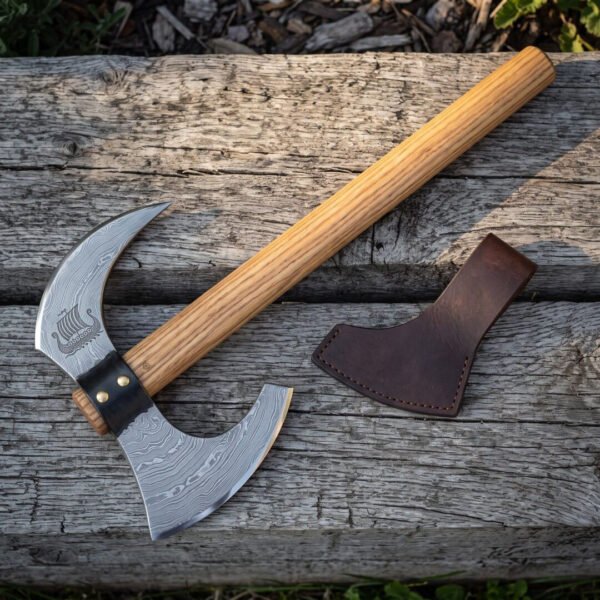
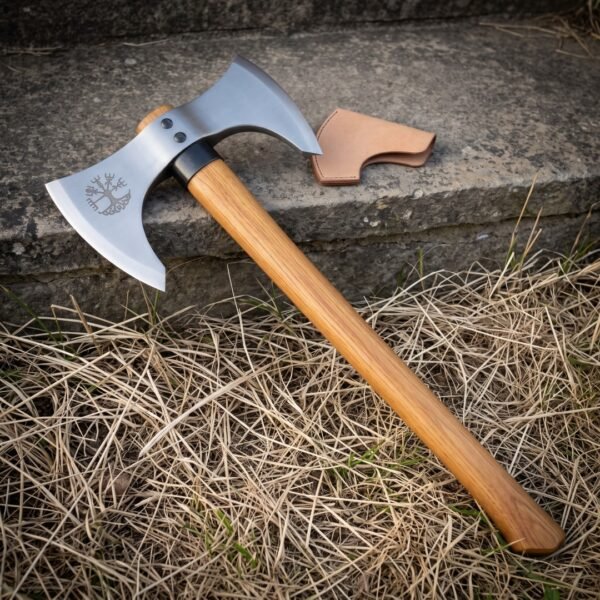
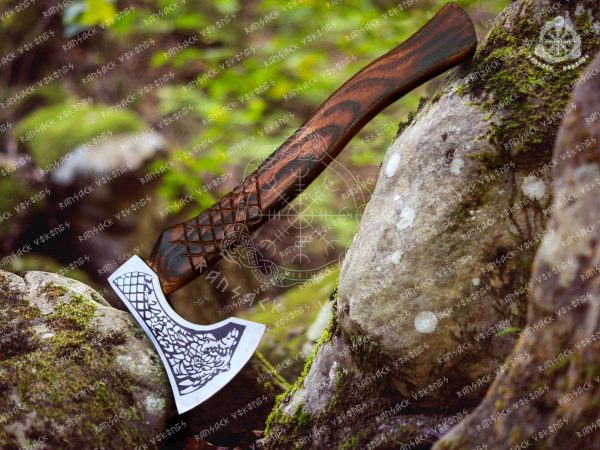
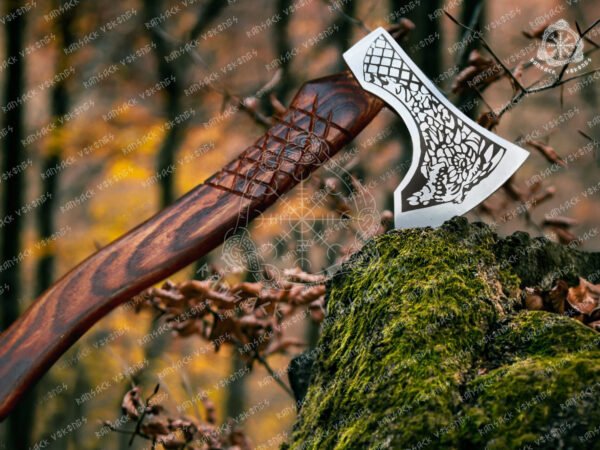
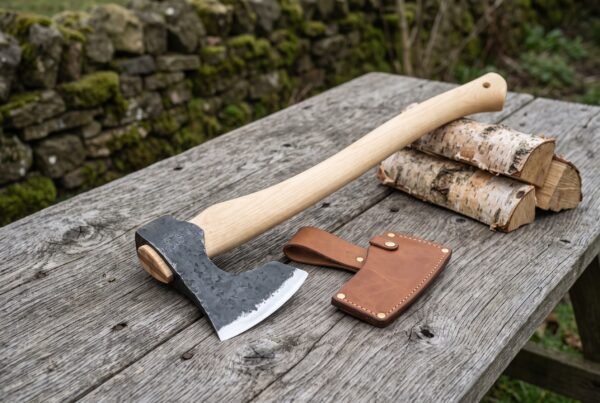
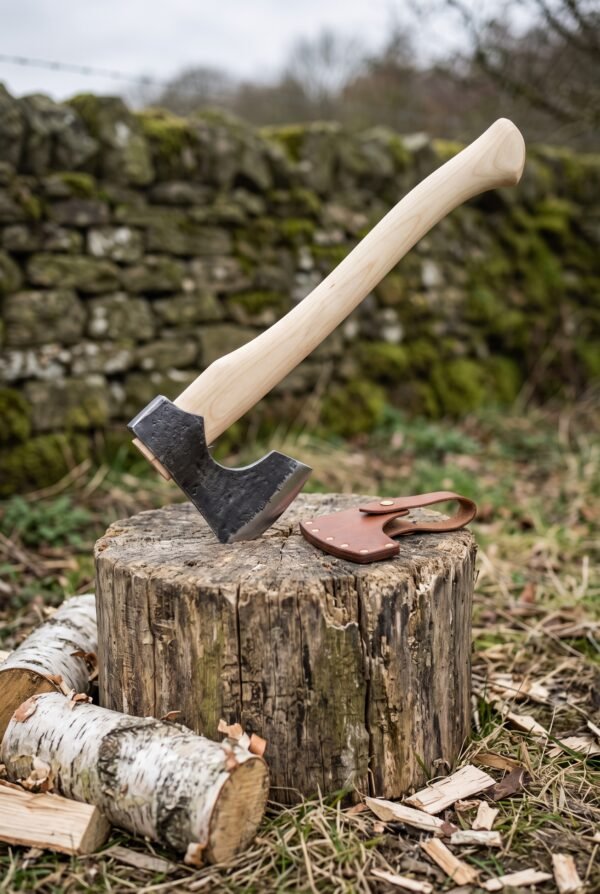
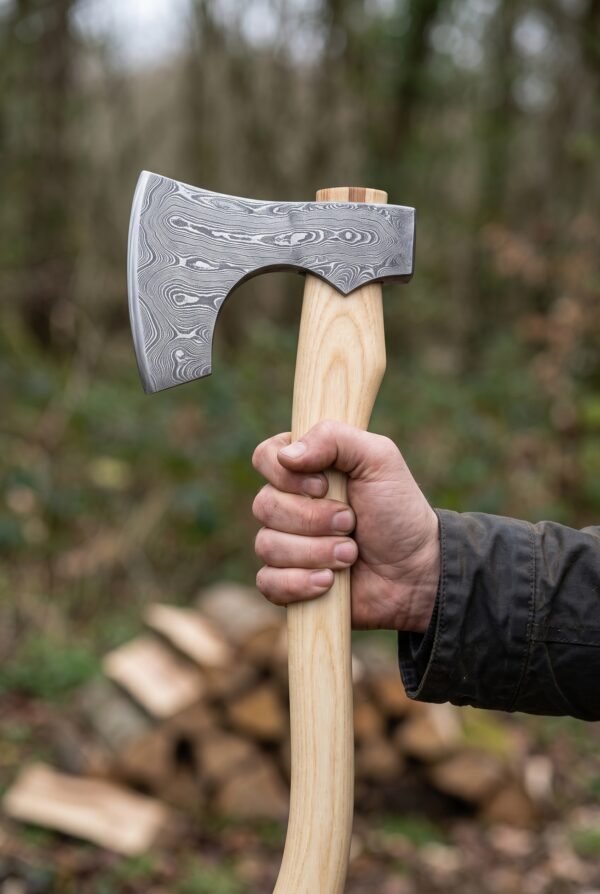
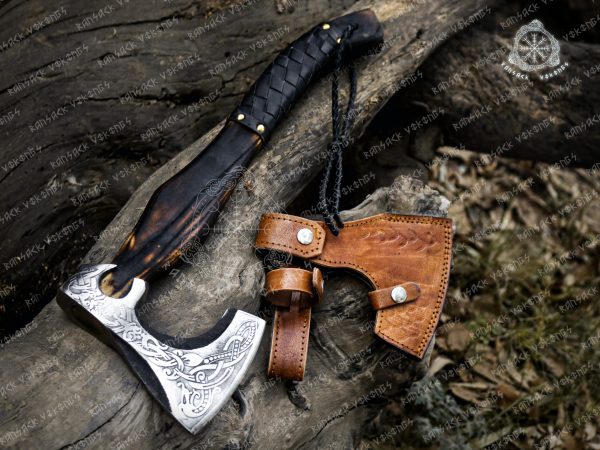
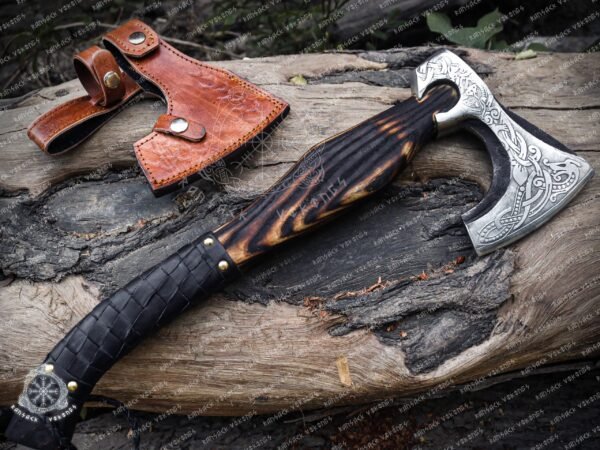
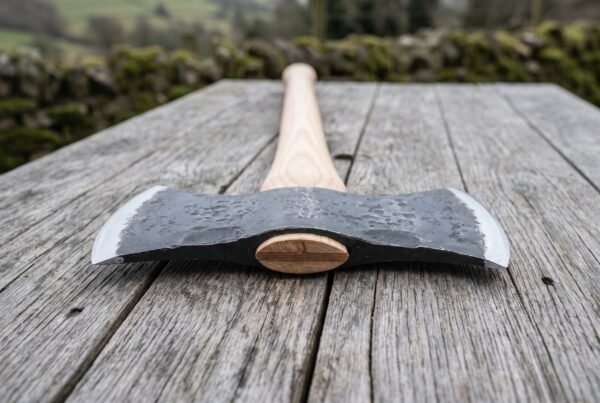
The Norsewind is a Norse pattern Viking bearded axe, forged from high carbon steel and hung on a 19 inch rosewood shaft. The bit carries 5.3 inches of cutting edge, the head is taken to 58 to 60 HRC, and the whole tool weighs 1.23kg. It is built as a tool first and a display piece second, which is why the edge is sharp when the box is opened rather than waiting for you to put an edge on it. The archaeology behind these shapes is written up in how Norse axes were made and used.
The best preserved Viking axe we have was found in a chamber grave at Mammen in Jutland, and tree ring dating of the timber put the burial in the winter of 970 to 971. Its iron head is inlaid with silver on both faces, in a style of interlaced animal ornament that archaeologists now simply call Mammen after it. What is striking about that axe is not the silver but the fact that underneath the decoration it is an ordinary working shape. The Norse did not have separate battle axes and tool axes for most purposes. The same geometry split firewood, shaped a boat strake and went to war, and the only difference between the axe in a farmer’s hand and the axe in a chieftain’s grave was what had been done to the surface.
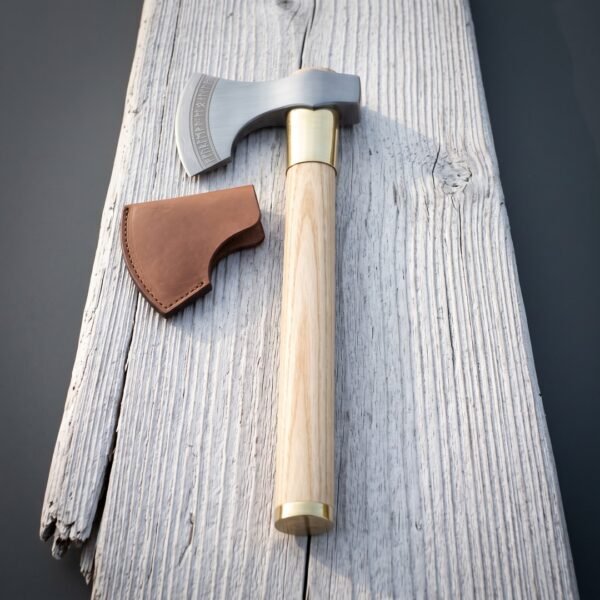
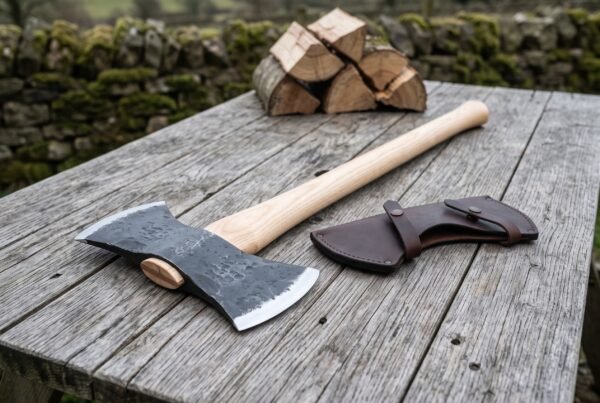
Forged and finished in the Czech Republic. It ships with a leather blade cover, a gift box and protective packaging.
Specifications
| Steel | Hand forged high carbon steel |
|---|
| Hardness | 58 to 60 HRC |
|---|
| Overall length | 19 inches |
|---|
| Cutting edge | 5.3 inches |
|---|
| Weight | 1.23kg |
|---|
| Handle | Rosewood shaft |
|---|
| Included | Leather blade cover and gift box |
|---|
| SKU | RK-391 |
|---|
The geometry that makes an axe work
An axe is not a heavy knife. A knife is thin all the way back from the edge because it is trying to pass through material; an axe has to open a cut and then get out of it again, and those are different problems.
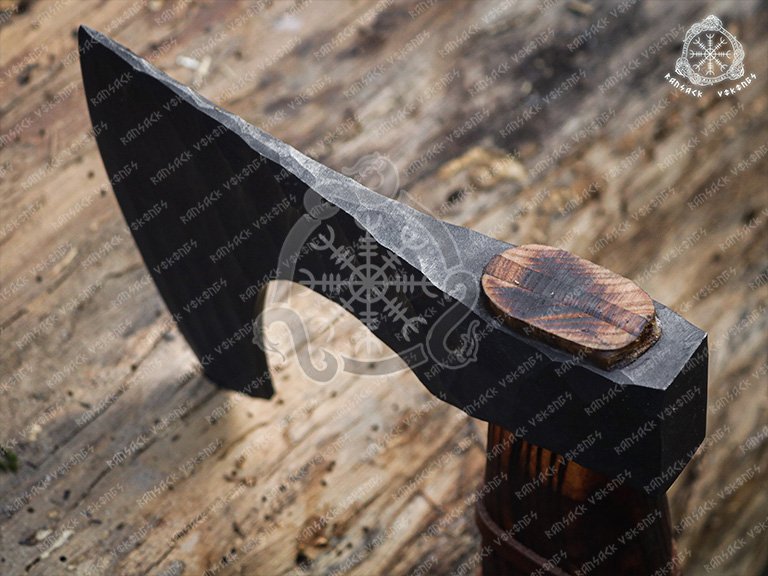
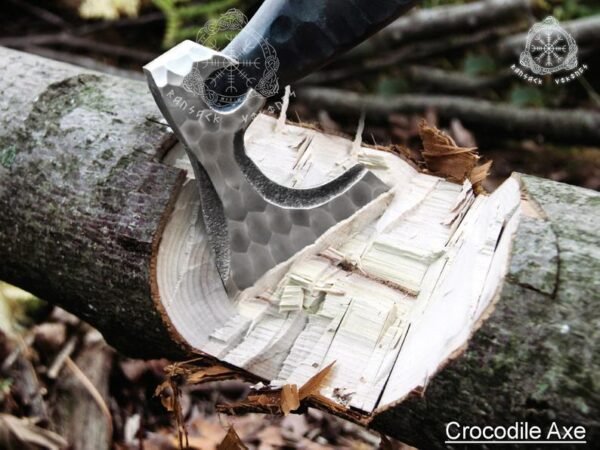
Look at the cheeks of this head from above and you will see they are convex rather than flat. That curve is doing the real work. As the bit enters wood, the swelling behind the edge acts as a wedge and levers the fibres apart, which is what actually splits a log; a flat cheeked head cuts a slot and then sticks in it. The convexity also means the head can be pulled free easily instead of being fought out of every strike.
The second thing is the hang, meaning the angle at which the head sits relative to the haft. Hung correctly, the edge meets the wood square when the axe is swung naturally from the shoulder, so the force goes into the cut rather than glancing off. Get it wrong by a few degrees and every strike skids. The third is where the mass sits. On a bearded axe the weight is concentrated close to the eye with the edge hanging below it, so the balance point stays near your hand and the axe stays controllable one handed even though it is carrying 5.3 inches of edge.
Why high carbon steel and not stainless
Plain high carbon steel, forged, hardened and tempered by hand. It sharpens faster than stainless, it holds an edge longer under impact loading, and it will take a patina with use that is protection rather than damage. Almost nobody makes a serious axe from stainless, and the reason is metallurgical: the chromium content that gives stainless its corrosion resistance makes it harder to achieve hardness and toughness together, and an axe bit needs both because it is being driven into knots at speed.
The trade off is that carbon steel rusts if it is neglected. That is a one minute job to prevent, and it is the same bargain every axe maker in history has made. A wipe of oil and the leather cover over the bit is the whole of it. If you want to understand where Damascus sits against a plain carbon head, that comparison is in Damascus versus stainless.
The rosewood shaft
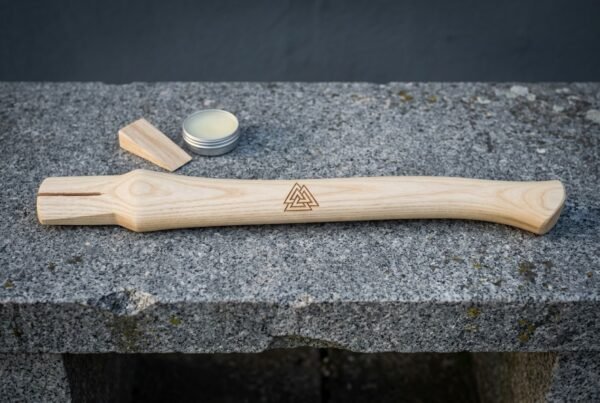
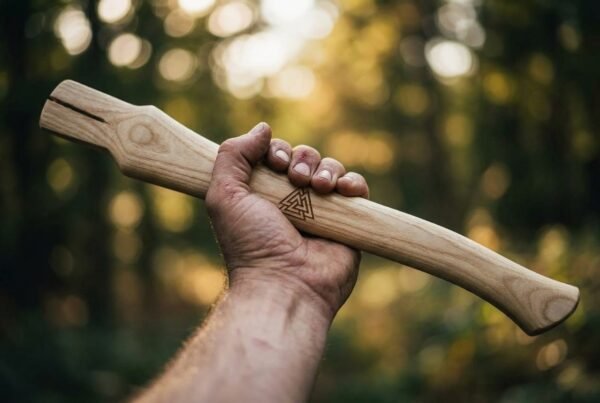
The shaft is rosewood, shaped and finished by hand. Density is the reason it is used. A heavy, tight grained timber damps the shock that travels back down a haft at the moment of impact, so less of it reaches your wrist and elbow, and the closed grain resists the splitting that starts at the eye on a soft handle.
It is oil finished rather than lacquered. Lacquer looks good until it chips and then it traps moisture underneath itself; oil dulls gradually and is renewed at home with a cloth. Feed the shaft twice a year, keep it out of direct sun and out of a dry heated room over a long winter, and it will not shrink away from the head. That single habit is what keeps an axe head tight for decades. The method is in wooden handle care.
Engraving, runes and your own design
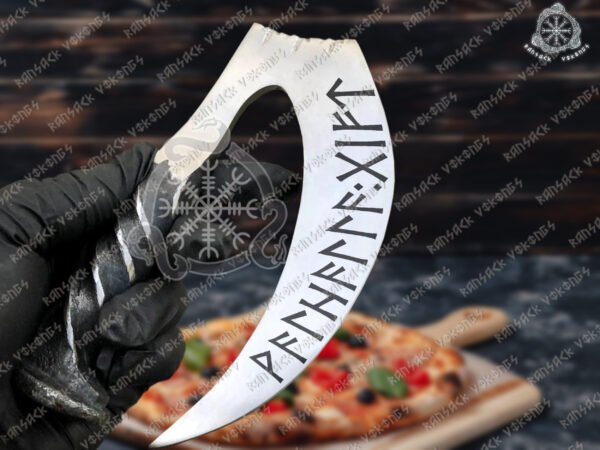
Use the rune converter on this page to turn a name, a date or a short phrase into Elder Futhark and we will cut it into the steel or the handle. If you would rather have a Viking pattern than a rune line, choose your own design in the engraving option above the add to cart button and tell us whether it goes on the blade or the handle. Where a piece already carries an engraved design, your chosen engraving replaces it rather than sitting alongside it. Norse knotwork and a rune line on the cheek of the head are the two most requested treatments on this axe, which is fitting given what was done to the Mammen head a thousand years ago. See the engraving page.
Care and sharpening
A file resets an axe edge faster than any stone. Clamp the head, work along the bevel following the curve of the bit, and stop before you flatten the belly of the edge. Finish with a fine stone or a puck, and a strop if you want it keen. An axe does not want a fine polished apex, because a fine apex chips when it meets a knot.
Keep the head lightly oiled, keep the leather cover on the bit between uses, and feed the shaft twice a year. If the head does pick up surface rust, it lifts with fine abrasive and oil rather than aggressive grinding. The steel routine is covered in steel care and the sharpening technique in sharpening with a whetstone.
Made in the Czech Republic
The work behind this piece happens in a Czech Republic workshop that has kept to the old methods. Steel is forged and heat treated by hand, the grind is taken down by eye rather than by machine, and the handle, fittings and sheath are cut and finished one at a time. Because of that, every piece carries small marks of the hand that made it.
Ransack Viking is a United States company. We import direct, check each piece when it reaches us, and ship from our Chicago, Illinois warehouse. Engraving is added here in the United States after arrival, so the piece you receive is finished to your order.
A note on handmade variation
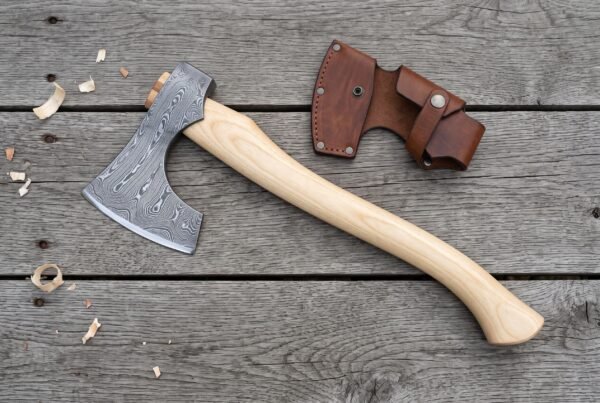
The Norsewind is hand forged rather than machine made or bulk produced, so what arrives will not be a pixel for pixel copy of the photograph. The hammer texture across the cheeks is where the smith put it, the line of the beard is drawn by eye, and the colour left by the heat treat runs from dark grey through to a mottled blue depending on how the head came out of the quench.
The rosewood carries its own grain and tone because it grew that way. The dimensions, the steel, the hardness and the build are the same on every one. The character is not.
Frequently asked questions
How does this differ from the other bearded axes in the range
The dimensions and the steel are shared across several of them. What changes between pieces is the profile of the head, the surface finish and the timber, since each head is drawn out by hand rather than pressed from a die.
Can I use it for splitting firewood
For kindling and small rounds, yes, and the convex cheeks help it release rather than bind. For splitting large seasoned rounds you want a heavier splitting axe or a maul; 1.23kg on a 19 inch haft is a camp axe rather than a splitter.
What is the leather cover for
It protects the edge in storage and transport, and it protects you and everything in the bag from the edge. Put it back on when the axe is not in use, and oil the head before covering it for a long period.
Will the head rust
High carbon steel will darken into a patina with use, which is normal and protective. Red rust only appears if the head is put away wet or stored in a damp shed. A wipe of oil prevents it.
Can this be given as a wedding or groomsman gift
It is one of the most common reasons it is bought. It arrives gift boxed, and a name, a date or a short rune line cut into the cheek of the head is what most people add.
How long will it take to arrive
Processing runs one to two weeks while the head is forged, hung and sharpened, then free shipping inside the US. Engraving does not usually add to that.
What is in the box
- One Norsewind Viking bearded axe
- Leather blade cover
- Gift box
- Protective packaging
- Care notes for high carbon steel and an oiled shaft
- Forged and finished in the Czech Republic
Explore the range
Look through the rest of the Viking axes, or pair it with the Viking knives and the Bowie knives. Sharpening, hanging and steel care are all written up in the guides.
If this one is not it
For a straight comparison, see the Ravenfeast Viking axe. Worth putting side by side with this is the Stormbeard Viking axe, pattern welded Damascus. In the same category sits the Emberbeard Viking axe, pattern welded Damascus.
From the same corner of the shop, there is the Birchskeg bearded axe. Pick the steel, the length and the fittings yourself on the custom Viking axe page.



Got this as a gift and now I want one for myself too. Weight and balance make it feel like a real functional piece not some cheap replica. Already planning my next purchase from this shop.