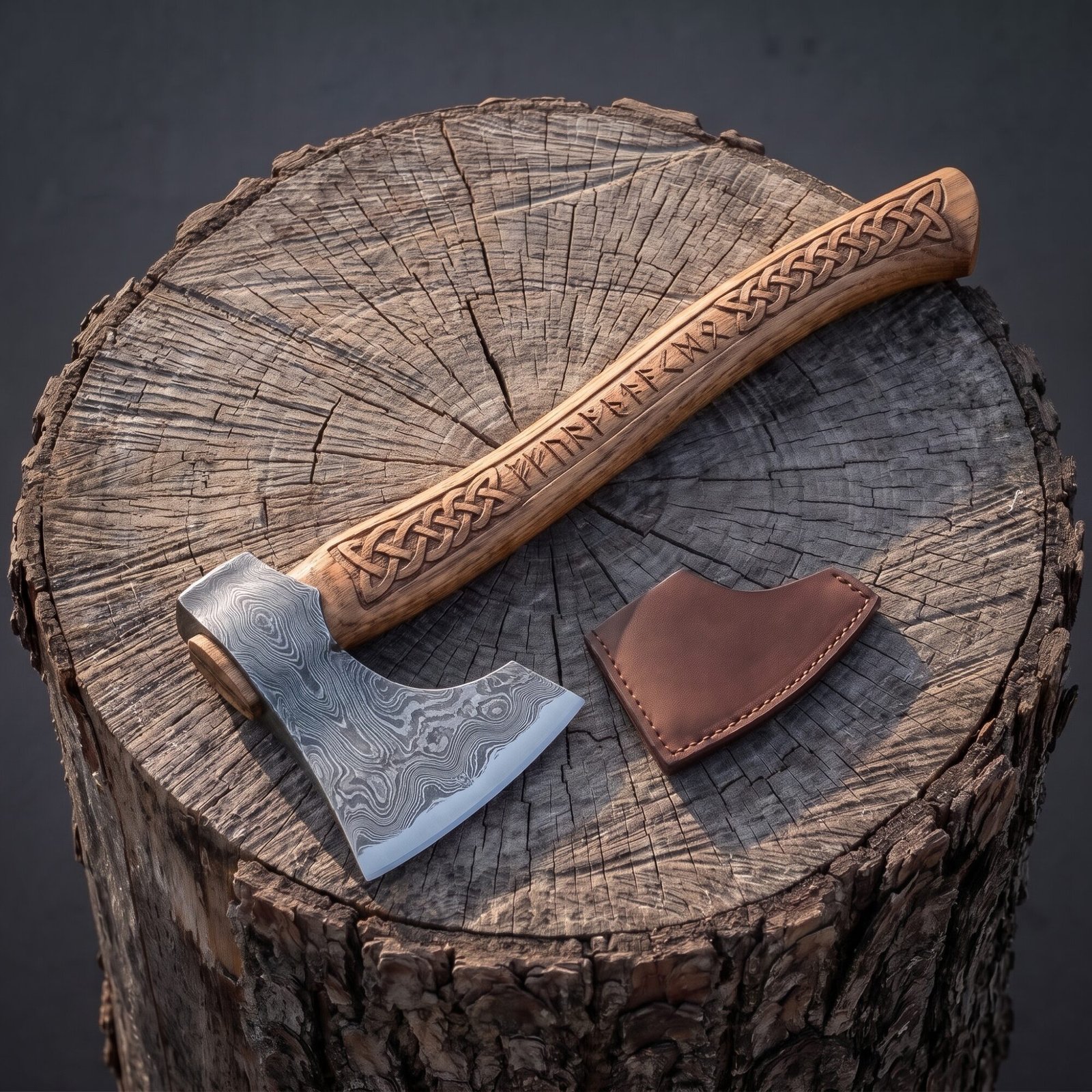
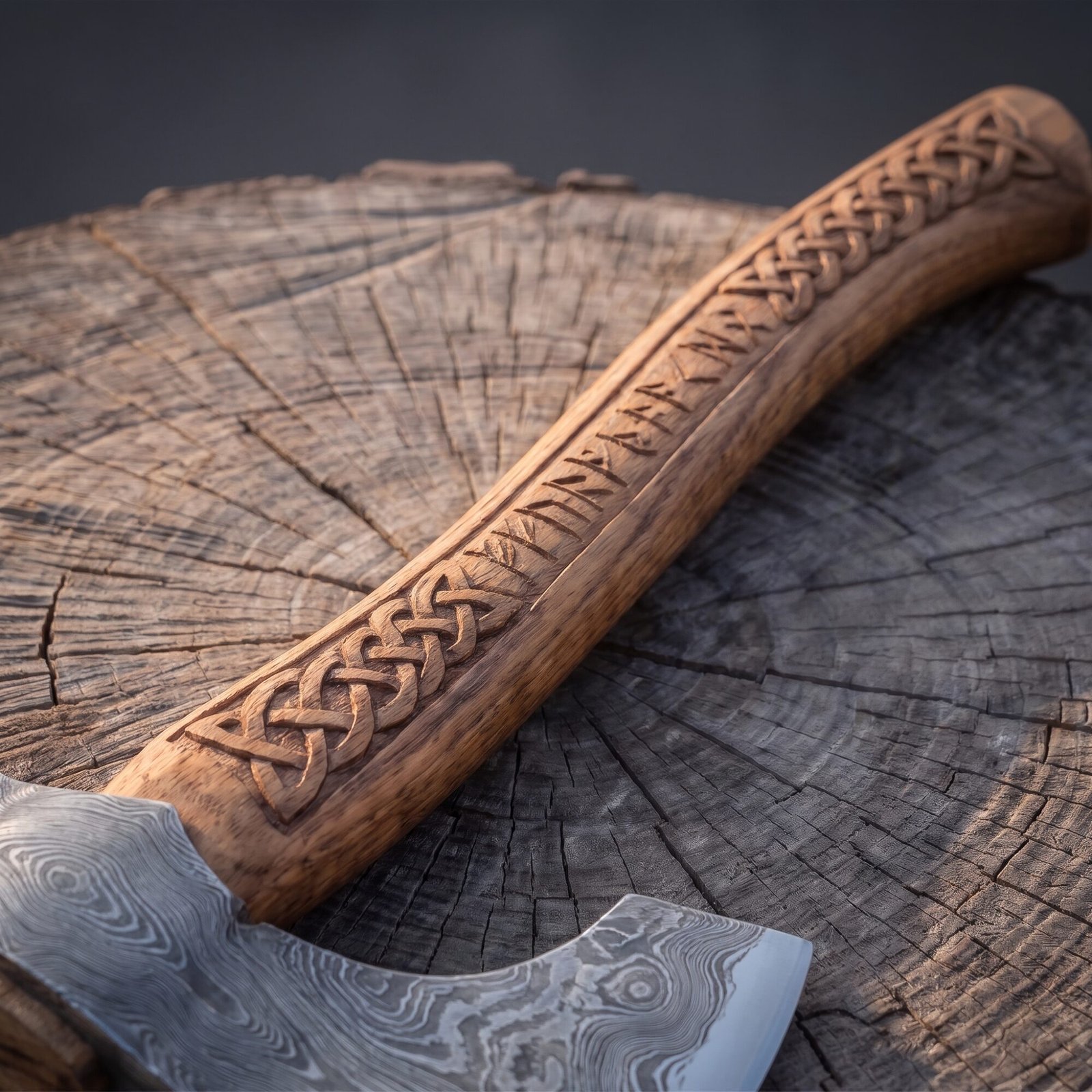
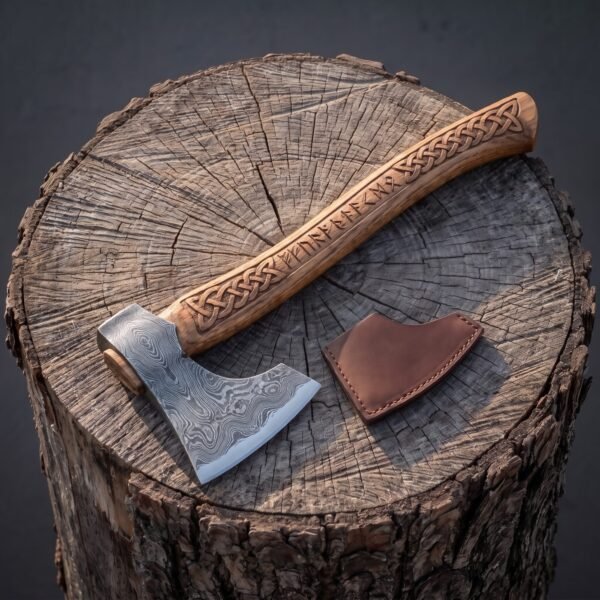
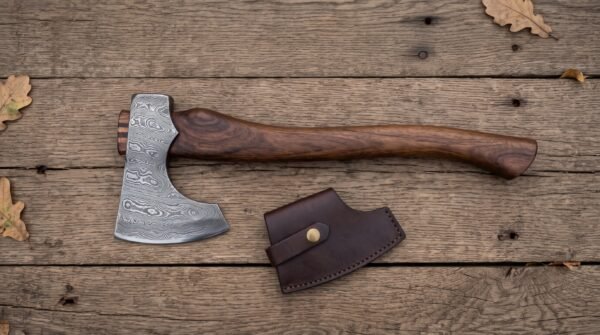
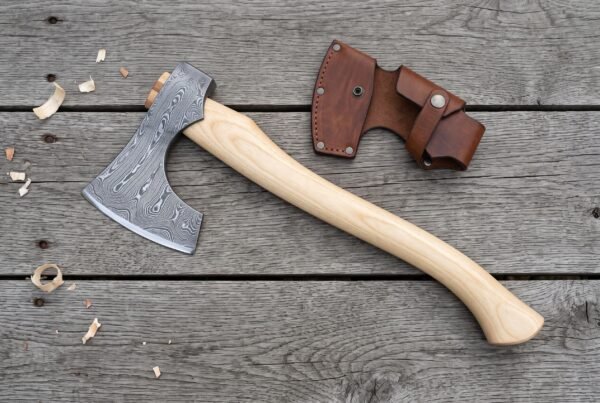
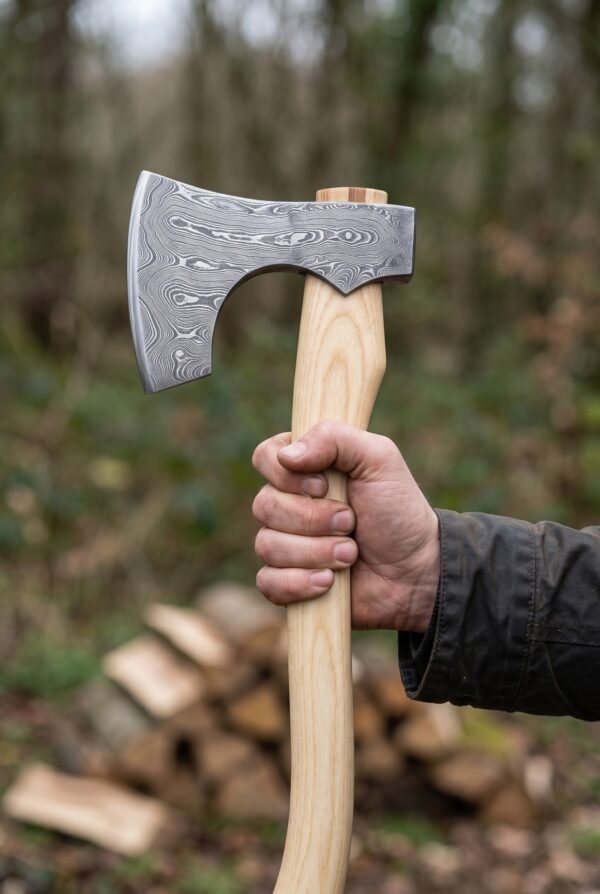
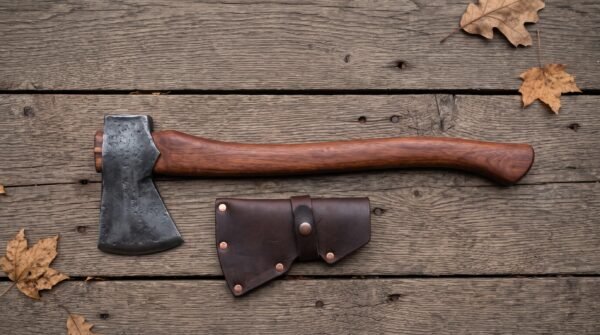
Knotstave is the one in this run without a face, a beast or a bird. Its oak handle is carved along nearly its whole length with interlaced Norse knotwork, two long bands of it, and between them a single line of Elder Futhark runes runs down the handle like writing on a runestone. The head is hand forged Damascus, 1095 and 15N20 pattern welded steel, with a wavy grain and a bright edge, on a 20 inch axe. A brown leather cover comes with it.
Pattern on the steel and pattern on the wood is a lot of pattern, and we were nervous about it, but the two work because they are different kinds. The Damascus is loose and fluid; the knotwork is tight and geometric. If you want to know what you are looking at, the Elder Futhark chart will let you read what the runes are, and runestones explained covers where the layout comes from.
More rune pieces sit in engraved and personalised pieces and the full range is in Viking axes.
Specifications
| Head | Hand forged Damascus, 1095 and 15N20 pattern welded, 54 to 58 HRC |
|---|
| Head profile | Bearded Norse pattern, etched Damascus finish, bright ground edge |
|---|
| Overall length | Approximately 20 inches |
|---|
| Cutting edge | Approximately 5 inches |
|---|
| Handle | Oak, oiled |
|---|
| Carving | Two interlaced knotwork bands with an Elder Futhark rune band between them, running the length of the handle |
|---|
| Included | Brown leather edge cover |
|---|
| SKU | RK-2366 |
|---|
The carving: knotwork and a rune band
Knotwork looks like one continuous strand going over and under itself, and that is exactly how it is carved. The carver lays out the grid in pencil, cuts the outline of the strand with a knife, then sets down every under crossing a little lower than the over crossing so the strand appears to weave. On a handle that is a long, slow job, and one slip leaves a strand that goes under twice, which anyone who has studied knotwork will spot immediately. Oak helps here, because it holds a crisp wall on each side of a strand where a softer wood would crush, and the open pores take the oil and darken in the cuts so the pattern reads without any stain.
The rune band runs down the middle between the two knotwork bands. The runes are cut as straight strokes, which is how runes were designed in the first place. They were made for cutting into wood, which is why the Futhark has almost no curves and hardly any horizontal lines that would run along the grain and split out. The band is decorative rather than a sentence we translate, but you can read the letters with the chart.
Runes and knotwork in the Viking Age
Two honest notes, because people ask. First, the Elder Futhark of 24 runes was the older alphabet. By the Viking Age, most Scandinavians were writing in the Younger Futhark of 16 runes, which is what you see on most Viking runestones. We carve Elder Futhark because it is the row people recognise and the one most customers ask for. Second, the interlaced knotwork most people call Celtic was shared across the North Sea world, and Norse carvers had their own styles of it, from the ribbon animals of the Borre style to the looping Urnes beasts of the eleventh century.
Runestones often frame their writing in a band that curls around the stone, sometimes as the body of a serpent. A rune line running between knotwork bands down a handle is the same idea turned on its side. The carving is decorative, but the layout is old.
The Damascus head
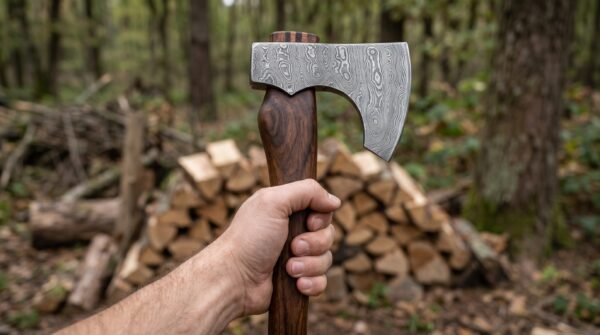
The head is pattern welded Damascus, forge welded from 1095 and 15N20 steels, folded and drawn out under the hammer, then hardened and tempered to 54 to 58 HRC. The two steels react to an acid etch differently, and that is where the wavy light and dark pattern comes from. It runs through the head rather than sitting on the surface, so when you sharpen the edge the same pattern shows in the new bevel. The pattern is etched before final polishing, so it shows as soft light and dark waves across both cheeks.
Both steels are high carbon and neither is stainless, so treat it like any carbon steel axe: dry it, oil it and do not leave it in a damp cover. If the contrast fades after years of handling, a smith can give it a fresh etch and bring it back.
Why oak
Oak is harder and heavier than ash, with a strong straight grain, and it holds a crisp edge on a carved line. That matters on this handle, where the detail is a long run of narrow cuts rather than one sculpted shape. Oak is a little less springy than ash, so the handle is kept full in section with no thin waist. It is oiled, not varnished, and it will darken slowly toward a warm brown as it ages.
Using it, and where the carving sits
The carving runs nearly the full length, so wherever you hold Knotstave you are holding knotwork. The cuts are shallow and rounded over, and in the hand they feel like a textured grip rather than a pattern, which is fine for a light swing and for choking up. They do collect dirt in the woods, which is one reason most owners keep this one indoors.
Damascus is a good working steel and the head will cut wood properly. Treat it as a gift and display axe that can do light camp work, and save the heavy splitting for a plain axe.
Who it suits
Knotstave suits someone who wants the look of a carved Norse handle without a face or a beast on it, or who is buying for a person who studies runes and would spot a wrong one at twenty paces. The Damascus head makes it the obvious choice if pattern welded steel matters to you as much as the carving.
Engraving, runes and your own design
Use the rune converter on this page to turn a name, a date or a short phrase into Elder Futhark and we will cut it into the steel, the leather or the wood. If you would rather have a Viking pattern than a rune line, choose your own design in the engraving option above the add to cart button and tell us where it goes. Where a piece already carries an engraved design, your chosen engraving replaces it rather than sitting alongside it. The carved handle is never altered. On Knotstave the oak is already carved, so a name or a rune line goes on the cheek of the Damascus head, where it sits well against the pattern, or on the leather cover. Details are on the engraving page, and for a piece built from scratch there is the custom Viking axe page.
Care
Wipe the head dry after use and give it a thin coat of mineral oil, camellia oil or paste wax. If a spot of red rust appears, lift it with fine steel wool and oil the area. Touch up the edge with a file and a fine stone rather than a bench grinder, which can heat a thin edge enough to spoil the temper before you notice.
A carved handle needs one extra habit. Dust settles in the cuts, so now and then brush the carving out with a soft dry brush, then work a little boiled linseed oil or furniture wax into it with the same brush and wipe off whatever sits on the surface. Once or twice a year is enough to keep the wood rich in colour and stop it drying and checking. Keep the axe away from radiators and fireplaces, and never store it in the leather cover when either is damp. Our axe care guide covers sharpening and storage in more detail, and hanging swords and axes on a wall covers putting it up safely.
Made in the Czech Republic
Knotstave is made by hand in a Czech Republic workshop that forges, grinds and hangs its axes at the bench and carves its handles in the same building. The head is forged and hardened, the handle is shaped and carved, and the two are fitted to each other one axe at a time. Ransack Viking is a United States company. We check every axe for the hang, the wedge, the edge and the carving when it reaches us, and ship it from our Chicago, Illinois warehouse. Processing runs one to two weeks, at the longer end if you order engraving. Shipping inside the United States is free, returns run seven days, and the lifetime warranty covers defects in forging, grind, heat treat and fittings.
A note on handmade variation
Every handle is carved by hand, so every crossing of the knotwork and every rune on yours will not match the photographs cut for cut. The oak will have its own grain and colour, and the hammer marks on the head will fall in different places. The size, the steel, the layout of the carving and the build are the same on every axe. The small differences are what you are paying a carver for.
Frequently asked questions
Is it sharp when it arrives
Yes. It ships with a working axe edge that will cut wood out of the box. Keep the leather cover on it in transit and storage.
How soon will it ship
Processing takes one to two weeks while the axe is finished and checked, then it ships free inside the United States from Chicago, Illinois.
What do the runes say
The rune band is decorative Elder Futhark rather than a phrase we translate. If you want a word or a name in runes, order the engraving option and we will cut yours on the head or the cover.
Why Elder Futhark and not Younger Futhark
Elder Futhark is the row most people know and ask for. Viking Age runestones mostly use the Younger Futhark, and we say so plainly.
Are there any animals or faces in the carving
No. Knotstave is knotwork and runes only, for anyone who wants a carved handle without a figure.
What is in the box
- One Knotstave bearded axe with a hand forged Damascus head
- Oak handle carved with knotwork bands and a rune band
- Brown leather edge cover
- Your rune line or chosen Viking design, if ordered
- Lifetime warranty against defects in forging, grind, heat treat and fittings
Explore the range
Close to this one in the carved handle run are the Huginmark raven axe and the Bjornhewn bear axe. See everything in Viking axes, bearded axes, engraved and personalised pieces, or read the guides.

Reviews
There are no reviews yet