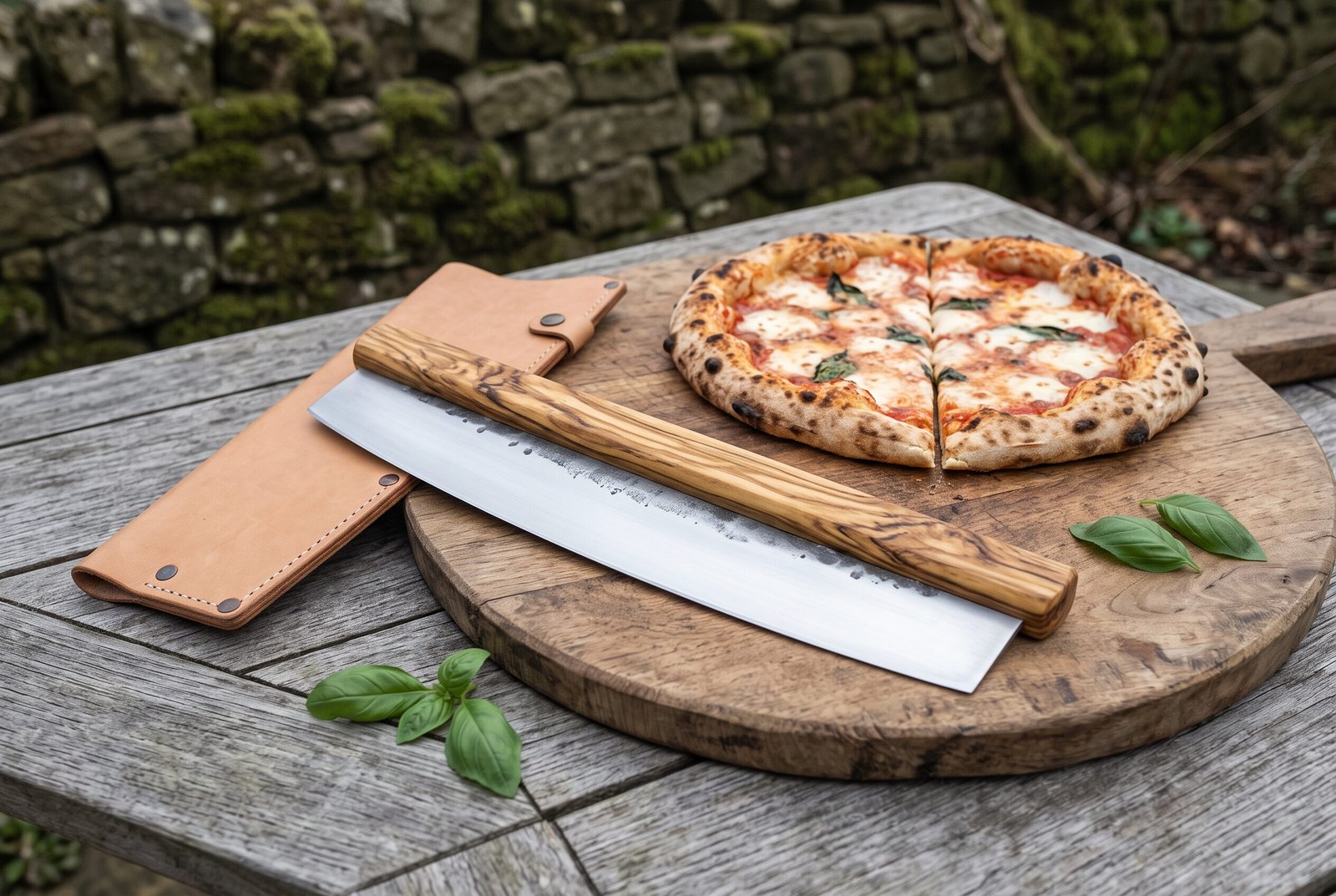
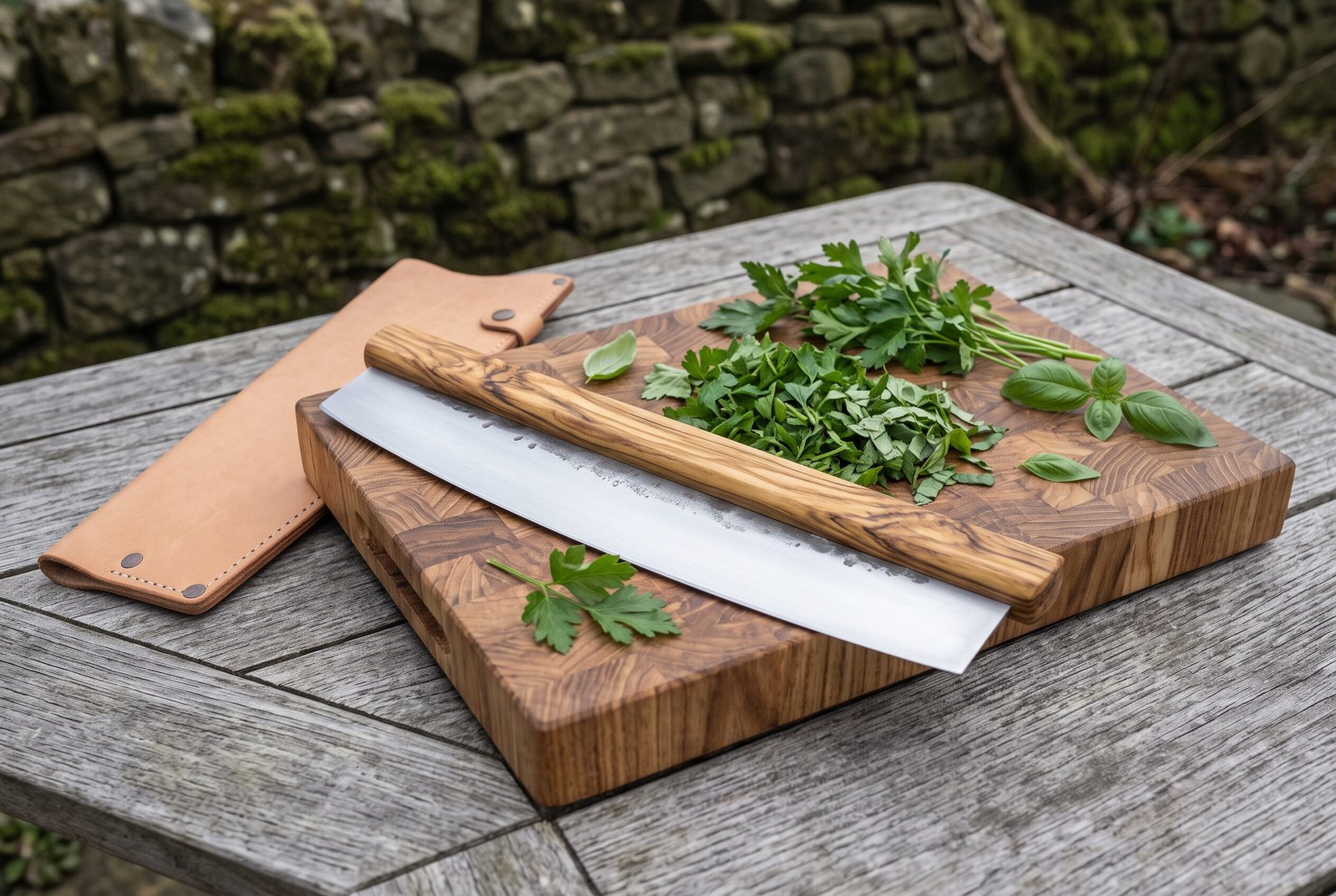
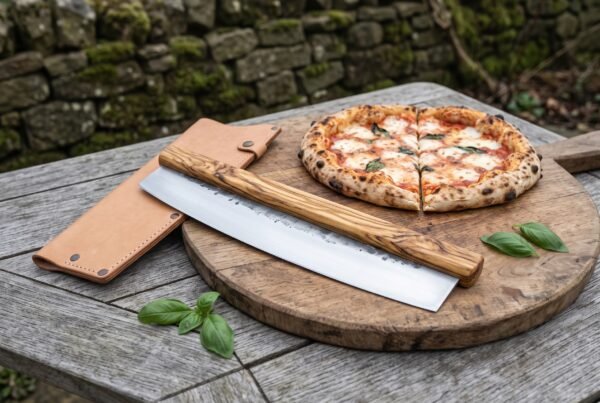
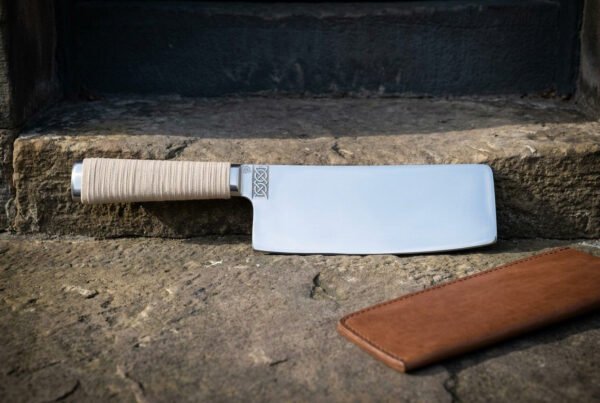
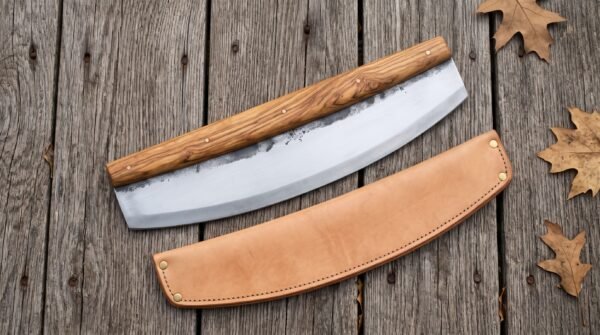
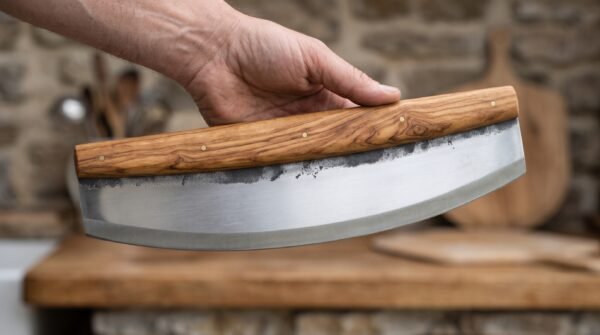
Ravenfeast is a hand forged stainless steel rocking pizza cutter with a 12 inch blade on a 12 inch olive wood handle. The blade is drawn out and shaped under the hammer, the edge is set by hand, and the blade is left clear so it can be personalised before it ships. It comes with a veg tanned leather blade cover. The raven in the name is not random, and Huginn and Muninn explains where the birds come from.
The raven is the right bird for a Norse kitchen piece and it carried real weight in the period. Odin kept two, Huginn and Muninn, thought and memory, which flew out over the world each day and returned to tell him what they had seen. Norse armies also fought under a raven banner. The Anglo Saxon Chronicle records a raven standard being captured from a Viking force in Devon in 878, and later Icelandic sources describe such banners as omens that could be read before a battle. A bird associated with knowledge, with feasting and with the aftermath of a fight is a more fitting mascot for a table than most people realise.
This piece is forged, ground, handled and covered in the Czech Republic. It ships free within the United States, sharp and ready to use.
Specifications
| Steel | Hand forged stainless steel |
|---|
| Blade length | 12 inches |
|---|
| Handle length | 12 inches |
|---|
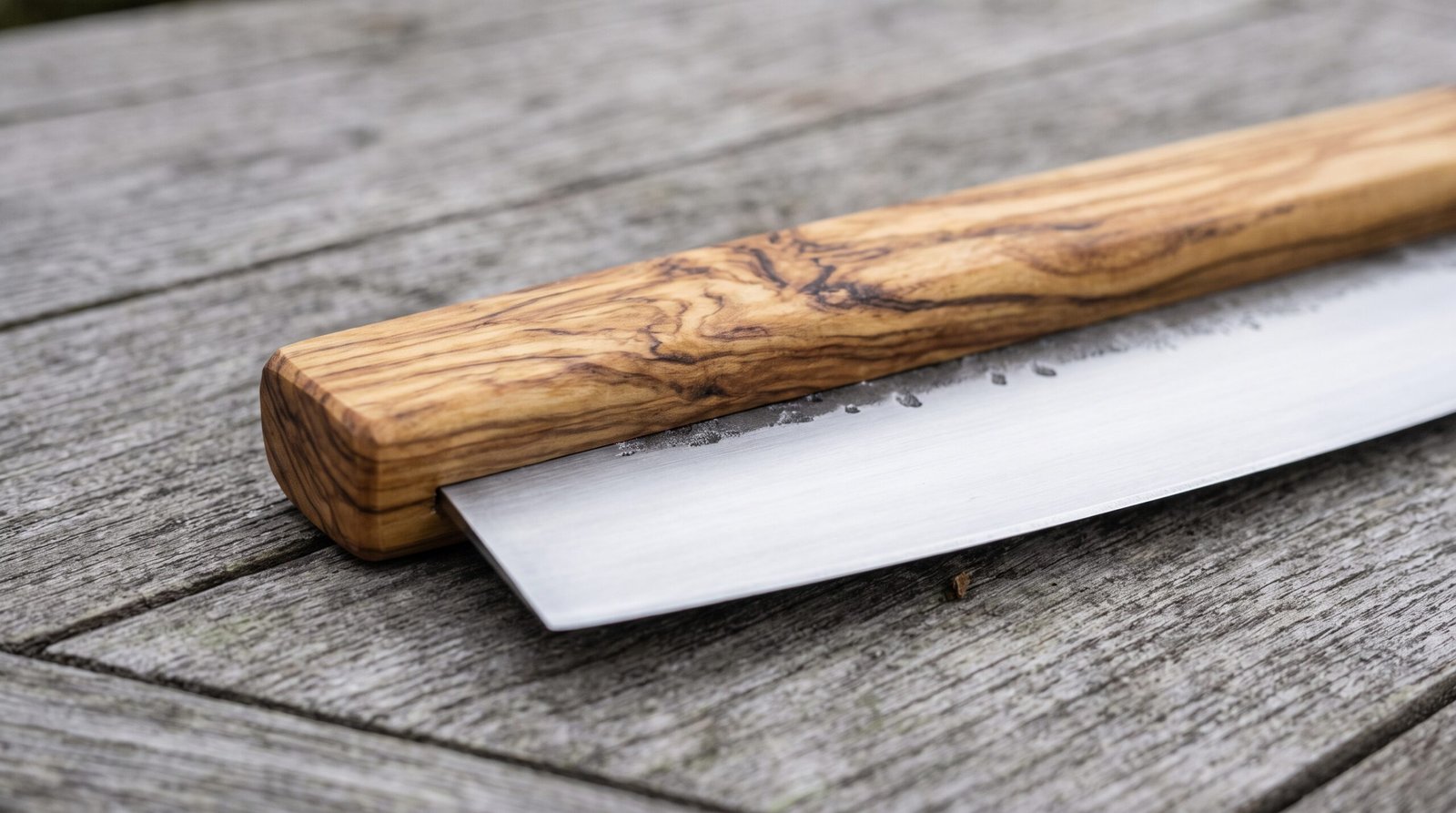
| Blade | Rocking edge with a polished face and a hammered forge finish band left along the spine |
|---|
| Handle | Olive wood, running the full length of the spine |
|---|
| Bolsters and guard | None, the handle is fitted straight onto the spine |
|---|
| Sheath | Veg tanned leather blade cover with stitched and riveted edges and a snap strap |
|---|
| Finish | Blade left clear and ready for personal engraving |
|---|
| SKU | RK-315 |
|---|
How to use it, and the two mistakes that dull it
A rocking pizza cutter is used differently from any other blade in a kitchen, and getting the motion right is most of the difference between a tool people love and one that goes in a drawer.
The motion is place and press, not draw and slice. Set the blade across the pizza so the whole edge is in contact, take the handle in one hand and put the heel of your other hand on the top of the blade near the far end, and press straight down. Every part of the cut happens at once. Nothing is pushed along the pie, so the toppings stay where they were put, and the cheese is severed rather than dragged into strings the way a rolling wheel drags it. On a thick or heavily loaded base, rock the edge slightly from one end to the other to start the cut and then bear down.
The first mistake is cutting in the pan. A steel pizza pan, a cast iron skillet or a pizza stone will take the edge off any blade in about three cuts, because you are driving hardened steel into something as hard or harder. Slide the pizza onto a wooden board or a large plastic board first. On a 12 inch blade you want a board wider than the pizza, which is a good reason to keep a big one.
The second is using it as a chopper on hard things. This is a food blade with a food edge on it, ground thin so it parts crust cleanly, and putting it into wood, bone or frozen food will chip or roll it. Keep it for pizza, herbs, vegetables, dough and pastry, and it will stay sharp for years.
Used correctly the same edge does everything a mezzaluna does for chopping herbs in quantity, and the flat of the blade lifts and moves what you have cut in the way a bench scraper does.
Why stainless rather than carbon or Damascus
We mostly carry 1095 and pattern welded Damascus, and both hold a harder edge than stainless. This piece is stainless on purpose, and the reasoning is worth stating plainly rather than dressed up.
A kitchen is a corrosive place for steel. Tomato, lemon, vinegar, brine and salt are all either acidic or aggressive, and a blade that sits out on a wall or on a rack is exposed to steam and humidity all day. High carbon steel meeting that will grey over within days and will pit if it goes away damp even once. On a hunting knife that patina is protective and welcome. On a food blade that people want to look bright and hand over as a wedding gift it is not.
Stainless carries enough chromium to hold a passive oxide film that resists all of the above with no attention at all. What it costs you is some edge retention and slower sharpening, because chromium rich steel is harder to abrade back on a stone. Given that cutting pizza and herbs puts almost no load on an edge, that is a very cheap price. The same decision on a field blade would go the other way, and the reasoning for that is in Damascus versus stainless.
The olive wood handle
Olive grows slowly and the timber shows it: tight interlocked grain, heavy figure, warm yellows and browns crossed with dark veining, and no two handles alike. It is dense and naturally oily, which is why olive boards, spoons and bowls have been standard around the Mediterranean for centuries and why it tolerates kitchen use better than most decorative timbers.
The 12 inch length is doing a job as well as looking right. It puts your hand well back from the blade and gives leverage for the downward press, and it makes the tool comfortable to use over a hot pizza straight out of the oven. Keep it out of the dishwasher, because heat and long soaking will dry olive wood and open fine checks. Wash the blade, wipe the handle, and two or three times a year rub in food safe mineral oil and buff it back. Routine in wooden handle care.
Engraving, runes and your own design
The blade on this piece is left clear so it can be personalised, and it is one of the most engraved things we make. Use the rune converter on this page to turn a name, a date or a short phrase into Elder Futhark and we will cut it into the steel or the handle. If you would rather have a Viking pattern than a rune line, choose your own design in the engraving option above the add to cart button and tell us whether it goes on the blade or the handle. Where a piece already carries an engraved design, your chosen engraving replaces it rather than sitting alongside it. Because it is bought so often as a wedding gift, two names and a date across the flat is the most common request on this model, and a raven or a knotwork panel is the most common design. Sizes and placement are on the engraving page.
Care and sharpening
Wash by hand in warm water and dry it, blade and handle both. Stainless will forgive being left wet for a while, olive wood and veg tanned leather will not. Store it with the cover on if it lives in a drawer, or hang it by the handle where the edge cannot meet anything hard.
Sharpening is occasional and light, because the cutting loads are low. Work a medium whetstone along the edge in overlapping sections at a consistent angle, then refine on a fine stone. A long straight edge is one of the few places where a pull through gadget does real harm, because it grinds unevenly across the length. Method in sharpening with a whetstone, and general blade upkeep in steel care.
Made in the Czech Republic
Every piece we sell is made by hand in the Czech Republic. The smiths there work the way the trade has been worked for a long time, heating and hammering the steel, taking the bevels down by eye, and fitting the handle and the leather one at a time. There is no automated line anywhere in it, so small differences from one piece to the next are normal and expected.
Ransack Viking is a United States company based in Chicago, Illinois. We bring the pieces in ourselves, inspect them on arrival and ship them from our own warehouse. If you add engraving, that is carried out here in the United States before your order goes out.
A note on handmade variation
This piece is hand forged rather than machine made or bulk produced, so the one that arrives will not be a pixel for pixel copy of the photograph on this page. The forge finish across the blade varies in tone with how the scale released, and hammer marks land where the smith put them. Olive wood is about as variable as timber gets, so the depth of the colour, the figure and the run of the dark veining are particular to your handle. The veg tanned cover is cut from a natural hide and each one takes its dye differently. The exact curve of the edge shifts by a hair, because it is ground by eye rather than to a machine stop.
The dimensions are the same every time, the steel is the same every time and the build is the same every time. Only the character changes, which on a piece that sits out in a kitchen is usually the point of buying it.
Frequently asked questions
Does the blade come with a raven or other design on it?
No. The blade is a plain straight edge with an olive wood handle along the spine, and the surface is left clear so your own engraving has room, and if a piece already carries an engraved design your chosen engraving replaces it rather than sitting next to it.
Will it cut a deep dish pizza?
Yes, and this is where it beats a wheel most clearly. Rock the edge slightly to start the cut through the rim, then press straight down and the whole thing severs at once instead of the toppings being shoved along.
Can I cut on the pizza pan or the stone?
No. That is the fastest way to ruin any edge. Slide the pizza onto a wooden or plastic board first, and keep a board wider than 12 inches so the whole blade lands on it.
Is it sharp when it arrives?
Yes. It is sharpened before boxing and it is ready to use straight away.
Is it a good wedding gift, and how long should I allow?
It is one of our most requested wedding and housewarming pieces, mainly because there is room for two names and a date on the blade. Allow one to two weeks of processing, plus engraving time, plus transit.
How do I look after the leather cover?
Keep it dry, do not store a wet blade in it, and treat it with a leather conditioner once or twice a year. Veg tanned leather darkens with handling, which is normal.
What is in the box
- One Ravenfeast stainless steel rocking pizza cutter, 12 inch blade
- Veg tanned leather blade cover
- Gift packaging
- Forged and finished in the Czech Republic
Explore the range
Related pieces sit in Viking axes, chef knives, engraved and personalised pieces and Viking beer mugs. Steel, sharpening and handle care are covered in the guides.
Others in the same line
If this one is not quite right, there is the Dragon Viking axe, high carbon steel. Also in this group is the Oakwarden Viking axe, high carbon steel. Sitting beside it in the catalogue is the Ashgrim Viking axe, pattern welded Damascus.
From the same corner of the shop, there is the Odin Viking hammer. You can have this made your way instead on the custom Viking axe page.
Buying for groomsmen? This piece also comes as a matched set of 6, 15% less than buying six singly, and each one can carry its own engraved name.


Reviews
There are no reviews yet