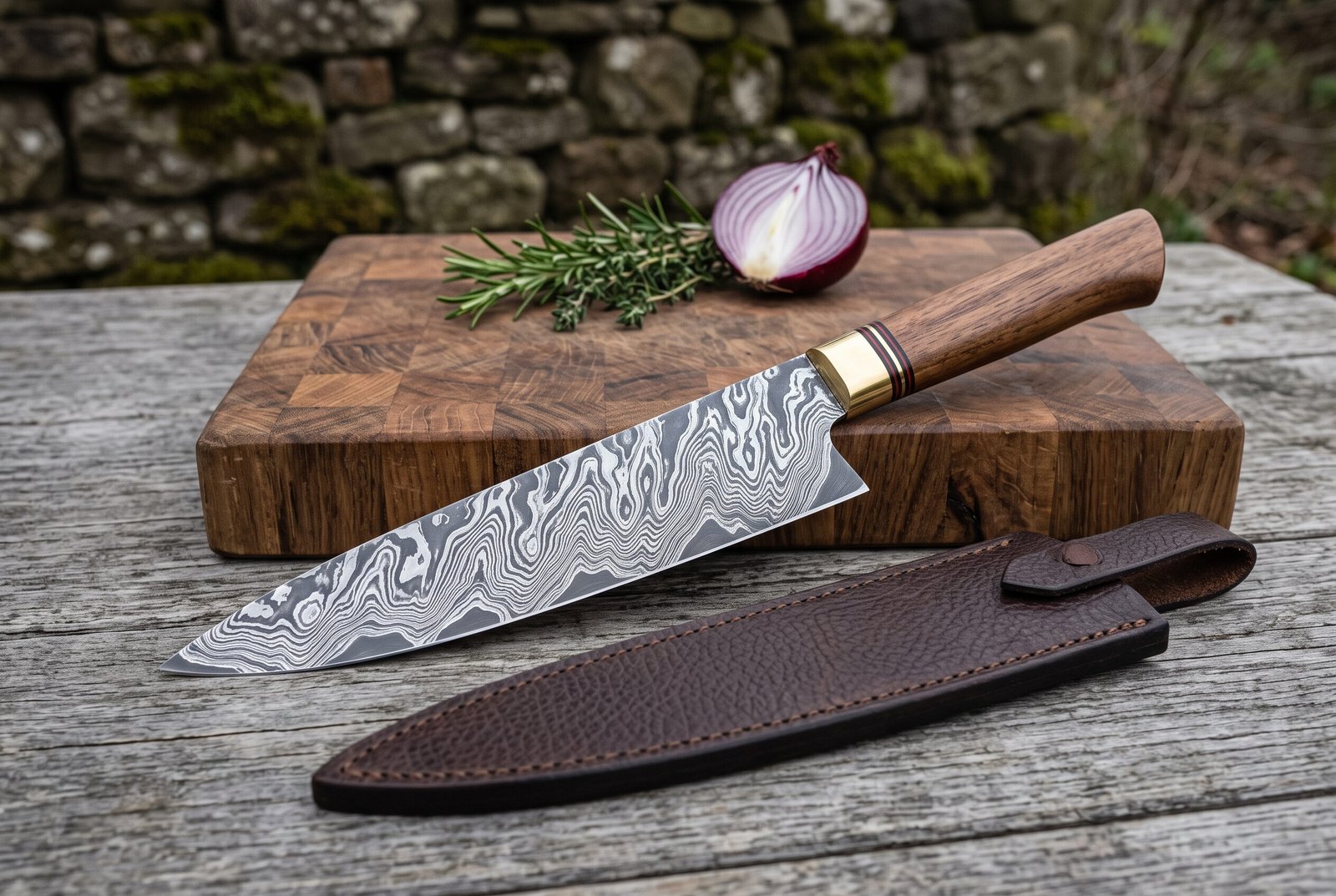
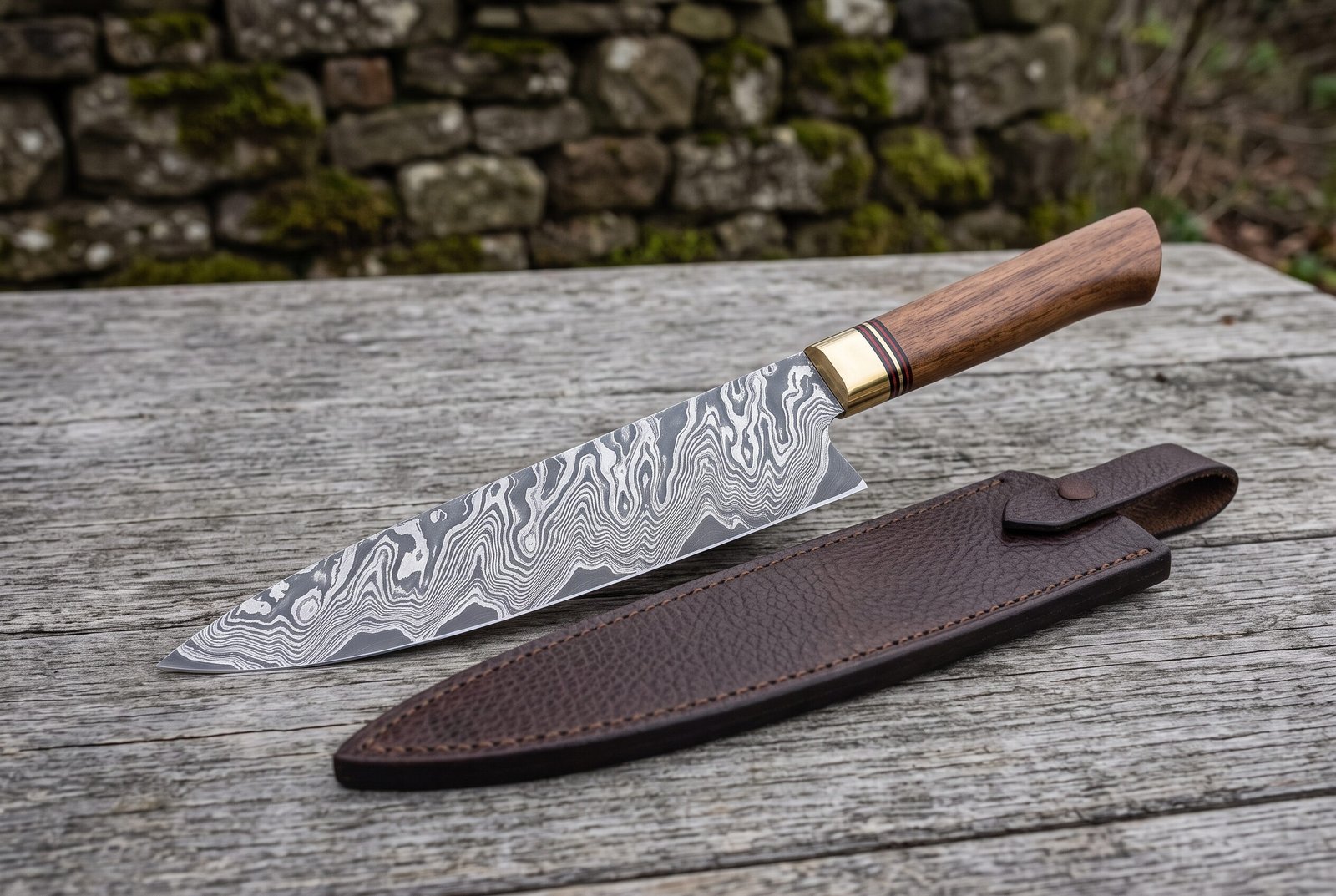
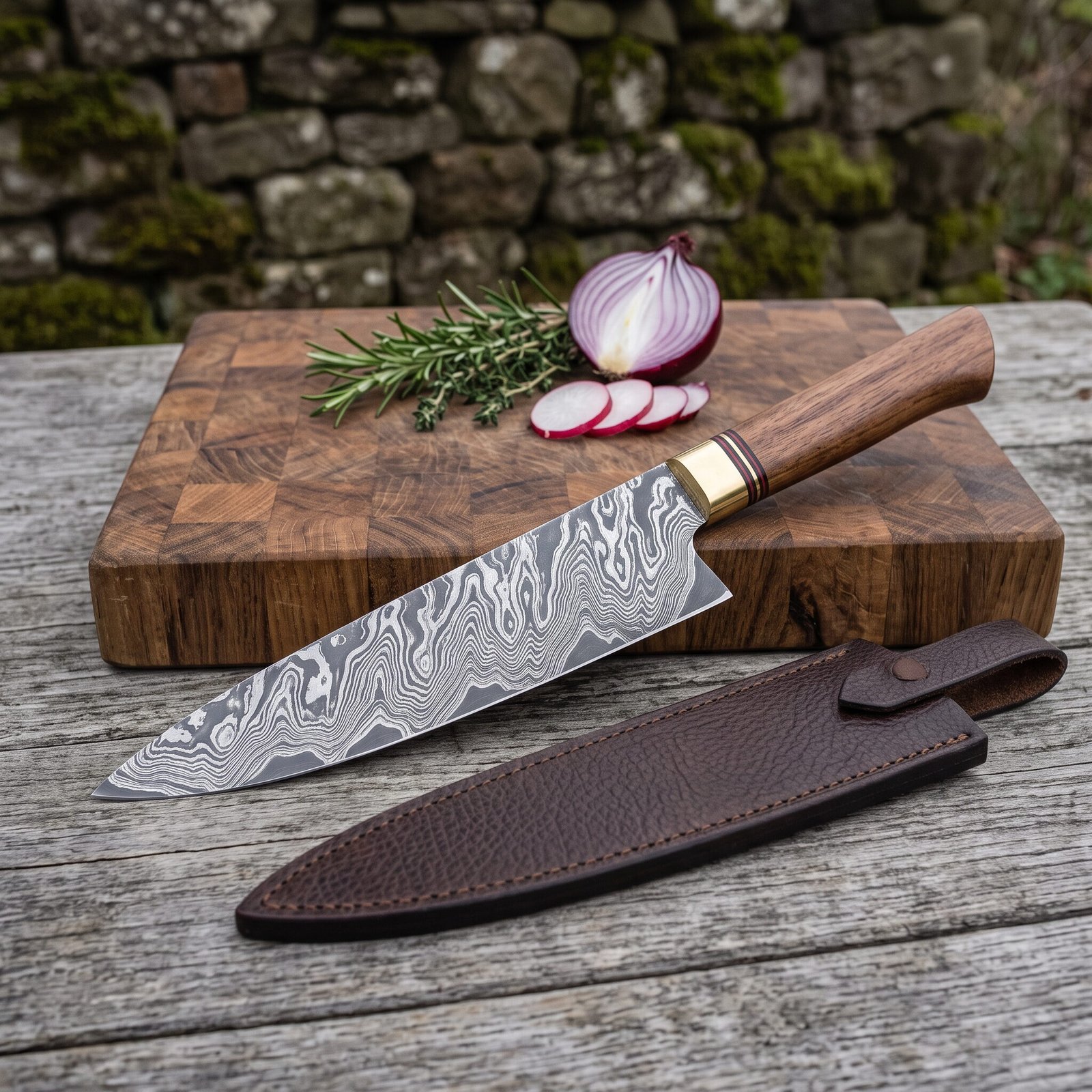
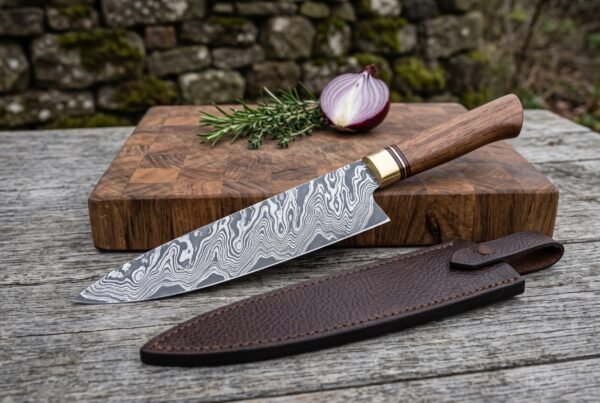
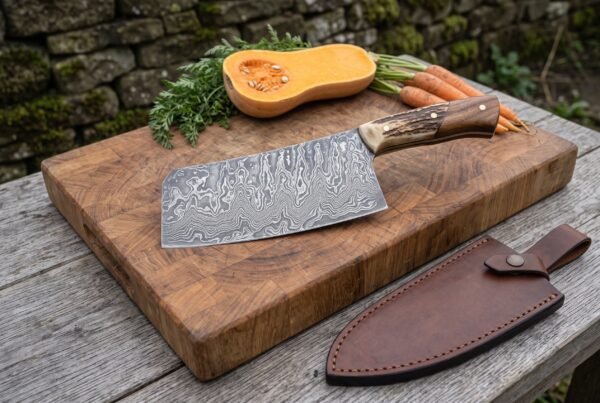
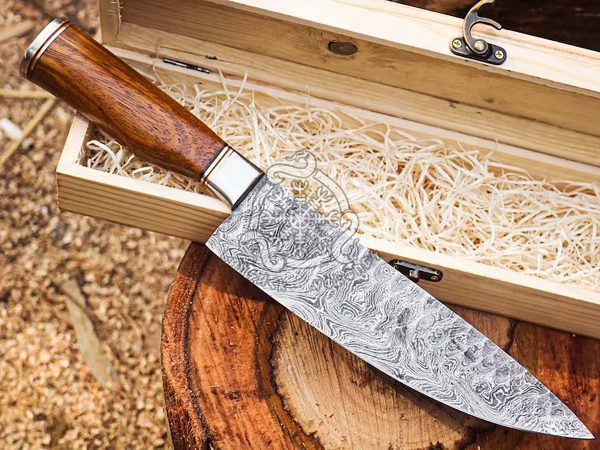
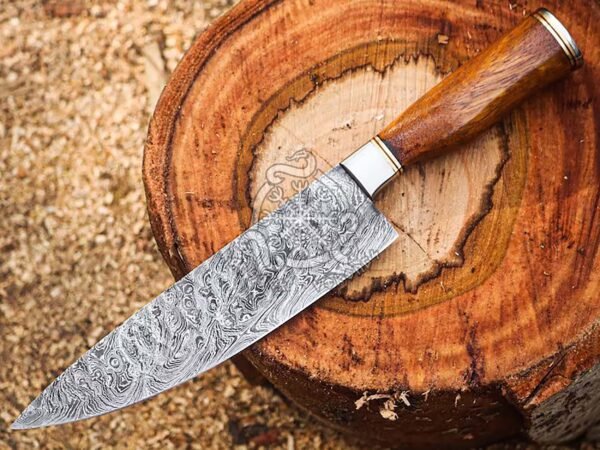
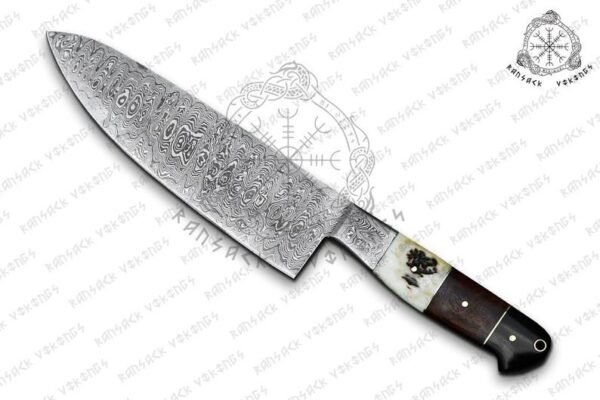
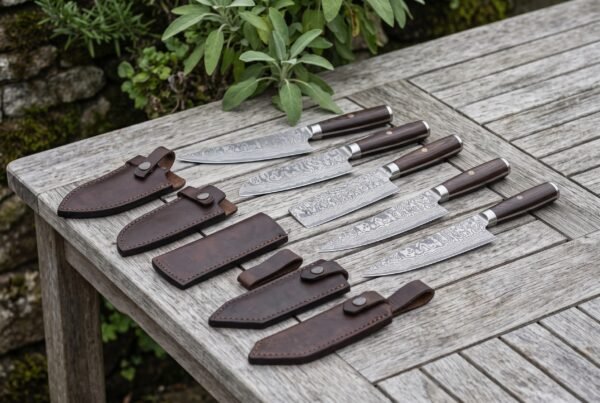
Take the Brasshearth out of the box and the weight tells you what it is. Thirteen ounces, thirteen inches overall, an 8 inch hand forged Damascus blade from a 352 layer billet, and a hardwood handle carrying a brass bolster and fibre spacers. It is a chef knife built to be used rather than admired, and it comes off the stones sharp. What to buy and what to skip in a kitchen set is set out in what to buy in a kitchen knife.
Professional kitchens ran on carbon steel for most of their history. Until stainless became widely available after the Second World War, essentially every knife in a European restaurant kitchen was plain carbon steel, and cooks were trained from their first week to wipe the blade as they worked. Those knives were not replaced because they cut badly; they were replaced because they stained on lemon and tomato and because hygiene regulation preferred a surface that did not discolour. Anyone who has used both knows what was traded away. A properly tempered carbon blade takes an apex that soft kitchen stainless cannot reach and holds it through far more work. The habit of wiping as you go is the entire price of admission.
Forged and finished in the Czech Republic. It ships with a leather sheath, protective packaging and a working edge.
Specifications
| Steel | Hand forged Damascus, 1095 and 15N20 |
|---|
| Hardness | 58 to 60 HRC |
|---|
| Damascus layers | 352 layers |
|---|
| Overall length | 13 inches |
|---|
| Blade length | 8 inches |
|---|
| Handle length | 5 inches |
|---|
| Weight | 13 oz |
|---|
| Handle | Hardwood with brass bolster and fibre spacers |
|---|
| Sheath | Leather sheath |
|---|
| SKU | RK-396 |
|---|
The French belly and the German belly
There are two schools of chef knife profile and they disagree about how a person should chop. Once you can see the difference you cannot unsee it.
The German pattern, associated with Solingen, has a deep continuous curve running from the heel all the way to the tip. There is no flat section. That profile is built for rock chopping: you keep the tip on the board, drop the heel, and rock the knife through a pile of herbs or garlic. It is fast, it is forgiving, and it wants a curved board contact at all times.
The French pattern, associated with Thiers and Sabatier, keeps the rear half of the edge much flatter and puts the curve into the last third. That profile is built for push cutting: the whole flat lands on the board at once so nothing is left uncut, and the blade advances forward through the food rather than rolling over it. It is more precise and it demands better knife handling.
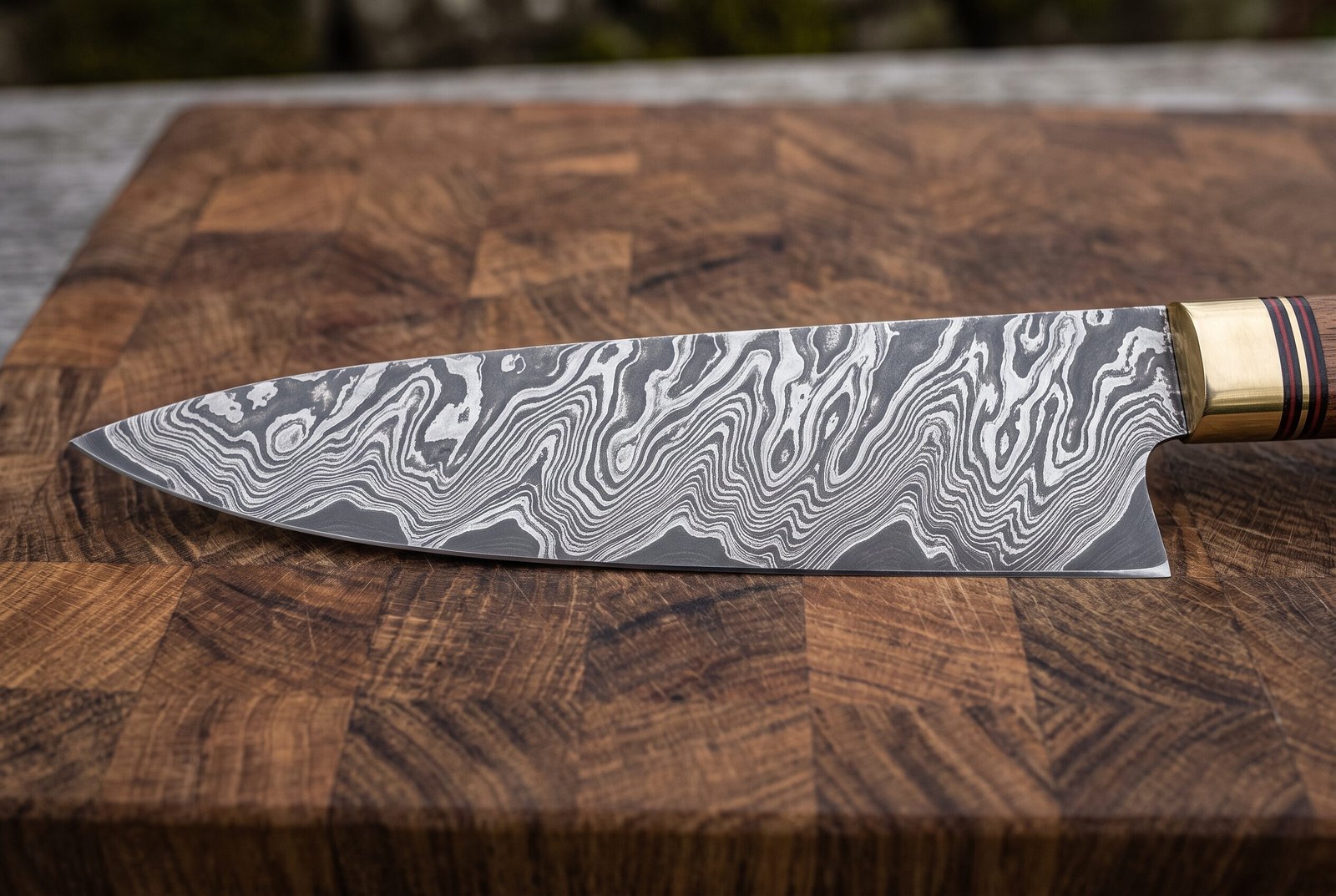
This blade sits between the two, with a usable flat towards the heel and a genuine curve through the front, which is where most modern chef knives have landed because most cooks use both motions in the same hour. The other measurement that matters is height at the heel, because that is what keeps your knuckles off the board. Anything much under an inch and a half and you will scrape a fingertip within a week.
Why Damascus and not stainless
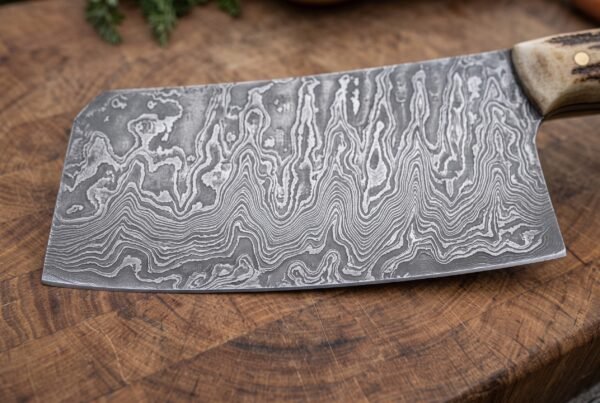
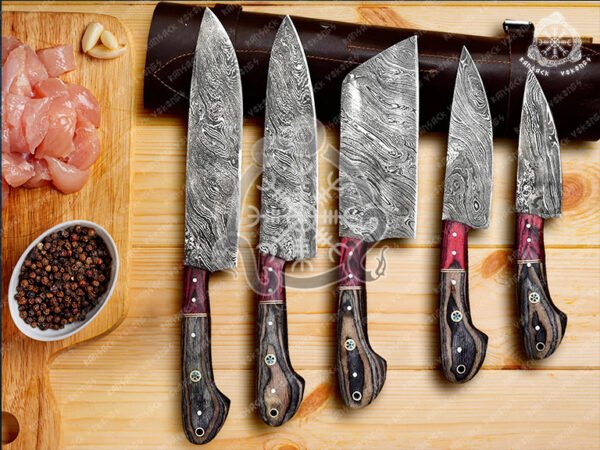
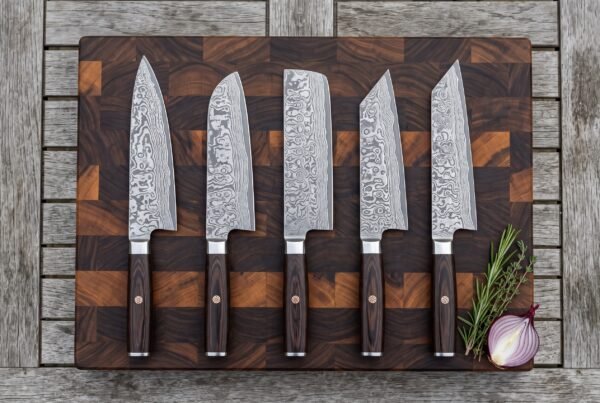
The blade is built from alternating 1095 and 15N20 layers, forge welded into one bar and drawn out to 352 layers before the shape is ever cut from it. Because the layers run through the steel, grinding reveals the pattern rather than removing it, and no amount of sharpening will wear it away. At 58 to 60 HRC the edge is genuinely harder than what comes on a supermarket kitchen knife.
In a kitchen the trade off is at its most visible, because kitchens are wet and full of acid. Carbon steel will grey where it meets tomato, lemon or onion, and that film is patina, which is a stable oxide layer and is protective. Actual rust needs standing water, which means leaving the knife wet in a sink or in a dishwasher. Neither should happen. Stainless forgives all of that and gives you a duller edge in return. The comparison is laid out in Damascus versus stainless.
The hardwood handle and the brass bolster
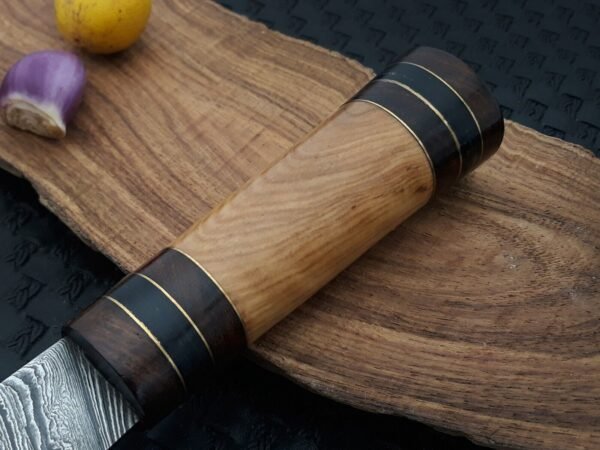
Hardwood gives this piece its balance. It is dense enough to counter eight inches of blade, light enough not to fight you through a long prep session, and it takes an oil finish that ages rather than flaking. Because it is timber, every handle carries different grain and colour, and the way the figure runs across a scale is decided by where in the board it was cut.
The brass bolster is doing more than dividing the handle from the blade. It puts mass immediately behind your pinch grip, which shifts the balance point back towards your fingers and makes the knife feel lighter in use than its thirteen ounces suggest. It also gives the front of the handle a hard, protective cap where a wooden scale would eventually bruise. The fibre spacers on either side of it are compressible layers that take up the small dimensional movement between wood and metal as the kitchen heats up and cools down, so the stack stays tight instead of opening a hairline gap.
Care is minimal. Keep the handle out of standing water, never leave the knife in a sink, and give the wood a light coat of mineral oil once or twice a year. The method is in wooden handle care.
Engraving, runes and your own design
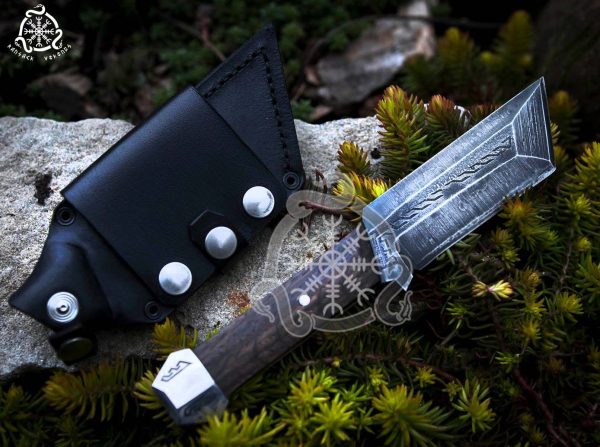
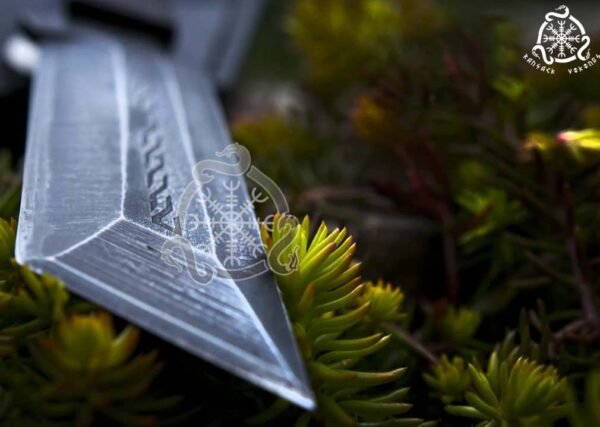
Use the rune converter on this page to turn a name, a date or a short phrase into Elder Futhark and we will cut it into the steel or the handle. If you would rather have a Viking pattern than a rune line, choose your own design in the engraving option above the add to cart button and tell us whether it goes on the blade or the handle. Where a piece already carries an engraved design, your chosen engraving replaces it rather than sitting alongside it. On a chef knife the wide flat above the bevel is the natural place for lettering, and it sits well clear of the edge and of anything that touches food. See the engraving page.
Care and sharpening
Hand wash in warm water with a little mild soap and dry it straight away, including the seam between the bolster and the wood. Keep it out of the dishwasher entirely, since the heat and detergent will dry the handle and pit the steel. Before it goes into a drawer or a block for any length of time, put a thin film of mineral or camellia oil on the blade.
Use a wood or composite board rather than glass, stone or steel, and keep the knife off bone and frozen food. Sharpening is ordinary stone work: 1000 grit to raise a burr, 3000 to refine, then a strop or a few light passes on a smooth steel to realign the edge between sharpenings. Keep the angle that is already on the blade rather than reprofiling it. Both jobs are covered in steel care and sharpening with a whetstone.
Made in the Czech Republic
This piece is made by hand in the Czech Republic, in a workshop that still works the old way. The steel is forged, ground, heat treated and finished by smiths who learned the trade from the people before them, and the wood, horn and leather are cut and fitted by hand rather than pressed out on a line. That is also why no two pieces come out exactly the same.
Ransack Viking is a United States company. We import these pieces ourselves, check every one when it lands and ship from our warehouse in Chicago, Illinois. Engraving is done here in the United States after the piece arrives, so your runes or your own design go on before it leaves for you.
A note on handmade variation
The Brasshearth is hand forged, not machine made and not bulk produced, so what arrives will not be a pixel for pixel copy of the photograph on this page. Timber is the most variable material in the build: two scales cut from the same board can differ noticeably in tone, and no two knives get the same grain running across the handle. The Damascus pattern falls out of the billet differently every time and the brass takes its own polish.
The dimensions, the steel, the hardness and the build are the same from one knife to the next. The character is not, because each one is worked by hand from natural materials.
Frequently asked questions
Is 8 inches the right size for a home kitchen
For most people, yes. Eight inches is long enough to slice through a cabbage or a roast in one pass and short enough to control on a domestic board. If your board is small, a 7 inch blade is easier to live with.
Can I use it on bone or frozen food
No. A thin, hard edge is what makes this knife cut well and it is the same thing that makes it chip on bone or ice. Use a cleaver or a heavy butchery knife for that work.
Why has my blade turned grey
That is patina forming on carbon steel where it has met acid. It is stable, protective and normal on a working carbon blade. It can be lifted with a fine abrasive and oil if you dislike the look.
How often will it need sharpening
With a home cooking load and a wooden board, most owners go a few months between real sharpenings, with a strop or a smooth steel used weekly to keep the edge straight in between.
What is the difference between this and the buffalo horn chef knife
Same blade length and the same steel. This one has a plain hardwood handle that is lighter and more uniform; the horn version balances a little further back and shows more variation in the handle material.
Is the leather sheath for storing it in
It is for transport and blade protection rather than long term storage. Leather holds moisture against steel, so keep the knife out of the sheath if it is going to sit for months in a humid kitchen.
What is in the box
- One Brasshearth Damascus chef knife
- Leather sheath
- Protective packaging
- Care notes for carbon steel and an oiled hardwood handle
- Forged and finished in the Czech Republic
Explore the range
Compare it with the rest of the chef knives, or look at the fish fillet knives and the Damascus skinner knives for the jobs a chef knife is wrong for. Sharpening and steel care are covered in the guides.
Close to this one
For a straight comparison, see the Woodsax chef knife, high carbon steel. Worth putting side by side with this is the Rosechef chef knife, pattern welded Damascus. In the same category sits the Hearthkeen chef knife, pattern welded Damascus.
From the same corner of the shop, there is the Brasswood folding pocket knife. Nothing here exactly right, build one to your own spec on the custom Damascus knife page.




Was nervous ordering something like this online but so glad I did. Even the small engravings are crisp and clean. Will definitely order again for another gift.