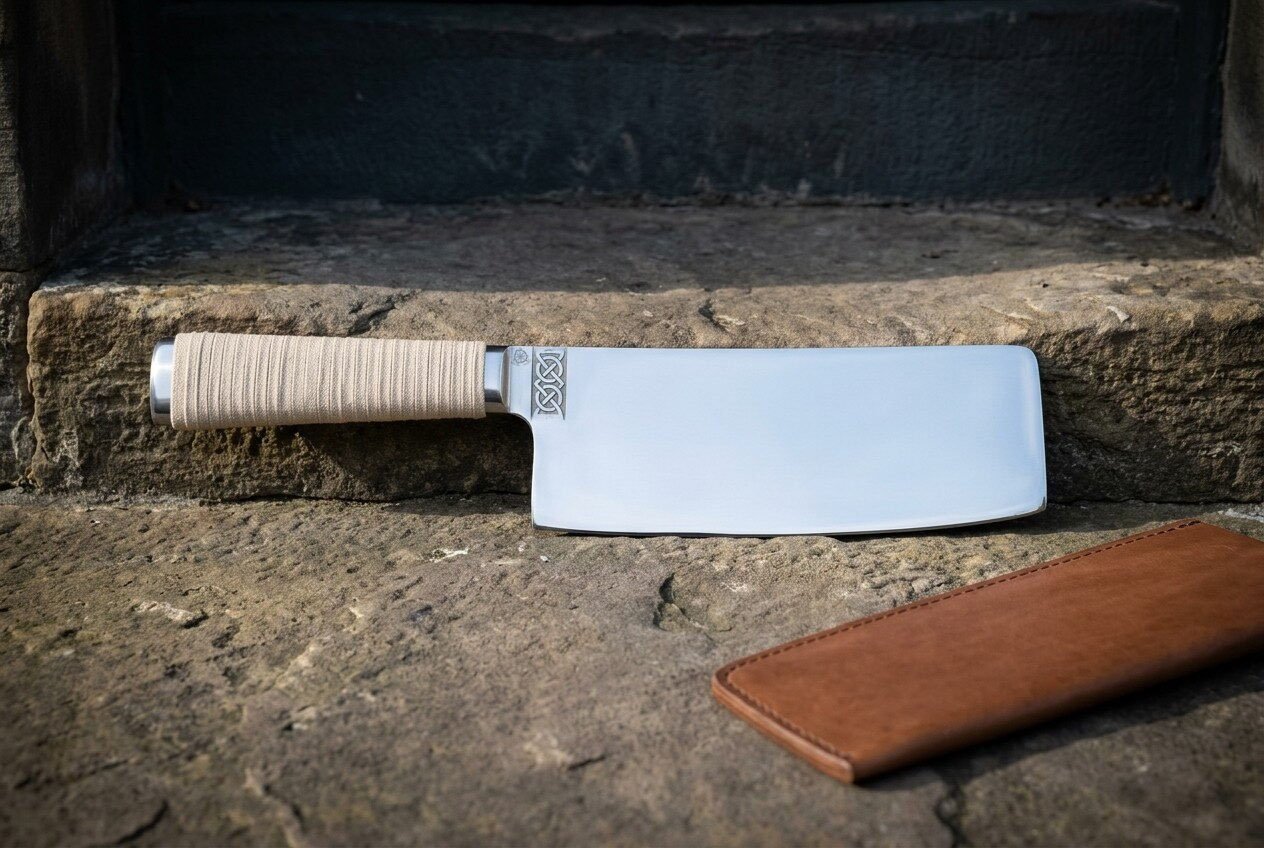
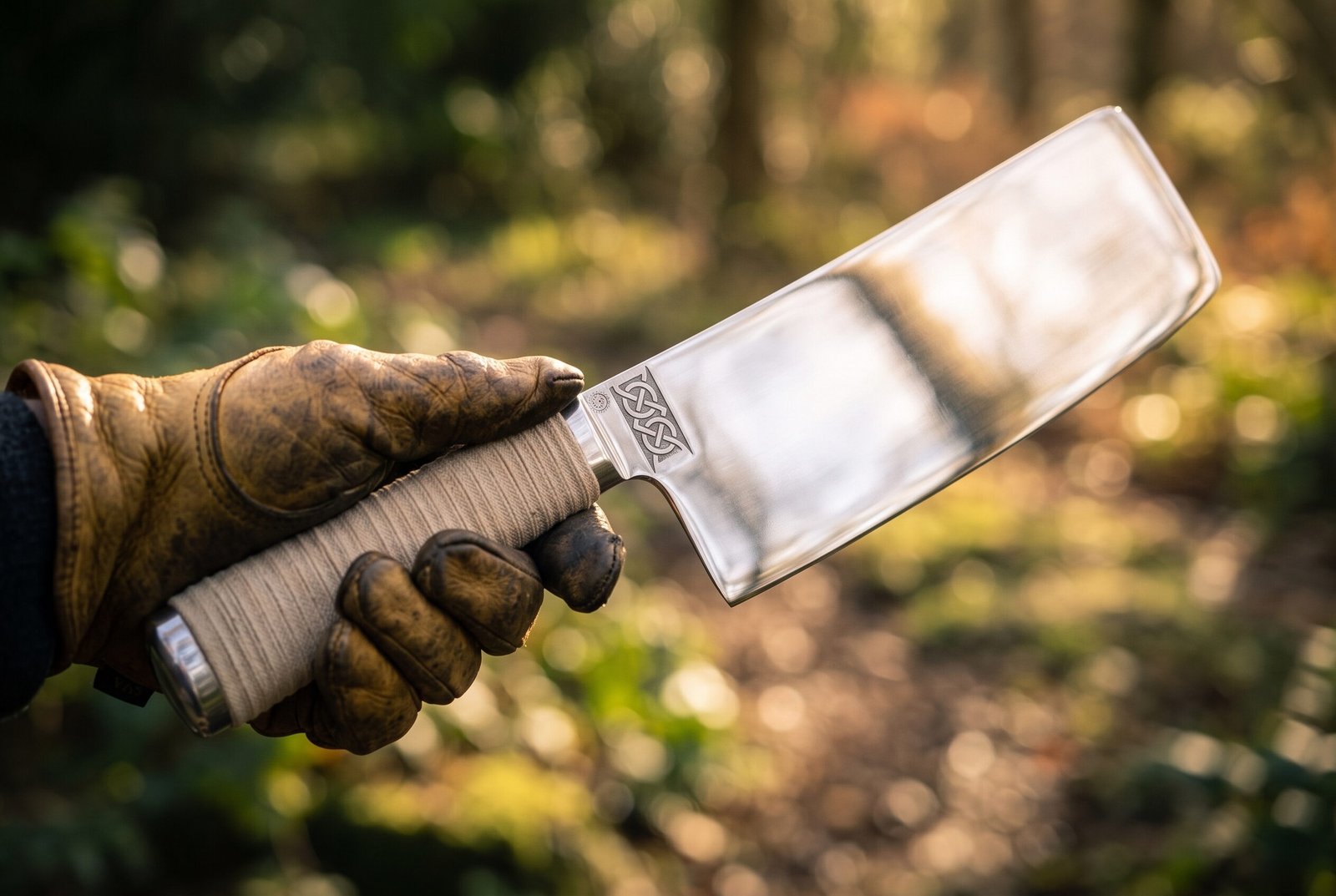
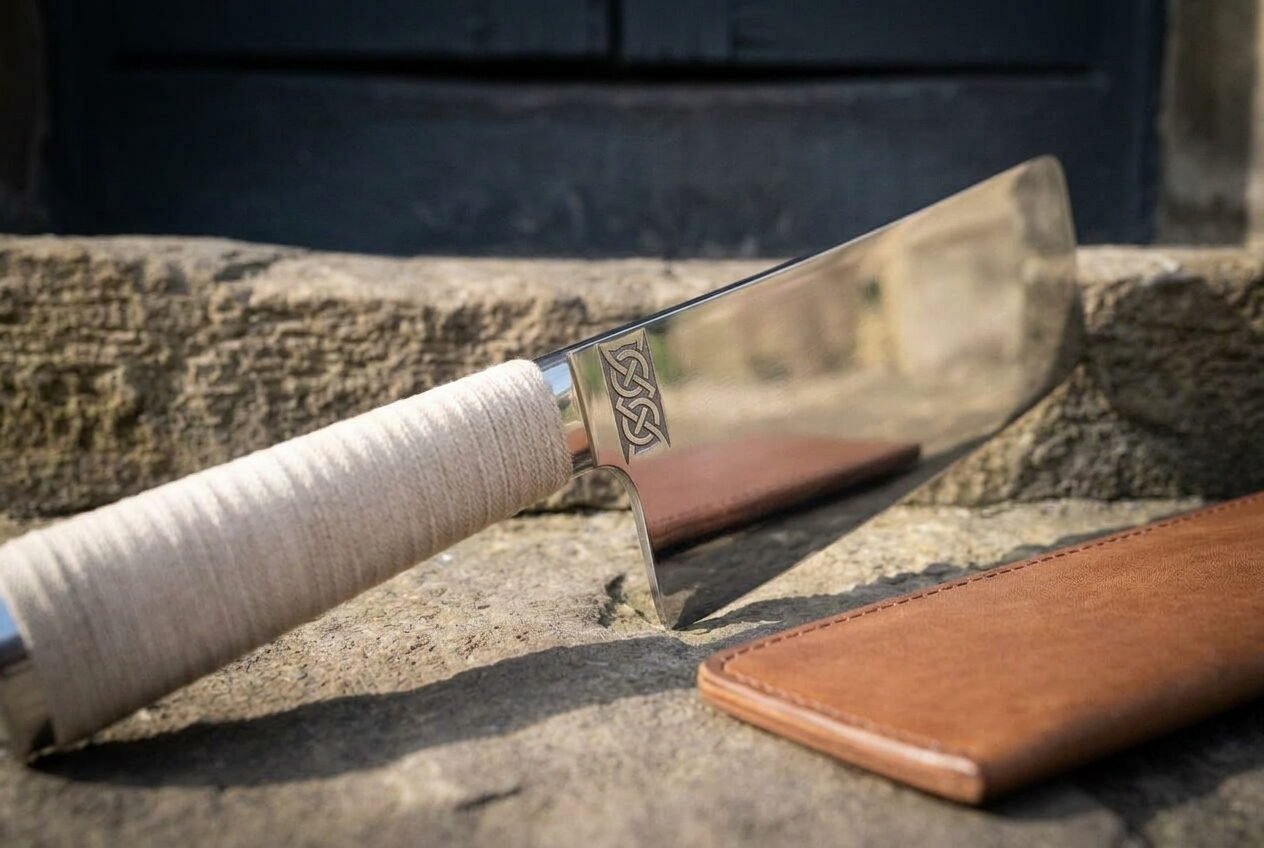
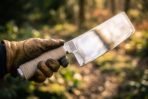
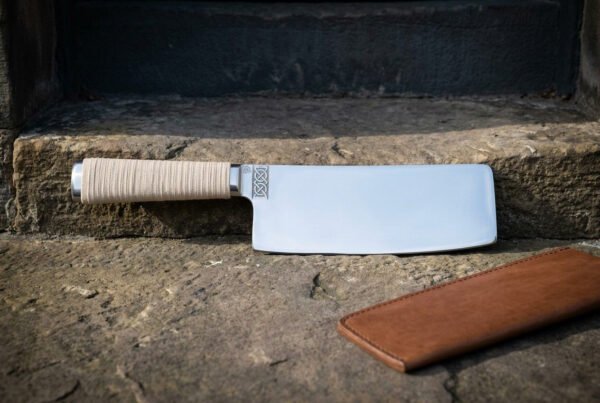
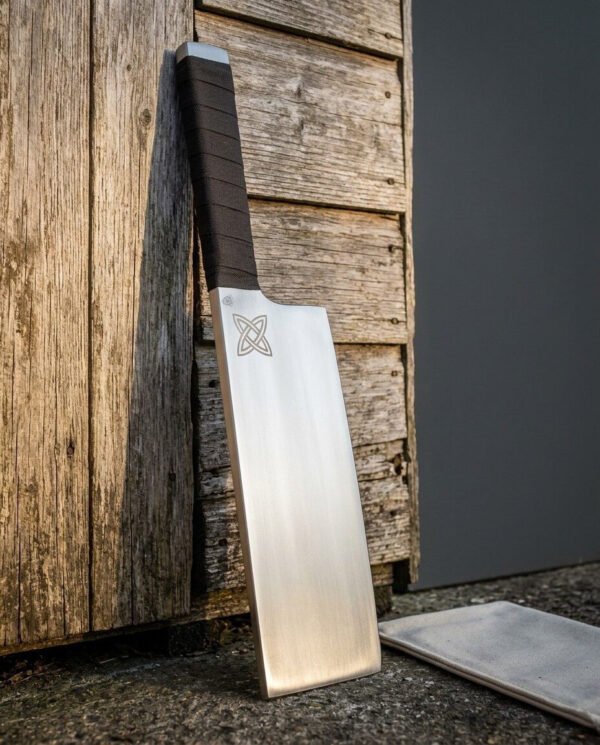
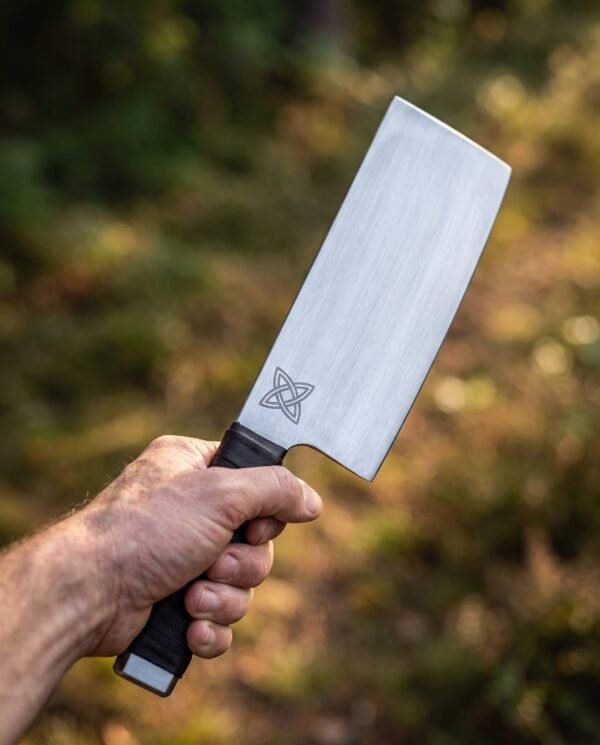
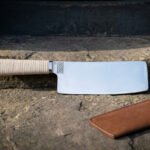
A broad rectangular kitchen cleaver in the nakiri pattern, hand forged from stainless steel and finished with a satin polish. The blade is tall from spine to edge and almost straight along the cutting edge with only the gentlest curve at the heel, which is exactly what you want for chopping down onto a board. The handle is bound in cream cord over a shaped core and seated against a steel ferrule, and at the heel of the blade there is a small engraved panel of Norse interlace knotwork. A tan leather blade sleeve comes with it.
The nakiri shape exists to solve one problem, which is that most knives are terrible at vegetables. A pointed chef knife rocks through an onion because its curved belly gives it somewhere to roll, but that rocking motion tears through anything fibrous and leaves you sawing at a cabbage. A flat edge and a tall blade let you do the opposite. You cut straight down, the whole edge meets the board at once so nothing is left hanging by a thread, and the height of the blade means your knuckles clear the board and the cut material stacks against the flat instead of falling over. It is made and finished by hand in the Czech Republic. Kept with the chef knives, and worth setting against the scabbards and sheaths before you decide.
Specifications
| Item type | Kitchen cleaver, nakiri style |
|---|
| Blade steel | Stainless steel, chosen for a kitchen knife that lives near water |
|---|
| Blade profile | Tall rectangular nakiri style with a near straight edge and squared tip |
|---|
| Engraving | Norse interlace knotwork panel cut into the heel of the blade |
|---|
| Handle | Cream cord wrapped over a shaped core |
|---|
| Ferrule and end cap | Brushed steel ferrule at the blade and a steel end cap at the butt |
|---|
| Sleeve | Tan leather blade sleeve, stitched and edge finished by hand |
|---|
| Finish | Hand polished satin blade |
|---|
| Use | Kitchen knife for vegetables, herbs and general board work |
|---|
| Included | Cleaver, leather blade sleeve, care card |
|---|
| SKU | RK-1801 |
|---|
How to actually use a flat edged cleaver
If you have only ever used a curved chef knife you will do this wrong for the first week, so it is worth saying. Do not rock it. A nakiri wants a push cut, which means the blade goes down and very slightly forward in one motion, all the way to the board, and then lifts clean. There is no pivot point on the edge to rock around and trying to find one will just give you a partly cut onion held together at the root end.
The second technique worth learning is the accordion cut, which is what the tall flat blade is really for. Lay a stack of leaves or a halved onion down, hold it with a clawed hand, and walk the knife along in small vertical chops without ever fully lifting it off the board. Because the edge is flat you get an even cut every time and because the blade is tall your knuckles ride against the flat as a guide. That is why professional vegetable prep is so much faster with this shape than with a pointed knife.
Stainless steel, and why a kitchen knife is not carbon
Most blades in our range are high carbon steel, and this one deliberately is not. A kitchen knife lives a different life. It gets wet, it sits on a wet board, it goes near acidic food, it gets put down while something else is happening. Carbon steel in that environment stains within a single meal and rusts within a week of neglect. Stainless carries enough chromium to form a passive oxide layer that repairs itself, which is the entire reason it exists.
There is a genuine trade. Stainless is a fraction harder to sharpen than plain carbon and it will not take quite the same hair splitting edge at the very finest grits. In a kitchen that difference is invisible and the corrosion resistance is worth everything. Anyone telling you a working kitchen knife should be carbon steel has not washed up after a large dinner.
Engraving, runes and your own design
Use the rune converter on this page to turn a name, a date or a short phrase into Elder Futhark and we will cut it into the steel, the leather or the wood. If you would rather have a Viking pattern than a rune line, choose your own design in the engraving option above the add to cart button and tell us where it goes. Where a piece already carries an engraved design, your chosen engraving replaces it rather than sitting alongside it, so a custom mark at the heel takes the place of the interlace panel. The leather sleeve is the other good surface here and it takes a stamped name cleanly. See the engraving page.
Balance and handling
A tall bladed cleaver carries most of its weight in the blade rather than the handle, and that is a feature. The knife falls through soft material under its own mass so you are steering rather than pushing. The balance point sits just in front of the ferrule, which means the knife pivots naturally where your pinch grip holds it.
Hold it with a pinch grip, thumb and forefinger on the flat of the blade just ahead of the ferrule, with the rest of the hand wrapped around the cord. That grip is what gives you control of the edge angle. Holding a knife like this by the handle alone is how people cut crooked and blame the knife.
Care
Wash it by hand in warm soapy water and dry it immediately. Never put this in a dishwasher. Dishwasher detergent is aggressive enough to dull a fine edge, the heat and steam will loosen a cord wrapped handle over time, and knives knocking around a rack chip their edges on everything else in there. Do not leave it soaking in the sink. Store it in the leather sleeve or on a magnetic rack rather than loose in a drawer where the edge meets other steel. Hone it regularly and sharpen it properly once or twice a year. Wipe the leather sleeve out and let it dry fully if it ever gets wet, and feed it with a leather conditioner occasionally. General blade guidance is under steel care.
Made in the Czech Republic
The work behind this piece happens in a Czech Republic workshop that has kept to the old methods. Steel is forged and heat treated by hand, the grind is taken down by eye rather than by machine, and the handle, fittings and sheath are cut and finished one at a time. Because of that, every piece carries small marks of the hand that made it.
Ransack Viking is a United States company. We import direct, check each piece when it reaches us, and ship from our Chicago, Illinois warehouse. Engraving is added here in the United States after arrival, so the piece you receive is finished to your order.
A note on handmade variation
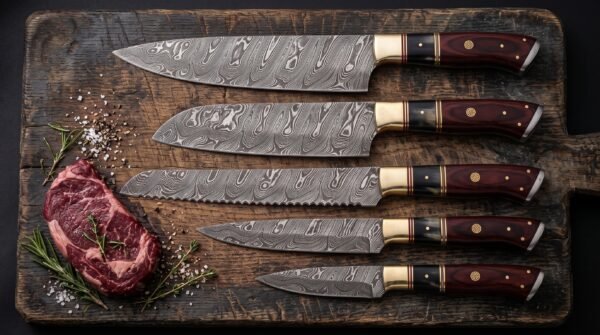
This cleaver is hand made, not machine made or bulk produced, so what arrives will not be a pixel for pixel copy of the photograph. The cord wrap tension and the exact rhythm of the winding differ knife to knife. The engraved panel is cut freehand so the interlace line weight varies. The satin polish carries its own hand direction and the leather sleeve will read lighter or darker depending on the hide. The steel, the geometry, the dimensions and the build are the same every time. The character is not. We wrote up the blade shapes guide separately, and there is a piece on the Damascus chef knives as well.
Frequently asked questions
Is it sharp when it arrives
Yes. It comes with a hand put working edge ready to use on a board. Unpack it carefully.
Is it food safe
Yes. The blade is stainless steel with no coating on it. Wash and dry it before first use as you would any new kitchen knife.
Can it go in the dishwasher
No. Hand wash and dry it immediately. A dishwasher will dull the edge, loosen the cord wrap and chip the blade against other items.
Will it rust
Stainless resists rust far better than carbon steel, but it is not rustproof. Dry it after washing rather than leaving it wet and you will never see a mark.
Can I use it for meat and bone
Use it for meat off the bone, yes. This is a vegetable cleaver in the nakiri pattern, not a bone cleaver, and chopping into bone will chip the fine edge.
Can I get a name engraved on it
Yes. Use the rune converter on this page for Elder Futhark, or choose your own design. A custom mark at the heel replaces the existing knotwork panel.
What is in the box
- Hand forged stainless steel Viking kitchen cleaver in the nakiri pattern
- Cream cord wrapped handle over a shaped core with a steel ferrule
- Engraved Norse interlace knotwork panel at the heel of the blade
- Tan leather blade sleeve, hand stitched and edge finished
- Care card covering washing, drying, honing and storage
- Lifetime warranty against defects in forging, grind, heat treat and fittings
- Made and finished in the Czech Republic
Explore the range
See the rest of the chef knives, the Viking knives, the engraved and personalised pieces and the guides.
Compare it with these
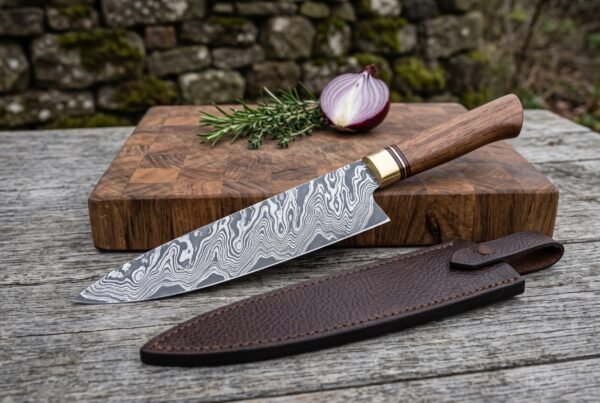
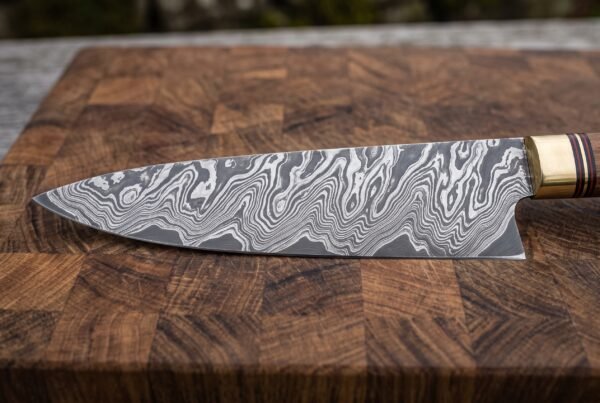
Also in this group is the Woodsax chef knife, high carbon steel. Sitting beside it in the catalogue is the Blockbreaker chef knife, pattern welded Damascus. Another in the same line is the Bluecleaver chef knife, pattern welded Damascus.
For a different piece from the same family, look at the Coalspine kukri knife. Pick the steel, the length and the fittings yourself on the custom hunting knife page.

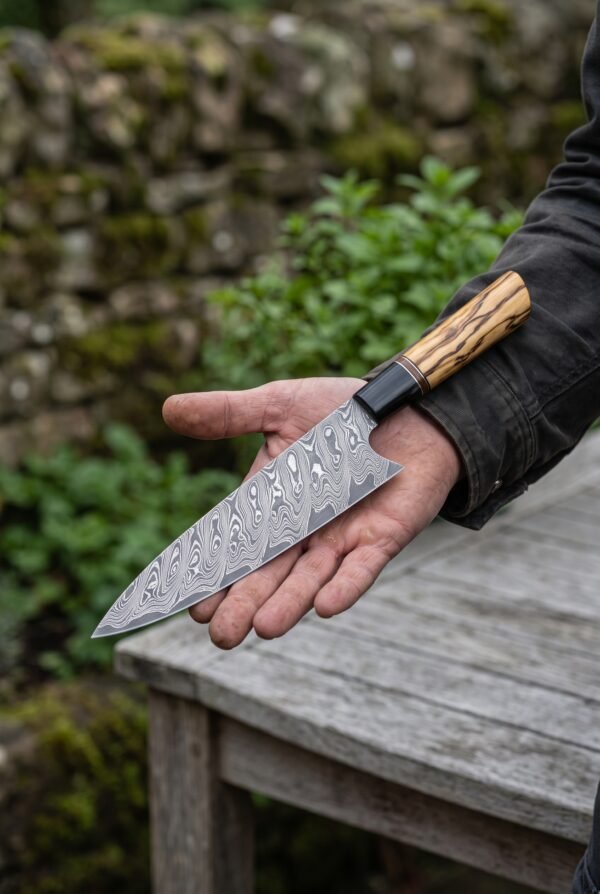
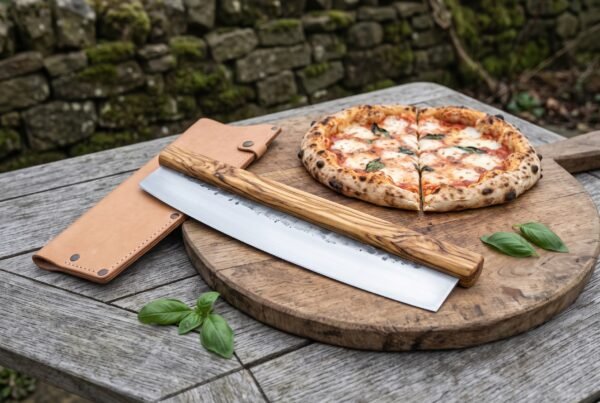
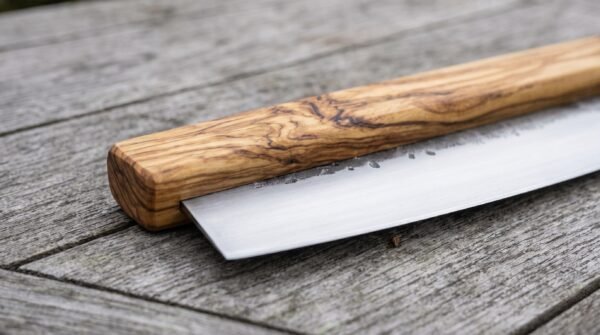
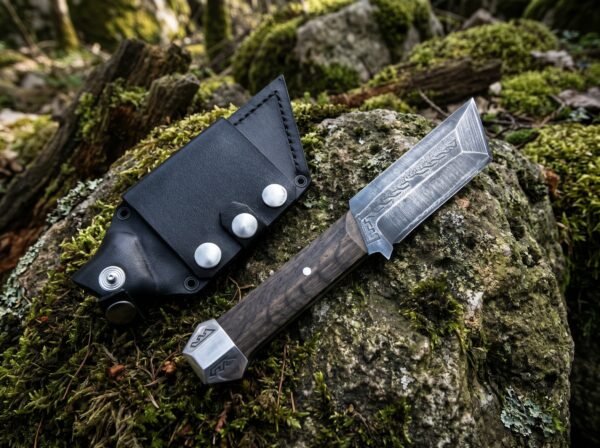
Bought this on a whim and it turned out to be one of my favorite purchases this year. Exactly as described and clearly made with care. Feels way more premium in person than the listing photos. This will be a family heirloom for sure.