Bulk set discount: 15% off. Buying this set of 6 costs 15% less than buying the same pieces one at a time.
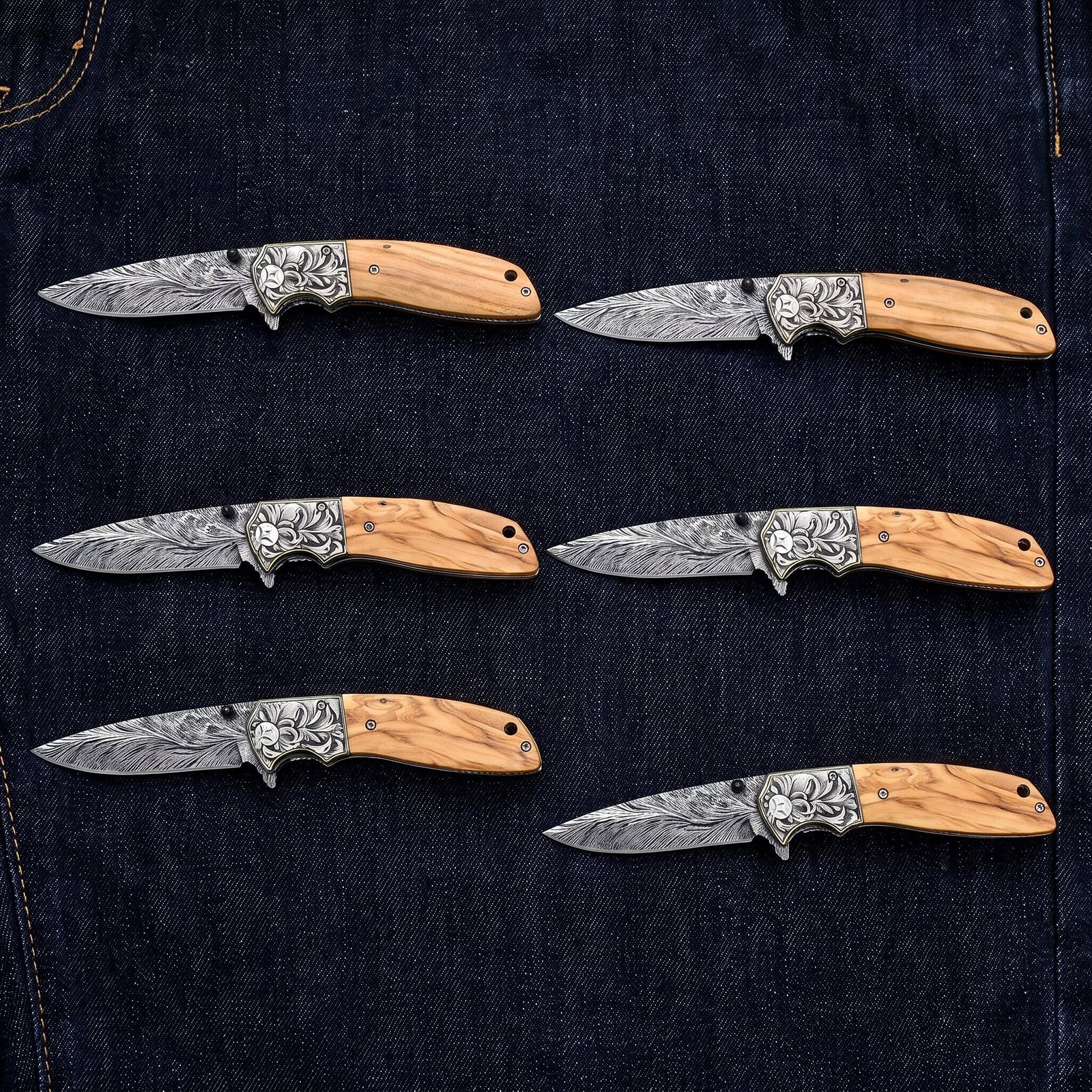
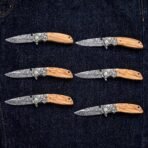
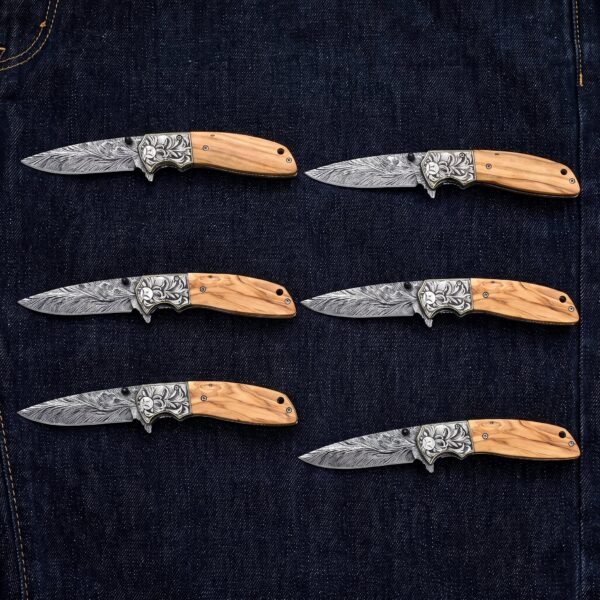
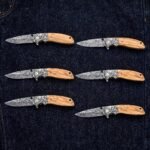
This set is 6 of the same piece: Olivefold Hand Forged Damascus Folding Pocket Knife with Olive Wood. It is the same item sold on its own single listing, packed together for groomsmen or a wedding party. Every piece in the set is the same model. Each one is handmade, so small differences in grain or pattern from one piece to the next are normal.
Buying the set costs 15% less than buying 6 single pieces. For names, choose Text engraving, type one name per line and each name goes on its own piece. Engraving is done here in the United States before the set ships.
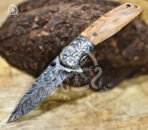
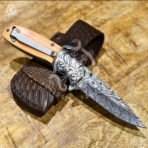
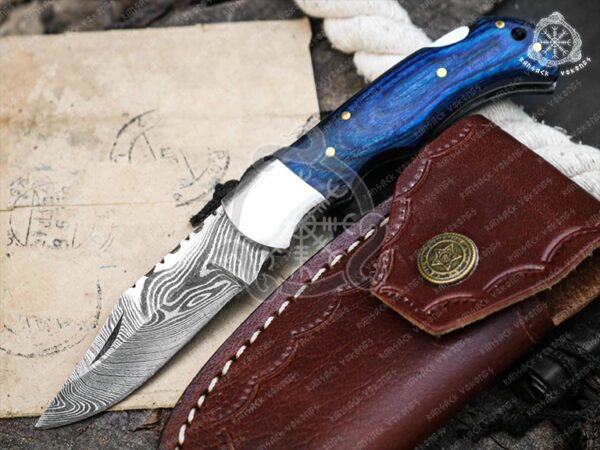
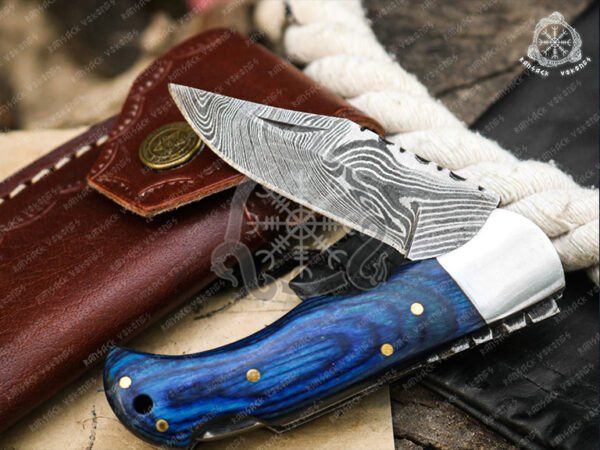
The Olivefold is a folding pocket knife for people who notice the difference between a knife that was made and a knife that was manufactured. A Damascus blade, an olive wood handle, ten inches from end to end with the knife open, and hand finishing on every surface you can see and several you cannot. Carry rules vary a great deal by state, and knife laws by state lists them.
Olive wood is one of the more interesting timbers a knifemaker can get hold of, and part of that is where it comes from. Olive trees are grown for fruit, not for lumber, and they are slow. A tree may be decades old before it produces well, and it can keep producing for a century or more, so nobody fells a healthy olive for its wood. What reaches a workshop is what comes out of orchard management: pruned limbs, stumps, root burl and trees pulled at the end of a productive life. That is why olive wood arrives in short, awkward, knotty sections rather than long clean boards, and it is exactly those sections, full of interlocked grain and dark streaking, that make the best knife scales.
This knife is forged and finished in the Czech Republic, from the welding of the billet through heat treat, grinding, handle fitting and final sharpening. It ships in protective packaging with the edge already set, and needs no sheath because it folds.
Specifications
| Steel | Hand forged Damascus, 1095 and 15N20 |
|---|
| Hardness | 58 to 60 HRC |
|---|
| Overall length | 10 inches open |
|---|
| Handle | Olive wood |
|---|
| Sheath | Not included, this is a folding knife |
|---|
| SKU | RK-689 |
|---|
What makes olive wood good on a knife
Three properties matter for a handle, and olive has all of them. The first is density. Olive is heavy for a timber, which means it has the mass to counterbalance a blade without needing a bulky handle, and it does not feel hollow the way light softwoods do in the hand. The second is grain structure. Olive grows with interlocked grain, where fibre direction reverses between growth layers, and interlocked grain resists splitting along the length in a way straight grained wood does not. That is precisely what a knife scale needs, because a scale is a thin panel with fasteners through it.
The third is oil. Olive wood is naturally resinous, which slows moisture movement in and out of the surface and gives the wood its resistance to swelling in a wet hand. It is also why it takes an oil finish so well. The finish soaks in and sits in the wood rather than forming a film on top, so it cannot chip or peel, and when it eventually dulls you refresh it with a cloth in two minutes instead of sending it away. The method is in wooden handle care. What olive wants in return is not to be soaked and not to be baked, so no dishwasher and no radiator.
Why Damascus and not stainless
The blade is built from alternating 1095 and 15N20 layers, forge welded into one bar before the shape is cut from it. Because the layers run through the steel rather than sitting on it, grinding a bevel reveals the pattern instead of removing it, and the pattern follows the grind line. Our guide to 1095 and 15N20 explains why those two steels are paired.
Choosing this over stainless is a genuine trade rather than an obvious win. Stainless would need essentially no care, and a knife that lives in a pocket sees damp, sweat and long spells closed with moisture in the pivot slot. What stainless will not do is harden the way a properly heat treated carbon blade does. At 58 to 60 HRC this blade takes a keener edge and holds it longer through cardboard, rope and tape, and it comes back on a stone with less effort than a stainless blade of similar quality. It asks for a dry wipe and an occasional film of oil, which is a couple of minutes a month at most. The whole argument is in Damascus versus stainless.
The olive wood handle
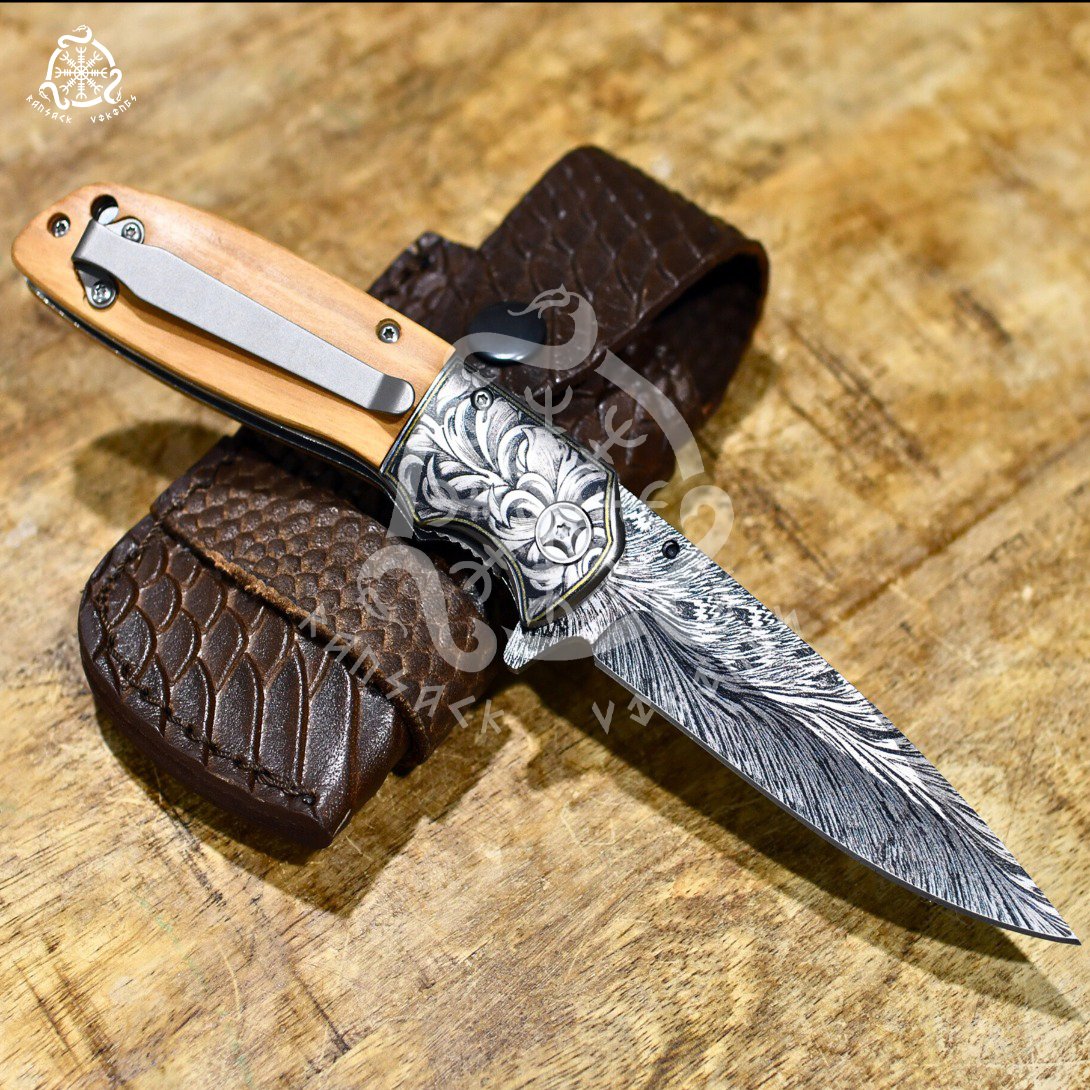
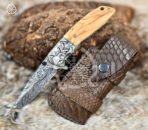
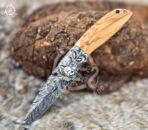
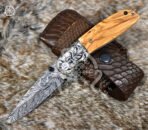
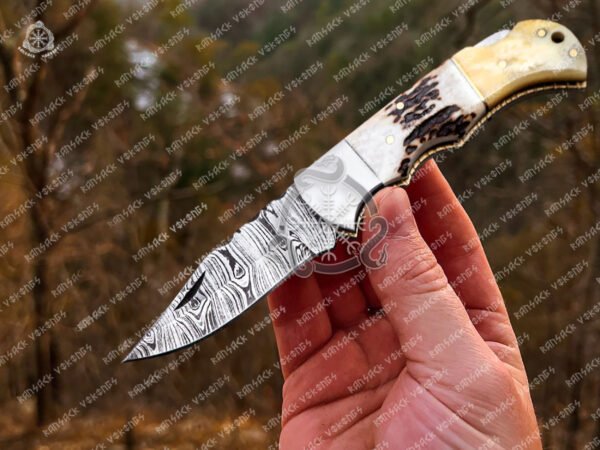
Every handle is shaped from a different section of olive, so the figure and the colour shift from one knife to the next. Expect a warm honey ground with darker streaking, and expect the streaking to be somewhere different on yours than on the piece in the photograph. Olive is dense enough to counter the blade, light enough not to fight you, and it takes a finish that ages rather than flakes.
Feed it with a light oil once or twice a year. Wipe it on, let it sit a few minutes, wipe the excess off. That is the entire maintenance routine for the life of the knife. Wash the knife by hand rather than soaking it, dry the handle with the blade, and leave the knife open until the pivot is dry before you close it.
Engraving, runes and your own design
Use the rune converter on this page to turn a name, a date or a short phrase into Elder Futhark and we will cut it into the steel or the handle. If you would rather have a Viking pattern than a rune line, choose your own design in the engraving option above the add to cart button and tell us whether it goes on the blade or the handle. Where a piece already carries an engraved design, your chosen engraving replaces it rather than sitting alongside it. Olive takes cut lettering cleanly and the dark streaking makes a rune line look as though it belongs there. See the engraving page for layout and lettering.
Care and sharpening
Damascus is carbon steel underneath the pattern, so treat it like carbon steel. Dry after use, thin film of oil before storage, and never put it away wet or closed and damp. A single drop of oil at the pivot once or twice a year keeps the action smooth, worked in by opening and closing the knife a few times. Detail is in steel care.
To sharpen, match the existing bevel angle and work one side in overlapping passes from heel to tip until you feel a burr along the whole edge. Turn the blade over and do the same, then strip the burr with a few light alternating strokes. Stop at a medium grit for a working edge that bites into rope and cardboard, or carry on to a fine stone if you prefer a polished edge for food. The whole method is in sharpening with a whetstone.
Made in the Czech Republic
The work behind this piece happens in a Czech Republic workshop that has kept to the old methods. Steel is forged and heat treated by hand, the grind is taken down by eye rather than by machine, and the handle, fittings and sheath are cut and finished one at a time. Because of that, every piece carries small marks of the hand that made it.
Ransack Viking is a United States company. We import direct, check each piece when it reaches us, and ship from our North Babylon, New York warehouse. Engraving is added here in the United States after arrival, so the piece you receive is finished to your order.
A note on handmade variation
The Olivefold is hand forged, not machine made and not bulk produced, so what arrives will not be a pixel for pixel copy of the photograph on this page. The Damascus pattern is unique to the billet and to where in it the blade was cut. The olive figure, the colour and the position of the dark streaks belong to that piece of wood and to no other. The dimensions, the steel and the build are the same every time. The character is not.
Frequently asked questions
Will the olive wood look like the photograph?
Similar in tone, different in detail. Olive is heavily figured and every scale is cut from a different section, so the streaking will fall somewhere else on yours. The shape, the size and the fit are consistent.
Is it sharp when it arrives?
Yes. The edge is set on a stone by hand before packing and it will slice paper out of the box. It is a working edge rather than a mirror polish, which is the finish that holds up best in daily use.
How often do I need to oil the handle?
Once or twice a year is plenty for normal use. Wipe a light oil on, leave it a few minutes, wipe the excess off. If the wood ever looks dry or pale rather than warm, that is the sign to do it sooner.
Can I put it in the dishwasher?
No. Heat and detergent will strip the finish and dry the wood out long before they trouble the steel, and a folder will also trap water in the pivot. Wash it by hand, dry it and leave it open until the pivot is dry.
How does this compare to a bone or horn handled folder?
Weight and feel, mostly. Olive is dense but still lighter than most bone, and it has a visible grain that bone does not. Horn is tougher against impact, bone takes a higher polish, and olive gives you figure and warmth with a finish you can refresh yourself.
Is a ten inch folder practical to carry?
It is a larger folder, so it suits a jacket pocket or a belt more than a tight jeans pocket. It gives you noticeably more blade than a small everyday folder. Check the blade length rules where you live before carrying any knife in public.
What is in the box
- One Olivefold hand forged Damascus folding pocket knife
- Protective packaging
- Forged and finished in the Czech Republic
Explore the range
More from the forge: Folding Pocket Knives, Viking Knives, Chef Knives and Engraved and Personalized. The background reading on steels and handle materials lives in the guides.
If this one is not it
In the same category sits the Bonebrass folding pocket knife, pattern welded Damascus. A near match for this one is the Pakkafold folding pocket knife. Closest to this in the range is the Stagsteel folding pocket knife.
Fitting out further, the Tantoguard tanto knife belongs with it. Pick the steel, the length and the fittings yourself on the custom Damascus knife page.
Matched sets for the whole wedding party are in Wedding & Groomsmen Gifts. Want just one? See the single piece listing.









Reviews
There are no reviews yet