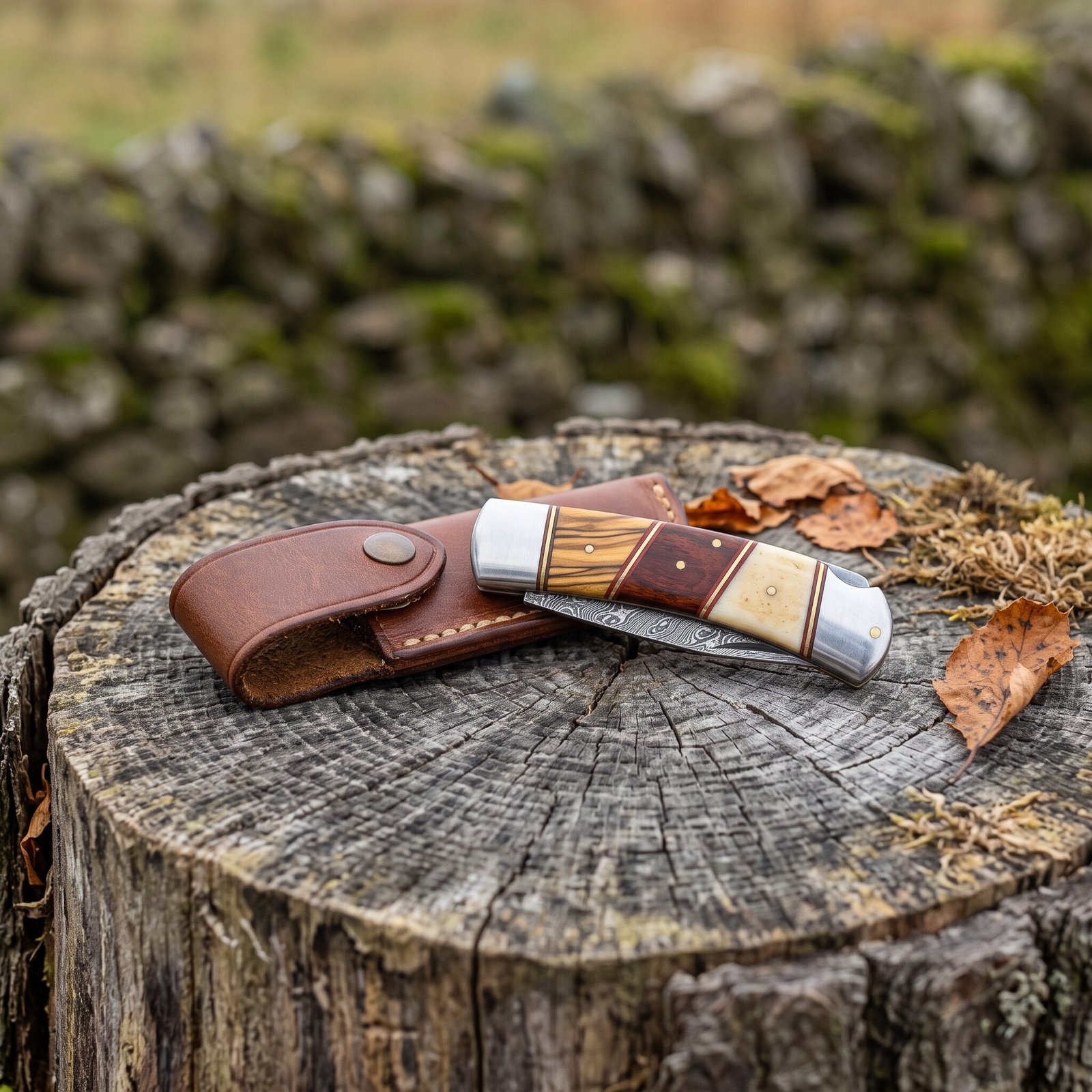
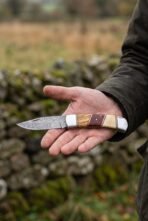
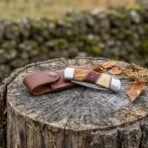
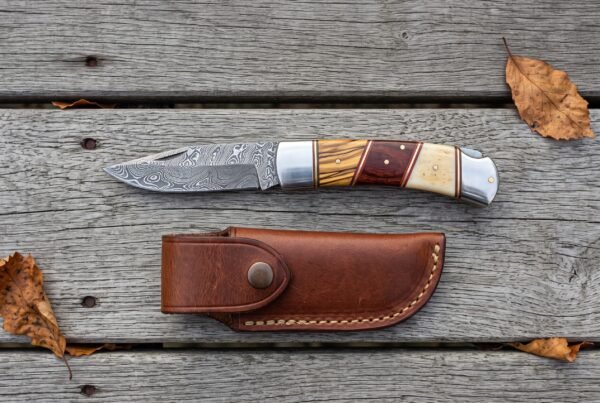
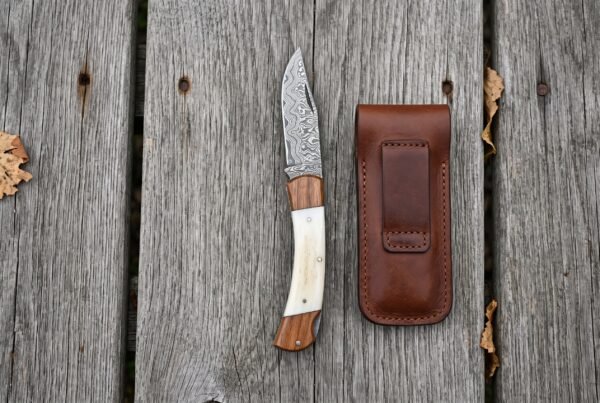
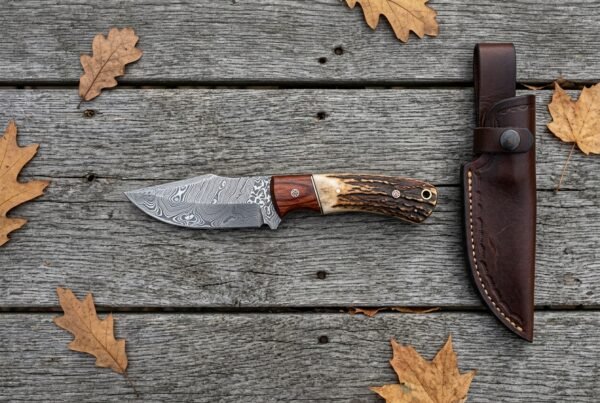
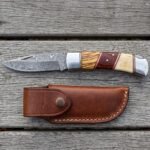
Take the Bonebrass out of the box and the weight tells you what it is. The handle is not one material but a stack of them: olive wood, rosewood and bone, separated by brass and red fibre spacers and capped with a steel bolster at each end. That kind of build is not done for decoration alone. Layering a handle from thin sections with fibre between them was how cutlers got stability out of natural materials long before synthetics existed, because a stack of thin pieces moves far less with humidity than one thick block, and the spacers absorb what movement is left.
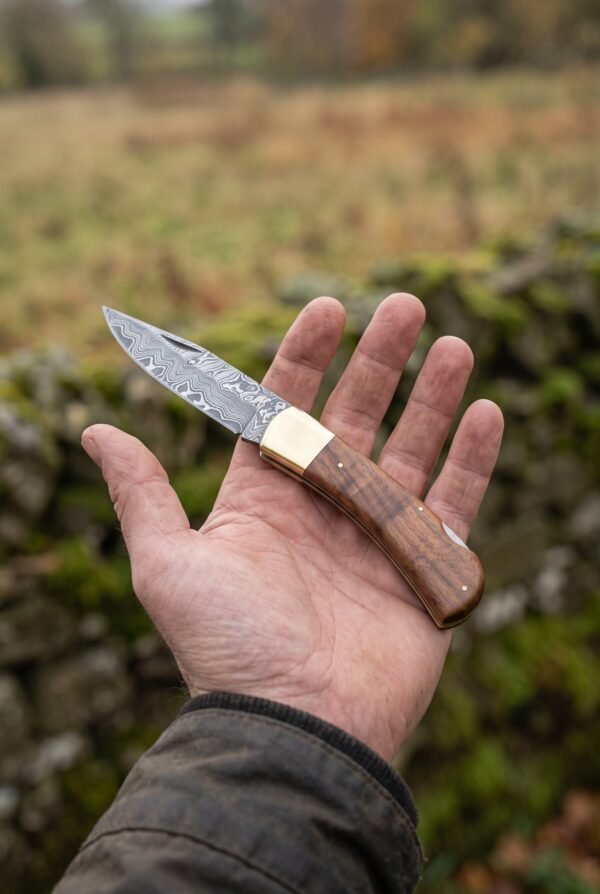
The blade is hand forged Damascus from 1095 and 15N20 at 58 to 60 HRC, 3.5 inches long, opening to 7.5 inches on a 4 inch handle. It is built to be used rather than admired, and it arrives with the edge already set.
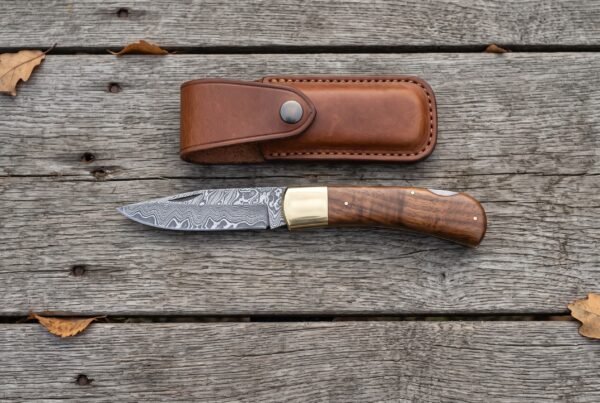
It is made in a Czech Republic workshop, and it ships with a cow leather sheath and protective packaging.
Specifications
| Steel | Hand forged Damascus, 1095 and 15N20 |
|---|
| Hardness | 58 to 60 HRC |
|---|
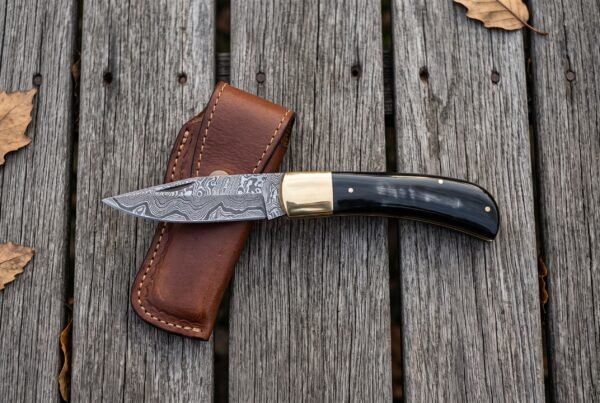
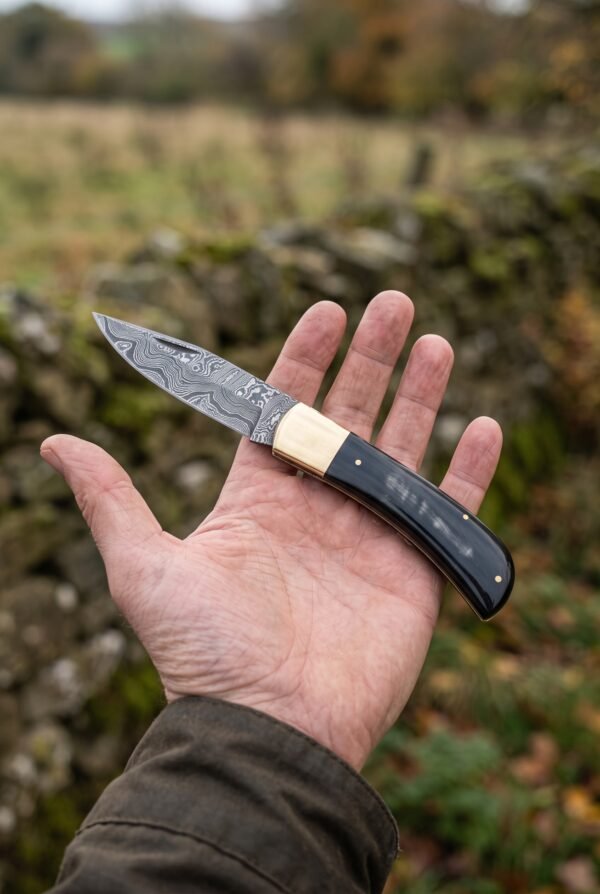
| Type | Folding pocket knife |
|---|
| Blade | Clip point blade with nail nick |
|---|
| Overall length open | 7.5 inches |
|---|
| Blade length | 3.5 inches |
|---|
| Handle length | 4 inches |
|---|
| Bolsters | Two polished steel bolsters, one at each end of the handle |
|---|
| Handle | Olive wood, rosewood and bone sections |
|---|
| Spacers | Brass and red fibre spacers between each section |
|---|
| Pins | Brass pins |
|---|
| Sheath | Brown cow leather belt pouch with snap flap |
|---|
| SKU | RK-1070-1 |
|---|
How the action on a hand fitted folder is set
Everything a folding knife feels like comes down to the pivot. The pin passes through the bolster, the liner and the tang, and it has to be tight enough that there is no side to side play at the tip when the blade is open, and loose enough that the blade will swing under thumb pressure. There is no adjustment screw on a traditional build. The pin is peened, which means the end is hammered until it spreads and locks, and the smith works up to the right tension a few taps at a time, testing the swing after each one. Go one tap too far and the pivot has to be drilled out and replaced.
That is why a hand fitted folder feels different from a factory one, and it is also why a new knife is often a little stiff. The bearing surfaces bed in over the first few weeks of use, and the action loosens slightly and then stays where it settles. What you should not have at any point is a blade that rattles sideways or one that will not close cleanly. Judge a folder on those two things before anything else. Sizes, actions and carry are compared in the everyday carry guide.
Why Damascus and not stainless
This is forge welded Damascus: 1095 high carbon steel and 15N20 nickel steel bonded at welding heat and worked down together, then etched so the two steels show as light and dark bands. It is hardened to 58 to 60 HRC, which suits a thin, short folding blade that needs to take a keen edge and keep it.
Against the soft stainless in a supermarket knife, this steel is harder, holds an edge longer and comes back on a stone faster. In return it wants a wipe of oil now and then, because it is carbon steel underneath and will spot if it is closed wet and forgotten. The honest version of that argument is in Damascus versus stainless, and whether the steel lives up to its name is discussed in is Damascus steel good.
The stacked handle
Three natural materials, each doing something different. Olive wood is dense, oily and famous for its wild figure, with dark veining running through pale gold that no two boards repeat. Rosewood is heavier still and gives the handle its weight and its grip in the wet. Bone is the hardest of the three, takes the deepest polish and provides the pale contrast. Between them sit brass and red fibre spacers, which frame each section and take up any small movement between materials.
Care is simple and it is aimed at the wood. A light coat of oil once or twice a year keeps both timbers from drying out, keeps the stack tight and deepens the colour instead of building a film that flakes. The bone wants nothing more than a wipe and protection from sustained heat, and the brass will dull to a soft gold that comes back with metal polish if you want it bright. The five minute routine is in wooden handle care.
Engraving, runes and your own design
Use the rune converter on this page to turn a name, a date or a short phrase into Elder Futhark and we will cut it into the steel or the handle. If you would rather have a Viking pattern than a rune line, choose your own design in the engraving option above the add to cart button and tell us whether it goes on the blade or the handle. Where a piece already carries an engraved design, your chosen engraving replaces it rather than sitting alongside it. On this knife the steel bolsters and the blade flat both take a clean line, and because the handle is a stack of narrow sections a mark generally reads better on the metal than across the materials. It is cut in house before packing. See the engraving page.
Care and sharpening
Wipe it dry, oil it lightly, and store it out of the sheath for long periods so trapped moisture cannot work on the steel. Put a drop of light oil on the pivot every few months and work the blade to spread it, since grit and dryness in a joint do more damage over a lifetime than rust. Leather care is its own subject and is covered in leather sheath care, with the steel routine in steel care.
A 3.5 inch blade fits on a stone in one pass, which makes sharpening quick. Set the angle, work one side until a burr rises along the whole length, match it on the other, then finish on a fine stone or a strop. Support the blade fully so the pivot takes no sideways load while you work. The method is in sharpening with a whetstone.
Made in the Czech Republic
Every piece we sell is made by hand in the Czech Republic. The smiths there work the way the trade has been worked for a long time, heating and hammering the steel, taking the bevels down by eye, and fitting the handle and the leather one at a time. There is no automated line anywhere in it, so small differences from one piece to the next are normal and expected.
Ransack Viking is a United States company based in Chicago, Illinois. We bring the pieces in ourselves, inspect them on arrival and ship them from our own warehouse. If you add engraving, that is carried out here in the United States before your order goes out.
A note on handmade variation
This folder is hand forged and hand assembled, not machine made and not bulk produced, so what arrives will not be a pixel for pixel copy of the photograph on this page. Olive wood in particular is never repeated, and the figure that ends up on your knife depends entirely on where in the board the section was cut. The bone takes a polish at its own rate, the Damascus banding is drawn out by hand, and even the width of the red fibre lines shifts by a fraction. The dimensions, the steel and the build are the same every time. The character is not.
Frequently asked questions
What steel is the blade?
Hand forged Damascus made from 1095 high carbon steel and 15N20, hardened to 58 to 60 HRC. It holds a keen edge and is easy to bring back on a stone, and like any carbon steel it wants to be kept dry and lightly oiled.
Should the action feel stiff when it is new?
A little, yes. The pivot is peened by hand rather than adjusted with a screw, and the bearing surfaces bed in over the first few weeks. What it should never do is rattle sideways or fail to close cleanly.
Why does the handle use three different materials?
Partly for looks and partly because a stack of thin sections separated by spacers is more stable in changing humidity than one thick block of a single material. Cutlers have built handles this way for well over a century.
Does the bone in the handle need any care?
Very little. A wipe is enough, and keep it away from radiators and hot car interiors. It is the olive wood and the rosewood that want a light oil once or twice a year.
Will my knife look like the photographed one?
The materials and dimensions match, the figure does not. Olive wood especially varies enormously from board to board, so expect a different pattern of dark veining on yours.
How long before it ships, and can it be engraved first?
Processing is one to two weeks and engraved orders sit at the longer end. Engraving is cut here rather than sent out. Shipping inside the United States is free.
What is in the box
- One Bonebrass Damascus folding pocket knife
- Cow leather sheath
- Protective packaging for storage or gifting
- Forged and finished in the Czech Republic
Explore the range
Sitting beside it in the catalogue are Folding Pocket Knives, New Arrivals, Viking Knives and Hunting Knives. Most of the questions that come before a first order are answered in the guides.
Others in the same line
Next along the rack is the Hornedge folding pocket knife, pattern welded Damascus. For a straight comparison, see the Copperfin folding pocket knife, pattern welded Damascus. Worth putting side by side with this is the Ramfold folding pocket knife, pattern welded Damascus.
If you are putting a set together, the Greyfell Damascus skinner knife sits alongside it. You can have this made your way instead on the custom Damascus knife page.



No regrets on this purchase at all. Edge retention has been great even after regular use. Came in a nice gift box which made it feel even more special. You can tell it’s real Czech blacksmith work and shipping from the States made delivery painless. Already planning my next purchase from this shop.
Been eyeing this knife for months and it did not disappoint. Even the small engravings are crisp and clean. Fit and finish is museum quality. You can tell real craftsmen made this by hand. Love it.
Did not expect this level of quality for the price. Leather sheath is thick and well stitched. Not the cheap stuff you usually get. Will definitely order again for another gift.
Did not expect this level of quality for the price. Beyond happy with how this turned out.
Been eyeing this knife for months and it did not disappoint. Came in a nice gift box which made it feel even more special. Already telling my friends to check this out.