
Blog
Knife Laws by State: Blade Length, Carry and Automatic Knife Rules for All 50 States

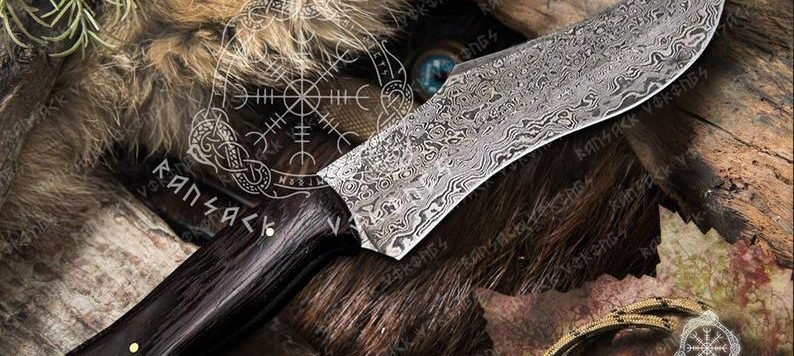
This page is a state by state summary of the knife carry rules that matter most to someone who owns, or is about to buy, a serious blade: whether the state sets a blade length limit for carry, whether a fixed blade can be carried concealed, how automatic knives are treated, and whether the state stops cities from writing their own stricter rules. It covers all fifty states and the District of Columbia in one table. Knife law is not so much difficult as inconsistent, and almost nobody finds that out at a convenient moment.
Read it as a starting point, not as legal advice. Every row was checked against the state statute or the American Knife and Tool Institute (AKTI) summary in the first week of September 2026, and the source is linked in the last column. Laws change, courts reinterpret them, and in states without preemption a city or county can be stricter than the state. If you plan to carry a knife, read the statute for your state and your city before you do. Where the sources were unclear or disagreed, the cell says so rather than guessing, which is less satisfying than a clean answer and considerably more useful.
How to read the table
Blade length limit. The blade length, if any, at which state law starts to treat a knife differently for carry. “None statewide” means the state sets no number. Many states with no number still restrict named types such as dirks or daggers regardless of length, so read the next column too.
Concealed fixed blade. Whether carrying a fixed blade knife hidden on your person is restricted. “Not restricted” means the state does not make concealment an offense for an adult who is not otherwise barred from carrying. “Restricted” means the statute names fixed blade types (bowie, dirk, dagger and so on) that cannot be concealed, or requires a permit.
Automatic knives. The status of switchblades and other knives that open by a button or spring. Assisted openers are a separate question in several states and are noted where the source raised it.
Preemption. A state has preemption when a state statute says local governments cannot regulate knives more strictly than the state does. With preemption, one set of rules applies everywhere in the state. Without it, a city such as Chicago, Denver, Seattle or New York City can and often does set its own blade limits, and the table can only warn you that local rules exist. It cannot read them for you.
Section numbers in the cells refer to the state code. The Source column links to the page checked. Blade lengths are in inches, written as “in”.
Knife laws by state
| State | Blade length limit | Concealed fixed blade | Automatic knives | Preemption | Notes | Source |
|---|---|---|---|---|---|---|
| Alabama | none statewide | not restricted | not restricted | no (13A-11-61.3 covers firearms only) | Montgomery has a local 3 in limit; school property restricted under 13A-11-72 | AKTI |
| Alaska | none statewide | allowed at 21 and over; must tell police on contact (11.61.220) | not restricted for adults; under 21 restricted (11.61.200, 11.61.210) | yes (29.35.145) | Concealed carry into another person’s home needs the owner’s permission | AKTI |
| Arizona | none statewide | not restricted at 21 and over (13-3102); under 21, pocketknife only | not restricted | yes (13-3120) | AKTI lists no prohibited knife types | AKTI |
| Arkansas | none statewide | not restricted; unlawful purpose is what 5-73-120 targets | not restricted | yes (Act 161 of 2025) | The 3 in figure in 5-73-120 is a definition, not a carry limit; swords, throwing stars and butterfly knives are named in it, but only carry with unlawful purpose is an offense | AKTI; Knife Rights |
| California | none statewide for most knives; 2 in for automatics (21510) | restricted: concealed dirk or dagger prohibited (21310); a sheath worn openly at the waist is not concealed (20200) | prohibited at 2 in or longer (21510, 17235) | no | Cane swords, ballistic and undetectable knives banned; fixed blades over 4 in restricted in public buildings (171b); many city ordinances | AKTI |
| Colorado | 3.5 in for concealed carry (18-12-101, 18-12-105) | restricted over 3.5 in outside home, business or vehicle; hunting and fishing defenses | not restricted since 9 Aug 2017 (SB17-008); the 3.5 in concealed rule still applies | limited: vehicle carry only (18-12-105.6); Denver and Boulder have their own rules | Ballistic knives banned (18-12-102) | AKTI |
| Connecticut | 4 in edged portion for carry (53-206); 1.5 in for automatics | not restricted by concealment, but the 4 in rule applies to any knife carried | limited to a 1.5 in blade (53-206) | no | Dirks were held to be protected arms in State v. DeCiccio (2014); school grounds are a felony | AKTI |
| Delaware | 3.75 in: knives with a blade of 3.75 in or less are exempt from the restricted list (11 Del. C. 222, amended by SB 108 of 2025) | restricted: a concealed fixed blade over 3.75 in needs a Delaware concealed carry license (11 Del. C. 1442) | not restricted since 1 Aug 2025 (SB 108) | no | Undetectable knives and knuckle-knife combinations banned; safe school and recreation zones apply | AKTI; Knife Rights |
| District of Columbia | 3 in for a knife carried with unlawful intent (22-4514(b)) | concealment is not the test; any knife can be treated as a dangerous instrument under 22-4504 | prohibited, including possession (22-4514(a)) | not applicable (single jurisdiction) | Dagger, dirk, stiletto and razor are named in 22-4514(b); AKTI notes DC does not recognize a right to carry a knife for self defense | AKTI |
| Florida | 4 in common pocketknife exemption (790.001) | restricted, but since 2023 an adult who meets the 790.06 license criteria may carry concealed without holding the license (790.01(1)(b)) | not restricted; ballistic knives banned (790.225) | no (790.33 covers firearms only) | Read 790.06 for the eligibility criteria before relying on the permitless rule | Fla. Stat. 790.01; AKTI |
| Georgia | 12 in: blades over 12 in need a 16-11-129 license outside home, vehicle or business (16-11-125.1) | not restricted | not restricted statewide | yes (16-11-136) | School grounds: blades of 2 in or more restricted | AKTI; 16-11-136 |
| Hawaii | none statewide | restricted: a dirk or dagger concealed on the person or in a vehicle is a misdemeanor (134-51) | legal to own since 14 May 2024 (Act 021); concealed carry still banned; enforcement unclear, check the statute | no | Butterfly knives, swords and spears legal to own since 2024; concealed carry of these still banned, open carry only | AKTI; Knife Rights |
| Idaho | 6 in: blades of 6 in or less are not on the restricted list (18-3302) | over 6 in: allowed for eligible adults under 18-3302(4)(f); age and city limit details, check the statute | not restricted | yes (18-3302(18)) | School: pocketknives under 2.5 in only | Idaho 18-3302; AKTI |
| Illinois | none statewide; 3 in in publicly funded buildings (720 ILCS 5/24-1(c)); Chicago 2.5 in | not restricted by state law | legal with a FOID card (720 ILCS 5/24-1); ballistic knives banned | no | Chicago and other city ordinances apply | AKTI |
| Indiana | none statewide | not restricted | not restricted since 2013; ballistic knives banned (35-47-5-2) | no knife statute; AKTI cites constitutional uniformity | Throwing stars legal since 1 Jul 2023 except on school property | AKTI |
| Iowa | 5 in: blades over 5 in are on the dangerous list (702.7) | not restricted for adults since 2021; 724.4 now applies only when the knife is used in a crime | not restricted; ballistic knives banned (724.1) | yes (724.28) | School zones (724.4A); carrying while intoxicated (724.4C) | Iowa Code 724.4; AKTI |
| Kansas | none statewide | not restricted (21-6301) | not restricted since 2013 | yes (12-16,134) | Felons restricted under 21-6304 | AKTI |
| Kentucky | none statewide | not restricted at 21 and over (237.109); under 21 restricted for knives other than an ordinary pocketknife or hunting knife (500.080, 527.020) | not restricted at 21 and over | limited (237.104); 65.870 covers firearms only; check the statute | “Ordinary pocketknife” and “hunting knife” are not defined in the code | AKTI |
| Louisiana | none statewide | not restricted (14:95) | not restricted since 1 Aug 2022 | yes (SB 194, effective 1 Aug 2024) | School property (14:95.2) | AKTI |
| Maine | none statewide | restricted: a bowie, dirk or stiletto concealed is prohibited (25 MRSA 2001-A) | not restricted since 15 Oct 2015 | no | Open carry of fixed blades is not restricted by 2001-A | AKTI |
| Maryland | none statewide | restricted: fixed blades cannot be carried concealed without a Maryland carry permit (CR 4-101); only penknives are exempt | possession and open carry legal; sale banned (CR 4-105); concealed needs a permit | no | Star knives restricted under 4-101 | AKTI |
| Massachusetts | 1.5 in for automatics (269 s10(b)) | restricted: carrying a dagger, dirk, stiletto or double-edged knife on the person is prohibited, concealed or not (269 s10(b)) | statute limits to 1.5 in; the SJC held the ban unconstitutional in Commonwealth v. Canjura (27 Aug 2024); check the statute | no (Boston ordinance) | Ballistic knives and balisongs restricted per AKTI | AKTI |
| Michigan | 3 in, only where unlawful intent is shown (750.226) | restricted: a dagger, dirk, stiletto or double-edged non-folding stabbing knife concealed or in a vehicle is a felony (750.227) | not restricted since Oct 2017 | no (Detroit and Lansing ordinances) | Throwing knives have been prosecuted as double-edged stabbing instruments | AKTI |
| Minnesota | none statewide | not restricted | prohibited (609.66 subd. 1(4)); assisted openers unclear | no | Schools and court facilities | AKTI |
| Mississippi | none statewide | restricted: a bowie, dirk or butcher knife concealed is prohibited unless carried in a visible sheath, holster or scabbard, or in a vehicle (97-37-1) | same concealed rule as bowies (97-37-1) | no statute; AKTI cites state constitution Art. 3 s12 | Open carry of any knife allowed | AKTI |
| Missouri | 4 in ordinary pocketknife exemption (571.010) | not generally restricted; knives over 4 in cannot be concealed in the places listed in 571.107 (571.030) | not restricted since 2012 | no | Private property owners may set their own rules | AKTI |
| Montana | none statewide; 4 in in school buildings (45-8-361) | not restricted since HB 251 (2017) | not restricted since HB 155 (2017) | yes (45-8-352) | Local governments may restrict knives on their own property | AKTI; Knife Rights |
| Nebraska | 3.5 in defines “knife” (28-1201) | not restricted statewide for adults who are not prohibited persons since LB 77 (2023); 28-1202 now applies to minors and prohibited persons | not restricted | no (Omaha and Lincoln ordinances) | City ordinances still restrict concealed knives | Neb. Rev. Stat. 28-1202; AKTI |
| Nevada | none statewide; Clark County 3 in for concealed carry | a concealed machete is prohibited (202.350); other fixed blades are not named, check the statute | not restricted since 2015 except on school and college property (202.265) | no | Clark County and Las Vegas ordinances | AKTI |
| New Hampshire | none statewide | not restricted | not restricted since 2010 | yes (159:26) | Courthouses (159:19); felons (159:3) | AKTI |
| New Jersey | none for adults; 5 in blade or 10 in overall for sales to minors (2C:39-9.1) | concealment is not the test; a dagger, dirk or stiletto without a lawful purpose is an offense (2C:39-3, 2C:39-5(d)) | prohibited without an explainable lawful purpose (2C:39-3); gravity and ballistic knives too | no | Any knife carried “under circumstances not manifestly appropriate” can be charged; self defense counts as a lawful purpose only at home | AKTI |
| New Mexico | none statewide | restricted: a dagger, bowie or dirk concealed outside your home or property is prohibited (30-7-2) | prohibited, including possession (30-7-8); balisongs included per State v. Riddall (1991); sources conflict, check the statute | yes (state constitution Art. II s6) | A concealed handgun license is an exception under 30-7-2 | NMSA 30-7-8; AKTI |
| New York | none statewide; NYC 4 in (Admin. Code 10-133) | concealment is not the test; a dagger, dirk, stiletto or “dangerous knife” with unlawful intent is an offense (265.01(2)), and 265.15(3) presumes intent | prohibited (265.01(1)) except licensed hunters, trappers and anglers (265.20) | no | Cane swords, metal knuckle knives and ballistic knives banned; NYC restricts open carry | AKTI |
| North Carolina | none statewide | restricted: a bowie, dirk or dagger concealed is prohibited except on your own premises (14-269); open carry legal | concealed carry restricted (14-269); ballistic knives banned (14-269.6) | no | An ordinary pocketknife carried closed is exempt | AKTI |
| North Dakota | 5 in: blades of 5 in or more are on the dangerous list (62.1-01-01) | restricted: concealed carry needs a class 1 or class 2 license (62.1-04-02); the permitless rule covers firearms only; open carry not restricted | legal to own and sell; concealed carry restricted like other listed blades | no (Bismarck, Fargo and Grand Forks ordinances) | Machete, scimitar, sword, dagger and stiletto are listed regardless of length | N.D.C.C. 62.1-04; AKTI |
| Ohio | none statewide | not restricted since 12 Apr 2021 (2923.12(H)); a knife counts only if used to harm | not restricted since 12 Apr 2021 (2923.20 amended); ballistic knives restricted | yes (9.68 covers “any knife”) | School safety zones and courthouses | R.C. 9.68; AKTI |
| Oklahoma | none statewide | not restricted (21 O.S. 1272) | not restricted since 2015 | yes | AKTI lists no restricted knife types | AKTI |
| Oregon | none statewide; pocketknife under 4 in only in public buildings (166.370) | restricted: a dirk, dagger or ice pick concealed is prohibited (166.240); open carry allowed | possession legal; concealed carry of automatics and butterfly knives restricted (166.240) | no statute; a Portland ordinance was struck down in City of Portland v. Lodi (1989) | Swords have been treated as a “similar instrument” under 166.240 | AKTI |
| Pennsylvania | none statewide | not restricted | not restricted since 3 Jan 2023 (908 amended) | no (Philadelphia 10-820) | Schools and court facilities | AKTI |
| Rhode Island | 3 in for concealed carry (11-47-42) | restricted: over 3 in, or any dagger, dirk, stiletto, bowie or sword cane regardless of length, cannot be concealed | not restricted | no | Open carry allowed absent unlawful intent | AKTI |
| South Carolina | none statewide; 2 in on school property (16-23-430) | not restricted unless carried to commit a crime (16-23-460) | not restricted | no statute; AKTI cites state constitution Art. 8 s14 | Columbia, Charleston and Greenville ordinances exist; AKTI considers them likely unenforceable | AKTI |
| South Dakota | none statewide | not restricted unless carried with intent to commit a felony (22-14-8) | not restricted since 1976 | no (city ordinances common) | State law does not define knife types | AKTI |
| Tennessee | none statewide (4 in rule repealed 2014) | not restricted | not restricted since 2014 | yes (39-17-1314) | School property is a Class E felony (39-17-1309) | AKTI |
| Texas | 5.5 in: longer blades are “location-restricted” (46.01) | not restricted | not restricted since 1 Sep 2013 (HB 1862) | yes (Local Gov. Code 229.001) | Blades over 5.5 in barred from the places in 46.03 (schools, courts, polling places, bars, sporting events, hospitals, churches and others) and from carry by under 18s | AKTI |
| Utah | none statewide | not restricted (76-10-501) | not restricted | yes (76-10-500) | School premises (76-10-505.5) | AKTI |
| Vermont | none statewide (3 in automatic rule repealed 1 Jul 2025) | not restricted | not restricted since 1 Jul 2025 (4013 amended) | yes (24 VSA 2291) | Schools and courts | AKTI |
| Virginia | none statewide; school pocketknife under 3 in (18.2-308.1) | restricted: a dirk, bowie or machete concealed is prohibited (18.2-308); open carry allowed | possession and sale legal since 1 Jul 2022 (18.2-311); concealed carry still restricted (18.2-308) | no (airports excepted) | Ballistic knife sales banned; throwing stars cannot be concealed | AKTI |
| Washington | none statewide; Seattle, Tacoma and Vancouver 3.5 in | restricted: furtive carry of a dagger or dirk with intent to conceal is prohibited (9.41.250) | prohibited (spring blade knife, 9.41.250) except on-duty responders | no | 9.41.270 covers carry that alarms others | AKTI |
| West Virginia | 3.5 in: blades over 3.5 in are on the restricted list (61-7-2) | not restricted at 21 and over (61-7-7); ages 18 to 20 open carry only without a provisional license | not restricted | yes (effective 31 May 2020) | Schools and courts (61-7-11a) | AKTI |
| Wisconsin | none statewide | not restricted (941.23) except violent felons (941.231) | not restricted since 6 Feb 2016 | yes (66.0409) | AKTI lists no restricted knife types | AKTI |
| Wyoming | none statewide | not restricted (6-8-104) | not restricted | yes (6-8-401) | AKTI lists no restricted knife types | AKTI |
Table checked in the first week of September 2026. AKTI pages carry their own “last updated” date, and several are older than the statutes they summarize; where a newer primary source was found, it is linked first.
What this means when you buy a large fixed blade, an axe or a sword online
Almost everything in the table is about carrying. Buying a knife, owning it at home, keeping it in a collection and having it shipped to you are a different matter, and in the large majority of states none of that is restricted for an adult. The exceptions are narrow and mostly about automatic knives: Minnesota, New Mexico and the District of Columbia still restrict possession of switchblades, and Maryland bars their sale. Ballistic knives are banned almost everywhere. Ordinary fixed blades, Damascus hunting and camp knives, Viking style seaxes, axes and display swords are not banned from ownership in any state we checked.
The carry rules start to matter the moment the piece leaves the house. A 9 in blade on a Damascus bowie is a fine thing to own in Texas, but it is a “location-restricted knife” the moment you walk into a bar or a courthouse with it. The same bowie cannot be carried concealed in North Carolina, Virginia or Mississippi, and in Rhode Island anything over 3 in has to be carried openly. If you are buying for the wall, the kitchen or the campsite, this is rarely an issue. If you plan to wear it, read your row and then read the statute.
Axes and hatchets sit outside most knife statutes. A few states fold them into a general “dangerous instrument” definition when used to harm someone, and some school and courthouse rules cover any blade, but no state in the table names an axe in its carry statute. A Viking bearded axe is treated much like any other tool: fine to own, fine to transport in a bag or a vehicle, and a bad idea to carry down a city street in your hand.
Swords are named in a handful of states (Arkansas, North Dakota, Rhode Island for sword canes, Oregon by case law, Hawaii until 2024) and are covered by the general concealed carry language in most others. Nobody conceals a sword, so in practice the rule is the same as for axes: own it, transport it cased, and do not carry it in public without a reason a police officer would accept. The safety and storage notes cover the sensible end of that at home.
The buyer is responsible for knowing the rules where they live. We check the law in Illinois, where the business is based, but we cannot check it for every city our customers live in, and city ordinances are exactly where the unwelcome surprises sit in states without preemption.
Where we ship
Ransack Viking is a US company in Chicago, Illinois. Every piece is handmade in the Czech Republic, then imported, inspected and shipped from Chicago, which the country of origin page sets out stage by stage. We ship within the United States. We do not sell automatic knives, ballistic knives, undetectable knives or disguised knives of any kind, so the items with the tightest possession rules are not in the catalogue and not a decision you have to make. Almost everything in the Viking knife range, the Damascus range and the axe range is a fixed blade, a manual folder or a hand tool. The two exceptions are the butterfly knives and the throwing knife sets: both are legal to own in most states, but a balisong is treated as a gravity or automatic knife in a few (New Mexico and California among them), so check the Automatic knives column for your state before ordering one.
If you are choosing a blade to carry rather than to keep at home, our picks are in the best Damascus pocket knives for everyday carry, and the wider selection process is in how to choose a Norse knife.
Questions people ask
Is it legal to buy a large fixed blade or a sword online and have it shipped to my state?
For an adult, yes in every state we checked. Possession of ordinary fixed blades, bowies, seaxes, axes and swords is not banned anywhere in the table. The restrictions you see in the rows are almost all about carrying, and a few are about automatic or ballistic knives, which we do not sell.
Does a blade length limit stop me from owning a longer knife?
No. A blade length limit tells you where the carry rules change, not what you can own. In Colorado a 3.5 in blade is the line for concealed carry; you can still own a 10 in bowie and carry it openly or keep it at camp. In Texas a blade over 5.5 in is simply barred from a list of places. Read the limit as a carry rule, not as a shopping restriction.
What counts as concealed?
Definitions vary, but the common thread is that a knife is concealed when an ordinary passerby would not notice it. A knife under a jacket, in a pocket or in a bag is usually concealed. Several states say a fixed blade in a sheath worn openly on the belt is not concealed, and California and Mississippi write that into the statute. Some states, such as Michigan and Hawaii, also treat a knife inside a vehicle as concealed.
Are Viking axes and hatchets covered by knife laws?
Mostly not. No state in the table names axes or hatchets in its knife carry statute. They can still fall under a general “dangerous instrument” rule if carried in a way that alarms people or used to threaten someone, and school and courthouse bans usually cover any blade. Treat an axe as a tool: own it, transport it covered, and do not carry it openly in town.
Are karambits and balisongs legal?
A fixed blade karambit is a fixed blade knife and follows the fixed blade rules in your row, and nothing in the table singles it out. Balisongs are different. They are legal to own in most states but are treated as automatic or gravity knives in some, including California, New Mexico and Oregon (for concealed carry), and Hawaii only legalized them in 2024. If you want a balisong, check your state’s automatic knife rule first.
If a balisong is the whole reason you opened this page, BalisongButterfly.com is a shop built around them, trainers included. A trainer is also kinder to your knuckles while you read the statutes, which is more than can be said for the statutes.
Can a city ban a knife that the state allows?
Only in a state without preemption. Where the Preemption column says yes, the state statute stops cities and counties from writing stricter knife rules, and the state rule is the only one that applies. Where it says no, cities can and do add their own limits: Chicago at 2.5 in, New York City at 4 in, Seattle at 3.5 in, Clark County (Las Vegas) at 3 in concealed. Always check the city as well as the state in those rows, because the state rule is not the last word there.
How often do these laws change?
Often enough that any table goes stale. Since 2021 alone, Ohio, Pennsylvania, Virginia, Louisiana, Hawaii, Vermont and Delaware have loosened their automatic knife rules, Arkansas and Louisiana have added preemption, and Massachusetts has had its switchblade ban struck down in court. We will revisit this page, but the linked statute is always more current than any summary of it, including this one.
If you are buying
The catalogue carries the Rosecarry folding pocket knife and the Steelfold folding pocket knife. So do the Brasslatch butterfly knife and the Pivotwing butterfly knife.
Shop the range
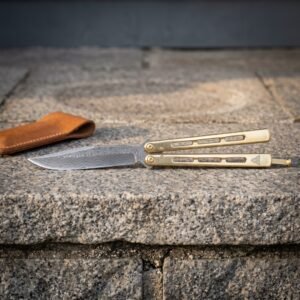 Brasslatch Hand Forged Damascus Butterfly Knife | 9 Inch Open Length | Skeletonised Brass Handles and Triquetra Mark with Tan Leather Pouch | Everyday Carry Gift | RK-1940
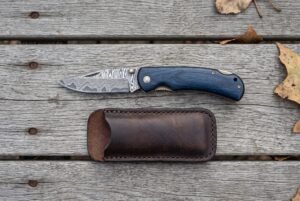 Bluegrain Hand Forged Damascus Folding Pocket Knife with Blue Hardwood Handle & Cowhide Leather Sheath | Gentlemans Everyday Carry Gift | RK-382
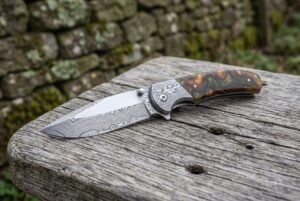 Resincarry Hand Forged Damascus Folding Pocket Knife with Resin Handle | Everyday Carry Collector Gift for Him | RK-10491
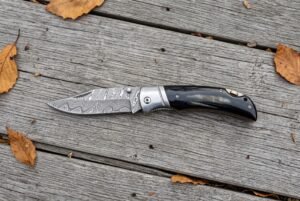 Hornfold Hand Forged Damascus Folding Pocket Knife with Buffalo Horn Handle | Everyday Carry Outdoor and Collector Gift | RK-687
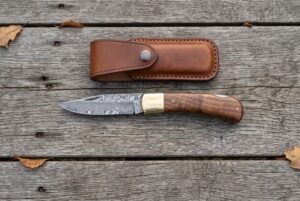 Walnutfold Hand Forged Damascus Folding Pocket Knife with Walnut Wood Handle and Brass Bolster & Handmade Leather Sheath | Everyday Carry Gift for Him | RK-1061
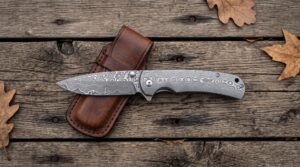 Leafcarry Hand Forged Damascus Folding Pocket Knife with Damascus Steel Handle Ready for Engraving & Cowhide Leather Sheath | Everyday Carry Collector Gift | RK-375