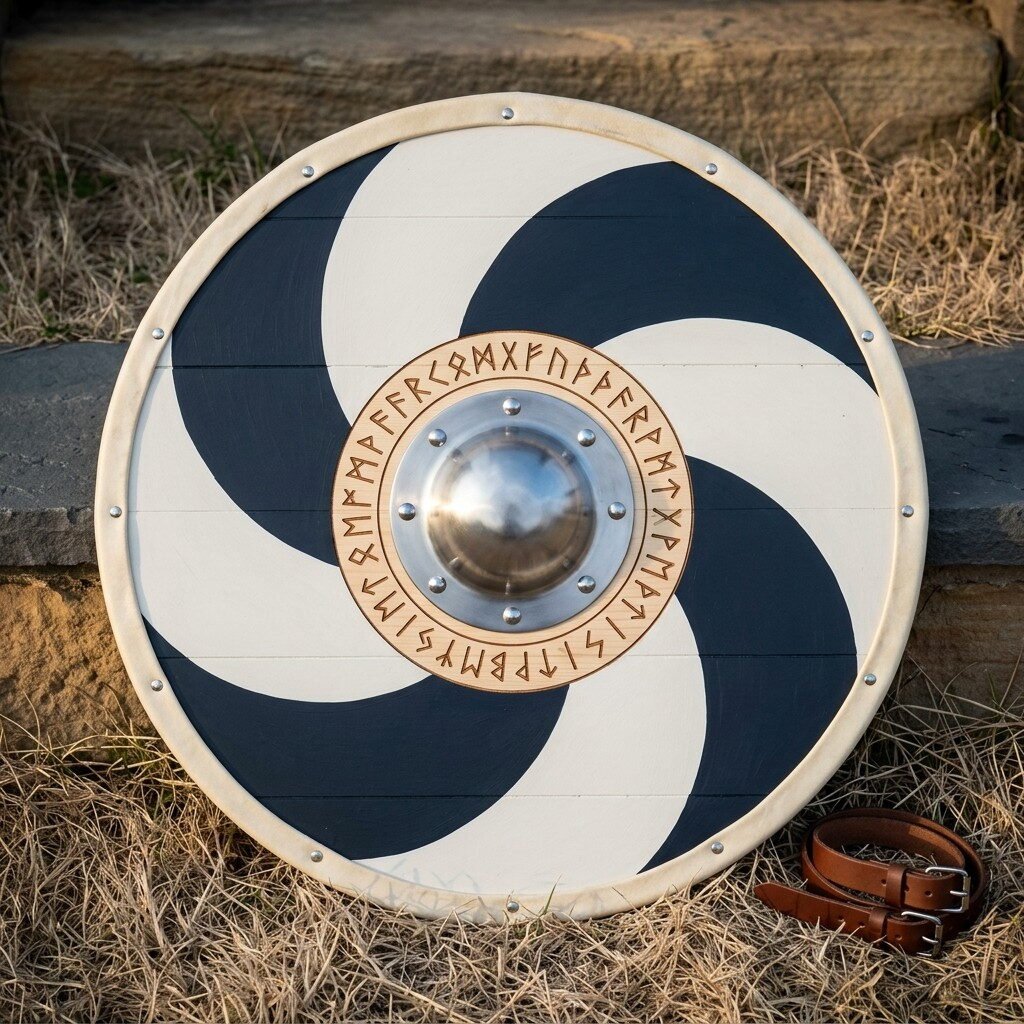
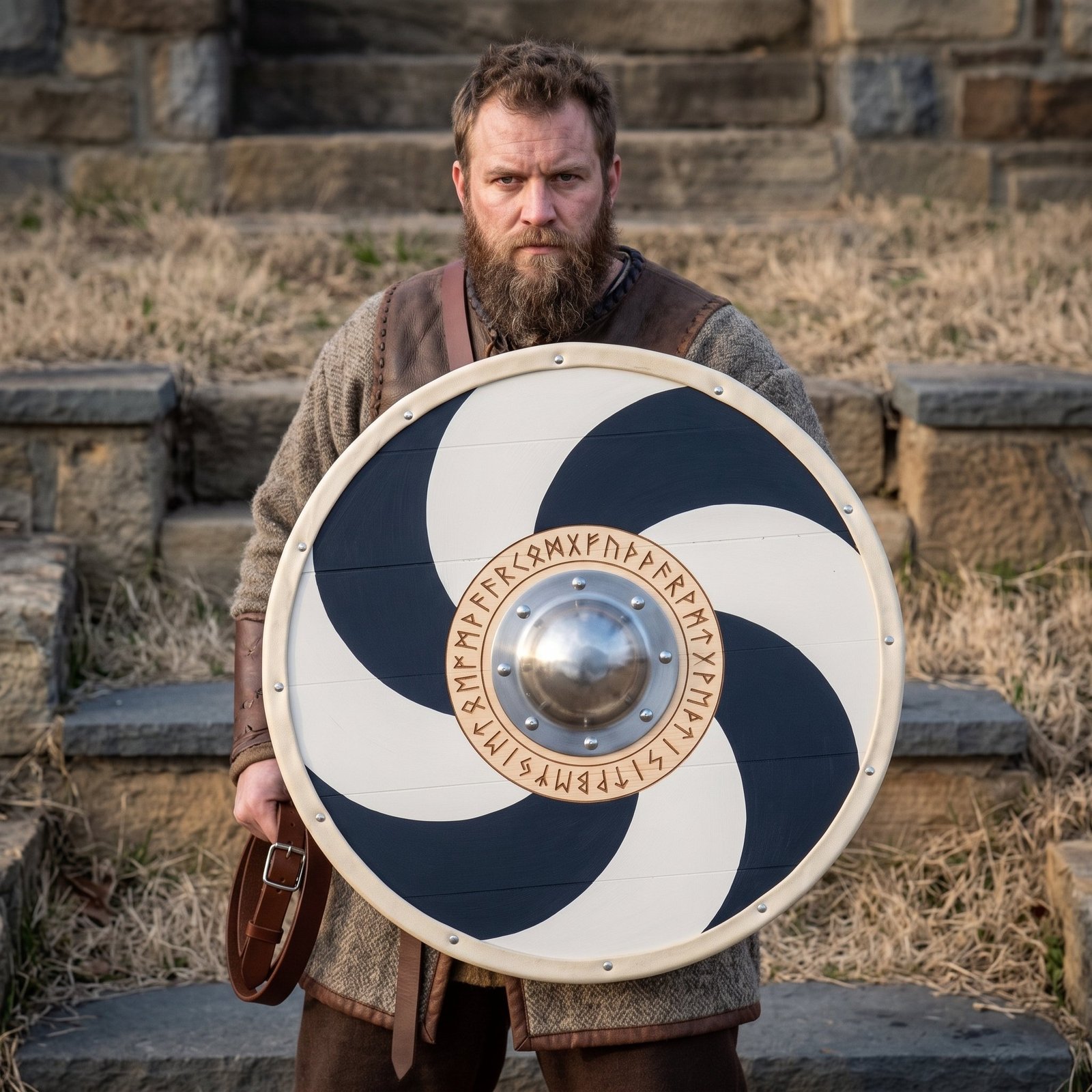
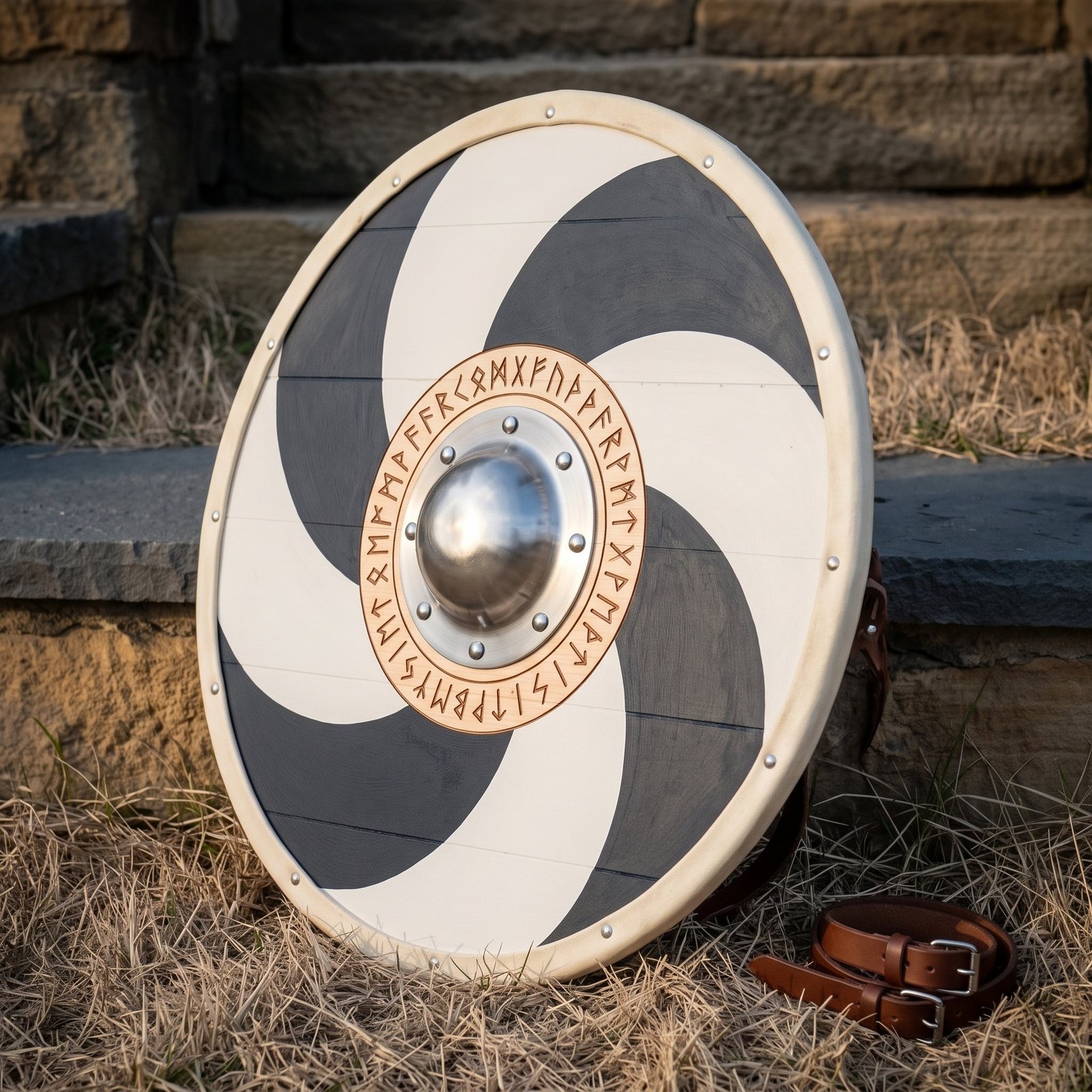
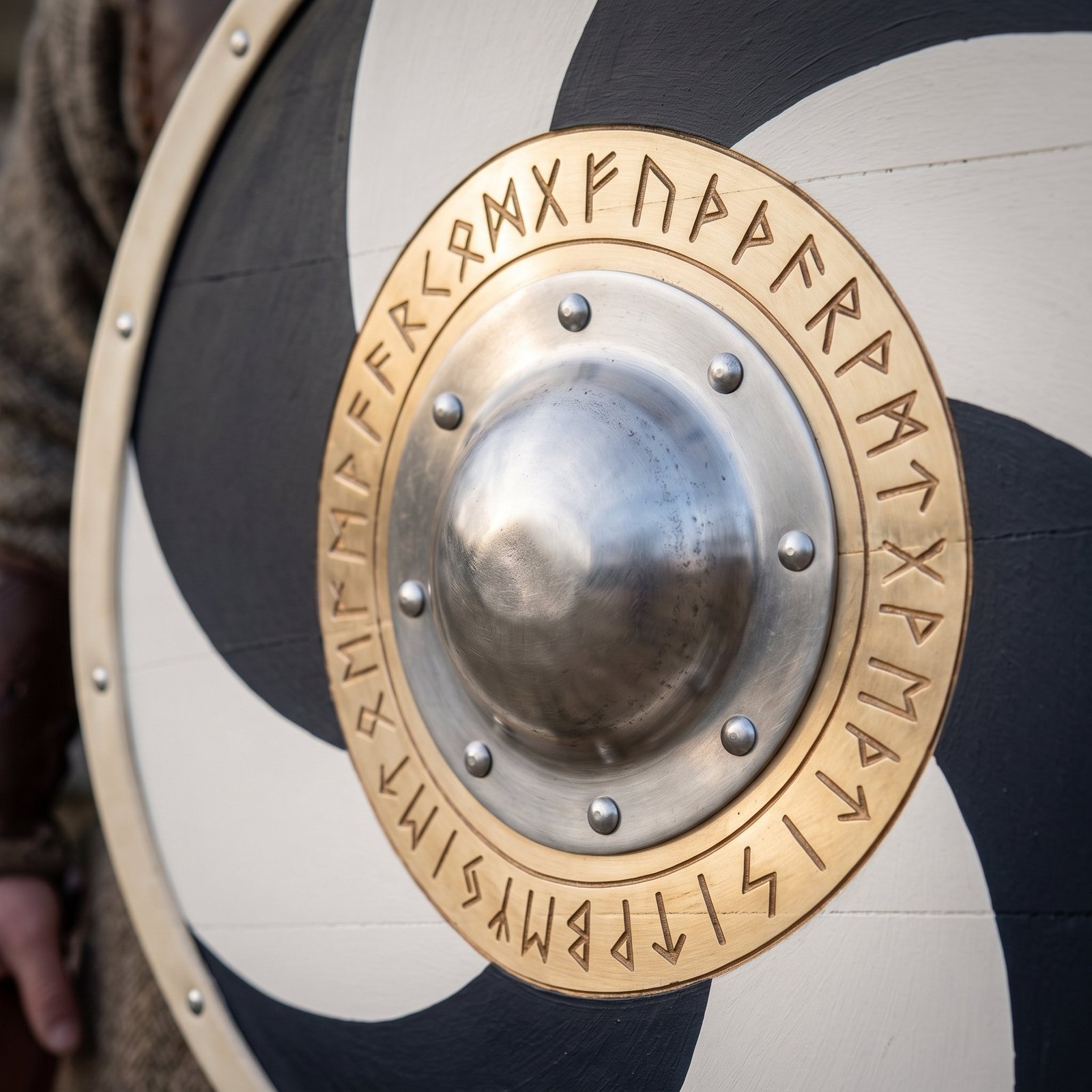
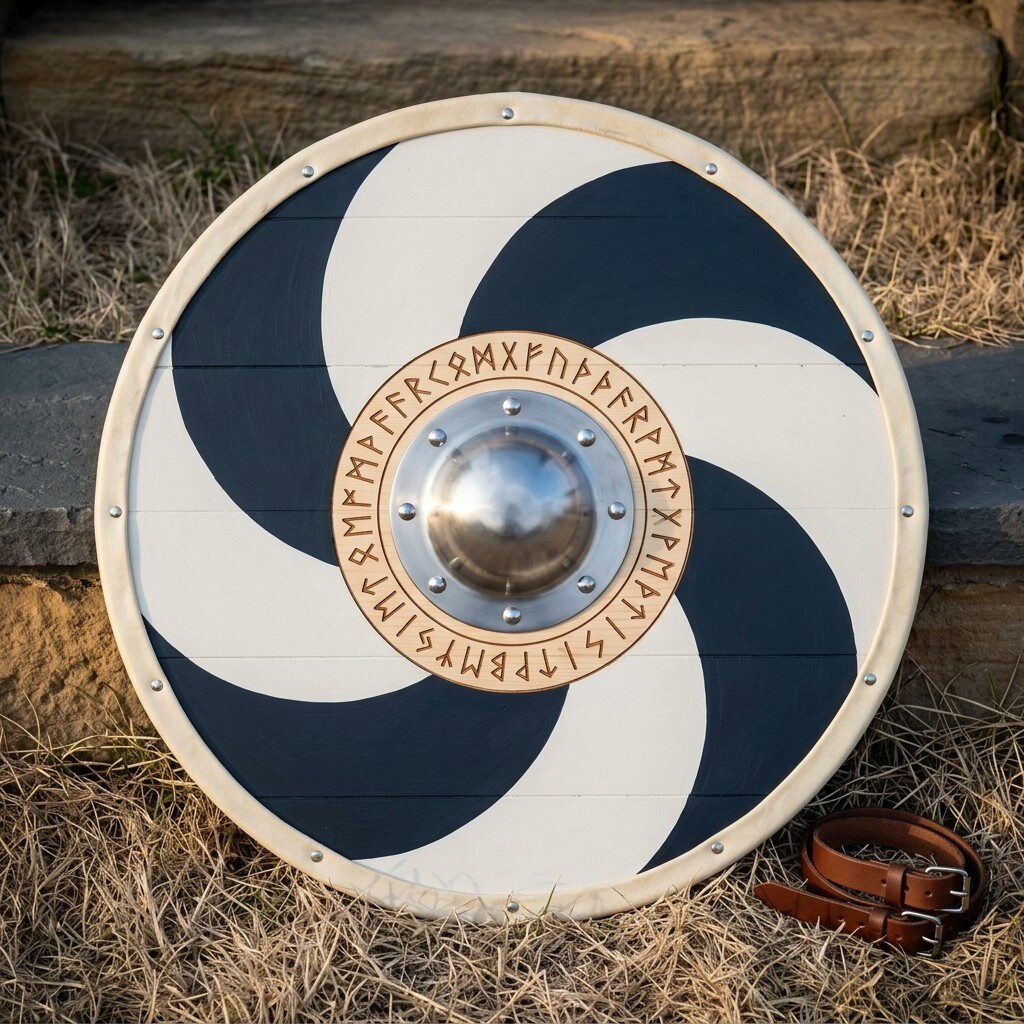
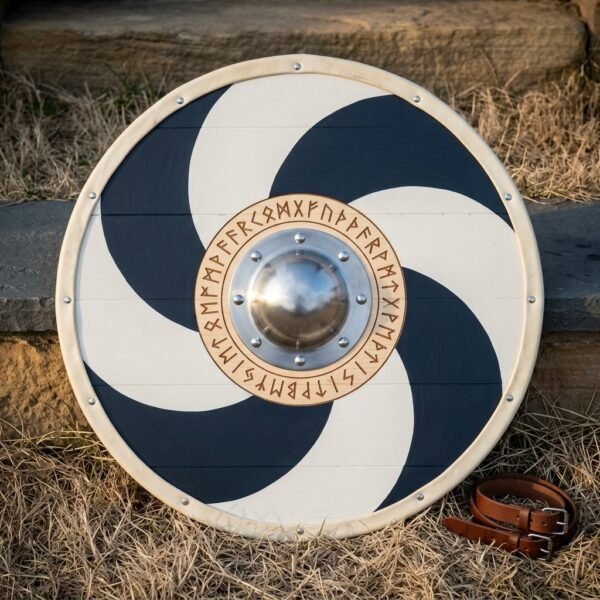
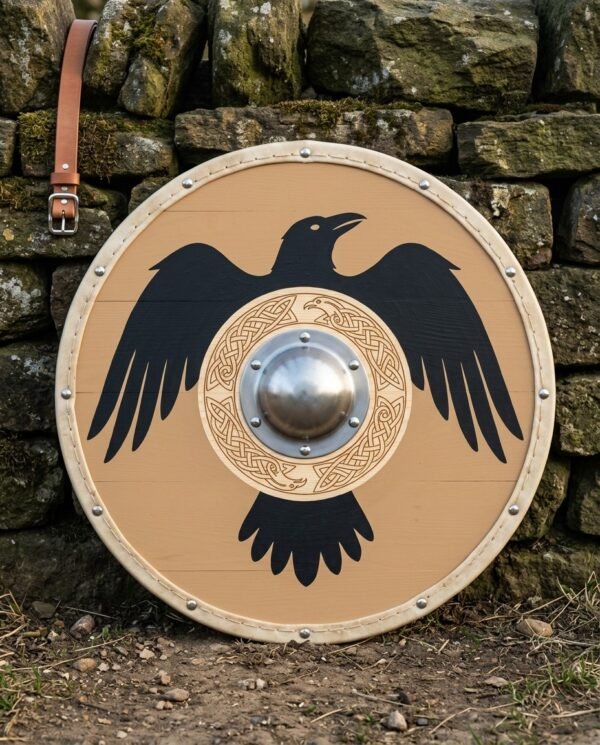
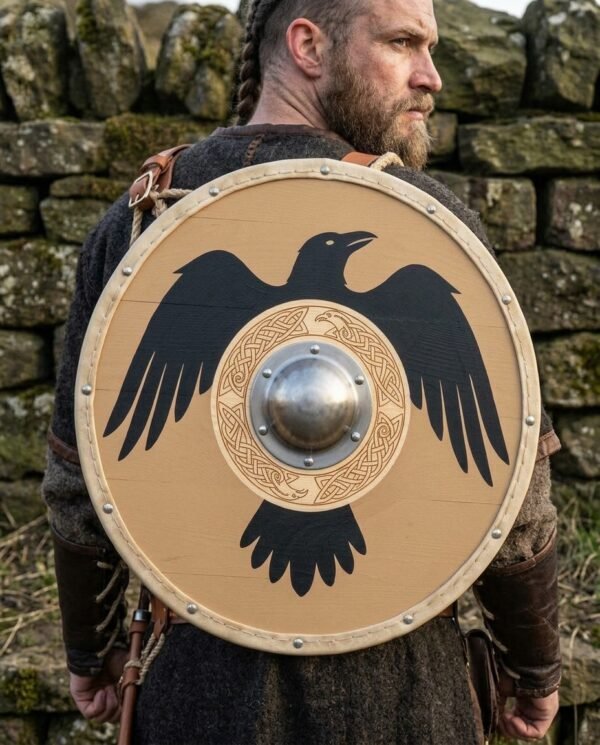
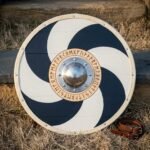
A Viking round shield built the way the originals were built: straight planks glued edge to edge into a disc, faced and painted, bound around the rim, and pierced at the centre for a hand hole that is covered by a domed steel boss. This one carries a four armed pinwheel in deep navy on off white, a pale rawhide rim held down by rivets around the whole circumference, and a wooden ring around the boss cut with a full line of Elder Futhark.
The pinwheel is not invented decoration. Fragments and whole shields recovered from the Gokstad ship burial in Norway were painted in alternating black and yellow, and simple radial and swirl schemes appear repeatedly in the archaeology and in later saga description. A pattern that rotates around the boss does something useful in a shield wall: it draws the eye to the centre, and it makes the shield read instantly as yours in a line of thirty identical discs. This one is cut, planked, faced, painted and fitted in the Czech Republic, and it ships assembled with the boss and grip already riveted. How these were planked, faced and gripped is in our guide to Viking shields.
Specifications
| Diameter | 24 inches |
|---|
| Material | Glued plank softwood board, horizontal planks, painted face |
|---|
| Board thickness | Approximately 12 mm at the centre |
|---|
| Face | Hand painted pinwheel with four navy arms on off white |
|---|
| Boss | Domed polished mild steel boss on a flat flange, fixed with eight steel rivets |
|---|
| Rune ring | Natural wood ring around the boss with a full line of Elder Futhark cut and darkened |
|---|
| Rim | Pale rawhide edging, held by steel rivets around the full circumference |
|---|
| Grip | Timber hand grip across the reverse behind the boss |
|---|
| Weight | Approximately 8 lb |
|---|
| SKU | RK-1553 |
|---|
What a shield boss is actually for
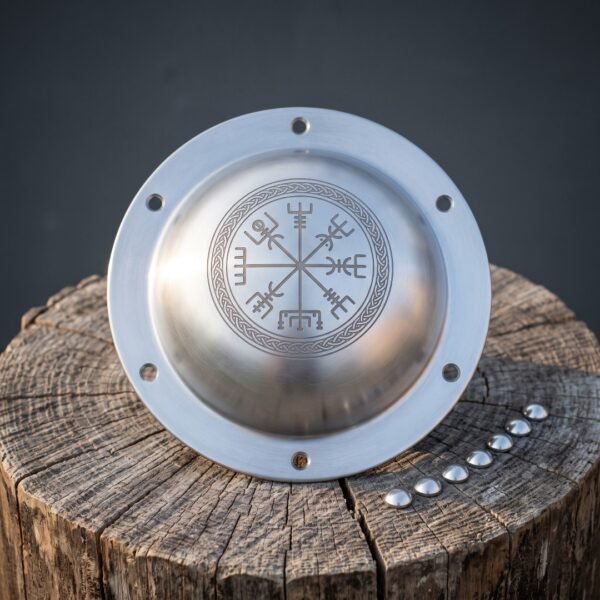
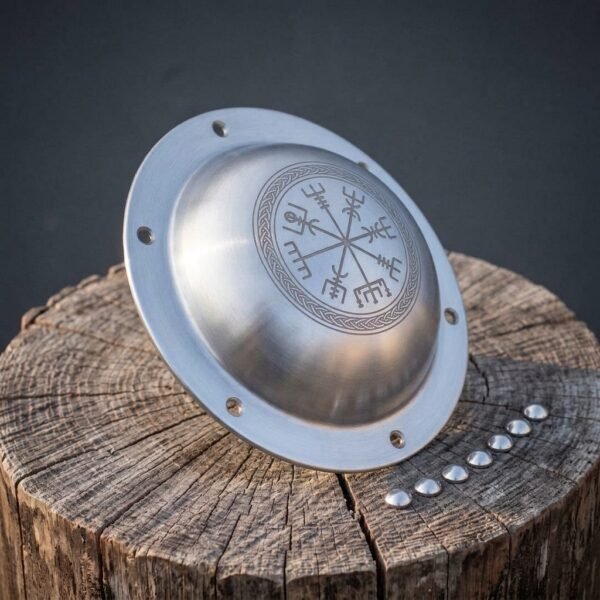
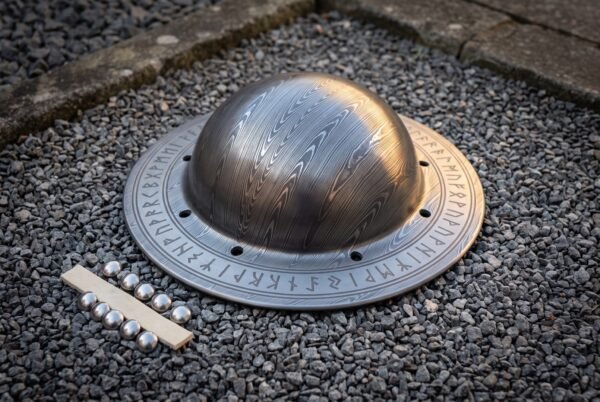
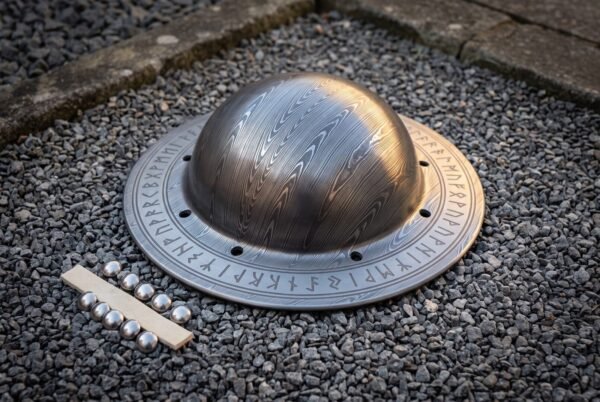
Most people assume the boss is armour for the front of the shield. It is not, or at least that is the least of its jobs. A Viking round shield is centre gripped. There is a hole cut clean through the middle of the board and your fist goes into that hole, closed around a bar that runs across the back. The boss is the iron dome that covers that hole from the front. Without it your knuckles would be sitting in an open window in the middle of the shield.
That single design choice changes everything about how the shield is used. A centre gripped shield can be rotated instantly in any direction with a flick of the wrist, because the whole disc pivots around your fist rather than being strapped to your forearm. It can be punched forward into an opponent, and the boss is what makes that punch land as a steel dome rather than a wooden edge. It can be angled to slide an incoming blow off to the side instead of stopping it dead. The trade is reach and endurance: your arm is out at full extension and it gets heavy fast, which is why round shields are relatively light and relatively thin.
The rawhide rim does the other half of the work. A plank board split along the grain the first time an edge lands on it, so the rim binds the plank ends together and takes the cut instead of the wood. Rawhide is used because it goes on wet, shrinks hard as it dries, and grips the board like a steel band.
Board, paint and the rune ring
The board is straight planks glued edge to edge and worked to about 12 mm at the centre, which is squarely in the range that survives from the period. Gokstad shields measured around 7 mm, thin enough that they were expected to be damaged and replaced. Ours is a little heavier because a modern buyer wants a shield that lasts years on a wall or at a dozen events, not one campaign.
The face is painted rather than printed, so the pinwheel arms have real edges and a little paint texture where the brush turned. The rune ring is cut into a timber collar around the boss and darkened so the characters read from a distance. The boss is mild steel, raised into a dome and riveted through the board with eight rivets around its flange.
Be honest about what this shield is for. It is built for display, for costume, for photography and for light reenactment and drill. It is not a full contact combat shield. A shield that goes into a hard hitting line needs a heavier board, a steel rim or a very heavy rawhide rim, and it will be treated as a consumable. If your group tests kit for the line, ask them what they specify before you buy.
Engraving, runes and your own design
Use the rune converter on this page to turn a name, a date or a short phrase into Elder Futhark and we will cut it into the steel or the leather. If you would rather have a Viking pattern than a rune line, choose your own design in the engraving option above the add to cart button and tell us where it goes. Where a piece already carries an engraved design, your chosen engraving replaces it rather than sitting alongside it. On this shield that means your rune line takes the place of the ring around the boss. More on the engraving page.
Mounting and display
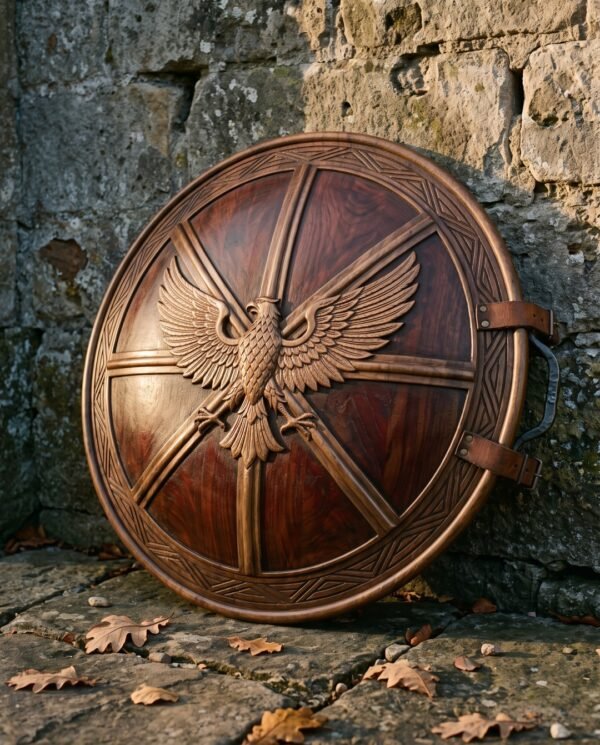
Hung on a wall, a 24 inch shield reads best at about eye height with the boss centred. Use two hooks bearing on the timber grip bar across the back rather than a single hook through the rim, which puts all eight pounds onto one rivet and will eventually pull. Keep it out of direct afternoon sun, because paint fades and rawhide dries and shrinks under UV faster than most people expect. If you are displaying it in a garage or a barn, be aware that a wooden board will move with humidity and the rawhide will tighten and loosen with it. The two loose leather belts lying in the grass in the photograph are studio props and are not included.
Care
Dust the face with a dry cloth. Do not wash it and do not use a solvent cleaner on the paint. The steel boss should get a wipe of light machine oil or a metal wax every couple of months, more often if it lives anywhere damp, and the same goes after any outdoor event. Feed the rawhide rim once or twice a year with a neutral leather conditioner so it does not go brittle at the rivets, which is where a rim always fails first. If a rivet loosens, tighten it rather than leaving it, because a loose rivet lets the rim shift and the plank ends start to work. Our notes on protecting metal are on the steel care page. If it is going on a wall rather than into a line, choosing a shield for display covers size and mounting.
Made in the Czech Republic
This is a handmade piece from the Czech Republic, made in a workshop that still forges, grinds and finishes by hand instead of stamping parts out. The smiths there have kept the older way of working, and the wood, horn and leather are shaped and fitted by hand as well. Two pieces of the same design will never be identical, and that is part of what you are buying.
Ransack Viking is a United States company. We handle the import ourselves, look over every piece when it lands and ship from our warehouse in Chicago, Illinois. Engraving is done in the United States after the piece arrives, so your design goes on before we send it out.
A note on handmade variation
This shield is hand made, not machine made or bulk produced. What arrives will not be a pixel for pixel copy of the photograph. The plank lines fall in different places, the paint edges are brushed rather than printed so no two pinwheels are identical, the rawhide takes colour unevenly across a hide, and the boss carries its own hammer marks. The diameter, the materials and the build are the same every time. The character is not, which is exactly what you want from a shield somebody actually made.
Frequently asked questions
Can I use this in full contact reenactment?
No. It is built for display, drill and light non contact reenactment. A combat line shield needs a heavier board and a much heavier rim, and it is expected to be destroyed and replaced. Check what your group certifies before buying any shield for the line.
Is it centre gripped or strapped to the arm?
Centre gripped, which is the historically correct arrangement for a Viking round shield. Your fist closes around a timber bar behind the boss. There is no forearm strap, and adding one changes how the shield handles completely.
How heavy is it to hold?
Around eight pounds, held at arm’s length on one fist. That is comfortable for a few minutes and tiring after twenty, which is exactly what a Viking would have told you.
Will the paint chip?
The face is painted wood, so yes, it will mark if you knock it against a doorframe or stack something on it. Small chips can be touched in. Treat it as a painted wooden object, not as a powder coated panel.
Can I choose different colours?
The listing is for the navy and off white pinwheel shown. If you want a different scheme or a family device, contact us before ordering and we will quote it as a custom paint job.
How does something this size ship?
Flat, in a fitted board box, free inside the United States. Processing is one to two weeks and returns are accepted within seven days in the original packing.
What is in the box
- One 24 inch Viking round shield, planked and painted
- Domed steel boss riveted at the centre
- Engraved Elder Futhark rune ring around the boss
- Rawhide rim, riveted around the full circumference
- Timber hand grip fitted across the reverse
- Care and warranty card
- Forged and finished in the Czech Republic
Explore the range
See the rest of the round shields, the shield bosses and fitting kits, the Viking helmets, and the guides.
Also in this part of the catalogue
Worth putting side by side with this is the Huginward round shield. In the same category sits the Emberward round shield. A near match for this one is the Boarshield round shield.
For a different piece from the same family, look at the Palecross buckler. Or start from a blank sheet on the design your own page.




Feels way more premium than the price suggests. Detail on this is incredibly crisp for something handmade. If you’re on the fence just get it. You won’t regret it.
Bought this on a whim and it turned out to be one of my favorite purchases this year. Exactly the weight and finish I wanted. Feels substantial without being bulky. Shipping was fast and everything arrived well packaged.
Did not expect this level of quality for the price. Ordered from Ransack Viking before and the quality stays consistent every time. If you’re on the fence just get it. You won’t regret it. Nice touch that it ships from within the US even though it’s crafted in the Czech Republic.
Was nervous ordering something like this online but so glad I did. Detail on this is incredibly crisp for something handmade. Already planning my next purchase from this shop.
Pretty impressed. Just a couple minor things I’d tweak. Nice piece though the chain is a little shorter than I expected. Would buy from this shop again.
This piece is well made. Just a couple small things kept it from 5 stars. Nice piece though the chain is a little shorter than I expected. Minor nitpicks aside, good quality piece.
So happy I finally pulled the trigger on this one. Detail on this is incredibly crisp for something handmade. So worth it.
My husband was speechless when he opened this. Exactly the weight and finish I wanted. Feels substantial without being bulky. This will be a family heirloom for sure.
Five stars isn’t even enough honestly. So worth it.
Middle of the road experience with this one. It’s alright. A bit smaller in person than the photos suggested. It’s okay for the price.