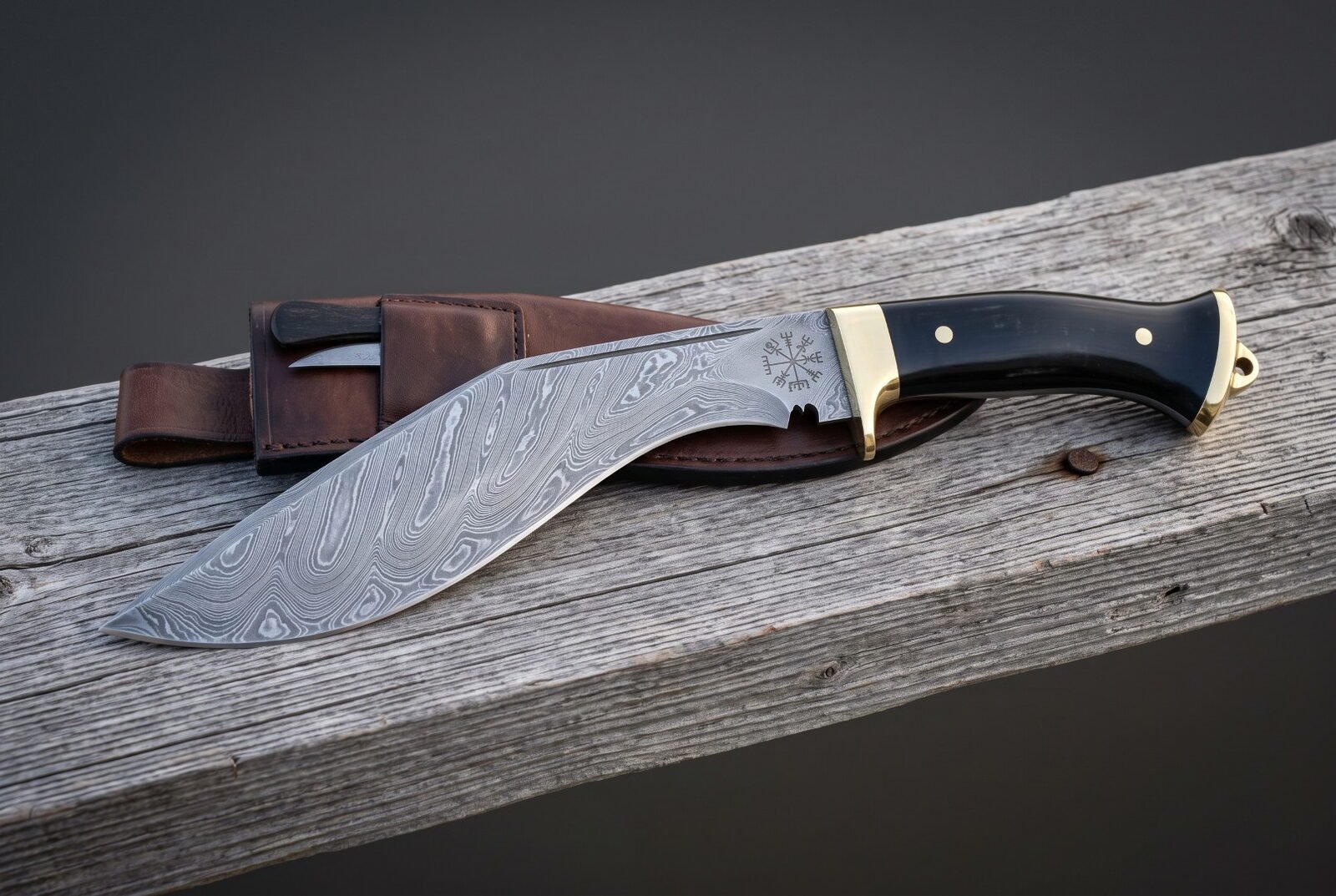
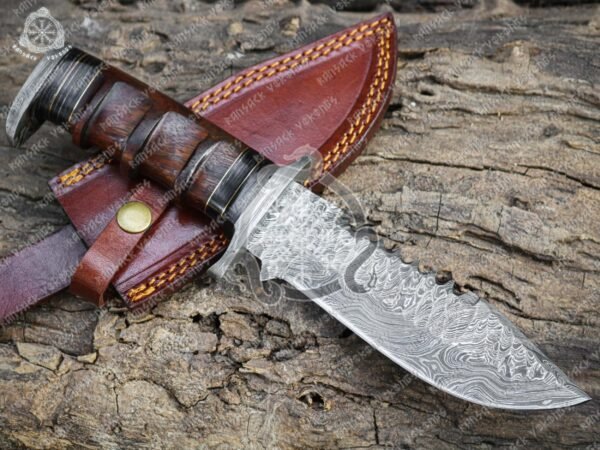
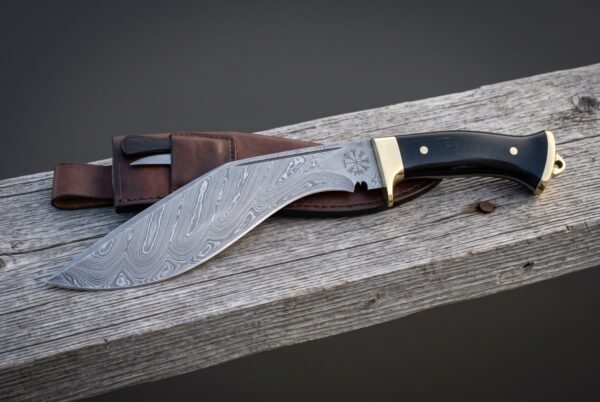
The Vegwarden is a kukri with a pattern welded blade, a brass bolster, black polished scales and a brass butt cap fitted with a small ring. Etched into the flat just forward of the bolster is a Vegvisir, the eight armed Icelandic stave usually called the runic compass, and cut into the base of the edge is the small notch that every traditional kukri carries. The Damascus figure follows the recurve of the blade, compressing on the inside of the belly where the steel has been squeezed and opening out along the spine.
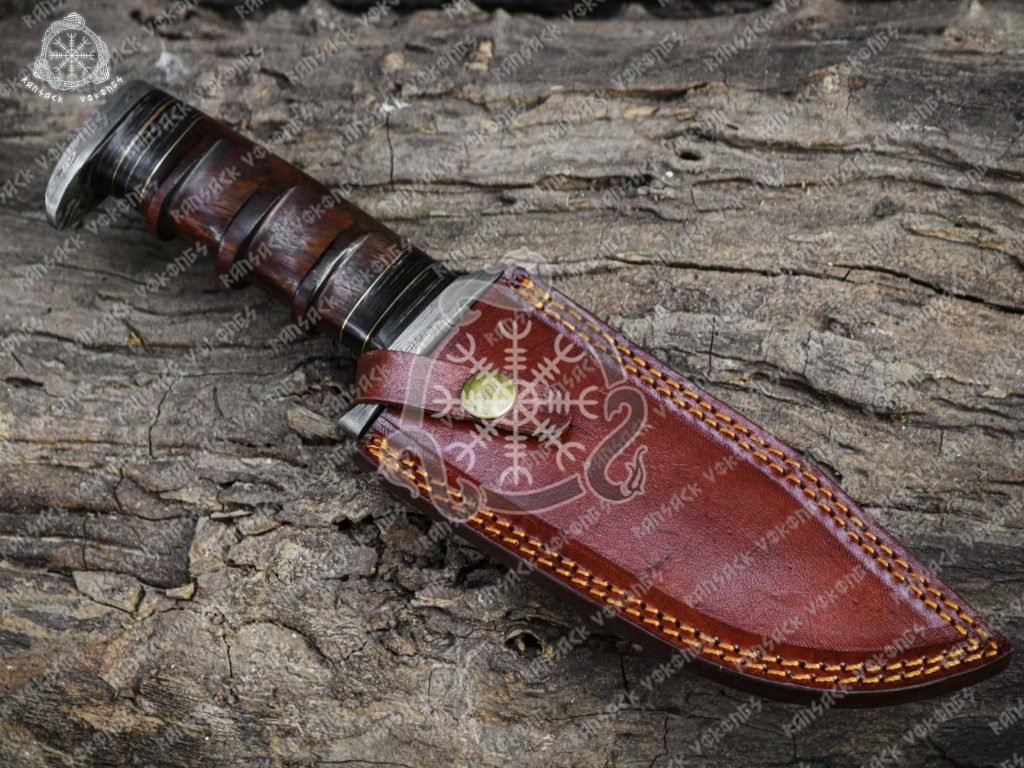
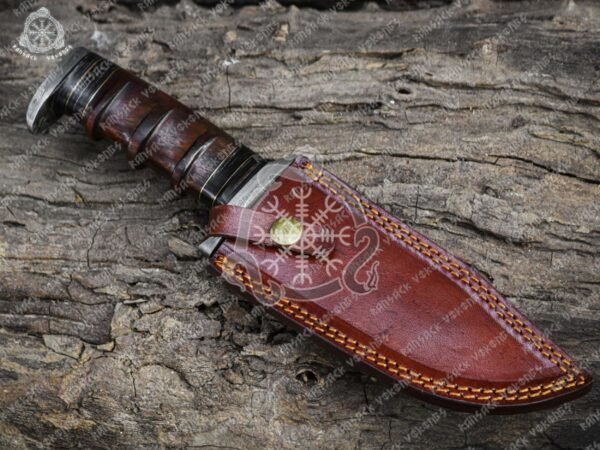
The kukri is one of the oldest continuously produced blade forms still in service anywhere. It has been the working knife and the sidearm of Nepal for centuries and it is still carried by Gurkha regiments today, which makes it a genuinely living design rather than a revival. Everything odd about the shape, the forward kink, the wide belly, the little notch, is there because generations of people who used one every day kept it. The Vegwarden is made by hand in the Czech Republic, imported and checked by Ransack Viking, and shipped from our Memphis, Tennessee warehouse. It comes with the fitted brown leather belt sheath shown in the photographs.
A kukri cuts on the belly rather than the tip, which is the argument the kukri explained makes at length. That stave is the vegvisir, and the vegvisir explained is worth reading before anyone tells you it is Norse. If you want a shorter belly for dressing game, the skinner knives cover that job.
Specifications
| Type | Kukri, forward angled recurve chopper, full tang |
|---|
| Blade | Pattern welded 1095 and 15N20 Damascus, 58 to 60 HRC |
|---|
| Blade profile | Deep recurve with a forward kink and a broad belly carrying the mass |
|---|
| Blade etching | Vegvisir stave etched on the flat forward of the bolster |
|---|
| Notch | Traditional cho cut into the edge at the ricasso |
|---|
| Bolster | Polished brass, wrapped around the front of the handle |
|---|
| Scales | Black polished scales pinned through the tang |
|---|
| Butt | Brass butt cap with a fitted ring |
|---|
| Sheath | Brown leather belt sheath with a loop |
|---|
| Included | Kukri and fitted brown leather belt sheath |
|---|
| SKU | RK-2078 |
|---|
Why a kukri is bent, and what the little notch is for
The forward kink in the spine is the entire point of the design. On a straight knife the edge is in line with the handle, so a chopping blow arrives with the wrist absorbing the shock and the mass of the blade spread evenly along its length. Angling the blade forward moves the centre of mass out past the hand and puts it directly behind the widest part of the belly, which is the part that actually meets the wood.
What that does is turn a knife into a short axe without adding much weight. The angle means the edge meets the target square even though your wrist is not bent, so you get the mechanical advantage of a chopping tool while still holding it like a knife. The broad belly carries the weight where it does the most good and the blade thins back towards the handle where weight would only slow the swing. It is a very old solution to the problem of wanting one tool that both chops and carves.
The notch cut into the edge at the ricasso is called the cho or the kaudi, and there are three explanations for it that all have some support. The practical one is that it stops a cut travelling back into the handle: a nick or a crack starting at the edge runs along the steel until it reaches the notch, where the shape breaks the stress path. The working one is that it acts as a drip point, so sap, blood and water run off the blade there rather than tracking back onto the grip. The traditional one is that it is a symbol, read variously as a cow hoof or as a representation of Shiva, and that reading is the reason it appears on every kukri whether or not anyone believes the other two. Take your pick. The notch has been there for centuries either way.
The Vegvisir, and the honest history of it
The eight armed stave etched into this blade is the Vegvisir. It is commonly sold as a Viking symbol and that is not true, so we will tell you what it actually is.
The Vegvisir appears in the Huld Manuscript, an Icelandic collection of magical staves compiled by Geir Vigfusson in 1860. It turns up in one or two other Icelandic grimoires of roughly the same period and nowhere at all before that. There is no Viking Age carving of it, no runestone, no grave find, nothing in the sagas. It is an Icelandic magical sign from the early modern period, separated from the Viking Age by something like eight hundred years.
The text alongside it in the Huld Manuscript is short and worth quoting in translation: if this sign is carried, one will never lose one’s way in storms or bad weather, even when the way is not known. That is the whole of it. Nothing about ships, nothing about navigation at sea, and no compass. The modern reading of it as a Viking navigation device is a twentieth century addition.
None of which makes it a bad thing to carry. It is real Icelandic folk magic with a documented source and a clear meaning, and it is simply not a Viking symbol.
Pattern welded steel on a recurved blade
The blade is forge welded from 1095 and 15N20, folded and drawn, then ground to shape and etched. The bright bands are the nickel bearing 15N20 which resists the acid, and the dark bands are the 1095. Hardened and tempered to 58 to 60 HRC, the edge holds up to chopping while staying soft enough to take a stone rather than chipping out.
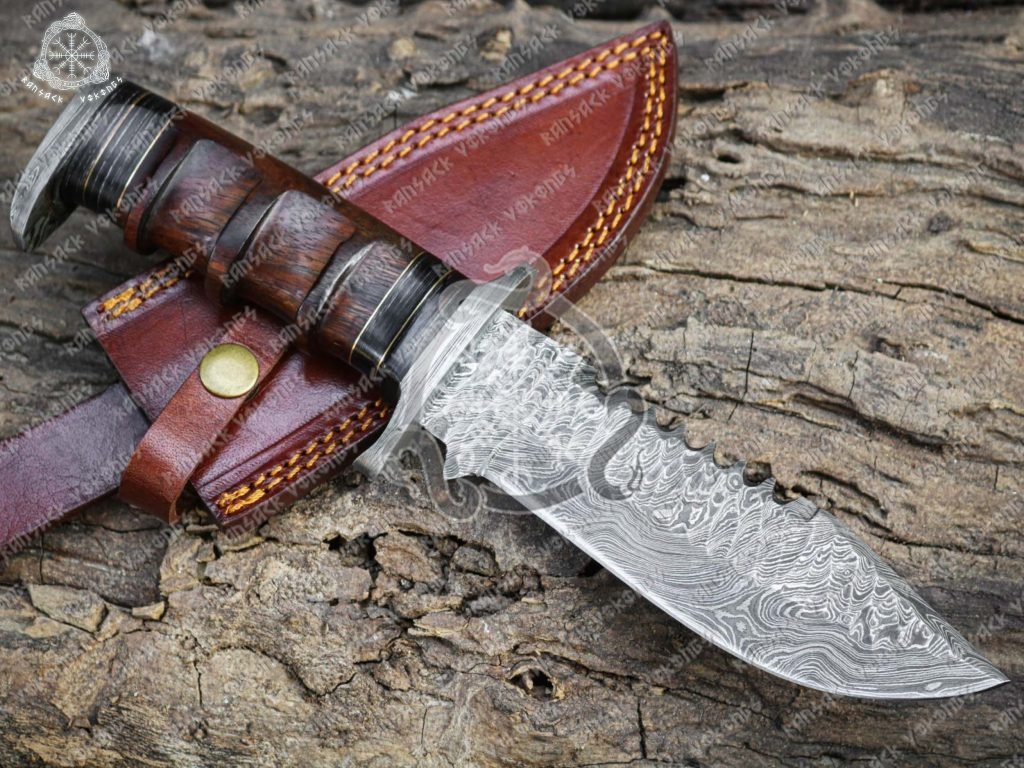
A recurve does something interesting to a pattern welded billet. Because the steel on the inside of the curve has been compressed and the steel along the spine stretched, the layers do not run parallel to the edge the way they would on a straight blade. They bunch up through the belly and fan out along the back, so the figure changes character along the length of one blade.
Engraving, runes and your own design
Use the rune converter on this page to turn a name, a date or a short phrase into Elder Futhark and we will cut it into the steel, the leather or the wood. If you would rather have a Viking pattern than a rune line, choose your own design in the engraving option above the add to cart button and tell us where it goes. Where a piece already carries an engraved design, your chosen engraving replaces it rather than sitting alongside it. On the Vegwarden a rune line would take the place of the Vegvisir stave. If you want to keep the stave, the leather sheath and the brass butt cap can both be marked instead. See the engraving page for what fits where.
Handling and balance
Pick this up and it feels blade heavy, and that is correct. A kukri is meant to balance well forward, out in the belly, because that is what lets a short blade chop like a much longer one. Hold it loosely, let the weight swing and let the edge do the work rather than muscling it. Gripping tight and forcing the cut is how people give themselves sore wrists with a kukri.
For carving and finer work, choke up so the hand sits right behind the bolster and use the section of edge nearest the notch, which is thinner and flatter. The ring on the brass butt cap gives you a positive stop against the little finger and somewhere to hang the knife.
This is a hand made collector and field knife with a real edge. It will chop, but it is not a felling axe and it is not a pry bar, and levering with the tip of a recurved blade is the quickest way to break one.
Care
Wipe the blade down and oil it after every use. Carbon Damascus is not stainless and the etched surface will find rust faster than a polish will, especially after cutting green wood or anything acidic. A light mineral oil on a cloth is enough.
Sharpen with a rod or a curved stone rather than a flat bench stone, following the existing bevel. Do not store the kukri in the sheath long term and never sheath it damp. Feed the leather with a cream once or twice a year and let it dry naturally. The brass tones down with handling and polishes back bright. Our steel care guide covers the rest.
Damascus wants oil more than plain steel does, because the etch that shows the pattern also opens the surface, and caring for a Damascus pattern covers what to use.
Made in the Czech Republic
This kukri is made by hand in the Czech Republic. Ransack Viking imports it, checks the grind, the recurve, the bolster fit, the pinning and the sheath, and ships it from our Memphis, Tennessee warehouse. Nothing here is drop shipped from an importer catalogue straight to a customer. Shipping in the United States is free. Processing usually takes one to two weeks and engraving adds to that. Returns are accepted within seven days. The lifetime warranty against defects in forging, grind, heat treat and fittings has no end date and needs no receipt.
A note on handmade variation
This knife is hand made rather than machine made or bulk produced, so what arrives will not be a pixel for pixel copy of the photograph. The pattern in the steel is different on every blade, and on a recurve it varies more than usual because of how the layers compress through the belly. The scales differ in the depth of their grain, the brass varies in tone, the notch is cut by hand and no two are identical, and the etched Vegvisir sits a fraction differently. The dimensions, the material and the build are the same every time. The character is not.
Frequently asked questions
Is the Vegvisir a genuine Viking symbol
No, and we would rather say so. It comes from the Huld Manuscript of 1860, an Icelandic collection of magical staves, and there is no evidence of it before the nineteenth century. It is real Icelandic folk magic, just not Viking Age.
What is the notch at the base of the edge
It is the cho, found on traditional kukri. It stops a crack from running back into the handle, it works as a drip point, and it is also read as a religious symbol.
Can I chop wood with it
Yes. That is what the forward angle and the heavy belly are for. Let the weight do the work rather than forcing it, and keep the edge out of dirt and stone.
How do I sharpen a recurved edge
With a round rod, a curved ceramic or the corner of a stone, following the existing angle. A flat bench stone cannot reach the inside of the curve and will only touch the tip and the heel.
Does the sheath take a belt
Yes. It is a stitched brown leather belt sheath with a loop, made to be carried rather than only displayed.
How long does an order take
Processing is one to two weeks from our Memphis warehouse, then free standard shipping inside the United States. Engraving is cut here after the knife arrives, so allow extra days for that.
What is in the box
- Vegwarden Damascus kukri with etched Vegvisir
- Fitted brown leather belt sheath
- Light protective oil film on the blade
- Hand made in the Czech Republic, shipped from our Memphis, Tennessee warehouse
Explore the range
More in kukri knives, hunting knives, Viking knives and engraved and personalised pieces, or read the guides.




Reviews
There are no reviews yet