
Blog
Hnefatafl: The Viking Board Game and How It Is Played


Hnefatafl is the board game the Norse played before chess reached the north, and nobody can prove they know its rules. Its name means something close to king’s table, and it is asymmetric: one player defends a king in the centre of the board with a small force, the other attacks from the edges with roughly twice as many pieces. The defender wins by getting the king out. The attacker wins by pinning him down.
That much is certain. The exact rules are not, and any page that hands you a confident rulebook is selling you an opinion. No complete medieval account of how the game was played survives. What we have are boards and pieces from excavations, scattered mentions in Norse, Irish and Welsh writing, and one outside description written down in 1732 by the Swedish naturalist Carl Linnaeus, who watched a related game called tablut being played by Sami people in Lapland. Modern hnefatafl is a reconstruction built on those foundations, and a good one, but it is a reconstruction.
What survives, and what does not
The physical evidence is solid. A wooden board from Ballinderry in Ireland, dated to the tenth century, has a grid of seven by seven marked by peg holes, with the centre and the corners picked out. Fragments of a gaming board came from the Gokstad ship burial in Norway. Boards have been found at Trondheim and other settlement sites, and gaming pieces of bone, antler, glass and amber appear in graves across Scandinavia and the British Isles.
So we know the boards existed, we know the common sizes, we know the pieces came in two unequal sets with one distinguished piece, and we know from the marked centre and corners that those squares mattered. What we do not have is anybody from the period bothering to write down how a turn worked.
The Linnaeus account fills that gap and quietly creates a worse one. He recorded tablut in a Latin field journal, and most English speakers meet it through a translation published in 1811 by James Edward Smith. Tafl players have argued for decades about two points in that chain: how the king is captured, and where he has to reach to escape. Those two questions decide the balance of the whole game, which is why nearly every modern rule set is a proposed answer to them.
The board and the setup
Boards are square with an odd number of squares to a side, so that there is a true centre. Four sizes are in common use.
 Kingsflight Hand Made Walnut and Maple Hnefatafl Viking Board Game | Solid Hardwood Board with Turned Playing Pieces and Elder Futhark Border | Norse Family Gift | RK-1732
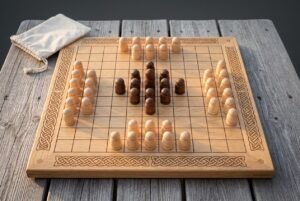 Kingsnare Hand Made Oak Hnefatafl Viking Chess Board Game | 11 by 11 Grid with 37 Turned Pieces | Burned Celtic Knotwork Border and Canvas Pouch | Norse Family Gift | RK-1752
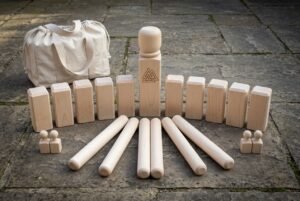 Oathfall Hand Made Maple Kubb Viking Lawn Game Set | 21 Pieces with Valknut Engraved King | Canvas Carry Bag and Field Markers | Outdoor Family Gift | RK-1755
Board sizes
Seven by seven is the smallest, matching the Ballinderry find and the Irish game called brandub. It plays fast and is the right size for teaching. Nine by nine is the size Linnaeus recorded for tablut. Eleven by eleven is what most modern players and tournaments use. Thirteen by thirteen appears in some reconstructions, and a very large variant called alea evangelii is described in a medieval English manuscript.
Setting up an eleven by eleven board
Label the files a to k from the left and the ranks 1 to 11 from the bottom, as on a chessboard. The centre square, f6, is the throne. The four corners, a1, a11, k1 and k11, are the refuges.
The king stands on the throne. Twelve defenders sit around him in a diamond: f4 and f8 on the file above and below, d6 and h6 on the rank to either side, then e5, f5 and g5 below him, e6 and g6 beside him, and e7, f7 and g7 above him.
Twenty four attackers sit in four groups of six, one against the middle of each edge. On the bottom edge they occupy d1, e1, f1, g1 and h1, with a sixth piece pushed forward to f2. The other three groups mirror that arrangement exactly against their own edges. The result is a cross of attackers pressing in on a diamond of defenders.
How the pieces move
Every piece on the board, the king included, moves the way a rook moves in chess. Any number of empty squares, in a straight line along a rank or a file, never diagonally. No piece jumps over another, and no piece lands on an occupied square. That single rule covers all movement in the game.
The attackers move first in most rule sets. Players then alternate, one move each turn.
The restricted squares
Only the king may stand on the throne or on a corner refuge. Ordinary pieces of either side are barred from all five. Most rule sets allow a piece to pass straight through the throne once the king has left it, though some require players to move around it, so agree this before you start.
The corners and the empty throne are also hostile squares. They act as though an enemy piece of either colour were standing on them for the purposes of capture, which is what makes the corners dangerous to approach carelessly.
Capture
Capture is custodian capture, meaning you take a piece by sandwiching it, not by landing on it. If your move leaves an enemy piece with one of your pieces directly on either side of it along a rank or a file, that enemy piece is removed at once. A hostile square counts as one of the two sides of the sandwich.
Three points follow from this and they cover almost every argument new players have.
First, capture only happens as a result of the moving player’s own move. A piece that moves voluntarily into the gap between two enemies is perfectly safe and stays there.
Second, a single move can capture more than one piece. If your arriving piece completes a sandwich on two or three different lines at once, every trapped piece comes off the board.
Third, diagonals never capture. Two enemies on the diagonal corners of a piece do nothing at all.
Capturing the king
This is the rule that varies most between versions, and it is the one to settle before the first move. In the most widely used modern form, the king is only captured when attackers or hostile squares occupy all four squares orthogonally adjacent to him. Some rule sets soften that when the king stands against the board edge or beside the throne, allowing three attackers to finish the job. Others treat the king as an ordinary piece who falls to a simple two piece sandwich, which is closer to one reading of Linnaeus and makes the attacker’s task far easier.
Winning
The defender wins by moving the king to a corner refuge. In the older tablut form recorded by Linnaeus the king escapes by reaching any square on the outer edge, which is a very much easier target and one reason that version tilts toward the defender.
The attacker wins by capturing the king. Some rule sets add a second attacking win: an unbroken ring around the entire defending force ends the game there.
Modern tournament rules add two further conditions. An exit fort is a formation the king builds against the edge that the attackers cannot break and from which he has a free move, and it counts as a defender win. A shieldwall capture lets a whole row of pieces standing against an edge be taken by bracketing the row at both ends. Both are twenty first century additions written to fix balance problems, and neither has medieval authority.
The known variants
Brandub is the Irish seven by seven game, played with a king and four defenders against eight attackers. Its name appears in early Irish verse, and the Ballinderry board fits it well.
Tablut is the nine by nine Sami game Linnaeus recorded, with a king and eight defenders against sixteen attackers. It is the only version of the family described by an eyewitness before the modern revival.
Tawlbwrdd is the Welsh form. A description written by Robert ap Ifan in 1587 puts a king and eight defenders against sixteen attackers on an eleven by eleven board, though most modern players run eleven by eleven with the larger twelve against twenty four armies.
Hnefatafl itself is the Norse name for the family, and the eleven by eleven twelve against twenty four setup is what most people mean by it today. The two rule sets you will meet by name are the Fetlar rules, written for the tournament held on the Shetland island of Fetlar, and the Copenhagen rules, which added the shieldwall and exit fort provisions.
How to actually play it well
The attacker’s job is to keep every route to a corner blocked while never leaving a gap in the perimeter. Attackers lose most often by chasing captures in the centre, which feels productive, and thinning the edge behind them. Hold the ring and force the defender to break out through a wall rather than a door you left open.
The defender’s job is to create two threats at once. A king who can reach one corner will be blocked. A king with clear lines toward two corners cannot be blocked by a single piece, and the whole art of the defending game is manufacturing that fork. Defenders should also be willing to give pieces away, since a defender piece traded for the opening of a line is usually a good deal.
Both sides should watch the hostile squares. A corner will capture your own piece if you park beside it and the enemy closes the other side, whoever owns it.
What is real and what is reconstructed
Real: the game itself, its two unequal sides, the king in the centre, the marked corners, the board sizes and the pieces. Real too is its decline, since chess arrived in Scandinavia and largely replaced tafl during the medieval period.
Reconstructed: nearly every specific rule. The movement rule is a confident reconstruction, since the game makes no sense otherwise and the Linnaeus account supports it. Custodian capture is also well supported. The king’s capture, the escape target, the status of the throne and every modern balance provision are argued positions rather than recovered facts. Anyone who tells you they know exactly how a tenth century Icelander played is describing a preference.
Setting the table around the game
Boards and pieces are in the hnefatafl and Viking games range, in solid hardwood with turned playing pieces and a burned or engraved border, with outdoor lawn sets alongside them for people who would rather throw things at a wooden king than move him around a grid. The rest of the setting is ours as well. Our Norse home pieces include carved birch kuksa cups, engraved slate rune stones on oak bases and wall plaques, all of which sit well beside a game that gets played over a long evening. The accessories range covers drinking horns, belt fittings and pouches. And because engraving is done in the US after arrival, anything from the engraved and personalised range can carry a name or a rune row cut to order, which makes a decent trophy for whoever keeps winning.
For background reading, our page on the Viking drinking horn and how it was really used and our guide to what runestones actually say are the two most useful starting points, and the Elder Futhark guide explains which rune row belongs to which century before you have anything engraved.
Other pieces that suit the same buyer are listed in presents for reenactors and, for a wedding, in Norse wedding gifts. A set also works as a groomsman present, covered in axes and blades for a wedding party.
Questions people ask
Do we know the real rules of hnefatafl?
Not completely, whatever you have been told. No medieval rulebook survives. We have boards and pieces from excavations, brief literary mentions, and the 1732 account of the related Sami game tablut by Carl Linnaeus. Modern rules are a reconstruction assembled from those sources, and the points that remain genuinely disputed are how the king is captured and where he must reach to escape.
How many pieces does each side have?
It depends on board size. The common eleven by eleven game gives the defender a king and twelve pieces against twenty four attackers. The nine by nine tablut game recorded by Linnaeus uses a king and eight defenders against sixteen. Seven by seven brandub uses a king and four defenders against eight. The attacker always has roughly double.
Is hnefatafl balanced?
Not inherently, which is why modern tournament rule sets exist. Small changes tilt it sharply: letting the king escape to any edge square favours the defender heavily, while allowing a simple two piece capture of the king favours the attacker. The Fetlar and Copenhagen rule sets are attempts to find a fair middle, and players are still arguing about whether either of them succeeded.
Can pieces move diagonally?
No. Every piece, including the king, moves only along ranks and files, any distance through empty squares, without jumping. Captures also work only along ranks and files. Two enemy pieces sitting diagonally beside one of yours have no effect at all, which catches out almost everyone arriving from chess, usually twice.
What happened to the game?
Chess replaced it. The chess family reached Scandinavia during the medieval period and spread quickly, and tafl faded from general play. It survived longest at the edges, which is why an eighteenth century naturalist in Lapland could still watch a version being played.
Is a seven by seven board worth buying for beginners?
Yes. Games finish in minutes rather than an hour, the tactics are the same in miniature, and it makes custodian capture obvious very quickly. Once players are comfortable, move to eleven by eleven, where the extra space turns the defender’s problem into a planning exercise.
On the shelf
Closest to this in the shop, the Kingsflight Viking board game and the Kingsnare chess board game. Alongside them, the Oathfall Viking lawn game and the Meadowfell Viking lawn game.
Shop the range
Kingsflight Hand Made Walnut and Maple Hnefatafl Viking Board Game | Solid Hardwood Board with Turned Playing Pieces and Elder Futhark Border | Norse Family Gift | RK-1732Kingsnare Hand Made Oak Hnefatafl Viking Chess Board Game | 11 by 11 Grid with 37 Turned Pieces | Burned Celtic Knotwork Border and Canvas Pouch | Norse Family Gift | RK-1752Oathfall Hand Made Maple Kubb Viking Lawn Game Set | 21 Pieces with Valknut Engraved King | Canvas Carry Bag and Field Markers | Outdoor Family Gift | RK-1755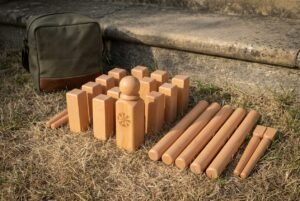 Meadowfell Hand Made Beech Kubb Viking Lawn Game Set | 20 Pieces with Vegvisir Engraved King | Waxed Canvas Bag and Leather Base | Outdoor Garden Gift | RK-1762