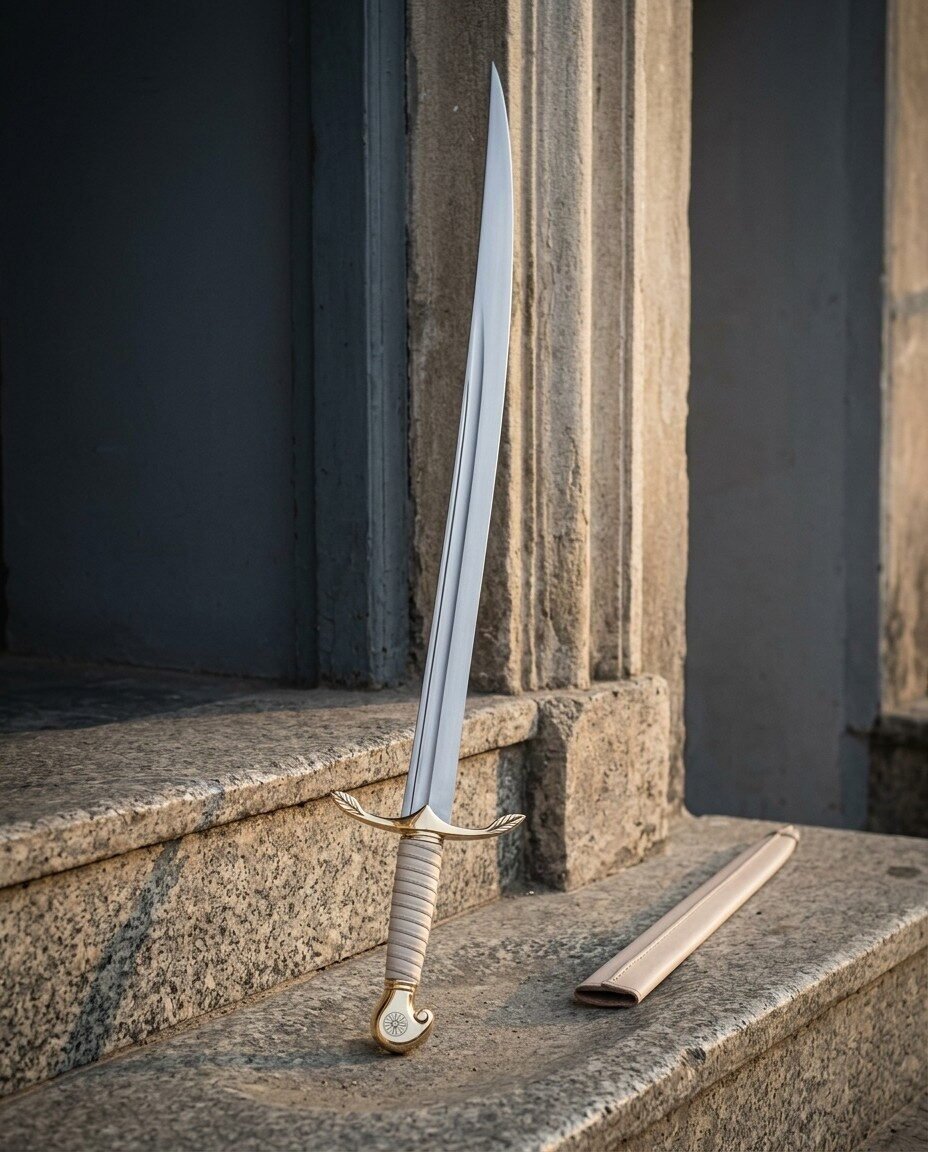
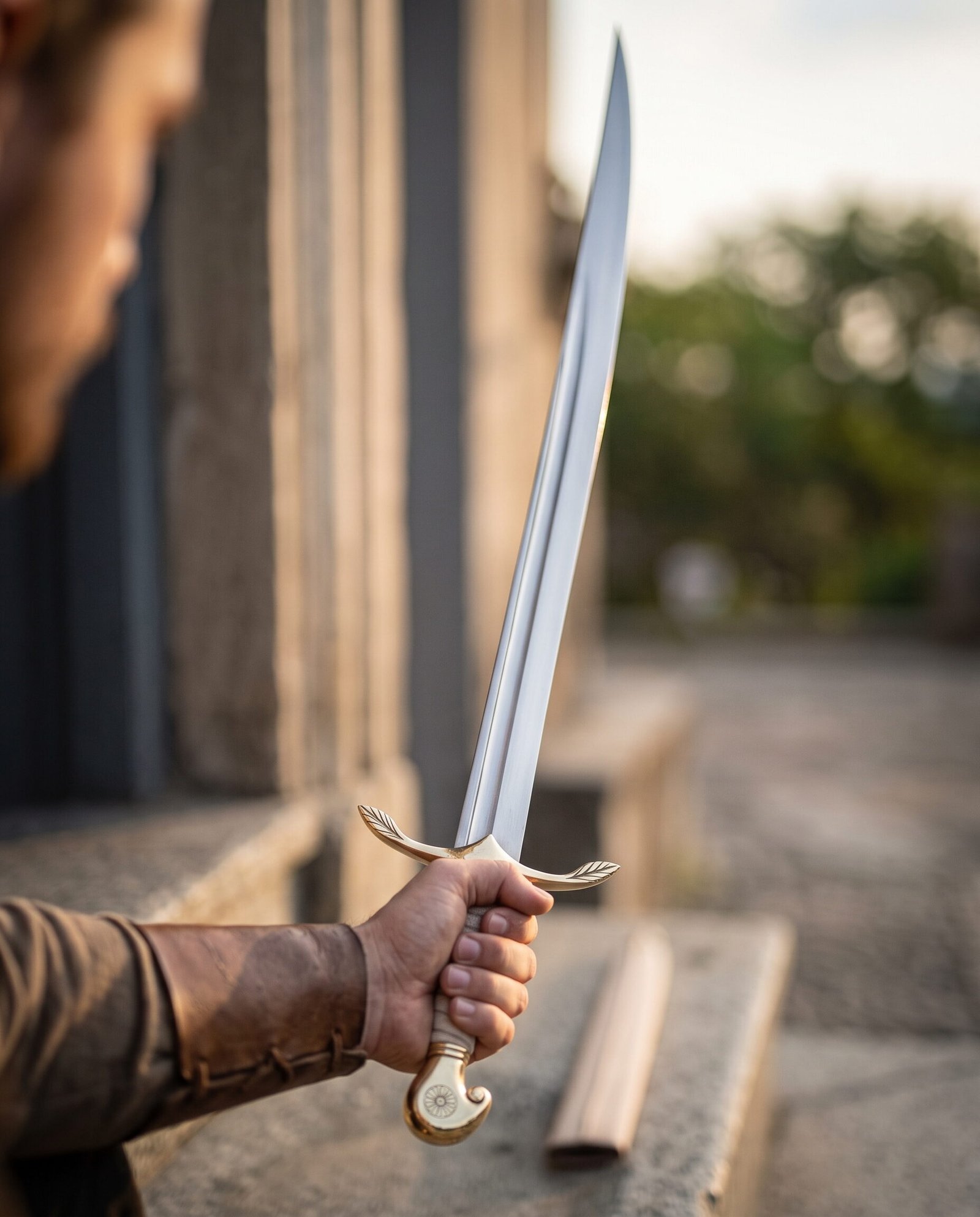
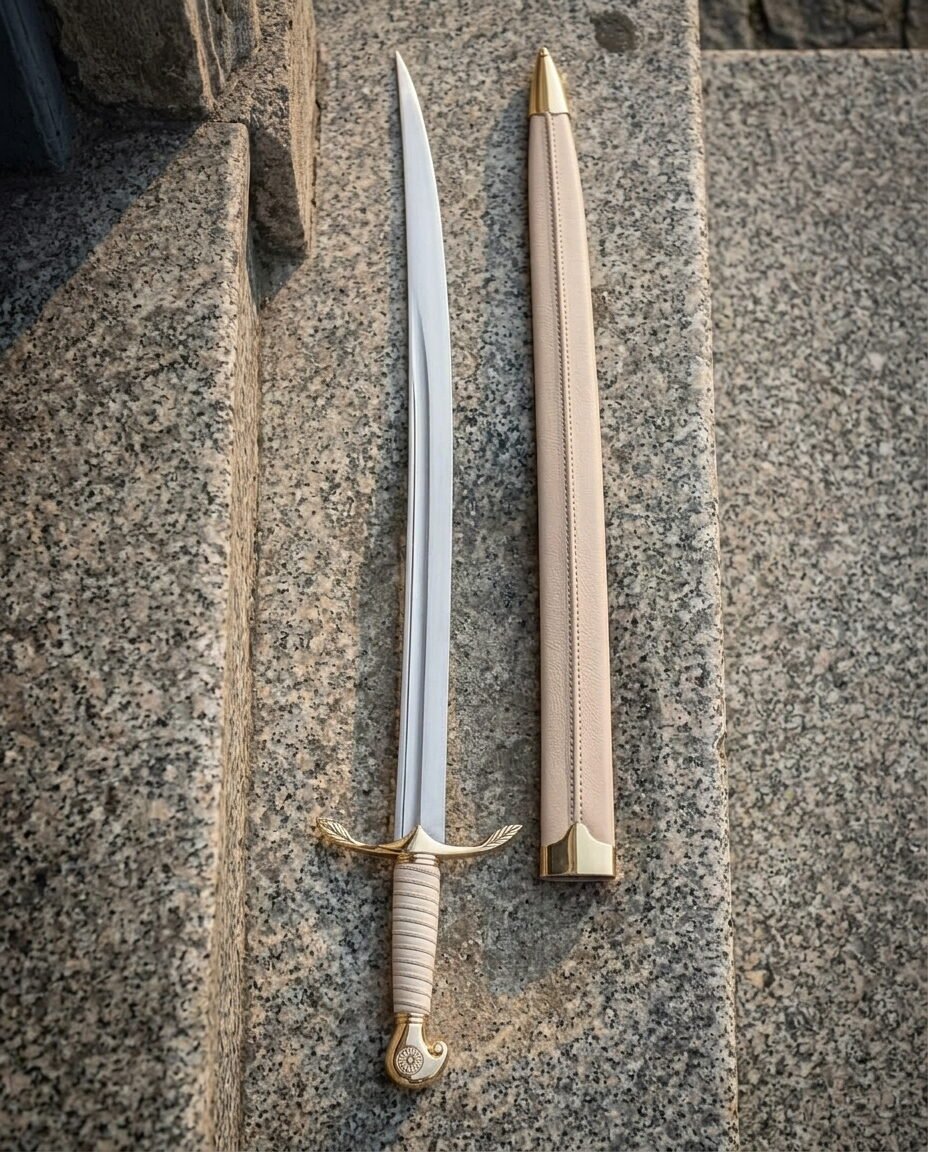
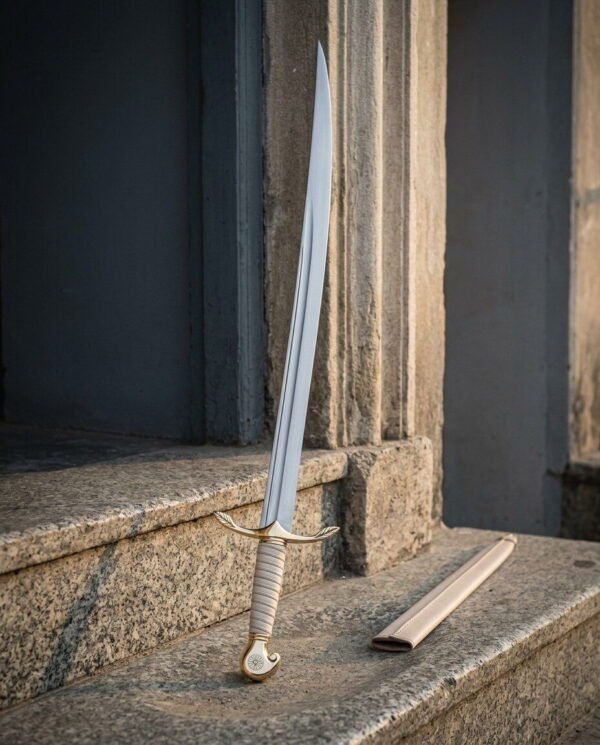
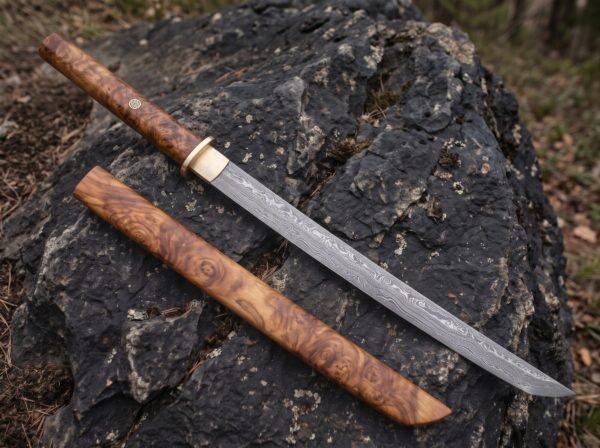
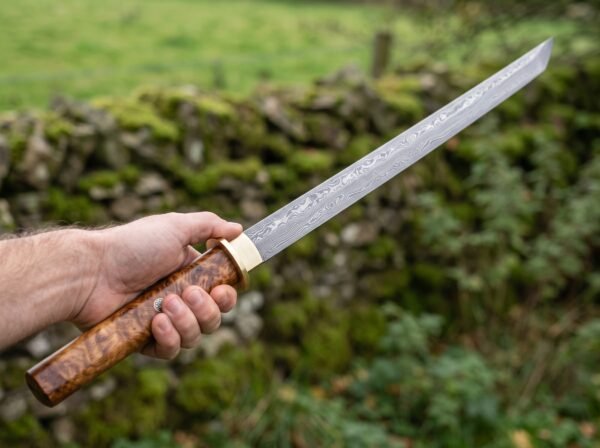
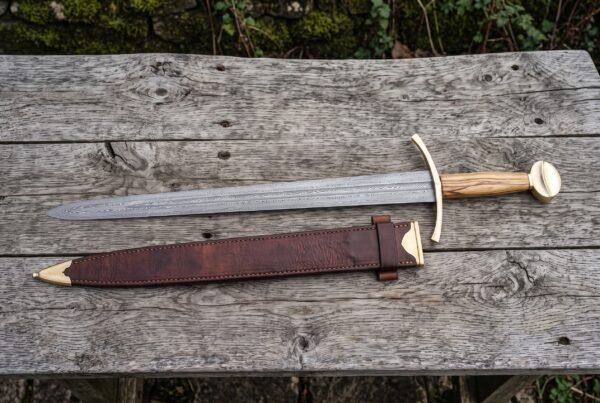
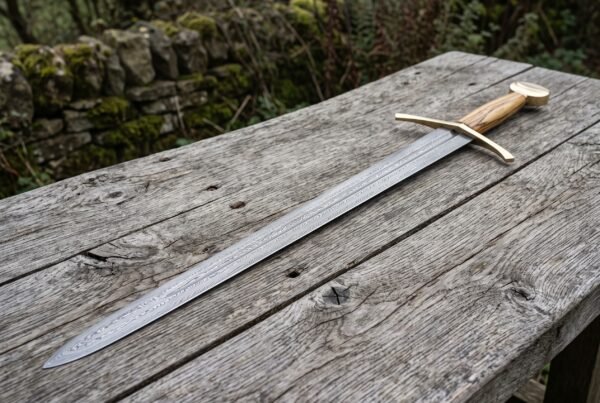
Palewind is a hand forged sabre with a slim curved single edged blade, a brass cross hilt whose quillons are shaped as long leaves sweeping toward the point, and a brass pommel finished as a tight volute set with a rosette medallion. The grip is wrapped in pale cream leather, and a matching pale leather scabbard ships with it. It is a ceremonial and display sabre rather than a fighting one, and everything about the fittings says so.
Brass on a sword hilt is a deliberate choice with real history behind it. Bronze and brass fittings appear on European hilts for two thousand years, not because smiths could not make steel ones but because a copper alloy can be cast to a fine shape in one pour, it takes engraving and chasing beautifully, and it does not rust in a scabbard against a sweaty hand. The trade off is softness. Brass dents where steel would spring. On a parade or presentation piece that never mattered, which is why the most elaborate hilts in any museum case are nearly always the soft yellow ones.
Forged, ground, hilted and finished in the Czech Republic. It ships with the pale leather scabbard, a protective oil film on the blade and a care card covering both steel and brass. Free shipping inside the United States, one to two weeks of processing while the brass is cast, filed and polished. It is catalogued with the fantasy and film swords, and the arming swords sit one click away.
Specifications
| Blade material | 1095 high carbon steel, 54 to 58 HRC |
|---|
| Hilt material | Brass guard and pommel, hand filed and polished |
|---|
| Overall length | Approximately 34 inches |
|---|
| Blade length | Approximately 27 inches |
|---|
| Blade profile | Slim curved single edge with a narrow spine side fuller |
|---|
| Guard | Leaf shaped brass quillons sweeping toward the blade |
|---|
| Pommel | Brass volute with an engraved rosette medallion |
|---|
| Grip | Pale cream leather with raised ribs, wrapped over a full tang |
|---|
| Scabbard | Matching pale leather scabbard with a brass throat and a brass chape |
|---|
| Included | Sabre and matching scabbard |
|---|
| SKU | RK-1816 |
|---|
What the curve is for
A curved blade does not cut harder than a straight one of the same weight. What it does is change the angle at which the edge meets what it is cutting. On a straight blade the edge arrives square on and has to push its way in. On a curve the edge arrives at a slant and slides along the target as it goes, which is a slicing action rather than a chopping one, and slicing takes far less force to start a cut in anything fibrous.
The cost is the same one every curved sword pays. You cannot thrust well with a curve because the point does not sit on the line of the handle, so your hand and the target are never quite in a straight line. Sabres accepted that bargain for four hundred years because on horseback, where every cut is a draw cut anyway, the curve wins outright.
The materials
The blade is 1095 high carbon steel, forged, normalised, hardened and tempered to 54 to 58 HRC. The spine is left thick and unsharpened, which keeps the blade rigid along its curve and lets the edge be ground fine.
The guard and pommel are brass, worked by hand after casting. Brass will darken with time into a deeper gold and eventually a warm brown patina. Some owners polish that back and some leave it. Neither is wrong, but be aware that a bright mirror polish on brass needs attention two or three times a year and a settled patina needs none at all.
Engraving, runes and your own design
Use the rune converter on this page to turn a name, a date or a short phrase into Elder Futhark and we will cut it into the steel, the leather or the wood. If you would rather have a Viking pattern than a rune line, choose your own design in the engraving option above the add to cart button and tell us where it goes. Where a piece already carries an engraved design, your chosen engraving replaces it rather than sitting alongside it. Brass takes an engraved line more deeply and more crisply than steel does, so the pommel medallion and the flat of the quillons are the best places on this sabre. See the engraving page.
Handling and balance
Brass is heavier than steel for its volume, so a brass hilt of this size puts real mass behind the hand and pulls the balance point back toward the guard. The sabre feels quicker than its length suggests and it turns easily from a high guard. The leaf quillons sit close to the hand and are shaped to guide rather than to trap.
This is a ceremonial and display sabre. The brass fittings are soft by nature and are not built to take repeated impact. It is not for sparring and should not be used in contact work against another person or another blade.
Care
Two materials, two routines. The steel wants a wipe down after handling and a thin film of mineral oil or paste wax on the flats, because 1095 is not stainless. Details are on the steel care page. The brass wants either a soft cloth and a little metal polish two or three times a year, or nothing at all if you would rather let it patinate. Do not use an abrasive paste on brass that sits next to a polished blade, because the grit travels.
Pale leather marks more easily than dark leather. Keep the grip and scabbard away from newsprint, denim dye and damp, and feed them with a colourless neutral balm rather than a tinted conditioner.
Made in the Czech Republic
The work behind this piece happens in a Czech Republic workshop that has kept to the old methods. Steel is forged and heat treated by hand, the grind is taken down by eye rather than by machine, and the handle, fittings and sheath are cut and finished one at a time. Because of that, every piece carries small marks of the hand that made it.
Ransack Viking is a United States company. We import direct, check each piece when it reaches us, and ship from our Chicago, Illinois warehouse. Engraving is added here in the United States after arrival, so the piece you receive is finished to your order.
A note on handmade variation
This sabre is hand made, not machine made or bulk produced, so what arrives will not be a pixel for pixel copy of the photograph. Brass is filed and polished by hand, so the leaf quillons will carry their own small differences in outline and the rosette will sit at its own depth. Pale leather is the least consistent leather there is, and the cream tone of your grip and scabbard will not match the photograph exactly. The curve of the blade is ground by eye. The dimensions, the materials and the build are the same every time. The character is not. If you want the longer version, look at the arms in Valhalla and then at the Witcher swords.
Frequently asked questions
Is the hilt solid brass or brass plated
Solid brass, cast and then filed and polished by hand. You can tell over time because plating wears through on the high points and solid brass simply darkens evenly.
Will the brass tarnish
Yes, and that is normal. Brass moves from bright yellow through gold to a warm brown over months or years depending on how often it is handled. Polish it back if you prefer bright, or leave it and it will settle.
Is the blade sharp
It ships with a cutting edge along the curve. Ask in the order notes if you would rather have it left blunt for a display room and we will do that at no extra charge.
Can I use it for stage or ceremonial work
For carrying, drawing and presenting, yes. For contact of any kind, no. Brass fittings deform under impact and this piece is not built or sold for that.
Does the pale leather stain easily
More easily than dark leather. Handle it with clean dry hands and keep it out of contact with dyed fabric, and it will stay pale for years.
How long does shipping take
One to two weeks of processing while the sabre is built, then free shipping inside the United States.
What is in the box
- One Palewind brass hilted sabre with leaf shaped quillons
- Matching pale leather scabbard with brass throat and chape
- Protective oil film on the blade
- Care card for high carbon steel, brass and pale leather
- Forged and finished in the Czech Republic
Explore the range
See more in swords, fantasy swords and Norse arms, or read the guides on caring for brass fittings.
If this one is not it
For a straight comparison, see the Twinreave movie sword, 44 inches overall. Worth putting side by side with this is the Everknot movie sword, forged from 1095. In the same category sits the Thornfang movie sword, 38 inches overall.
From the same corner of the shop, there is the Brassbloom scimitar. Pick the steel, the length and the fittings yourself on the design your own page.

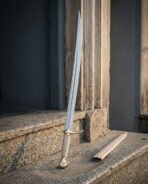
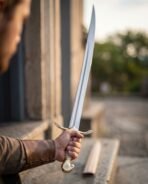
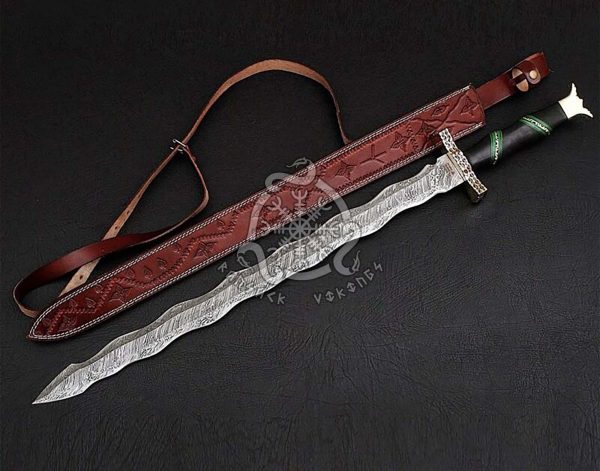
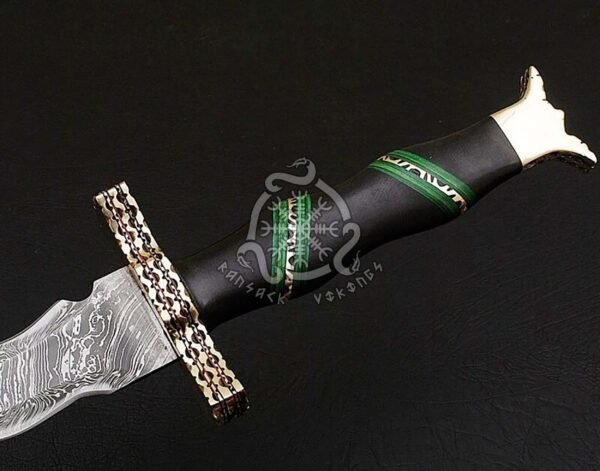
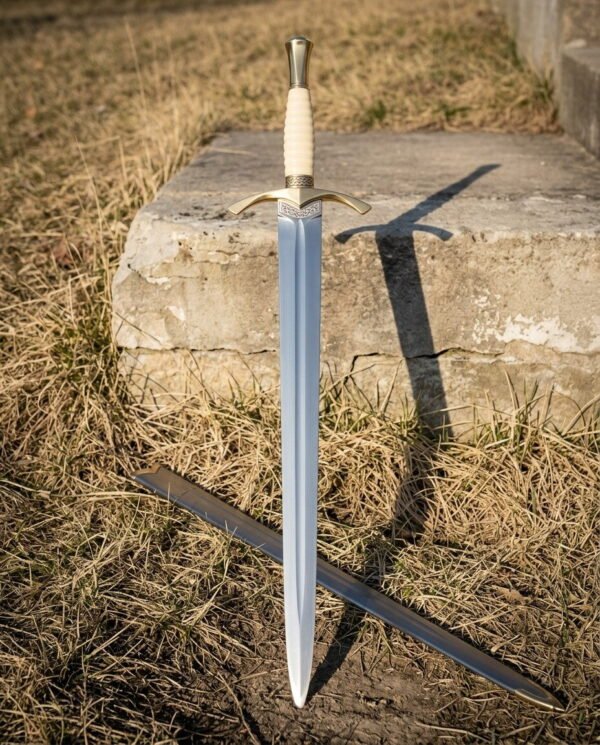
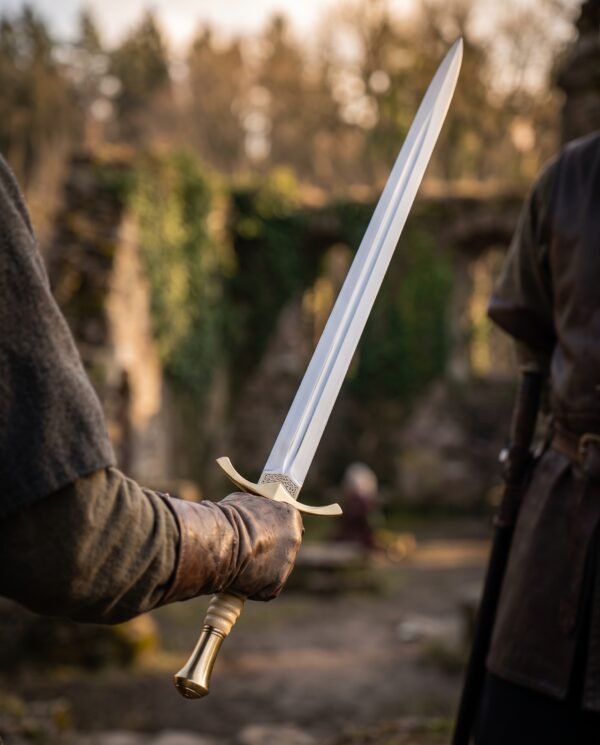
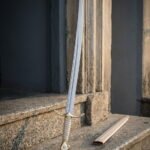
I collect stuff like this and this piece is on another level. Packaging was excellent and it arrived in perfect condition. Couldn’t be happier with this. You can tell it’s real Czech blacksmith work and shipping from the States made delivery painless.