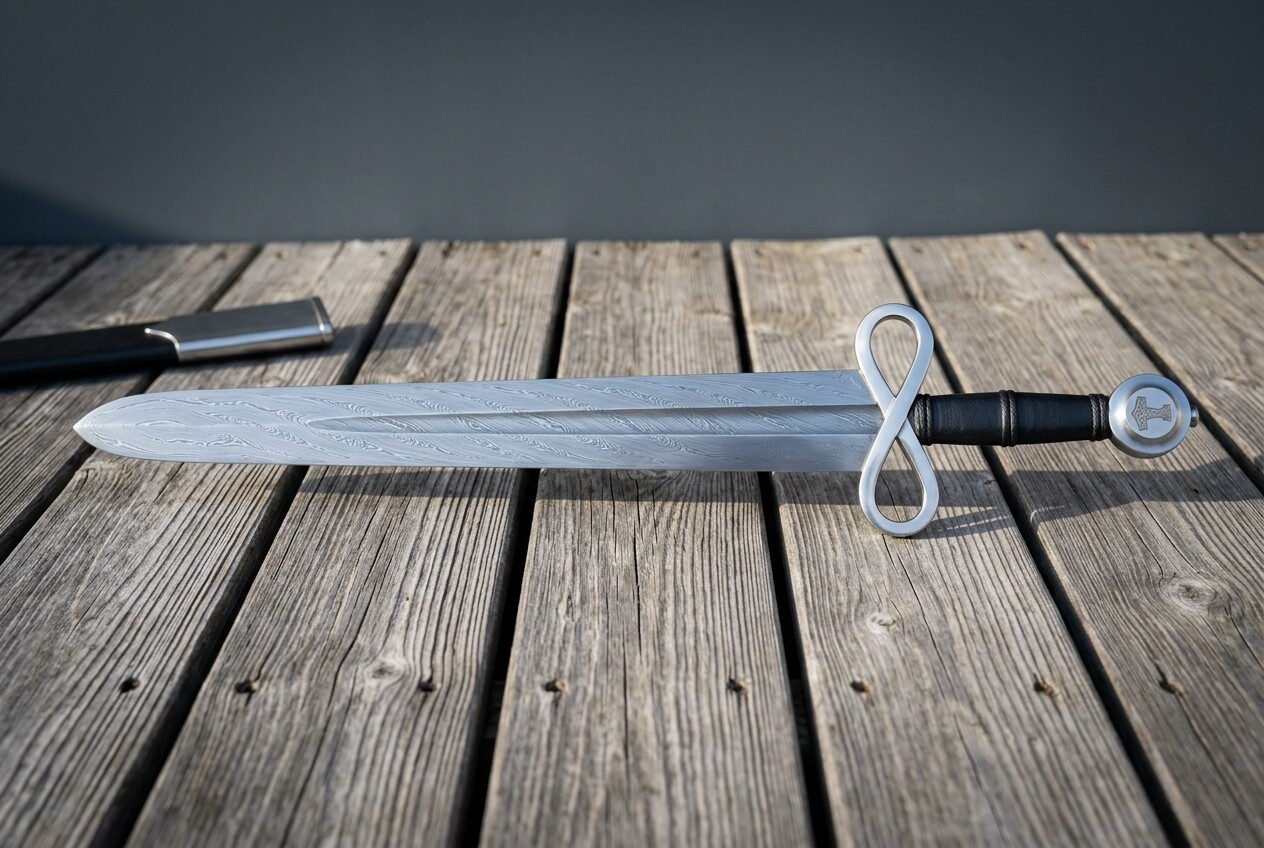
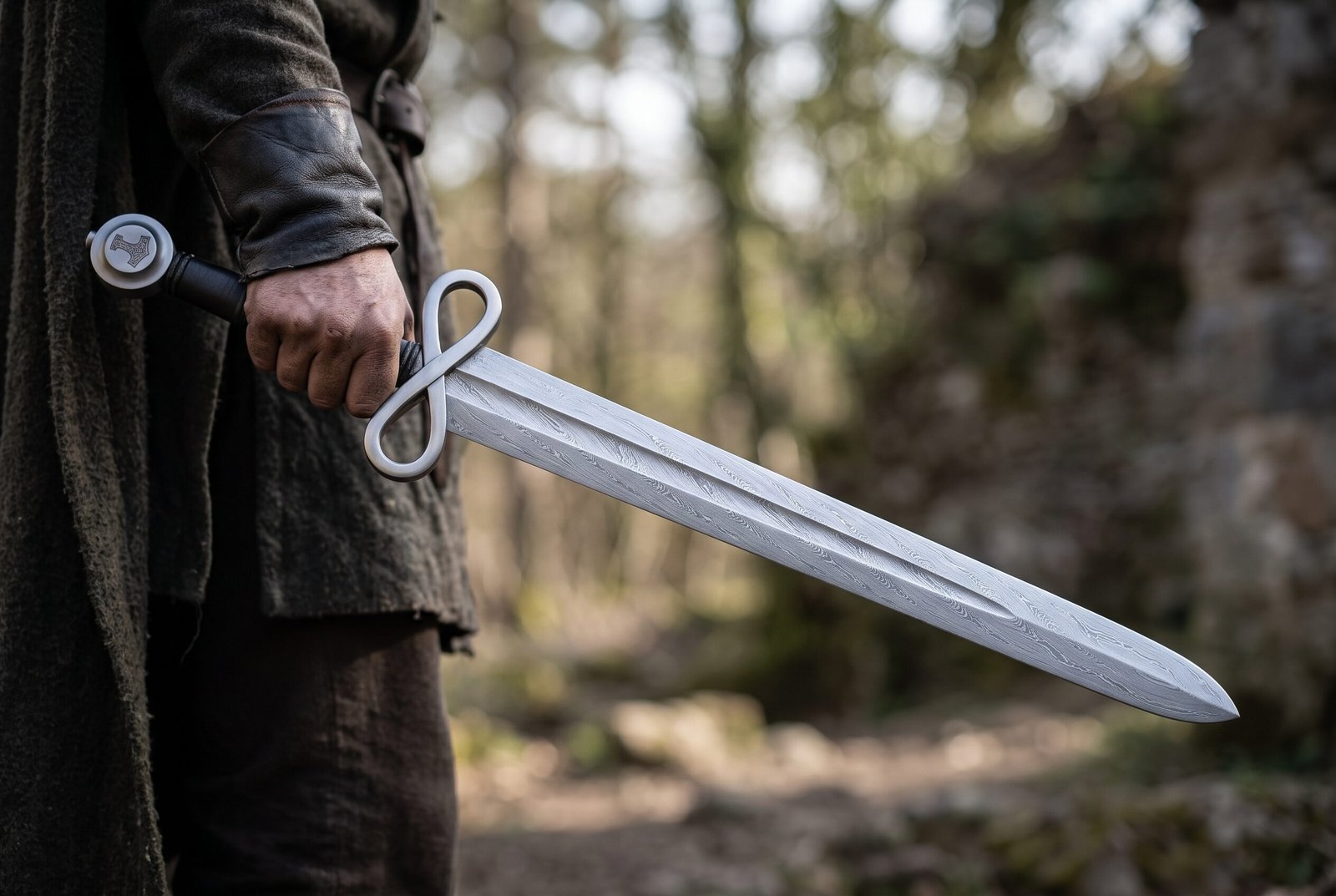
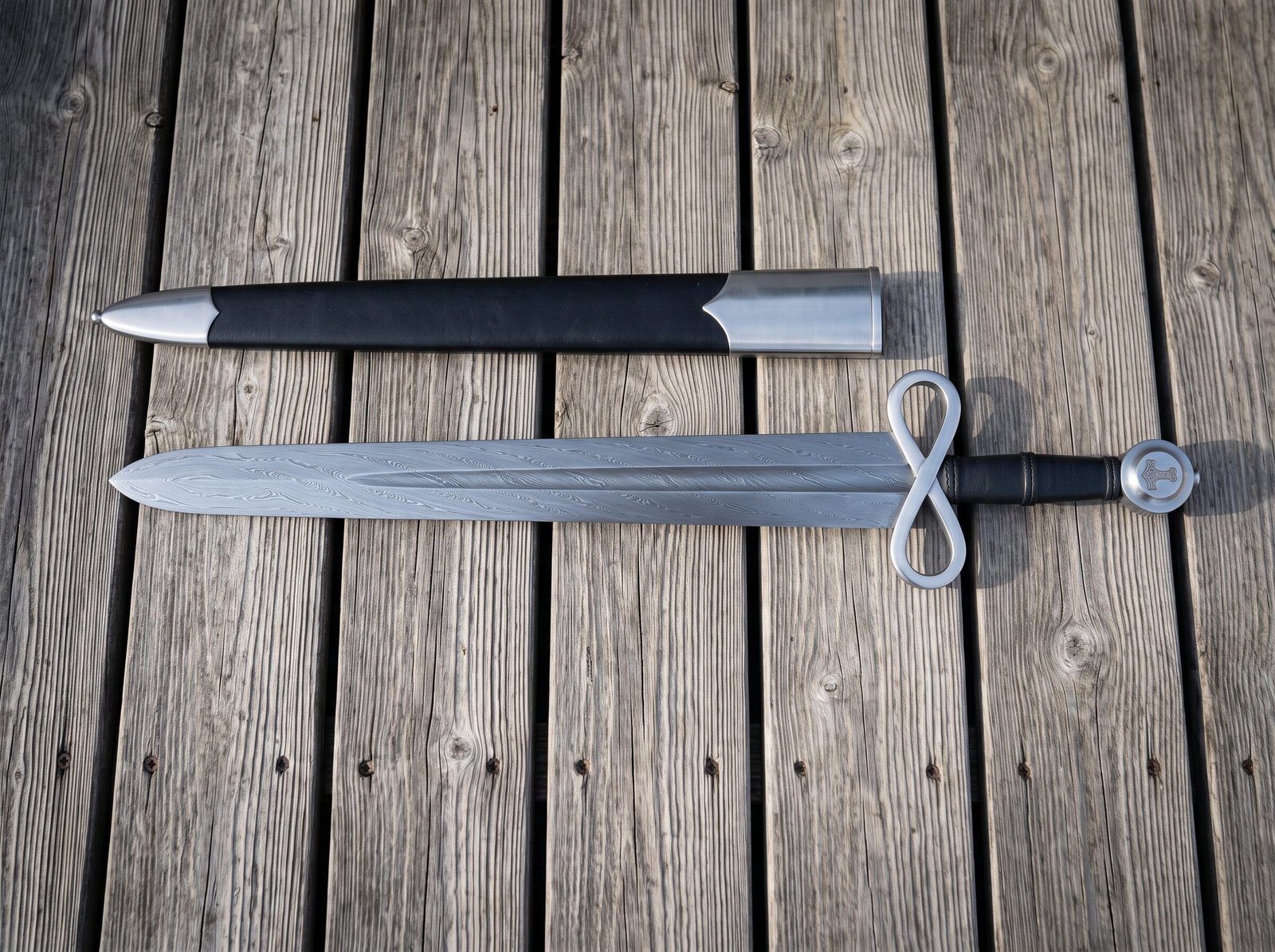
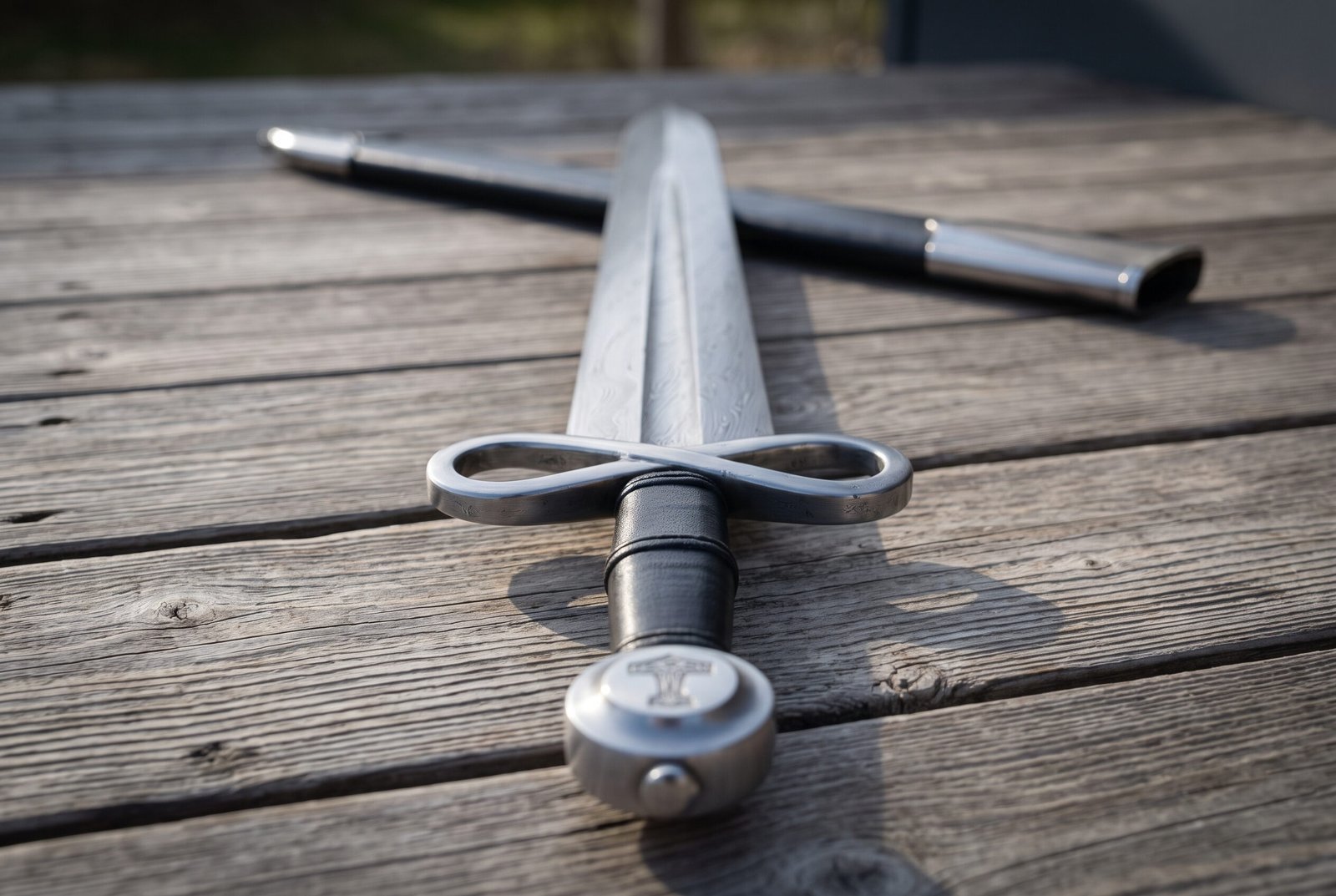
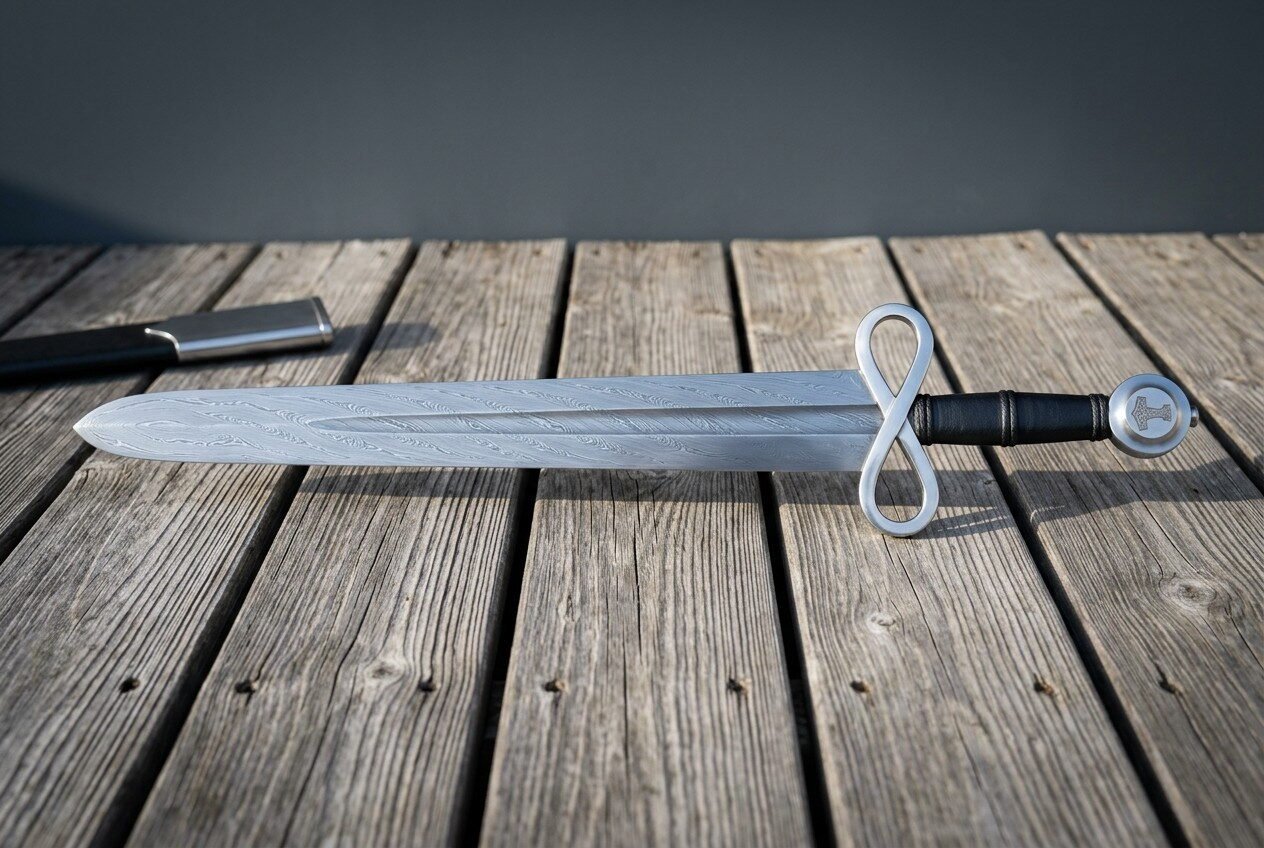
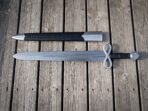
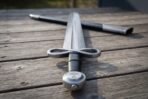
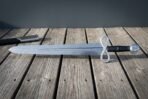
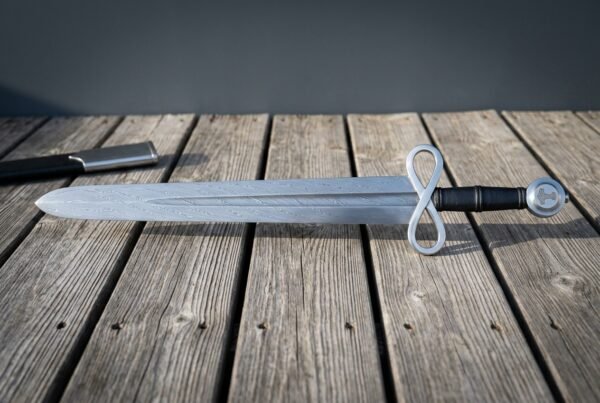
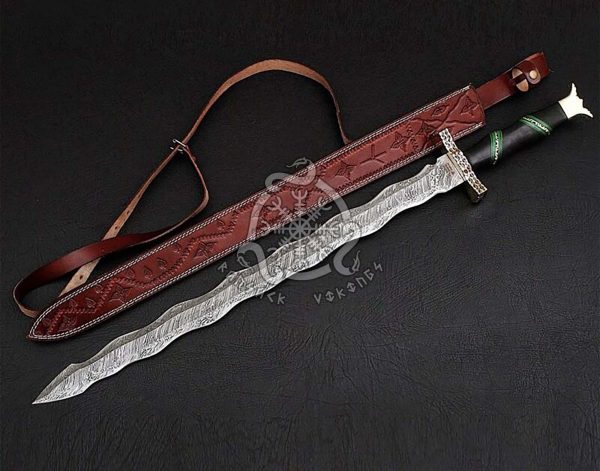
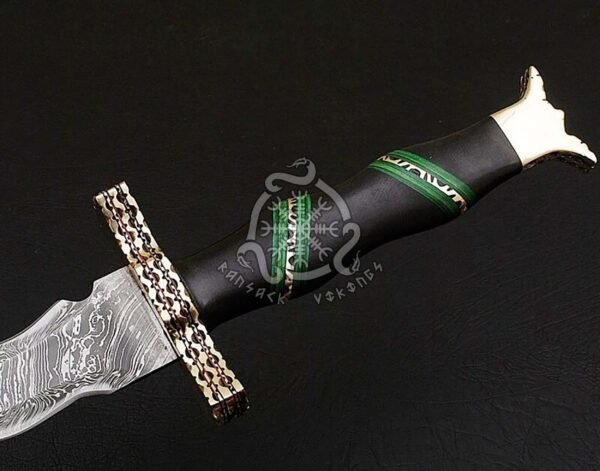
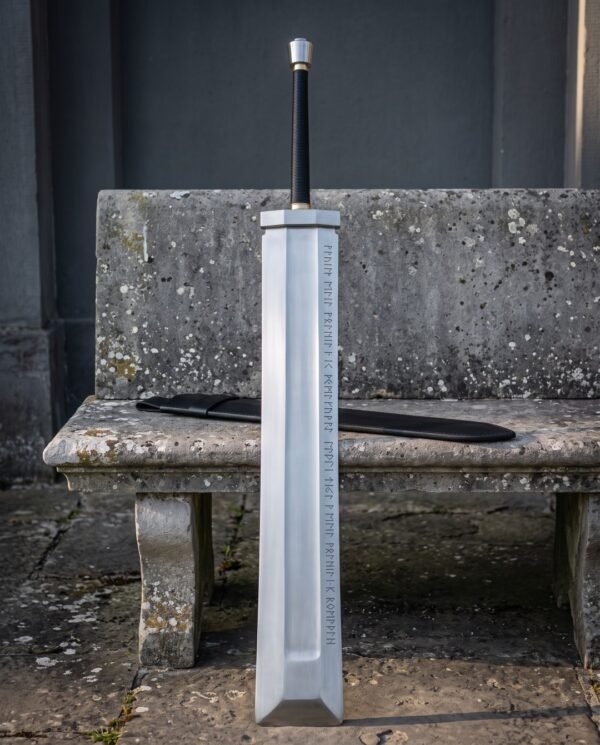
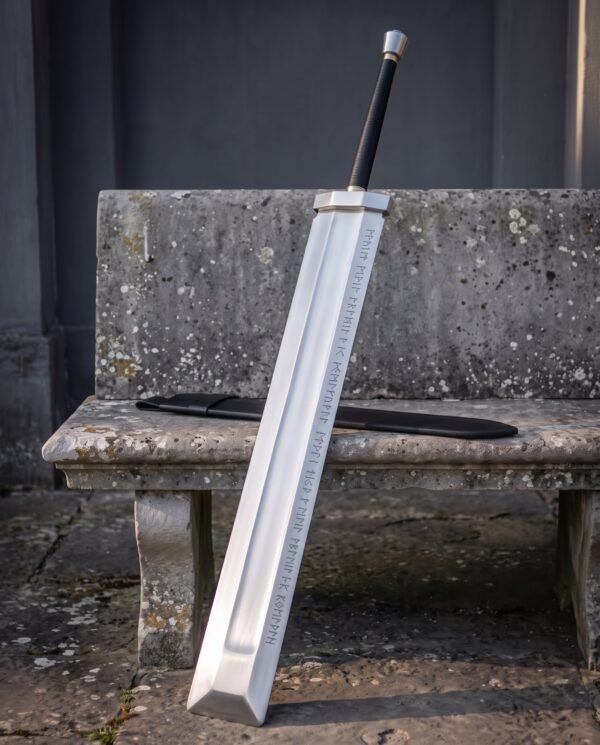
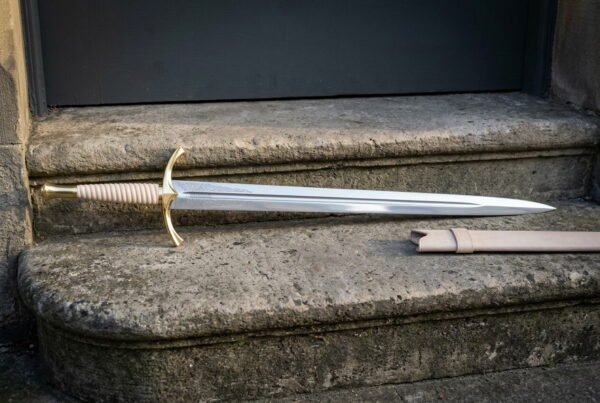
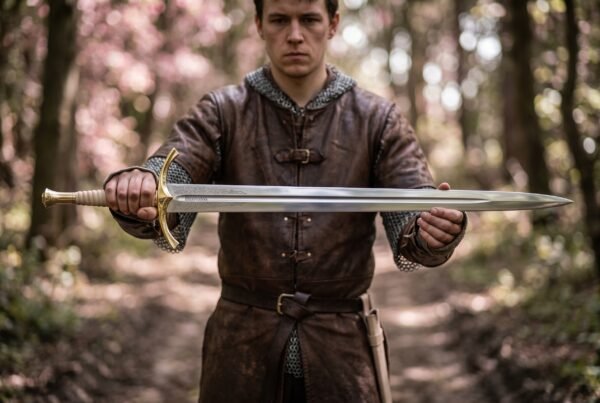
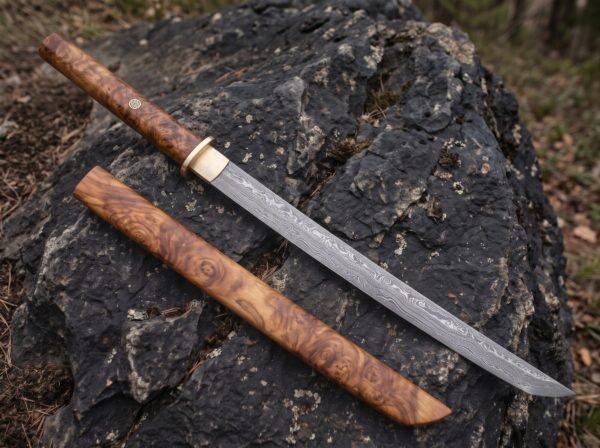
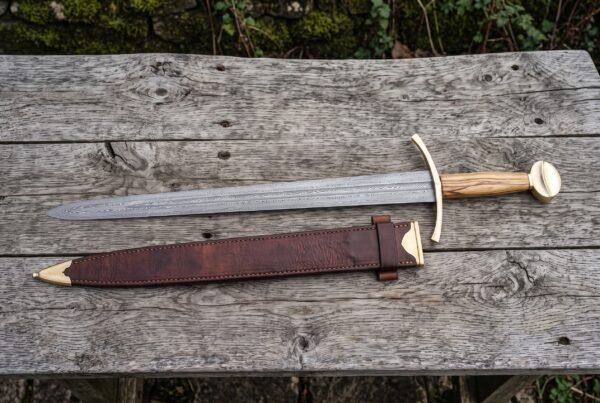
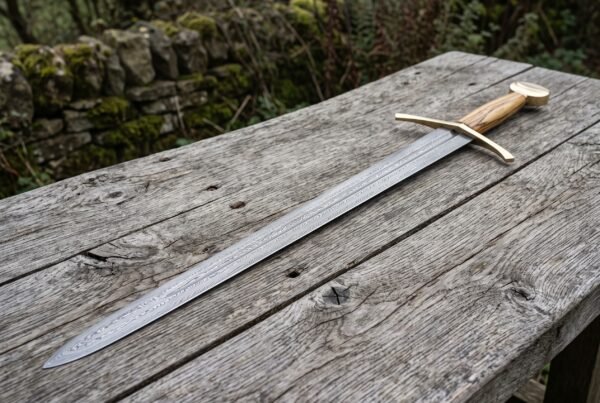
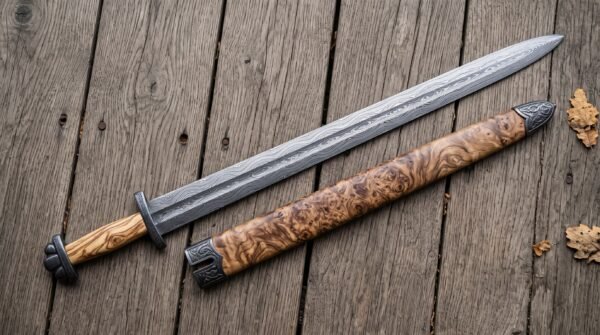
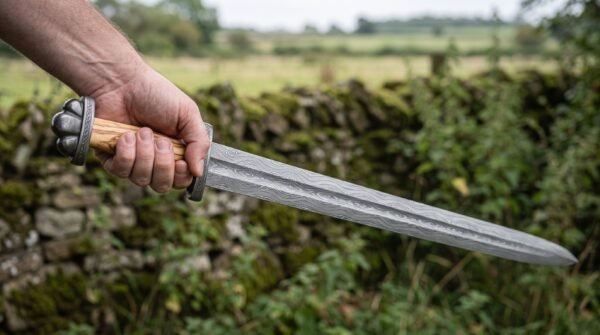
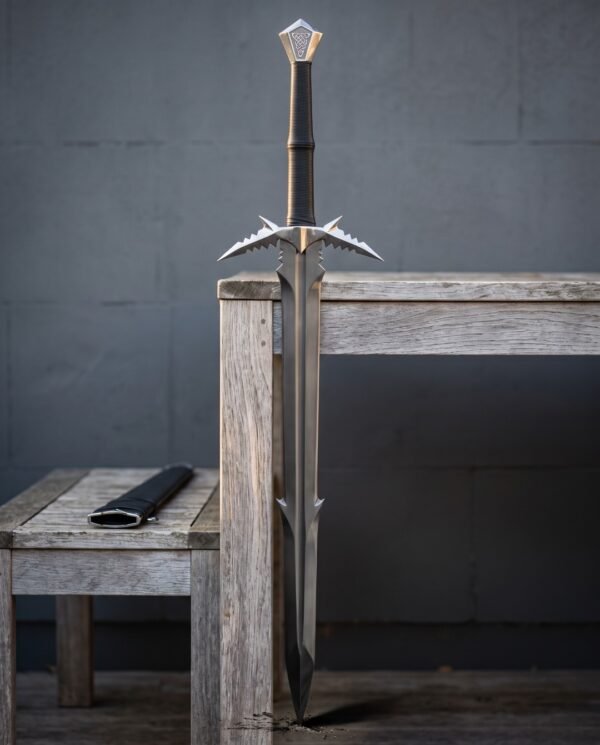
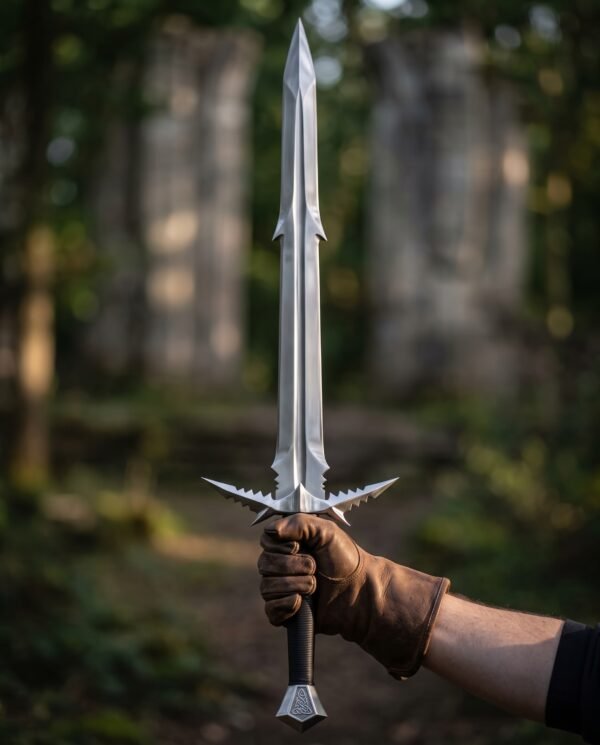
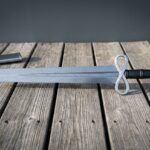
The Wyrmfold is a single hand sword forged from 1095 and 15N20 damascus, hilted with a polished steel guard that leaves the blade and folds back into a closed figure of eight, a black leather grip banded with cord, and a round steel pommel with a Mjolnir engraved into its face. A long engraved panel runs down the centre of the blade. It ships with a black leather scabbard with a polished steel throat and chape.
The word damascus causes more confusion than any other term in knife and sword making, so it is worth clearing up. What we sell here is pattern welded steel, which is a European and Scandinavian tradition going back to the Roman iron age. It has nothing genealogically to do with the original Damascus steel, which was wootz, a crucible steel made in south India and Sri Lanka and traded through Damascus, whose surface figure came from carbide banding inside a single ingot rather than from welding different steels together.
Forged, folded, ground, heat treated, etched and hilted in the Czech Republic. It ships with the fitted scabbard and a care card. If the fantasy and film swords brought you here, the arming swords are the obvious next stop.
Specifications
| Blade material | 1095 and 15N20 damascus, hardened and tempered to 58 to 60 HRC |
|---|
| Blade length | Roughly 22 inches, double edged, patterned with an engraved central panel |
|---|
| Overall length | Roughly 28 inches including grip and pommel |
|---|
| Grip | Roughly 4 inches, black leather over a shaped core with cord banding |
|---|
| Guard | Polished steel figure of eight loop guard |
|---|
| Pommel | Round polished steel disc with an engraved Mjolnir, peened over the tang |
|---|
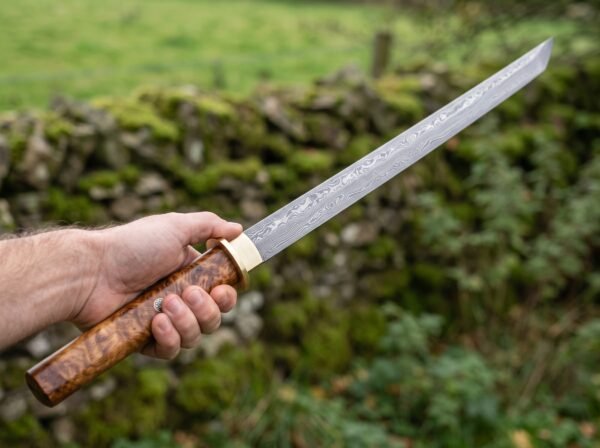
| Pattern | Flowing damascus, hand etched to bring the layers up |
|---|
| Scabbard | Black leather over a wooden core with a polished steel throat and chape |
|---|
| Included | Sword and fitted leather scabbard |
|---|
| SKU | RK-1725 |
|---|
Pattern welded steel and the wootz that got the name
Pattern welding starts with a stack of alternating bars, in our case 1095 and 15N20. The stack is brought to welding heat, hammered until the layers fuse into a single billet, then drawn out, cut, folded and welded again. Each fold doubles the layer count, so eight folds from a stack of twelve bars puts you into the low thousands of layers. Grinding the finished blade cuts through that stack at an angle and exposes the layers as lines on the surface. Etching in ferric chloride darkens the 1095 and leaves the nickel bearing 15N20 bright, and the pattern appears.
Wootz worked completely differently. Iron ore, carbon and a sealed crucible were heated until the steel melted, then cooled very slowly, and as it cooled the carbon precipitated into bands of carbide inside one single homogeneous ingot. There were no layers and nothing was welded. The famous watered figure of a historic Damascus blade is those carbide bands, and the specific ores and the specific cooling regime that produced them were lost around the eighteenth century. Anyone selling you a modern blade as true Damascus steel is selling you pattern welding under an older name, which is what this is, honestly described.
The steel and the fittings
1095 and 15N20 are the standard pairing for a reason. They have close enough carbon content and thermal behaviour to weld cleanly and quench together, so the finished blade hardens as one material rather than as a stack of arguing layers. Heat treated to 58 to 60 HRC, which is where a damascus blade of this length belongs. It is harder than our plain 1095 swords, holds an edge longer, and is correspondingly less forgiving of impact.
The guard and pommel are steel, forged, filed and polished to a bright finish that contrasts with the dark etched blade. The Mjolnir on the pommel face is cut rather than stamped. The tang runs through guard, grip core and pommel and is peened over the disc, which puts the whole hilt under compression. The grip is a shaped core wrapped in black leather over cord banding. The scabbard is black leather over a carved wooden core with a polished steel throat and chape.
Engraving, runes and your own design
Use the rune converter on this page to turn a name, a date or a short phrase into Elder Futhark and we will cut it into the steel, the leather or the wood. If you would rather have a Viking pattern than a rune line, choose your own design in the engraving option above the add to cart button and tell us where it goes. Where a piece already carries an engraved design, your chosen engraving replaces it rather than sitting alongside it.
This blade already carries an engraved central panel, and that is the natural place for a rune line, because your text goes into the panel rather than across the figured steel where it would fight the pattern. The pommel face is the other option, though a design there replaces the Mjolnir. The scabbard leather can be stamped. See the engraving page.
Handling and balance
Point of balance sits about four inches ahead of the guard. The mass of the closed loop guard sits directly at the hand, which does much of the work a heavier pommel would otherwise do and keeps the sword responsive rather than tip heavy. It moves quickly and it stops quickly.
The grip is single handed and the loop partly encloses the fingers, so it feels close rather than open. Understand what this sword is. It is a sharpened collector and display piece, hand forged, hand etched and hand balanced. Damascus at 58 to 60 HRC is hard steel and hard steel chips under impact, so it must not be used for sparring, blade on blade work or hard target cutting. Keep it scabbarded when it is not in your hand.
Care
An etched damascus blade needs more care than a plain polished one. The etch leaves the surface faintly textured and that texture holds moisture, so wipe the blade with an oiled cloth every time you handle it and before it goes away. Camellia oil, light machine oil or a purpose made blade oil all work. Never take an abrasive polish or a scouring pad to the pattern, because you will flatten the contrast permanently. Full guidance is on steel care.
Do not store the sword sheathed for long periods. Leather holds damp against steel and etched steel is the worst candidate for that. Keep the blade oiled and stored out of the scabbard, and feed the scabbard leather twice a year with a neutral balm. The polished steel fittings can be kept bright with the same oiled cloth. Clear dust out of the engraved pommel with a soft brush.
Made in the Czech Republic
The work behind this piece happens in a Czech Republic workshop that has kept to the old methods. Steel is forged and heat treated by hand, the grind is taken down by eye rather than by machine, and the handle, fittings and sheath are cut and finished one at a time. Because of that, every piece carries small marks of the hand that made it.
Ransack Viking is a United States company. We import direct, check each piece when it reaches us, and ship from our Chicago, Illinois warehouse. Engraving is added here in the United States after arrival, so the piece you receive is finished to your order.
A note on handmade variation
This is hand made, not machine made and not bulk produced, so what arrives will not be a pixel for pixel copy of the photograph. Damascus varies more than anything else we make, because the figure is a cross section through a billet that was folded and drawn by hand. Layer spacing, how boldly the pattern runs into the edge bevel and where the swirls fall are different on every blade and cannot be repeated to order.
The etch also bites at its own rate depending on temperature and how fresh the acid is, so contrast ranges from crisp and high to soft and smoky. The steel fittings polish to their own character and the black leather shows its own grain. Blade length, overall length, steel, hardness and construction are the same every time. The pattern is what makes yours unrepeatable. There is more on that in the Witcher swords, and in the arms in Valhalla if you want the background.
Frequently asked questions
Is this real damascus steel
It is real pattern welded steel, forge welded from 1095 and 15N20 and etched to reveal the layers. It is not wootz, the original crucible steel traded through Damascus, because that process was lost centuries ago. Anyone claiming otherwise is renaming pattern welding.
Is it sharp out of the box
Yes, keen along the full length and to the point. Handle it as sharp from the moment you open the box.
Can I spar or cut with it
No. Damascus at 58 to 60 HRC is hard and hard steel chips against another blade or a hard target. This is a sharpened collector and display sword and it is not sold for contact use of any kind.
What is the symbol on the pommel
It is Mjolnir, the hammer of Thor, cut into the face of the steel pommel disc. If you want your own design there instead, it replaces the hammer rather than sitting beside it.
Will the pattern fade
Not from normal handling and oiling, because the contrast is in the steel rather than on it. It can be flattened by abrasive polish, a scouring pad or a wire wheel, so never use any of those on the blade.
How long does shipping take
One to two weeks, because the billet is welded, folded and forged after you order. US shipping is free.
What is in the box
- One hand forged 1095 and 15N20 damascus sword with a steel loop guard
- One fitted black leather scabbard over a wooden core with a polished steel throat and chape
- Care card covering oiling, etched steel and storage
- Lifetime warranty against defects in forging, grind, heat treat and fittings
- Forged and finished in the Czech Republic
Explore the range
See the rest of the damascus swords, the fantasy swords, the wider swords, and the guides for more on pattern welding.
If this one is not it
In the same category sits the Ramskull movie sword, 36 inches overall. A near match for this one is the Thornreaver movie sword, 42 inches overall. Closest to this in the range is the Silverthorn movie sword.
Fitting out further, the Wolfrune Viking sword belongs with it. Pick the steel, the length and the fittings yourself on the design your own page.


My whole family was impressed when I unboxed it. Ordered from Ransack Viking before and the quality stays consistent every time.
Feels way more premium than the price suggests. Even the small engravings are crisp and clean. You can tell it’s real Czech blacksmith work and shipping from the States made delivery painless. Weight and balance make it feel like a real functional piece not some cheap replica. Shipping was fast and everything arrived well packaged.
Pretty impressed. Just a couple minor things I’d tweak. Second time ordering from Ransack Viking and still happy overall. Good product. Just not quite perfect.
Five stars isn’t even enough honestly. Fit and finish is museum quality. You can tell real craftsmen made this by hand. The wood handle feels amazing and the balance is perfect. Leather sheath is thick and well stitched. Not the cheap stuff you usually get. This is going straight into my display case.
My husband was speechless when he opened this. Fit and finish is museum quality. You can tell real craftsmen made this by hand. 10/10 would buy again.