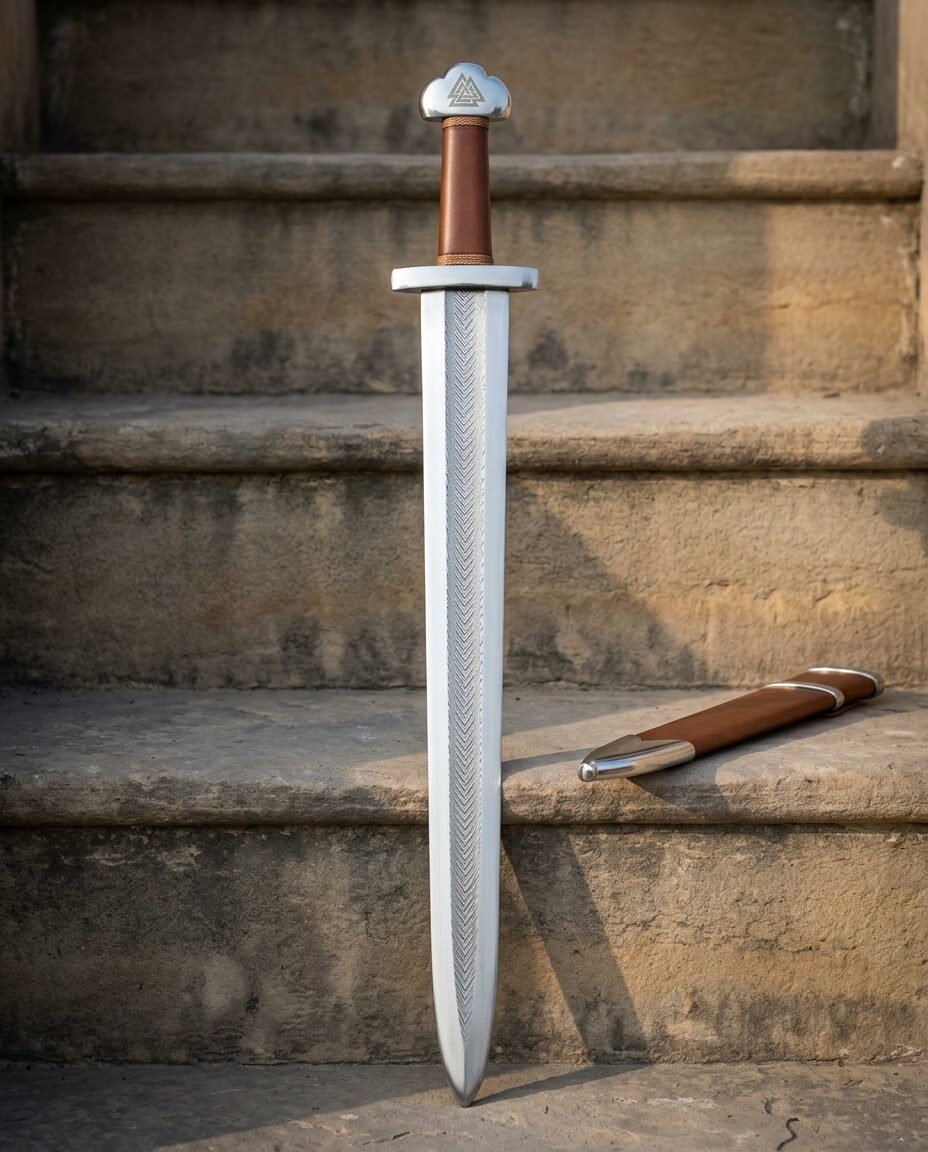
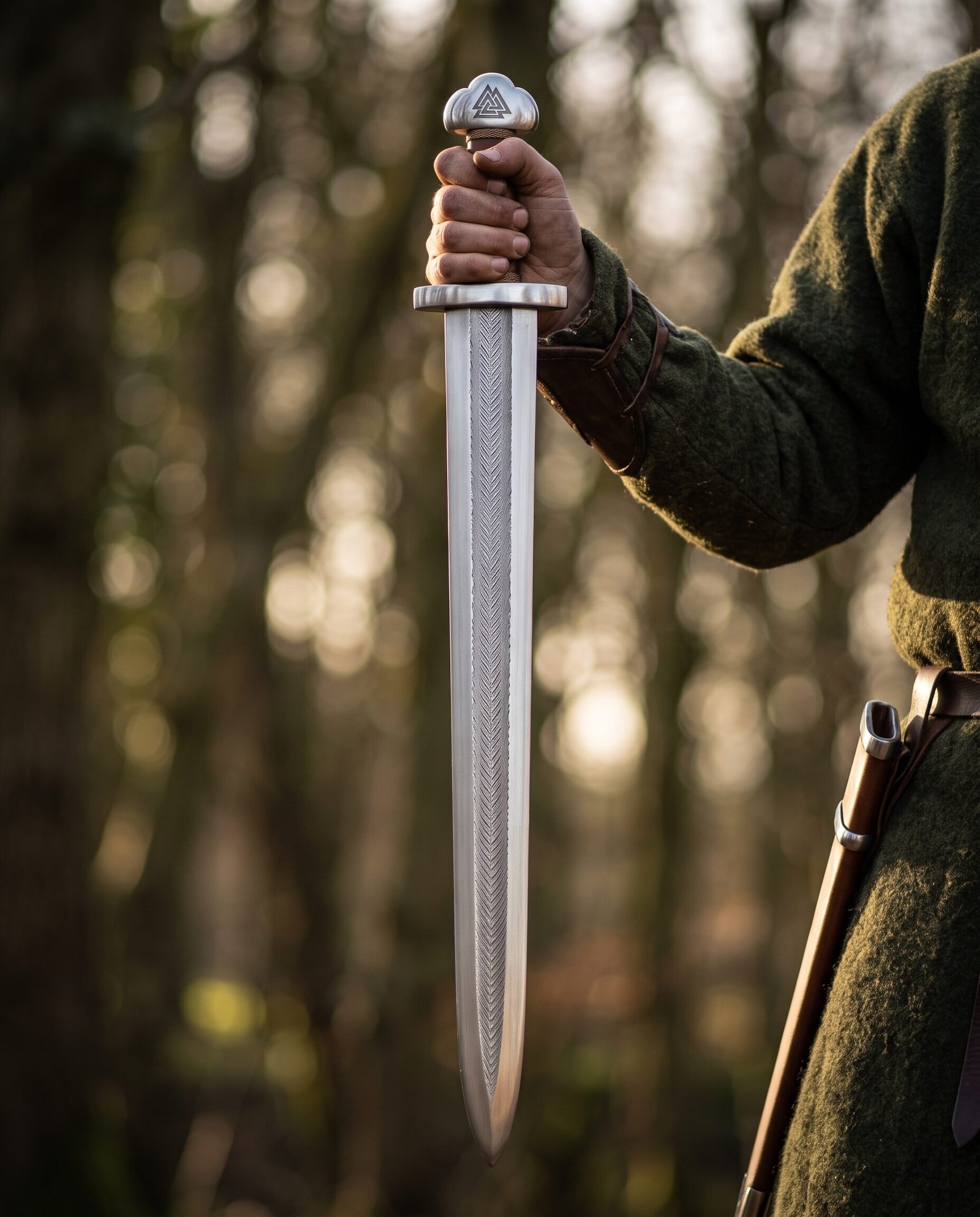
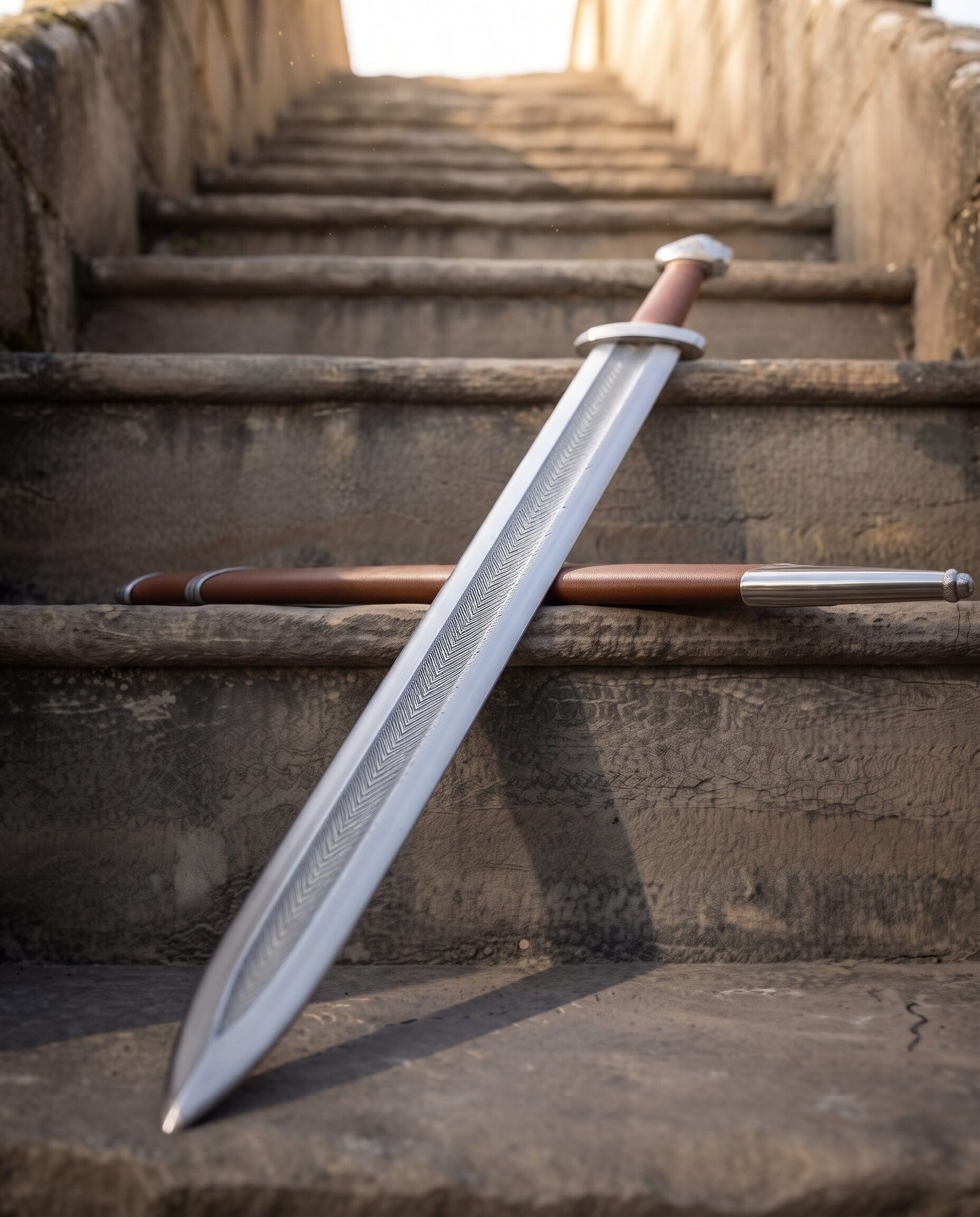
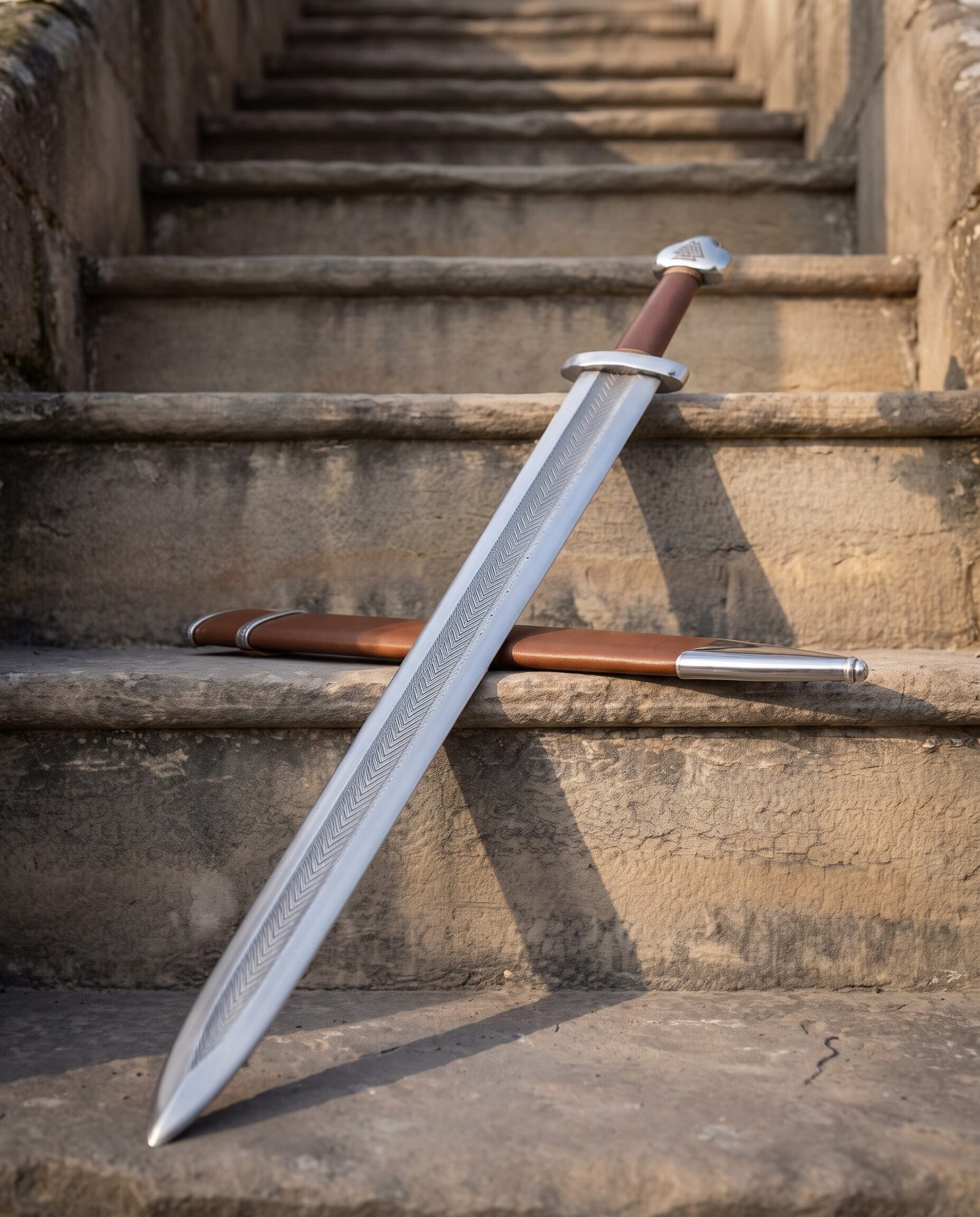
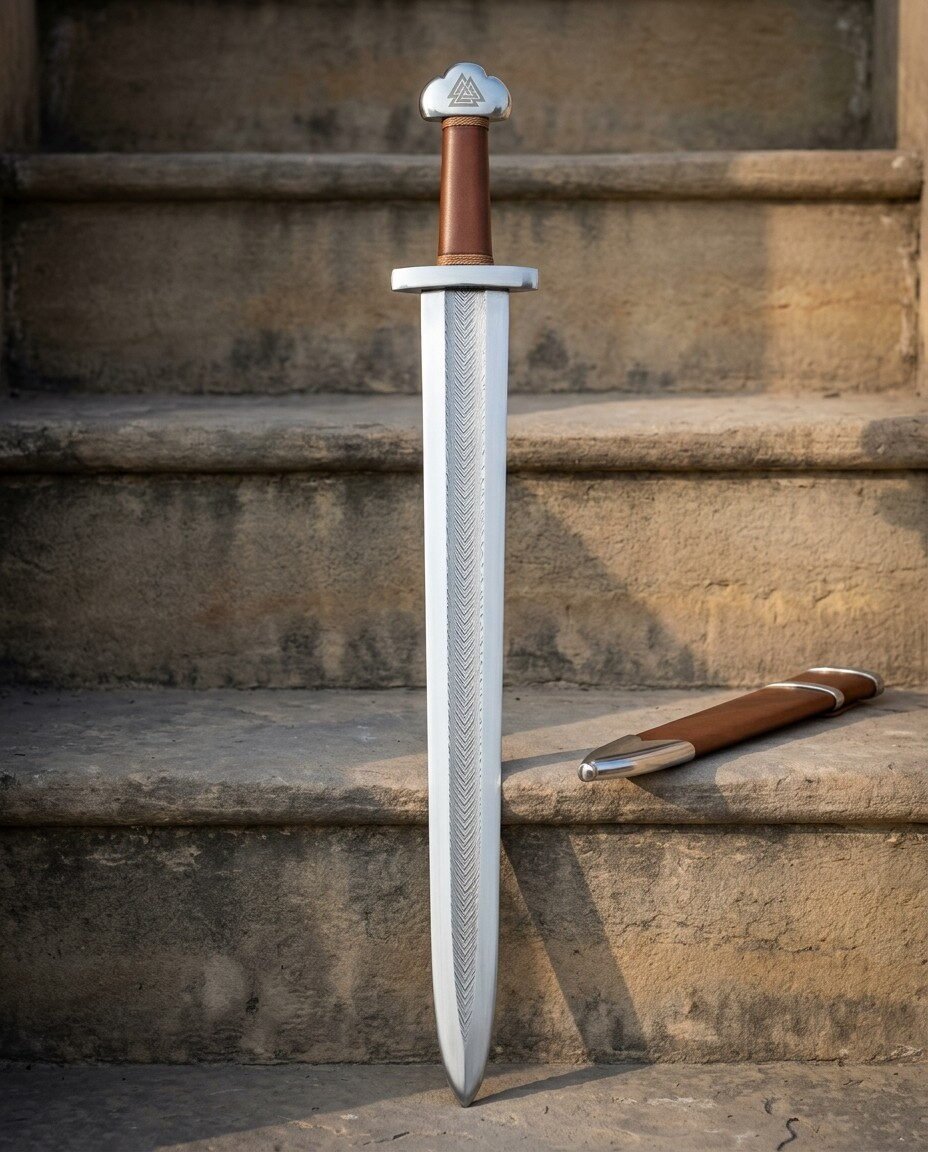
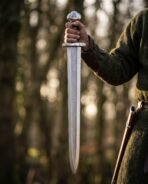
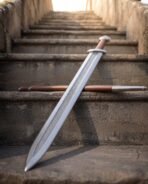
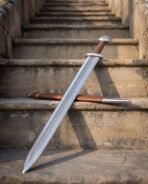
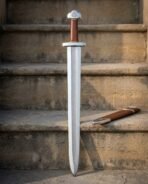
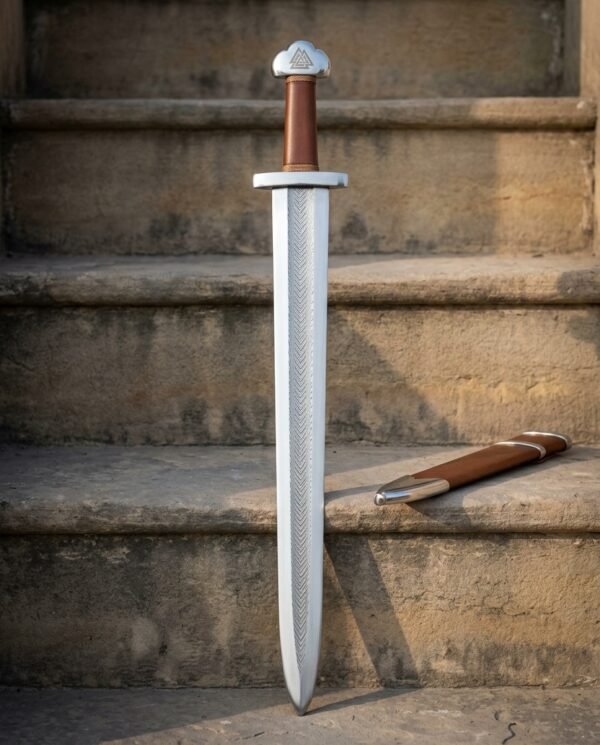
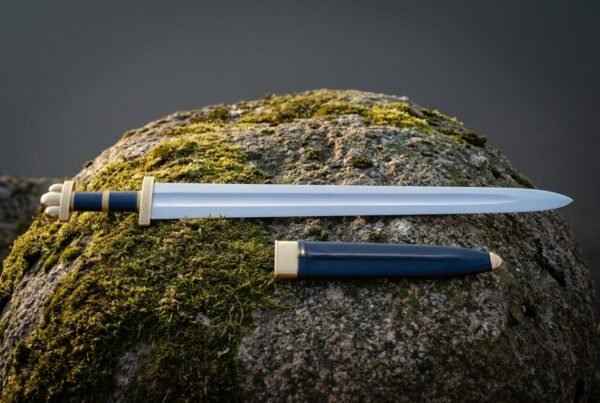
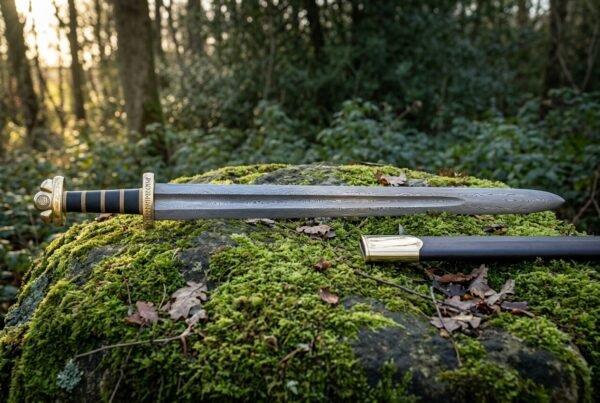
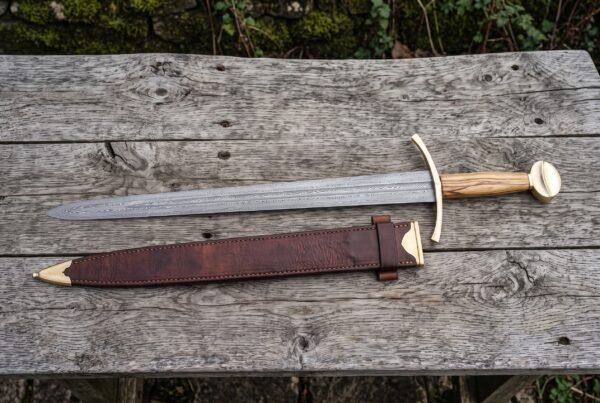
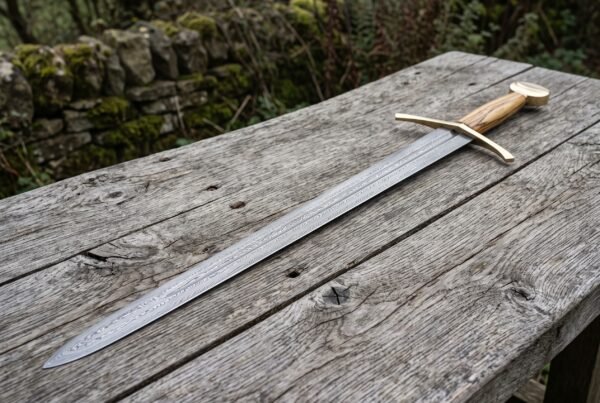
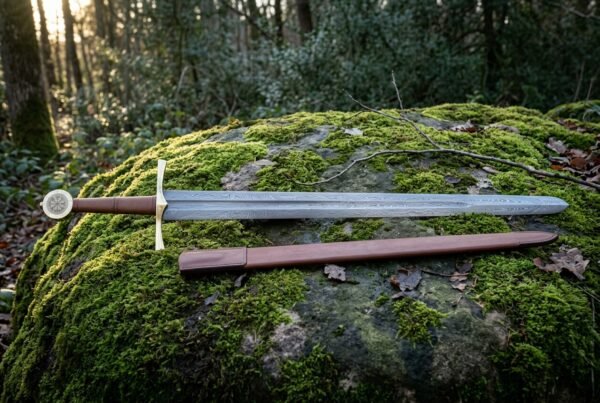
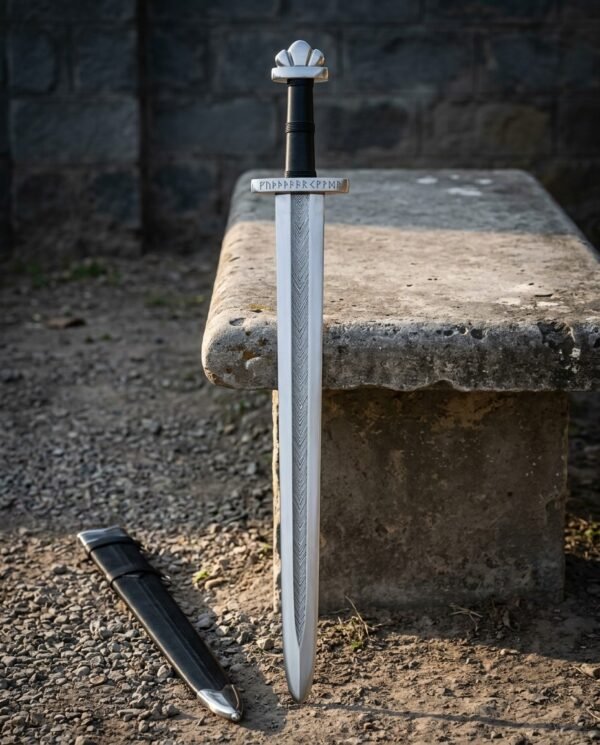
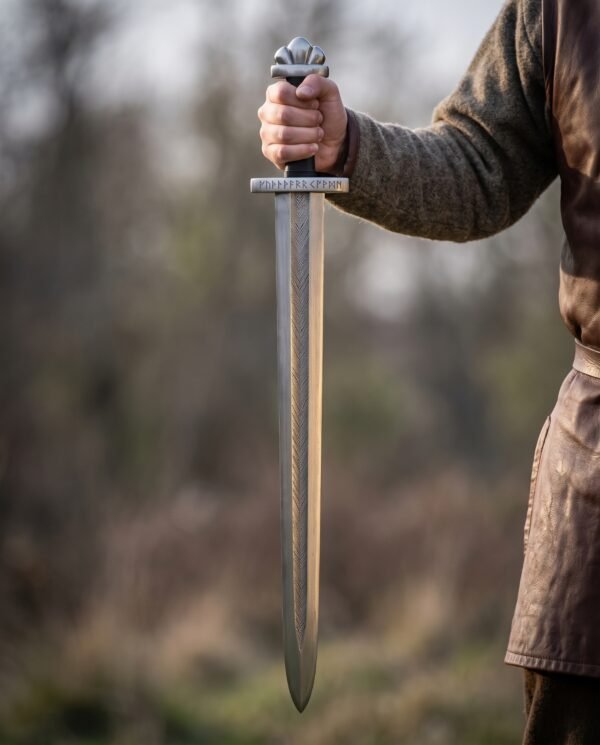
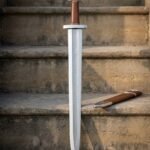
The Serpentweld is a Viking sword built the way the originals were built. A pattern welded core runs the length of the blade in a herringbone chevron, and bright hard steel edges are welded on either side of it. The hilt is a Petersen style trilobate pommel with a Valknut cut into the centre lobe, over a brown leather grip and a straight lower guard, and it ships in a brown leather scabbard with a steel throat and chape.
Pattern welding was not decoration to the smiths who invented it. Before the blast furnace, the iron available in northern Europe came out of a bloomery as a spongy mass of wildly varying carbon content. No single billet was uniform enough to make a four foot blade that would neither bend nor snap. The answer was to take many thin rods, twist them in alternating directions, weld them into a core and then weld hard steel edges onto that core. The chevron you see here is the end grain of that twisting showing through after the blade is ground and etched. This one is forged and finished in the Czech Republic. It is catalogued with the Damascus swords, and the arming swords sit one click away.
Specifications
| Material | 1095 and 15N20 pattern welded core with bright high carbon edges, steel fittings |
|---|
| Hardness | 58 to 60 HRC at the edges |
|---|
| Overall length | Approximately 36 in / 91 cm |
|---|
| Blade length | Approximately 29 in / 74 cm |
|---|
| Blade profile | Broad double edged blade with a wide fuller, tapering to a point |
|---|
| Pattern | Herringbone chevron core running the length of the fuller, plain bright steel at the edges |
|---|
| Guard | Short straight steel lower guard |
|---|
| Grip | Brown leather over timber |
|---|
| Pommel | Steel lobed Petersen style pommel with a Valknut cut into the centre lobe |
|---|
| Scabbard | Brown leather with a steel throat and steel chape |
|---|
| Included | Sword and fitted leather scabbard |
|---|
| SKU | RK-1684 |
|---|
How the chevron gets into the blade
Take a stack of alternating layers, weld it solid, draw it into a square rod and then twist that rod hot along its length. The flat layers inside become a spiral. Now grind a flat down the side of that twisted rod and you cut across the spiral, and what appears on the surface is a row of chevrons. Weld two such rods side by side, twisting one clockwise and one anticlockwise, and the chevrons mirror each other into the herringbone you see on this blade.
That is why a pattern welded core has to sit in the fuller and not at the edge. The twisted structure is beautiful and tough but it is not the part that should be taking a cutting edge, because the carbon is not evenly distributed through it. So a separate strip of high carbon steel is welded down each side of the core to carry the edge. Look at the blade and you can see the arrangement plainly. Bright plain steel at the edges, patterned core down the middle.
Archaeologists find exactly this construction when they section Viking Age blades, and they can read the number of rods and the direction of each twist from the surface pattern. It is the closest thing early medieval metalwork has to a signature. The Norse called good blades things like leg biter and gold hilt and they clearly valued the pattern, but the pattern is a side effect of solving a real materials problem.
The steel and the fittings
The core is 1095 and 15N20. 1095 is a plain high carbon steel that etches dark and 15N20 carries nickel and stays bright, so the twisted structure shows clearly once the finished blade goes into acid. The edges are high carbon steel welded to the core and heat treated to 58 to 60 HRC, which is where an edge wants to be while the softer core keeps the blade from being brittle. That differential is the whole point of the construction and it is why these swords survived being used.
None of this is stainless. A pattern welded blade will spot if it is handled and put away, and the etched surface holds a fingerprint more readily than a plain polish does. Keep a cloth and a little oil with the sword.
The pommel is the Petersen trilobate form, three lobes rising off a bar, which is one of the most recognisable Viking hilt types and is common on tenth century Scandinavian finds. Ours has a Valknut cut into the centre lobe. The tang is peened over the pommel bar so the hilt is mechanically locked. The grip is brown leather over timber, and the scabbard is leather over a fitted core with a steel throat and chape.
Engraving, runes and your own design
Use the rune converter on this page to turn a name, a date or a short phrase into Elder Futhark and we will cut it into the steel, the leather or the wood. If you would rather have a Viking pattern than a rune line, choose your own design in the engraving option above the add to cart button and tell us where it goes. Where a piece already carries an engraved design, your chosen engraving replaces it rather than sitting alongside it, so your runes take the place of the Valknut on the pommel. A rune line can also run along the flat beside the fuller. Full details are on the engraving page.
Handling and balance
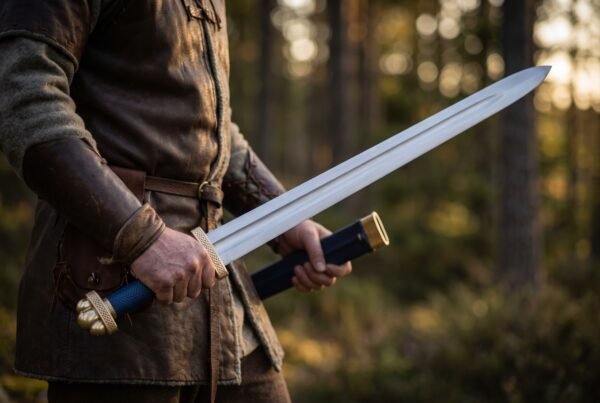
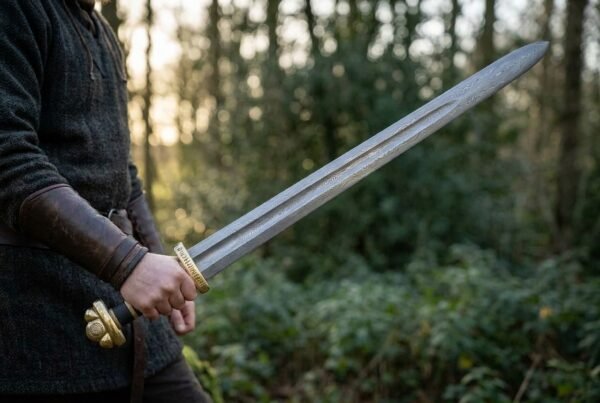
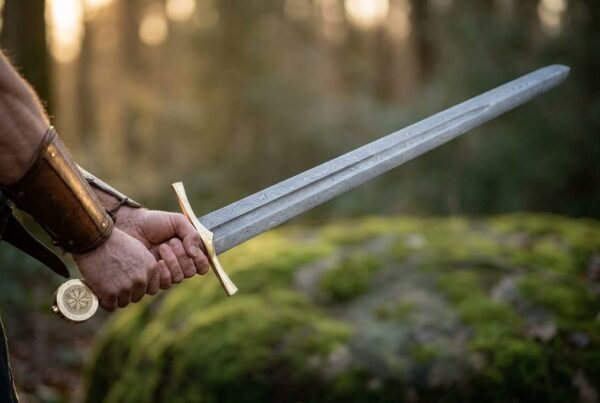
Viking swords are quicker in the hand than most people expect. The wide fuller takes a lot of weight out of the middle of the blade and the heavy trilobate pommel puts it back behind the hand, so the balance point sits close to the guard and the sword turns easily. It is a one handed sword that assumes a round shield in the other hand, and the short grip between guard and pommel is a deliberate part of that. It locks the hand in one place rather than letting it slide.
Hold it with the heel of the hand against the underside of the pommel. The broad profile is the tell. This is a cutting sword. The Norse fought with the edge from behind a shield, and the profile follows from that rather than from any interest in punching through mail.
It arrives sharp and it is a display, collecting and light cutting sword. It is not built for edge to edge contact with another blade and we do not sell it for sparring or full contact reenactment.
Care
Wipe the blade after handling and lay a thin film of oil over the steel before it goes back into the scabbard. The etched core holds oil in its texture, which is helpful, but it also holds skin salts, so do not put the sword away with a print on it. A soft cloth is better than paper for this.
If a rust spot appears, work it off with oil and a fine synthetic pad along the length of the blade rather than across it, then re oil. Do not use a wire wheel or a coarse abrasive on a pattern welded surface, because you will cut through the etch and lose the contrast. Feed the leather grip and scabbard with a balm once or twice a year, keep them out of long direct sun and never store the sword sheathed in a damp room. Our steel care notes cover this in full.
Made in the Czech Republic
This piece is made by hand in the Czech Republic, in a workshop that still works the old way. The steel is forged, ground, heat treated and finished by smiths who learned the trade from the people before them, and the wood, horn and leather are cut and fitted by hand rather than pressed out on a line. That is also why no two pieces come out exactly the same.
Ransack Viking is a United States company. We import these pieces ourselves, check every one when it lands and ship from our warehouse in Chicago, Illinois. Engraving is done here in the United States after the piece arrives, so your runes or your own design go on before it leaves for you.
A note on handmade variation
This sword is hand made rather than machine made or bulk produced, so what arrives will not be a pixel for pixel copy of the photograph. No two twisted rods behave the same way, so the chevrons on your blade will be tighter or looser and will sit at their own angle. The etch depth, the hammer texture, the tone of the leather on the grip and the exact set of the three lobes on the pommel all vary. The dimensions, the construction, the steels and the hardness are the same every time. The character is not. If you want the longer version, look at the Norse symbols and what they meant and then at the Viking swords collectors go for.
Frequently asked questions
Is the chevron pattern etched on or forged in
Forged in. It is the end grain of a twisted pattern welded core, revealed by acid. Grind into the fuller and the same structure continues through the steel.
Why is the pattern only in the middle of the blade
Because that is how Viking swords were built. The twisted core sits in the fuller and separate high carbon edges are welded on either side to carry the cutting edge.
Is it sharp out of the box
Yes. Both edges arrive sharpened and the sword should be stored and handled accordingly.
Can I use it for reenactment combat
No. It is sharp and it is not built for edge to edge contact. It is a display, collecting and light cutting sword.
What is the symbol on the pommel
A Valknut, three interlocked triangles found on Gotland picture stones and in the Oseberg burial. It can be replaced with your own runes or design.
How long does it take to make
One to two weeks of processing before it ships, then free shipping inside the United States. Pattern welding is slow work.
What is in the box
- Serpentweld pattern welded Viking sword, hard edges at 58 to 60 HRC
- Herringbone chevron core running the length of the fuller
- Trilobate pommel with a Valknut cut into the centre lobe
- Fitted brown leather scabbard with steel throat and chape
- Care card for pattern welded steel and vegetable tanned leather
- Lifetime warranty against defects in forging, grind, heat treat and fittings
- Forged and finished in the Czech Republic
Explore the range
See more in viking swords, damascus swords, swords and Norse arms, or read the guides.
Other pieces in this group
Also in this group is the Wyrmweave Viking sword, 36 inches overall. Sitting beside it in the catalogue is the Ironsong Viking sword, pattern welded Damascus. Another in the same line is the Skaldbone Viking sword, 36 inches overall.
For a different piece from the same family, look at the Trinelobe short sword. Nothing here exactly right, build one to your own spec on the custom Viking sword page.

Perfect gift. Perfect quality. No complaints. The wood handle feels amazing and the balance is perfect. Already planning my next purchase from this shop.
Pretty impressed. Just a couple minor things I’d tweak. Wood handle looks great though it’s a little smaller than I imagined. Minor nitpicks aside, good quality piece.
Turned out better than I expected going in. Second time ordering from Ransack Viking and still happy overall.
Showed up right on time and looked even better than the photos. Even the small engravings are crisp and clean. So worth it.
It’s a decent sword. Nothing extraordinary though. It’s fine but I expected a little more for the price. It’s okay for the price.
Incredible craftsmanship on this one. Leather sheath is thick and well stitched. Not the cheap stuff you usually get. Will definitely order again for another gift. It’s handmade in the Czech Republic but ships from a US warehouse so it arrived quicker than I expected.
This sword is well made. Just a couple small things kept it from 5 stars. Sheath is nice. Wish it had more padding but it does the job. Blade quality is solid. Arrived a bit less sharp than expected but a few passes on a strop fixed it. Would buy from this shop again.
This is exactly what I wanted and then some. Leather sheath is thick and well stitched. Not the cheap stuff you usually get. This is my third order from Ransack Viking and they never disappoint. Great buy overall.
This thing is a beast in the best way. Came in a nice gift box which made it feel even more special. Will definitely order again for another gift.
Perfect gift. Perfect quality. No complaints. Fit and finish is museum quality. You can tell real craftsmen made this by hand. It’s handmade in the Czech Republic but ships from a US warehouse so it arrived quicker than I expected. Already telling my friends to check this out.