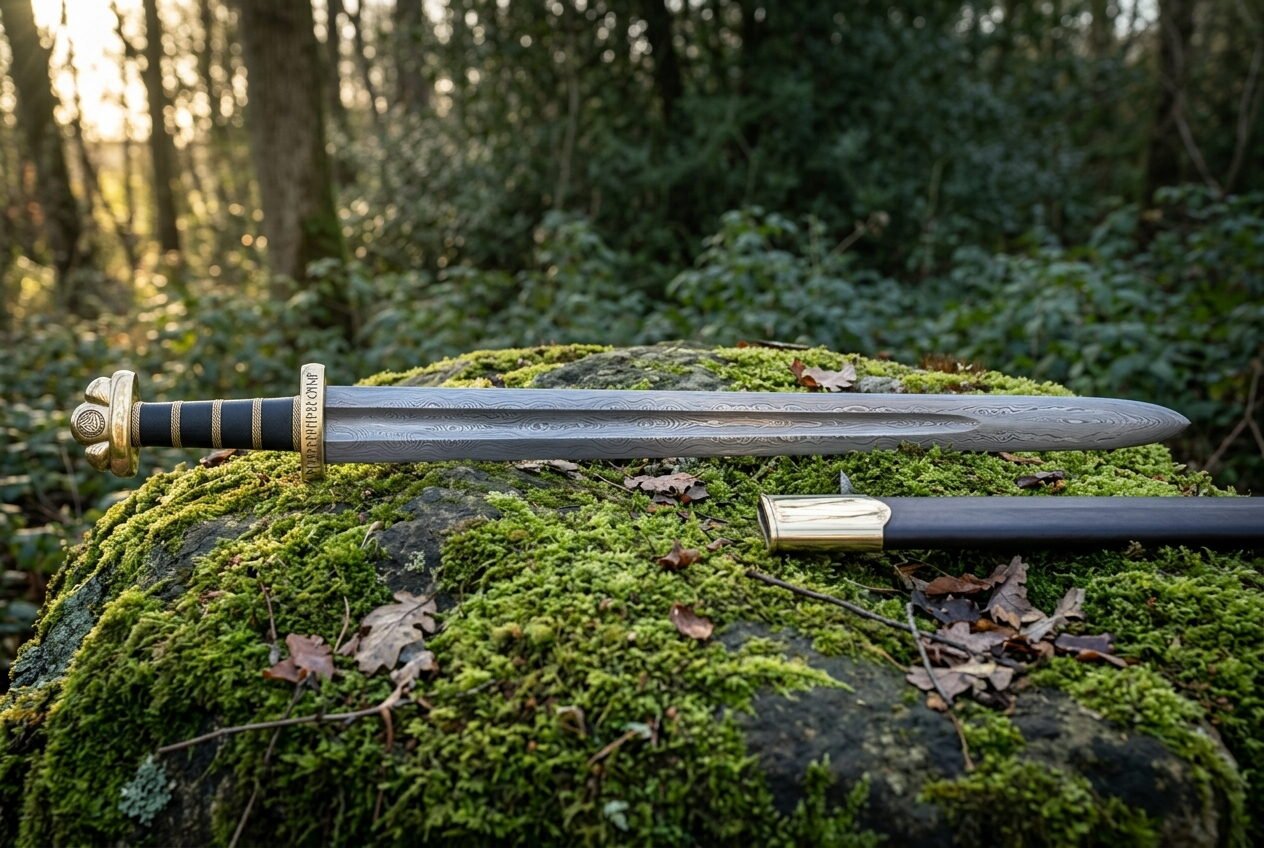
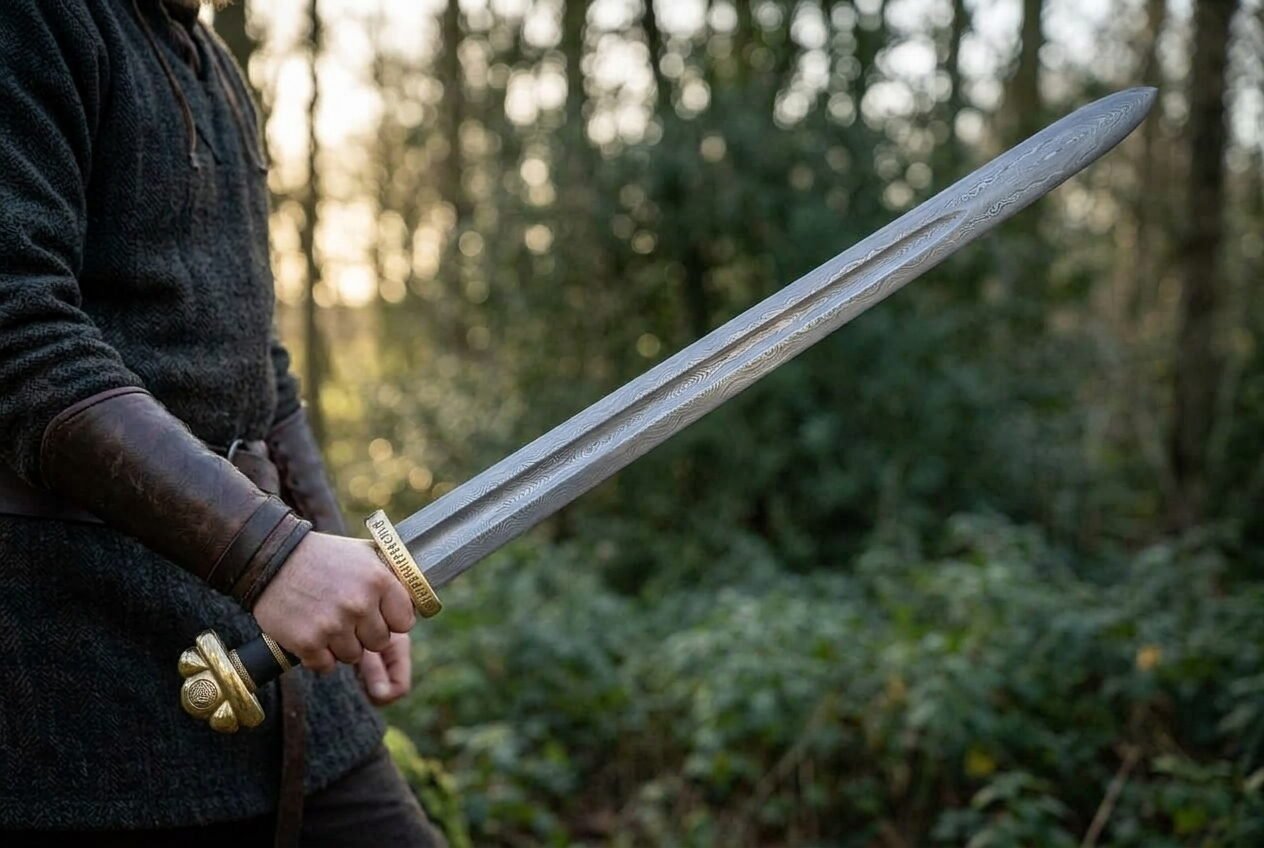
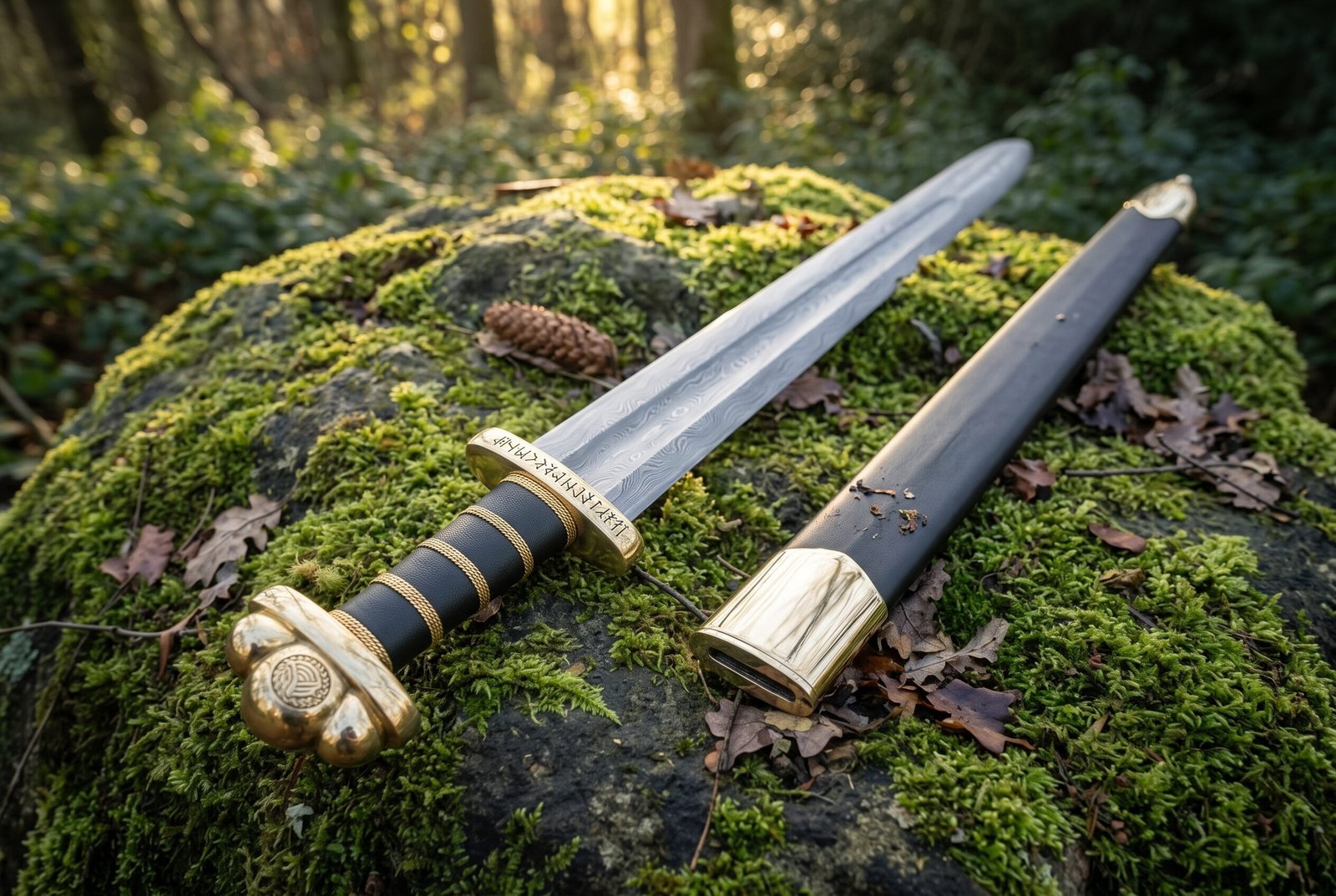
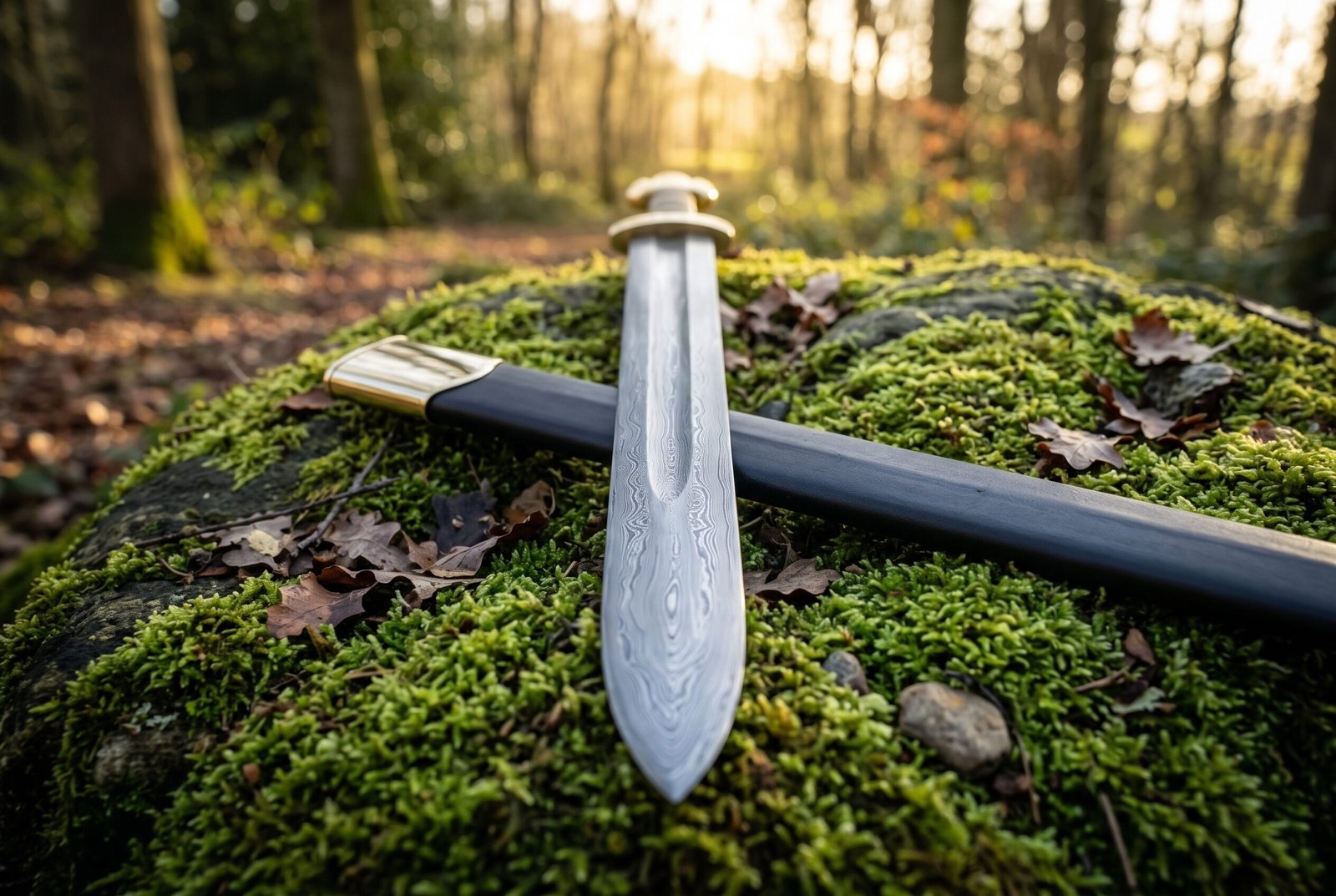
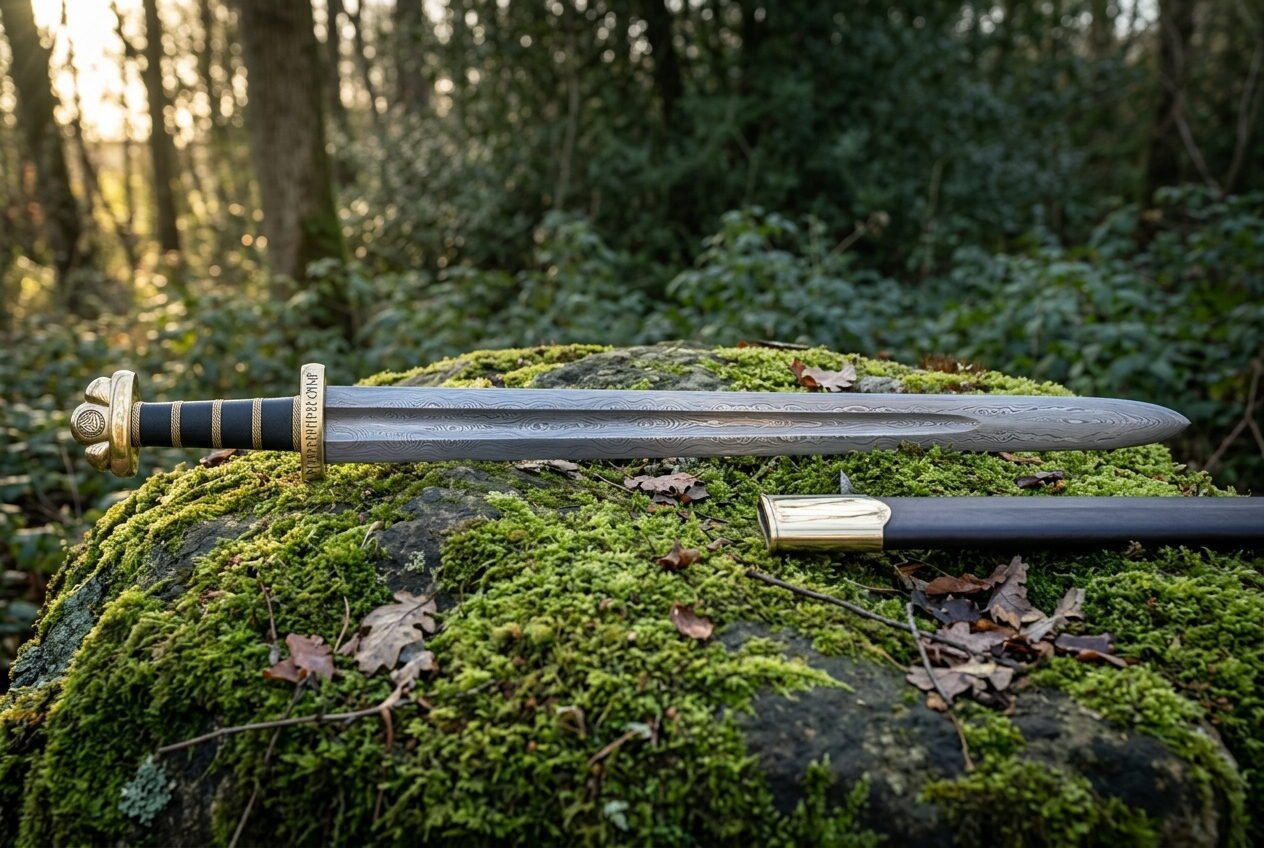
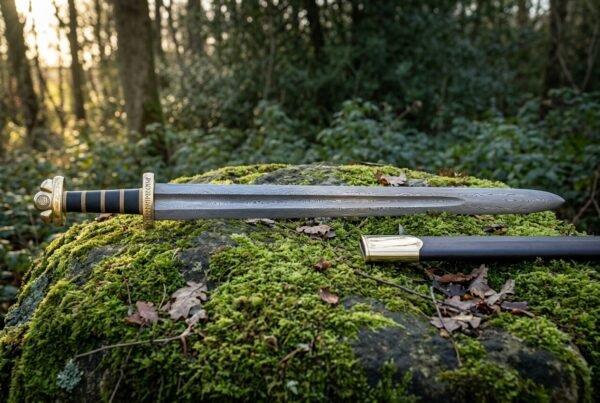
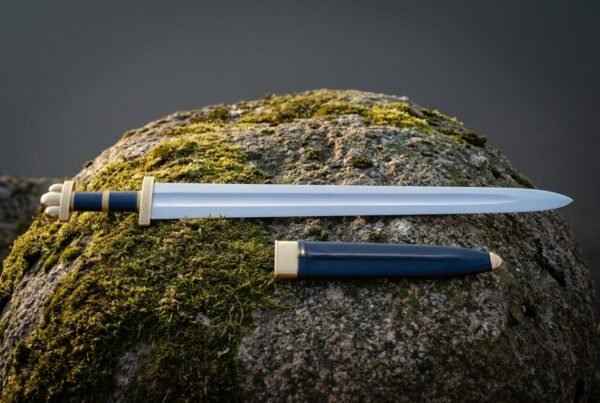
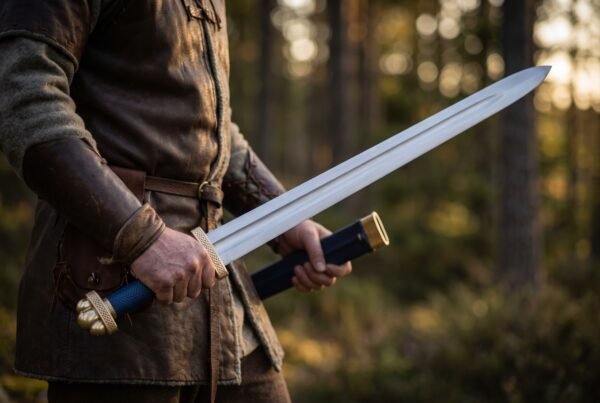
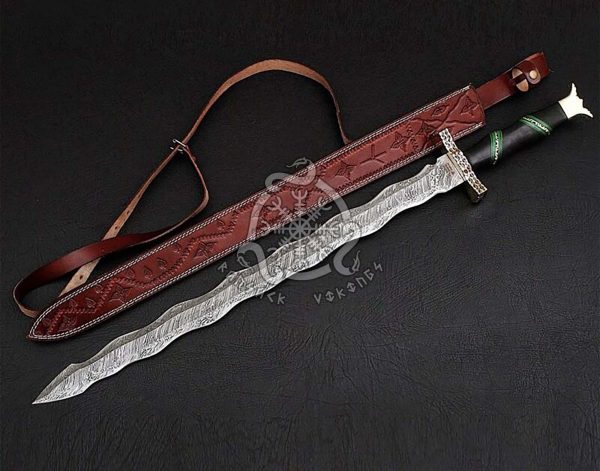
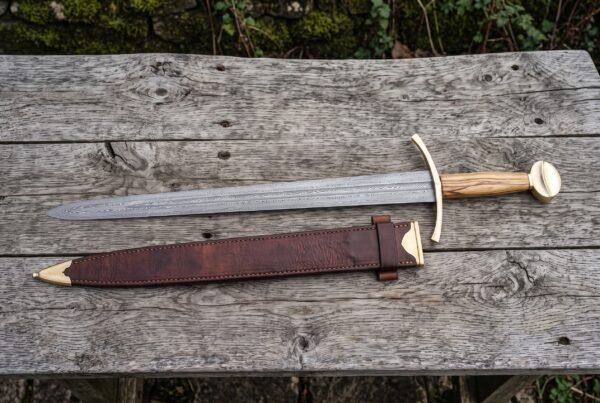
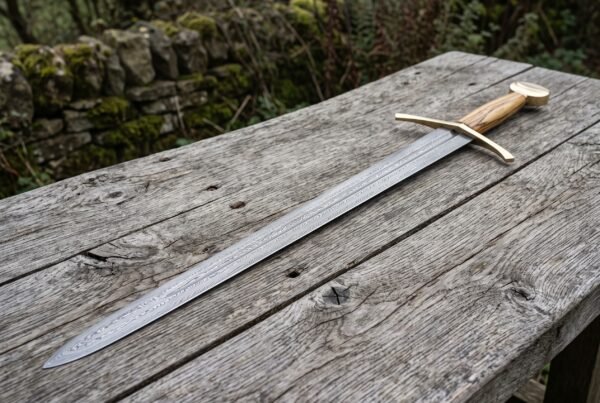
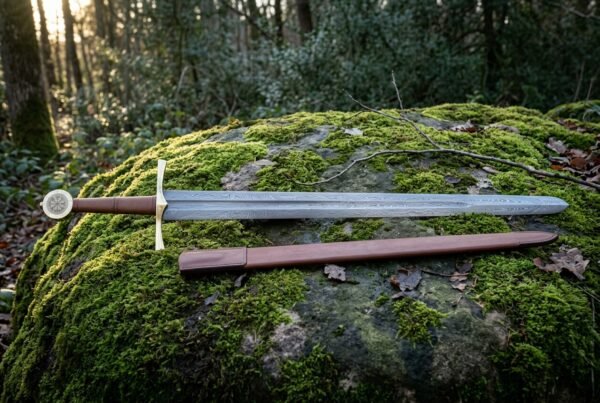
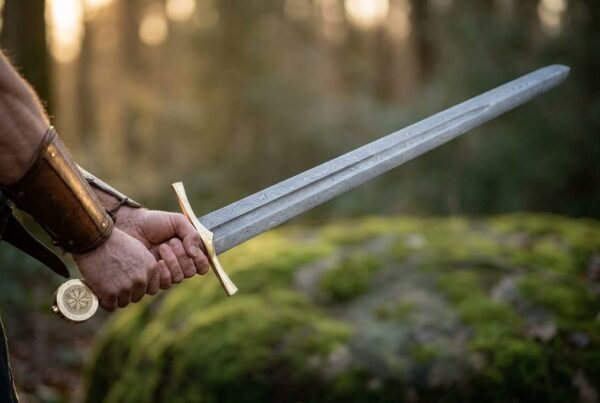
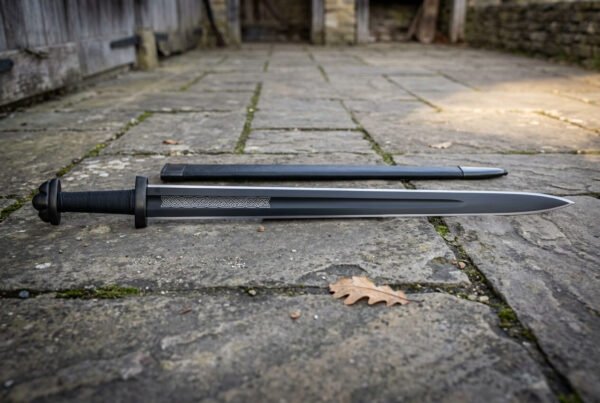
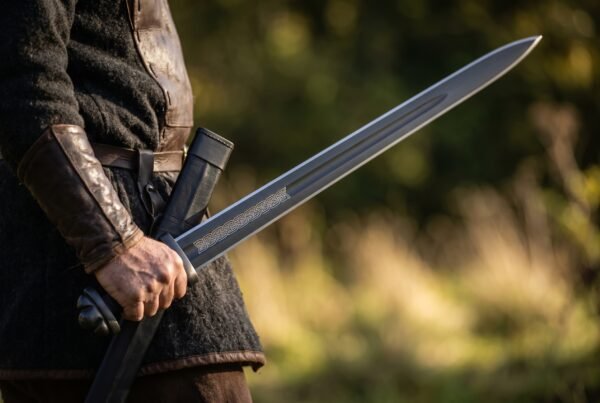
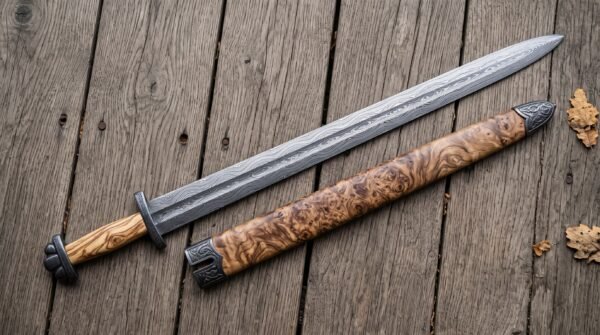
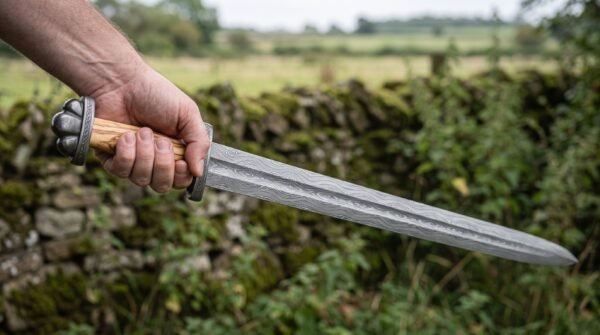
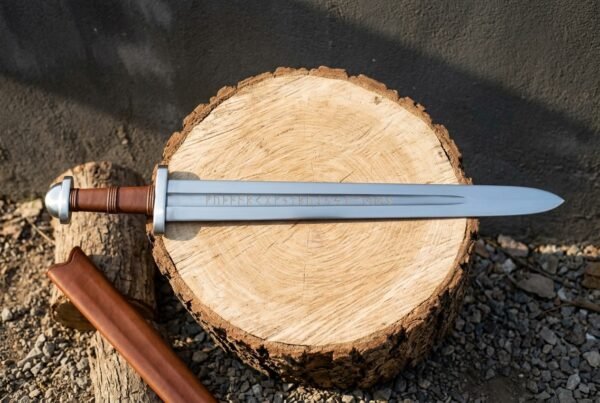
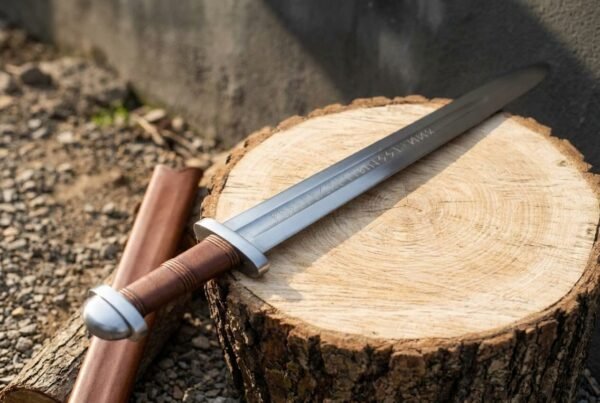
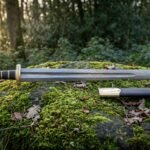
The Emberkeel is a Damascus Norse sword built on the late Viking age pattern, 37 inches overall with a 31 inch layered blade etched dark, a rune engraved brass guard and a heavy lobed brass pommel. It is the pattern welded counterpart to our polished 11th century sword, same geometry, different material. Something worth knowing about swords of this period: Norway alone holds roughly three thousand Viking age swords, almost all of them recovered from pagan burials where a man was sent into the ground with his arms. That supply of swords stops almost overnight in the middle of the eleventh century, not because the Norse stopped making swords but because Christian burial ended the practice of putting grave goods in the earth. Everything scholars know about how these blades were built, how they were balanced and how the fittings were assembled comes overwhelmingly from that narrow window of pagan graves, which is why late Viking swords are comparatively rare finds and why the shape of an 11th century blade is reconstructed as much from carvings and manuscripts as from the swords themselves. Whether layered steel is worth the difference over plain carbon is answered in Damascus against plain high carbon.
This one is forged and finished by hand in the Czech Republic. The billet is forge welded from alternating high carbon and nickel bearing steel, drawn out to length, ground, hardened, tempered and then etched in acid to bring the layers up before the furniture is fitted and the tang peened. It ships with a fitted dark leather scabbard over a wooden core with matching throat and chape, a belt hanger, blade oil and a care card. Shipping inside the United States is free, and the engraving option above the add to cart button is open on every piece we sell.
Specifications
| Item type | Double edged Viking sword, late Viking age pattern |
|---|
| Steel | Layered Damascus in 1095 and 15N20, hand forge welded, acid etched dark |
|---|
| Layers | Approximately 200, ladder and random figure through the length |
|---|
| Hardness | 58 to 60 HRC |
|---|
| Overall length | 37 inches |
|---|
| Blade length | 31 inches |
|---|
| Blade width at guard | 1.9 inches, with strong distal taper to a reinforced point |
|---|
| Fuller | Central fuller running most of the blade and stopping short of the point |
|---|
| Guard | Straight brass guard with an Elder Futhark rune line engraved along it |
|---|
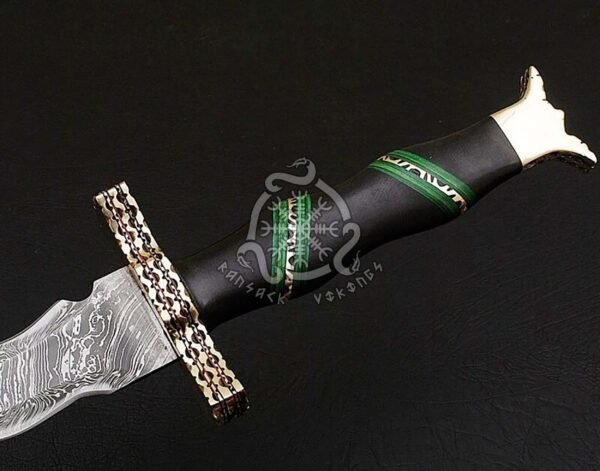
| Handle | Hardwood core wrapped in black leather with six twisted brass wire rings |
|---|
| Pommel | Three lobed brass pommel over a brass upper bar, knotwork disc on the centre lobe, peened tang |
|---|
| Scabbard | Black leather over a wooden core with polished brass throat and chape, belt hanger |
|---|
| Weight | Approximately 2 lb 11 oz |
|---|
| SKU | RK-1233 |
|---|
Distal taper, and why it matters more than weight
Most people judge a sword by how much it weighs. Smiths judge it by where the weight is. This blade is 1.9 inches wide at the guard and a little over a quarter of an inch thick there, and by the last six inches it is under half that thickness. That progressive thinning is distal taper, and it is the single most important thing separating a sword that feels alive from a sword that feels like a crowbar. Two blades of identical length and identical total weight will handle completely differently if one carries its mass evenly and the other sheds it toward the tip.
Taper does three jobs at once. It moves the balance point back toward the hand, which is what lets you stop a cut and start another. It stiffens the blade in the region that matters, because a thick base resists the bending loads that concentrate near the guard. And it puts the remaining mass where the edge does its cutting, roughly a third of the way back from the tip, at the point of percussion where a struck blow produces the least shock in the hand. On a pattern welded blade taper is harder to execute, because grinding away thickness cuts down through the layer stack and changes the figure as you go. The pattern you see on a well tapered Damascus sword is therefore not uniform from guard to tip, and it should not be.
The fuller adds to the same effect. It runs most of the blade and stopping short of the point so the last several inches keep a solid section behind the tip. Blade, fuller, taper and the mass of the lobed pommel are one system. Change any of them and the sword feels wrong.
Why Damascus steel and not stainless
Our Damascus is 1095 alternated with 15N20, both high carbon steels, both hardening to the same range, so the finished blade behaves as a single piece of properly heat treated steel rather than a laminate of dissimilar materials. The pattern shows because nickel in the 15N20 resists the etchant while the plain carbon layers darken under it. Stainless steel cannot do this. Its rust resistance comes from a heavy chromium content that produces coarse carbides in long sections and brittle failure under load, and it does not etch into a legible pattern, so anything sold as stainless Damascus is a printed, stencilled or laser marked surface rather than folded steel. What you give up with real Damascus is easy maintenance, since high carbon steel rusts if neglected and an etched surface shows fingerprints. The comparison is set out properly on our Damascus versus stainless page.
The grip, the guard and the pommel
The core is shaped hardwood, waisted so the hand indexes the edge by feel, with twisted brass wire risers over the leather to give the fingers positive stops. The wrap is black leather, wet fitted so it shrinks tight to the core, and stitched along the back edge away from the palm. Guard and pommel are brass, set against the dark etched blade, filed and fitted by hand, with the tang peened over the pommel button so the assembly is locked mechanically. There is no glue holding anything structural together.
Because the core under that wrap is wood, look after it as wood. Keep it away from standing water and away from heat, never dry a damp grip with a hairdryer or a radiator, and wipe rather than wash it. The advice in our note on wooden handle care applies to this core exactly, and a light leather dressing once or twice a year keeps the wrap from drying and splitting at the seam.
Engraving, runes and your own design
Use the rune converter on this page to turn a name, a date or a short phrase into Elder Futhark and we will cut it into the steel or the handle. If you would rather have a Viking pattern than a rune line, choose your own design in the engraving option above the add to cart button and tell us whether it goes on the blade or the handle. Where a piece already carries an engraved design, your chosen engraving replaces it rather than sitting alongside it. Cutting into an etched Damascus blade exposes bright steel under the dark surface, so a rune line on this sword reads pale against the pattern and is far more visible than the same line on a polished blade. See the engraving page for examples and the line lengths that hold at this size.
Care and sharpening
Oil it and keep it dry. An etched surface is microscopically more open than a mirror polish and will hold the salt and moisture from a fingerprint longer, so wipe the blade down every time you handle it. Do not store the sword inside its leather scabbard for long periods, because leather holds damp and tanning residue and both will pit a blade over a season. Keep it on a rack with the scabbard beside it. If a rust spot appears, address it early using the method in our steel care guide, which also covers how to darken a patch again where the etch has been rubbed bright by handling.
Sharpening is standard high carbon technique carried out over more length. Work in overlapping sections along a coarse stone then a fine one, keep the angle consistent, and finish on a strop. Keep the flat of the blade off the stone, because dragging the etched face across abrasive will leave a bright streak through the pattern. Our guide to sharpening with a whetstone covers the angle control, and everything in it scales up to a sword.
Made in the Czech Republic
Every piece we sell is made by hand in the Czech Republic. The smiths there work the way the trade has been worked for a long time, heating and hammering the steel, taking the bevels down by eye, and fitting the handle and the leather one at a time. There is no automated line anywhere in it, so small differences from one piece to the next are normal and expected.
Ransack Viking is a United States company based in Chicago, Illinois. We bring the pieces in ourselves, inspect them on arrival and ship them from our own warehouse. If you add engraving, that is carried out here in the United States before your order goes out.
A note on handmade variation
This sword is hand forged. It is not machine made and it is not bulk produced, so what arrives will not be a pixel for pixel copy of the photograph on this page. The Damascus figure is unrepeatable by nature. Where the layers stack, how the ladder marks land along the fuller, how deep the etch bites and how the grain runs in the wood under the grip leather all vary from billet to billet and piece to piece because each is worked by hand from natural materials. What stays constant is the specification: the steels, the layer count, the heat treatment, the dimensions and the standard of the build are identical every time. The character is what changes, and on pattern welded steel the character is the reason people buy it.
Frequently asked questions
Is the pattern real, and will it wear off?
It is real forge welded steel, not a surface print, and the pattern goes all the way through the blade. The dark contrast comes from an acid etch on the surface, and that contrast can be polished bright over years of handling. It is easily restored with a light second etch, which our steel care guide explains, and the layers themselves are permanent.
Is it sharp, and can I cut with it?
Yes on both counts. It arrives with a hand honed working edge and is a functional through hardened sword suitable for target cutting on bottles, mats and pool noodles. It is not for contact sparring, not for cutting against steel, stone or seasoned hardwood, and not for throwing.
Can I have Elder Futhark runes engraved?
Yes. Use the rune converter on this page and select the engraving option above the add to cart button, telling us whether the line goes on the blade or the handle. On dark etched Damascus the cut exposes bright steel, so runes stand out strongly.
Will the pattern match the photograph?
No. Every billet twists and stacks differently and every grind reveals a different section through the layers, so your sword will carry its own figure. Dimensions, steels, layer count and finish standard are the same. The photograph shows the style accurately, not the individual object.
What is the difference between this and the polished steel version?
Geometry, dimensions, hardness and handling are the same. The Damascus version costs more because the billet takes a full day of forge welding before the sword exists, it looks entirely different, and it asks for a little more attention to oiling because the etched surface holds moisture more readily than a bright polish.
How long does shipping take?
Free inside the United States, with tracking. In stock pieces leave within two business days. Forged to order, a Damascus sword of this length needs three to four weeks of bench time, and custom engraving adds a few days on top.
What is in the box
- One Emberkeel Damascus Norse sword, 37 inches overall with a 31 inch layered blade
- Fitted dark leather scabbard over a wooden core with matching throat and chape
- Leather belt hanger with buckle
- Blade oil and a lint free cloth for first storage
- Care and sharpening card written for etched Damascus
- Forged and finished in the Czech Republic
Explore the range
See the rest of the Damascus swords, the full Viking swords range, the wider swords collection and the Norse arms we carry to go with them. Steel, etching and sharpening are covered in the guides.
Others in the same line
Worth putting side by side with this is the Skeinfell Viking sword, 33 inches overall. In the same category sits the Ironsong Viking sword, pattern welded Damascus. A near match for this one is the Lobecrown Viking sword, pattern welded Damascus.
For a different piece from the same family, look at the Wyrmcoil broadsword. You can have this made your way instead on the custom Viking sword page.


So happy I finally pulled the trigger on this one. Ordered from Ransack Viking before and the quality stays consistent every time.
This sword beat every expectation I had. Fit and finish is museum quality. You can tell real craftsmen made this by hand. This will be a family heirloom for sure.
Been eyeing this sword for months and it did not disappoint. Leather sheath is thick and well stitched. Not the cheap stuff you usually get. Even the small engravings are crisp and clean. 10/10 would buy again.
Photos don’t do this sword justice at all. This is my third order from Ransack Viking and they never disappoint. The wood handle feels amazing and the balance is perfect. Love it.
My whole family was impressed when I unboxed it. Leather sheath is thick and well stitched. Not the cheap stuff you usually get. Even the small engravings are crisp and clean. This is my third order from Ransack Viking and they never disappoint. Highly recommend this one.
Best sword I’ve ever owned. Fit and finish is museum quality. You can tell real craftsmen made this by hand. Beyond happy with how this turned out.
Was nervous ordering something like this online but so glad I did. Damascus blade holds a razor edge right out of the box. Edge retention has been great even after regular use. Ordered from Ransack Viking before and the quality stays consistent every time. Fit and finish is museum quality. You can tell real craftsmen made this by hand. Love it.
My whole family was impressed when I unboxed it. The wood handle feels amazing and the balance is perfect. This shop clearly takes pride in their work.
This thing is a beast in the best way. The wood handle feels amazing and the balance is perfect. Beyond happy with how this turned out.
Photos don’t do this sword justice at all. This is my third order from Ransack Viking and they never disappoint. So worth it.