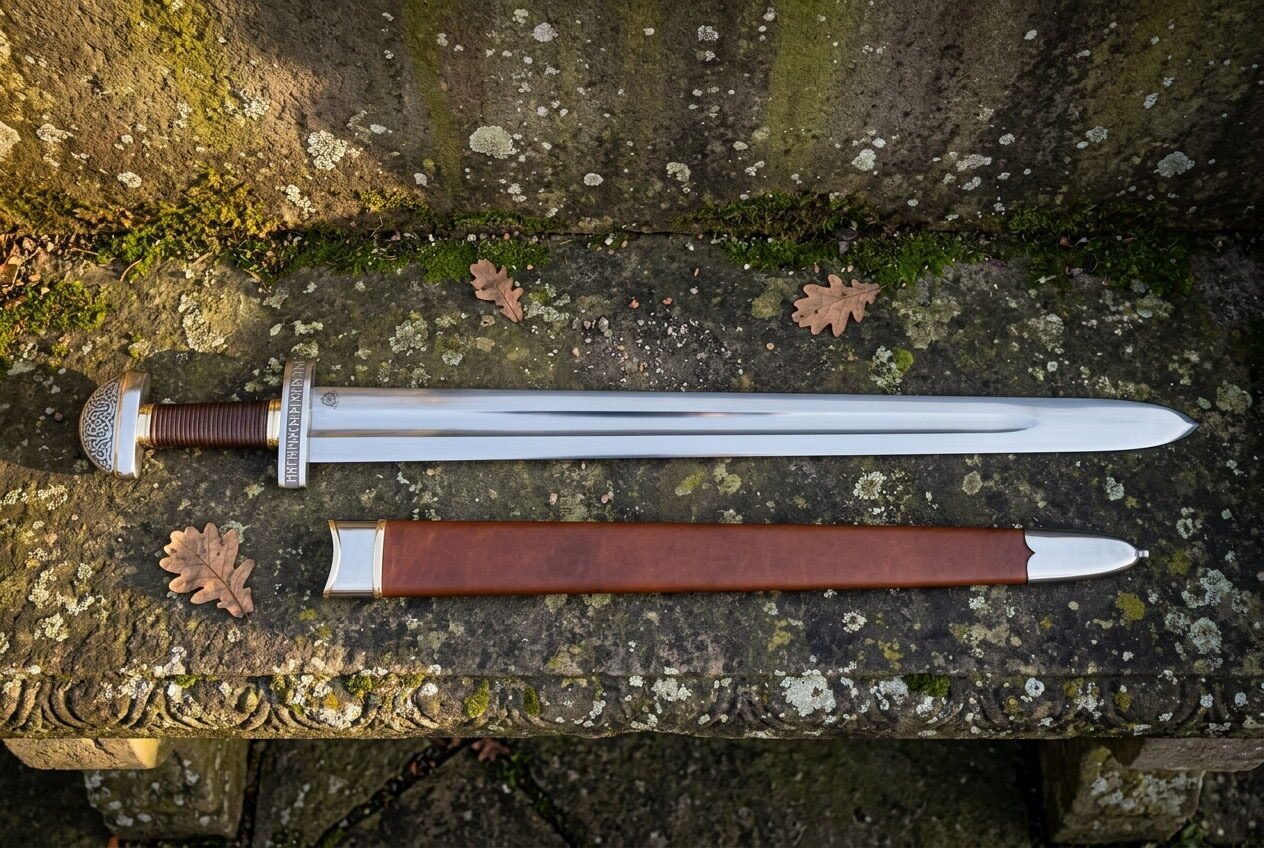
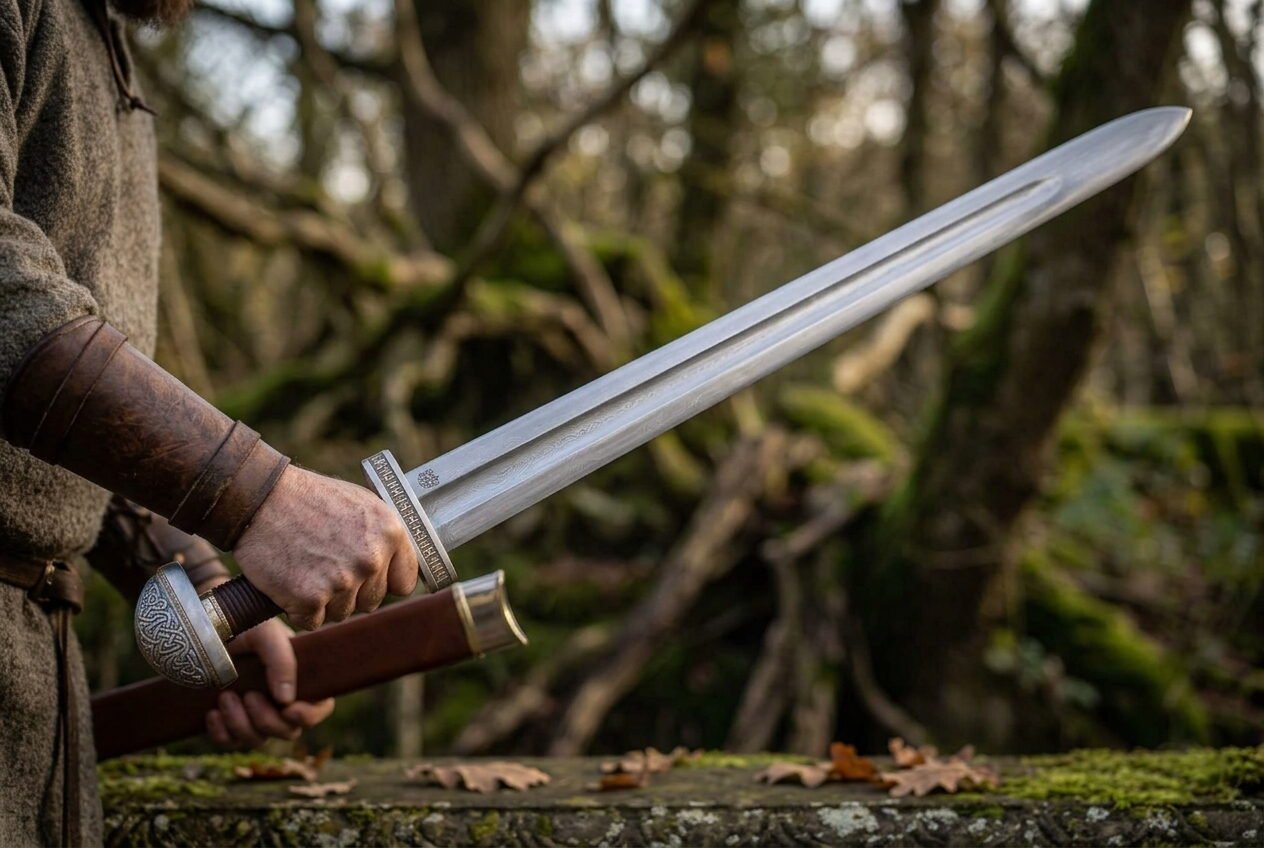
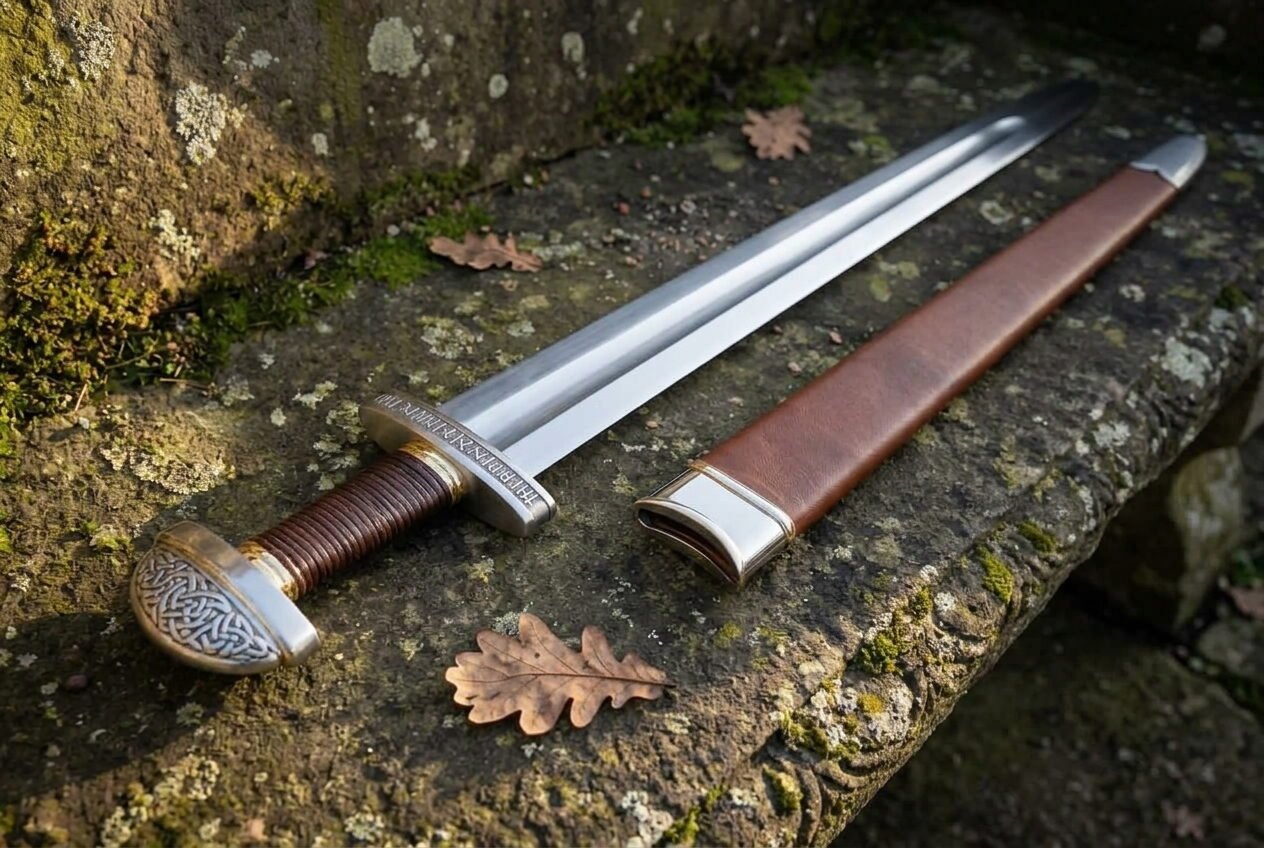
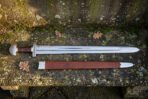
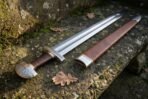
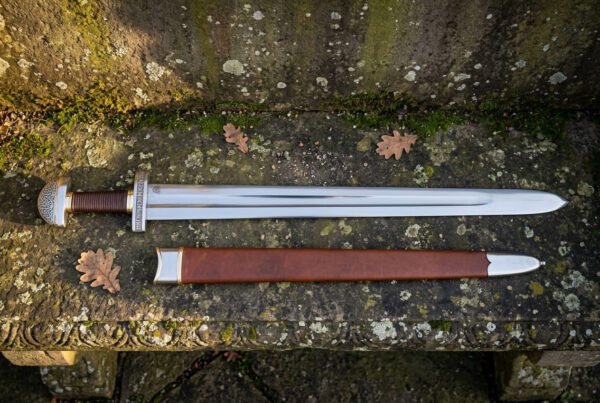
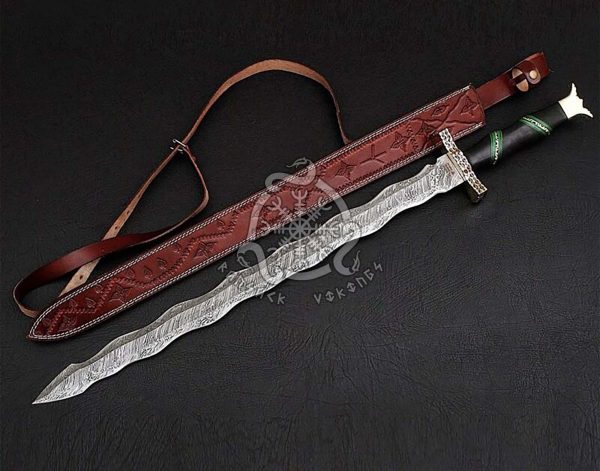
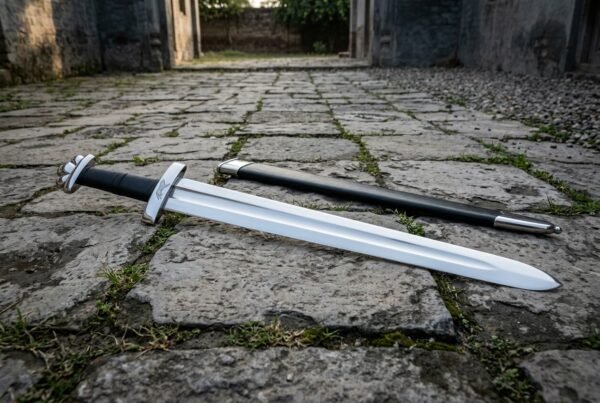
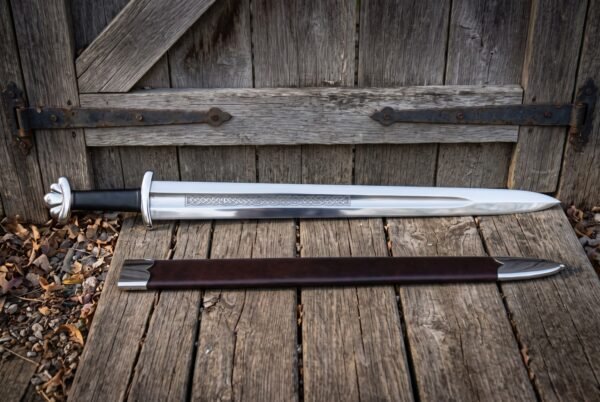
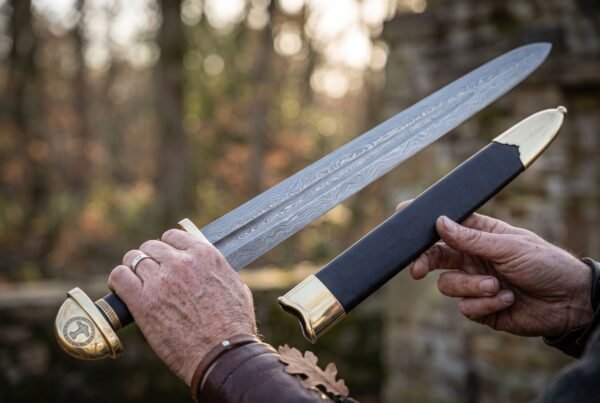
The Wyrmcoil is a Viking broadsword with a wire wrapped grip, 36 inches overall with a 30 inch fullered blade, polished steel guard and pommel engraved with runes and knotwork, and a fitted brown leather scabbard with steel throat and chape. The wire is the detail worth talking about. Norse hilts of the higher grades were routinely decorated with wire, but not the way most people imagine. Rather than winding a wire around the outside of a grip, the smith cut fine hatched grooves into the surface of the iron guard and pommel and hammered soft silver, copper or brass wire down into them until it locked mechanically, then filed the surface flat so the inlay sat flush and the pattern read as bands, chevrons and interlace across the metal. Surviving hilts from Norway and Denmark carry dense geometric fields worked this way, and because silver and copper age differently against iron, the original effect was a hilt that was not one colour but three. Wire on a grip and wire in a hilt are different techniques from the same instinct: use a soft metal to add grip, contrast and status to a hard one. For the sensible way to start, see buying your first sword.
This sword is forged and finished by hand in the Czech Republic. The blade is drawn out under the hammer, hand fullered, hardened and tempered in house, and the grip is built over a shaped wooden core with leather and a wound wire wrap before the steel furniture is fitted and the tang peened. It ships with the fitted scabbard, a belt hanger, blade oil and a care card. Shipping inside the United States is free, and the engraving option above the add to cart button is available on every piece we make.
Specifications
| Steel | 1095 high carbon steel, hand forged, oil quenched and tempered |
|---|
| Hardness | 54 to 58 HRC |
|---|
| Type | Single handed Viking broadsword |
|---|
| Overall length | 36 inches |
|---|
| Blade length | 30 inches |
|---|
| Blade width at guard | 2.1 inches, tapering to a point |
|---|
| Fuller | Wide central fuller, hand ground, running most of the blade and ending short of the tip |
|---|
| Grip | Hardwood core in brown leather with a tight wound wrap over cord risers |
|---|
| Grip collars | Brass ferrule at each end of the grip |
|---|
| Guard | Polished steel straight guard with an engraved rune band |
|---|
| Pommel | Polished steel rounded pommel engraved with knotwork, tang peened |
|---|
| Scabbard | Brown leather over a wooden core with polished steel throat and chape, belt hanger |
|---|
| Weight | Approximately 2 lb 13 oz |
|---|
| SKU | RK-1240 |
|---|
What a wire wrapped grip actually does
A wire wrap is not decoration bolted onto a handle. It changes how the sword behaves in the hand, and it does so in three ways.
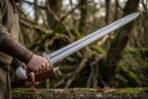
The first is friction. Smooth leather is comfortable dry and treacherous wet, and a sword is used outdoors in weather by people whose hands are not always clean. Winding wire over the wrap breaks the surface into a series of hard ridges that the fingers can bite against, so the hand stops sliding even when the leather itself is slick. Anyone who has held a plain leather grip in the rain and then held a wired one understands the difference in about two seconds.
The second is indexing. Under the leather this grip carries cord risers, low ridges of bound cord that swell the profile at set points. Combined with the waisted wooden core, they tell your hand exactly where it is on the grip and which way the edge is pointing without any need to look. Edge alignment is most of what separates a cut that goes through a target from a cut that slaps it, and a grip that indexes itself does that work for you.
The third is durability. Leather wears where the hand rubs. Wire takes that wear instead, spreads the load over the whole wrap and holds the leather down at the same time, which is why wired grips outlast plain ones by a wide margin on swords that actually get handled.
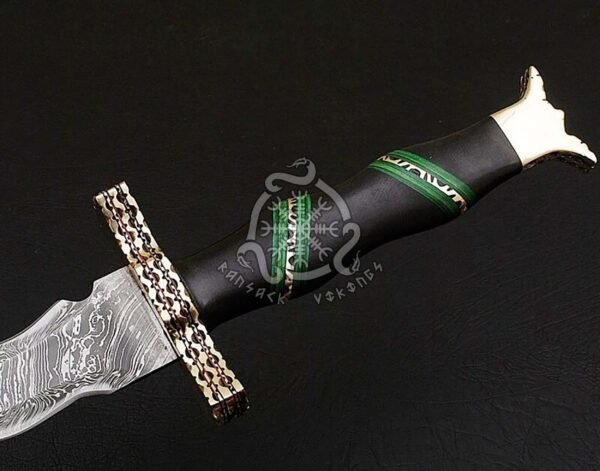
Underneath it all is a Norse hilt of guard and pommel, here in polished steel with an engraved rune band across the guard and knotwork cut into the pommel, with the tang peened over the top so the stack is locked.
Why high carbon steel and not stainless
1095 is a plain, clean, high carbon steel. It hardens through, takes and keeps an edge, and at 54 to 58 HRC it will bend under load and spring back rather than break. Stainless steel earns its rust resistance from a heavy chromium content, and in a section as long as a sword blade that chromium encourages coarse carbides and brittle failure. Long stainless blades are wall hangers, and inexpensive ones can let go at the tang without warning. Carbon steel wants a wipe and a film of oil in return for behaving properly, and it takes a patina over the years that most owners come to prefer to a factory shine. Our Damascus versus stainless page lays the comparison out in full.
The grip, the fittings and how to look after them
The core is shaped hardwood, waisted through the middle, with cord risers bound in place before the leather goes on. The leather is wet fitted so it dries tight, then the wire is wound under tension from guard to pommel and its ends are secured under the fittings so there is nothing to snag or unravel. The steel guard and pommel are filed, fitted and polished by hand, and the tang is peened over the pommel button. There is no adhesive doing structural work anywhere in the assembly.
There is wood inside that grip and wood inside the scabbard, so treat both as wood. Keep them out of standing water, out of hot cars and away from radiators, wipe rather than wash, and let anything damp dry at room temperature. Our note on wooden handle care covers the same material and the same failure modes. The steel guard and pommel want the same light film of oil as the blade.
Engraving, runes and your own design
Use the rune converter on this page to turn a name, a date or a short phrase into Elder Futhark and we will cut it into the steel or the handle. If you would rather have a Viking pattern than a rune line, choose your own design in the engraving option above the add to cart button and tell us whether it goes on the blade or the handle. Where a piece already carries an engraved design, your chosen engraving replaces it rather than sitting alongside it. See the engraving page for what fits where.
Care and sharpening
Wipe the blade after handling and keep a light film of oil on it, because skin oils are mildly acidic and will mark polished steel within days in a humid room. Do not store the sword inside its scabbard for months, since leather traps moisture and tanning salts that will pit a blade over a season. Keep it on a rack or wall mount with the scabbard alongside. Pay a little attention to the wire wrap when you oil, because the grooves between the turns will hold damp from a wet hand. Storage, patina and early rust are covered in our steel care guide.
Sharpening is standard high carbon work over a longer edge. Support the blade, work in overlapping sections along a coarse stone and then a fine one at a steady angle, and finish on a strop. A long combination stone or a guided rod system both suit a sword. The angle control method in our guide to sharpening with a whetstone is what we use on the bench and scales directly to a blade this size.
Made in the Czech Republic
This piece is made by hand in the Czech Republic, in a workshop that still works the old way. The steel is forged, ground, heat treated and finished by smiths who learned the trade from the people before them, and the wood, horn and leather are cut and fitted by hand rather than pressed out on a line. That is also why no two pieces come out exactly the same.
Ransack Viking is a United States company. We import these pieces ourselves, check every one when it lands and ship from our warehouse in Chicago, Illinois. Engraving is done here in the United States after the piece arrives, so your runes or your own design go on before it leaves for you.
A note on handmade variation
This sword is hand forged. It is not machine made and it is not bulk produced, so what arrives will not be a pixel for pixel copy of the photograph on this page. The spacing of the wire turns, the grain of the wood under the leather, the tone the hide takes from the dye, the finish on the guard and pommel and the way light runs along the hand ground fuller all vary from piece to piece, because each one is worked by hand from natural materials. The specification does not vary. The steel, the heat treatment, the stated dimensions, the construction and the standard of the finish are the same on every sword we send out. The character is what changes, and it is the whole reason to buy from a forge rather than a factory.
Frequently asked questions
Does the wire wrap make the grip uncomfortable?
No. The wire is wound over leather rather than over bare wood, so the ridges are firm but not sharp, and the wrap is set under even tension so there are no proud turns to dig in. It grips considerably better than plain leather with a wet or gloved hand.
Can the wire come loose?
It should not. The wrap is wound under tension in a single pass and both ends are captured under the fittings, with the tang peened over the pommel on top of that. If a turn ever does go slack through hard use, it can be rewound, and we will do it for you at cost.
Is the sword sharp and can I cut with it?
Yes to both. It arrives with a hand honed working edge and is through hardened 1095 with a peened full tang, so it will handle target cutting on bottles, mats and green pool noodles. It is not a sparring sword. Do not use it against steel, stone or seasoned hardwood, and do not throw it.
Will the guard and pommel rust?
They are steel, so they can. Wipe them with the same oiled cloth you use on the blade and they will stay bright.
Can I have runes engraved on the hilt instead of the blade?
The guard already carries an engraved rune band and the pommel carries knotwork, so the blade is the usual place for your own line. Use the rune converter on this page and pick the engraving option above the add to cart button.
How long does shipping take?
Free inside the United States with tracking. In stock swords leave within two business days. Forged to order, allow two to three weeks of bench time, plus a few days more if you have added a custom engraving.
What is in the box
- One Wyrmcoil Viking broadsword, 36 inches overall with a 30 inch 1095 high carbon steel blade
- Fitted brown leather scabbard over a wooden core with steel throat and chape
- Leather belt hanger with buckle
- Blade oil and a lint free cloth for first storage
- Care and sharpening card covering steel and leather
- Forged and finished in the Czech Republic
Explore the range
See the full Viking swords range, the wider swords collection, the Norse arms we carry alongside them and the scabbards and sheaths made to fit each blade. Steel, brass and care are covered in the guides.
Close to this one
For a straight comparison, see the Knotwake broadsword, 34 inches overall. Worth putting side by side with this is the Knotfell Viking sword, 30 inches overall. In the same category sits the Twinreave movie sword, 44 inches overall.
From the same corner of the shop, there is the Barrowlight Viking sword. Nothing here exactly right, build one to your own spec on the custom Viking sword page.
If you would rather train with a sword than hang one up, the Haldvane blunt arming sword suits club work, and our HEMA arming swords covers the choices.

This sword beat every expectation I had. Edge retention has been great even after regular use. Already planning my next purchase from this shop.