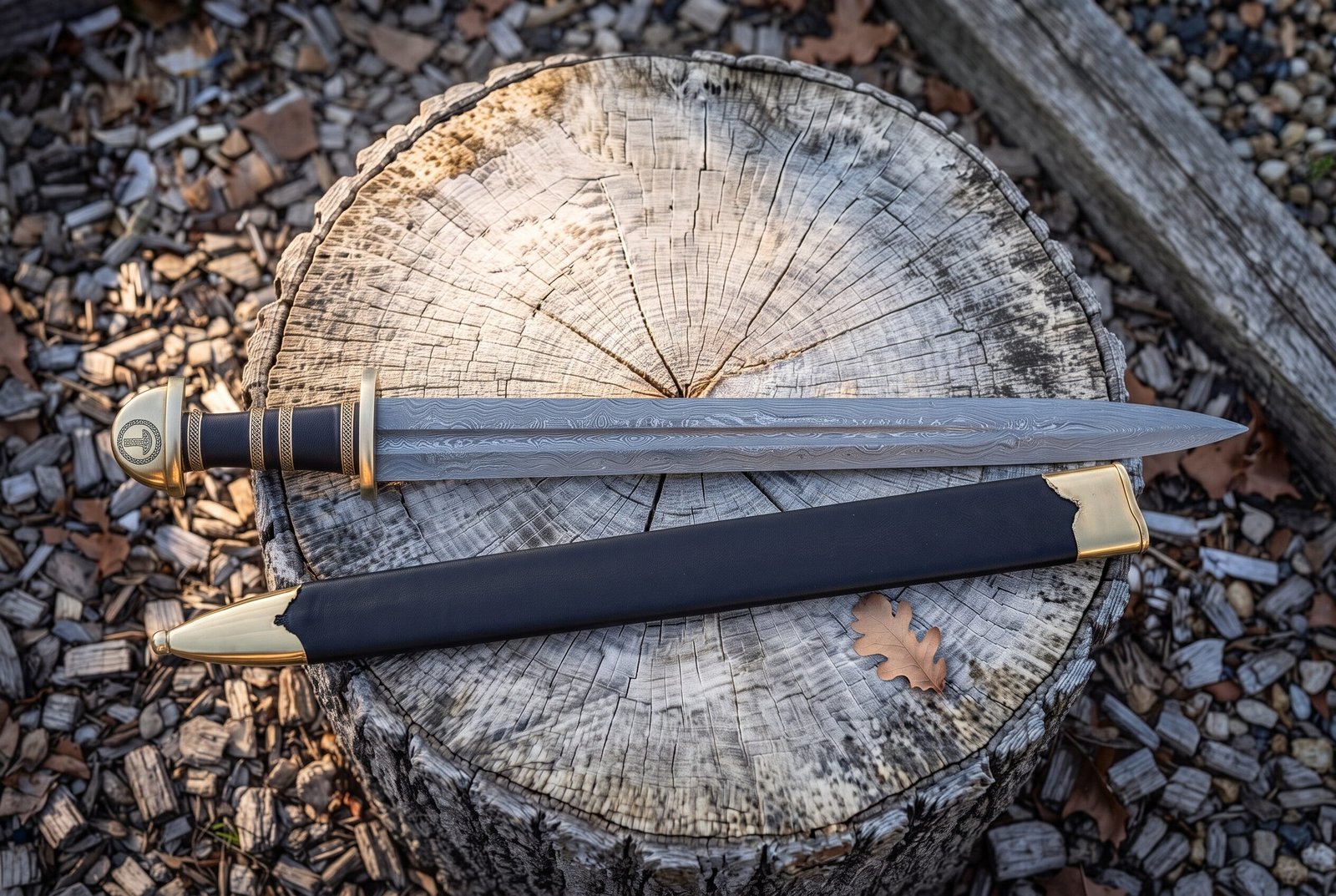
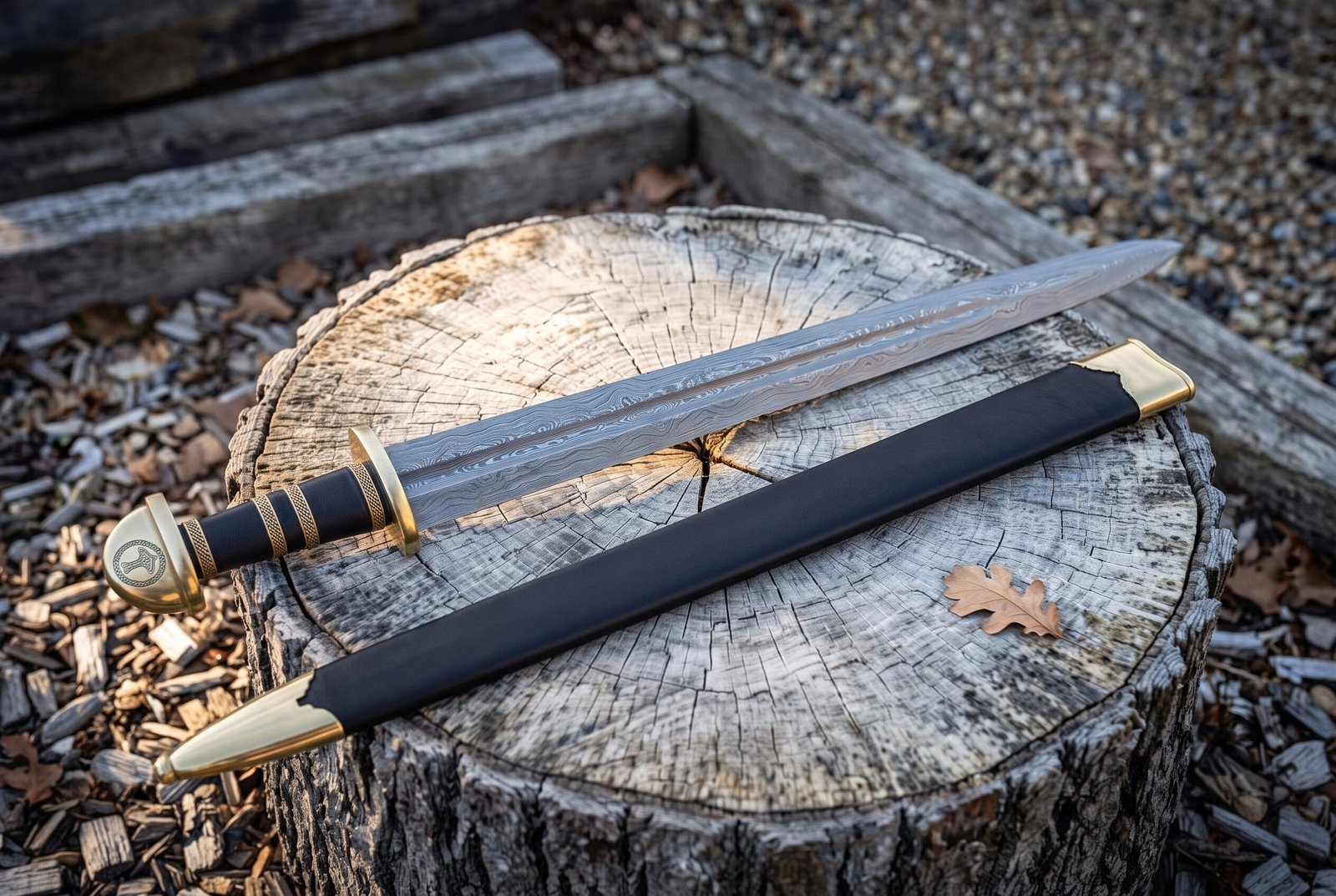
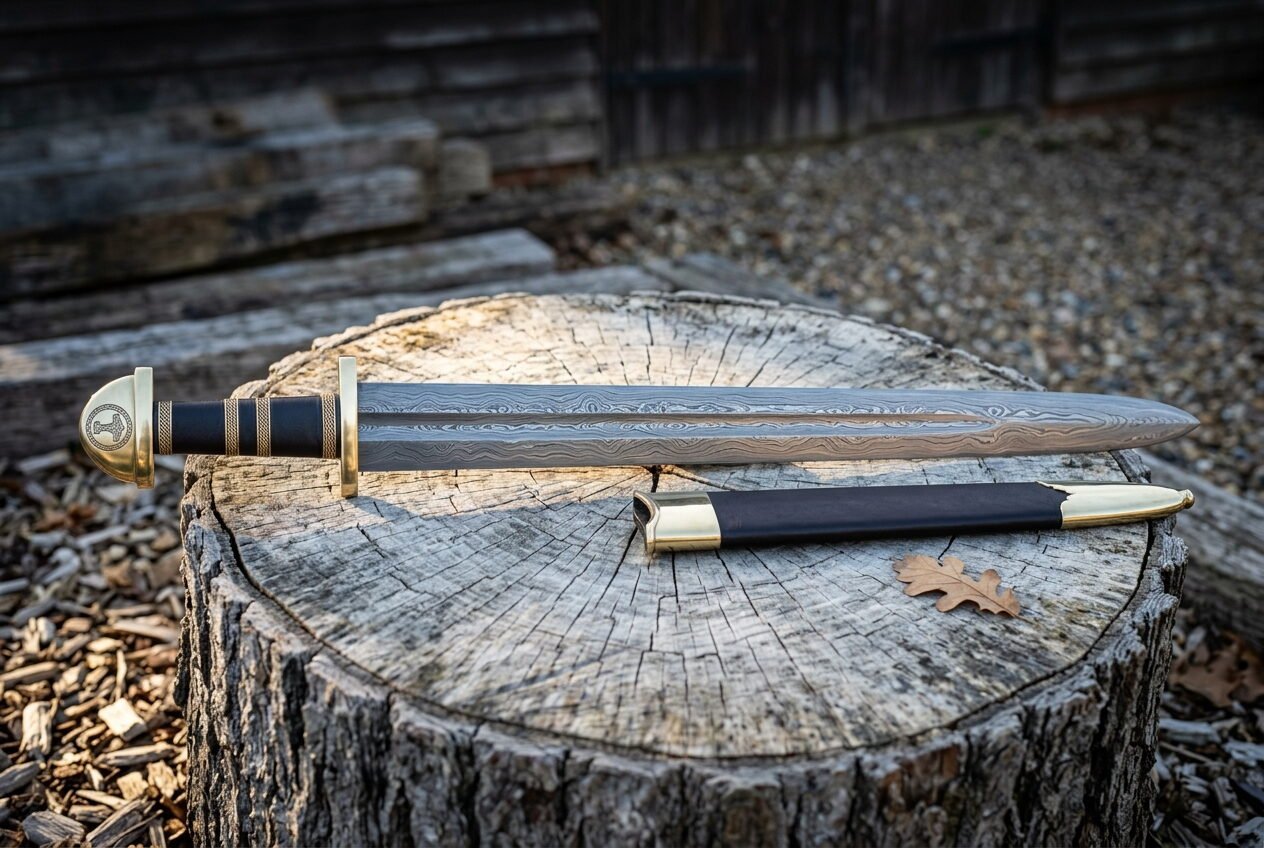
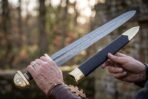
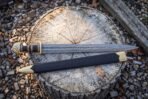
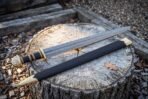
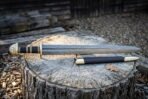
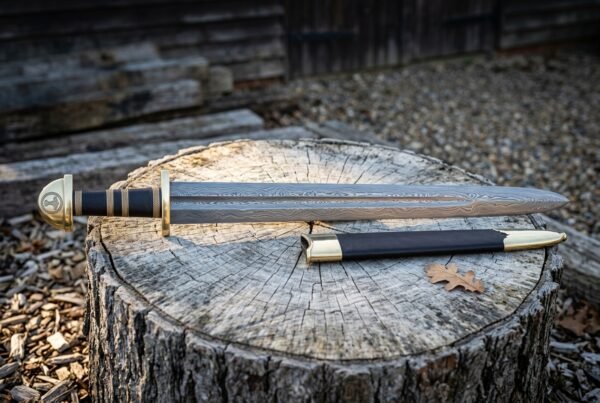
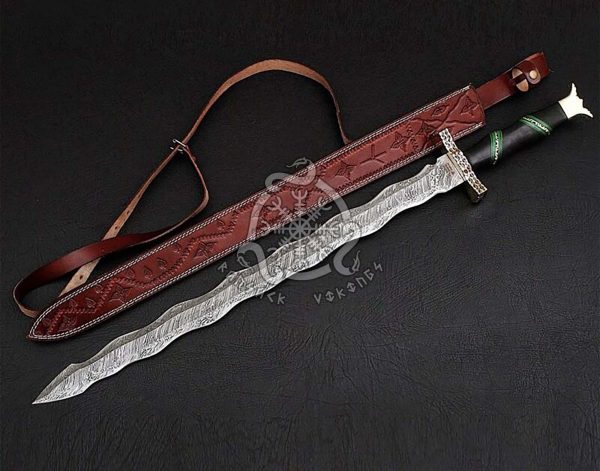
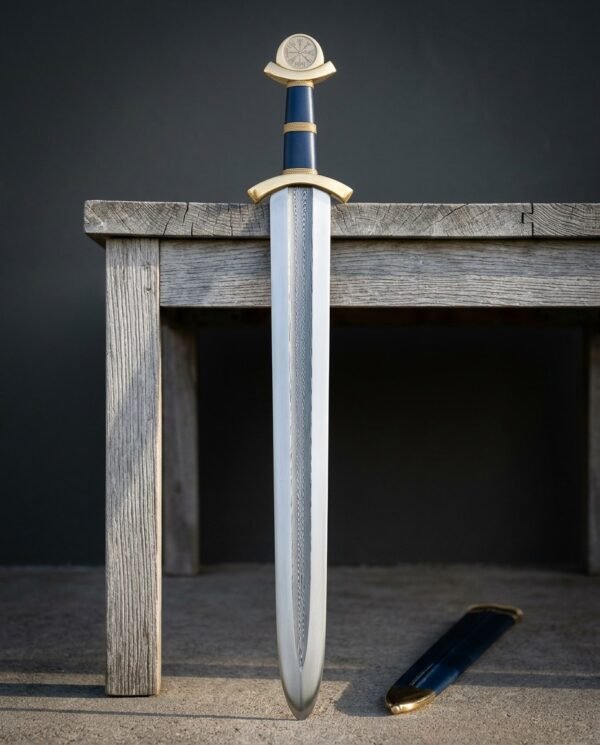
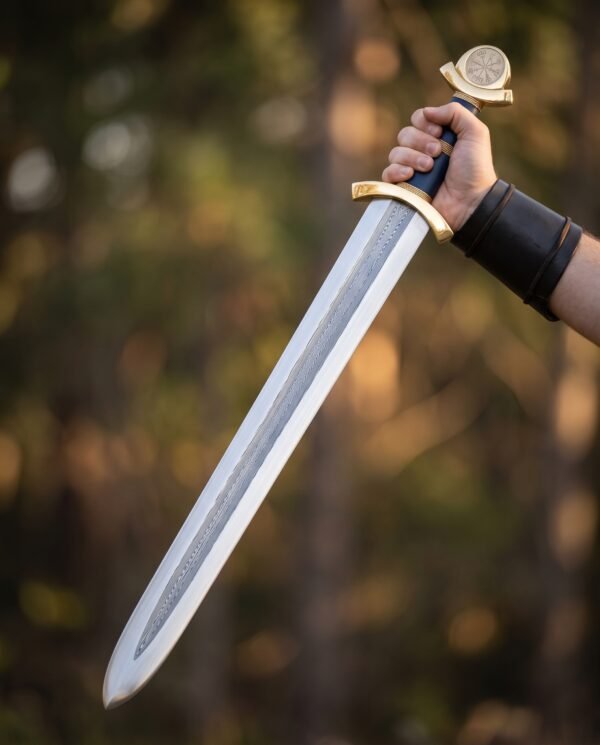
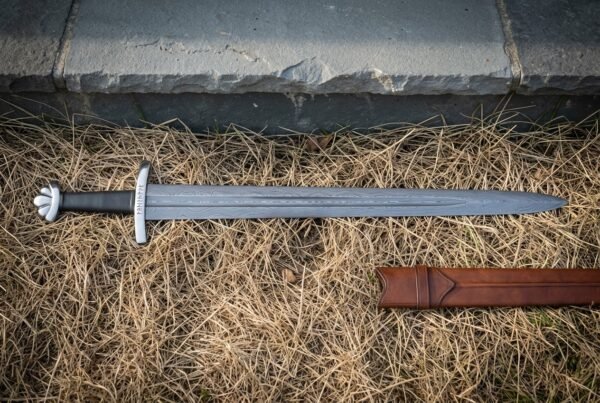
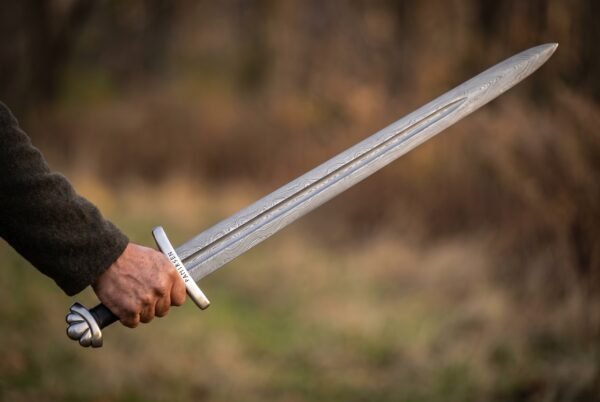
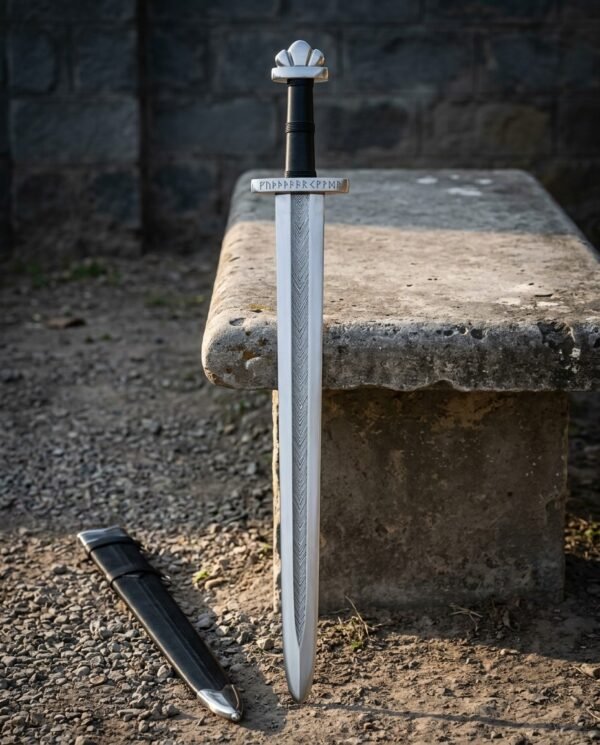
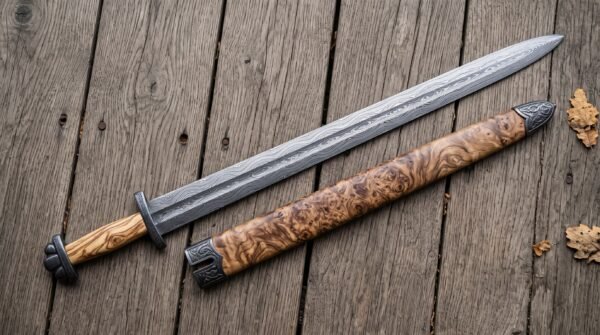
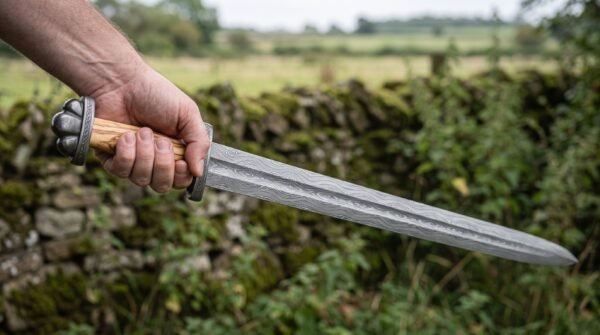
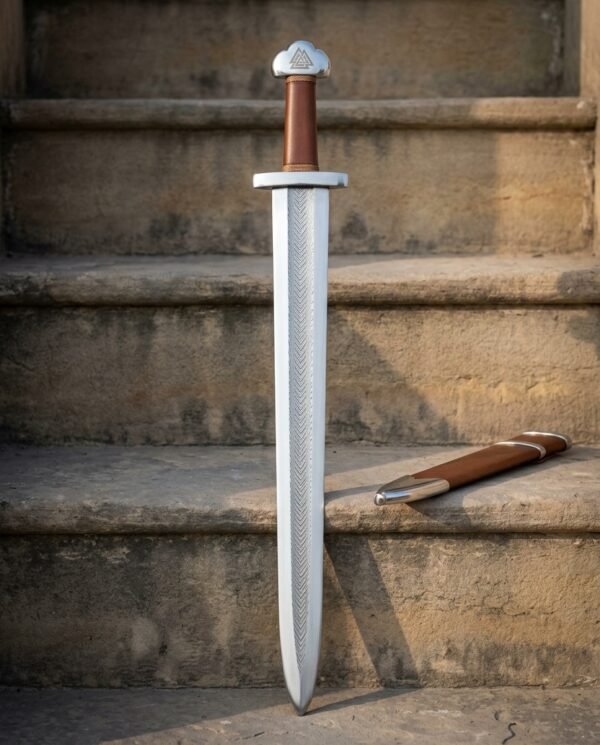
The Wolfrune is the Damascus counterpart to our Ulfberht pattern Viking sword, 36 inches overall with a 30 inch blade in layered 1095 and 15N20 steel etched dark so the pattern reads as smoke moving down the length. It carries the same broad fuller as the polished steel version, fitted with a brass cap pommel and brass guard and dressed in a black leather scabbard with brass fittings. Pattern welding was not decoration to the smiths who invented it. Before reliable high carbon stock reached Northern Europe, a bloomery gave you a bag of inconsistent iron and steel, and the only way to build a four foot object out of it was to sort the pieces, stack them, forge weld them and twist the resulting rods so that hard and soft material alternated through the blade. The pattern you see on a genuine migration era or early Viking sword is the fingerprint of that sorting process. Norse poetry noticed it and gave the effect names, the serpent in the blade among them, and grave finds from the sixth to the ninth century show smiths twisting rods in opposing directions purely to make the herringbone and chevron figures land symmetrically. By the time the Ulfberht workshops were running, cleaner steel had made the technique unnecessary for strength, and pattern welding survived because it was beautiful. Who actually made the originals is still argued over, and the Ulfberht mystery covers the argument.
This sword is forged and finished by hand in the Czech Republic. The billet is welded, drawn, folded and cut in house, the fuller is ground by hand once the pattern is set, and the blade is normalised, hardened, tempered and then etched in acid to lift the layers before the furniture goes on. It ships with a fitted black leather scabbard over a wooden core with a brass throat and chape, a belt hanger, blade oil and a care card. Shipping inside the United States is free, and the engraving option above the add to cart button is open on every piece we make.
Specifications
| Steel | Layered Damascus in 1095 and 15N20, hand forge welded, acid etched dark |
|---|
| Layers | Approximately 200, twist and ladder worked through the billet |
|---|
| Hardness | 58 to 60 HRC |
|---|
| Overall length | 36 inches |
|---|
| Blade length | 30 inches |
|---|
| Blade width at guard | 2.1 inches, tapering through the length |
|---|
| Fuller | Wide central fuller running most of the blade, hand ground after the pattern is set |
|---|
| Guard | Narrow straight brass guard |
|---|
| Handle | Black leather over a hardwood core with cord risers, four braided brass grip bands |
|---|
| Pommel | Rounded brass cap pommel engraved with a Thor hammer roundel, peened tang |
|---|
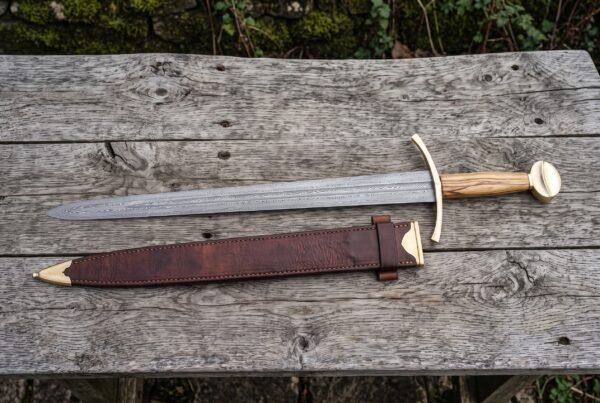
| Scabbard | Black leather over a wooden core with brass throat and chape, belt hanger |
|---|
| Weight | Approximately 2 lb 13 oz |
|---|
| SKU | RK-1231 |
|---|
How a pattern welded Viking blade is actually built
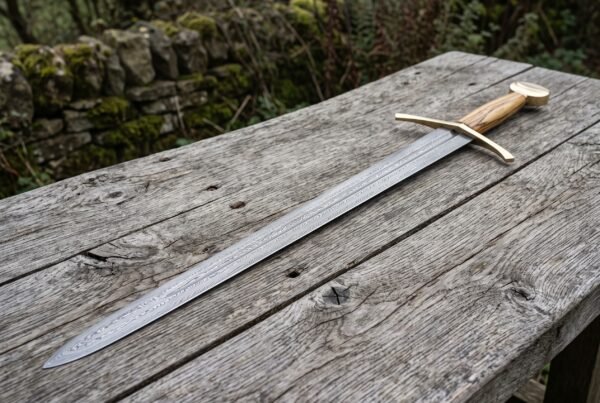
A Damascus billet starts as a stack. The smith alternates 1095, a plain high carbon steel, with 15N20, a nickel bearing steel from the bandsaw trade. Both harden to a similar degree, which is the important part, but nickel resists the etching acid while plain carbon steel darkens under it. That difference in etching response is the entire reason the pattern shows. The stack is brought to welding heat, forge welded solid, then drawn out and folded back on itself until the layer count is where the smith wants it. For this sword the billet is then twisted in sections and reground flat, which drags the flat layers into the spirals and chevrons you can see running along the fuller.
The order of operations matters more than most people realise. The fuller is ground after the pattern is established, because grinding into a twisted billet cuts through the layers at a shallow angle and reveals a different figure than the surface shows. The etch goes on after heat treatment, not before, because quenching scale would strip it. And the edge is left slightly proud through the etch, then sharpened afterwards, so that the working bevel is bright metal rather than acid darkened. That bright line down the cutting edge against the dark body is a genuine mark of a blade that was etched and then finished, not merely coated.
Why Damascus steel and not stainless
Layered Damascus in 1095 and 15N20 is high carbon steel through and through, and it hardens, holds an edge and flexes the way a sword should. Stainless steel achieves rust resistance with a high chromium content, and across a 30 inch blade that chromium promotes coarse carbides and brittle failure modes that you do not want in something you swing. There is also a simple visual problem: stainless does not etch into a legible pattern, so a stainless Damascus sword is either a printed film, a laser mark or a chemical stencil rather than folded steel. The trade with real Damascus is that it will rust if you neglect it, and the acid etched surface will show fingerprints faster than a bright polish will. Our Damascus versus stainless page sets the two out side by side, including what each does when you actually load it.
The grip, the guard and the pommel
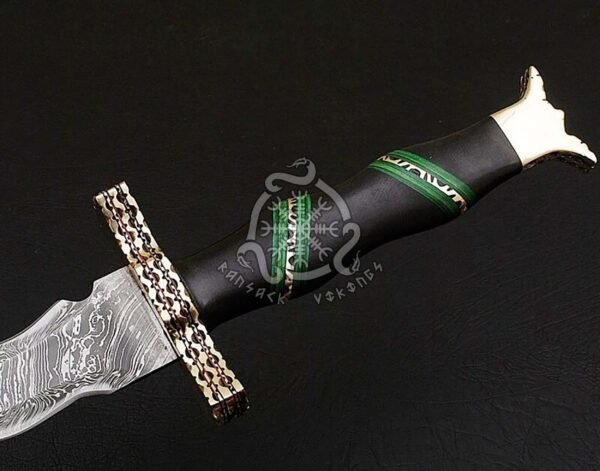
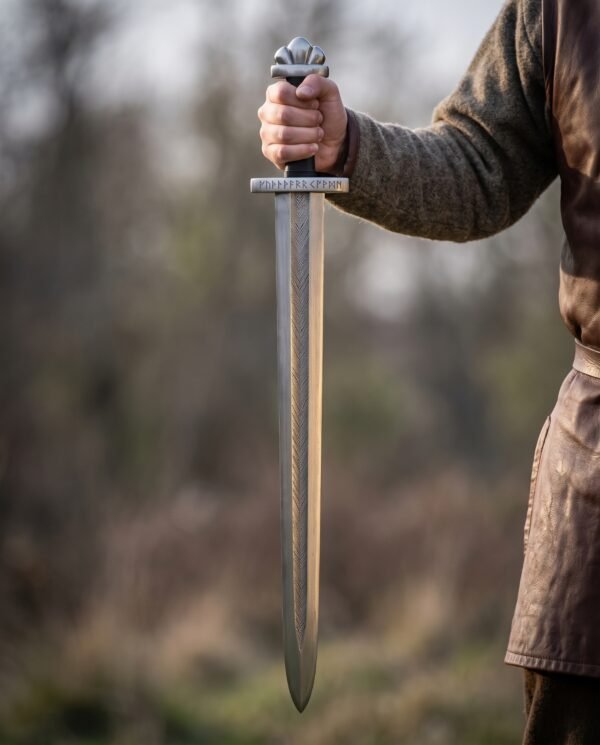
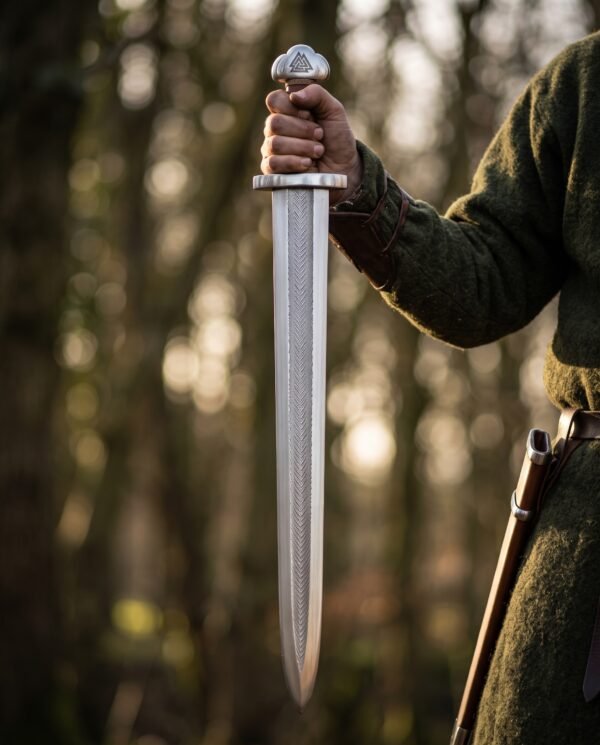
The grip is a shaped hardwood core, waisted so the hand knows which way the edge points without looking, with cord risers wrapped underneath the leather to give positive index points. Dark leather goes over that, wet fitted and stitched along the back edge away from the palm. The guard and the rounded cap pommel are brass, with a Thor hammer roundel engraved on the pommel face and four braided brass bands set around the grip, and the tang is peened over the pommel button so the whole assembly is mechanically locked. Nothing structural is glued.
Because there is hardwood under the leather, treat the grip as wood. Keep it out of standing water and out of a hot vehicle, wipe it with a barely damp cloth and dry it immediately, and do not try to dry a wet grip with heat. Our notes on wooden handle care cover the same core and the same failure modes, and a light leather conditioner once or twice a year keeps the wrap supple.
Engraving, runes and your own design
Use the rune converter on this page to turn a name, a date or a short phrase into Elder Futhark and we will cut it into the steel or the handle. If you would rather have a Viking pattern than a rune line, choose your own design in the engraving option above the add to cart button and tell us whether it goes on the blade or the handle. Where a piece already carries an engraved design, your chosen engraving replaces it rather than sitting alongside it. On a Damascus blade the engraving cuts through the etched surface into bright steel underneath, so a rune line reads light against dark and stands out considerably more than it does on a polished sword. The engraving page shows how that looks and what line lengths hold at this scale.
Care and sharpening
An etched Damascus blade wants a film of oil on it at all times. Wipe it down after handling, because the etched surface is slightly more open than a mirror polish and holds the moisture and salt from a fingerprint for longer. Never store the sword inside the leather scabbard for months at a time, since leather traps damp and tanning residues will pit the pattern. Keep it on a rack or a wall mount with the scabbard alongside. If a spot of orange appears, deal with it early using the method in our steel care guide, which also explains how to darken an area again where the etch has been polished off by handling.
Sharpening is normal high carbon sharpening with more length to cover. Work in overlapping sections along a coarse stone, then a fine one, keeping the angle steady, and finish on a strop. Take care not to lay the flat of a Damascus blade against a coarse stone, because the etch will come off in a bright streak. The technique in our guide to sharpening with a whetstone applies directly, and a long combination stone or a guided rod system both work at this size.
Made in the Czech Republic
This is a handmade piece from the Czech Republic, made in a workshop that still forges, grinds and finishes by hand instead of stamping parts out. The smiths there have kept the older way of working, and the wood, horn and leather are shaped and fitted by hand as well. Two pieces of the same design will never be identical, and that is part of what you are buying.
Ransack Viking is a United States company. We handle the import ourselves, look over every piece when it lands and ship from our warehouse in Chicago, Illinois. Engraving is done in the United States after the piece arrives, so your design goes on before we send it out.
A note on handmade variation
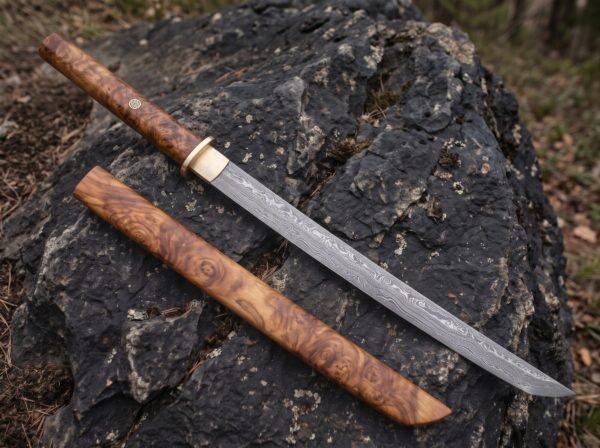
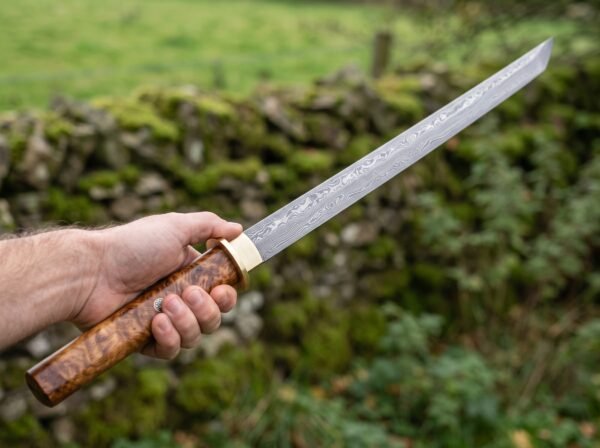
This sword is hand forged. It is not machine made and it is not bulk produced, so what arrives will not be a pixel for pixel copy of the photograph on this page. The Damascus pattern in particular is impossible to repeat. Where the twists land, how the chevrons stack along the fuller, how dark the etch bites and how the wood grain runs under the grip leather all change from billet to billet and from piece to piece, because each is worked by hand from natural materials. What does not change is the specification: the steels, the layer count, the heat treatment, the stated dimensions and the build quality are the same every time. The character is what varies, and on a Damascus blade that is most of the reason to own one.
Frequently asked questions
Is the Damascus pattern real folded steel or is it printed?
It is real. The billet is forge welded from alternating 1095 and 15N20, drawn, folded and twisted by hand, then acid etched so the nickel bearing layers stay bright and the plain carbon layers go dark. You can see the pattern on the edge bevel and in the fuller where the grind cuts through the layers, which is something a printed or stencilled pattern cannot do.
Why does this cost more than the polished steel version of the same sword?
Because the billet alone takes a day of forge welding and drawing before the sword exists, the scrap rate is higher, and every grinding pass has to respect a pattern that cannot be recovered once it is cut through. The geometry and the heat treatment are identical to the steel version. You are paying for the material and the hours in it.
Can I have runes engraved on a Damascus blade?
Yes, and it shows better here than on a bright blade. Use the rune converter on this page for Elder Futhark, then choose the engraving option above the add to cart button and tell us whether the line goes into the fuller or onto the handle. The cut goes through the dark etch into bright steel, so the runes read light on dark.
Will the pattern on mine match the photograph?
No, and it should not. Every billet twists differently and every grind reveals a different section through the layers, so the figure on your sword will be its own. The steels, the layer count, the dimensions and the finish are the same. Think of the photograph as an accurate guide to the style rather than a picture of the exact object.
What is the difference between this and a plain high carbon Viking sword?
Function is close to identical, since both are through hardened high carbon steel at the same hardness with the same geometry. The differences are appearance, price and upkeep. Damascus looks like nothing else, costs more because of the labour in the billet, and needs slightly more attention to oiling because the etched surface holds moisture more readily than a polished one.
How long does shipping take?
Free inside the United States. In stock pieces leave within two business days with tracking. A Damascus sword forged to order needs three to four weeks of bench time first, and custom engraving adds a few days on top of that.
What is in the box
- One Wolfrune Damascus Viking sword, 36 inches overall with a 30 inch layered blade
- Fitted black leather scabbard over a wooden core with brass throat and chape
- Leather belt hanger with buckle
- Blade oil and a lint free cloth for first storage
- Care and sharpening card written for etched Damascus
- Forged and finished in the Czech Republic
Explore the range
Browse the rest of the Damascus swords, the full Viking swords range, the wider swords collection and the Norse arms we carry alongside them. Steel, etching and edge geometry are covered in the guides.
Also in this part of the catalogue
Sitting beside it in the catalogue is the Fjordgleam Viking sword, 34 inches overall. Another in the same line is the Wyrmweave Viking sword, 36 inches overall. Next along the rack is the Serpentweld Viking sword, 36 inches overall.
Fitting out further, the Thornwatch longsword belongs with it. Or start from a blank sheet on the custom Viking sword page.

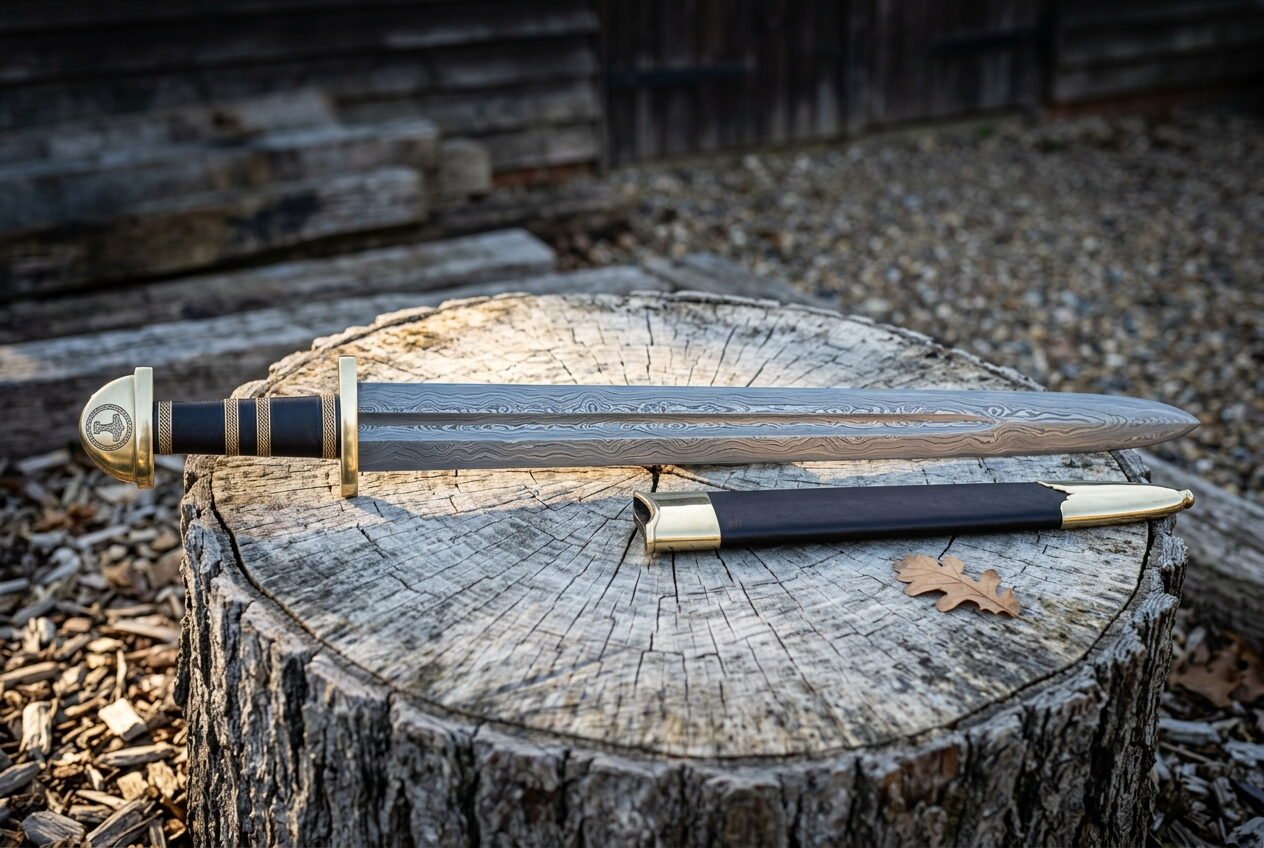
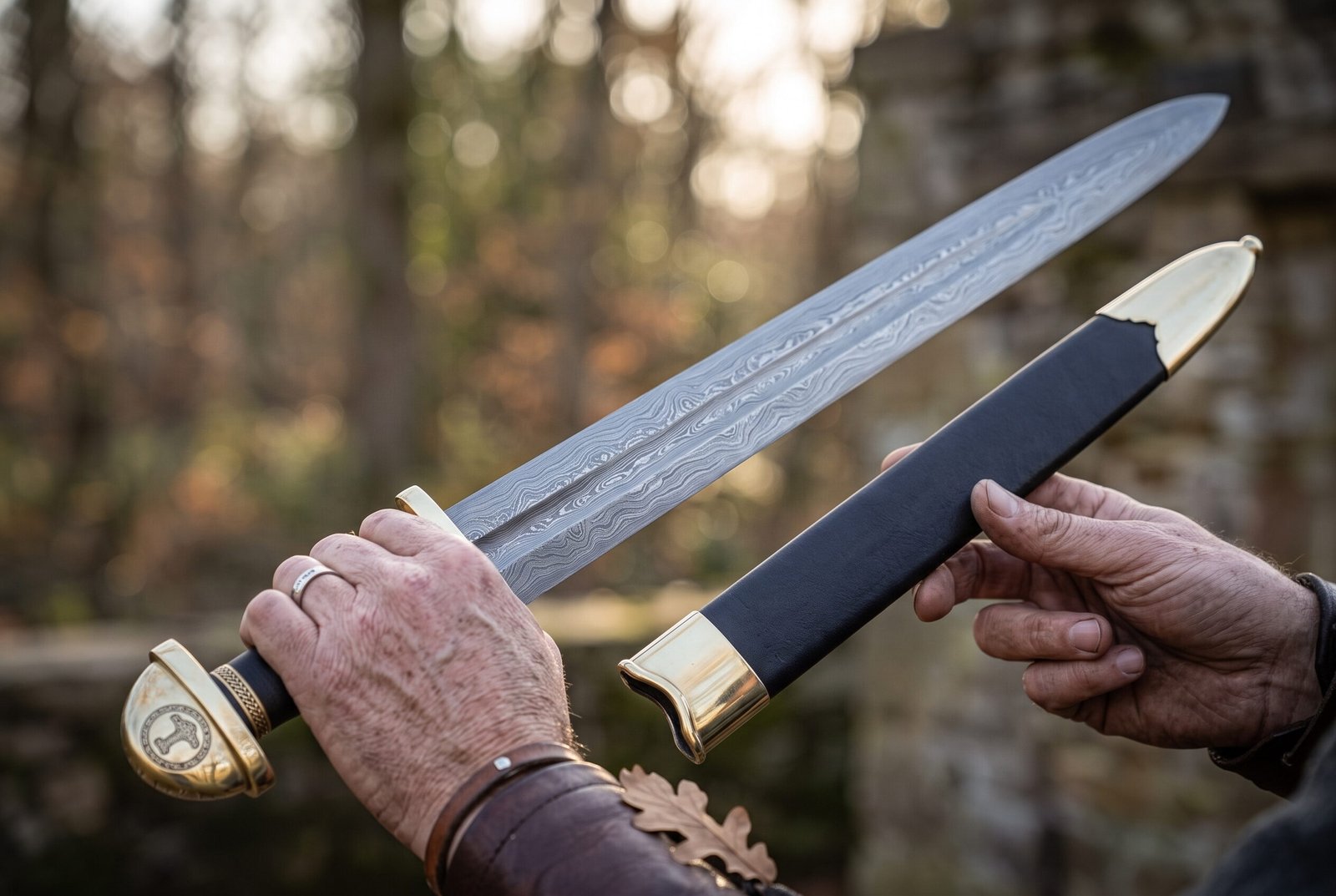
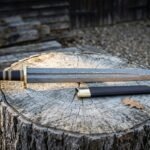
This sword is a genuine work of art. Weight and balance make it feel like a real functional piece not some cheap replica. Edge retention has been great even after regular use. This will be a family heirloom for sure. This is my third order from Ransack Viking and they never disappoint.
Solid sword. Glad I ordered it. Sheath is nice. Wish it had more padding but it does the job. Wood handle looks great though it’s a little smaller than I imagined. Good product. Just not quite perfect.
Was nervous ordering something like this online but so glad I did. Damascus blade holds a razor edge right out of the box. Already planning my next purchase from this shop.