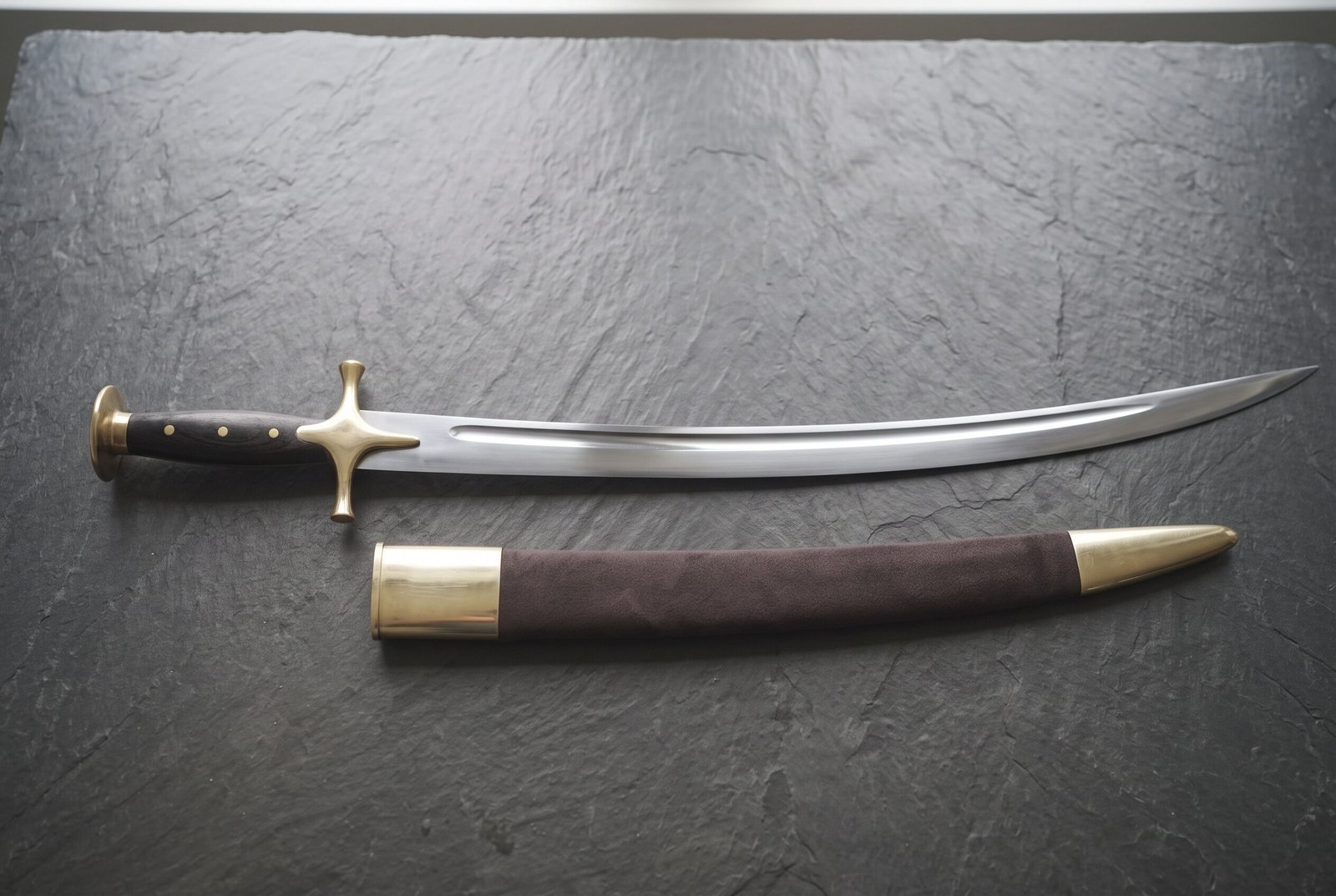
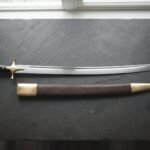
The Slatecrown is a talwar, the curved sword of northern India and the Mughal empire, and the thing that makes it a talwar is not the blade. Indian smiths mounted all sorts of blades on this hilt, including captured European ones, and a talwar blade can run from almost straight to deeply curved without ceasing to be a talwar. What defines the type is the hilt, and specifically the flat disc that closes off the end of the grip. Find that disc and you are holding a talwar whatever the blade above it is doing.
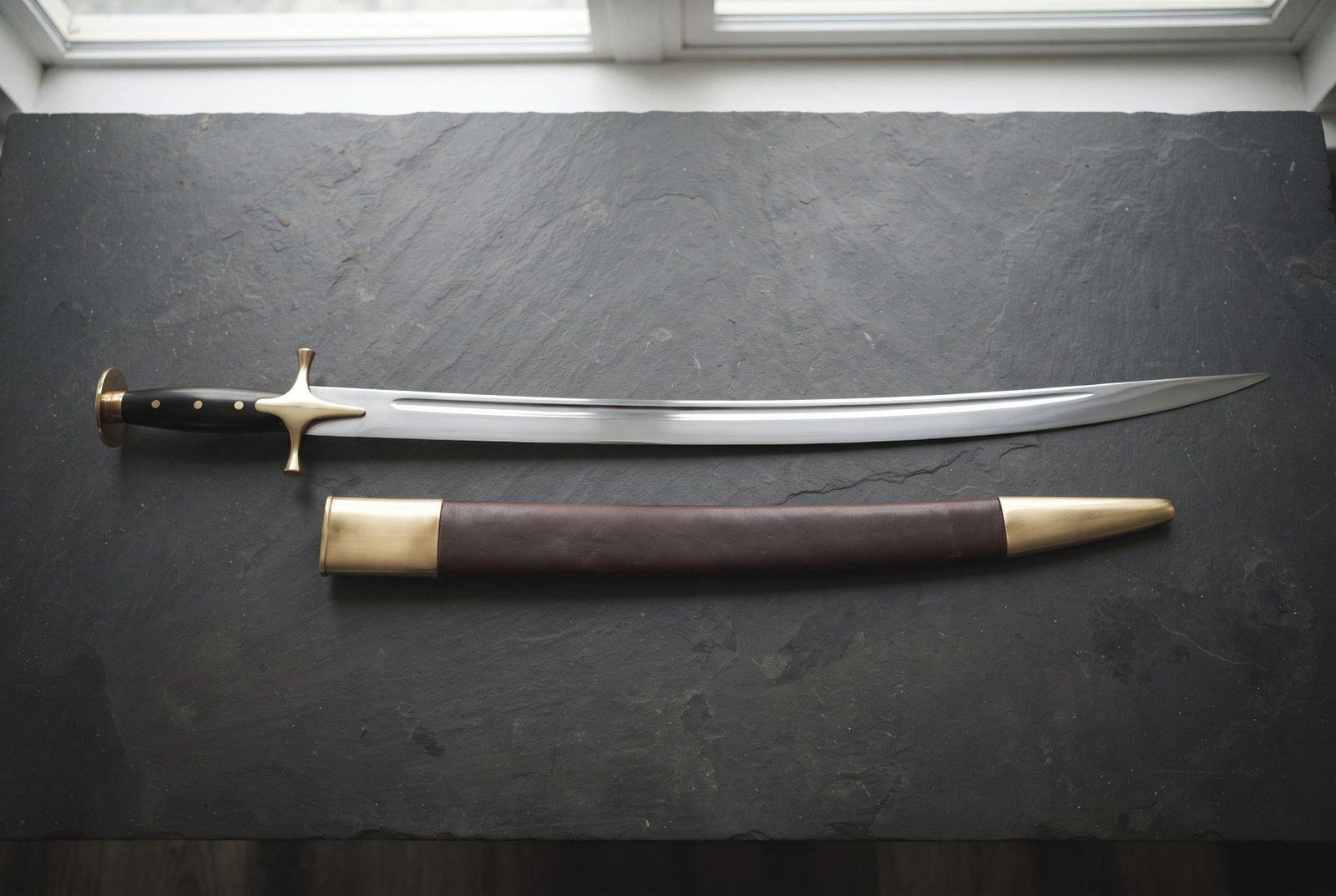
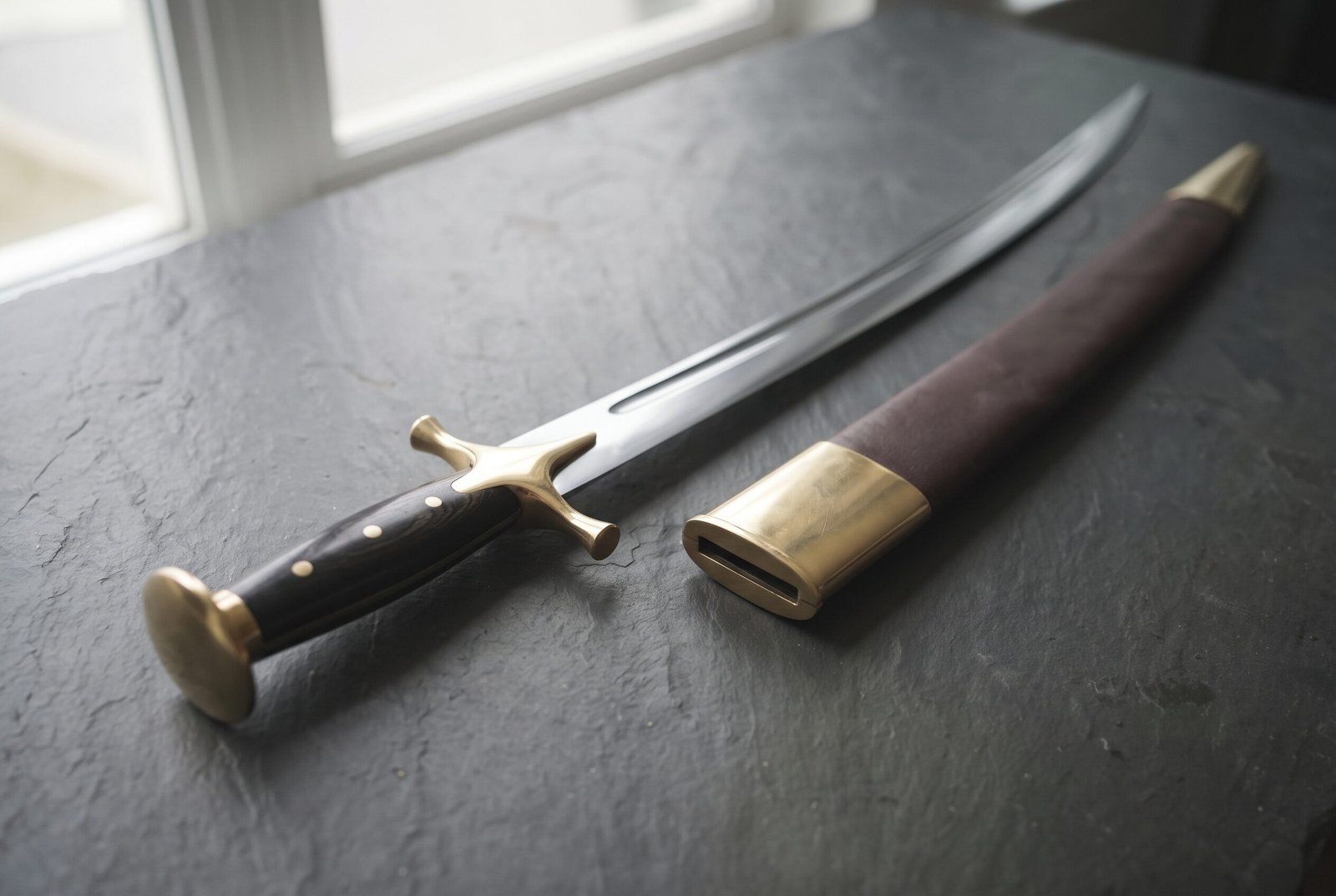
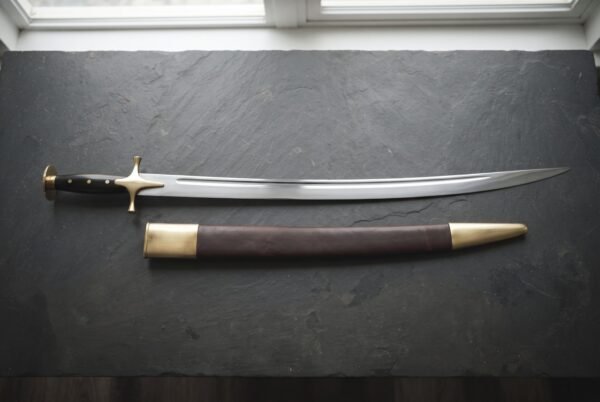
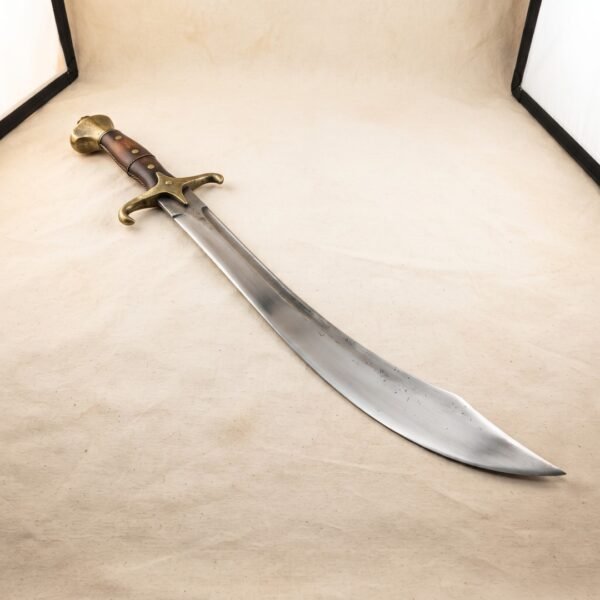
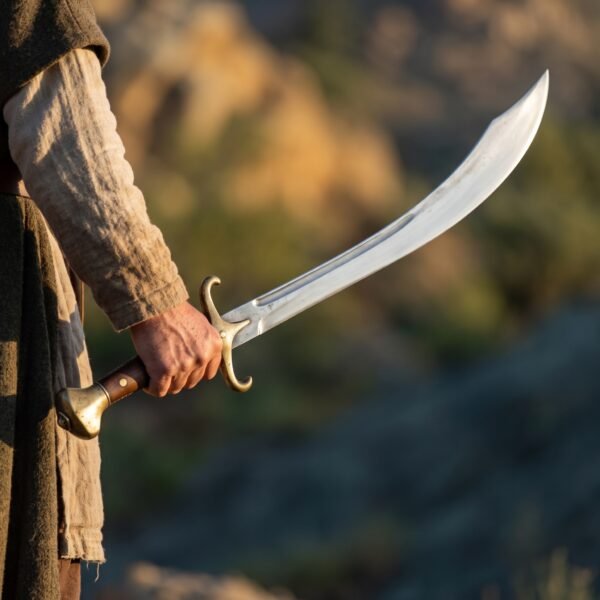
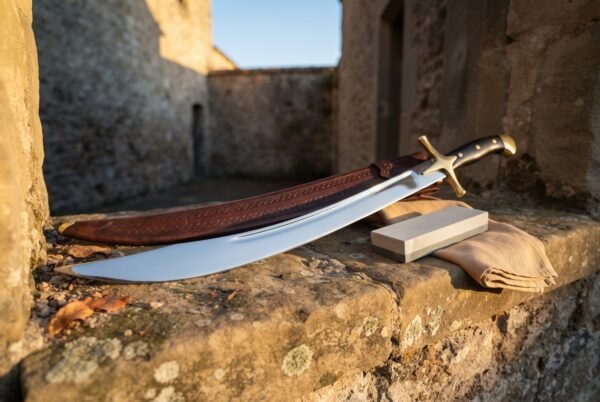
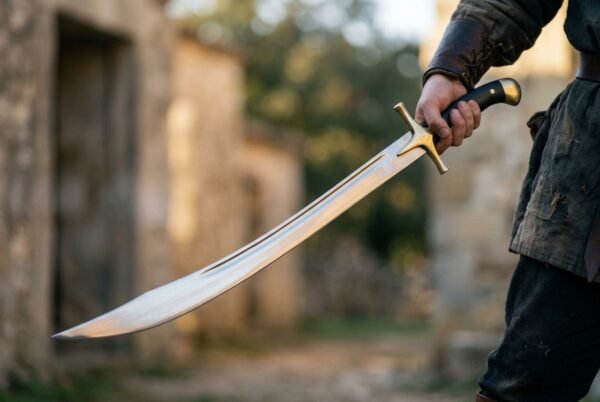
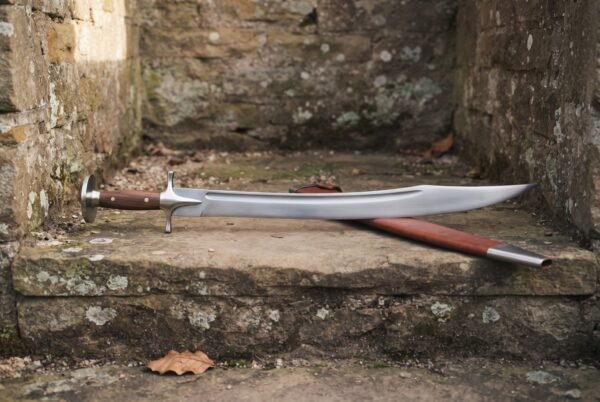
This one is forged and finished in the Czech Republic. The blade is 1095 high carbon steel with a long even curve that widens slightly toward an upswept point, hardened, tempered and taken to a mirror polish. The hilt is dark hardwood pinned with brass between a slim brass cross guard and a solid brass disc pommel. It ships in a leather covered scabbard with a heavy brass throat and chape, with a care card, and shipping inside the United States is free.
Specifications
| Steel | 1095 high carbon steel |
|---|
| Hardness | 54 to 58 HRC |
|---|
| Overall length | 36 inches |
|---|
| Blade length | 30 inches |
|---|
| Blade | Single edged curved talwar blade, widening slightly to an upswept point, with a narrow fuller along the spine, mirror polished |
|---|
| Handle | Dark hardwood scales on a full tang |
|---|
| Pins | Three brass pins |
|---|
| Guard | Brass cross guard with flared quillon ends and short langets |
|---|
| Pommel | Solid brass disc pommel |
|---|
| Scabbard | Dark brown leather covered with a brass throat and a long pointed brass chape |
|---|
| SKU | RK-1389 |
|---|
What the disc pommel is for
The disc looks like an ornament and it is nothing of the kind. It is the reason the talwar is held the way it is, and it changes how the sword works in the hand more than any other feature on it.
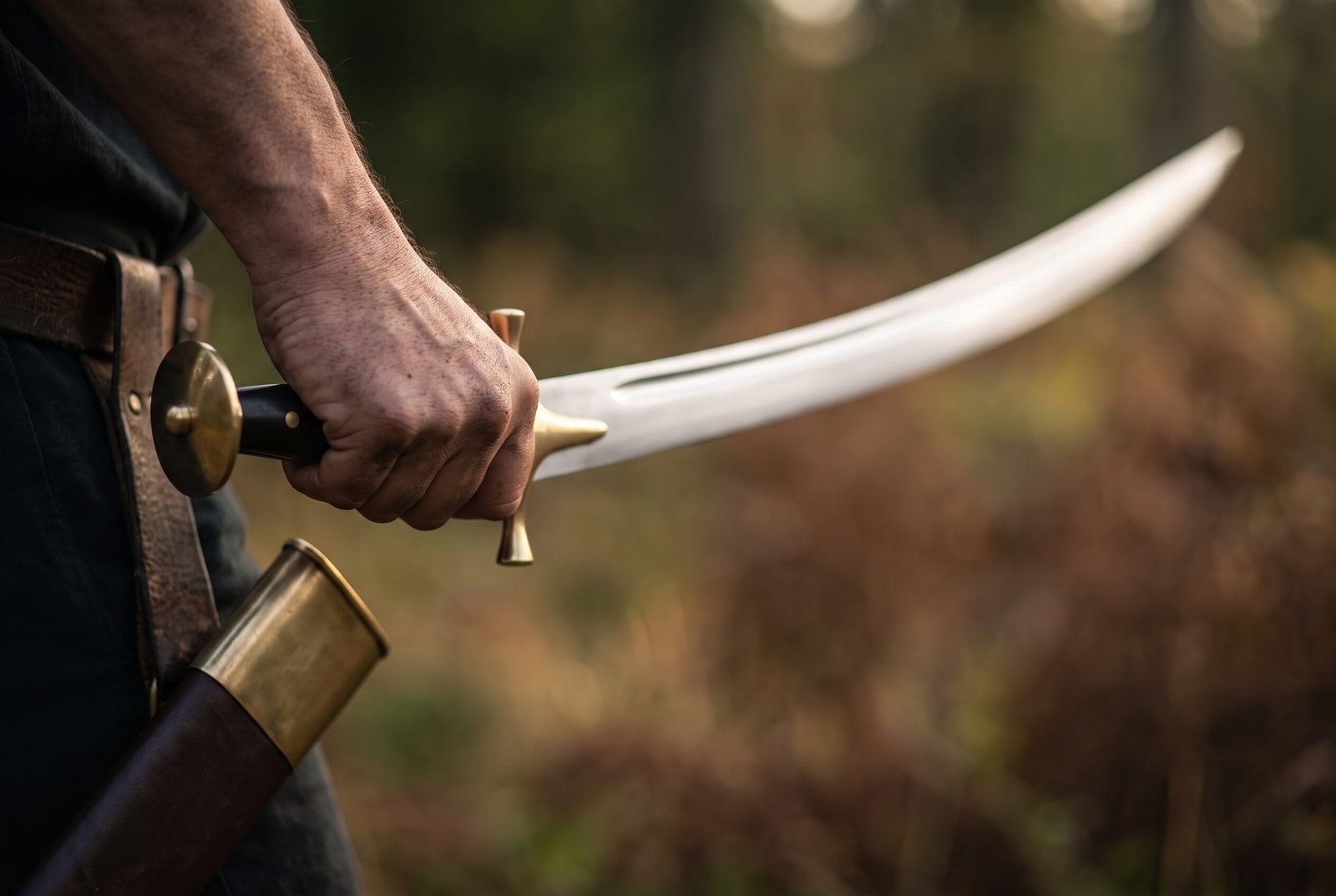
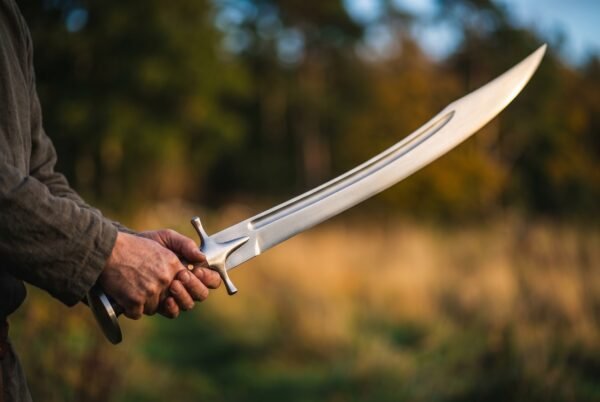
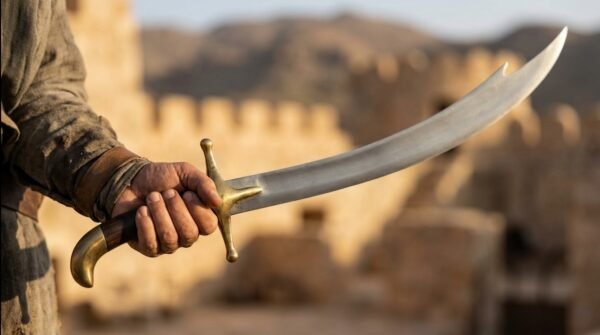
The grip of a talwar is short, often uncomfortably short to a Western hand, and it swells in the middle. The disc caps it off perpendicular to the grip, so the heel of your hand runs into a flat plate rather than sliding off the end. Two things follow. The first is that the sword simply cannot escape forward on a cut, no matter how loosely you hold it, which is what allows the light grip that Indian swordsmanship depends on. The second is more interesting: because the disc stops the hand at a fixed point, the wrist is set at a consistent angle every single time you pick the sword up. The blade always presents its edge the same way. On a curved sword, where the cut works only if the edge is aligned with the arc of the swing, that repeatability is worth a great deal.
Indian sources describe the talwar as a wrist sword rather than an arm sword, and the hilt is what makes that possible. You cut by rotating the hand and letting the disc take the load, not by driving through with the shoulder.
Why 1095 high carbon steel and not stainless
1095 is a plain carbon steel with just under one percent carbon and no significant alloying. It is what a sword blade should be made of. It hardens all the way through a blade of this section, the fine grain takes a genuine edge, and tempered to 54 to 58 HRC it stays tough enough to bend and come back rather than snap.
Stainless buys corrosion resistance with chromium, and chromium locks carbon into hard carbides. That is a good bargain in a short kitchen blade and a poor one in thirty inches of sword, where those carbides give a crack somewhere to start. What you accept with 1095 is rust if you neglect it, which is a cloth and a bottle of oil rather than a defect. There is a longer version of this argument on Damascus versus stainless.
The hardwood grip
The grip is dark hardwood in two scales, pinned through a full width tang with brass, swelling gently at the centre and closed at the front by the brass guard and at the rear by the disc. Full tang construction is not negotiable on a sword. Anything narrower is a liability on a blade that is going to be swung.
Historically talwar grips were made in wood, horn and steel, and the wooden ones survive best in use because wood absorbs shock instead of transmitting it. The swell in the middle of the grip is functional: it fills the palm so the hand can stay relaxed and still keep the sword aligned, which is the same idea as the disc from the other direction. Give the wood a wipe of oil once or twice a year, especially if the sword hangs somewhere with dry winter heating, and it will stay stable for decades. There is a short routine on wooden handle care.
Engraving, runes and your own design
Use the rune converter on this page to turn a name, a date or a short phrase into Elder Futhark and we will cut it into the steel or the handle. If you would rather have a Viking pattern than a rune line, choose your own design in the engraving option above the add to cart button and tell us whether it goes on the blade or the handle. Where a piece already carries an engraved design, your chosen engraving replaces it rather than sitting alongside it. On a talwar the disc pommel is a second option worth considering, since it presents a flat circular face that suits a short mark or a date. See the engraving page.
Care and sharpening
Mirror polished carbon steel shows everything, so wipe the blade with a dry cloth whenever it has been handled and keep a thin film of light oil on the surface. Fingerprints are acidic enough to etch a permanent grey mark into a polish like this within a couple of weeks. Once a month with an oiled rag is enough for a sword on a wall indoors. Do not store it sheathed for long periods, because leather holds moisture and tanning salts against steel. The full routine is on steel care.
When the edge needs attention, work with the curve rather than against it. Take three or four inches at a time, keep the bevel angle constant and sweep the blade along its arc so the whole edge sees the same number of passes. Finish on a fine stone and a strop. There is a full guide at sharpening with a whetstone.
Made in the Czech Republic
Every piece we sell is made by hand in the Czech Republic. The smiths there work the way the trade has been worked for a long time, heating and hammering the steel, taking the bevels down by eye, and fitting the handle and the leather one at a time. There is no automated line anywhere in it, so small differences from one piece to the next are normal and expected.
Ransack Viking is a United States company based in Chicago, Illinois. We bring the pieces in ourselves, inspect them on arrival and ship them from our own warehouse. If you add engraving, that is carried out here in the United States before your order goes out.
A note on handmade variation
This talwar is hand forged. It is not machine made and it is not bulk produced, so what arrives will not be a pixel for pixel copy of the photograph on this page. The figure and tone of the hardwood, the colour of the brass, the exact sweep of the curve and the grain of the scabbard leather all vary between pieces, because each is worked by hand from natural materials by a smith making decisions as they go. The dimensions, the steel and the build are identical every time. The character is not.
Frequently asked questions
Does it arrive sharp?
Yes, with a working edge rather than a razor edge. That is the correct state for a sword of this size. Say the word in your order notes and we will take it further before it ships.
What is the difference between a talwar and a shamshir?
The hilt. A shamshir is Persian and has a cross guard with a hooked pommel that curls down over the hand. A talwar is Indian and has a disc pommel that caps the grip flat. Shamshir blades are also narrower and more evenly curved as a rule.
Is the grip meant to be that short?
Yes. Talwar grips are short by design, because the hand is meant to sit tight against the disc rather than to spread out along the handle. It feels wrong for about a minute and then it makes sense.
Can I use it for cutting practice?
It will cut mats and bottles. It is not a sparring sword, must never be used against another blade, and should be kept away from hard targets like wood.
Will mine look like the photograph?
Very close, but not identical. Wood grain, brass tone and leather all vary from piece to piece. The steel, the size and the build do not.
How long does shipping take?
Free inside the United States. Two to three business days for a sword in stock, two to three weeks for one that is engraved.
What is in the box
- Slatecrown hand forged 1095 high carbon steel talwar
- Leather covered scabbard with brass throat and chape
- Care card with oiling and storage instructions
- Certificate of hand forging
- Forged and finished in the Czech Republic
Explore the range
See the rest of the scimitars, the whole swords collection, the sabres and the scabbards and sheaths, or read the guides.
Others in the same line
If this one is not quite right, there is the Hollowmoon scimitar, 36 inches overall. Also in this group is the Nightwheel scimitar, 35 inches overall. Sitting beside it in the catalogue is the Mossgate scimitar, 36 inches overall.
From the same corner of the shop, there is the Fernstride longsword. You can have this made your way instead on the design your own page.
Anyone moving from display pieces to sparring can start with the Skaldrun spadroon trainer, and our smallsword guide fills in the rest.


Not worth the money in my opinion. Arrived with noticeable defects. Even shipping from a US warehouse this took way longer to arrive than promised. Quality felt well below what was shown in the listing. Would not recommend based on my experience.
I collect stuff like this and this piece is on another level. Exactly as described and clearly made with care. Will definitely order again for another gift.
Good quality piece for the price. Good overall quality. Just a couple very minor details off. Good product. Just not quite perfect.
So happy I finally pulled the trigger on this one. Ransack Viking is quickly becoming my go to shop for anything Norse themed.
Bought this on a whim and it turned out to be one of my favorite purchases this year. The craftsmanship really shows in the small details. This will be a family heirloom for sure.
This piece beat every expectation I had. Packaging was excellent and it arrived in perfect condition. Ransack Viking is quickly becoming my go to shop for anything Norse themed. Feels way more premium in person than the listing photos. Worth every penny.
Five stars isn’t even enough honestly. Exactly as described and clearly made with care. Worth every penny.
Solid piece. Glad I ordered it. Made in the Czech Republic but ships from the US. Delivery was quick even so. Not my first Ransack Viking order and it held up to their usual standard. Solid piece. Packaging could’ve been a bit sturdier. Good overall quality. Just a couple very minor details off. Glad I made this purchase.
My husband was speechless when he opened this. Feels way more premium in person than the listing photos. Exactly as described and clearly made with care. Packaging was excellent and it arrived in perfect condition. Worth every penny.
Happy with this one for the most part. Not my first Ransack Viking order and it held up to their usual standard. Still very happy with it and would recommend.