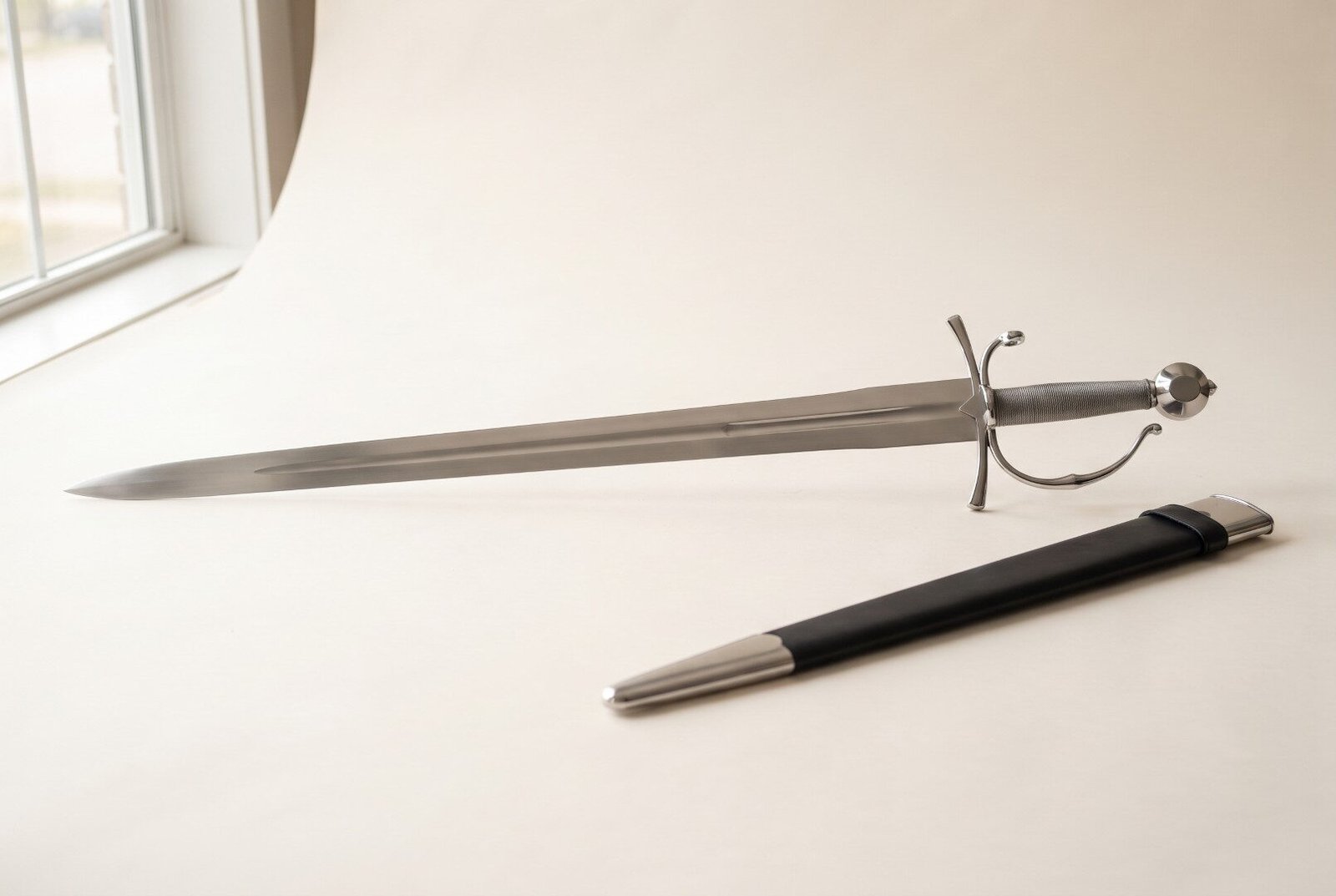
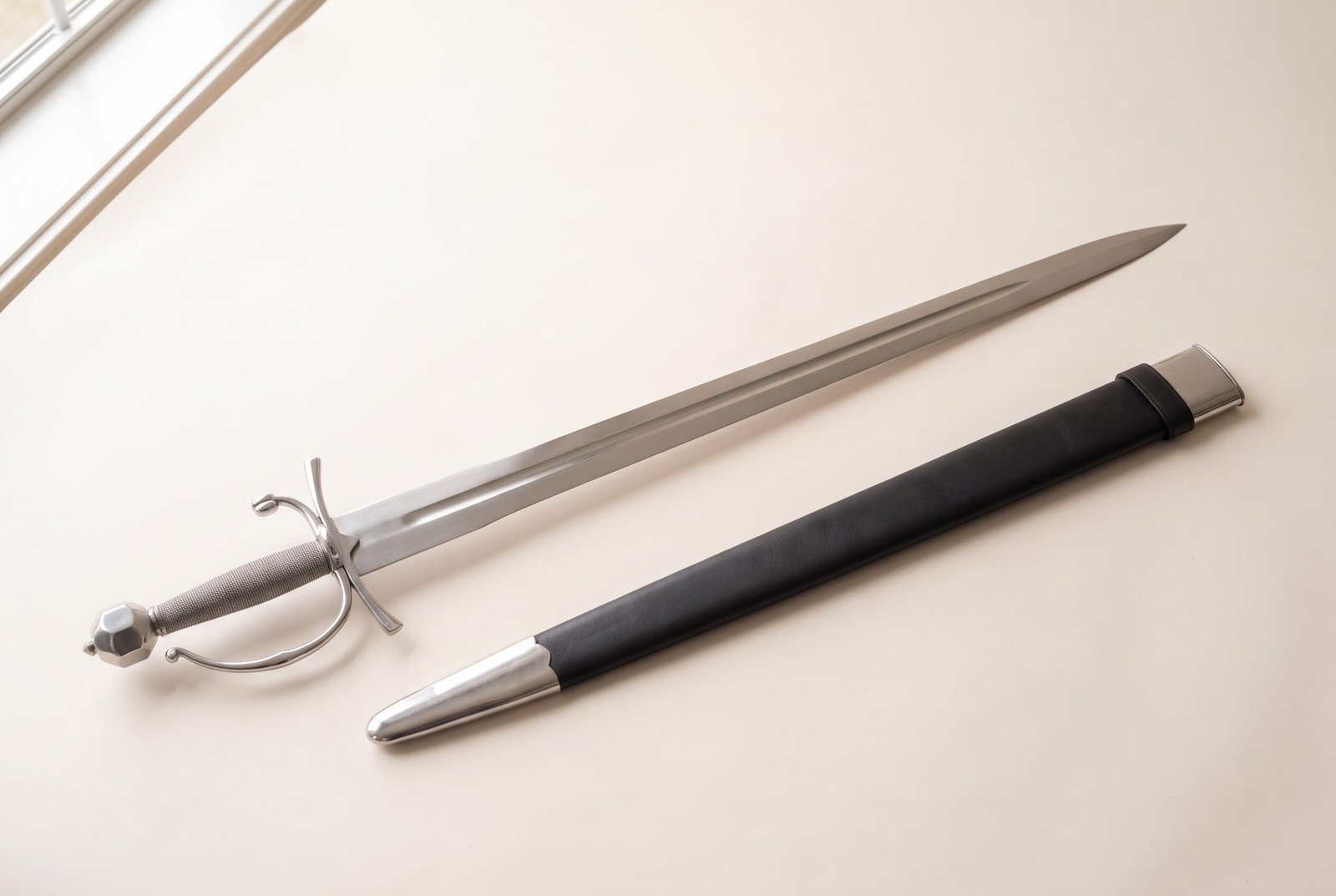
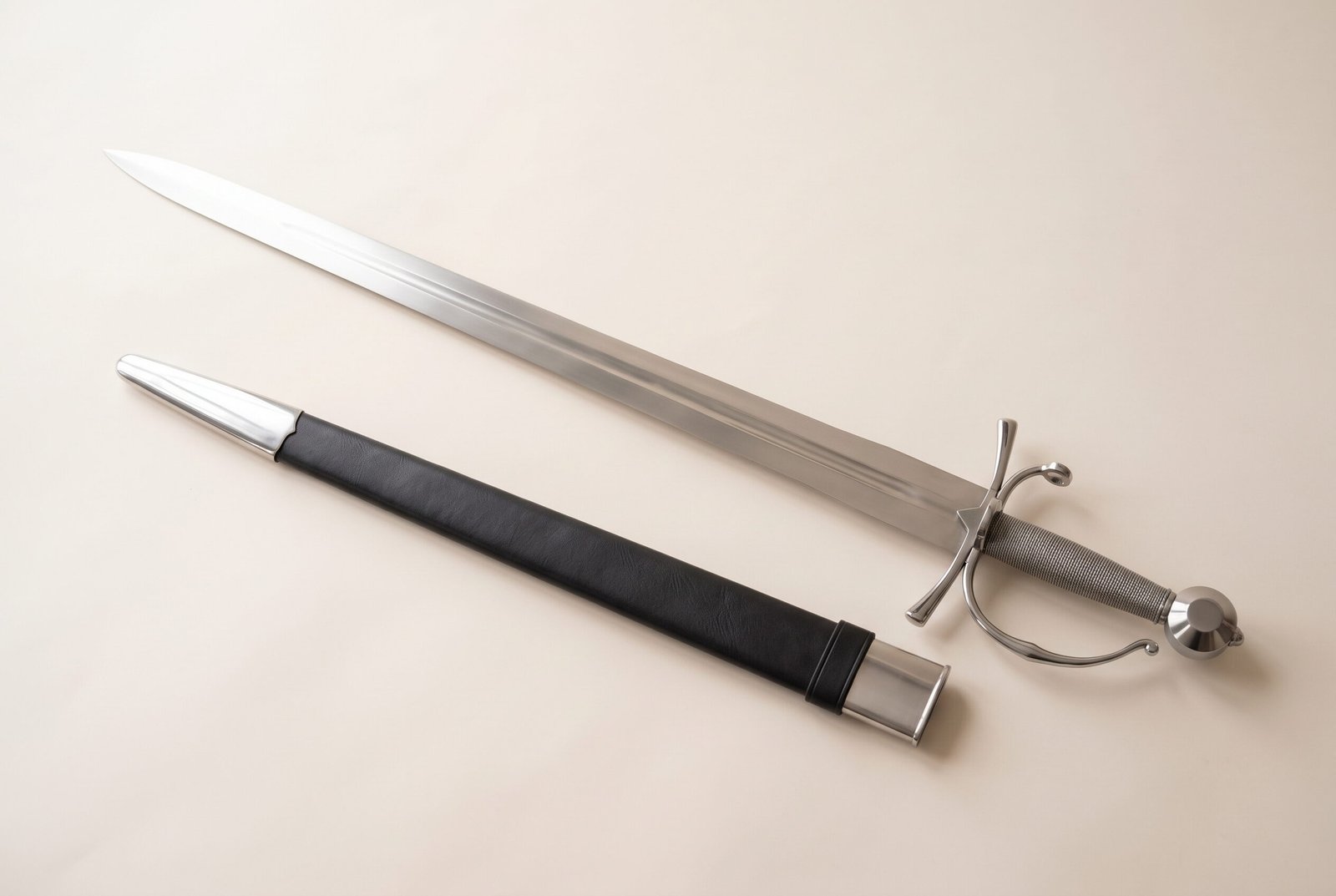
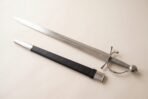
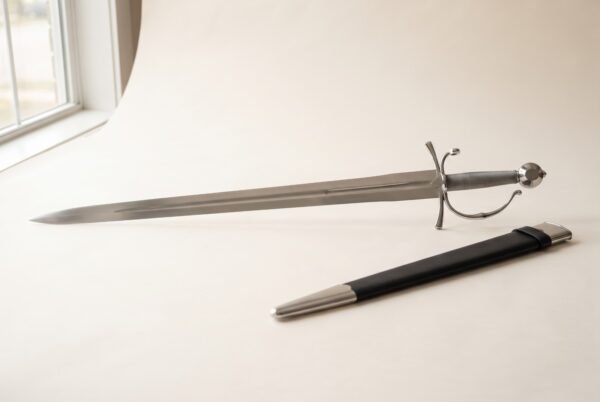
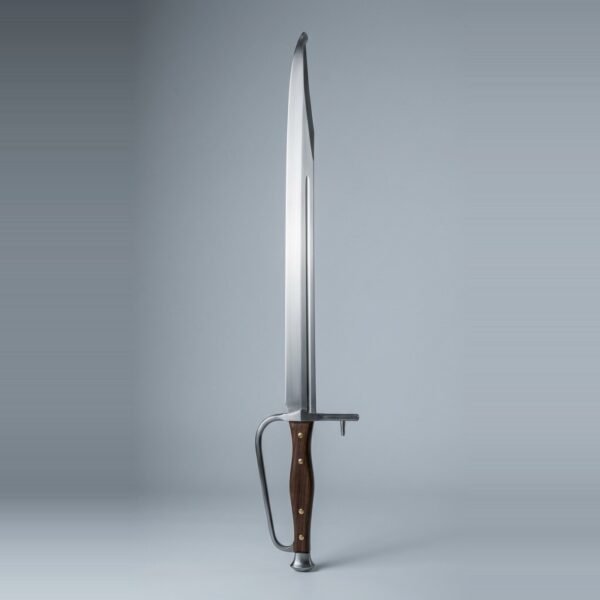
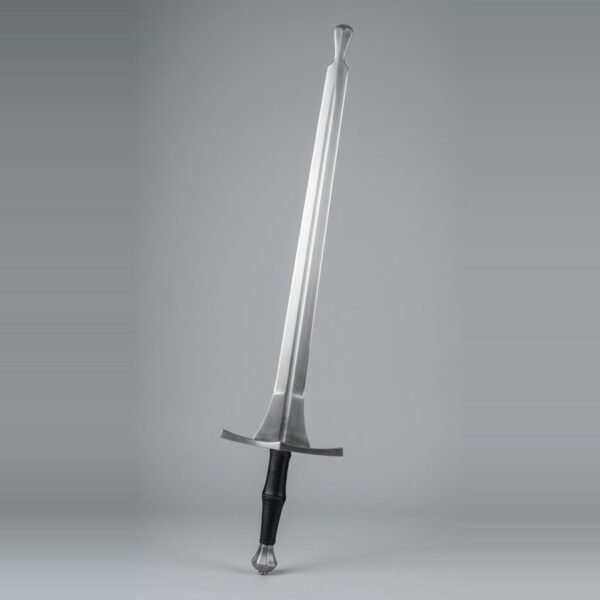
The Cliphawk is a hand forged renaissance short sword with a straight double edged blade a little over two feet long, a central fuller and a knuckle bow. Light single handed swords with a guard that closes the front of the hand were the everyday side arm of sixteenth century Europe. They were worn by tradesmen, watchmen, sailors and soldiers, and a shorter blade was cheaper to make and easier to carry in a crowded street than a full length sword.
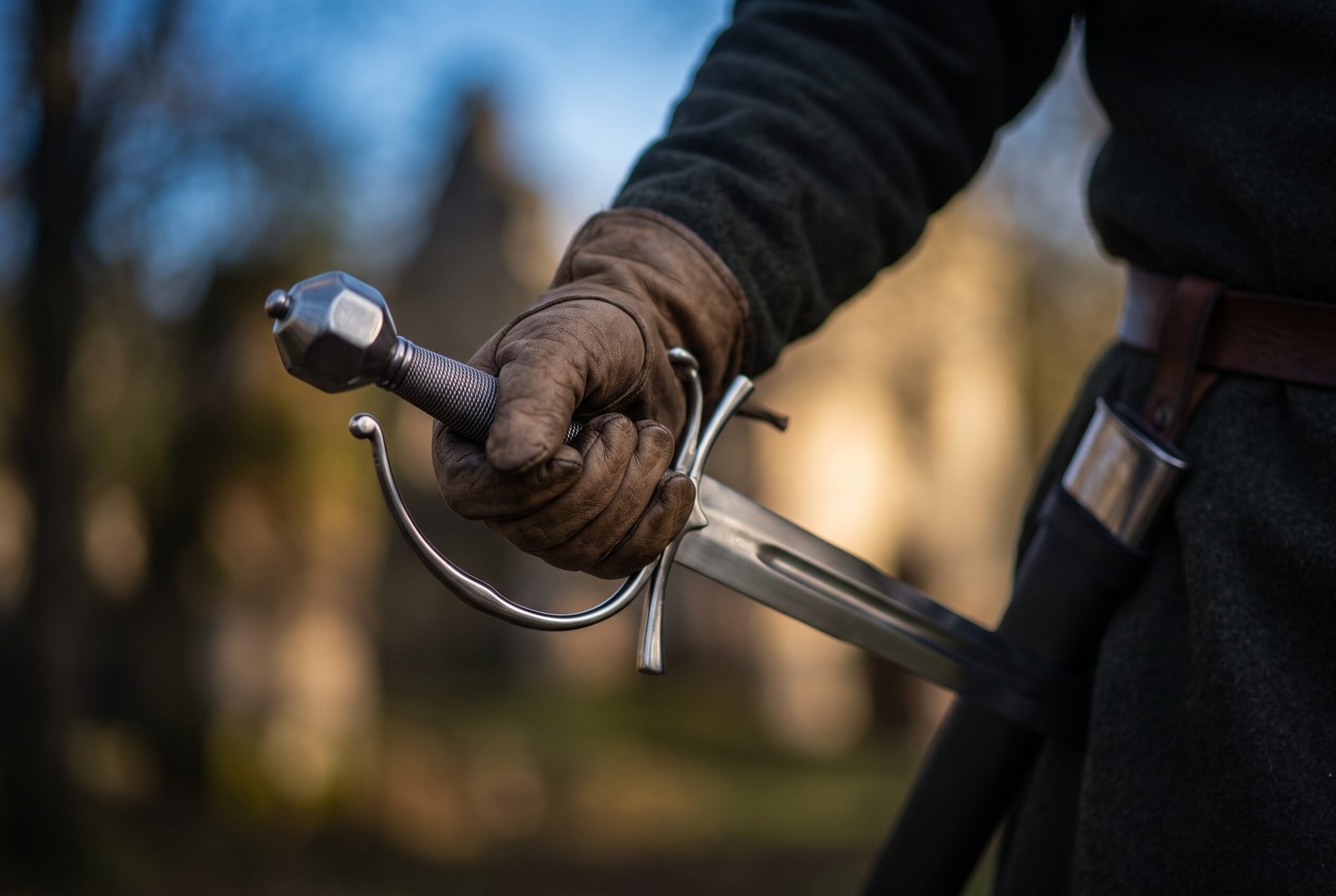
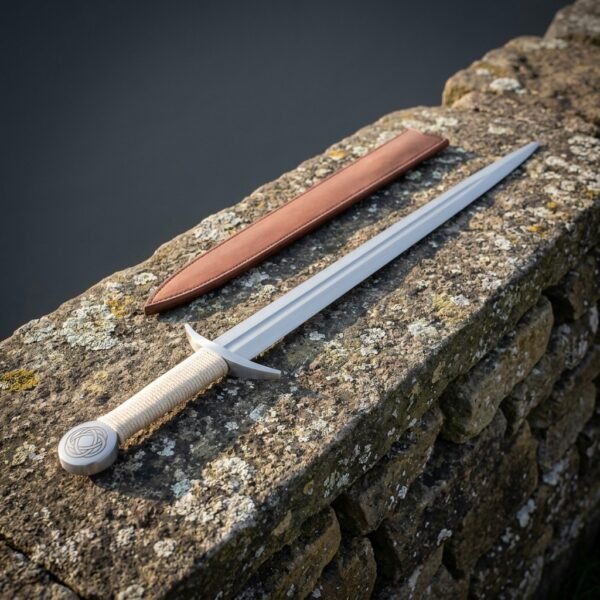
This one is forged and finished in the Czech Republic. The blade is 1095 high carbon steel, hardened and tempered, ground with two edges and a long central fuller running towards a centred point, then mirror polished. The hilt is polished steel with recurved quillons with flared ends, an open knuckle bow and a curled side bar guarding the front of the hand. The grip is bound in twisted wire under a faceted wheel pommel. It ships with the fitted black leather scabbard shown, mounted with a polished steel throat and chape.
Specifications
| Steel | 1095 high carbon steel |
|---|
| Hardness | 54 to 58 HRC |
|---|
| Overall length | 31 inches |
|---|
| Blade length | 24.5 inches |
|---|
| Blade profile | Double edged with a long central fuller and a centred point, mirror polished |
|---|
| Guard | Polished steel recurved quillons with flared ends, an open knuckle bow and a curled side bar |
|---|
| Grip | Twisted steel wire wrap with steel ferrules |
|---|
| Pommel | Faceted polished steel pommel with end button |
|---|
| Scabbard | Black leather with polished steel throat and chape |
|---|
| SKU | RK-1419 |
|---|
Why two edges and a centred point
The blade is sharpened on both sides and the point sits on the centreline, in line with the fuller. A centred point means a thrust travels straight along the line of the forearm and lands where you are looking, with no thick spine pushing it off line. The second edge means the sword can cut on the return stroke as well as the first, so the recovery after one cut can be the next one, coming back on a rising line from below.
The fuller running down the middle takes weight out of the blade without taking away stiffness, which keeps a single handed blade quick in the hand. Grinding two edges so they meet cleanly at the point without leaving a weak spot is one of the better tests of whether a blade was ground by someone paying attention.
Why 1095 high carbon steel and not stainless
Stainless owes its rust resistance to chromium, and chromium is precisely why it makes a poor blade for a sword. It ties carbon into coarse hard carbides through the metal, and each one is a place a crack can begin in a blade that flexes or takes an impact across the flat. Stainless swords are therefore either soft, in which case they take a permanent bend, or hardened, in which case they can break.
1095 is iron with just under one percent carbon and very little else in it. It hardens through, tempers to a figure you can predict, and at 54 to 58 HRC gives a broad short blade a durable edge with plenty of toughness left over. It will rust if you neglect it, which is the honest cost, and the remedy is a wipe and a film of oil. See Damascus versus stainless for more.
The wire grip and the wheel pommel
The grip is bound in twisted steel wire. On a cutting sword this matters more than it does on a rapier, because a real cut torques the blade in the hand and a smooth grip lets it rotate, which throws the edge out of alignment. A ridged wire surface holds the sword square through the cut without needing a tight fist, and it does not soften with sweat or stretch with age the way leather does.
The pommel is a faceted wheel rather than a sphere. Flat faces on a pommel do two useful things: they stop the sword rolling when it is put down, and they give the heel of the hand something to bear against when the grip is held far back for maximum reach on a cut. On a short sword the pommel is also proportionally more important as a counterweight, because there is less blade out front to balance against, which is why it looks large for the length of the sword.
Engraving, runes and your own design
Use the rune converter on this page to turn a name, a date or a short phrase into Elder Futhark and we will cut it into the steel or the handle. If you would rather have a Viking pattern than a rune line, choose your own design in the engraving option above the add to cart button and tell us whether it goes on the blade or the handle. Where a piece already carries an engraved design, your chosen engraving replaces it rather than sitting alongside it. The Cliphawk is plain and the broad flat above the fuller takes lettering well. The faceted pommel is the other option, and its flat faces are natural panels for a short mark or a date. See the engraving page.
Care and sharpening
Wipe the blade after handling and keep a thin film of mineral or camellia oil on it. Fingerprints on a mirror polish are mildly acidic and will etch permanent marks within a week or two. Work a little oil into the grooves of the wire wrap with a cloth as well, since they hold moisture. Do not store the sword inside the scabbard for months at a time. The routine is on the steel care page.
The blade arrives sharp on both edges. When you refresh them, work each side along its existing bevel and keep the two even, and take care near the tip, because it is easy to round the point while working the last inch. See sharpening with a whetstone.
Made in the Czech Republic
Every piece we sell is made by hand in the Czech Republic. The smiths there work the way the trade has been worked for a long time, heating and hammering the steel, taking the bevels down by eye, and fitting the handle and the leather one at a time. There is no automated line anywhere in it, so small differences from one piece to the next are normal and expected.
Ransack Viking is a United States company based in Chicago, Illinois. We bring the pieces in ourselves, inspect them on arrival and ship them from our own warehouse. If you add engraving, that is carried out here in the United States before your order goes out.
A note on handmade variation
This piece is hand forged. It is not machine made or bulk produced, so what arrives will not be a pixel for pixel copy of the photograph. The exact line of the fuller, the curve of the quillons and the pitch of the wire winding are all set by hand, and the polish reads differently under different light. The dimensions, the steel and the build are the same every time. The character is not.
Frequently asked questions
Is it sharp on both edges
Yes. The blade is double edged, ground on both sides from the guard to the point.
Is this a sword or a large knife
A sword, and a historically common one. Twenty four and a half inches of blade on a knuckle bow hilt is a short sword by any reasonable definition, and the sources of the period treat the type as a sword rather than a knife.
Can I cut with it
Yes, within reason. It is a properly hardened and tempered blade and light target cutting on bottles or a rolled mat is well within its design. It is not intended for edge on edge sparring with another steel blade.
Can I have runes engraved on it
Yes. Use the rune converter on this page for Elder Futhark or select your own design in the engraving option, and tell us whether it goes on the blade or the pommel.
What is the difference between this and a cutlass
The blade. A cutlass is curved through its length with the belly doing the cutting. This is straight and double edged with a centred point, which cuts on a different line and thrusts far better. The hilts are similar because both are short swords carried where space is tight.
How long does shipping take
Free shipping in the United States. In stock pieces ship within a few days. It takes two to four weeks in the shop before it ships, and engraved work a few days more.
What is in the box
- Cliphawk hand forged 1095 high carbon steel renaissance short sword
- Fitted black leather scabbard with polished steel throat and chape
- Care card covering oiling, polish upkeep and wire grip care
- Elder Futhark rune engraving or your own Viking design if selected at checkout
- Forged and finished in the Czech Republic
Explore the range
See the short swords, the messers, the cutlasses and the full sword range, or read the guides.
Others in the same line
A near match for this one is the Grimtide short sword, 21 inches overall. Closest to this in the range is the Manecrest short sword, 26 inches overall. If this one is not quite right, there is the Duneglint short sword, high carbon steel.
The Riverstone wakizashi covers the other half of the same kit. You can have this made your way instead on the custom Viking sword page.


Bought this on a whim and it turned out to be one of my favorite purchases this year. Came in a nice gift box which made it feel even more special. Already planning my next purchase from this shop.
Good quality sword for the price. Ransack Viking usually delivers solid quality and this was no exception. Still very happy with it and would recommend.
Best sword I’ve ever owned. Fit and finish is museum quality. You can tell real craftsmen made this by hand. The wood handle feels amazing and the balance is perfect. Weight and balance make it feel like a real functional piece not some cheap replica. Worth every penny.
This is exactly what I wanted and then some. Weight and balance make it feel like a real functional piece not some cheap replica. Ransack Viking is quickly becoming my go to shop for anything Norse themed. This shop clearly takes pride in their work.
Does the job but I wasn’t blown away. Handle material felt a bit different than pictured. It’s fine but I expected a little more for the price. Might work for casual use or display. It’s Czech made and US shipped. Packaging was just okay though. Ordered from Ransack Viking a couple times. This one was just average compared to the rest.
My whole family was impressed when I unboxed it. Fit and finish is museum quality. You can tell real craftsmen made this by hand. Will definitely order again for another gift. You can tell it’s real Czech blacksmith work and shipping from the States made delivery painless.
Pretty impressed. Just a couple minor things I’d tweak. Sheath is nice. Wish it had more padding but it does the job. Glad I made this purchase.
Middle of the road experience with this one. Blade edge needed some sharpening out of the box. Handle material felt a bit different than pictured. Not bad, not amazing either.
Can’t stop showing this off to everyone who comes over. Weight and balance make it feel like a real functional piece not some cheap replica. Even the small engravings are crisp and clean. Will definitely order again for another gift.
Best sword I’ve ever owned. 10/10 would buy again.