The Brinehook is a hand forged cutlass, the short curved sword that armed sailors for roughly three hundred years. The cutlass is often mistaken for a cut down sabre, but it developed the other way around. It grew out of the hanger, a stubby civilian hunting sword, because the space between the decks of a wooden ship was low, narrow and crowded with rigging, guns and men. A long straight blade was useless there. A blade of two feet with a pronounced belly could be swung in a half arc from the elbow rather than the shoulder, and it would still bite through a hemp line or a boarding net in a single pass. The broad guard was not decoration either. It protected a hand that had to grab ladders, rails and rope in the same minute it held a sword.
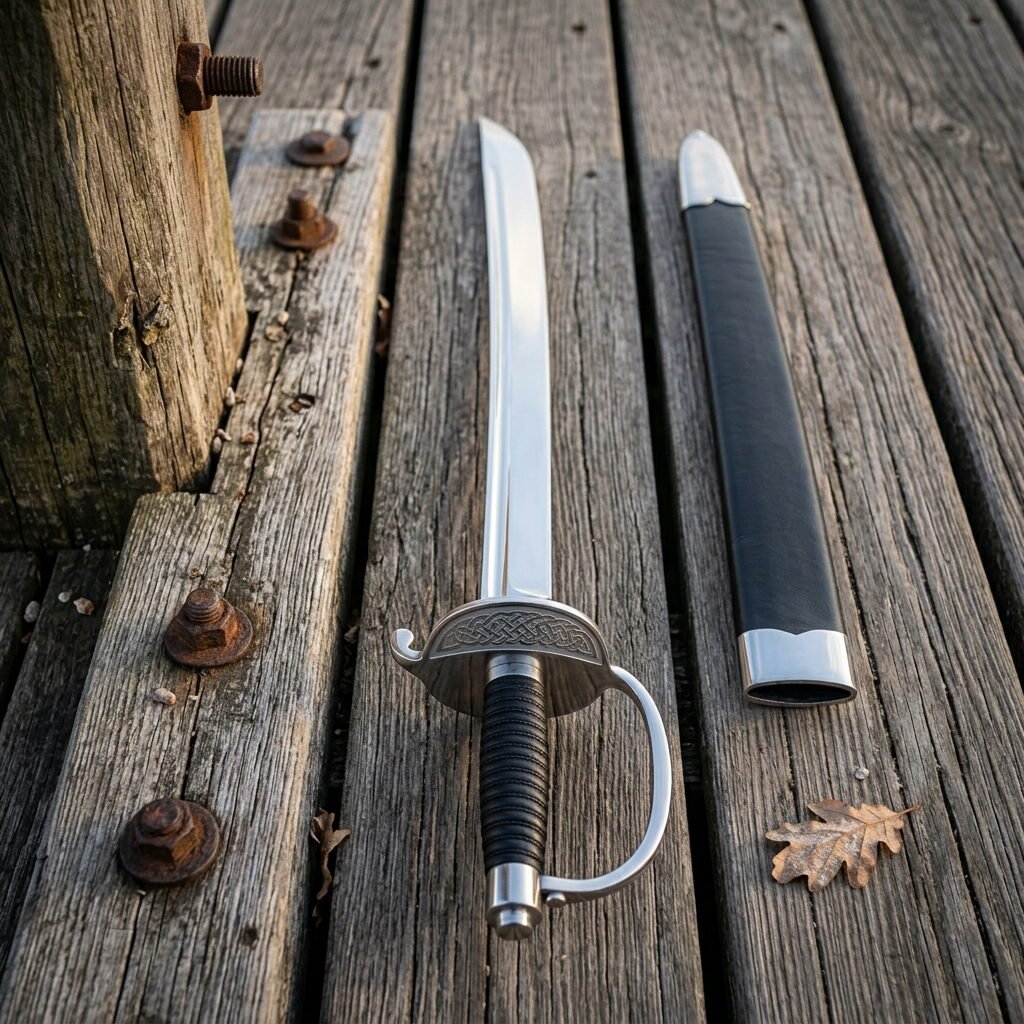
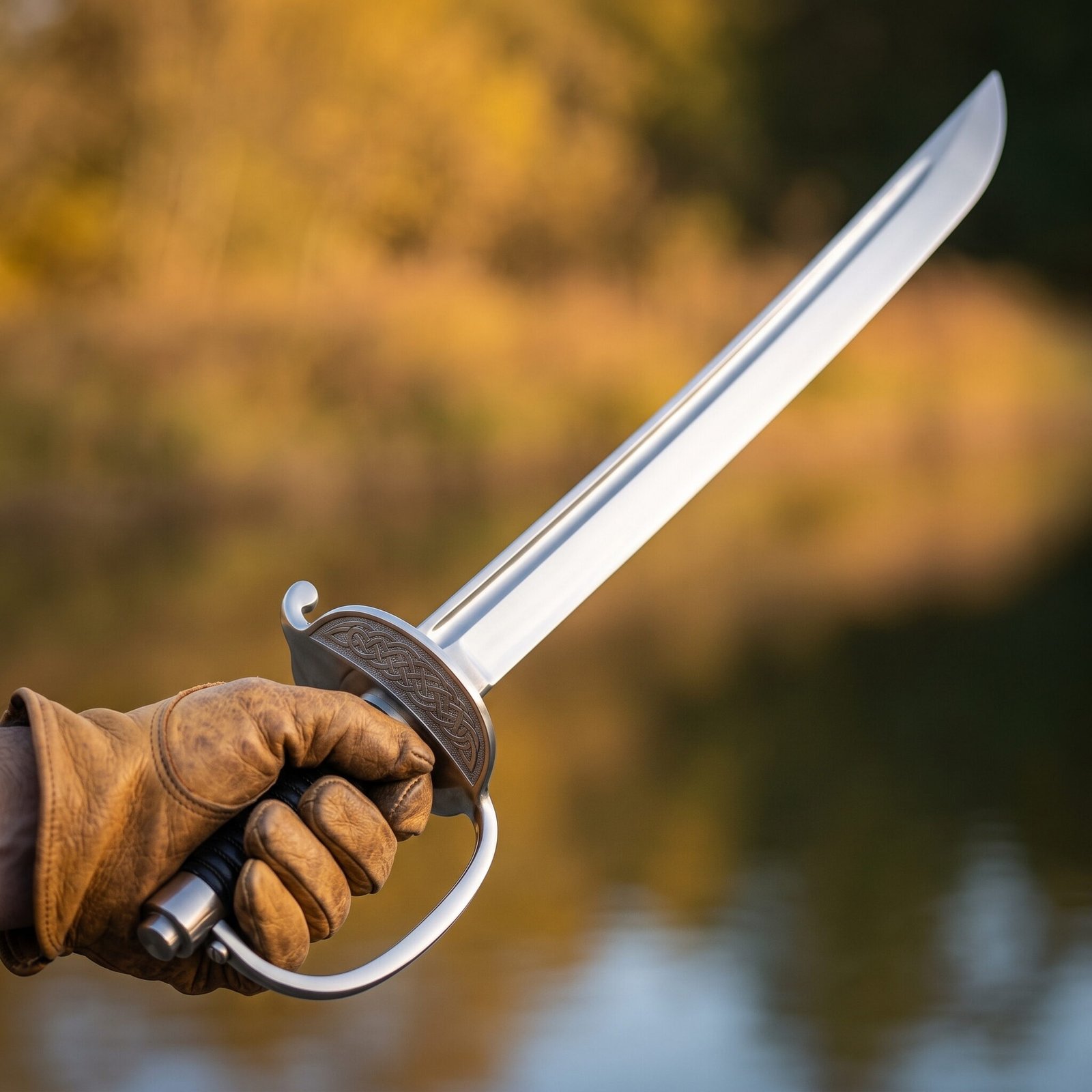
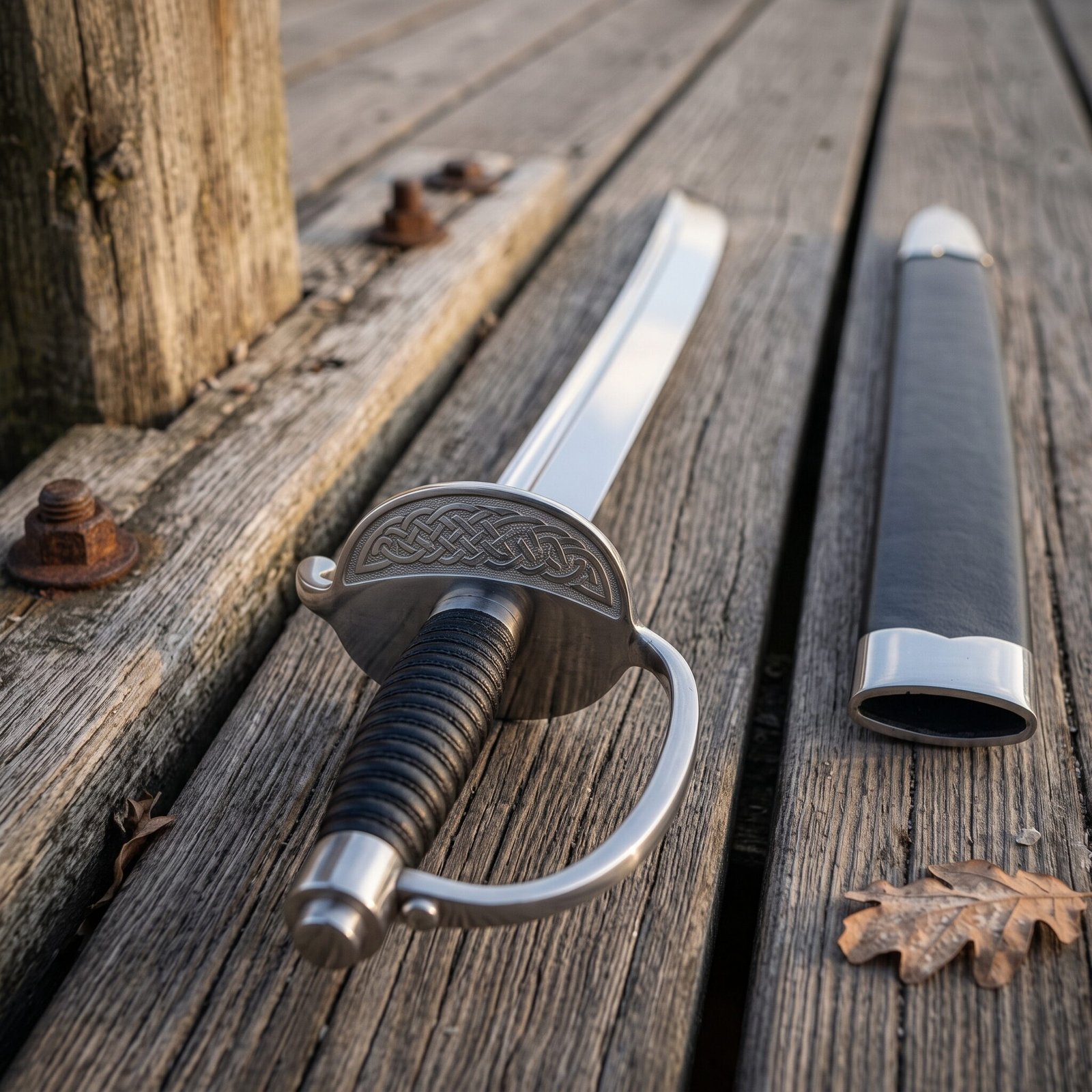
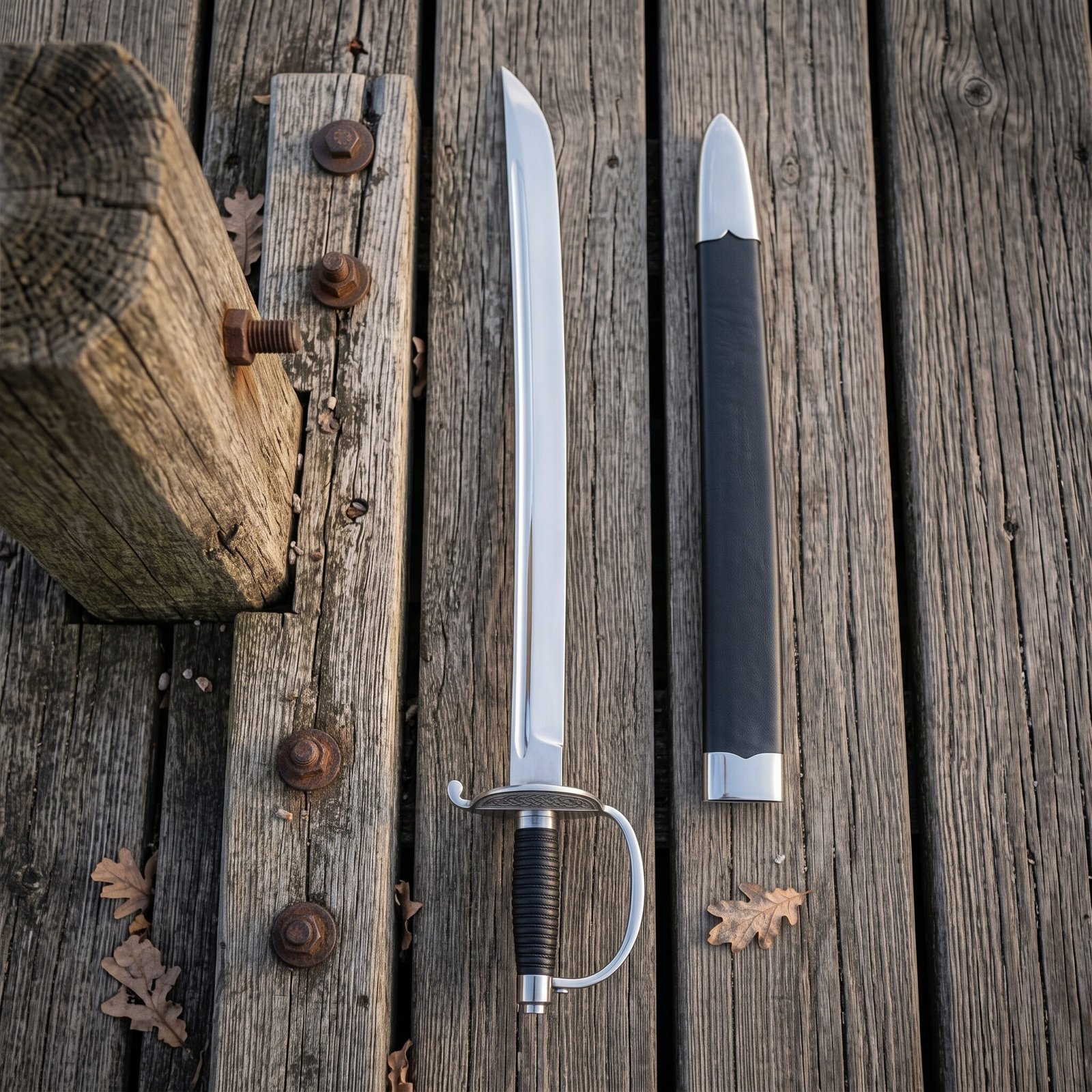
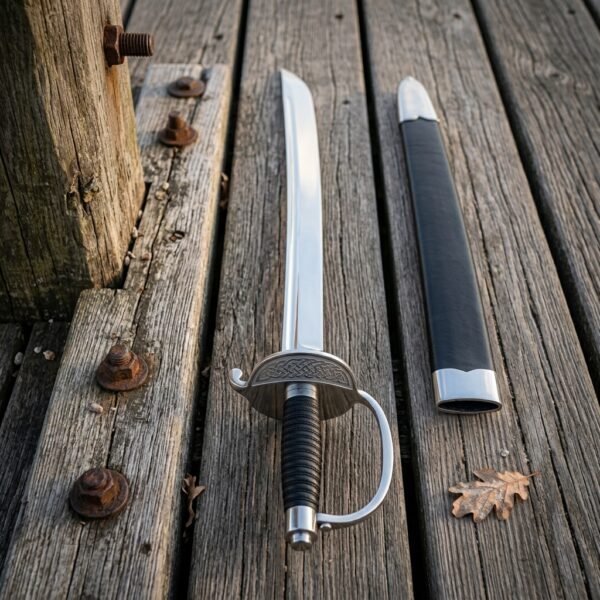
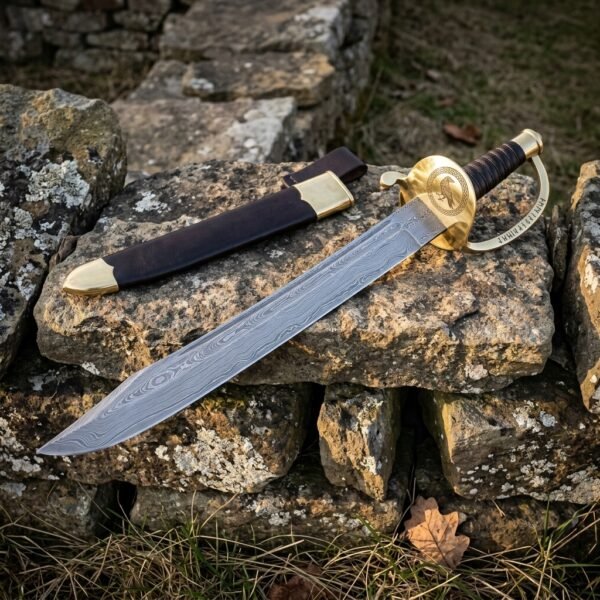
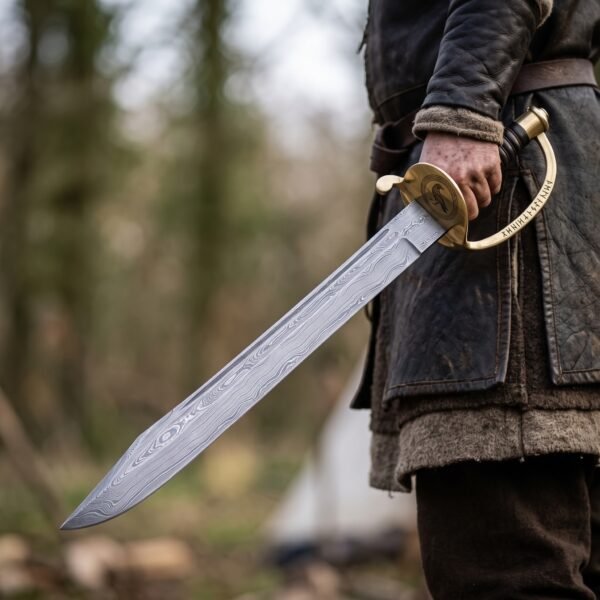
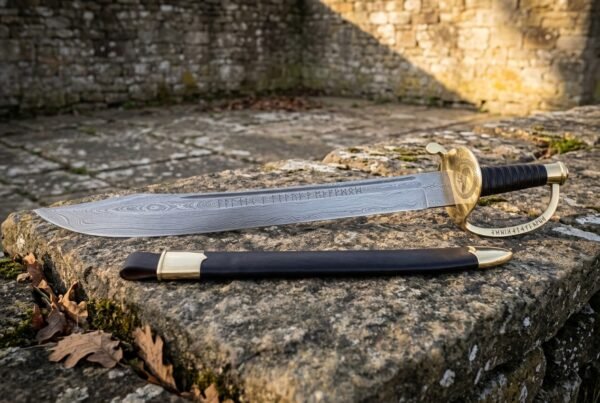
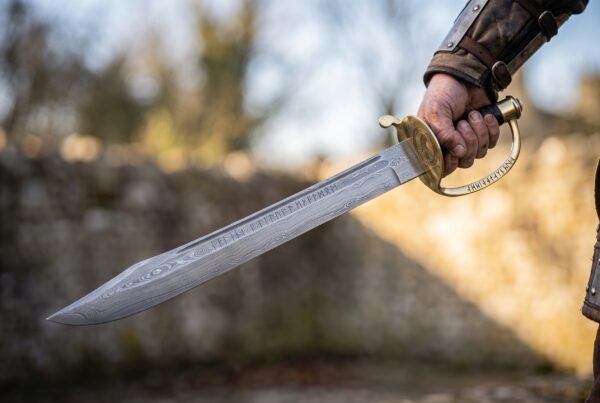
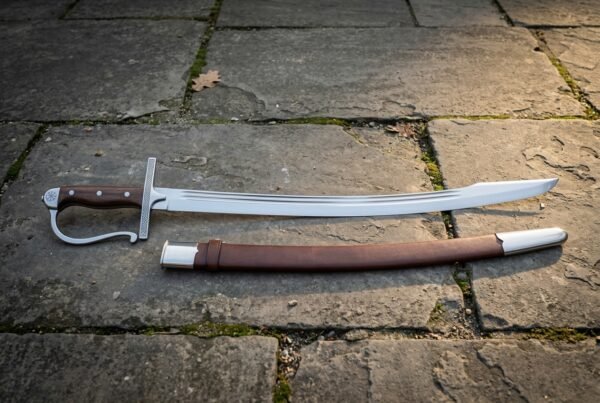
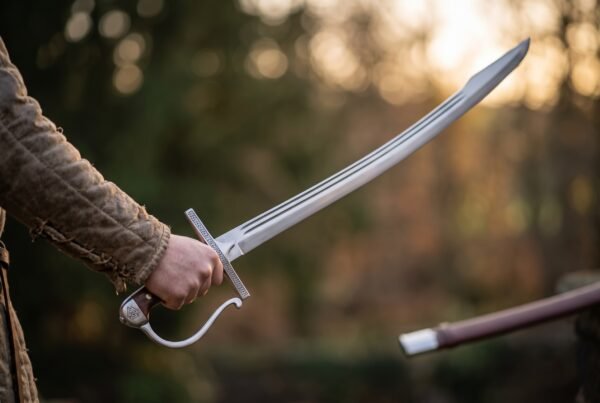
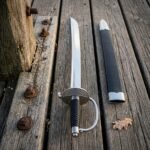
This one is forged and finished in the Czech Republic. The blade is 1095 high carbon steel, hardened and tempered, ground with a long distal taper and brought to a mirror polish. The guard is a broad steel shell engraved with an interlaced knotwork band, carried on a full knuckle bow that sweeps down to a stepped steel pommel cap. The grip is leather over a corded core, ribbed so the hand locks in even when wet. It ships with the fitted black leather scabbard shown, mounted with a polished steel throat and chape.
Specifications
| Steel | 1095 high carbon steel |
|---|
| Hardness | 54 to 58 HRC |
|---|
| Overall length | 30 inches |
|---|
| Blade length | 24 inches |
|---|
| Blade profile | Gently curved single edge with one narrow fuller near the spine, spine curving down to the point, mirror polish |
|---|
| Guard | Steel half shell engraved with a knotwork band, full knuckle bow and short curled rear quillon |
|---|
| Grip | Black ribbed leather over a corded core with a steel ferrule |
|---|
| Pommel | Stepped steel pommel cap |
|---|
| Scabbard | Black leather with polished steel throat and chape |
|---|
| SKU | RK-1405 |
|---|
Why a cutlass blade curves the way it does
Look at the profile from the side and you will see a gentle, even curve from the guard to the point. That curve does the work. When the edge meets a target at an angle rather than square on, it slices rather than chops, and a curved blade gives you that angle no matter how imprecise the swing. A narrow fuller near the spine takes a little weight out of the blade without costing it stiffness.
At the point, the spine curves down to meet the edge. A strongly curved blade thrusts badly because the tip sits off the line of the arm, and the gentle curve here keeps the point close enough to that line for a usable thrust as well as a cut. Aboard ship you might need to cut a line one moment and take a straight thrust down a companionway the next.
The mass of this blade sits forward of the hand, about eight inches ahead of the guard. That is deliberate. A forward balance is slower to change direction but it carries far more energy into the cut, which is what a short sword needs if it is going to do anything more than scratch. The result feels heavier in the hand than a rapier of the same weight, and it is meant to.
Why 1095 high carbon steel and not stainless
Stainless steel resists rust by carrying a large amount of chromium. That chromium forms hard carbides that interrupt the steel matrix, and in a long blade those interruptions become places where a crack can start. It is a fine choice for a kitchen knife and a poor one for a sword, which flexes, takes lateral load and gets struck across its flat. Stainless swords sold as display pieces are usually cast or stock removed from soft bar and left deliberately soft so they will not shatter, which is why so many of them bend and stay bent.
1095 is a simple high carbon steel with very little in it besides iron and just under one percent carbon. It hardens deeply and predictably, it takes and holds a fine edge, and at 54 to 58 HRC it keeps enough spring that a long blade returns to true after a flex. It will rust if you neglect it, which is the honest trade. A wipe of oil after handling is the whole maintenance routine. If you want to read the longer comparison, see Damascus versus stainless.
The guard, the knuckle bow and the grip
The shell on this cutlass is a single piece of steel, dished and then engraved with a continuous interlaced band around its face. It covers the back of the hand from above and from the outside, which is where cuts arrive in a crowded fight. The knuckle bow runs from the front of the shell down to the pommel and closes the hand in from the front. Between them there is very little of the hand left exposed, and that is the entire design brief of a boarding sword.
The grip is leather wrapped over a corded core, so the surface is ribbed rather than smooth. Ribbing matters more than it sounds. A smooth grip relies on friction, and friction disappears the moment the leather is wet or the hand is sweating. Ribs give the fingers something to key against, so the sword stays put without a crushing hold. Wipe the leather with a barely damp cloth and let it dry away from heat, and give it a light leather conditioner once or twice a year.
Engraving, runes and your own design
Use the rune converter on this page to turn a name, a date or a short phrase into Elder Futhark and we will cut it into the steel or the handle. If you would rather have a Viking pattern than a rune line, choose your own design in the engraving option above the add to cart button and tell us whether it goes on the blade or the handle. Where a piece already carries an engraved design, your chosen engraving replaces it rather than sitting alongside it. On this cutlass that means the knotwork band on the shell is the panel your design would take over. More examples and lettering options are on the engraving page.
Care and sharpening
Handle the blade, then wipe it down. Fingerprints are mildly acidic and they will etch a mirror polish within days if you leave them there. A microfibre cloth and a film of mineral oil, camellia oil or any light gun oil is enough. Store it out of the scabbard if the piece is going to sit for months, because leather holds a small amount of moisture and traps it against the steel. Full detail is on the steel care page.
The edge arrives sharp but not razored, which is the correct state for a sword. If you want it keener, work it on a whetstone and follow the existing bevel rather than trying to impose a new angle. A curved edge is sharpened in short overlapping sections, moving the stone along the belly as you go, not in one long pass. The method is walked through in sharpening with a whetstone.
Made in the Czech Republic
This is a handmade piece from the Czech Republic, made in a workshop that still forges, grinds and finishes by hand instead of stamping parts out. The smiths there have kept the older way of working, and the wood, horn and leather are shaped and fitted by hand as well. Two pieces of the same design will never be identical, and that is part of what you are buying.
Ransack Viking is a United States company. We handle the import ourselves, look over every piece when it lands and ship from our warehouse in Chicago, Illinois. Engraving is done in the United States after the piece arrives, so your design goes on before we send it out.
A note on handmade variation
This piece is hand forged. It is not machine made or bulk produced, so what arrives will not be a pixel for pixel copy of the photograph. The grain and tone of the leather, the exact depth of the knotwork engraving, the way the polish catches light along the belly of the blade and the precise line of the curve all vary a little, because each one is worked by hand from natural materials. The dimensions, the steel and the build are the same every time. The character is not, and that is the point of buying something forged rather than stamped.
Frequently asked questions
Is the cutlass sharp when it arrives
Yes, it arrives with a working edge that will cut paper and rope. It is not honed to a razor, because a razor edge on a sword chips the first time it touches anything hard. You can take it further on a stone if you want to.
Can I actually cut with this or is it display only
The blade is properly hardened and tempered 1095, so it is a functional sword rather than a wall hanger. Light target cutting on water bottles or a rolled mat is within its design. It is not built for edge on edge sparring against another steel blade, and we do not recommend it for that.
Can I have runes engraved on the blade
Yes. Use the rune converter on this page, or choose your own design in the engraving option. Tell us whether it goes on the blade or on the shell guard. Engraving adds a little to the lead time.
Will mine look exactly like the photograph
Very close in shape and size, not identical in character. The leather tone and the polish pattern shift from piece to piece because they are finished by hand.
What is the difference between a cutlass and a sabre
Length and purpose. A sabre is a cavalry blade, usually thirty three inches of blade or more, made to reach down from a horse. A cutlass is roughly two feet, heavier for its length, and made to be used on foot in a confined space. The cutlass gives up reach to gain control.
How long does shipping take
Shipping inside the United States is free. In stock pieces leave within a few days. This piece takes two to four weeks in the shop before it ships, and engraved work takes a little longer.
What is in the box
- Brinehook hand forged 1095 high carbon steel cutlass
- Fitted black leather scabbard with polished steel throat and chape
- Care card covering oiling, storage and leather upkeep
- Elder Futhark rune engraving or your own Viking design if selected at checkout
- Forged and finished in the Czech Republic
Explore the range
See the rest of the cutlasses, the short swords, the full sword range and the rapiers, or read the guides for more on steel, edges and care.
Worth a look beside this
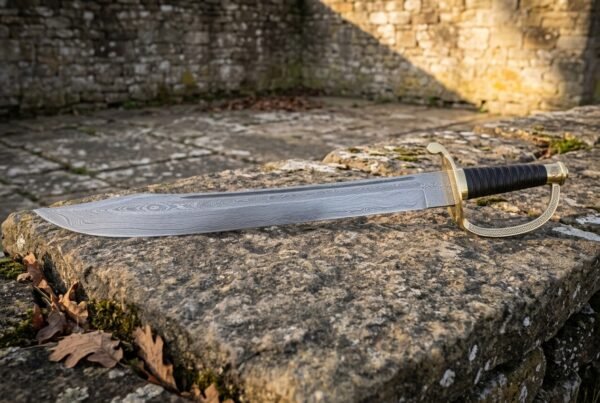
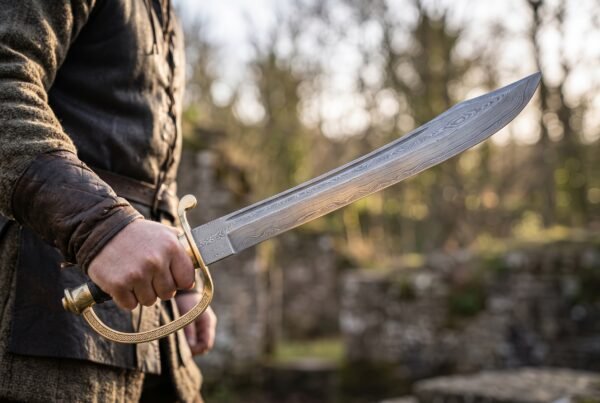
If this one is not quite right, there is the Saltbrand cutlass, 30 inches overall. Also in this group is the Ravenhold cutlass, pattern welded Damascus. Sitting beside it in the catalogue is the Tidewrack cutlass, 31 inches overall.
From the same corner of the shop, there is the Wolfmarch messer. Or start from a blank sheet on the design your own page.
Anyone moving from display pieces to sparring can start with the Orlunde spadroon, and our smallsword guide fills in the rest.


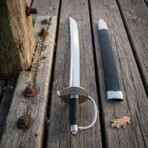
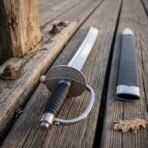
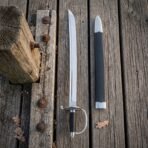
So happy I finally pulled the trigger on this one. The craftsmanship really shows in the small details. Couldn’t be happier with this.
Best piece I’ve ever owned. Exactly as described and clearly made with care. Ransack Viking’s attention to detail is honestly unmatched. Worth every penny.
Overall a good buying experience. Minor nitpicks aside, good quality piece. Second time ordering from Ransack Viking and still happy overall.