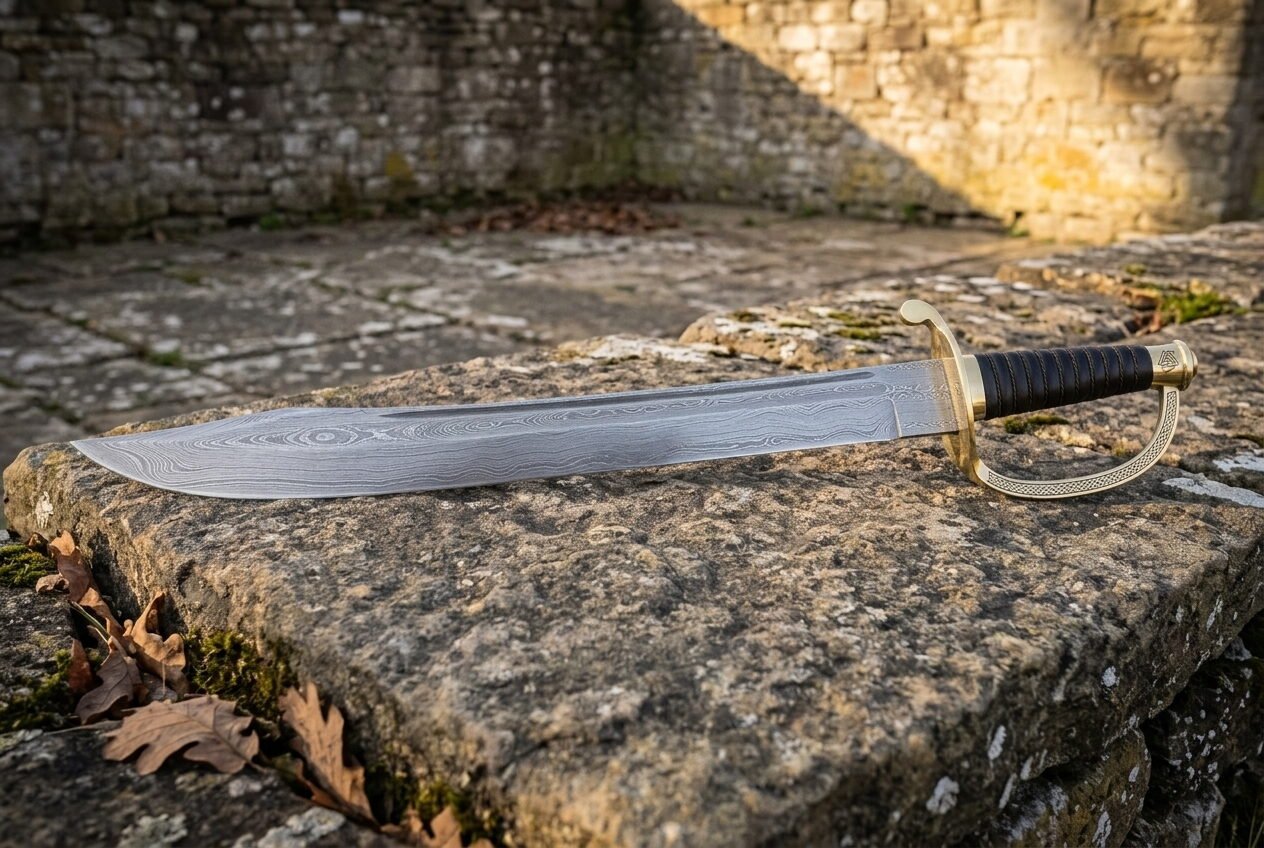
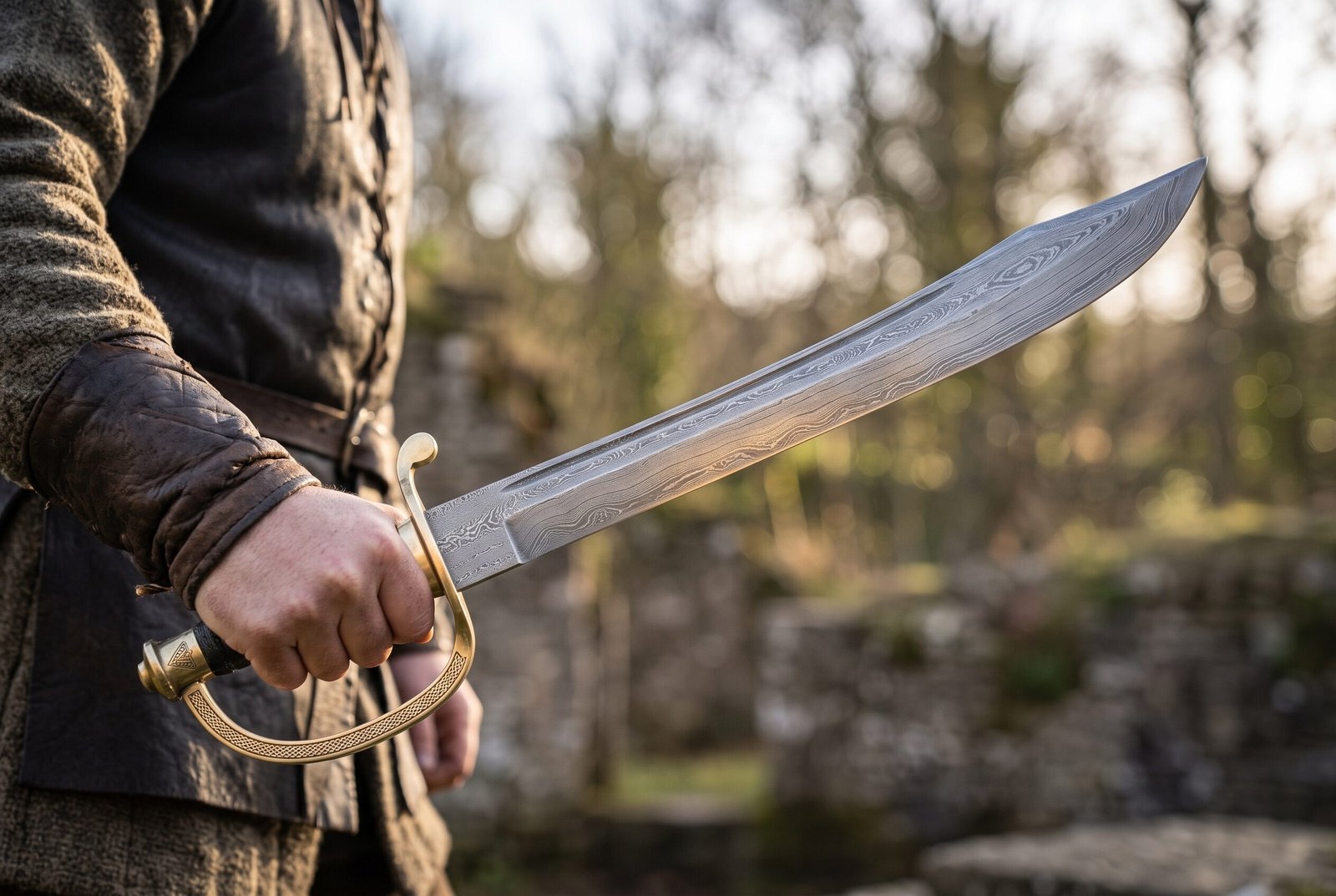
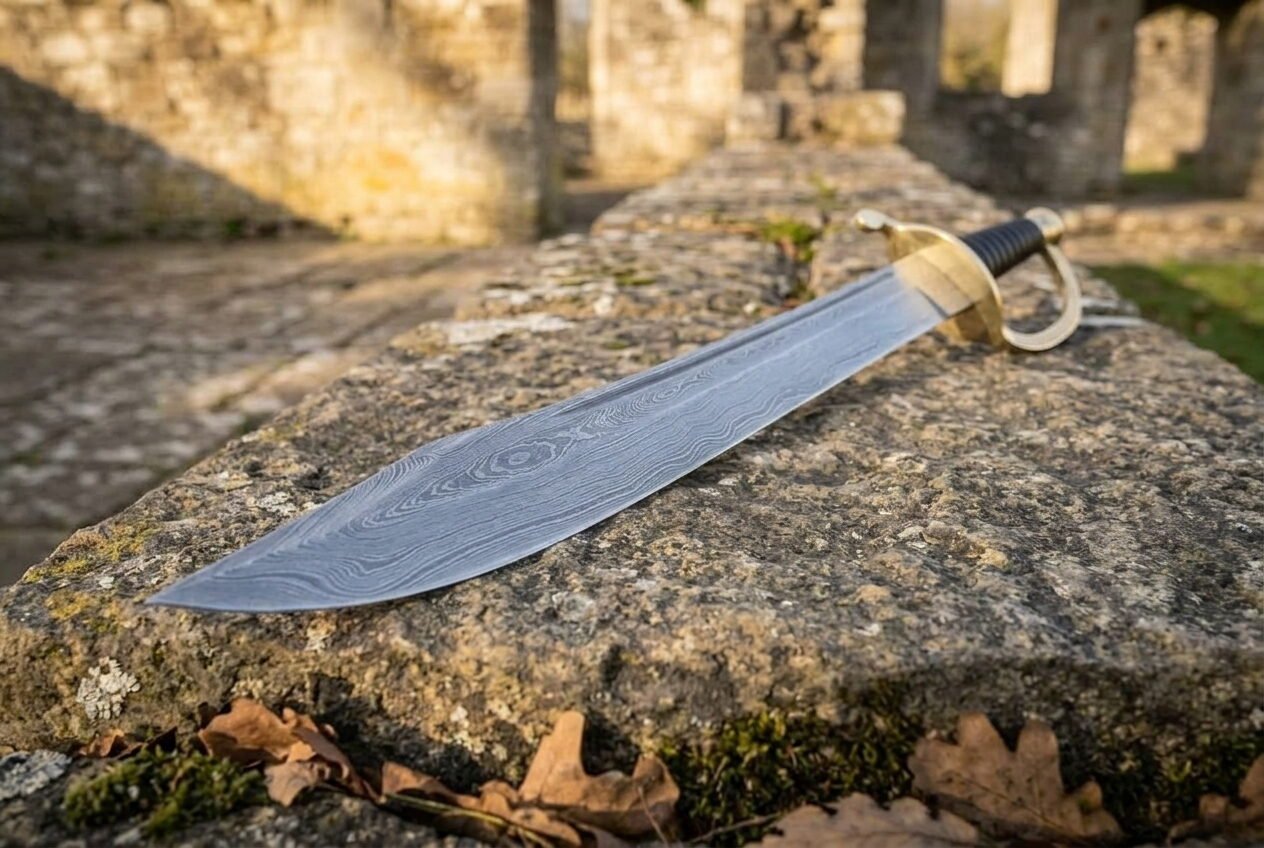
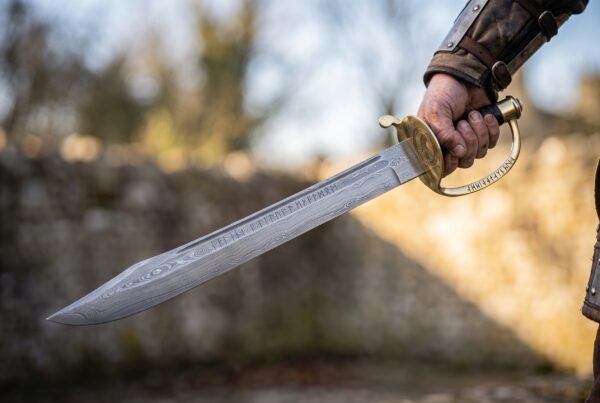
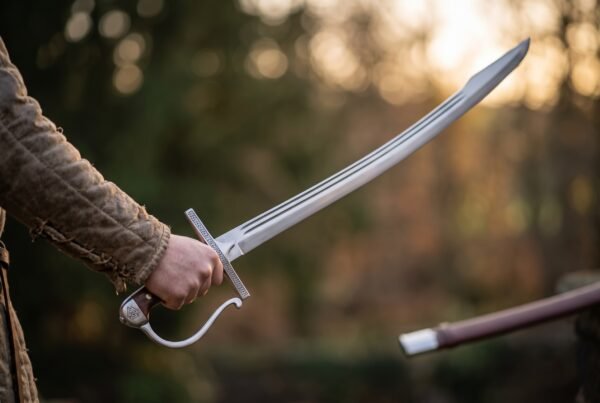
Put a cutlass next to almost any other sword and the first thing you notice is that the edge is not a straight line and not a simple arc. It swells outward through the middle third into what smiths call the belly, and then sweeps back up to the point. That belly is the reason a cutlass cuts the way it does. A curved edge presents less steel to the target at any one instant, so the same force is concentrated into a smaller contact patch, and the curve keeps feeding fresh edge into the cut as the blade travels. It is the same principle that makes a sickle better than a straight knife for grass, applied to a sword.
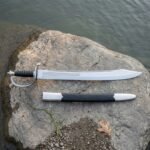
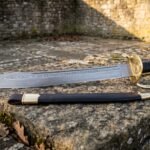
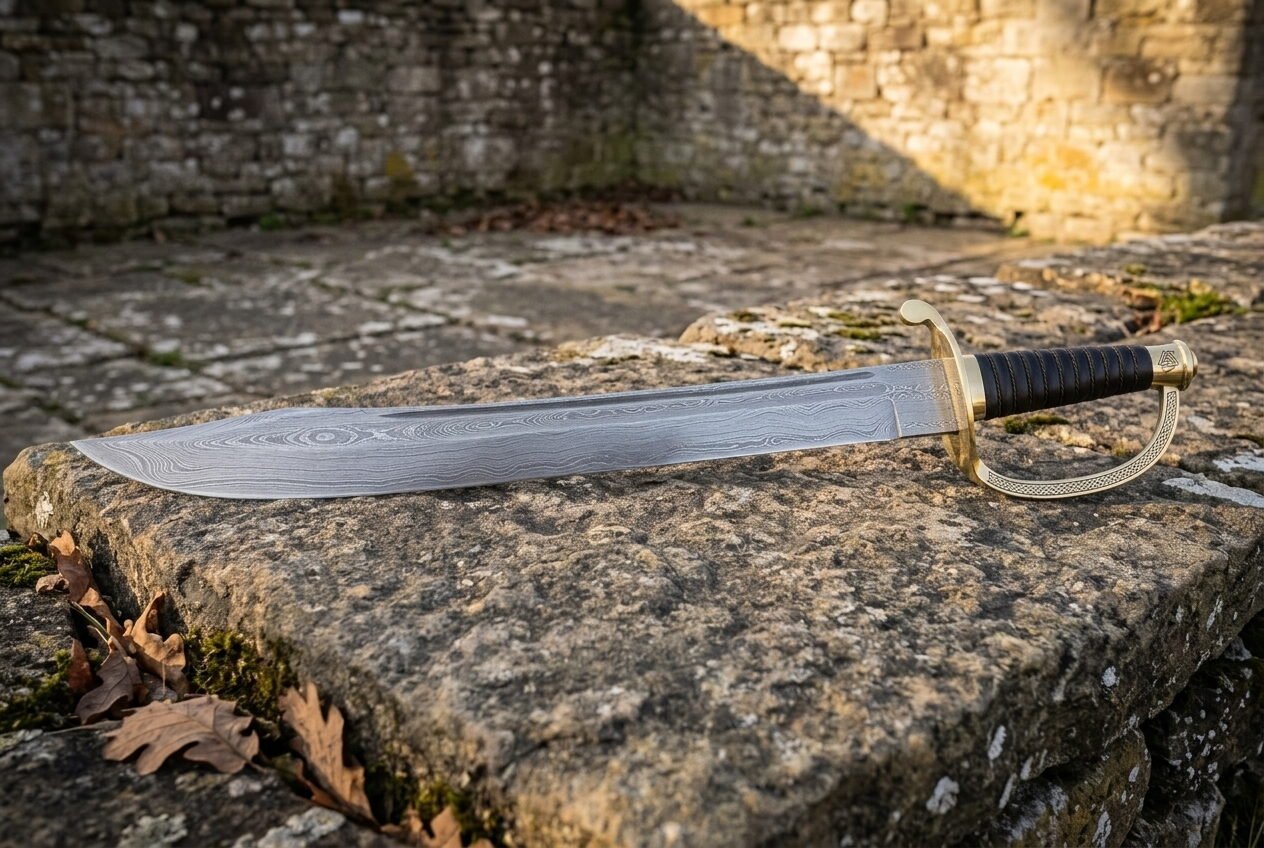
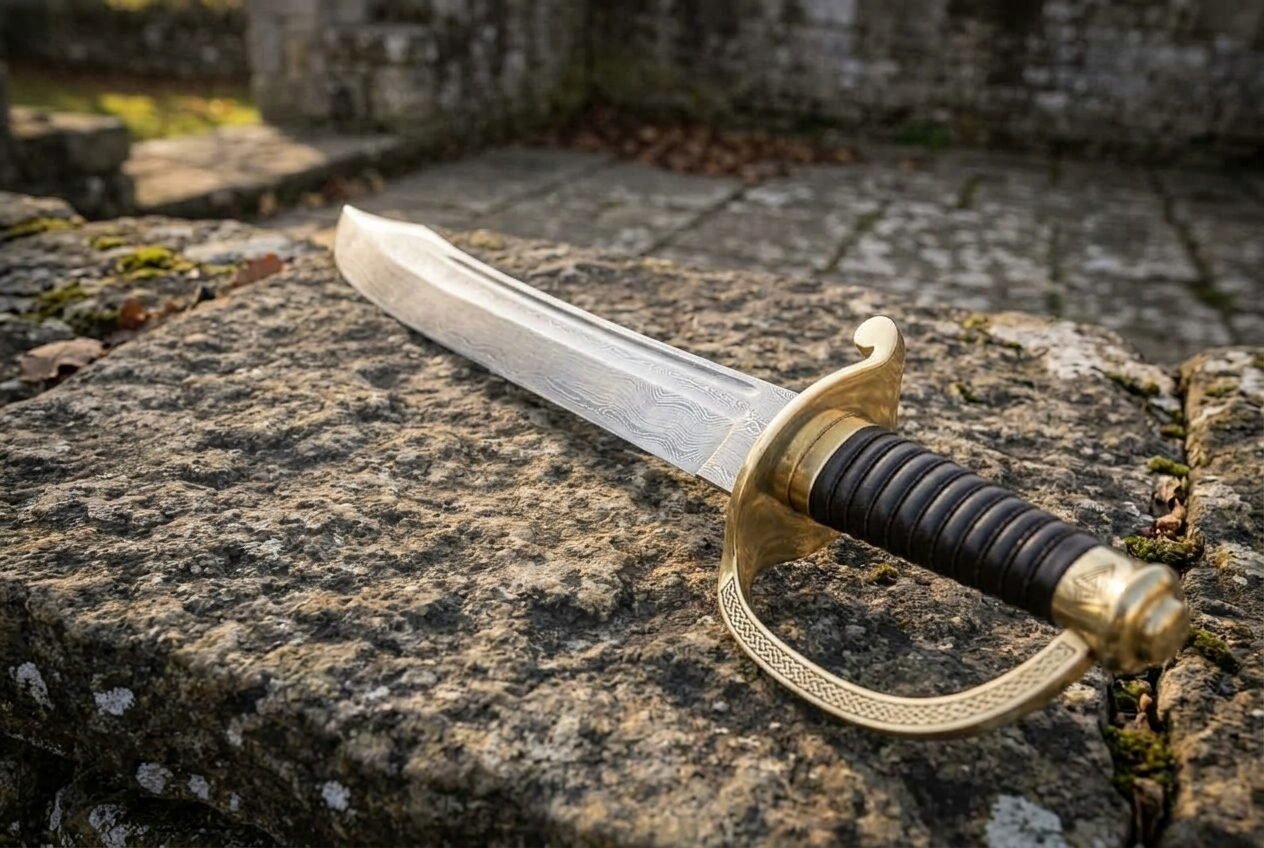
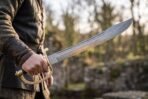
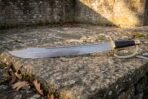
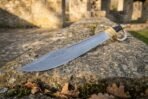
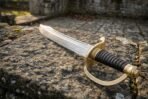
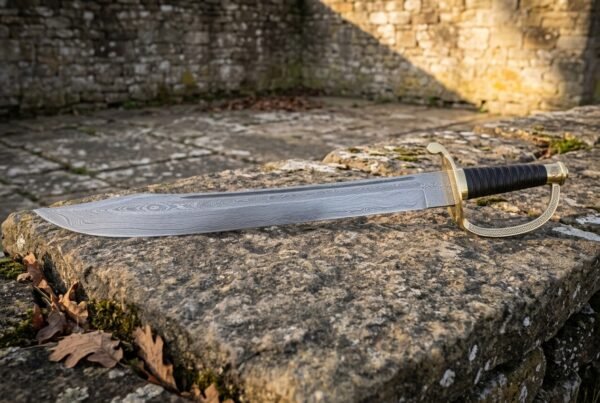
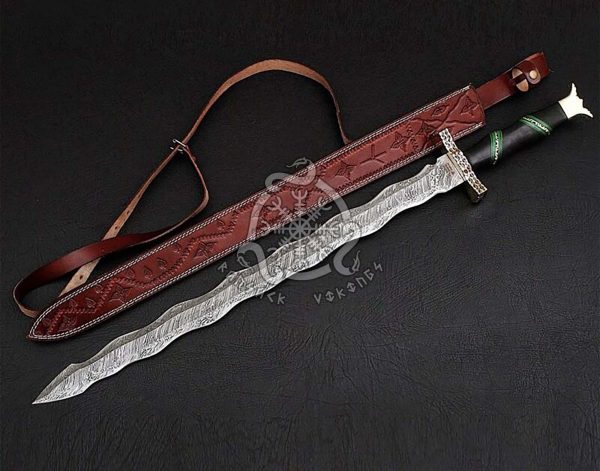
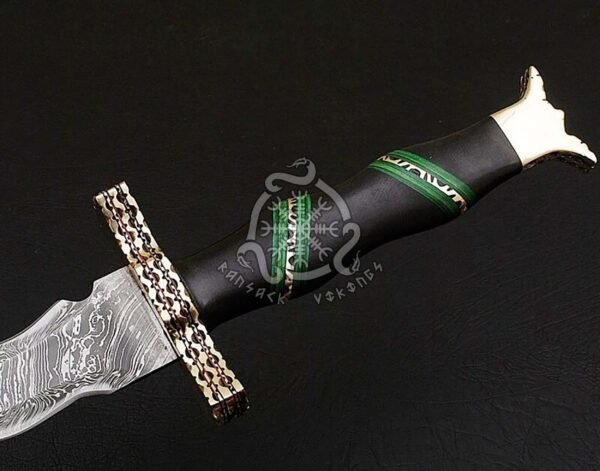
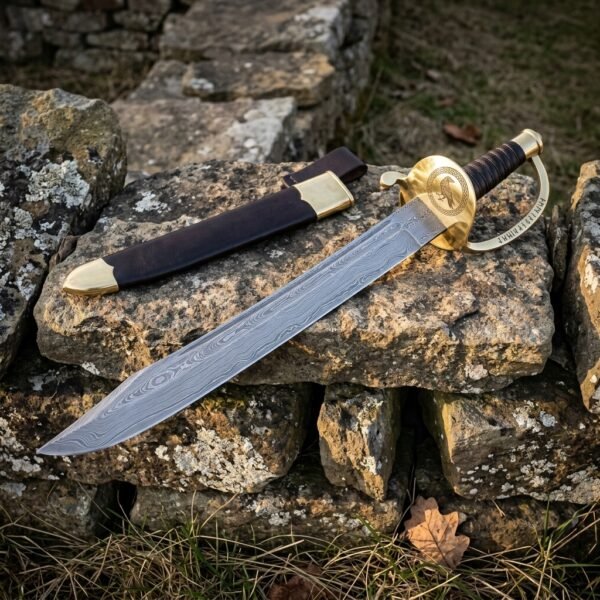
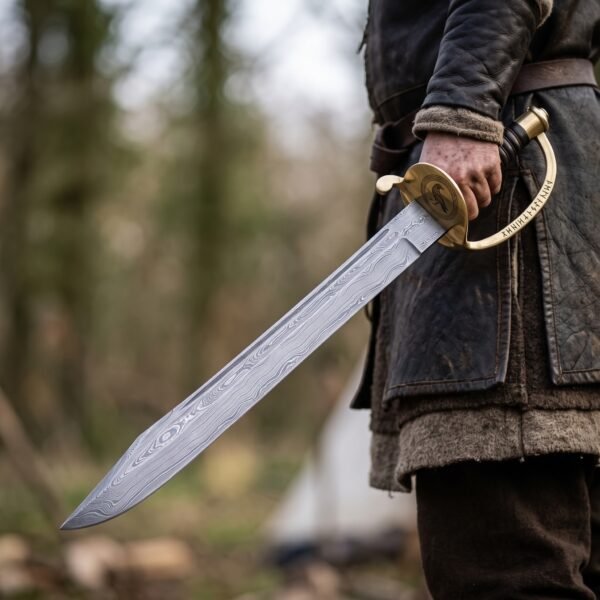
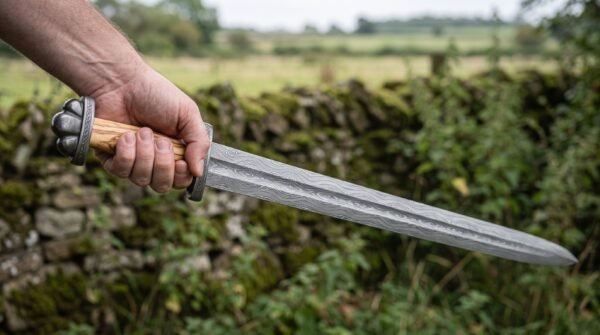
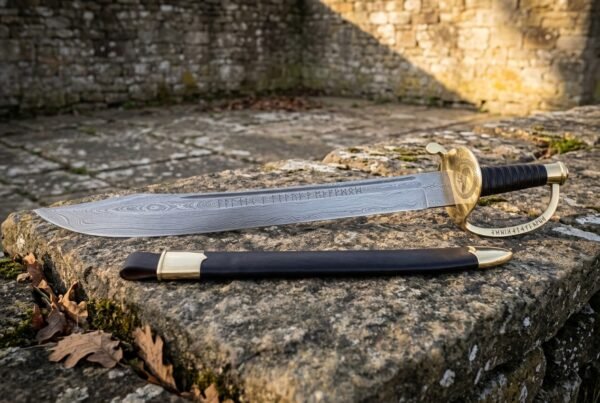
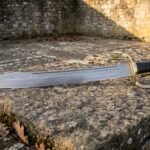
This Valknight cutlass is forged by hand in the Czech Republic. The blade is welded from 1095 and 15N20, drawn broad, given a deep belly, hardened, tempered and etched to raise the layers. The hilt is filed brass with a hooked quillon and an open knuckle bow cut with knotwork, over a ribbed black leather grip capped with a brass pommel bearing a valknut. It is supplied without a scabbard, wrapped for safe carriage, and shipping inside the United States is free.
Specifications
| Steel | 1095 and 15N20 forge welded Damascus, hand etched |
|---|
| Hardness | 58 to 60 HRC |
|---|
| Overall length | 29 inches |
|---|
| Blade length | 23 inches |
|---|
| Blade profile | Broad single edged blade with a deep belly, a narrow fuller along the spine and a clipped point |
|---|
| Guard | Open brass knuckle bow cut with knotwork, hooked quillon and a small brass langet |
|---|
| Handle | Ribbed black leather over a shaped core with a brass ferrule |
|---|
| Pommel | Brass pommel cap cut with a valknut |
|---|
| Scabbard | Not included. The cutlass ships in a protective blade wrap |
|---|
| Edge | Shipped with a working edge, sharpened on request at no charge |
|---|
| SKU | RK-1317 |
|---|
Why a cutlass blade has a belly
Three things happen when you forge that outward swell into the edge, and they all pull in the same direction.
The first is contact geometry. A straight edge meeting a target lands along its whole length at once and has to shear through everything simultaneously. A curved edge lands on a short section and rolls through, which concentrates the force and lets the blade start the cut before it has to finish it. The second is mass. Widening the blade through the middle third puts steel where the cut lands, which moves the centre of percussion forward and makes the sword hit harder without the hand feeling it. The third is edge length. A bellied blade carries more inches of cutting edge than a straight one of the same overall length, and on a working sword that used to be sharpened at sea with whatever stone was aboard, more edge meant longer between resharpenings.
The cost is a sword that does not thrust particularly well and that needs a little more skill to sharpen evenly. Naval and merchant crews were content with that trade. A cutlass was expected to cut rope, canvas, timber and, when it came to it, people, and a point was a luxury.
How the Damascus is made, and why not stainless
Two steels go into this blade. 1095 is a plain high carbon steel that hardens hard and etches dark. 15N20 carries around two percent nickel and stays bright under the same acid. Alternating layers are brought to welding heat and hammered until they fuse into one bar, then drawn, cut, folded and welded again, doubling the layer count each time. Only once the billet is finished does it become a cutlass, so every hammer blow that forms the belly also stretches and compresses the pattern. That is why the figure follows the shape of the sword instead of sitting on it.
Stainless steel cannot be pattern welded in a normal forge, because the chromium that makes it stainless builds an oxide skin at welding heat and the layers refuse to bond through it. The mechanical objection matters just as much: at the section a sword needs, enough chromium to resist rust makes the steel brittle. This blade runs 58 to 60 HRC at the edge with a spine that still flexes and returns. The honest cost is that carbon steel spots if left wet. We set the whole comparison out on our page covering Damascus versus stainless.
The ribbed leather grip and brass furniture
The grip is leather laid over a shaped core and bound down into raised ribs. Ribs are not decoration. They give the fingers a hard edge to register against so the hand finds its place without looking, and they stop the palm creeping forward under a heavy cut, which on a bellied blade with the mass forward is a real risk. Leather also swells slightly when damp, so the hold tightens in wet weather rather than loosening.
The ferrule and the pommel are brass, peened over the tang so the hilt is held by metal moved into metal rather than by glue. Brass is the right choice for the parts you handle: it files to a clean line, it never rusts, and under a hard knock it deforms instead of cracking. The pommel is cut with a valknut, the three interlocked triangles found on Gotland picture stones and in the Oseberg burial. Nobody can say for certain what it meant, which is part of why it has lasted. Wipe the leather dry if it gets wet, keep it away from direct heat, and give it a little neutral conditioner once or twice a year. Do not soak it, because saturated leather stretches and the ribs go soft.
Engraving, runes and your own design
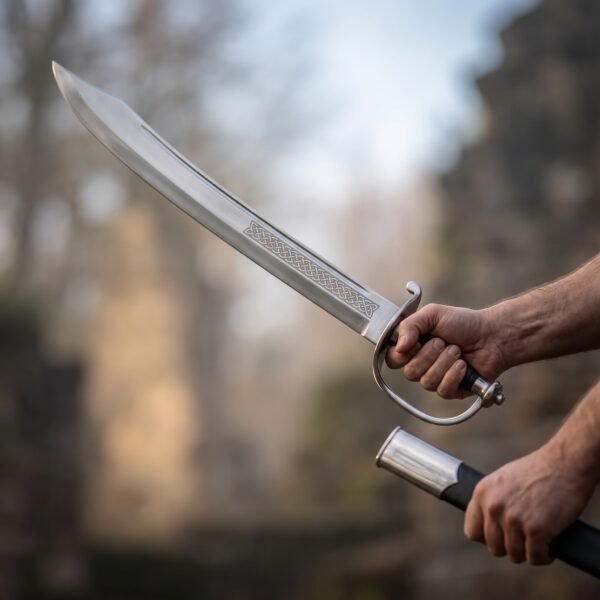
Use the rune converter on this page to turn a name, a date or a short phrase into Elder Futhark and we will cut it into the steel or the handle. If you would rather have a Viking pattern than a rune line, choose your own design in the engraving option above the add to cart button and tell us whether it goes on the blade or the handle. Where a piece already carries an engraved design, your chosen engraving replaces it rather than sitting alongside it. This cutlass carries knotwork on the brass bow and an engraved panel at the ricasso, so tell us which surface you want used. What we can and cannot cut is listed on the engraving page.
Care and sharpening
An etched Damascus surface is a relief only a few thousandths of an inch deep, so abrasive polishing will flatten it. Clean with a soft cloth, never a scouring pad, and keep a thin film of oil on the steel. Wipe fingerprints off promptly, because skin acid continues etching and leaves marks that show badly against the layers. Since this piece ships without a scabbard, store it on a rack or in a soft lined case rather than in a sealed sleeve, where trapped moisture will find the steel. The full routine is on our steel care page.
Sharpening a bellied edge means moving the sword rather than your hands. Set the angle, then draw the blade across the stone so the contact point travels steadily around the curve and back up to the point. Our guide to sharpening with a whetstone covers the method properly.
Made in the Czech Republic
This piece is made by hand in the Czech Republic, in a workshop that still works the old way. The steel is forged, ground, heat treated and finished by smiths who learned the trade from the people before them, and the wood, horn and leather are cut and fitted by hand rather than pressed out on a line. That is also why no two pieces come out exactly the same.
Ransack Viking is a United States company. We import these pieces ourselves, check every one when it lands and ship from our warehouse in Chicago, Illinois. Engraving is done here in the United States after the piece arrives, so your runes or your own design go on before it leaves for you.
A note on handmade variation
This cutlass is hand forged. It is not machine made and it is not bulk produced, so what arrives will not be a pixel for pixel copy of the photograph on this page. Damascus is never repeatable: the figure depends on how that specific billet was drawn, folded and cut, so the pattern on your blade will be its own. The brass will have taken the file and the graver differently, the leather will sit a shade lighter or darker, and the sweep of the belly will show the hand of the smith who forged it. Dimensions, steel, hardness and build are the same every time. The character is not.
Frequently asked questions
Does this cutlass come with a scabbard?
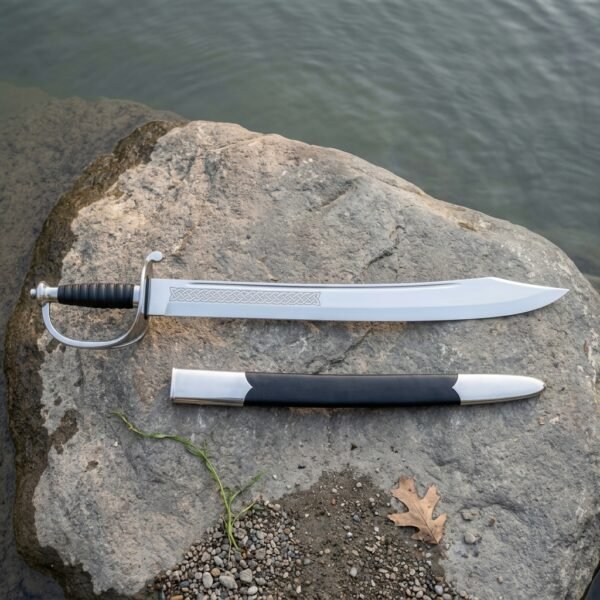
No. It is supplied as a bare blade in a protective wrap, which is how it is photographed. If you want a fitted leather scabbard made for it, contact us before ordering and we will quote for one built to that specific blade.
Is the pattern real forge welded Damascus?
Yes. Alternating layers of 1095 and 15N20 welded in the fire, so the pattern runs through the full thickness of the steel. It cannot be sharpened or polished off.
Does it arrive sharp?
It arrives with a working edge. Ask in the order notes and we will take it up to a full cutting edge before it ships at no extra charge.
Can I cut with it or should it stay on the wall?
It is functional. Full tang, peened brass pommel, properly hardened and tempered steel. The short bellied blade is very effective on tatami, bottles and rope. It is not a sparring sword and must never be used against another blade or against a person.
Can I have runes engraved on it?
Yes. Use the rune converter on this page for Elder Futhark or choose your own Viking design, and say whether you want it on the blade or on the brass. It replaces the engraving already there.
What is the difference between this and a falchion?
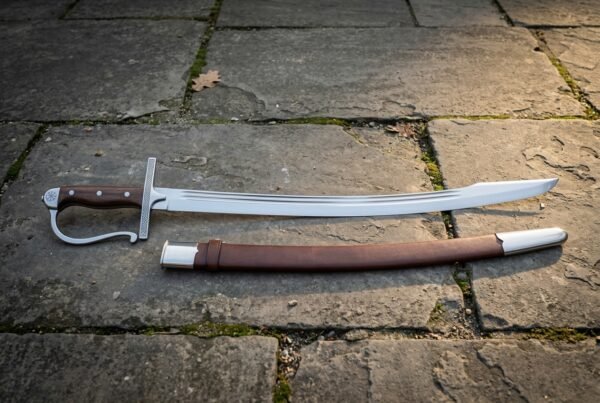
A falchion is the medieval European cleaver: broad, often heaviest right at the tip, usually with a simple cross guard and no hand protection. A cutlass is its later seagoing cousin, shorter in the blade, with the mass in the belly rather than the very end and a guard wrapping the hand. The falchion hits harder; the cutlass is faster and safer to hold.
What is in the box
- One Valknight hand forged Damascus cutlass in 1095 and 15N20, 29 inches overall
- Protective blade wrap for carriage and storage. No scabbard is supplied
- Care card covering oiling, etched surfaces and rack storage
- Certificate of hand forging with the SKU recorded
- Forged and finished in the Czech Republic
Explore the range
Browse the rest of the cutlasses, the full damascus swords collection, the longer sabres, and the wider swords range. Background on pattern welding, geometry and care is in the guides.
Close to this one
Also in this group is the Sunwarden cutlass, 30 inches overall. Sitting beside it in the catalogue is the Ravenhold cutlass, pattern welded Damascus. Another in the same line is the Tidewrack cutlass, 31 inches overall.
For a different piece from the same family, look at the Gildhawk sabre. Nothing here exactly right, build one to your own spec on the design your own page.
Want something you can actually fence with? The Sturvang sabre trainer is blunt and made for it, and our HEMA sabre range is worth a look before you buy.

Solid piece. Glad I ordered it.