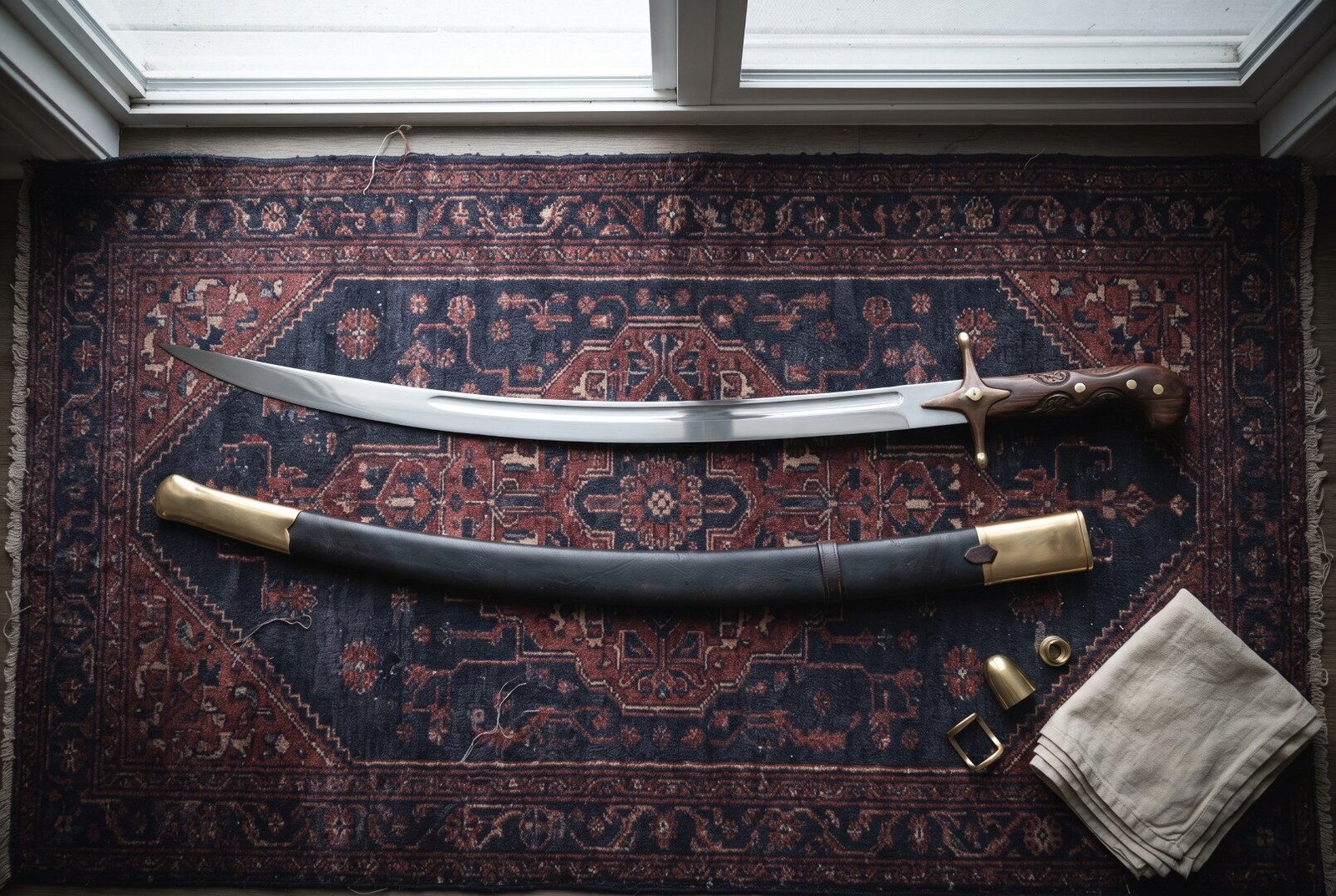
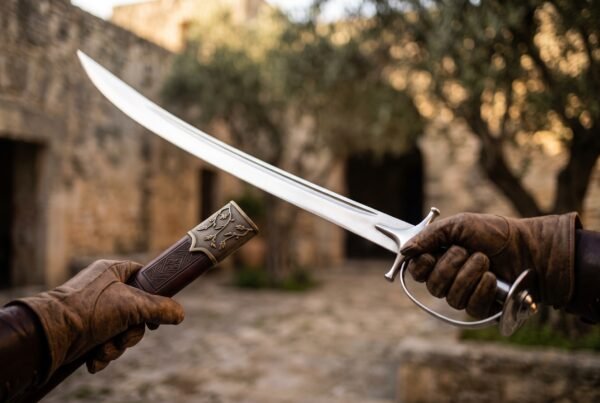
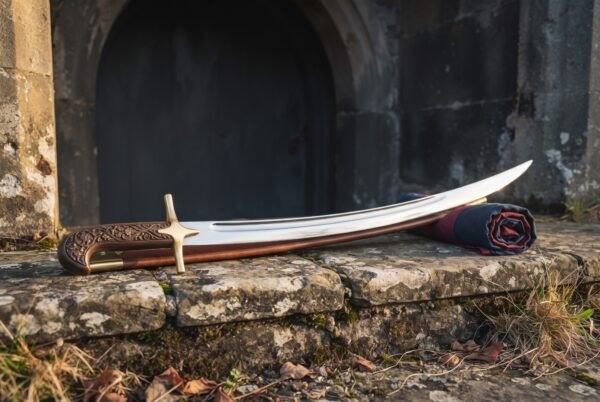
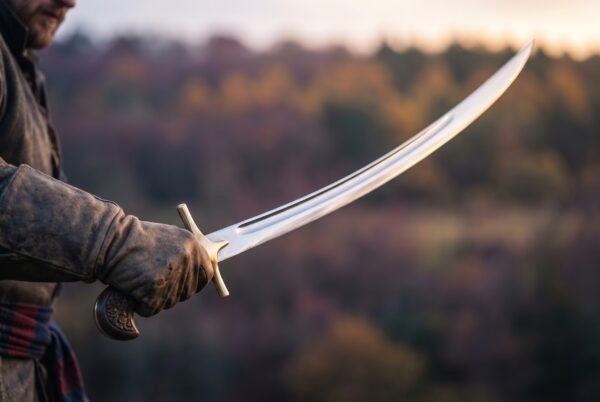
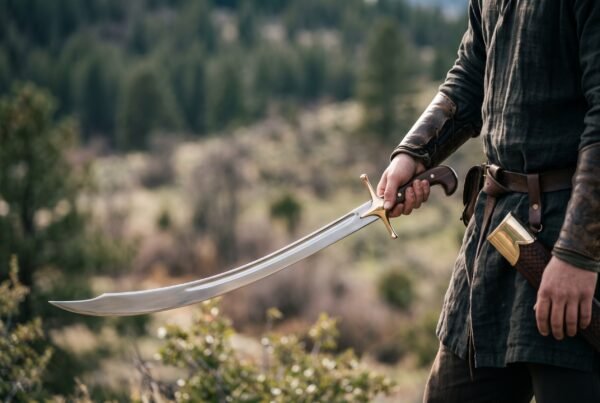
The Silkmoon is a Persian sword of the shamshir type, thirty eight inches of narrow blade curved so evenly that it reads as a single crescent from guard to point. Persia produced this shape in enormous numbers from the Safavid period onward and exported it in every direction, which is why versions of it turn up in Ottoman Turkey, Mughal India, the Caucasus and eventually in European light cavalry patterns. The famous Persian blades were made of wootz, a crucible steel imported from southern India that carried a watered surface pattern, and a good part of the sword trade of the entire region ran on it for four hundred years.
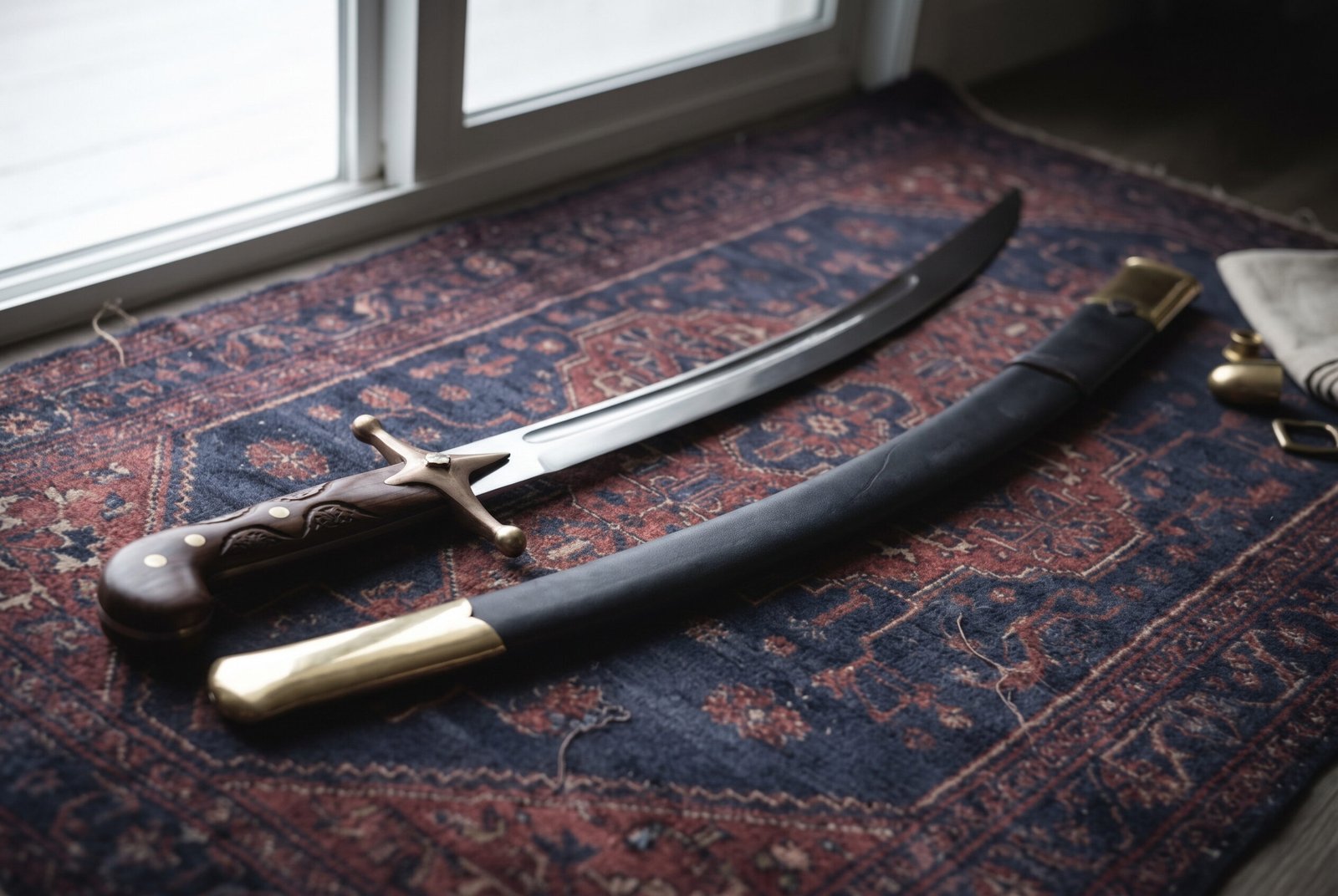
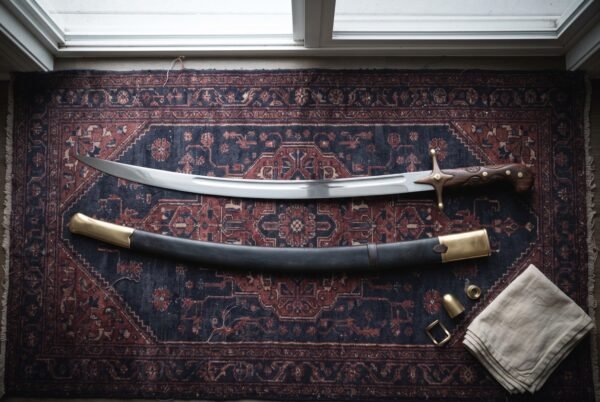
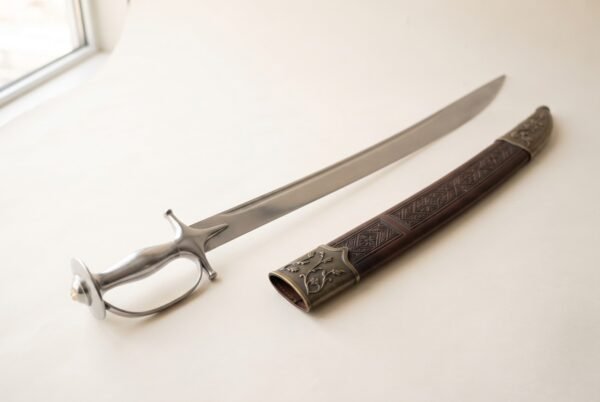
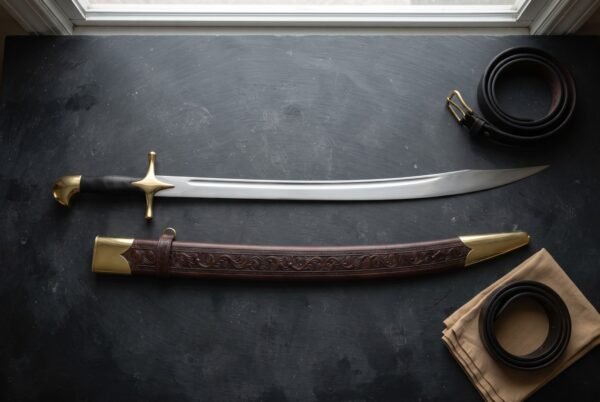
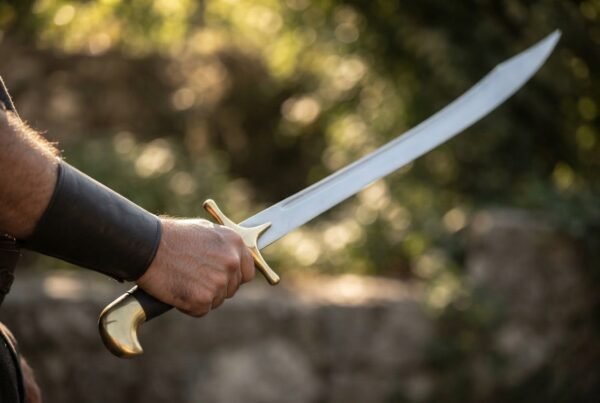
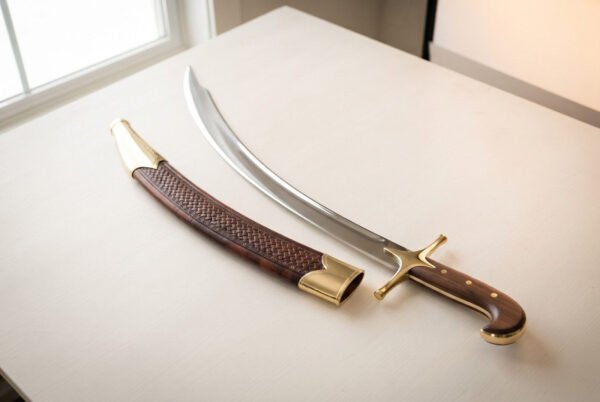
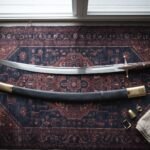
This one is forged and finished in the Czech Republic in 1095 high carbon steel, hardened, tempered and taken to a mirror polish. The hilt is walnut pinned in brass, with a brass cross guard ending in ball finials and a rounded hooked pommel. It ships in a black leather scabbard with a brass throat and chape, with a care card, and shipping inside the United States is free.
Specifications
| Steel | 1095 high carbon steel |
|---|
| Hardness | 54 to 58 HRC |
|---|
| Type | Persian shamshir, single edged curved sword |
|---|
| Overall length | 38 inches |
|---|
| Blade length | 32 inches |
|---|
| Blade finish | Mirror polished, narrow crescent with an even deep curve and a narrow fuller along the spine |
|---|
| Grip | Walnut scales with brass pins and carved scroll detail |
|---|
| Guard | Brass cross with straight quillons ending in ball finials and a central langet |
|---|
| Pommel | Rounded hooked walnut pommel |
|---|
| Scabbard | Black leather with brass throat and chape and a leather mid band |
|---|
| SKU | RK-1395 |
|---|
How the scabbard is built
The scabbard is black leather over a curved core, with a brass throat at the mouth, a brass chape at the tip and a leather band a little below the throat. The chape takes the wear where the tip drags, and the throat keeps the mouth from spreading as the blade goes in and out. The curve of the scabbard follows the curve of the blade, so the sword draws along its own arc, which is how a shamshir was meant to come out.
Why 1095 high carbon steel and not stainless
1095 is a plain carbon steel with just under one percent carbon and no significant alloying. It hardens fully and evenly through a slim blade like this, its fine grain lets an edge come to a genuine apex, and tempered to 54 to 58 HRC it keeps enough spring to flex under load and come back straight.
Stainless gets its corrosion resistance from chromium, which locks carbon into hard carbides. That is a reasonable bargain in a short kitchen blade and a poor one in thirty two inches of narrow sword, where those carbides make chipping and cracking more likely. The trade with 1095 is that it will rust if you neglect it, which is a maintenance question and a small one. We set the comparison out properly on Damascus versus stainless.
The walnut grip
The grip is walnut in two scales, riveted through a full width tang in brass. Walnut is lighter than rosewood and slightly softer, which suits a shamshir well: the sword already carries all the mass it needs out in the blade, and a lighter grip keeps the reach forward where the design wants it.
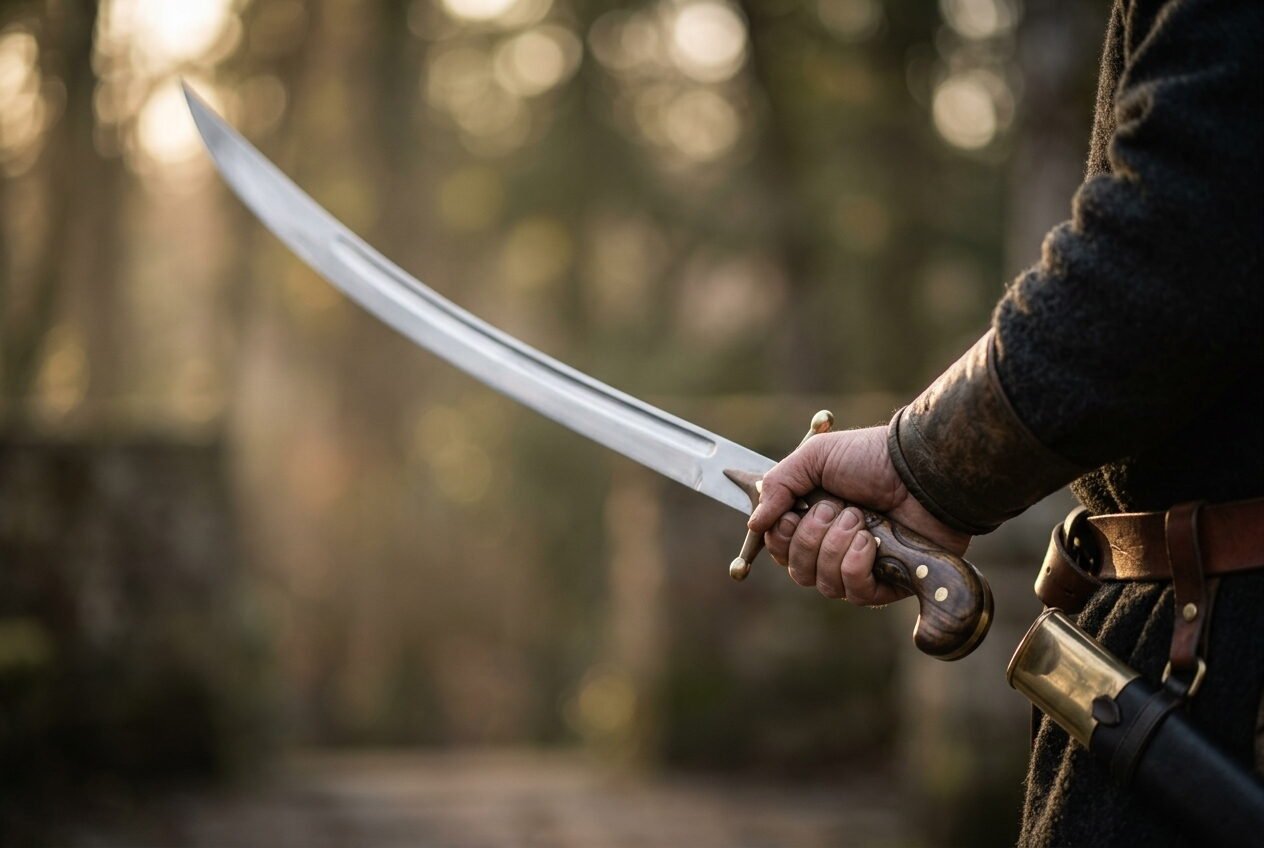
Walnut also does something rosewood does not, which is that it takes and holds the shape of a hand over years of use. The scales are cut slim and slightly waisted, and the rounded hook at the end sits against the heel of the hand as a positive stop. Between the hook and the waist you end up holding the sword with almost no grip pressure at all, which is exactly the point. Walnut is more open grained than rosewood and benefits from a wipe of oil two or three times a year rather than one or two, particularly if the sword is displayed anywhere with dry heating. There is a routine on wooden handle care.
Engraving, runes and your own design
Use the rune converter on this page to turn a name, a date or a short phrase into Elder Futhark and we will cut it into the steel or the handle. If you would rather have a Viking pattern than a rune line, choose your own design in the engraving option above the add to cart button and tell us whether it goes on the blade or the handle. Where a piece already carries an engraved design, your chosen engraving replaces it rather than sitting alongside it. Persian smiths put their inscriptions in a cartouche near the guard, following the curve, and a line of runes laid the same way suits this blade better than anything set square to it. See the engraving page.
Care and sharpening
Wipe the blade with a dry cloth after every handling and keep a thin film of light oil on the steel. A mirror polish on carbon steel records fingerprints as permanent grey shadows within a fortnight, and on a narrow blade like this the whole surface is in view at once so any mark is obvious. Once a month with an oiled rag will hold a displayed sword indefinitely. Keep it out of the scabbard for storage, because leather retains moisture and tanning residue against steel. The routine is on steel care.
To sharpen, follow the arc across the stone in exactly the direction the edge travels in a cut. Work three or four inches at a time and keep the angle constant. Because the curve on a shamshir is even, every section of the edge should get the same number of passes, which makes it one of the easier sword profiles to sharpen well. Finish on a fine stone and strop it. See sharpening with a whetstone.
Made in the Czech Republic
This is a handmade piece from the Czech Republic, made in a workshop that still forges, grinds and finishes by hand instead of stamping parts out. The smiths there have kept the older way of working, and the wood, horn and leather are shaped and fitted by hand as well. Two pieces of the same design will never be identical, and that is part of what you are buying.
Ransack Viking is a United States company. We handle the import ourselves, look over every piece when it lands and ship from our warehouse in Chicago, Illinois. Engraving is done in the United States after the piece arrives, so your design goes on before we send it out.
A note on handmade variation
This Persian sword is hand forged. It is not machine made and it is not bulk produced, so what arrives will not be a pixel for pixel copy of the photograph on this page. Walnut varies in figure and colour from board to board, brass takes its own patina, leather grain is never twice the same and the radius of the curve moves a fraction between blades because it is set by hand under a hammer. The dimensions, the steel and the build are identical every time. The character is not, and that is what you are paying a smith for.
Frequently asked questions
Does it arrive sharp?
Yes, with a working edge rather than a razor. That is the right condition for a sword this long. Ask in the order notes and we will take it further before shipping.
Can it be hung on the wall in its scabbard?
It can, and it looks well that way, but do not store the blade inside the leather long term. Display the sword drawn on a mount and hang the scabbard beside it if you want both on show.
What is the difference between a Persian shamshir and an Arabian saif?
A shamshir is narrow and evenly curved with no widening at all. A saif of the common type has a fuller belly and often flares toward the point. The shamshir slices, the saif chops as well as slices.
Can I use it for cutting practice?
Mats and bottles, yes. It is not a sparring sword, it must never be used against another blade and it should be kept away from hard targets.
Will mine look like the photograph?
Close but not identical. Walnut grain, brass tone and leather all vary between pieces. The steel, the size and the build do not.
How long does shipping take?
Free inside the United States. Two to three business days for a stock sword, two to three weeks if it is engraved.
What is in the box
- Silkmoon hand forged 1095 high carbon steel Persian shamshir
- Black leather scabbard with brass throat and chape
- Care card with oiling and storage instructions
- Certificate of hand forging
- Forged and finished in the Czech Republic
Explore the range
See the other scimitars, the whole swords range, the sabres and the scabbards and sheaths, or read the guides.
Also in this part of the catalogue
Sitting beside it in the catalogue is the Weavewind scimitar, 37 inches overall. Another in the same line is the Duneclaw scimitar, 33 inches overall. Next along the rack is the Sandspire scimitar, 35 inches overall.
Fitting out further, the Runemark longsword belongs with it. Or start from a blank sheet on the design your own page.


Pretty impressed. Just a couple minor things I’d tweak. Solid piece. Packaging could’ve been a bit sturdier. Glad I made this purchase.
This piece beat every expectation I had. The craftsmanship really shows in the small details. It’s handmade in the Czech Republic but ships from a US warehouse so it arrived quicker than I expected. Beyond happy with how this turned out.
So happy I finally pulled the trigger on this one. Feels way more premium in person than the listing photos. You can tell it’s real Czech blacksmith work and shipping from the States made delivery painless. The craftsmanship really shows in the small details. Exactly as described and clearly made with care. This is my third order from Ransack Viking and they never disappoint. Love it.
This is exactly what I wanted and then some. So worth it.
Incredible craftsmanship on this one. Ordered from Ransack Viking before and the quality stays consistent every time. Packaging was excellent and it arrived in perfect condition. Feels way more premium in person than the listing photos. Exactly as described and clearly made with care. Great buy overall.
This piece beat every expectation I had. So worth it.
It’s okay. Not great not bad. Decent quality overall though not amazing. Might work for casual use or display.
Did not expect this level of quality for the price. Packaging was excellent and it arrived in perfect condition. Great buy overall.
Incredible craftsmanship on this one. Feels way more premium in person than the listing photos. The craftsmanship really shows in the small details. Exactly as described and clearly made with care. Worth every penny.
No regrets on this purchase at all. Packaging was excellent and it arrived in perfect condition. Nice touch that it ships from within the US even though it’s crafted in the Czech Republic. Couldn’t be happier with this.