
Blog
Tyr, the God Who Gave His Hand

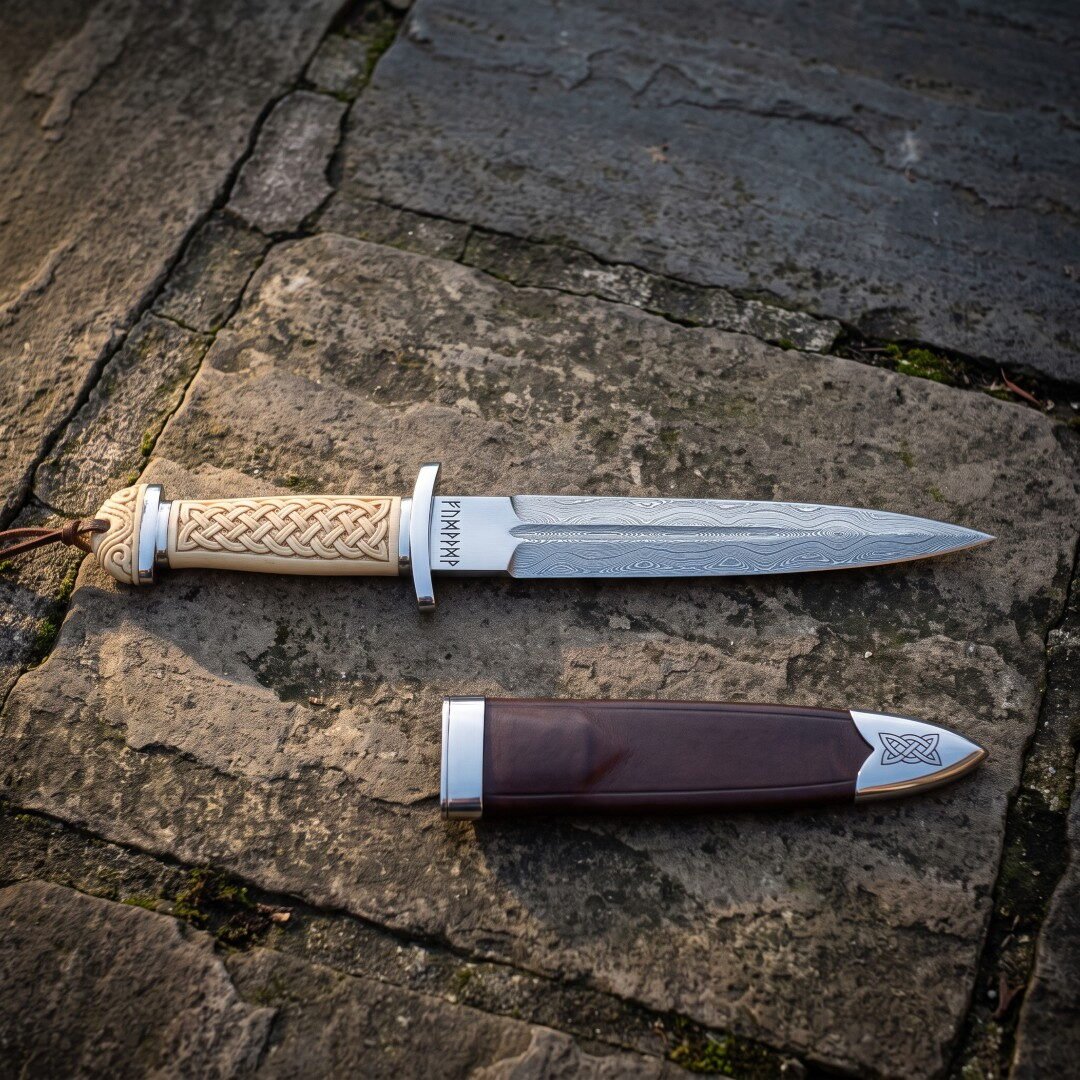
Tyr is the god who saw what needed doing, worked out what it would cost, and did it anyway. Everyone else at that meeting looked at their boots. He is also, on the linguistic evidence, probably the oldest god in the Norse pantheon and quite possibly the one who used to run it, which makes his near-total absence from the surviving stories one of the more frustrating gaps in the material.
This page covers what the sources say, what the language says, and what the two Roman-era inscriptions add. Where the evidence runs out, it says so.
The name is the biggest clue
Tyr goes back to Proto-Germanic Tiwaz, and Tiwaz goes back to the Proto-Indo-European root that also produced Zeus, Jupiter, and Sanskrit Dyaus. That root means sky, or day, or shining. It is the word for the chief god of the sky in every branch of the family that kept one.
In Old Norse the word tyr also functions as a common noun meaning god, and it appears in the plural tivar for gods generally. Odin collects it as part of his own names: Hangatyr, Sigtyr, Farmatyr. That is roughly what you would expect if a formerly dominant divine name had decayed into a job title that the newly dominant god then borrowed.
So the theory is straightforward. Tyr was once the head of the pantheon, an Indo-European sky father, and by the time anyone wrote anything down Odin had taken the position and Tyr was reduced to a specialist. It is a tidy theory and it is genuinely contested. The objection is that Tiwaz may have been an epithet rather than a personal name from the start, in which case the whole demoted-sky-father narrative is a modern reconstruction resting on very little. Both positions are held by serious people.
Tuesday, and Mars
When the Germanic-speaking peoples took over the Roman week they matched each day to whichever of their own gods best fitted the Roman one. Dies Martis, the day of Mars, became Tiwesdaeg in Old English and then Tuesday. Wednesday went to Woden, Thursday to Thunor, Friday to Frigg. The full set is discussed on the page for the Norse gods.
 Staveholm Hand Forged Damascus Viking Sword | 35 Inch Overall with 29 Inch Blade | Runic Arched Guard and Olive Leather Grip and Brown Scabbard | Norse Collector Gift | RK-2120
 Valkbraid Hand Forged Damascus Viking Sword with Valknut Lobed Pommel | Vegvisir Etched Blade | Brown Leather Grip and Steel Mounted Scabbard | Norse Collector Gift | RK-2054
 Slatestave Hand Made Engraved Pale Grey Rune Stone with Full Elder Futhark Row & Knotwork Arch | 10 Inch Standing Height | Solid Oak Display Base | Norse Home Decor Gift | RK-1705
So Tyr was the one they thought looked like Mars. That is a real piece of evidence about how he was understood, and it points at war rather than sky by that period.
It gets more specific. At Housesteads on Hadrian’s Wall, a third century altar set up by Frisian soldiers is dedicated to Mars Thingsus. Thing is the Germanic word for the assembly where law was made and disputes were settled, the same word behind the Icelandic Althing. Mars of the Assembly. That is a god of war attached to the legal gathering, which is a specific and unusual combination, and it fits a figure whose one famous story is about the binding force of a pledge.
The hand
The story everyone knows is in Snorri’s Gylfaginning, and it is the only place the full version survives.
The gods were raising Fenrir, Loki’s wolf son, in Asgard. Snorri gives one line that carries the whole characterisation: only Tyr had the courage to go and feed him. Not the wisest of the gods, not the strongest. The one who would walk up to it.
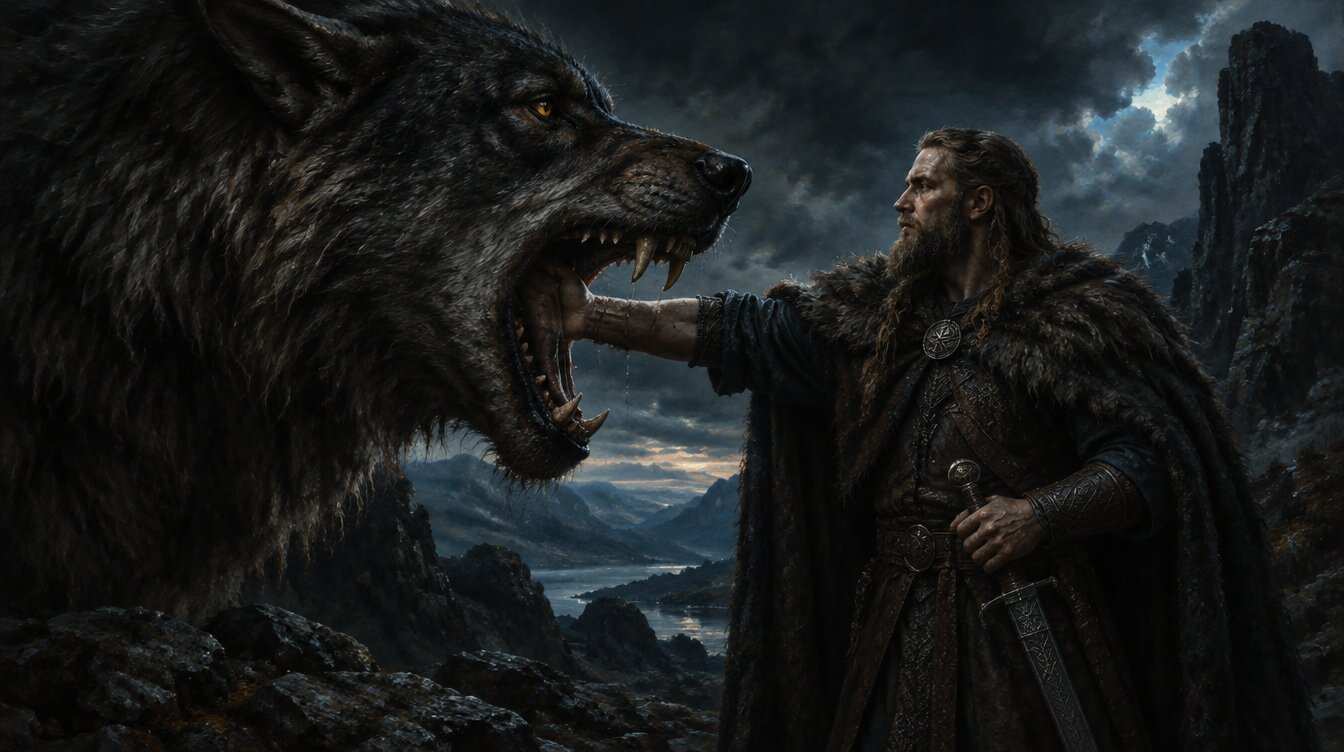
When the wolf grew and the gods decided to bind him, they tried twice with ordinary chains and failed twice. The third fetter, Gleipnir, was made by dwarves out of impossible materials and looked like a silk ribbon. Fenrir was not fooled. He would consent to be tested only if one of the gods put a hand in his mouth as a pledge that the thing would be untied again.
Nobody moved. Then Tyr put in his right hand. The fetter held, the wolf understood, and the hand came off at the joint that Old Norse calls the wolf-joint, which is the wrist. Snorri notes that all the gods laughed except Tyr, and that is the whole moral content of the episode: he kept a promise he had already decided to break, and paid for it, in front of an audience that found it funny. The wolf’s side of it is on the page for Fenrir.
This is not only Snorri. Lokasenna, an older poem, has Loki taunt Tyr about the missing hand in verse, so the story was in circulation before the Prose Edda gathered it up.
What Snorri says about his character
Gylfaginning describes him as the boldest and most courageous, and says he has great power over victory in battle, so that it is good for brave men to call on him. Then it adds a sharper line. A very brave man is called Tyr-brave, and a very wise man is called Tyr-wise, but Tyr is not called a reconciler of men.
Read that carefully. It is a compliment and a diagnosis at the same time. He is the one you want in a fight and the one who will not help you settle it. For a god associated with the legal assembly, that is a strange note, and it may be a fragment of something older that Snorri no longer understood.
The parentage problem
Snorri makes Tyr a son of Odin. The Poetic Edda poem Hymiskvida does not. In that poem Tyr goes with Thor to fetch a brewing cauldron from a giant called Hymir, and refers to Hymir as his father. His mother in the poem is a giantess with gold and a fair brow, living in the same hall.
Two possibilities. Either the tradition genuinely disagreed about where Tyr came from, or Snorri assimilated him into Odin’s family the way he assimilated a good deal else. There is no way to decide from what survives. It is a small thing that tells you something large, which is that the Norse pantheon was not a fixed structure with an agreed genealogy.
The rune
The Elder Futhark has a rune named after him, an upward arrow shape, usually transliterated t. Both the Old English and the Old Icelandic rune poems associate it with the god, and the Old English poem describes it as a guiding star that keeps faith well with princes and never fails on a journey.
Sigrdrifumal, in the Poetic Edda, contains the instruction that has done more for tattoo studios than any other line in the corpus: victory runes should be cut on the hilt of a sword, and Tyr named twice. It is one of the very few places where a source tells you to physically carve a specific god’s name on a specific object for a specific effect. The full rune row is set out on the page for the Elder Futhark.
Was he worshipped
Some, but not on the scale of Thor or Freyr. A handful of place names carry him, mostly in Denmark and Norway. Tyrseng, Tyr’s meadow. Tislund, his grove. Tysnes in Norway. At Viby in Denmark, excavation has found traces of ritual activity running over a very long period at a site whose name may carry his, though a long-used sacred place can serve more than one god.
Compared to the density of Thor place names across Scandinavia, this is thin. It supports the picture of a god who mattered once and mattered less later, without proving it. Who the Norse actually gave offerings to is set out on the page about the Aesir and Vanir.
Ragnarok
Snorri gives Tyr a poor end, or at least a mutual one. He fights Garm, the hound bound at the entrance to the world of the dead, and they kill each other. Voluspa is vaguer and does not name his opponent clearly, which has led some readers to suspect Garm and Fenrir were originally the same animal under two names. Either way, the god who lost a hand to one bound predator dies fighting another. Whoever shaped that had a sense of structure. The whole sequence is on the page for Ragnarok.
Carrying it
The Tyr rune is one of the few Norse marks with a genuine textual instruction attached to it, which makes it a better engraving choice than most of the shapes sold as Viking symbols. Ransack Viking is a US company in Chicago, Illinois. Pieces are handmade in the Czech Republic, then imported, inspected and shipped from Chicago, and engraving is cut here after arrival. Plain 1095 runs 54 to 58 HRC, Damascus of 1095 and 15N20 runs 58 to 60. US orders ship free and tracked with no import duty, and there is a lifetime warranty against defects. The relevant ranges are Viking swords, runestones and rune sets and engraved pieces. The rest of the writing is in the guides.
Questions people ask
Who is Tyr in Norse mythology?
A god of war, oaths and the legal assembly, best known for losing his right hand to the wolf Fenrir. He put the hand in the wolf’s mouth as a pledge while the gods bound him, knowing the pledge was false, and lost it when the trick was discovered. Snorri calls him the boldest of the gods and notes that he is not a reconciler of men.
Why did Tyr lose his hand?
Fenrir refused to be tested with the fetter Gleipnir unless a god guaranteed his release by placing a hand in his jaws. None of the others would do it. Tyr did, the fetter held, and the wolf bit the hand off at the wrist. The episode is told in full by Snorri and referred to in the older poem Lokasenna.
Was Tyr originally the chief Norse god?
Possibly. His name descends from the Proto-Indo-European sky father root that also gave Zeus and Jupiter, and in Old Norse the word tyr still functions as a common noun for a god. That pattern suggests a demotion. The counter-argument is that the name may always have been an epithet, in which case the demotion story is a modern reconstruction. It is genuinely unsettled.
Is Tuesday named after Tyr?
Yes. Old English Tiwesdaeg is the day of Tiw, the English form of the same god, assigned to the day the Romans gave to Mars. That equation with Mars also shows up on a third century altar at Housesteads on Hadrian’s Wall, dedicated by Frisian soldiers to Mars Thingsus, Mars of the assembly.
Is Tyr the son of Odin or of a giant?
The sources disagree. Snorri makes him Odin’s son. The poem Hymiskvida has him call the giant Hymir his father and describes his mother as a giantess in the same hall. There is no way to reconcile the two, and it is a useful reminder that the pantheon had no fixed and agreed genealogy.
What is the Tyr rune?
The Elder Futhark rune transliterated t, shaped like an upward pointing arrow, named for the god. The Old English rune poem calls it a guiding star that keeps faith well and never fails on a journey. Sigrdrifumal instructs that victory runes be cut on a sword hilt with Tyr named twice, which is a rare specific ritual instruction in the surviving material.
How does Tyr die at Ragnarok?
Snorri has him fight Garm, the hound bound at the entrance to the world of the dead, and says they kill each other. Voluspa is less clear about who fights whom, and some readers have suspected that Garm and Fenrir were once the same creature under two names.
Was Tyr widely worshipped?
Less than Thor or Freyr, on the evidence of place names. A scattering of sites in Denmark and Norway carry his name, including Tyrseng and Tislund, and a long-used ritual site at Viby in Denmark may be his. Against the density of Thor place names across Scandinavia this is thin, and it fits a god whose importance had faded before the Viking Age.
If you are buying
Carried in the shop, the Runetooth rune sword and the Runeglint Viking sword. The Wolfmark Seax knife and the Runebite bearded axe sit with them.
Shop the range
Staveholm Hand Forged Damascus Viking Sword | 35 Inch Overall with 29 Inch Blade | Runic Arched Guard and Olive Leather Grip and Brown Scabbard | Norse Collector Gift | RK-2120Valkbraid Hand Forged Damascus Viking Sword with Valknut Lobed Pommel | Vegvisir Etched Blade | Brown Leather Grip and Steel Mounted Scabbard | Norse Collector Gift | RK-2054Slatestave Hand Made Engraved Pale Grey Rune Stone with Full Elder Futhark Row & Knotwork Arch | 10 Inch Standing Height | Solid Oak Display Base | Norse Home Decor Gift | RK-1705 Stonecast Hand Made Elder Futhark Rune Set | 24 Engraved Casting Stones | Tumbled Stone with Tan Leather Drawstring Pouch | Norse Divination Gift | RK-1780
 Ropewind Hand Made Norse Rune Ring with Twisted Rope Borders & Elder Futhark Centre Band | 9mm Wide | Groomsmen Gift | RK-1604
 Everrune Hand Made Viking Rune Ring with Elder Futhark Band & Bevelled Polished Edges | 6mm Wide | Norse Wedding Gift | RK-1603