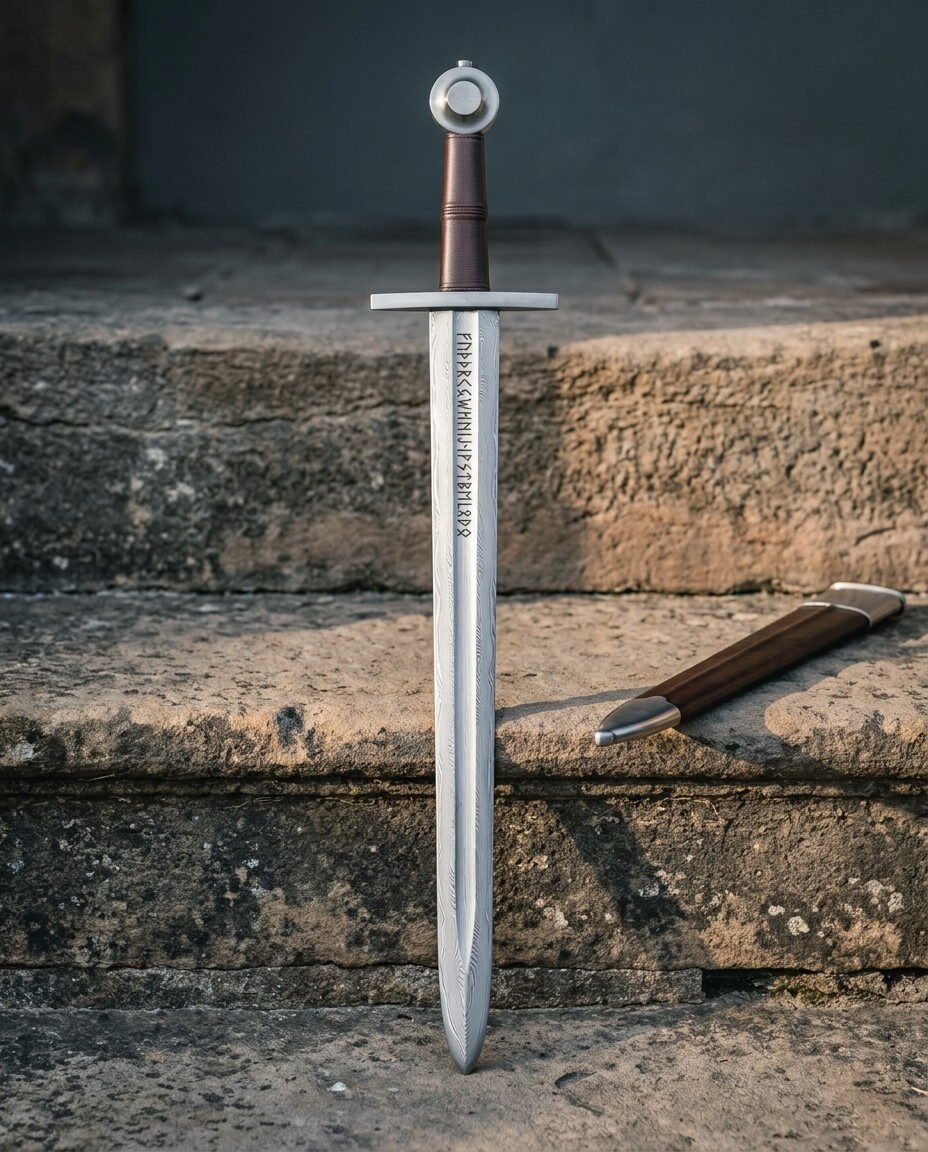
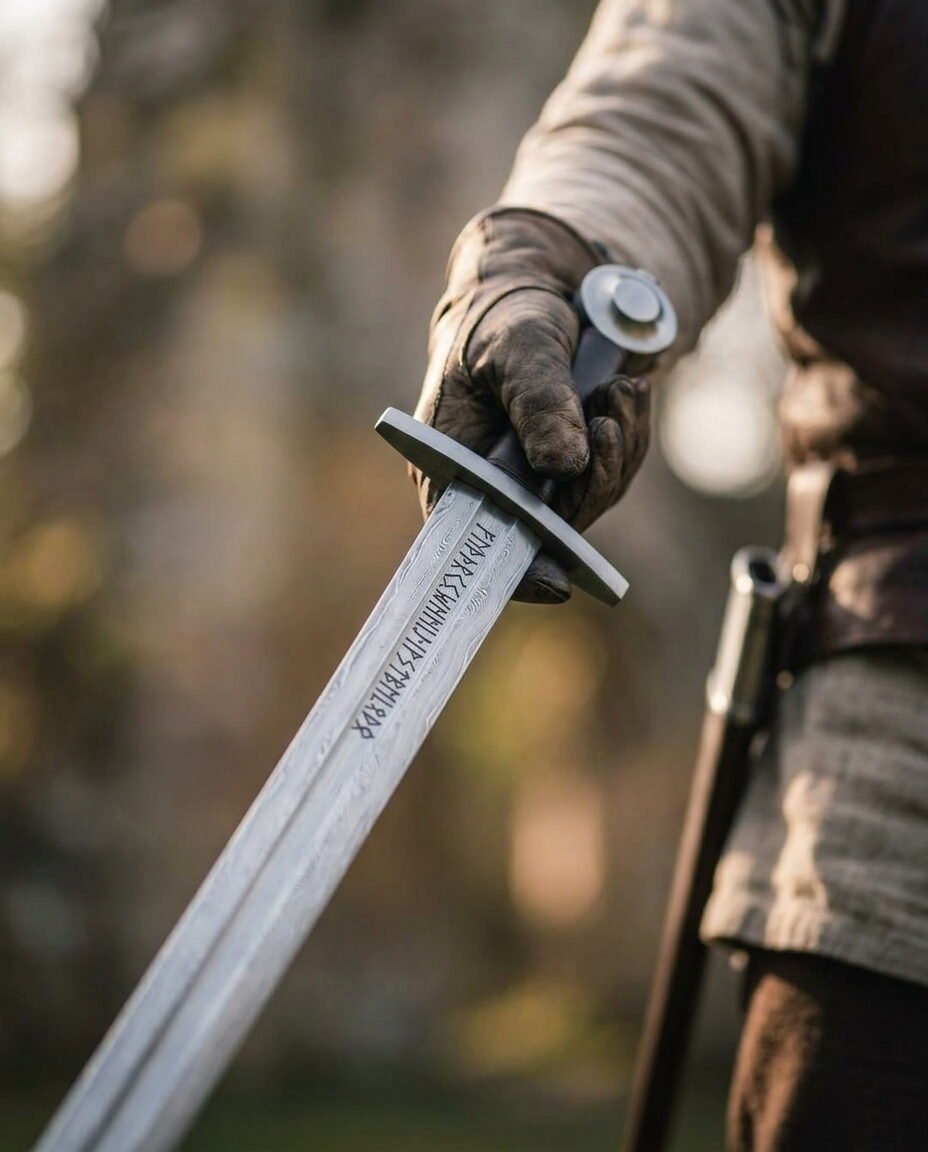
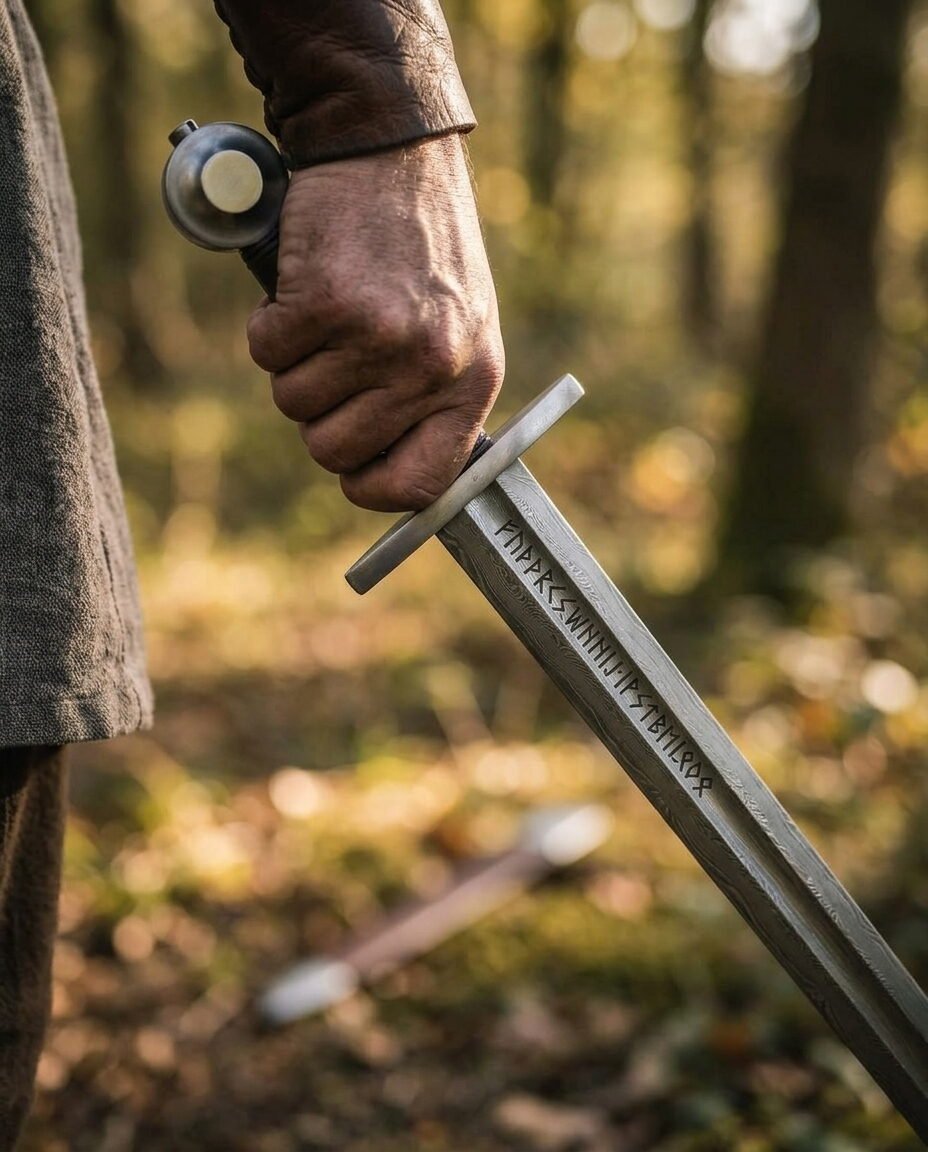
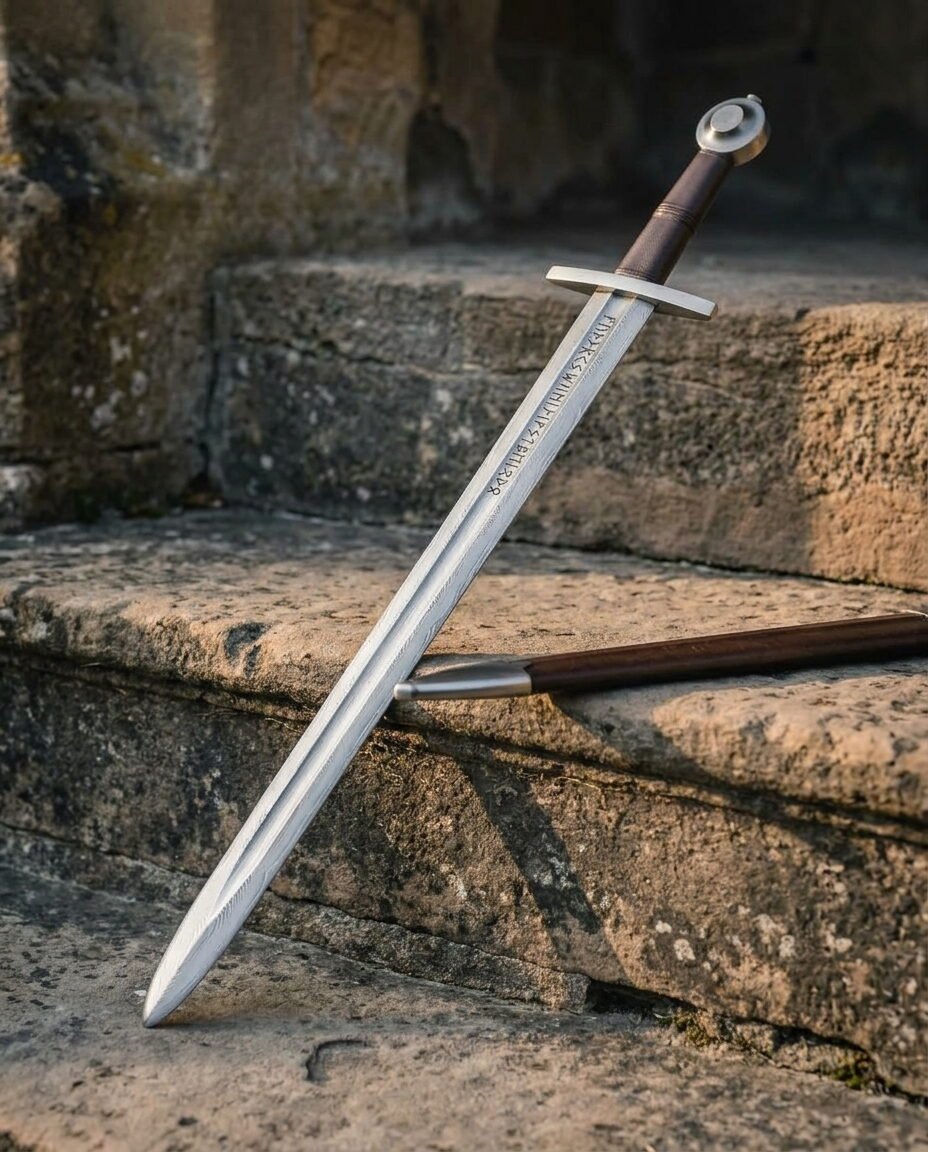
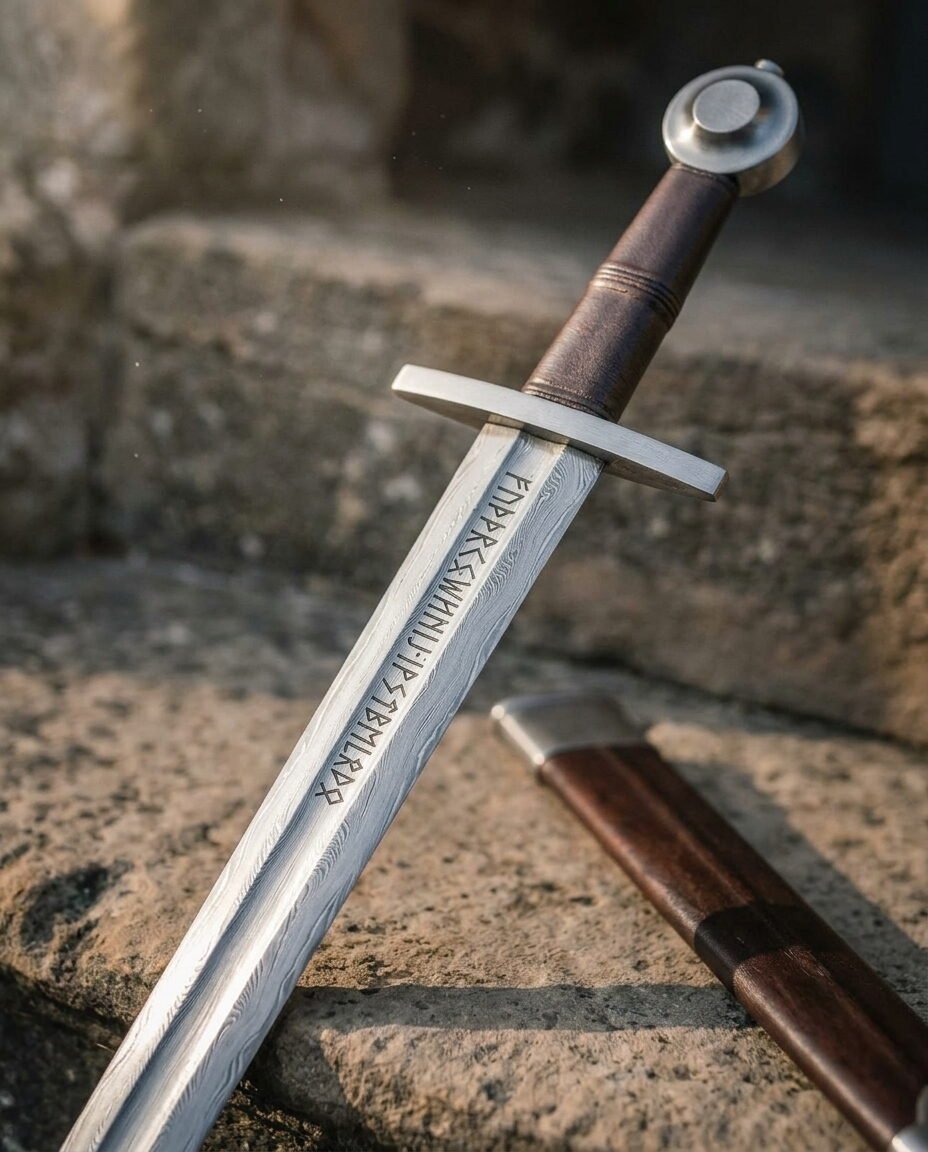
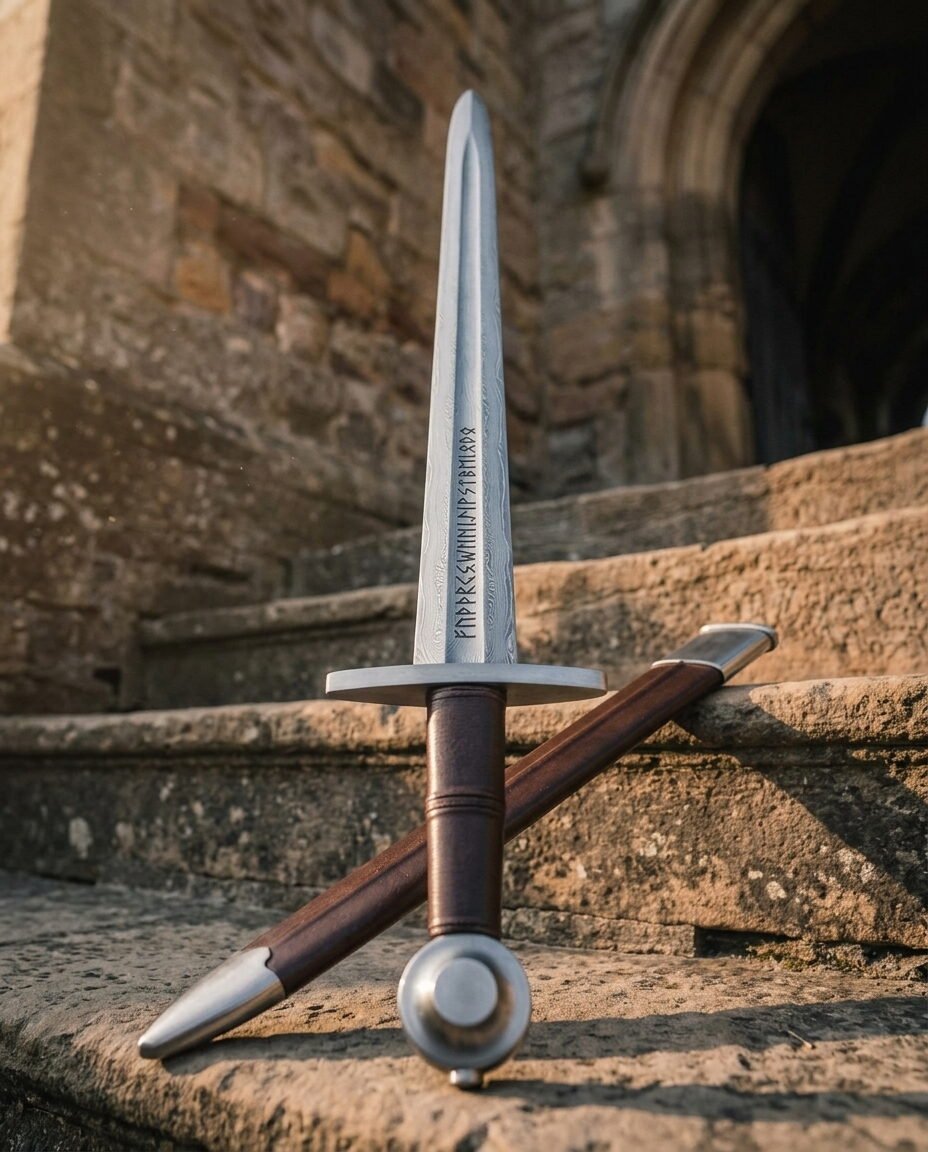
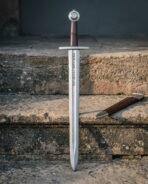
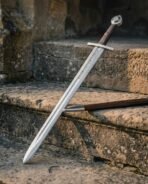
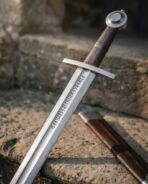
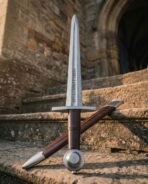
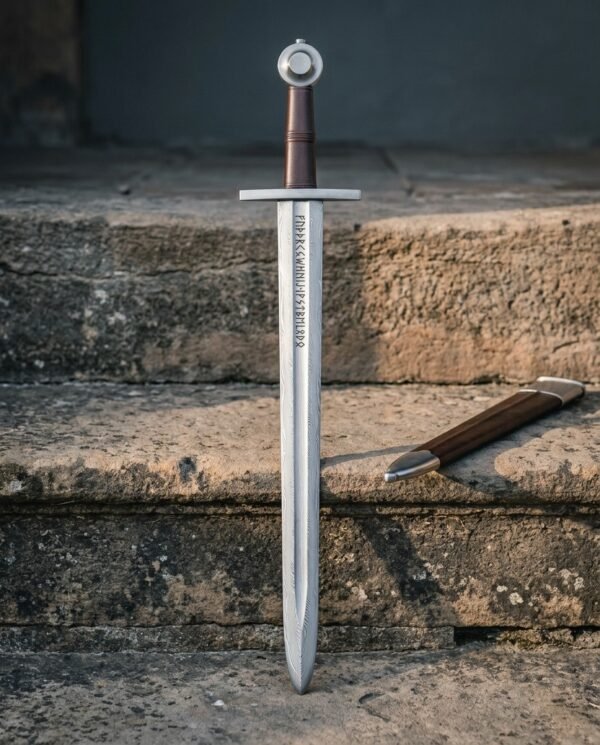
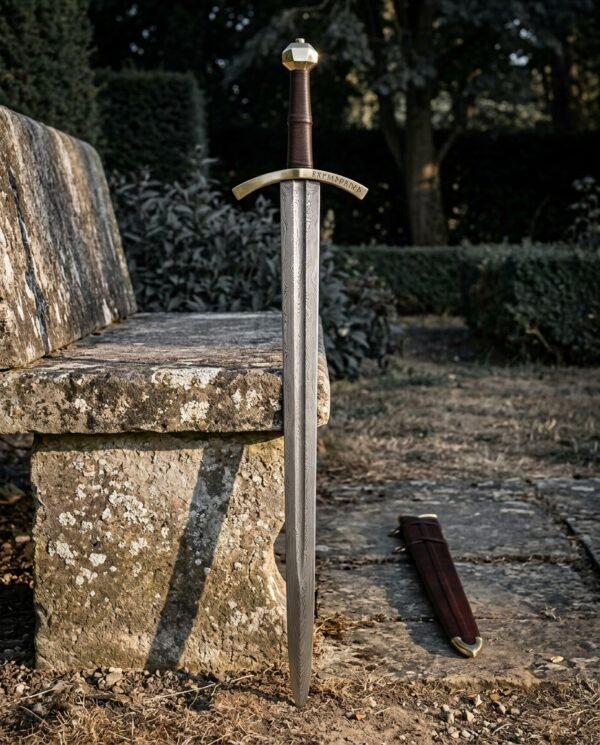
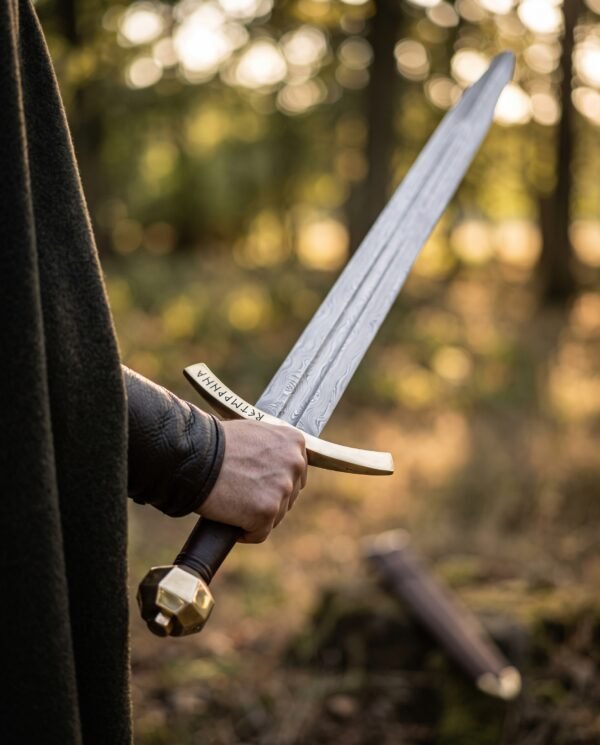
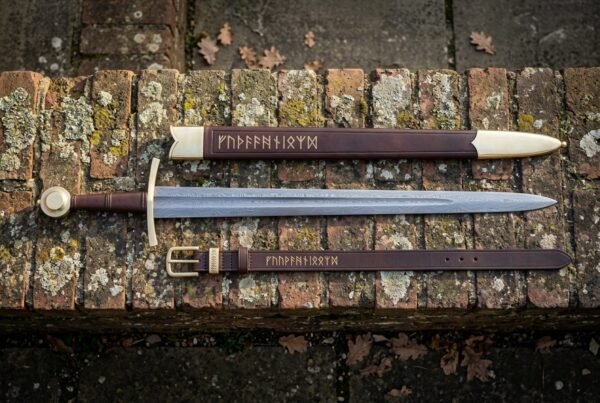
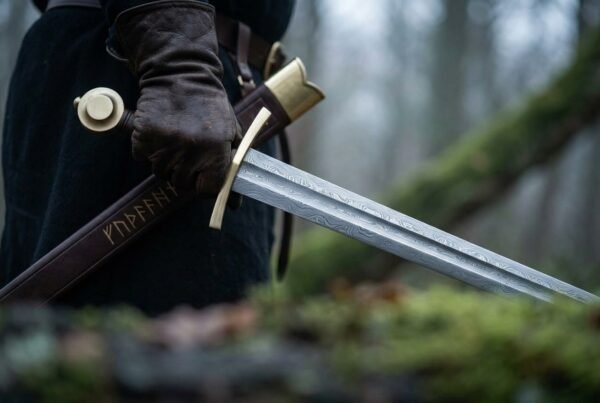
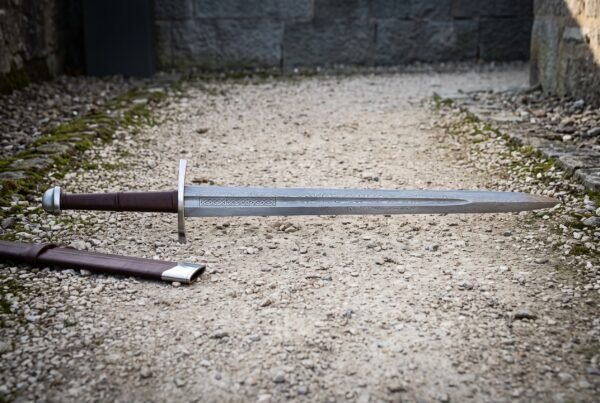
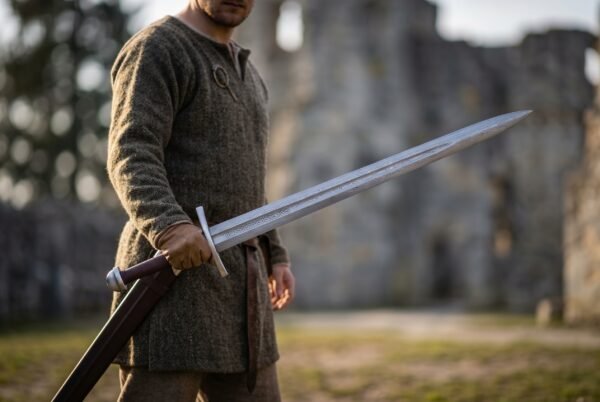
The Runeglint is a broad single hand sword in Damascus steel, cut with a line of Elder Futhark runes across the upper blade, hung on a plain steel crossguard with a leather wrapped grip and a heavy wheel pommel. The blade is wide at the shoulder and tapers gently to a point, which is the profile of a sword built mainly to cut rather than to punch through plate.
Inscribed blades are not a modern invention. Between roughly 850 and 1050 a workshop somewhere in the Rhineland stamped the name Ulfberht into the fullers of a couple of hundred swords, and archaeologists have since pulled them out of rivers and graves from Ireland to Russia. Some carry the name in iron inlay, some carry crosses and geometric marks, and a fair number are forgeries with the letters spelled wrong, which tells you the name was worth counterfeiting. A sword with something written on it was a sword worth remembering. Ours is forged and finished in the Czech Republic from 1095 and 15N20 Damascus, and it ships in a timber scabbard with steel mounts. Kept with the Damascus swords, and worth setting against the Damascus knives before you decide.
Specifications
| Material | 1095 and 15N20 Damascus blade, steel guard and pommel, leather over timber grip |
|---|
| Hardness | 58 to 60 HRC |
|---|
| Overall length | Approximately 36 in / 91 cm |
|---|
| Blade length | Approximately 29 in / 74 cm |
|---|
| Blade profile | Broad double edged blade with a gentle taper to a point |
|---|
| Engraving | Elder Futhark rune row cut along the upper third of the blade |
|---|
| Guard | Straight steel crossguard, squared ends |
|---|
| Grip | Dark brown leather over timber with raised cord risers |
|---|
| Pommel | Steel wheel pommel with a raised central boss |
|---|
| Scabbard | Brown timber scabbard with a steel throat and steel chape |
|---|
| SKU | RK-1673 |
|---|
What the runes on the blade actually say
The line cut across this blade is the Elder Futhark, the oldest runic alphabet, in its traditional order. It runs fehu, uruz, thurisaz, ansuz, raido, kaunan and on through twenty four characters, and the name Futhark comes from the sound of the first six of them, the same way alphabet comes from alpha and beta. It was in use across Germanic Europe from roughly the second century to the eighth, before the Norse cut it down to the sixteen character Younger Futhark that the Viking Age actually wrote in.
The shapes are angular for a practical reason. Runes were cut, not written. A carver working across the grain of wood or into bone or metal wants straight strokes and diagonals, because a curve either follows the grain and disappears or splits it. That is why there is no rounded rune in the whole row, and it is why a rune line reads cleanly when it is cut into a sword blade rather than smudging the way a script letter would.
Each character also carried a name and a meaning, which is why runes turn up on amulets and grave markers as well as in plain writing. Fehu is cattle and by extension wealth, uruz is the aurochs and raw strength, thurisaz is the giant or the thorn, ansuz is the god or the mouth that speaks. If you want your own name or a date on the blade instead of the full row, the rune converter on this page will set it for you.
The steel
The blade is 1095 and 15N20 forge welded into a billet, then drawn out, folded and welded again until the layer count is up where it needs to be. 1095 is a simple high carbon steel that etches dark. 15N20 carries about two percent nickel and resists the acid, so it stays bright. Etch the finished blade and every weld line between the two shows up as a stripe. The pattern you see is a record of the forging, and it goes all the way through the steel rather than sitting on the surface.
After forging, the blade is normalised, quenched and tempered to 58 to 60 HRC. That range is the useful compromise for a sword this size. Harder and a long blade gets brittle in a way that matters when the tip flexes. Softer and the edge rolls. Damascus is not stainless and it will spot if it is handled and put away wet, so keep a rag and a little oil near wherever you store it.
The guard and the wheel pommel are steel, peened over the tang rather than glued or screwed, and the grip is leather over a shaped timber core with cord risers underneath to stop the hand sliding. The scabbard follows the historical pattern for a Viking Age sword, a timber core shaped to the blade and dressed with a steel throat and a steel chape at the tip.
Engraving, runes and your own design
Use the rune converter on this page to turn a name, a date or a short phrase into Elder Futhark and we will cut it into the steel, the leather or the wood. If you would rather have a Viking pattern than a rune line, choose your own design in the engraving option above the add to cart button and tell us where it goes. Where a piece already carries an engraved design, your chosen engraving replaces it rather than sitting alongside it. On this sword that means your rune line or your pattern takes the place of the Futhark row shown in the photograph. Full details are on the engraving page.
Handling and balance
This is a single hand sword and it is meant to be swung with the shoulder and the wrist rather than muscled with both arms. The wheel pommel sits behind the hand and does most of the balancing work, pulling the point of balance back toward the guard so the sword feels lighter in the tip than its blade width suggests.
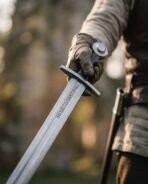
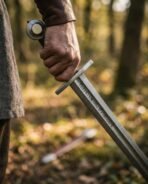
Grip it with the heel of the hand against the underside of the pommel, not choked up on the guard. That is the historically correct hold and it gives you the leverage to stop a cut and bring the edge back on line. The broad blade tells you what this profile was for. It is mainly a cutting sword, built to open a target with the edge rather than to find a gap in armour.
It arrives sharp. Treat it as a display and collecting piece and as a light cutting sword on soft targets. It is not built for edge to edge sparring against another blade and we do not sell it for that.
Care
Wipe the blade after handling and put a thin film of oil on the steel before it goes away. Damascus takes fingerprints and shows them as grey shadows a week later, so a soft cloth and a light mineral oil are worth keeping with the sword. The rune cuts hold oil and dust, so work a cloth along them rather than across.
If a rust spot appears, lift it with oil and a fine synthetic pad, moving along the pattern rather than across it, and re-oil afterwards. The timber scabbard wants nothing more than a dry cloth and the occasional wipe of furniture oil, and it should not be stored damp with the blade inside. Keep the leather grip out of long sun and feed it with a leather balm once a year. Our full notes are in steel care.
Made in the Czech Republic
This piece is made by hand in the Czech Republic, in a workshop that still works the old way. The steel is forged, ground, heat treated and finished by smiths who learned the trade from the people before them, and the wood, horn and leather are cut and fitted by hand rather than pressed out on a line. That is also why no two pieces come out exactly the same.
Ransack Viking is a United States company. We import these pieces ourselves, check every one when it lands and ship from our warehouse in Chicago, Illinois. Engraving is done here in the United States after the piece arrives, so your runes or your own design go on before it leaves for you.
A note on handmade variation
This sword is hand made rather than machine made or bulk produced, so what arrives will not be a pixel for pixel copy of the photograph. No two Damascus billets fold the same way, so the pattern on your blade will run differently. The hammer texture, the exact depth of the etch, the tone of the leather on the grip and the grain of the scabbard timber all vary because they are worked by hand from natural materials. The dimensions, the steel, the hardness and the build are the same every time. The character is not. We wrote up what Damascus steel actually is separately, and there is a piece on keeping Damascus from staining as well.
Frequently asked questions
Is the blade sharp when it arrives
Yes, it comes with a working edge on both sides. It is a sharp sword and should be stored and handled as one.
Can I choose what the runes say
Yes. Use the rune converter on this page for a name, a date or a short phrase. Your chosen line replaces the Futhark row rather than sitting next to it.
Is this a battle ready sparring sword
No. It is sharp and it is not built for edge to edge contact against another blade. It is a display, collecting and light cutting sword.
Is the Damascus pattern etched on the surface
No. The pattern is the layered structure of the steel itself, revealed by an acid etch. Grinding into the blade would show the same layers continuing.
Does it come with a scabbard and a belt
The timber scabbard with its steel mounts is included. A sword belt or baldric is not.
How long before it ships
One to two weeks of processing, then free shipping inside the United States. Add a little at the longer end if you have ordered a custom engraving.
What is in the box
- Runeglint Damascus sword, 1095 and 15N20 at 58 to 60 HRC
- Elder Futhark rune row cut into the blade
- Fitted timber scabbard with steel throat and chape
- Care card for Damascus steel, timber and leather
- Lifetime warranty against defects in forging, grind, heat treat and fittings
- Forged and finished in the Czech Republic
Explore the range
See more in damascus swords, arming swords, viking swords and Norse arms, or read the guides.
Other pieces in this group
Closest to this in the range is the Pathstave arming sword, 35 inches overall. If this one is not quite right, there is the Fellwhorl arming sword, 36 inches overall. Also in this group is the Trineholt arming sword, 36 inches overall.
If you are putting a set together, the Ravenmark Viking sword sits alongside it. Nothing here exactly right, build one to your own spec on the custom Viking sword page.
If you want to spar rather than display, the Haldvane blunt arming sword is the blunt trainer built for it, and our HEMA arming swords is worth a look.

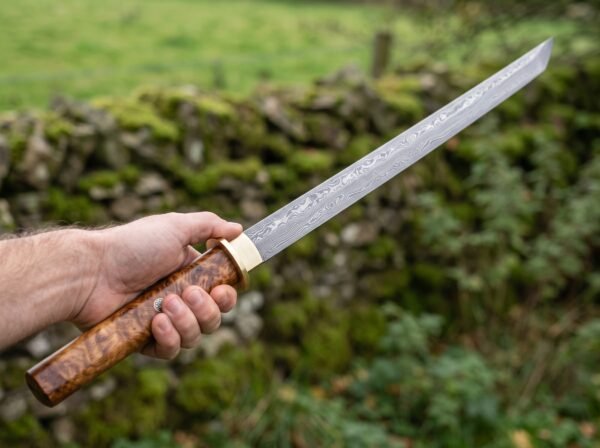
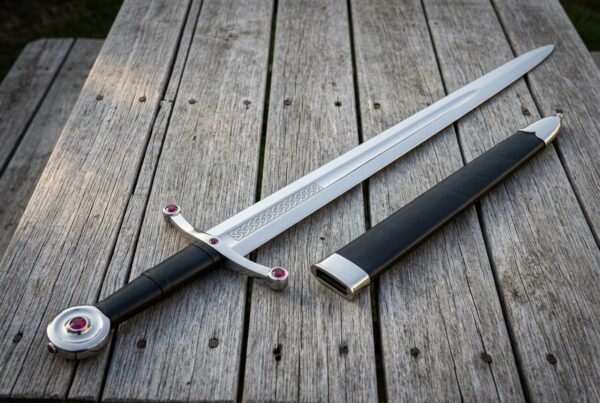

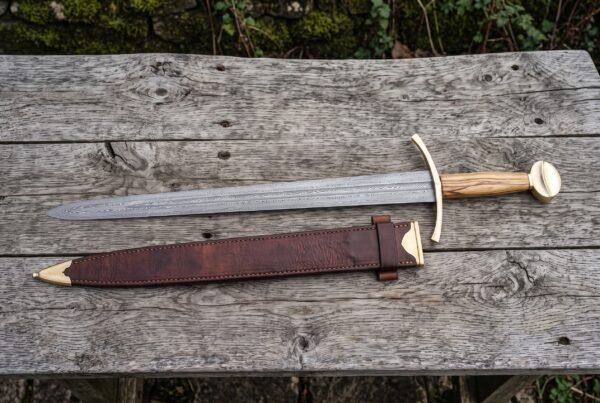
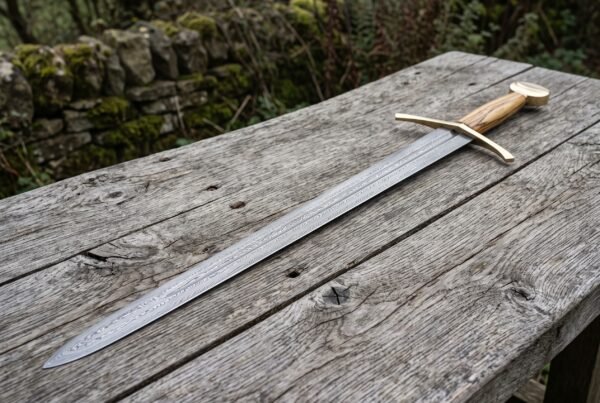
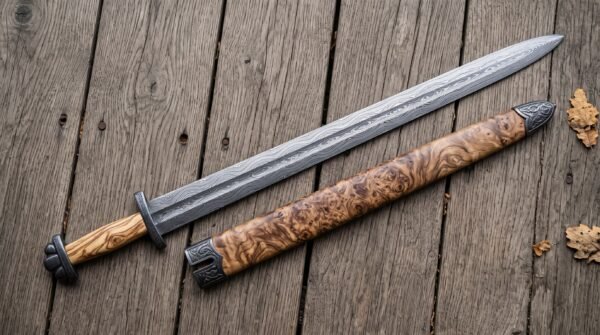
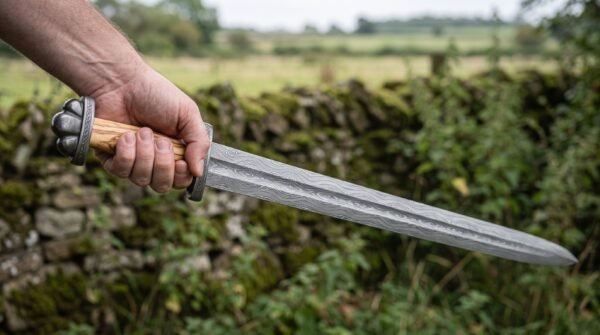
Turned out better than I expected going in. Wood handle looks great though it’s a little smaller than I imagined. Blade quality is solid. Arrived a bit less sharp than expected but a few passes on a strop fixed it. Minor nitpicks aside, good quality piece.
No regrets on this purchase at all. Edge retention has been great even after regular use. Love it.
No regrets on this purchase at all. Nice touch that it ships from within the US even though it’s crafted in the Czech Republic. Damascus blade holds a razor edge right out of the box. Will definitely order again for another gift.
Did not expect this level of quality for the price. Damascus blade holds a razor edge right out of the box. Came in a nice gift box which made it feel even more special. This shop clearly takes pride in their work.
Got this as a birthday gift and the reaction was priceless. The wood handle feels amazing and the balance is perfect. Came in a nice gift box which made it feel even more special. Edge retention has been great even after regular use. Couldn’t be happier with this.
This is exactly what I wanted and then some. The wood handle feels amazing and the balance is perfect. Can’t recommend this enough.
Did not expect this level of quality for the price. Weight and balance make it feel like a real functional piece not some cheap replica. The wood handle feels amazing and the balance is perfect. Great buy overall.
Absolutely blown away by this sword. This shop clearly takes pride in their work.
Average quality for the price honestly. Might work for casual use or display.
Feels way more premium than the price suggests. The wood handle feels amazing and the balance is perfect. Came in a nice gift box which made it feel even more special. 10/10 would buy again.