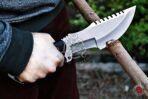
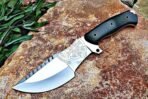
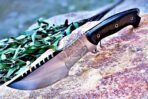
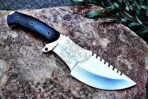
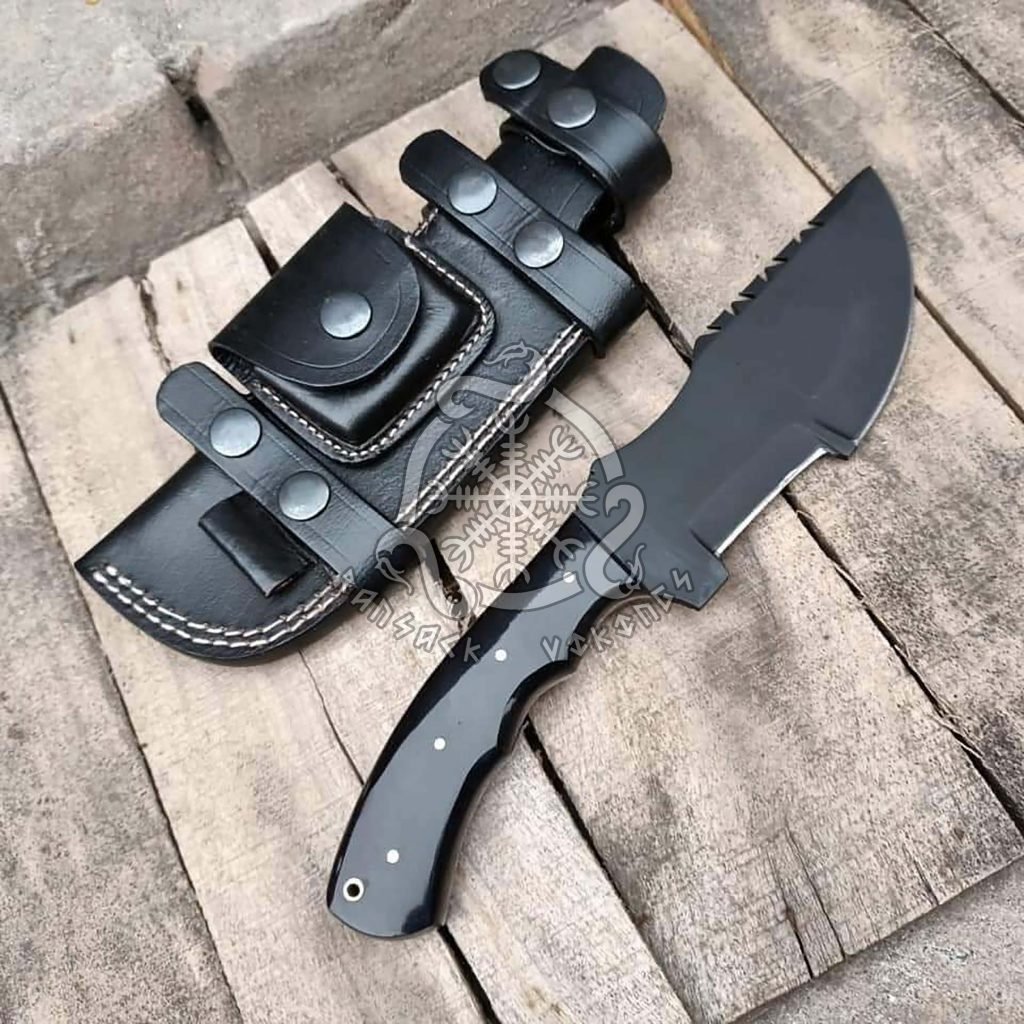
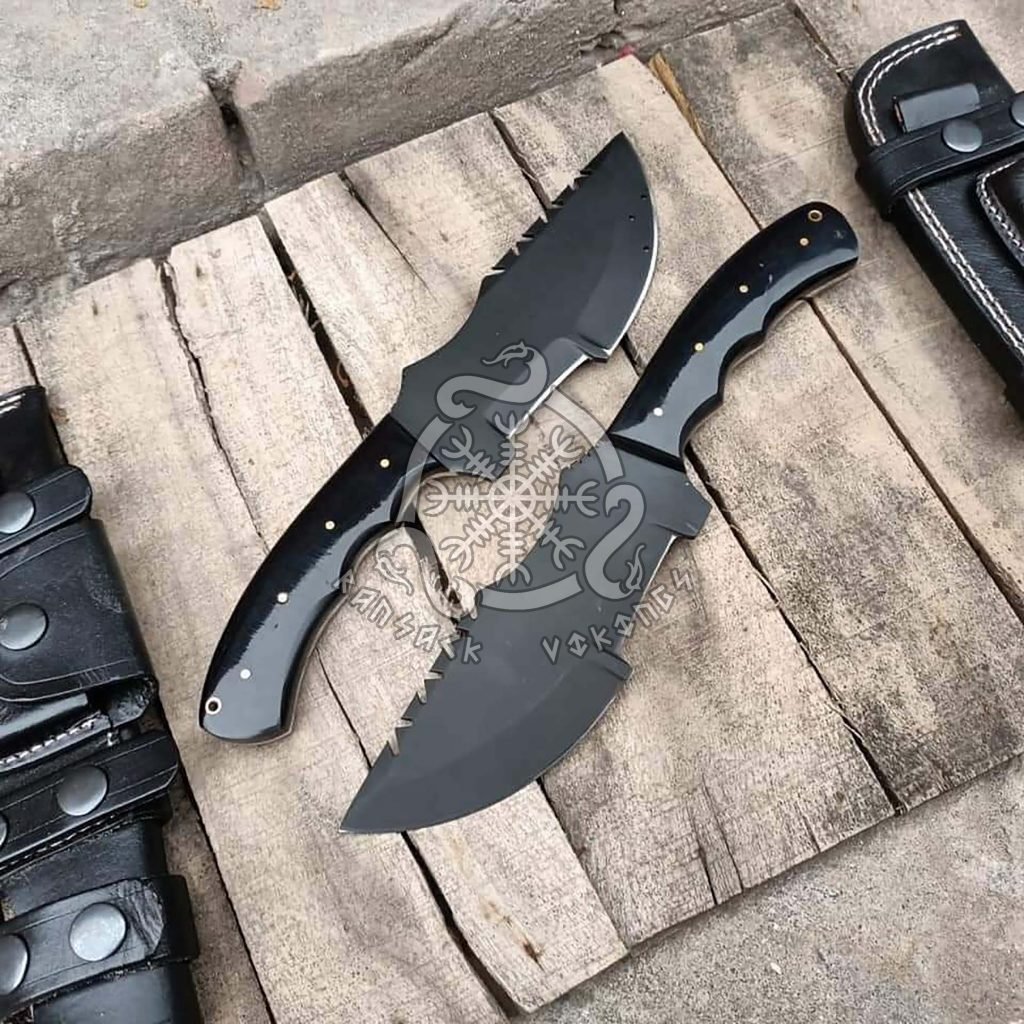
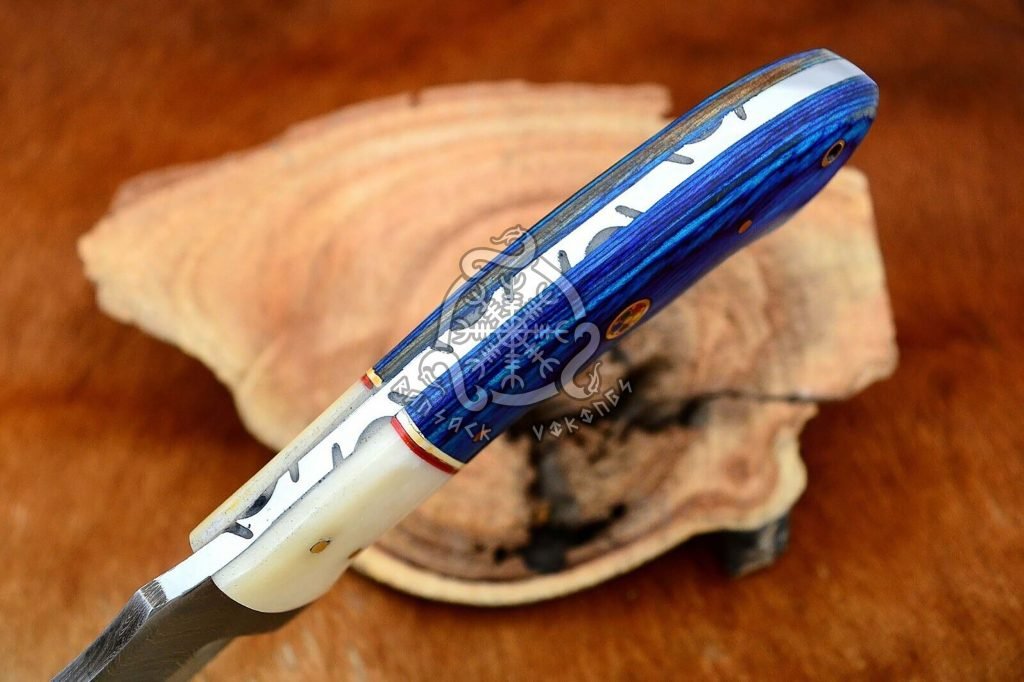
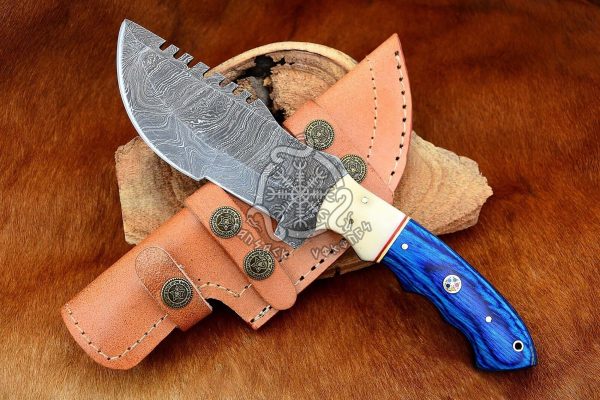
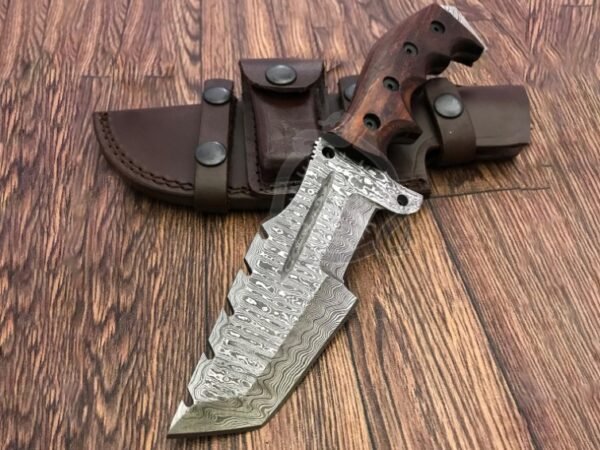
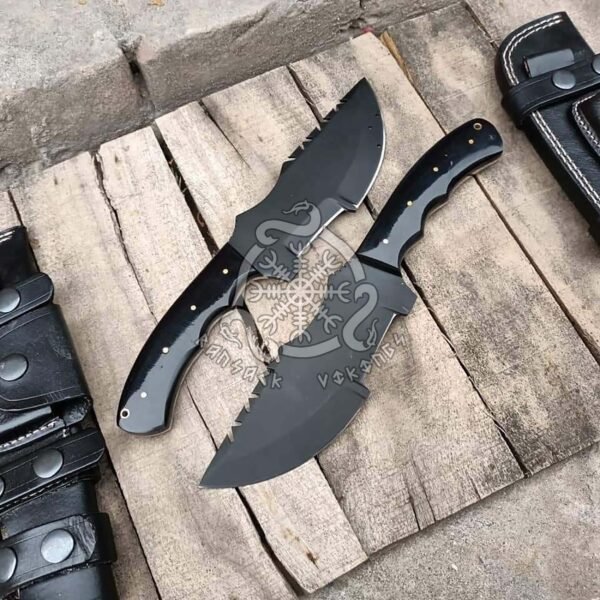
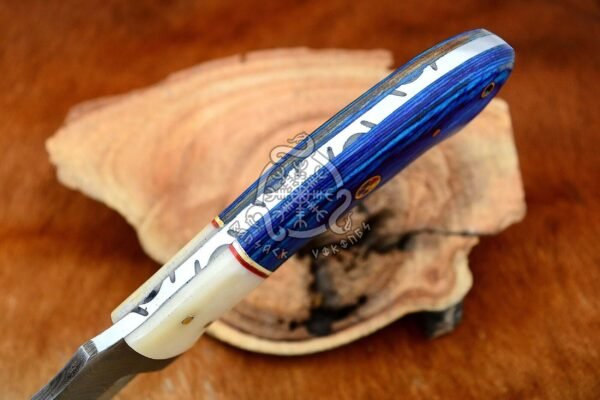
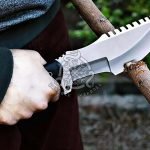
Every Trackerfell is forged, ground and finished by hand. The blade is D2 tool steel with a saw spine, the handle is micarta, and the two are fitted so the knife sits balanced in the palm. It runs 12 inches overall with a 7 inch blade and a 5 inch handle, which makes it the biggest tracker we build and the one that does the most work per swing. Why the tang running the full length matters is explained in full tang against partial tang.
The tracker is the only common blade pattern that was designed backwards. Most knives start from a job and evolve a shape. This one started from a constraint, which was that a person genuinely out in the woods carries one tool and not three, and the profile was then assembled out of whatever it takes to chop, carve and notch on a single piece of steel. That is why it looks odd from the side and why every part of it makes sense the moment you use it. Nothing on the blade is styling.
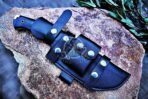
The Trackerfell is forged and finished in the Czech Republic, and ships with a fitted leather sheath, free inside the United States.
Specifications
| Steel | D2 tool steel |
|---|
| Hardness | 58 to 60 HRC |
|---|
| Blade shape | Tracker profile with saw spine |
|---|
| Overall length | 12 inches |
|---|
| Blade length | 7 inches |
|---|
| Handle length | 5 inches |
|---|
| Handle | Micarta |
|---|
| Sheath | Leather sheath |
|---|
| SKU | RK-586 |
|---|
How to actually use the saw spine
More trackers get returned to the shelf over the saw than over anything else, and it is almost always because the owner tried to cut a branch in half with it. It will not do that well, and no short saw with fourteen teeth ever has. What the spine is genuinely built for is notching, and notching is most of the joinery that ever gets done in a camp.
The method is worth learning because it takes about thirty seconds. Lay the stick on a solid surface, run the teeth across it at a shallow angle and cut a kerf about a third of the way through. Move along a finger width and cut a second kerf at an angle so the two meet. Then twist the waste out with the tip of the blade or snap it with your thumb. What you have is a clean square notch, and notches are what hold a camp together: pot hangers, tent pegs, trap triggers, a figure four deadfall, a pot crane, a spindle socket for a bow drill. Once you have made a dozen of them you stop thinking of the spine as a saw at all.
The other section that gets misread is the concave sweep between the chopping belly and the point. Held with the edge facing you and the handle braced against your thigh, drawn toward you, it works as a short spokeshave. It is the fastest way to strip bark, round a spindle or take the corners off a stake, and it is far more controllable than trying to do the same job with a straight edge.
The honest weaknesses of the pattern are worth stating too. A tracker is heavy for its length, it is a poor slicer compared with a plain drop point of the same size, and the saw spine makes it awkward to sheath and awkward to baton. You buy it because it does several jobs adequately rather than one job beautifully.
Why D2 and not stainless
The blade is D2, a high chromium tool steel that sits between carbon and stainless. It carries around one and a half percent carbon and around twelve percent chromium, and that chromium figure is just below the roughly thirteen percent usually needed to call a steel stainless, which is why semi stainless is the accurate description.
The chromium locks up with carbon into large hard carbides, and those carbides are what make D2 wear so slowly. Hardened to 58 to 60 HRC, it holds a working edge through far more cutting than plain carbon steel, and it resists rust much better, both of which matter on a knife that lives in a damp pack and does not get cleaned every night.
What you give up is honest and worth knowing before you buy. D2 takes real patience on a stone, because the carbides that resist wear also resist abrasive, and a diamond plate is worth owning if you keep one of these. It does not refine to a razor as cleanly as a simple carbon steel, and pushed to a very thin edge it can microchip rather than roll, so it wants a slightly more obtuse bevel. And it is not stainless: neglect it in salt or standing water and it will spot. A true stainless would rust less and dull faster, which on a chopping and notching knife is the wrong trade. The full picture is in D2 steel for knives, and the wider comparison in Damascus versus stainless.
Micarta, and why it is on this knife
Micarta is the material you choose when the piece will get wet, dirty and used. It is made by soaking layers of linen or canvas in phenolic resin and curing them under heat and pressure into a solid block, which is then cut and ground like any other handle material. The result is completely inert. It does not swell, crack, rot or shrink, it is unaffected by temperature and humidity, and it will not be damaged by anything you are likely to spill on it.
The property that makes it worth having on a tracker specifically is what happens when it gets wet. Ground rather than polished, micarta has a slightly fibrous surface where the cloth layers meet the resin, and that texture actually grips better with damp hands than smooth timber does. On a knife that gets swung, that matters. It is also the only handle material in the range that needs no maintenance whatsoever. Wash it with soap and water and put it away. Do not oil it, because there is nothing in it for the oil to feed.
The trade against natural material is warmth and character. Micarta stays colder in the hand than horn or timber and it will never develop the depth that a natural handle picks up over years. It is chosen here for function rather than looks.
Engraving, runes and your own design
Use the rune converter on this page to turn a name, a date or a short phrase into Elder Futhark and we will cut it into the steel or the handle. If you would rather have a Viking pattern than a rune line, choose your own design in the engraving option above the add to cart button and tell us whether it goes on the blade or the handle. Where a piece already carries an engraved design, your chosen engraving replaces it rather than sitting alongside it. On this knife the broad flat between the saw teeth and the edge is the best surface in the catalogue for a long inscription, and D2 holds a cut line crisply because of its hardness. Micarta can also be engraved, and the cut shows pale against a dark block. See the engraving page.
Care and sharpening
D2 is semi stainless, so it tolerates damp better than carbon steel, but a light oil before storage is still sensible and the knife should not live permanently in the sheath. Vegetable tanned leather holds moisture and mild acid against a blade, and sheath care is its own subject, covered in leather sheath care.
Sharpening a tracker is two jobs and a third. Use a coarse stone or a diamond plate to reset, work the chopping belly at a slightly steeper angle than the straight carving section, blend where they meet, and finish fine. The saw teeth never touch a stone: if they dull after years, a small triangular file run down each gullet restores them. Method in steel care and sharpening with a whetstone.
Made in the Czech Republic
This piece is made by hand in the Czech Republic, in a workshop that still works the old way. The steel is forged, ground, heat treated and finished by smiths who learned the trade from the people before them, and the wood, horn and leather are cut and fitted by hand rather than pressed out on a line. That is also why no two pieces come out exactly the same.
Ransack Viking is a United States company. We import these pieces ourselves, check every one when it lands and ship from our warehouse in Memphis, Tennessee. Engraving is done here in the United States after the piece arrives, so your runes or your own design go on before it leaves for you.
A note on handmade variation
The Trackerfell is hand forged. It is not machine made and it is not bulk produced, so what arrives will not be a pixel for pixel copy of the photograph. The micarta figures differently as it is ground, the saw teeth are cut by hand and no two rows are spaced identically, and the sweep of the belly and the concave section shift by fractions because a person ground them. The dimensions, the steel and the build are the same every time. The character is not.
Frequently asked questions
Is it full tang
Yes. The tang runs the full length of the handle with the micarta fitted to it, which is the only construction worth having behind a chopping edge.
Does micarta need oiling like a wooden handle
No. It is resin bonded cloth and it is completely inert. Soap and water is the whole routine, and oil does nothing for it.
How is this different from the Damascus trackers in the range
Same geometry, different steel. Damascus is high carbon and takes a finer edge with a visible pattern. D2 holds its edge longer and rusts less, and it is slower to sharpen.
Can the saw teeth be resharpened
Yes, with a small triangular file worked down each gullet. Never on a bench stone, which will just flatten them.
Is a 7 inch tracker too big for everyday camp use
For chopping and notching it is the right size, and it is the version most people keep. For food preparation and fine carving a smaller knife alongside it is worth the extra few ounces.
Will it arrive sharp
Yes. The cutting edge is set and honed before packing. The saw spine is deliberately left as teeth rather than as a sharpened edge.
What is in the box
- One Trackerfell D2 steel tracker knife
- Fitted leather sheath
- Protective packaging
- Forged and finished in the Czech Republic
Explore the range
Compare it with the rest of Tracker Knives, the field blades in Hunting Knives, the chopping tools in Camping Axes and Hatchets and the Norse pieces in Viking Knives. Background on steel and handle materials is in the guides.












Reviews
There are no reviews yet