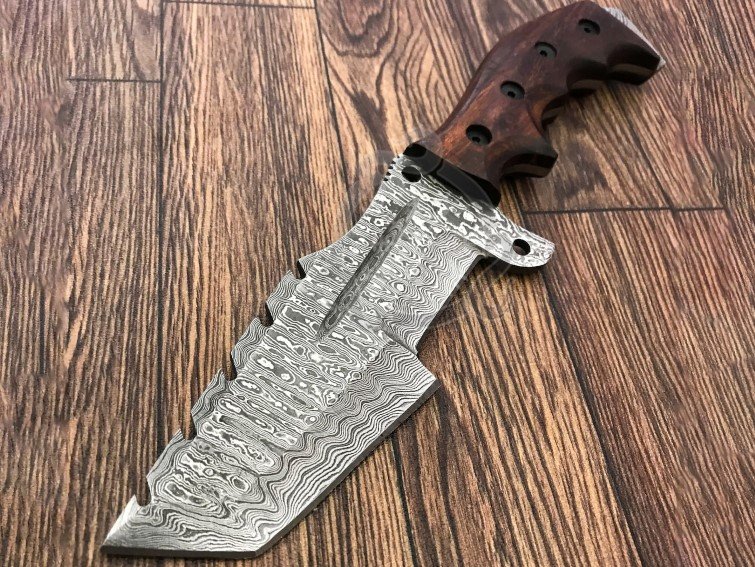
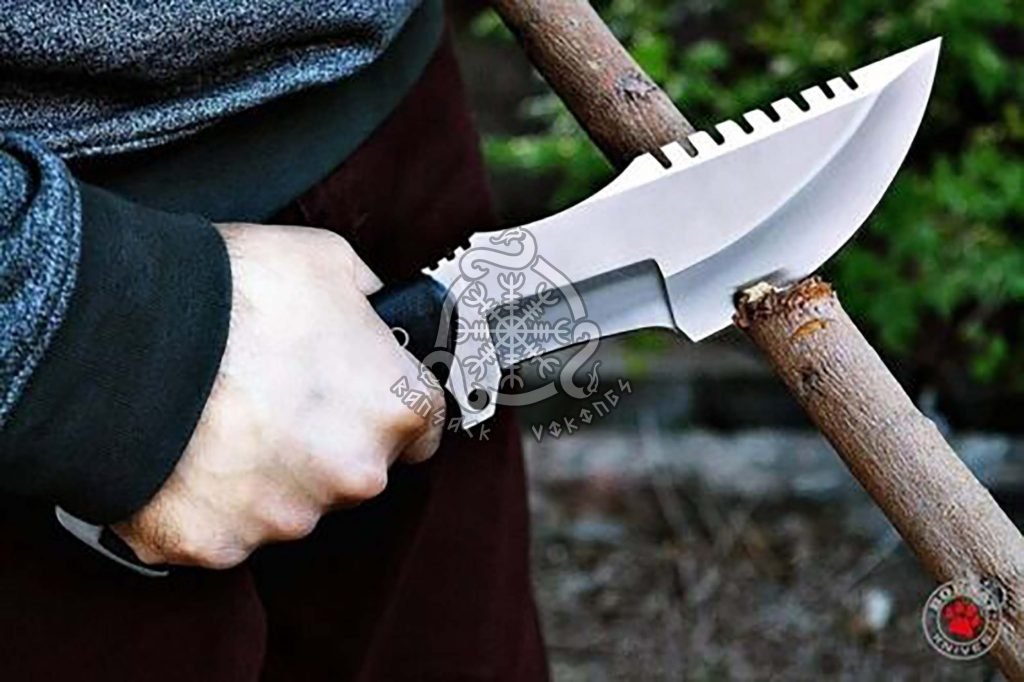
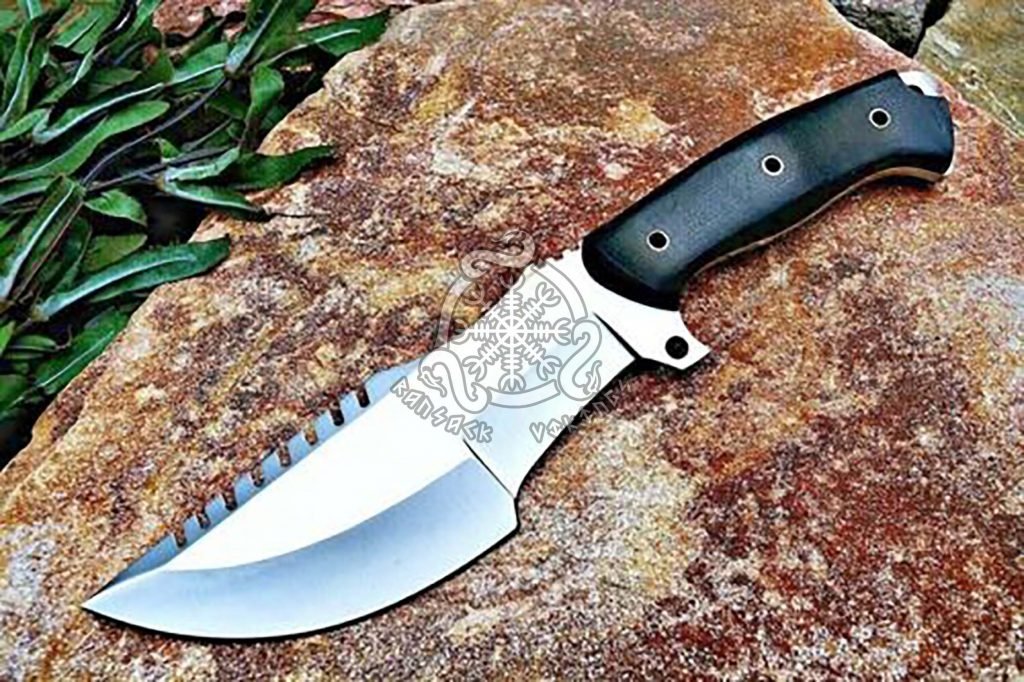
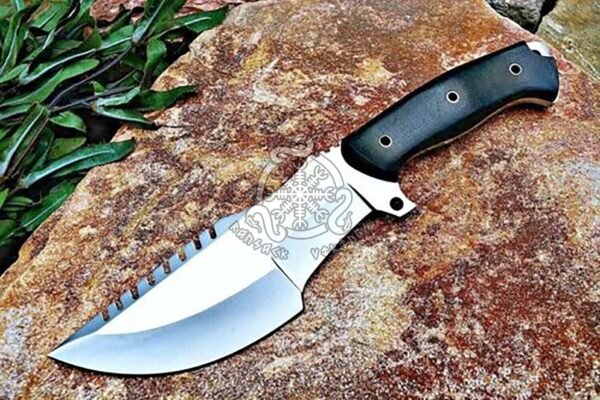
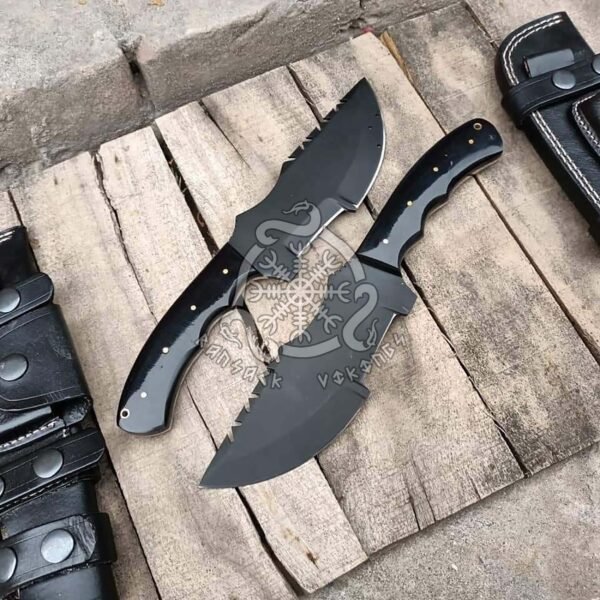
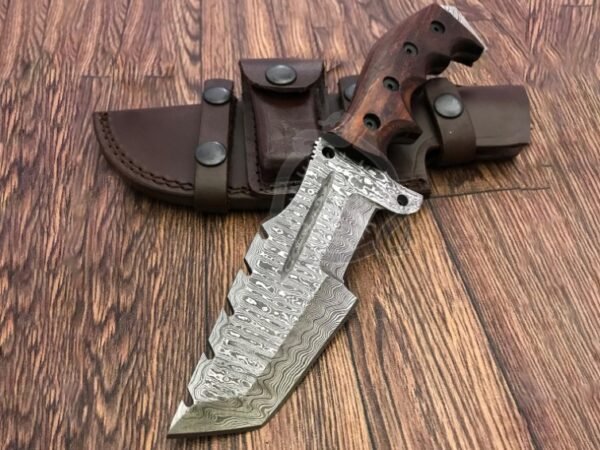
The tracker is one of the few genuinely modern blade patterns in this catalogue. It is not a Norse shape or a medieval one. It came out of the American bushcraft and tracking scene in the late twentieth century, associated above all with the survival instructor Tom Brown Jr, and it reached a much wider audience after a 2003 film put one on screen. The idea behind it was to fold three tools into one piece of steel: a long straight section for slicing and skinning, a deep forward curve for chopping and draw cuts, and a row of teeth along the spine for notching wood.
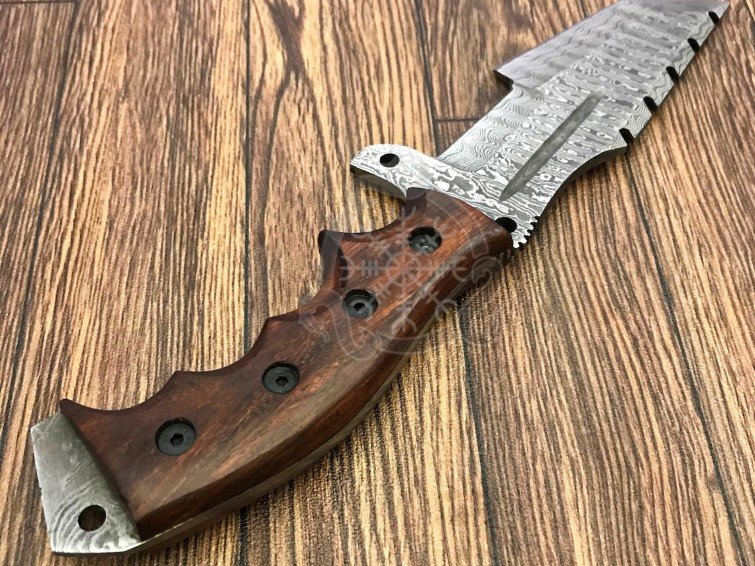
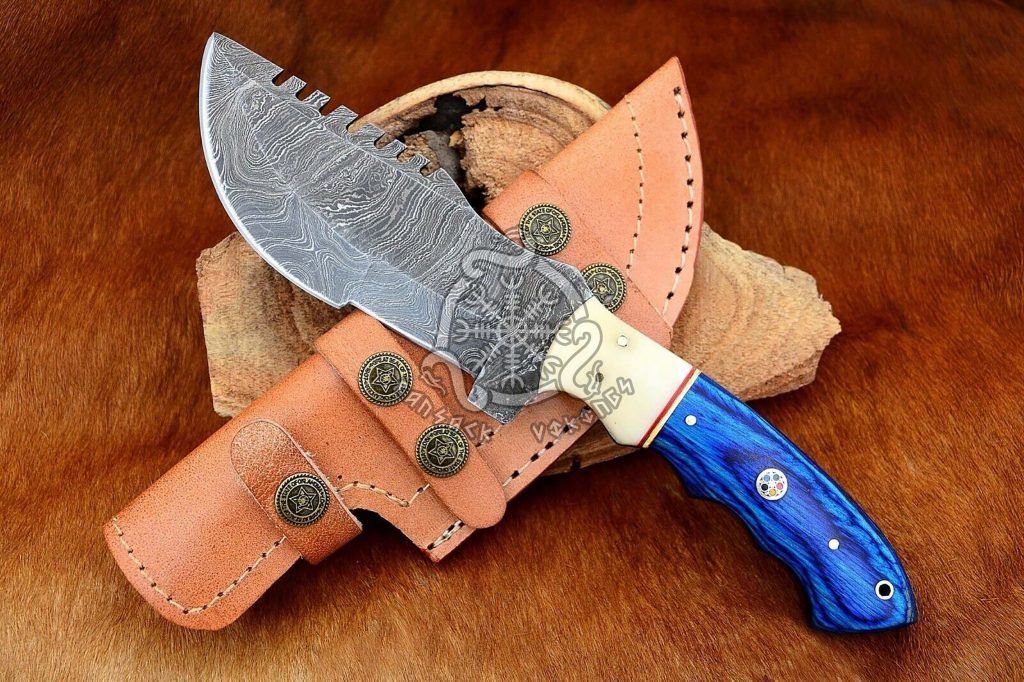
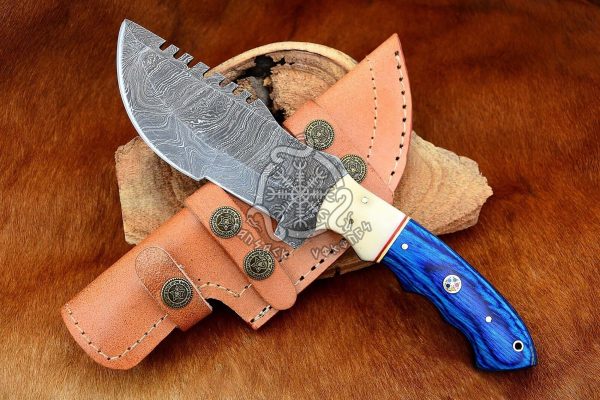
The Rosetracker follows that layout at a size you can actually carry. The blade is hand forged Damascus from 1095 and 15N20 at 58 to 60 HRC, 5 inches long on a knife that measures 10 inches overall, with a 5 inch rosewood handle balancing it. Everything is forged, ground and fitted by hand, so the knife sits balanced in the palm rather than nose heavy.
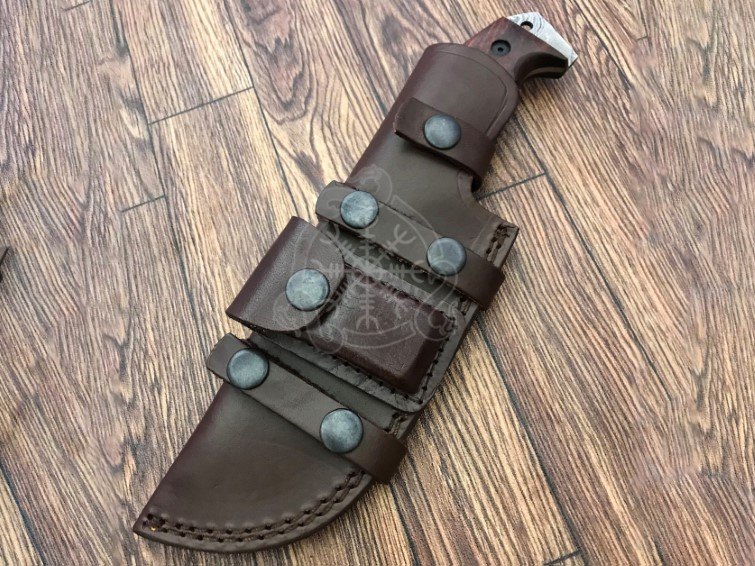
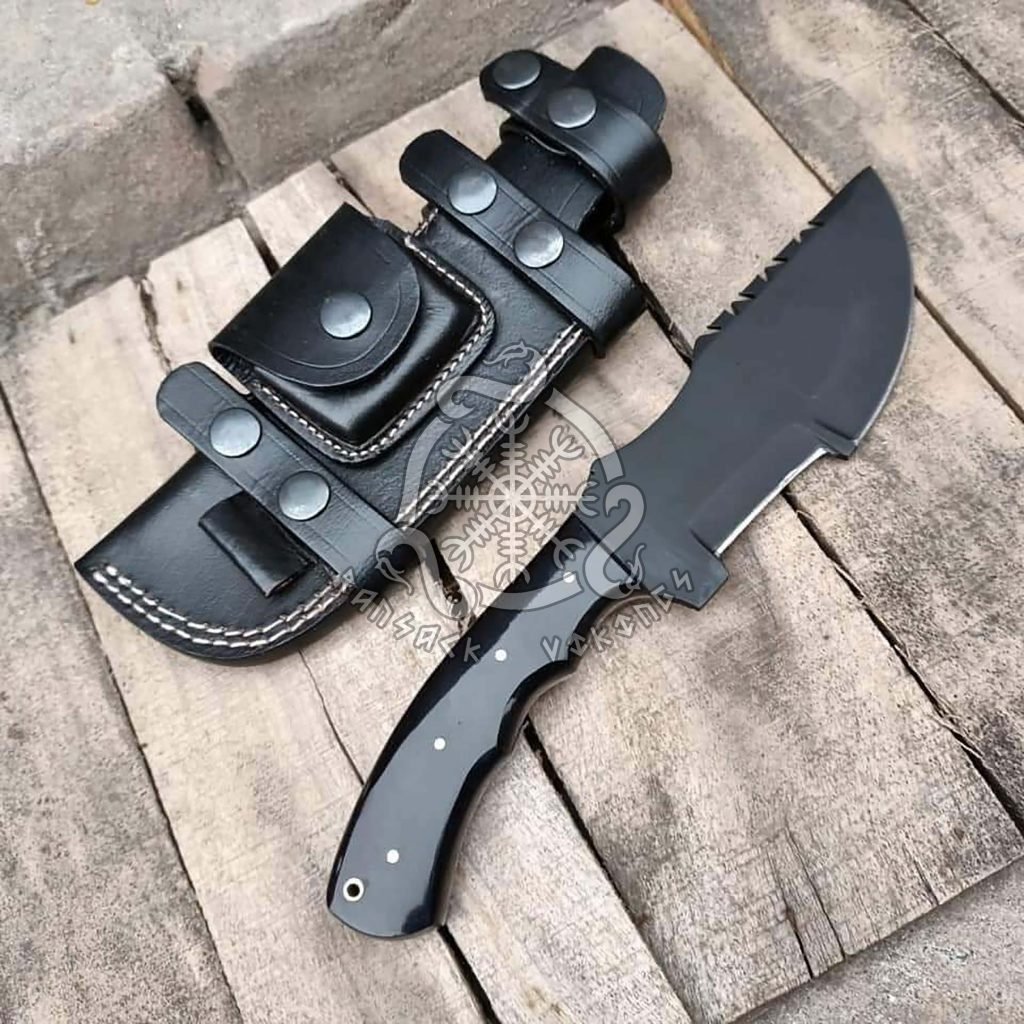
It is made in the Czech Republic, and it ships with a handmade leather sheath, protective packaging and a working edge already set on the stone.
Specifications
| Steel | Hand forged Damascus, 1095 and 15N20 |
|---|
| Hardness | 58 to 60 HRC |
|---|
| Overall length | 10.00 inches |
|---|
| Blade length | 5.00 inches |
|---|
| Handle length | 5.00 inches |
|---|
| Handle | Rosewood |
|---|
| Sheath | Handmade leather |
|---|
| SKU | RK-1048 |
|---|
What the saw spine is really for
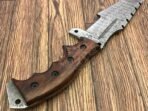
This is the part of a tracker most often misunderstood, so here is the straight version. The teeth on the spine are not a wood saw. They will not fell a sapling and they are poor at cutting across a green branch, because a saw needs set teeth that cut a kerf wider than the blade in order to clear itself, and a spine ground into a knife has no set. What the teeth are genuinely good at is notching: cutting the square notches for a figure four deadfall, scoring a bow drill fireboard, starting a controlled split, cutting through cordage and roots, and rasping a point or a bevel into dry wood. Used for those jobs it does something no straight spine can do.
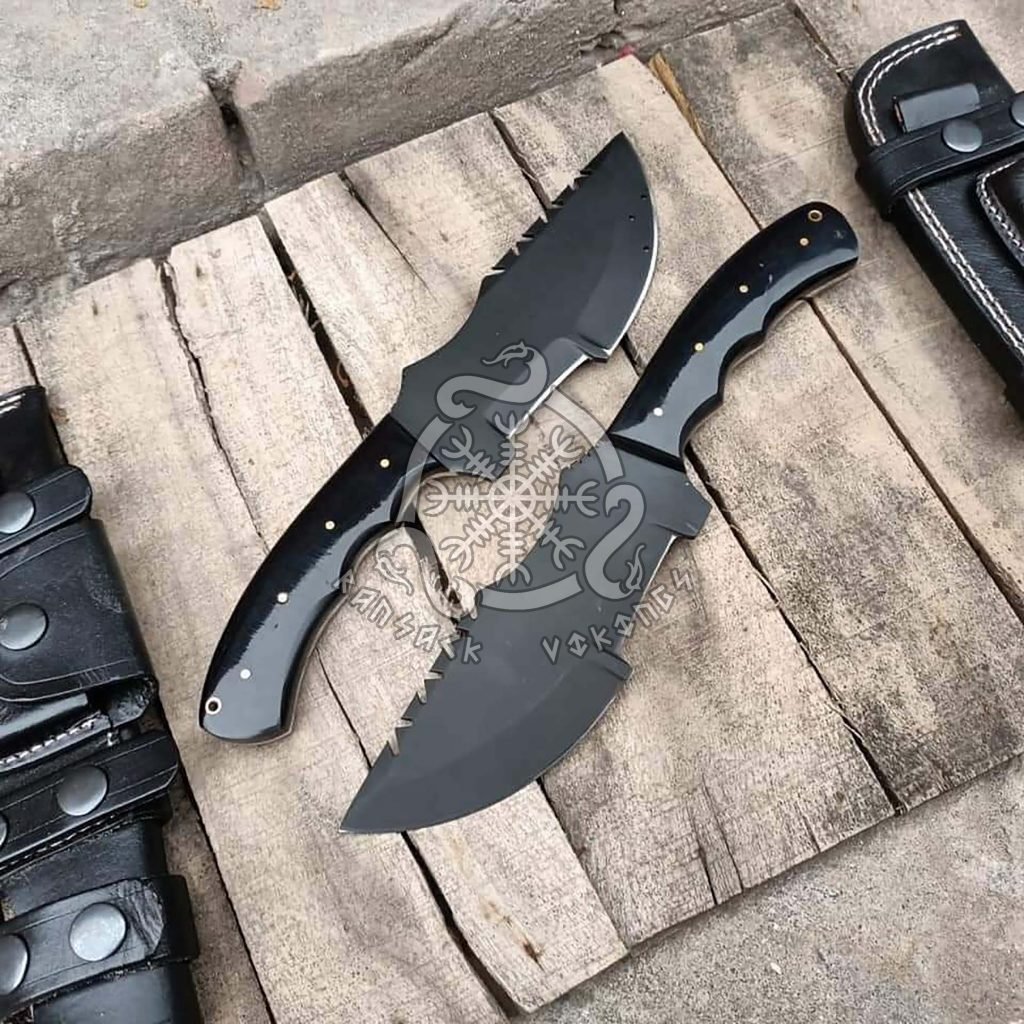
The rest of the profile earns its place more easily. The long straight run of edge behind the belly is where the skinning and the fine slicing happen, because a straight section gives you a predictable depth of cut. The deep forward curve concentrates weight ahead of the hand, which is what lets a 5 inch blade chop and take draw cuts out of proportion to its size. The flat unsharpened spine ahead of the teeth gives your thumb somewhere to press when you want maximum control. It is a compromise design and it is fair to say a dedicated axe and a dedicated skinner each do their own job better, but the whole argument for a tracker is the pack where only one blade fits. More on profiles in blade shapes explained.
Why Damascus and not stainless
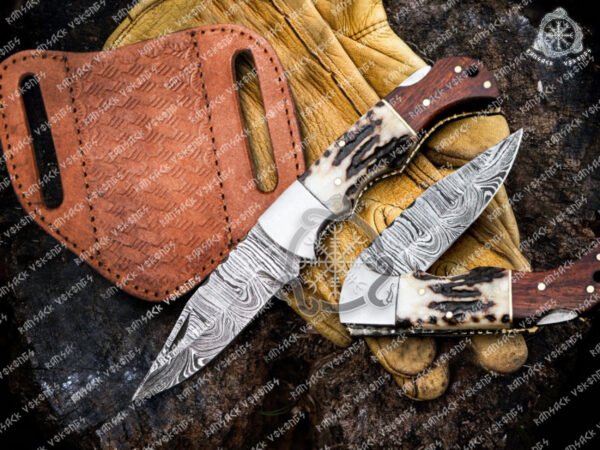
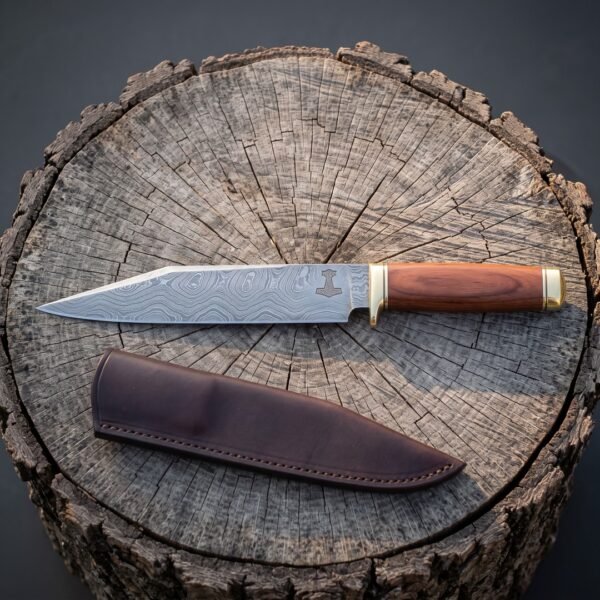
The blade is pattern welded, which means 1095 high carbon and 15N20 nickel steel are stacked, forge welded into a single billet at welding heat, then folded and drawn out until the layers show as bands through the steel. The two alloys etch at different rates at the end, so the 1095 goes dark and the nickel bearing 15N20 stays bright. That pattern is a cross section of the billet, not a print, so grinding the bevels reveals more of it rather than removing it.
On a knife meant for the woods the practical argument matters more than the pattern. High carbon Damascus at this hardness takes a keener edge than soft stainless, holds it through chopping and batoning, and sharpens back on a stone in minutes with nothing more than a rock or a strop if that is what you have. The trade is that it is carbon steel underneath and it will spot if it is put away wet, which needs a little more attention here than usual because water sits in the saw teeth. The comparison is set out in Damascus versus stainless and the making of the billet is in what Damascus steel is.
The rosewood handle
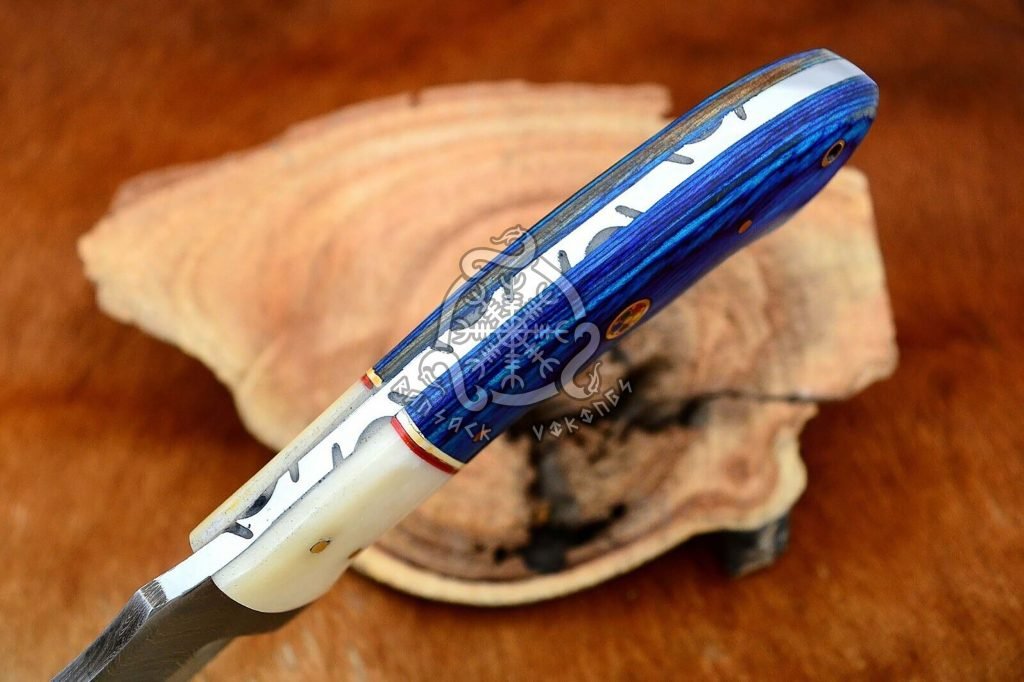
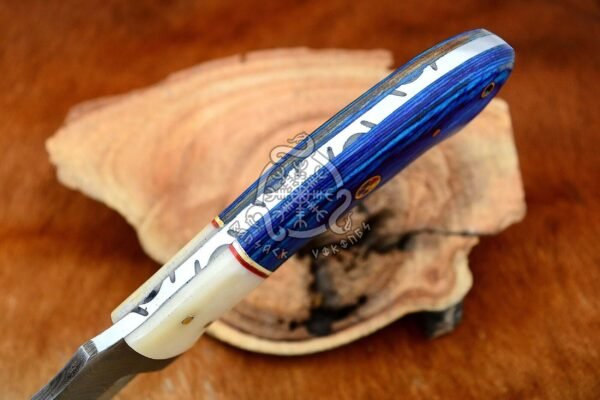
Rosewood was chosen for weight and for grip. It is dense, so it counterbalances a forward heavy blade instead of letting the knife hang nose down, and the natural oils in the timber mean it stays grippy when your hand is wet or cold rather than turning slick like a varnished surface. It also warms to the hand within seconds, which is worth more than it sounds in November.
Wood moves with temperature and humidity, so it wants feeding. A light coat of a drying oil once or twice a year keeps the grain tight, stops it drying out at the pin holes and deepens the colour rather than sitting on top of it as a film that can flake. It takes about five minutes and the method is in wooden handle care. Because every handle is cut from a different piece of timber, the figure and the tone shift from one knife to the next.
Engraving, runes and your own design
Use the rune converter on this page to turn a name, a date or a short phrase into Elder Futhark and we will cut it into the steel or the handle. If you would rather have a Viking pattern than a rune line, choose your own design in the engraving option above the add to cart button and tell us whether it goes on the blade or the handle. Where a piece already carries an engraved design, your chosen engraving replaces it rather than sitting alongside it. On a tracker the flat behind the ricasso and the rosewood scales are both good surfaces, and rosewood takes a cut cleanly because of how dense it is. All of it is done in house. See the engraving page.
Care and sharpening
Two rules cover almost everything. Dry it, and oil it. Wipe the blade down after use, pay particular attention to the saw teeth and the inside of the curve where water collects, and put a thin film of mineral or camellia oil on the flats before it goes away. Keep it out of the sheath for long storage, because vegetable tanned leather holds moisture against steel. The detail is in steel care.
Sharpening is ordinary work with one wrinkle. The straight section sharpens like any other blade, flat on the stone with even pressure until a burr rises. The forward curve needs the same technique applied in short sections while you rotate the knife, so the contact point travels around the belly. Leave the saw teeth alone unless one is visibly damaged, and if you do touch them use a small triangular file rather than a stone. The basics are in sharpening with a whetstone.
Made in the Czech Republic
Every piece we sell is made by hand in the Czech Republic. The smiths there work the way the trade has been worked for a long time, heating and hammering the steel, taking the bevels down by eye, and fitting the handle and the leather one at a time. There is no automated line anywhere in it, so small differences from one piece to the next are normal and expected.
Ransack Viking is a United States company based in Memphis, Tennessee. We bring the pieces in ourselves, inspect them on arrival and ship them from our own warehouse. If you add engraving, that is carried out here in the United States before your order goes out.
A note on handmade variation
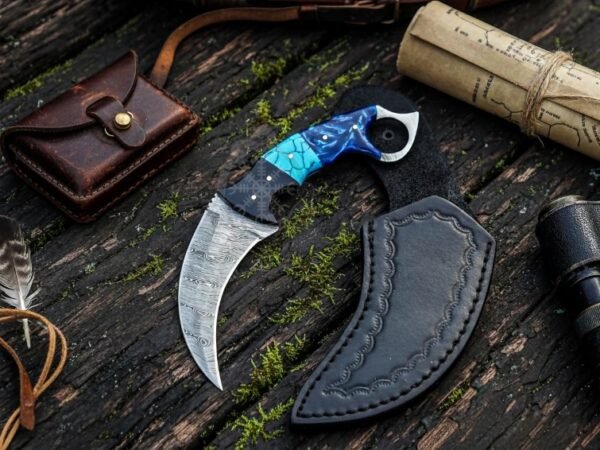
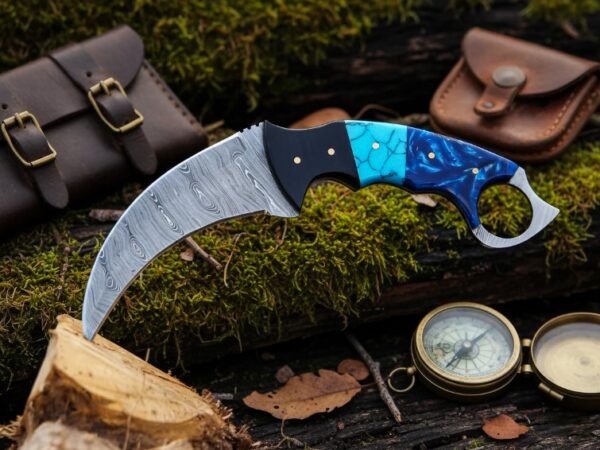
This tracker is hand forged, not machine made and not bulk produced, so what arrives will not be a pixel for pixel copy of the photograph on this page. The Damascus is drawn out under a hammer and every billet lands differently, so the banding across the flats has its own rhythm on each blade. The rosewood comes from a different board each time, which changes the figure, the grain and the depth of colour. Even the spacing of the saw teeth carries the hand that cut them. The dimensions, the steel, the hardness and the build are the same every time. The character is not.
Frequently asked questions
Will the saw spine cut through a branch?
Slowly and badly. It has no tooth set, so it binds in green wood. Treat it as a notching and rasping tool for traps, fireboards and cordage, which is what it was designed for, and carry a folding saw if you need to cut wood to length.
Is a tracker better than a plain bushcraft knife?
It is different rather than better. A tracker chops harder and notches better than a straight bushcraft knife of the same length, and it is less precise for fine carving. If you can only take one blade, that trade usually favours the tracker.
Is it full tang?
Yes. The tang runs the full length of the handle with the rosewood scales pinned to it, which is what you want on a blade that will be chopped with and occasionally struck.
Will my Damascus pattern look like the photograph?
It will be the same style of pattern from the same forge, but not the same billet. The bands will sit at their own spacing and angle, which is how you know it was forged rather than printed.
How do I stop rust forming in the saw teeth?
Dry them properly. A twist of cloth or a corner of a paper towel worked between the teeth takes about ten seconds, and a wipe of oil after that is enough. Water left sitting between teeth is the one place this knife will spot first.
Can I have it engraved before it ships?
Yes. A name, a date, initials or a full Elder Futhark line can be cut into the blade flat or into the rosewood. Allow the longer end of the one to two week processing window.
What is in the box
- One Rosetracker Damascus tracker knife with saw spine
- Handmade leather sheath
- Protective packaging for storage or gifting
- Forged and finished in the Czech Republic
Explore the range
Sitting beside it in the catalogue are Damascus Tracker Knives, Hunting Knives, Damascus Skinner Knives and Bowie Knives. Background reading on steel, sheaths and edge work lives in the guides.







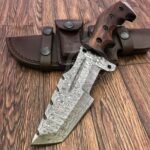
Been eyeing this knife for months and it did not disappoint. Edge retention has been great even after regular use. Will definitely order again for another gift.