Blog
What Is a Gut Hook Knife For?

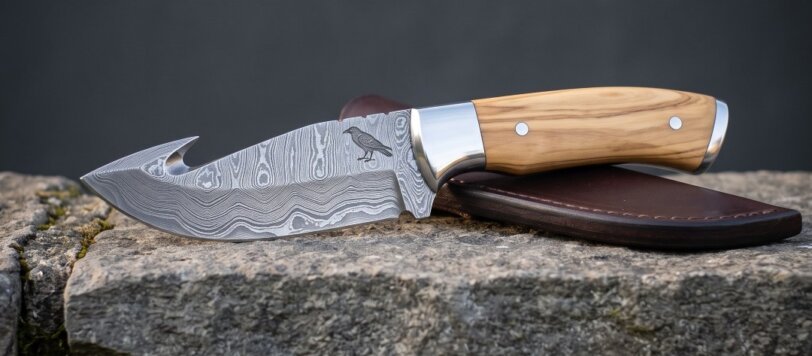
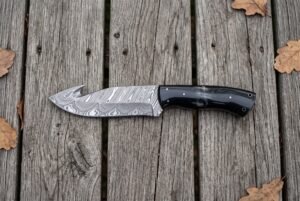
A gut hook knife is a hunting knife with a sharpened, C-shaped hook ground into the spine of the blade. It exists for one job: opening the abdominal hide of big game without the blade tip ever pointing at the stomach beneath. You nick a small opening, slip the hook in with the dull spine facing the organs, and pull. That single feature prevents the most common and least pleasant field-dressing mistake, puncturing the gut and tainting the meat. A gut hook is very good at that one job and clumsy at most others, which is the honest summary. The rest of this covers how it works, when it earns its place, and how to choose and maintain one.
How a Gut Hook Actually Works
Think of the hook as a tiny, guarded blade facing backward. The inside curve of the “C” is sharpened; the outside is not. When you draw the knife along the belly, hide feeds into the hook and is sliced from underneath while the rounded outer spine rides against the organs like a shoe over a zipper. The geometry does two jobs at once: it lifts the skin away from the viscera, and it physically prevents the cutting edge from reaching anything but hide and the thin muscle layer beneath it. Compared with running a blade tip under the skin, where one slip or one hidden bump means a punctured stomach, the hook removes the risk almost entirely. That is why it has survived on deer-camp knives long after most added features were quietly dropped.
What a Gut Hook Is Used For
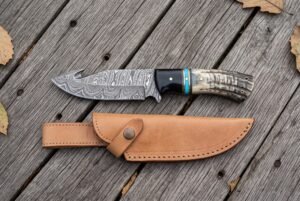 Hornreaver Hand Forged Damascus Gut Hook Hunting Knife with Buffalo Horn and Ram Horn Handle and Turquoise and Brass Spacers | Hunting Gift | RK-360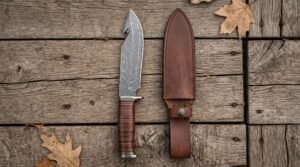
Opening game for field dressing
This is the headline job: unzipping the abdominal cavity of deer, elk, hogs, and antelope from pelvis to sternum quickly and cleanly. Speed matters when the goal is cooling the carcass, and the hook turns the trickiest cut of the process into a ten-second pull.
Skinning assistance
The same principle helps when opening the hide along the legs before skinning: the hook follows the line, splitting skin without scoring the meat beneath.
Utility odd jobs
Owners find secondary uses, slicing baling twine, cutting cord away from a load without exposing a blade edge, even cutting a seatbelt in a pinch. These are bonuses rather than the purpose. If you are buying a tool to cut a seatbelt, buy a rescue hook and keep the hunting knife for hunting.
Gut Hook vs Plain Blade for Field Dressing
| Consideration | Gut Hook Knife | Plain-Spine Knife |
|---|---|---|
| Risk of puncturing organs | Very low, edge is shielded inside the hook | Depends on skill; tip-up technique required |
| Speed of the belly cut | One continuous pull | Slower, more careful work |
| Sharpening | Main edge normal; hook needs a round file or rod | Standard stones only |
| Cleaning | Hook traps hair and fat; needs a brush-out | Simple wipe-down |
| Versatility of the spine | Hook prevents thumb-on-spine grip near tip | Full spine available for pressure |
| Best for | Hunters who dress game every season | Minimalists and multi-purpose users |
What to Look For in a Gut Hook Knife
Four things separate a working gut hook from a shape ground into the spine to fill out a feature list. First, hook geometry: the opening should be wide enough to feed thick winter hide but tight enough to keep the edge shielded, roughly the width of a pencil is the classic proportion. Second, blade pairing: most good gut hooks ride on a drop-point or trailing-point skinner, so one knife handles the unzip, the skinning and the quartering, and the blade shapes explained shows where the hook sits among the rest; browse any set of Damascus skinner knives and you will see the hook almost always paired with a deep-bellied profile. Third, steel and construction: a full tang hunting knife in plain 1095, or in 1095 and 15N20 Damascus, holds its edge through an entire animal and resharpens easily at camp, and the tang matters more than the marketing. If you are weighing the two steels, our steel glossary covers the upkeep honestly. Fourth, grip when wet: field dressing is slippery work, so a contoured handle with a guard earns its keep. Fixed blades dominate this category for good reason, hinges and body fluids are a poor match, though a well built folding knife still makes a fine backup for lighter tasks.
How to Use a Gut Hook, Step by Step
Lay the animal on its back. With the plain edge of the knife, make a shallow pilot cut through the hide just above the pelvis, only deep enough to pass the hook through. Insert the hook, rounded spine down toward the organs, and pull steadily toward the sternum with the blade nearly parallel to the body. Let the hook do the cutting. If you find yourself sawing, the hook is dull or you are in too much of a hurry. Stop at the sternum, then proceed with normal field-dressing technique. The whole belly opens in seconds, with the viscera untouched, which means cleaner meat, faster cooling, and a far less messy job.
Sharpening and Caring for the Hook
The main edge of a gut hook knife sharpens like any other blade. The hook itself needs a round abrasive: a small round diamond file, a tapered ceramic rod, or fine sandpaper wrapped around a dowel that matches the hook’s inside curve. A few light strokes along the inside edge once or twice a season is typically enough, because the hook only ever cuts hide. After each use, brush hair and fat out of the hook’s recess, wash and dry the knife, and oil it, the hook’s tight curve traps moisture, and on plain 1095 and Damascus blades it is the first place rust appears, which the Damascus care routine deals with. Treated this way, a gut hook outlasts its owner.
Do You Actually Need One?
No hunter needs a gut hook. Generations dressed game with plain blades and a careful tip-up cut, and they managed perfectly well. What the hook buys is speed, repeatability, and a wide margin for error when you are tired, cold, and working in fading light. If you dress one deer a year with practiced hands, a plain skinner is enough. If you process several animals a season, guide others, or simply want the belly cut to be foolproof, the hook is one of the few “extra features” on a knife that genuinely pays rent.
Gut Hook Knife FAQ
What is a gut hook knife used for?
Primarily for field dressing big game. The sharpened hook on the blade’s spine slices the abdominal hide from the inside out while its rounded back shields the organs, letting a hunter open a deer’s belly in one pull without risking a punctured stomach or intestines.
How do you use a gut hook without cutting the organs?
Make a small starter cut through the hide, insert the hook with its rounded spine facing down toward the organs, and pull steadily along the belly line. The edge sits inside the hook where it can only reach hide, so the organs are protected by design.
How do you sharpen a gut hook?
Use a small round or tapered abrasive that fits the hook’s inside curve, a round diamond file, a ceramic rod, or fine sandpaper around a dowel. A few light strokes along the inner edge restore it; the hook dulls slowly because it only ever cuts skin.
Is a gut hook worth it on a hunting knife?
For hunters who field dress game regularly, yes. It makes the riskiest cut of the job fast and nearly foolproof. For occasional hunters, or anyone who likes a clean spine to put a thumb on, a plain drop-point or skinner does the same work and simply asks for more care.
What is the downside of a gut hook?
Minor ones. The hook needs its own round file to sharpen, its recess traps hair and moisture and must be cleaned to prevent rust, and it occupies the spine where some users like to rest a thumb. None of that touches the main edge’s performance, and none of it has ever stopped anyone finishing a deer.
Can a gut hook knife still skin and butcher?
Yes. The hook is added to an otherwise normal blade, usually a deep-bellied skinner or drop point, so the primary edge skins, quarters, and slices exactly as it would without the hook. You lose a flat spine near the tip, and nothing else.
Whether a gut hook earns its place next to a plain blade is argued in hunting knife against skinning knife, and the job it is built for is walked through in how to skin a deer. For the fishing equivalent, see the best fillet knife for fishing.
If nothing on the shelf is quite right, build a custom hunting knife and choose the blade profile, the steel, the length and the sheath.
If you are buying
Ready to ship, the Gutwarden gut hook hunting knife and the Hornreaver gut hook hunting knife. The Wengehook gut hook hunting knife and the Stagcurve gut hook hunting knife are the other two.
Shop the range
Hornreaver Hand Forged Damascus Gut Hook Hunting Knife with Buffalo Horn and Ram Horn Handle and Turquoise and Brass Spacers | Hunting Gift | RK-360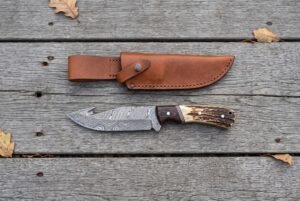 Wengehunter Hand Forged Damascus Gut Hook Hunting Knife with Stag Horn and Wenge Wood Handle | Deer Field Dressing Gift | RK-610