
Blog
Hunting Knife vs Skinner vs Bowie: Which Do You Need?

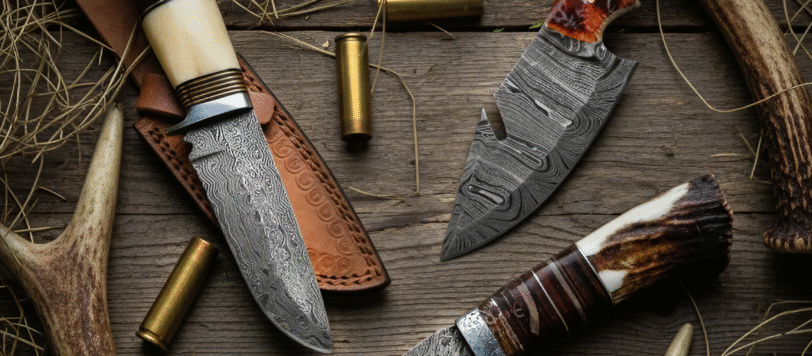
A hunting knife is the all-rounder, typically a 3.5 to 4.5 inch drop-point that field dresses, skins, and handles camp chores acceptably well. A skinning knife is a specialist, shorter, with a deep curved belly that peels hide faster and cleaner than anything else and does little else nearly as well. A Bowie is the big camp blade, a 6 to 12 inch clip-point built for chopping, batoning, and heavy work rather than fine game processing. If you hunt and can own only one knife, buy the hunting knife. If you process several animals a season, add the skinner. The Bowie gets bought for camp duty and for how it looks on the belt, and there is no shame in the second reason. The rest of this guide breaks down why.
The Three Knives at a Glance
| Feature | Hunting Knife | Skinning Knife | Bowie Knife |
|---|---|---|---|
| Typical blade length | 3.5 to 4.5" | 3 to 4" | 6 to 12" |
| Blade shape | Drop point, modest belly | Deep curved belly, rounded or trailing tip | Clip point with pronounced tip |
| Best at | Field dressing, general game work, camp tasks | Removing hide quickly without holes | Chopping, batoning, heavy camp work |
| Weakest at | Master of nothing, adequate everywhere | Piercing, detail work, chores | Fine game processing, skinning |
| Carry weight | Light, medium | Light | Heavy |
| Who needs it | Every hunter | Hunters processing multiple animals | Camp cooks, campers, collectors |
Hunting Knife: The All-Rounder
A general-purpose hunting knife is defined by balance. The drop-point profile gives a strong, controllable tip for opening the field-dressing incision without puncturing organs, enough belly for competent skinning, and a straight-enough edge for slicing meat and rope alike. A 3.5 to 4.5 inch fixed blade with a full tang is the sweet spot: small enough for precise work inside a body cavity, big enough for camp chores, and unremarkable enough that nobody writes advertising copy about it. This is the knife that lives on a hunter’s belt all season, which is why our hunting knife collection centers on exactly this pattern. If your hunting includes wilderness trips where the knife must also split kindling and build blinds, lean toward the longer, stouter end of the range or a tracker-style knife, which adds chopping mass while keeping a usable edge for game.
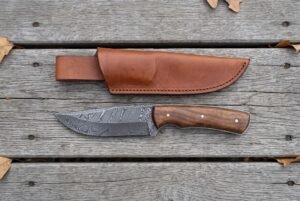 Bobcat Hand Forged Damascus Skinner Knife with Walnut Wood Handle & Leather Sheath | Full Tang Hunting and Skinning Gift | RK-331
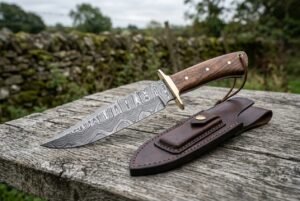 Timberedge Hand Forged Damascus Bowie Knife with Wood Handle & Leather Sheath | Hunting Camping and Fathers Day Gift | RK-492
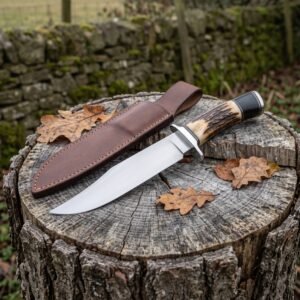 Blackguard Hand Forged 1095 High Carbon Steel Bowie Knife with Stag Horn and Black Micarta Handle and Steel Guard and Butt Cap | Hunting Bowie Gift | RK-574
Skinning Knife: The Specialist
A skinner does one job better than any other blade shape: separating hide from carcass. The deep, sweeping belly presents a long arc of edge to the membrane in each stroke, and the rounded or trailing tip glides along the hide instead of stabbing through it, fewer holes in the hide, no score marks on the meat, faster work. The trade-offs are real. A skinner’s blunt-ish tip is poor at piercing, the short blade is awkward for slicing, and the shape wastes its whole advantage the moment you use it to open a box. Hunters who take one deer a year can skin adequately with a drop-point; hunters who process several animals, or who keep hides for tanning, feel the difference immediately, which is exactly who our Damascus skinner knives are forged for.
Bowie Knife: The Camp Heavyweight
The Bowie is the American big knife: a long clip-point blade, often with a guard, carrying enough mass to chop limbs, baton firewood, clear brush, and handle heavy butchering like quartering. The dramatic clip gives it a fast, acute tip, and the sheer edge length makes long slicing cuts easy. What it is not is a game-processing knife. Inside a deer, six-plus inches of blade is a liability, and its weight punishes fine work. Think of the Bowie as the camp tool that also happens to be the one people pick up and comment on; our Bowie knife collection runs from practical camp sizes to full presentation pieces, all hand-forged and shipped from Chicago, IL.
Which Should You Buy?
You hunt once or twice a season: one good drop-point hunting knife covers everything from field dressing to dinner prep.
You fill multiple tags or keep hides: hunting knife plus a dedicated skinner. The pair weighs less than one Bowie and covers game work completely.
You camp more than you hunt: a Bowie or tracker for wood and camp tasks, with a small folder for detail work.
You want one hard-use wilderness blade: a 5 to 6 inch stout drop-point or a compact Bowie splits the difference, which means accepting a compromise at both ends rather than escaping one.
You collect or gift: the Bowie’s history and presence make it the classic centerpiece; a patterned Damascus blade adds one-of-a-kind character.
Steel and Build Notes That Matter More Than the Label
Whatever pattern you pick, three build details decide how the knife performs. Full tang construction, steel running the entire handle, is non-negotiable for hard use. Blade steel drives edge-holding and maintenance: high-carbon and Damascus blades take a keener edge and hold it through an animal but want a wipe of oil after use, while stainless forgives neglect at some cost in edge character; our Damascus steel vs stainless steel guide covers the trade-off in depth. And handle shape beats handle beauty. A grip that stays secure when wet and bloody matters more than any material, however well that material photographs. A well-fitted sheath completes the package; a knife you cannot carry safely is a knife left at home.
There is a fourth answer people arrive at, usually after owning the first three. A mid size Norse seax does most of what a hunting knife does, carries flatter on the belt, and looks like nothing else on the tailgate. It is a worse skinner and a worse chopper than the specialists above, but as a single blade for everything it has a thousand years of use behind it. The Viking knives collection has those patterns in 1095 and Damascus.
Hunting, Skinning, and Bowie Knife FAQ
What is the difference between a hunting knife and a skinning knife?
Shape and specialization. A hunting knife is a general-purpose drop-point that handles field dressing, skinning, and camp tasks acceptably; a skinning knife trades that versatility for a deep curved belly and rounded tip that remove hide faster and with fewer accidental punctures. Every skinner is a poor camp knife, and every all-rounder is a slower skinner. That is the trade, and no amount of marketing removes it.
Can I skin a deer with a regular hunting knife?
Yes, hunters do it every season. A 3.5 to 4.5 inch drop-point skins competently, just more slowly and with more attention needed near the hide. The dedicated skinner earns its place when you process several animals a year, care about keeping hides intact for tanning, or simply want the fastest, cleanest job possible.
Is a Bowie knife good for hunting?
It is good around hunting rather than for the game work itself. A Bowie excels at camp chores, chopping, and heavy butchering like quartering, but its long blade is clumsy for field dressing and skinning, where control near the tip matters. Many hunters settle it by carrying a Bowie on the pack and a smaller knife on the belt, which is a quiet admission that one blade was never going to do both.
What blade length is best for a deer hunting knife?
For the actual game work, 3.5 to 4.5 inches handles deer-sized animals with the best mix of control and reach; go shorter for fine skinning, longer only if the knife must double as a camp tool. Blades over 5 inches gain chopping ability and lose precision inside the body cavity.
Do I need a gut hook on my hunting or skinning knife?
It is a convenience, not a requirement. A gut hook zips the abdominal hide open without risking a nicked paunch, which beginners appreciate, but it adds a feature that needs its own sharpening technique and snags in sheaths. A careful two-finger technique with a plain drop-point does the same job, so this one comes down to preference rather than necessity.
Should I choose Damascus or stainless for a hunting knife?
Choose by your maintenance honesty. High-carbon Damascus takes a wickedly keen edge, holds it through a full animal, and looks like nothing else, but it needs drying and a wipe of oil after wet, bloody work. Stainless shrugs off neglect with a somewhat less refined edge. Hunters who care for tools love Damascus; hunters who throw the knife in a wet pack until next season are better served by stainless.
If the answer is a dedicated skinner, our shortlist is in the best skinning knife for deer, and the wider field selection is in the best Damascus hunting knives. The process itself is in skinning a deer step by step.
For one built to your own measurements, build a custom hunting knife and choose the blade profile, the steel, the length and the sheath.
The shop side of this
If you are shopping rather than reading, the Olivecamp camp knife and the Brasscamp camp knife are the nearest match. Also worth opening, the Vampire skinner knife and the Hornreach Bowie knife.
Shop the range
Bobcat Hand Forged Damascus Skinner Knife with Walnut Wood Handle & Leather Sheath | Full Tang Hunting and Skinning Gift | RK-331Timberedge Hand Forged Damascus Bowie Knife with Wood Handle & Leather Sheath | Hunting Camping and Fathers Day Gift | RK-492Blackguard Hand Forged 1095 High Carbon Steel Bowie Knife with Stag Horn and Black Micarta Handle and Steel Guard and Butt Cap | Hunting Bowie Gift | RK-574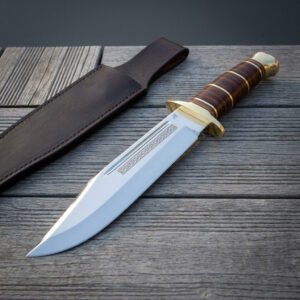
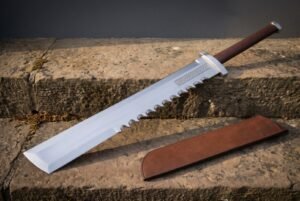
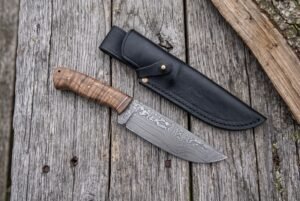 Vampire Hand Forged Damascus Skinner Knife with Stabilized Wood Handle and Fiber and Brass Spacers & Leather Sheath | Full Tang Hunting Camping and Anniversary Gift | RK-330