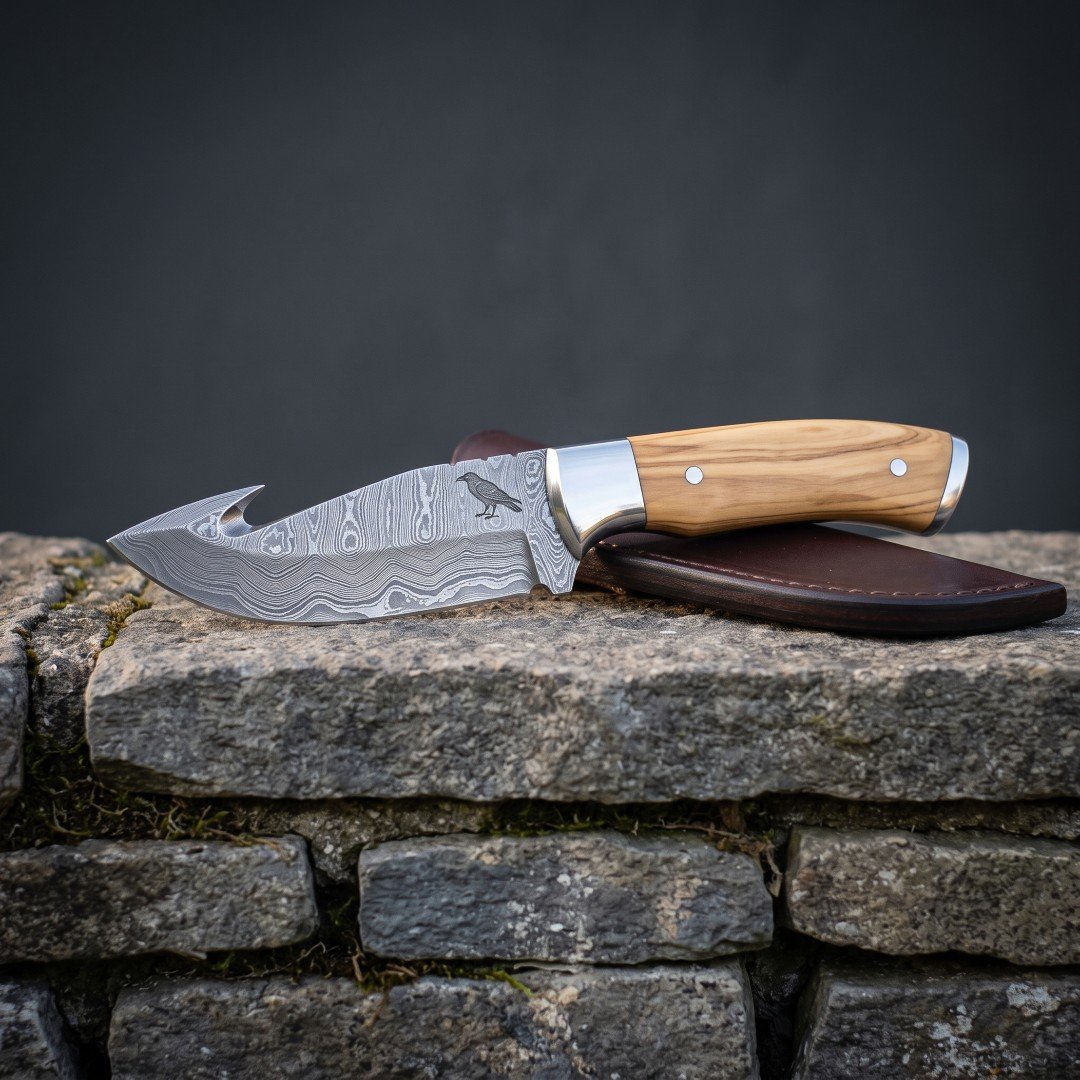
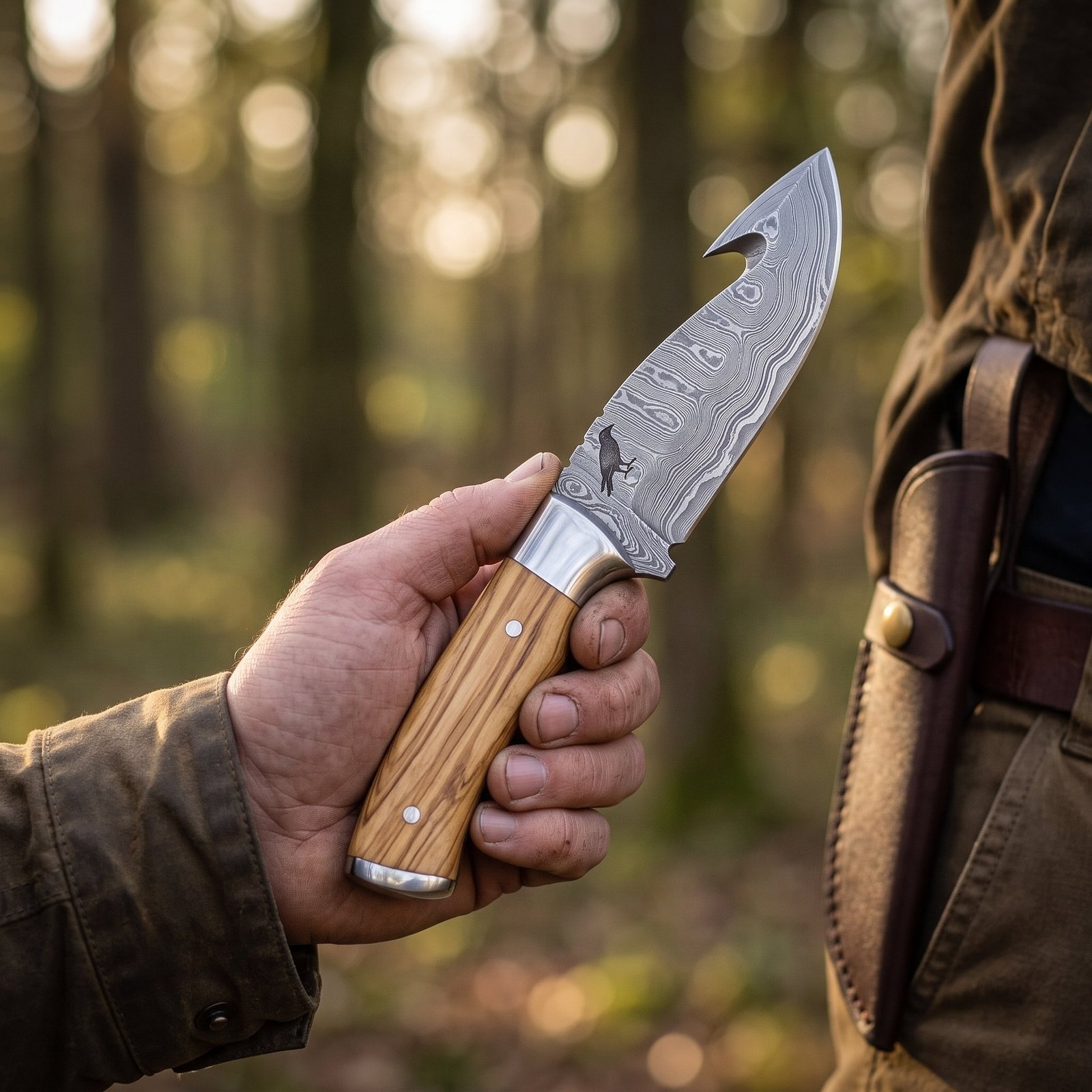
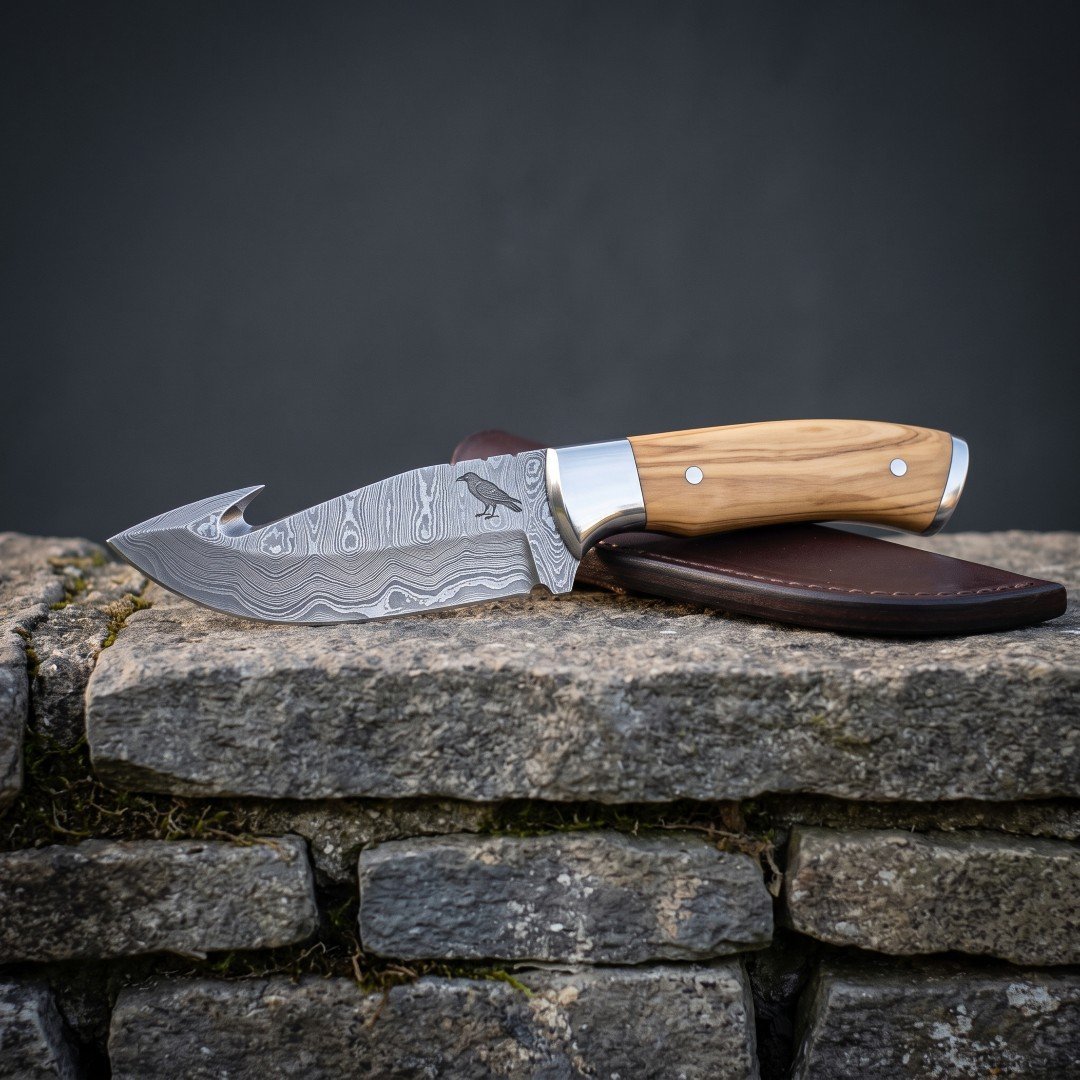
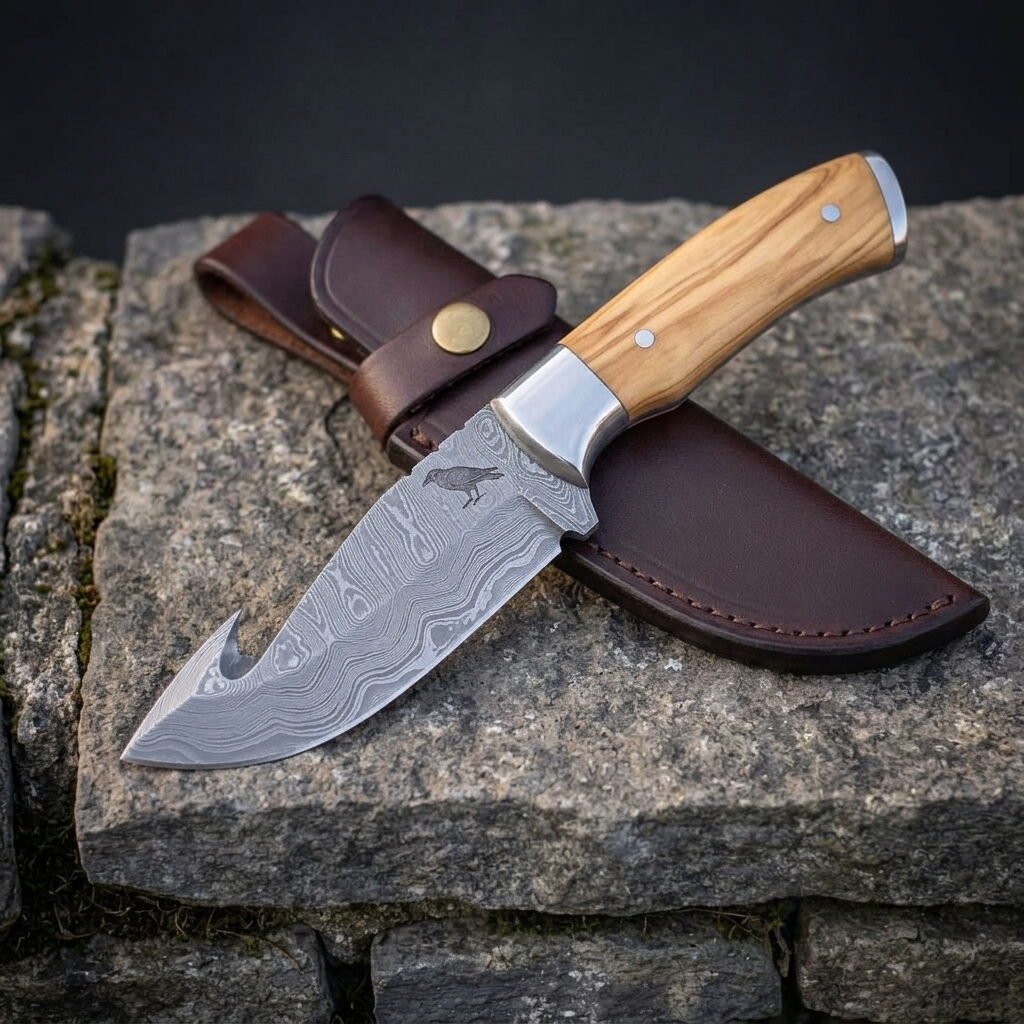
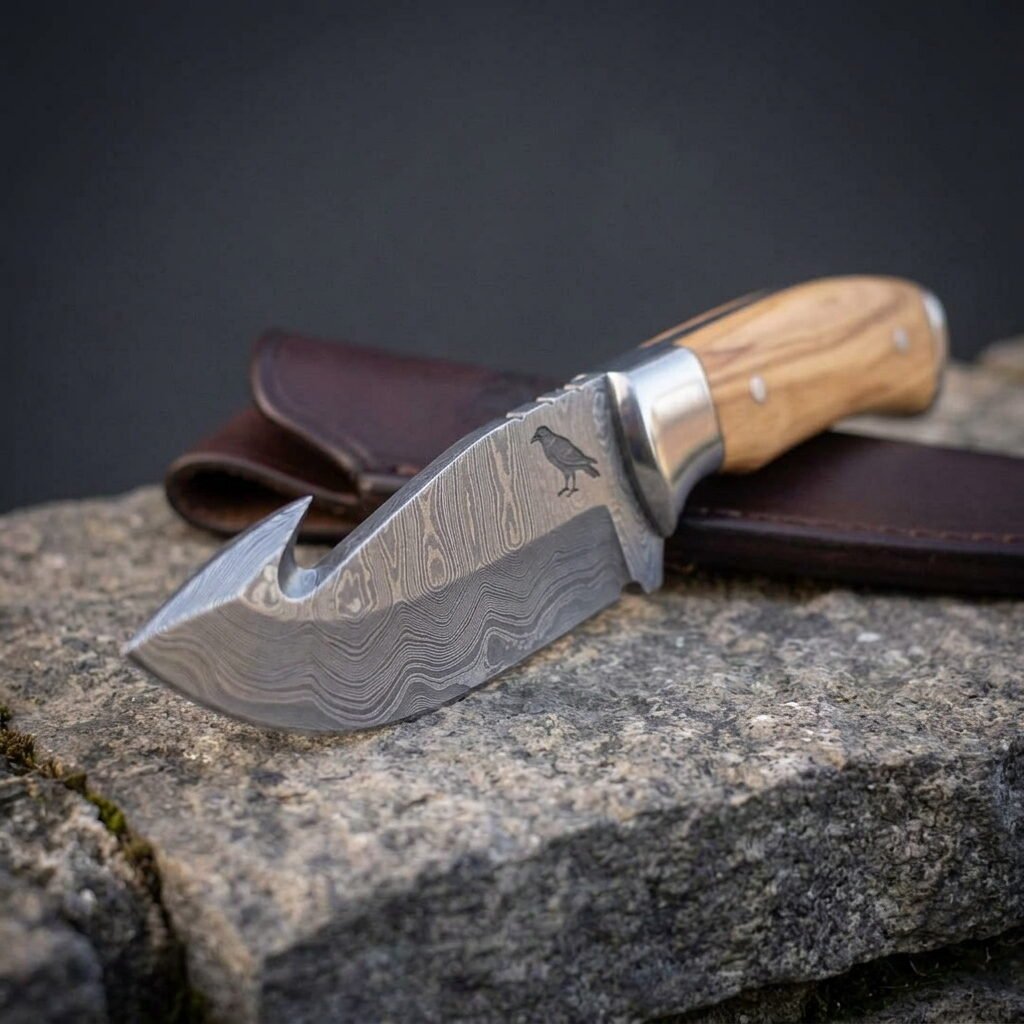
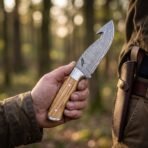
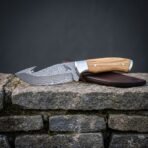
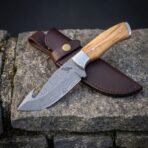
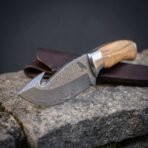
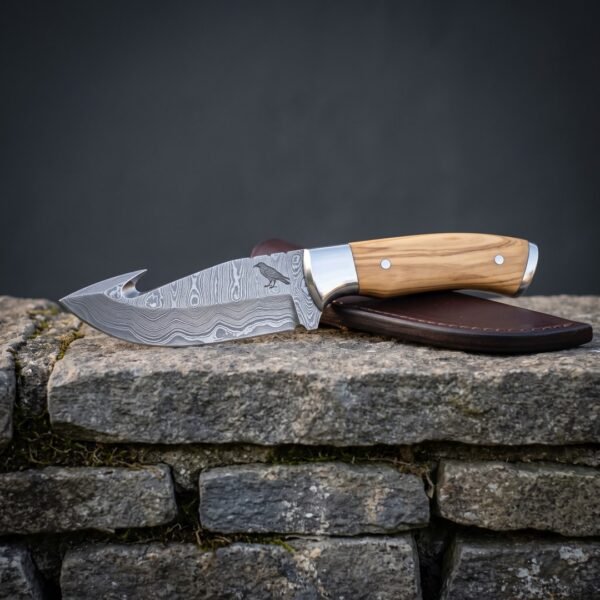
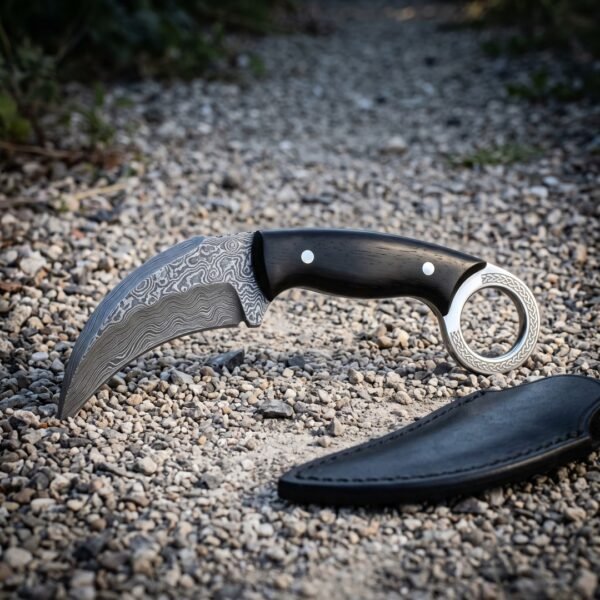
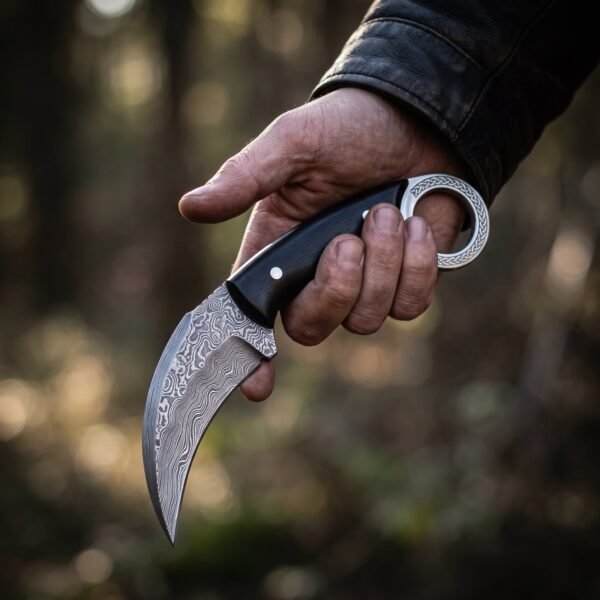
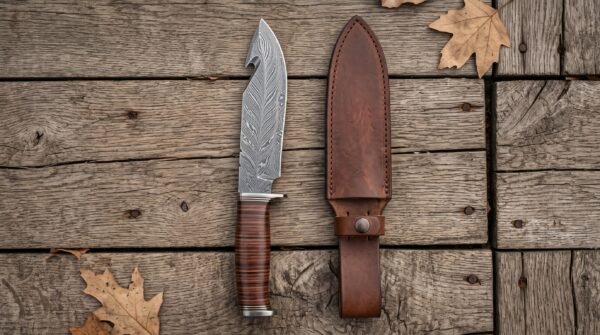
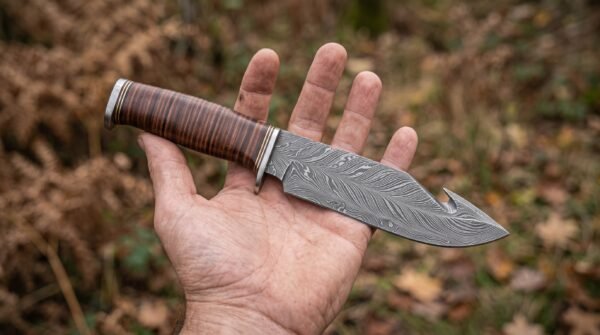
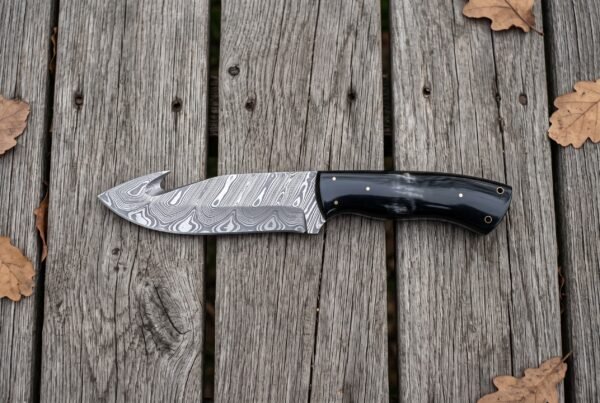
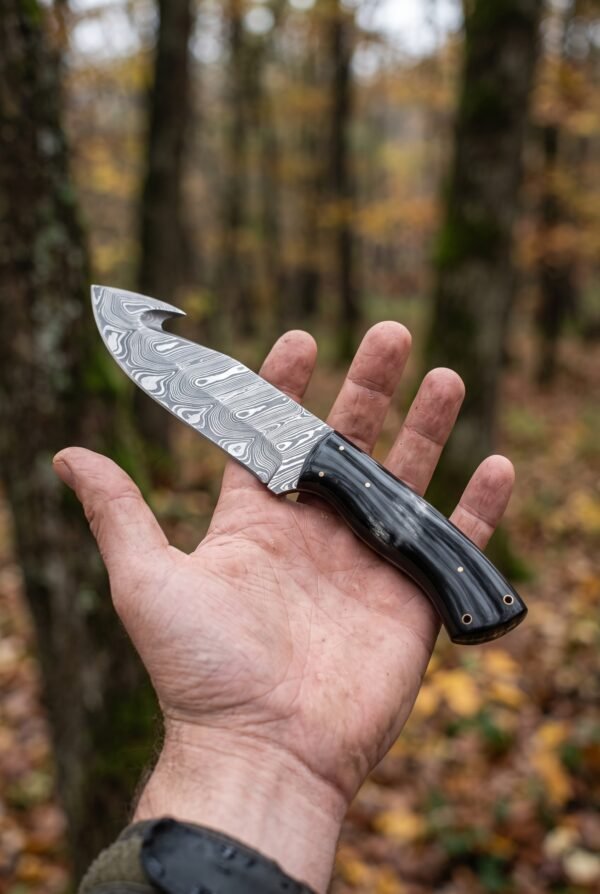
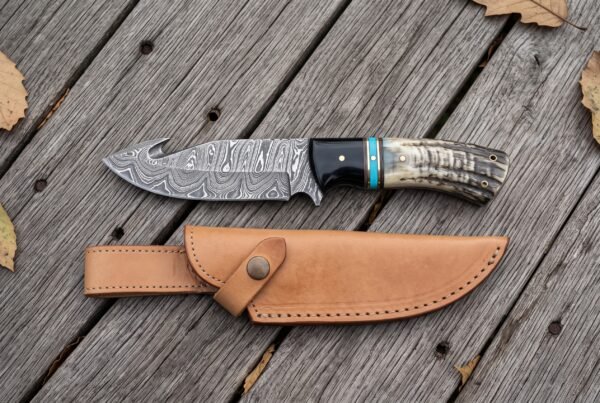
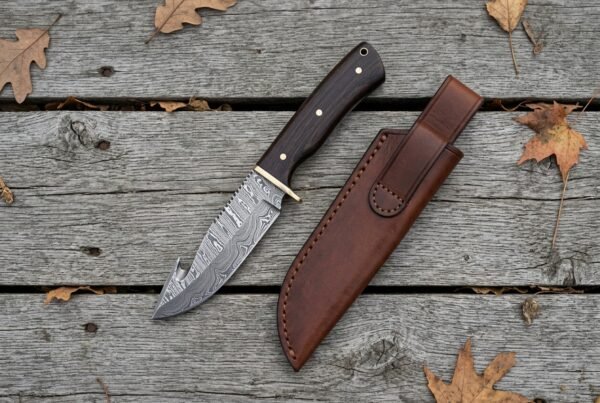
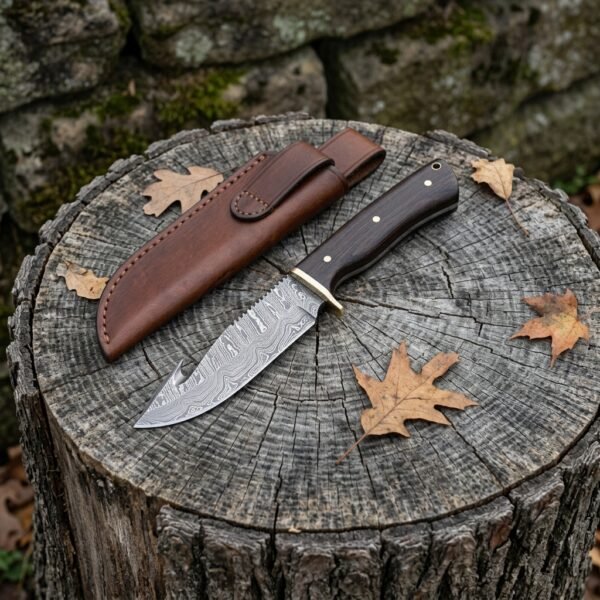
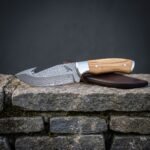
A gut hook skinner forged from Damascus, folded and drawn until the layers run in long tight waves down the whole blade and around the hook itself. Look at where the pattern turns the corner into the hook. That is how you tell real pattern welded steel from an etched imitation. In Damascus the pattern is the structure of the bar, so it follows every curve and every grind line. An etched surface pattern is printed on the outside and stops dead at a bevel. This one is the real thing, made from 1095 and 15N20 forge welded together, and it carries a small engraved raven on the flat above the ricasso. The handle is olive wood, set between a polished steel bolster and a steel butt cap and pinned through with two steel pins.
Forged, ground, heat treated, etched and fitted in a Czech Republic workshop, and it ships with a hand stitched brown leather belt sheath cut to it. What the hook is actually for, and when it gets in the way, is in what is a gut hook knife for.
Specifications
| Type | Gut hook skinning and field dressing knife |
|---|
| Blade steel | Damascus, 1095 and 15N20 pattern welded |
|---|
| Hardness | 58 to 60 HRC |
|---|
| Pattern | Tight running wave, through the bar rather than etched on the surface |
|---|
| Blade shape | Swept skinner belly with an integral gut hook at the spine |
|---|
| Guard | None |
|---|
| Bolsters | One polished steel bolster at the front of the handle |
|---|
| Handle | Olive wood scales |
|---|
| Pins | Two steel pins |
|---|
| Butt cap | Polished steel |
|---|
| Engraving | Raven cut into the blade flat |
|---|
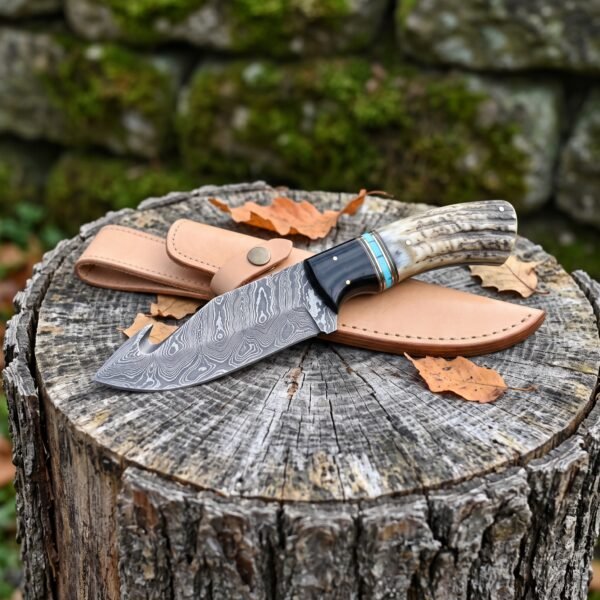
| Sheath | Hand stitched brown leather belt sheath with snap retention strap |
|---|
| SKU | RK-1534 |
|---|
What the gut hook is for and how to use it
The hook exists to solve one problem. Opening the abdominal cavity of a deer with a plain blade means running a sharp point along the belly wall with the paunch immediately underneath it, and if you nick the stomach or the intestine you contaminate the meat and give yourself an unpleasant hour. The gut hook removes the point from the equation. You make a short starting cut, slide the blunt back of the hook under the hide with the sharpened inner curve facing up, and pull. The hide is drawn into the throat of the hook and cut from the inside out, and because nothing sharp is leading, the blade rides over the gut instead of into it.
The two mistakes people make are sawing and forcing. A gut hook cuts on a smooth continuous pull, one long stroke, not a series of jabs. And if it stops, it is either full of hair or it is dull, and forcing it will tear rather than cut. Keep the hook clear and keep it sharp and it will open a whole deer in one movement.
The rest of the blade is a skinner. The belly is long and swept so you can use the curve rather than the point when you take the hide off, and the point sits high and out of the way, which is what keeps it from punching through when you are working under a hide.
Damascus, and what the hardness means
This blade is 1095 and 15N20 forge welded in alternating layers. The two steels are close in composition but 15N20 carries nickel, and nickel refuses to darken in the etch, which is why one set of layers goes bright and the other goes dark. That contrast is the pattern. It is not a coating and it does not wear off, because it goes all the way through the bar.
Heat treated to 58 to 60 HRC, which is where a hunting blade belongs. That is hard enough to take a fine edge and hold it through a whole animal, and it is where the 1095 layers do their real work, since 15N20 contributes toughness and the visual contrast rather than edge holding. Do not use it as a pry bar. A blade at this hardness is a cutting tool, and levering a joint apart with the tip is how people snap knives that would otherwise last a lifetime.
Engraving, runes and your own design
Use the rune converter on this page to turn a name, a date or a short phrase into Elder Futhark and we will cut it into the steel or the leather. If you would rather have a Viking pattern than a rune line, choose your own design in the engraving option above the add to cart button and tell us where it goes. Where a piece already carries an engraved design, your chosen engraving replaces it rather than sitting alongside it, so on this knife your line would take the place of the raven on the blade flat. Many buyers put the rune line on the sheath instead and leave the raven where it is, which is worth saying out loud. Full detail is on the engraving page.
Carry and storage
The sheath is a standard vertical belt sheath and sits best just behind the hip on the strong side, where it clears a pack belt and does not foul a seat. Do not store the knife in the sheath for months at a time. Leather holds moisture and the tannins in it are mildly acidic, so a carbon steel blade left in a damp sheath through a wet season will come out spotted. Carry it in the sheath, store it out of it, and both will last longer.
Care
Damascus is carbon steel and it will spot if you leave it wet or bloody. Wash it, dry it properly, and put a film of mineral oil or camellia oil on it after every use, especially after field dressing. Never put it in a dishwasher. Touch the edge up on a fine stone or a strop rather than letting it get dull enough to need a coarse grind, and keep the inner curve of the hook sharp with a round file or a tapered ceramic rod, since a flat stone cannot reach it. Feed the leather sheath with a neutral conditioner once or twice a year. There is more in our guide to steel care. Whether you want a skinner or a general hunting blade is settled in hunting knife versus skinner versus bowie.
Made in the Czech Republic
Every piece we sell is made by hand in the Czech Republic. The smiths there work the way the trade has been worked for a long time, heating and hammering the steel, taking the bevels down by eye, and fitting the handle and the leather one at a time. There is no automated line anywhere in it, so small differences from one piece to the next are normal and expected.
Ransack Viking is a United States company based in Chicago, Illinois. We bring the pieces in ourselves, inspect them on arrival and ship them from our own warehouse. If you add engraving, that is carried out here in the United States before your order goes out.
A note on handmade variation
This is hand made, not machine made or bulk produced, so what arrives will not be a pixel for pixel copy of the photograph. Every Damascus billet draws out with its own pattern, so no two blades carry the same figure, and olive wood is one of the most varied timbers there is, running from pale cream to deep amber in the same board. Grain, tone, hammer texture and exact profile vary because each one is worked by hand from natural materials. The dimensions, the material and the build are the same every time. The character is not.
Frequently asked questions
Is this real Damascus or an etched pattern?
Real pattern welded Damascus, 1095 and 15N20. You can see it in the way the layers wrap around the gut hook and follow the bevel. An etched surface pattern would stop at the grind line.
Is the gut hook sharp when it arrives?
Yes, the inner curve is sharpened and the back of the hook is left blunt, which is what lets it ride under the hide safely.
Can I skin with it as well as open the cavity?
That is what the swept belly is for. It is a skinner with a gut hook added, not a gut hook with a token blade.
Will the blade rust?
It can. Carbon steel Damascus needs drying and oiling, particularly after blood and water. Treated properly it will stay clean for decades.
How do I sharpen the hook?
With a round file, a tapered diamond rod or a ceramic rod that fits the inner curve. A bench stone will not reach it.
How long before it ships?
Processing is one to two weeks because each knife is forged and fitted to order, then free shipping within the United States. Returns are accepted within seven days.
What is in the box
- Damascus gut hook skinning knife with olive wood handle and steel fittings
- Hand stitched brown leather belt sheath
- Engraved raven on the blade, or your rune line or design if selected
- Care card and lifetime warranty against defects
- Forged and finished in the Czech Republic
Explore the range
See more in hunting knives, engraved and personalised pieces, Norse arms and Viking axes, or read the guides.
Others in the same line
A near match for this one is the Runecast hunting knife, forged from 1095. Closest to this in the range is the Olivecamp hunting knife, pattern welded Damascus. If this one is not quite right, there is the Hollowfell hunting knife.
The Palefang kukri knife covers the other half of the same kit. You can have this made your way instead on the custom Damascus knife page.

Middle of the road experience with this one. Handle material felt a bit different than pictured. Blade edge needed some sharpening out of the box. Not bad, not amazing either.