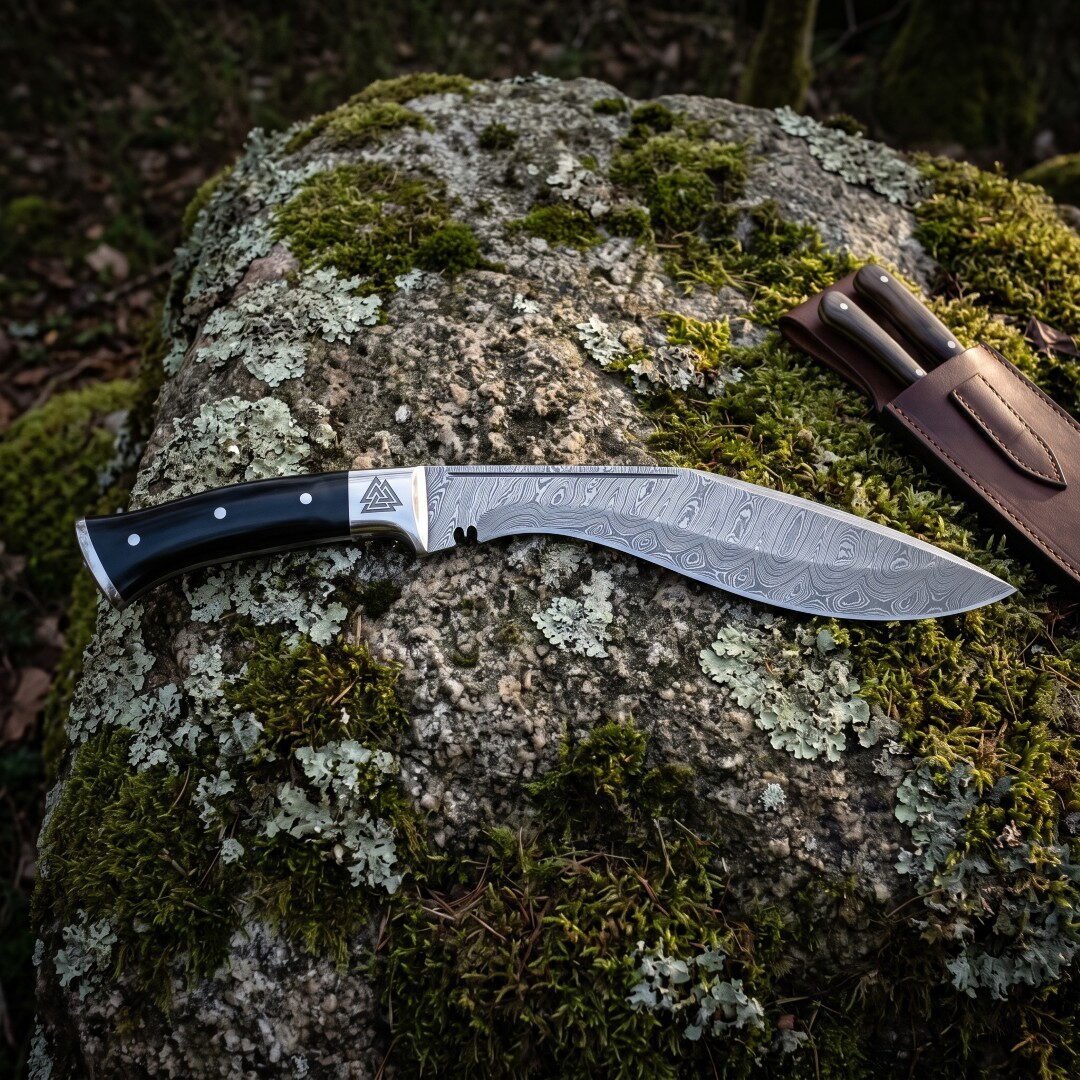
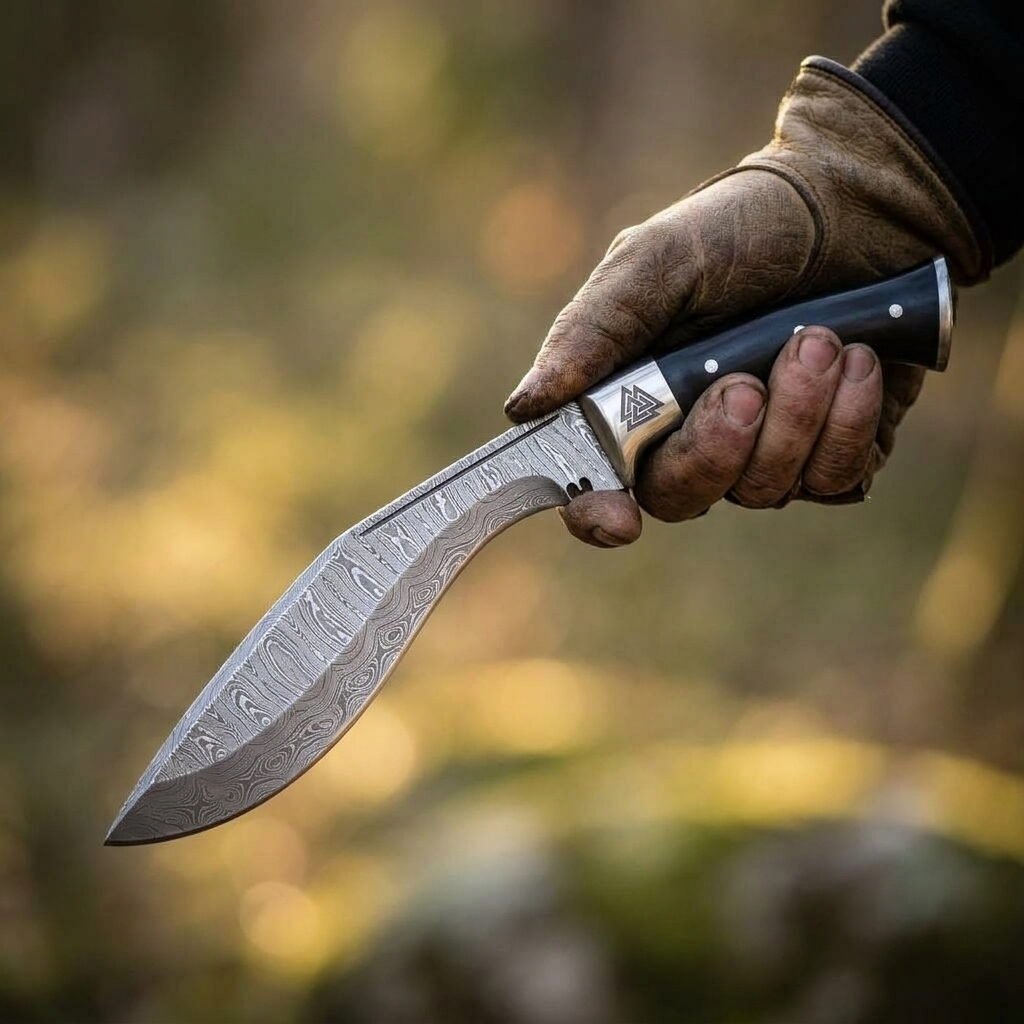
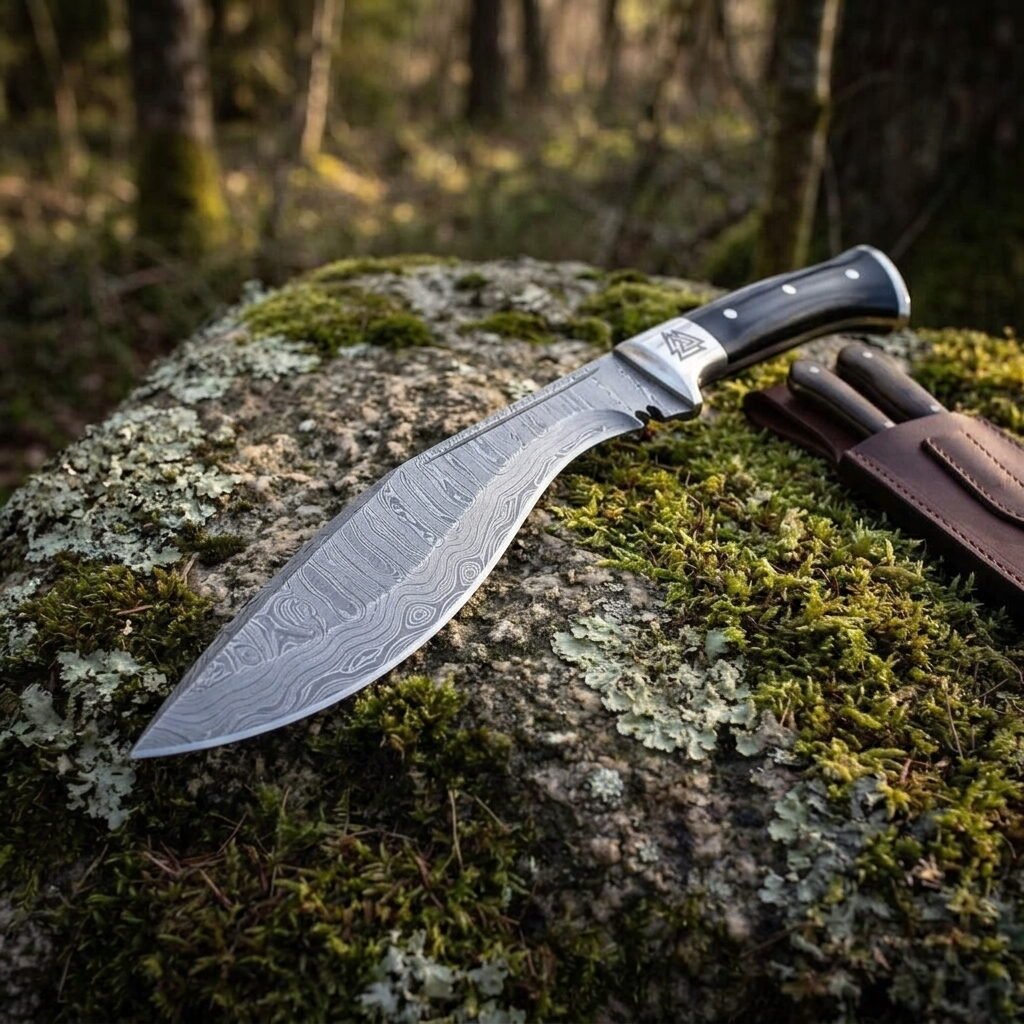
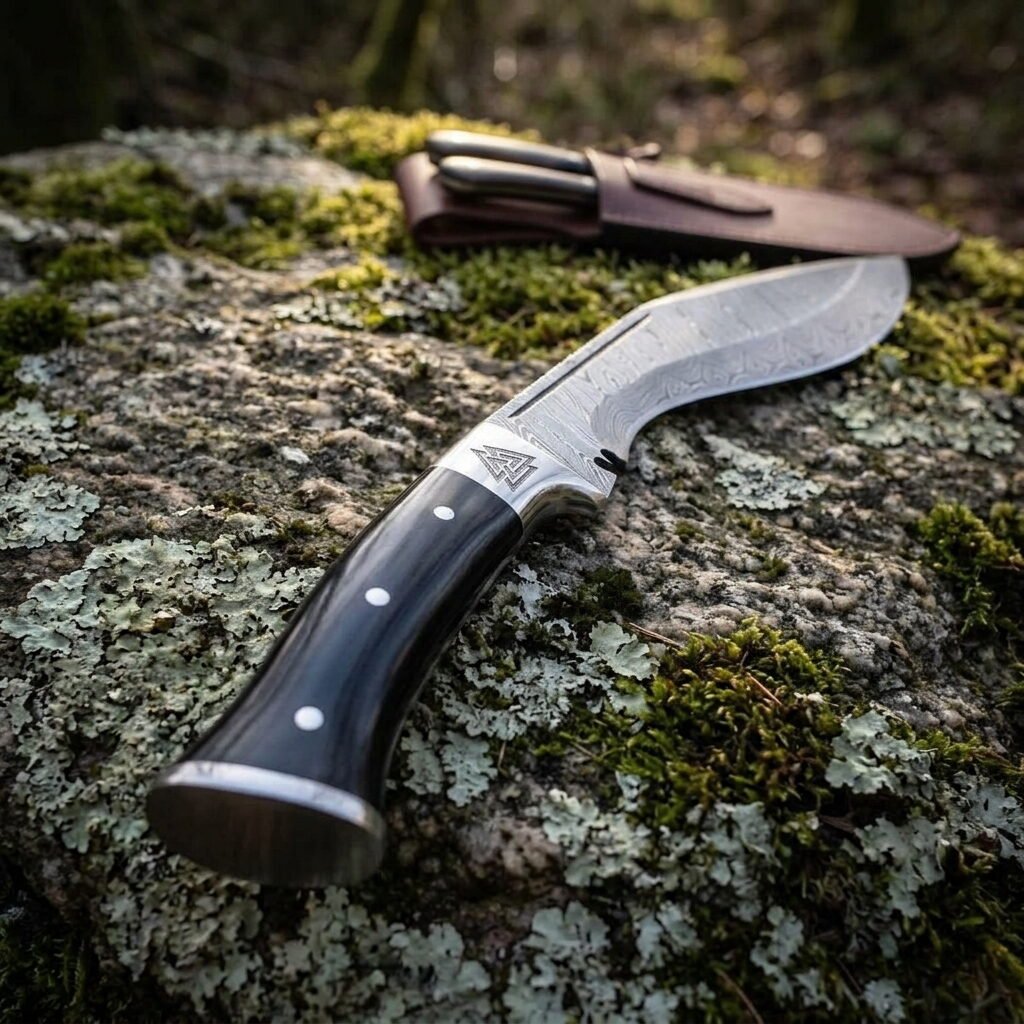
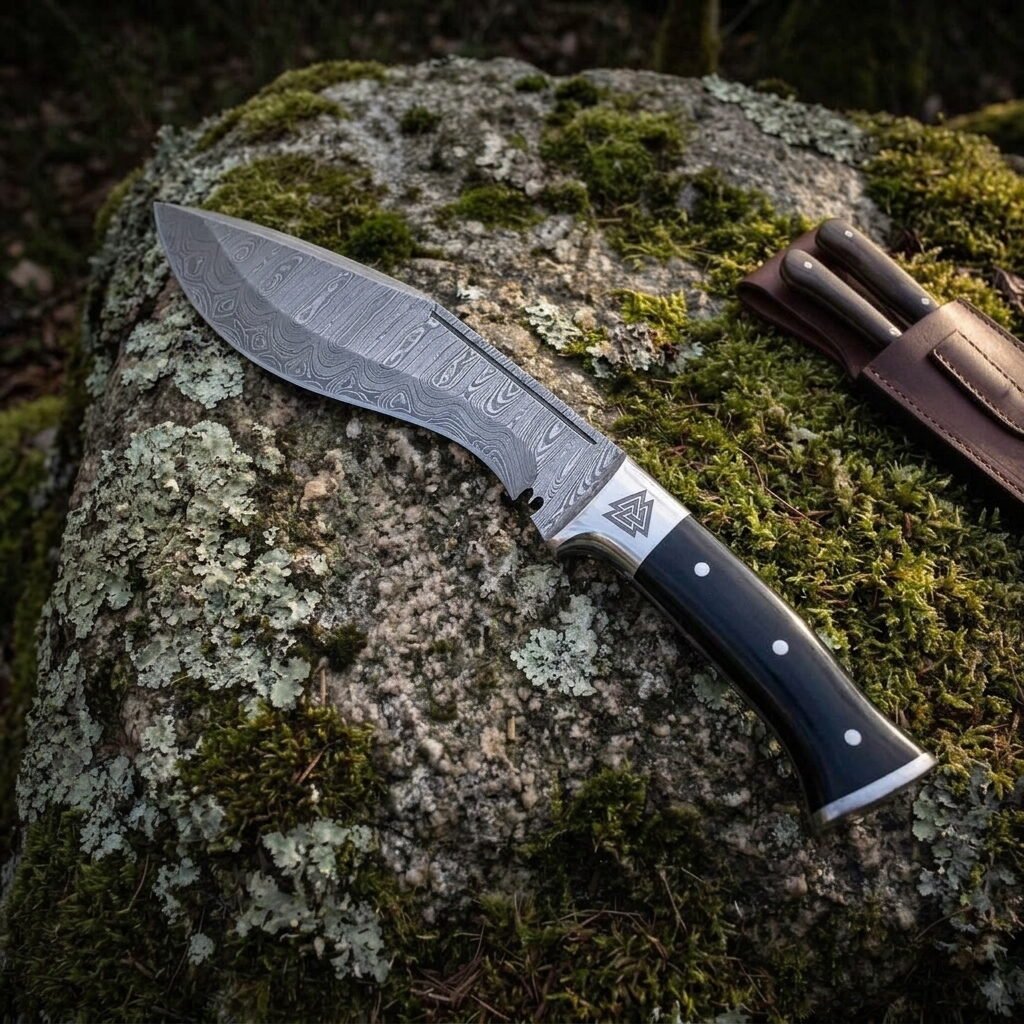
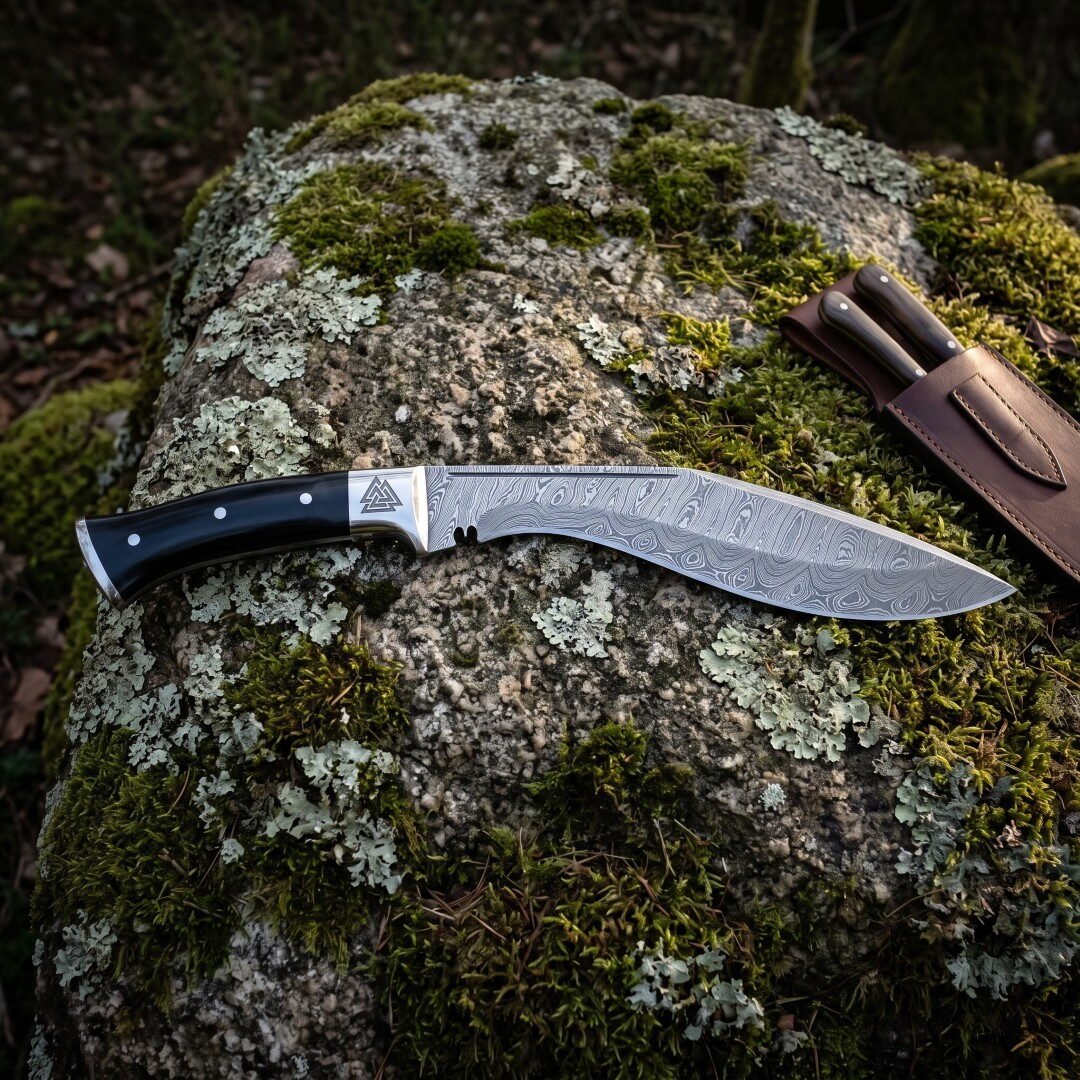
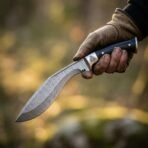
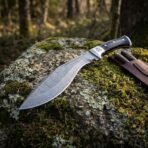
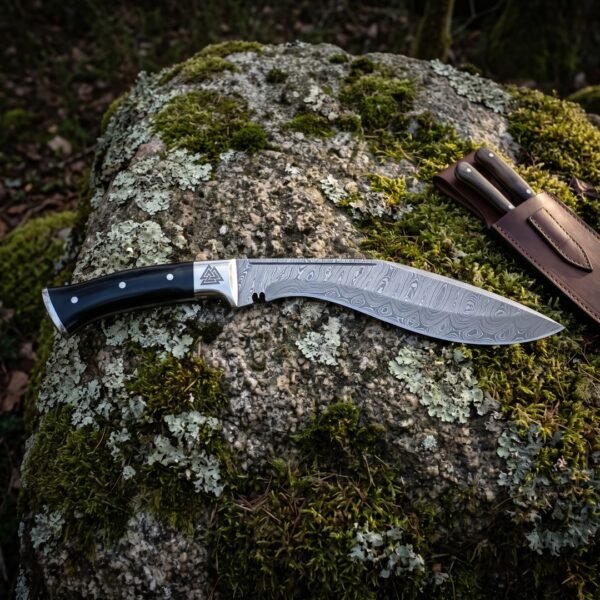
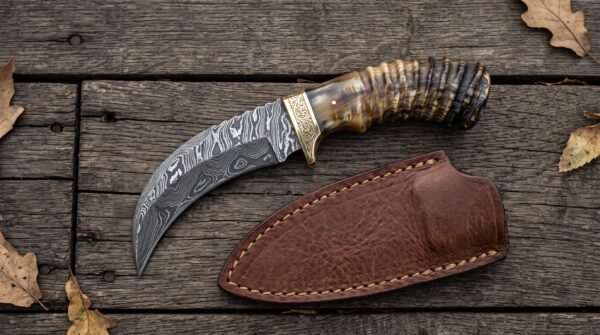
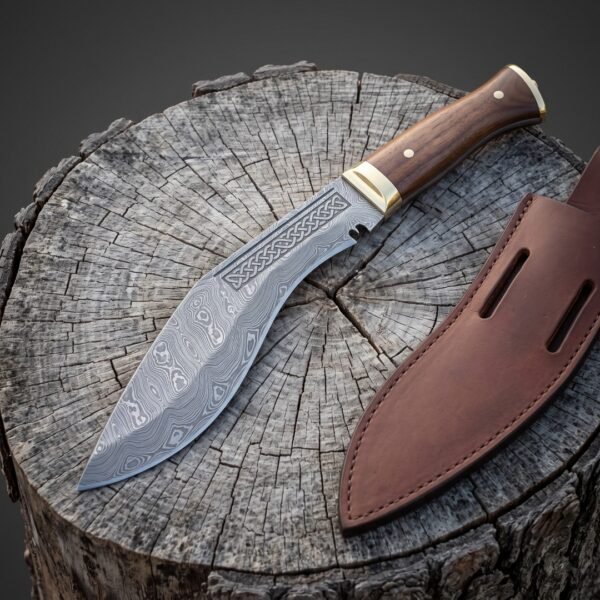
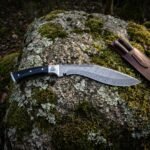
A forward curved chopping blade in pattern welded Damascus, a dark buffalo horn handle pinned through a steel bolster, and a stitched leather sheath carrying the two traditional companion knives in a front pouch. This is a kukri, the national knife of Nepal and the service blade of the Gurkha regiments since 1815, and almost every part of its shape exists for a mechanical reason rather than a decorative one.
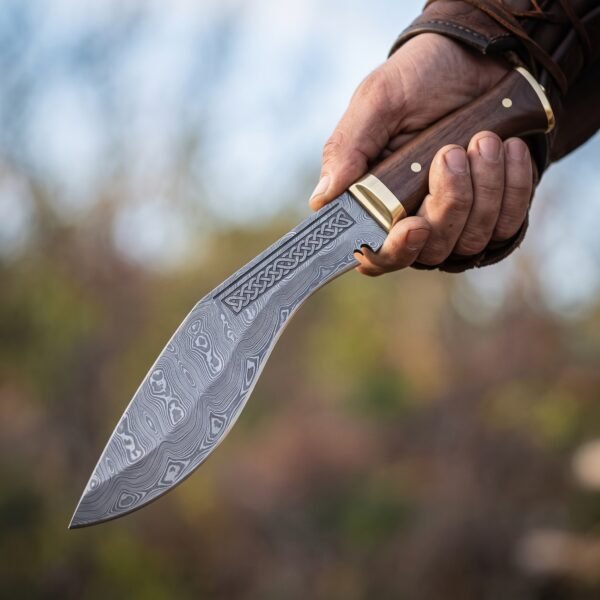
Start with the curve. Angling the blade forward moves the centre of mass ahead of your hand, which means that when you swing it the head of the blade arrives with far more energy than its weight suggests. A kukri of this size chops like a much heavier tool while still handling like a knife. Then look at the notch cut into the blade just in front of the handle. That is the cho, sometimes written kaudi, and it is not ornament. It stops a cut in the edge from running back into the tang, it gives sap and fluid a place to drain away from the grip rather than down onto your hand, and it puts a stress relief radius at the point where the blade meets the tang, which is the single most likely place for a hard use chopper to crack. The steel bolster just behind it carries an engraved Valknut. This one is forged, ground, etched, fitted and sheathed in a Czech Republic workshop. The bend, the cho and the reason the balance sits so far forward are in what is a kukri.
Specifications
| Blade material | Pattern welded Damascus, 1095 and 15N20, 58 to 60 HRC |
|---|
| Blade | Forward curved kukri blade with a cho notch at the base of the edge |
|---|
| Blade length | Approximately 11 inches along the curve |
|---|
| Overall length | Approximately 16 inches |
|---|
| Bolster | Polished steel bolster engraved with a Valknut |
|---|
| Handle | Black buffalo horn scales over a full tang |
|---|
| Pins | Three steel pins |
|---|
| Butt | Flared steel butt cap |
|---|
| Weight | Approximately 1 lb 8 oz for the kukri alone |
|---|
| Included | Karda utility knife and chakmak burnisher, both with matching horn handles |
|---|
| Sheath | Brown stitched cowhide leather with a belt loop and a front pouch for the companions |
|---|
| SKU | RK-1582 |
|---|
The karda and the chakmak
The two small knives in the front of the sheath are not accessories added to make the set look better. They are part of how a kukri has always been carried. The karda is the little one with an edge on it, a utility knife for the fine jobs a heavy chopper is useless at, cutting cord, trimming a strap, preparing food. The chakmak is the blunt one, and it is the more interesting of the pair. It is a burnisher, used to straighten and true a rolled edge on the kukri in the field without removing metal, in exactly the way a butcher uses a steel. Traditionally its hardened back was also struck against flint to throw sparks for a fire, which is why the tool survives on a knife set into the modern era when a small sharpening rod would have done the honing job on its own.
Both companions here have horn handles cut from the same stock as the kukri and pinned in the same way, and both sit in a stitched pouch on the face of the sheath.
Damascus steel and the Valknut
The blade is genuine pattern welded Damascus, forge welded from alternating layers of 1095 and 15N20 and then drawn, folded and shaped before grinding. The pattern is structural. It is the edges of those layers showing at the surface, which is why it flows across the whole blade and does not stop at the grind lines or the spine. The reason the layers show light and dark at all is nickel. 15N20 carries around two percent of it and 1095 carries none, so when the finished blade goes into an acid the 1095 darkens and the nickel bearing layers resist and stay bright. Nothing is added at that stage. The acid reveals what is already there. Heat treated to 58 to 60 HRC, this combination holds a working edge through a long day of chopping and comes back on a stone rather than needing a grinder.
The Valknut engraved on the bolster is three interlocking triangles, a symbol that genuinely does appear in Norse material culture, on Gotland picture stones and on the Oseberg ship burial carvings. What we cannot tell you is what it meant, because nobody knows. No Norse source names it or explains it, and the word Valknut itself is a modern Norwegian coinage rather than an Old Norse term. Anyone who tells you with confidence that it means one specific thing is guessing. It is a real Norse motif with a lost meaning, and we would rather say that than invent a story for it.
Engraving, runes and your own design
Use the rune converter on this page to turn a name, a date or a short phrase into Elder Futhark and we will cut it into the steel or the leather. If you would rather have a Viking pattern than a rune line, choose your own design in the engraving option above the add to cart button and tell us where it goes. Where a piece already carries an engraved design, your chosen engraving replaces it rather than sitting alongside it. On this knife the steel bolster carries the Valknut as standard and your engraving takes its place, and the face of the leather sheath will also take a name or a date. Details are on the engraving page.
Using it and carrying it
A kukri is swung, not pushed. Let the weight of the forward blade do the work and keep your wrist relaxed, and it will bite into green wood in a way that surprises anyone used to a straight bladed knife. The belly of the curve is the chopping zone. The section closest to the handle, just ahead of the cho, is where the blade is thickest and where you do the controlled work, carving points, splitting kindling with a baton, scraping. Keep the tip out of hard knots, because a thin forward tip on a heavy chopper is the part most likely to take damage.
The sheath carries on a belt through the loop on the back. Because the blade is heavy and forward weighted, it hangs better on a proper belt than on a light one, and it wants to sit far enough back on the hip that the tip does not catch when you sit down.
Care
Damascus is bare high carbon steel and it rusts. Wipe the blade after every use and especially after cutting green wood, since sap is acidic and will mark an etched surface overnight. A thin film of mineral oil, camellia oil or paste wax on the blade after use is all it takes. Do not store the knife inside the leather sheath for long periods, because leather holds moisture and tanning residues against the steel and will etch a permanent shadow into the blade. Sharpen on a stone following the existing convex bevel rather than flattening it, since the convex edge is what stops a chopper wedging in the cut. Feed the leather with conditioner occasionally, and wipe the horn scales with a little wax once a year to stop them drying out and checking. Full guidance is on the steel care page. A curved edge is sharpened in segments, which sharpening a curved blade walks through.
Made in the Czech Republic
This is a handmade piece from the Czech Republic, made in a workshop that still forges, grinds and finishes by hand instead of stamping parts out. The smiths there have kept the older way of working, and the wood, horn and leather are shaped and fitted by hand as well. Two pieces of the same design will never be identical, and that is part of what you are buying.
Ransack Viking is a United States company. We handle the import ourselves, look over every piece when it lands and ship from our warehouse in Chicago, Illinois. Engraving is done in the United States after the piece arrives, so your design goes on before we send it out.
A note on handmade variation
This knife is hand made, not machine made and not bulk produced, so what arrives will not be a pixel for pixel copy of the photograph. The Damascus pattern is unique to the billet it came from and can never be repeated, the buffalo horn has its own colour banding and translucency, the leather takes dye in its own way and the cho is filed by hand. The dimensions, the material and the build are the same every time. The character is not.
Frequently asked questions
Is this a Viking knife?
No, and we will not pretend it is. The kukri is Nepalese and it is the service knife of the Gurkha regiments. We have engraved a Norse Valknut on the bolster because customers ask for it, but the knife itself belongs to Nepal and it is listed here honestly as what it is.
Is the blade real Damascus?
Yes, genuine pattern welded 1095 and 15N20. You can tell because the pattern runs continuously across the grind, over the spine and around the tip. A printed or surface etched pattern stops wherever the steel has been cut into.
What are the two little knives for?
The karda is a small utility knife for the fine work a heavy chopper cannot do. The chakmak is a blunt burnisher for straightening a rolled edge in the field without removing metal, and traditionally for striking sparks off flint. Both are included and both sit in the pouch on the sheath.
What is the notch near the handle?
It is the cho, or kaudi. It stops a nick in the edge running back into the tang, it drains fluid away from your grip and it acts as a stress relief point where the blade meets the handle. It is functional, not decorative.
Does it come sharp?
Yes. It ships with a working convex edge at 58 to 60 HRC, ready to chop. Sharpen on a stone following that convex bevel rather than trying to put a flat V grind on it.
How long before it ships?
One to two weeks of processing, because each billet is welded, drawn and ground to order, the horn is fitted to that tang and the sheath is stitched to that blade. Engraving adds a few days. Shipping is free within the United States and returns are accepted within seven days.
What is in the box
- One pattern welded Damascus kukri with buffalo horn scales and a steel bolster
- One karda utility knife with a matching horn handle
- One chakmak burnisher with a matching horn handle
- Stitched cowhide sheath with a belt loop and a front pouch for the companions
- Light oil sachet and a care card for etched Damascus
- Forged and finished in the Czech Republic
Explore the range
More working blades are in hunting knives, the Norse edged work is in Norse arms, the chopping tools are in Viking axes, and everything we can cut a name into is in engraved and personalised. Pattern welding, hardness and sharpening are covered in the guides.
Also in this part of the catalogue
Next along the rack is the Pitchgrove kukri knife, 16 inches overall. For a straight comparison, see the Fellcarve kukri knife, pattern welded Damascus. Worth putting side by side with this is the Coilbrand kukri knife, pattern welded Damascus.
If you are putting a set together, the Stormknot throwing knife sits alongside it. Or start from a blank sheet on the custom Damascus knife page.
Best knife I’ve ever owned. Highly recommend this one.
My whole family was impressed when I unboxed it. Fit and finish is museum quality. You can tell real craftsmen made this by hand. The buffalo horn handle feels amazing and the balance is perfect. If you’re on the fence just get it. You won’t regret it.
I collect stuff like this and this knife is on another level. Weight and balance make it feel like a real functional piece not some cheap replica. So worth it.
Absolutely blown away by this knife. Weight and balance make it feel like a real functional piece not some cheap replica. So worth it.
Perfect gift. Perfect quality. No complaints. The buffalo horn handle feels amazing and the balance is perfect. This will be a family heirloom for sure.