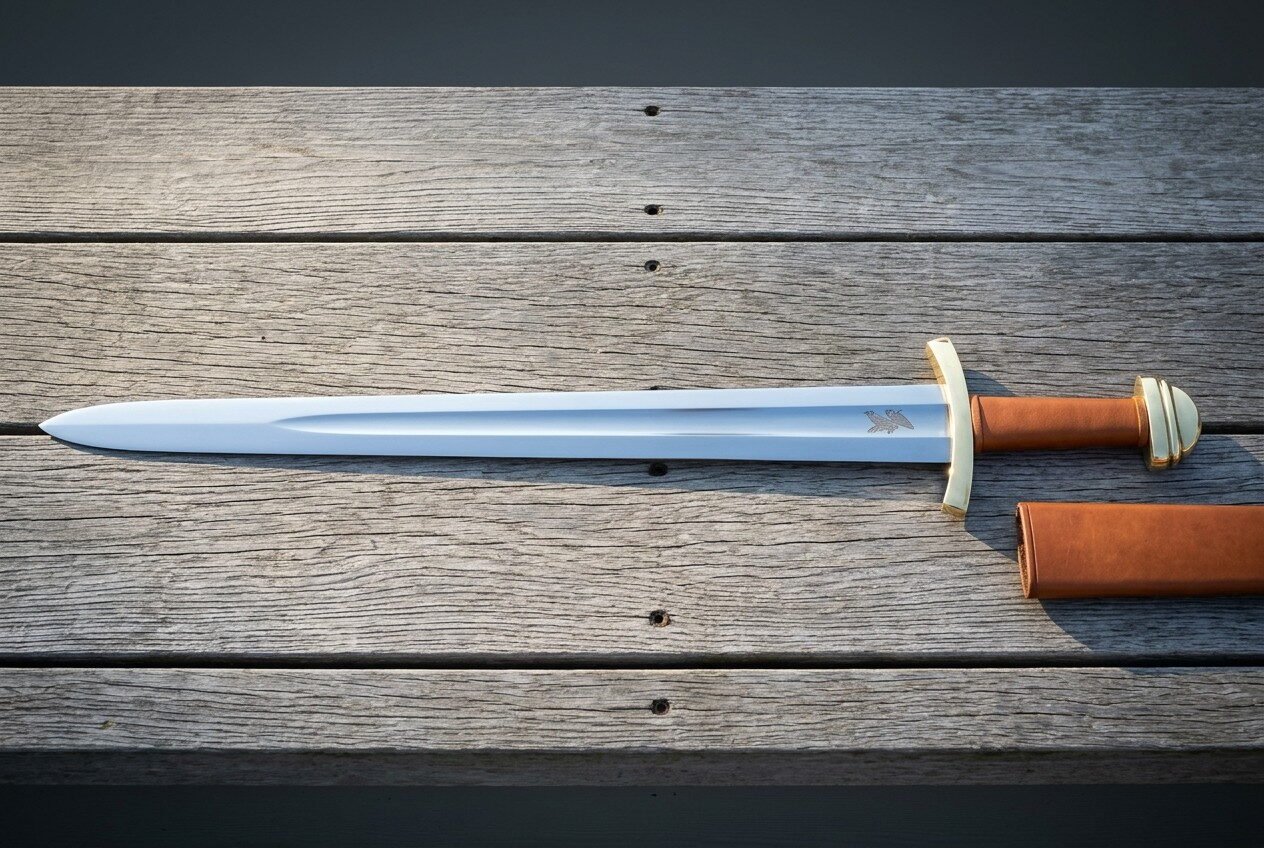
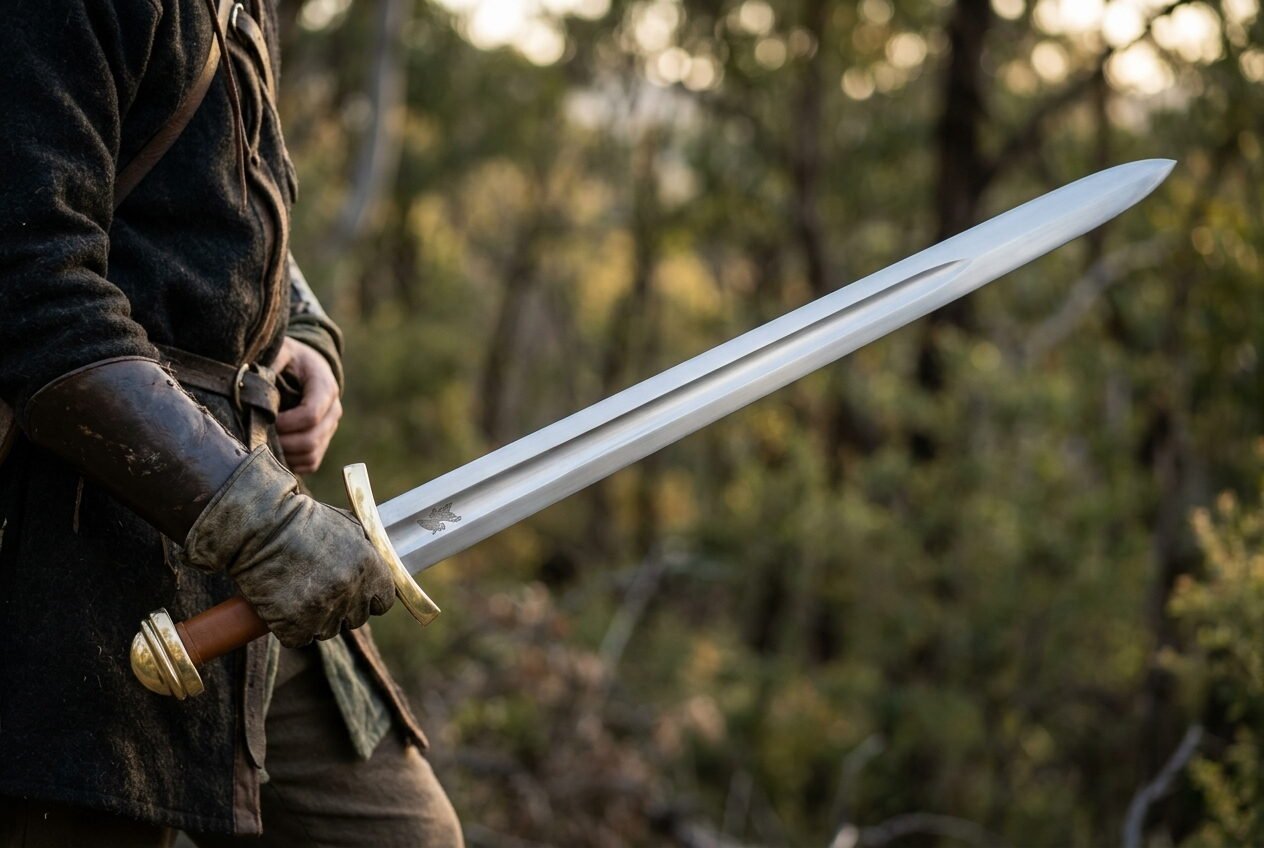
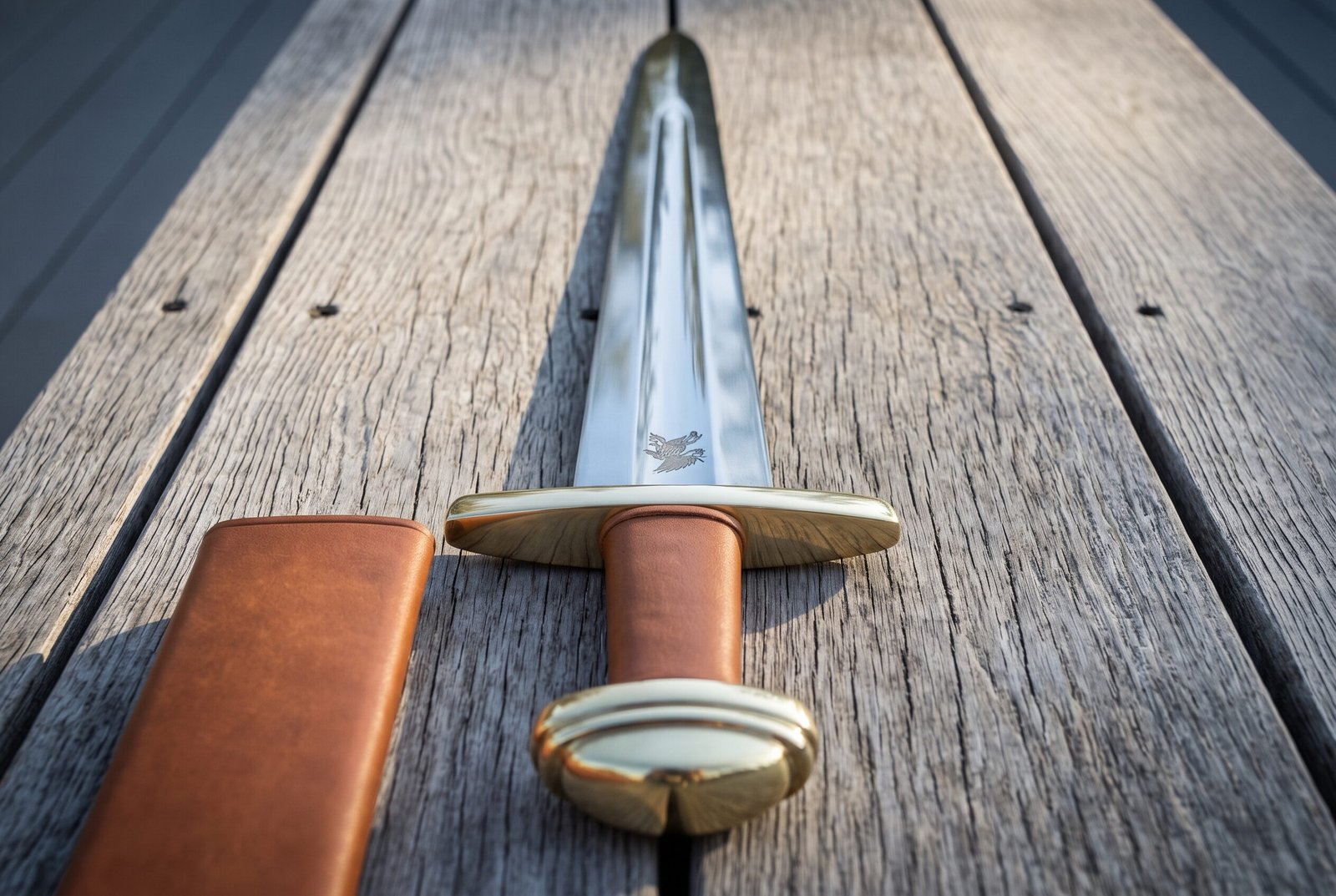
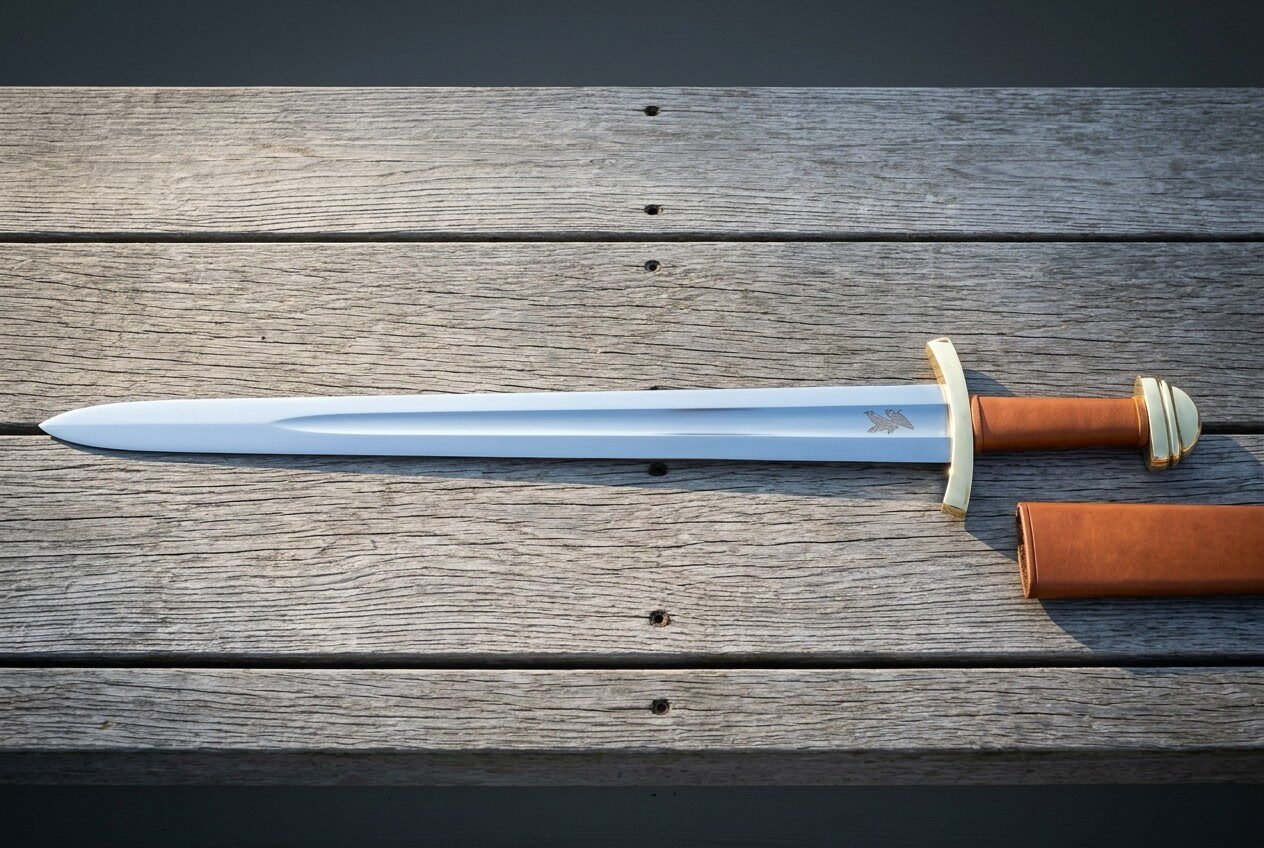
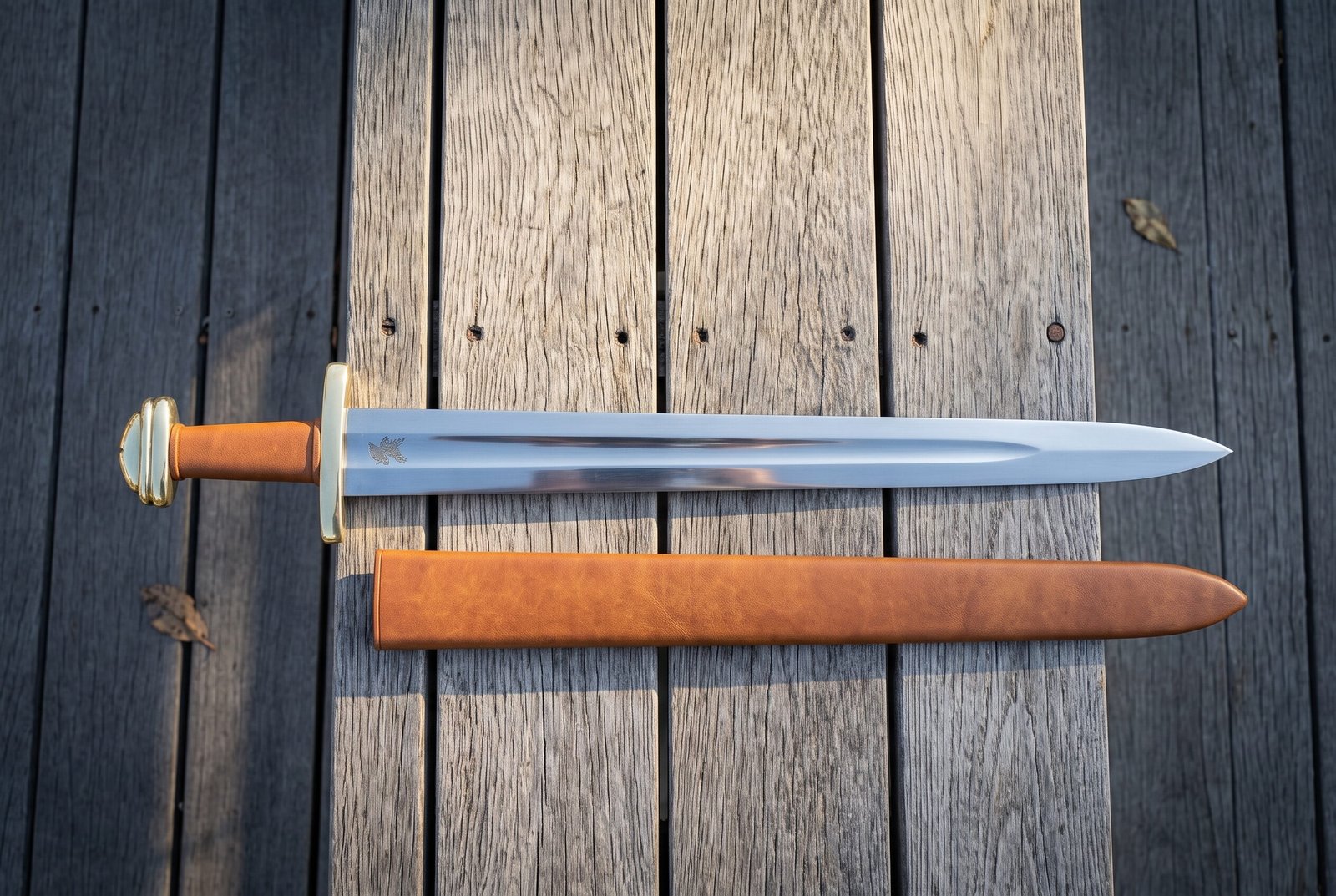
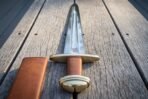
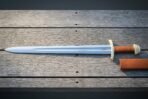
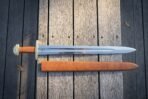
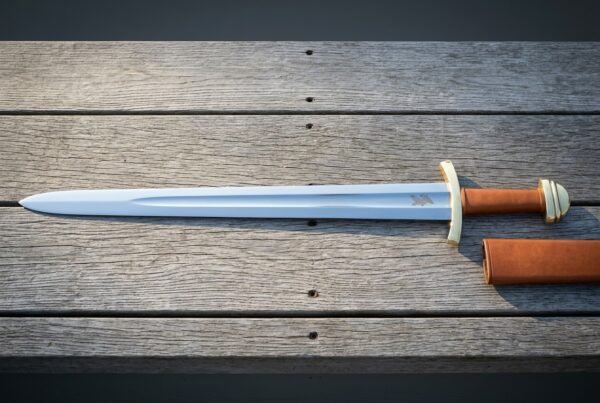
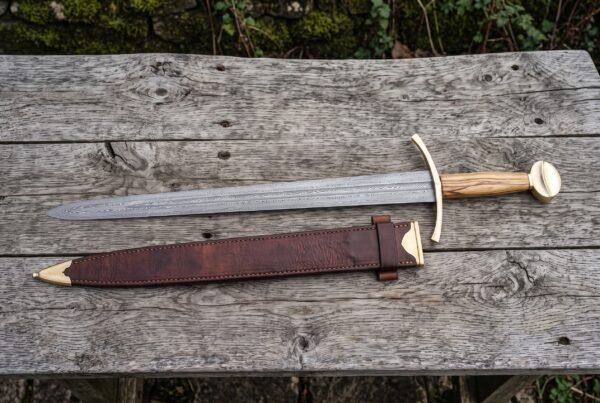
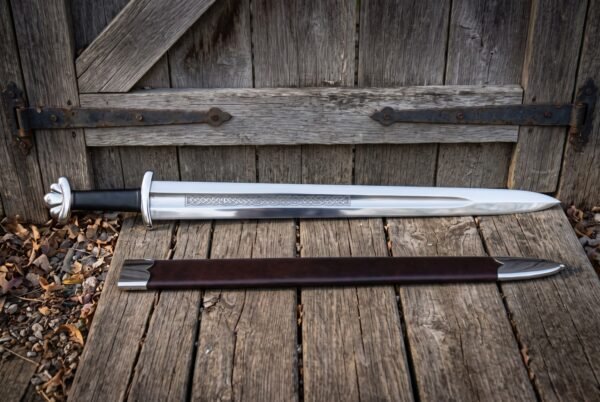
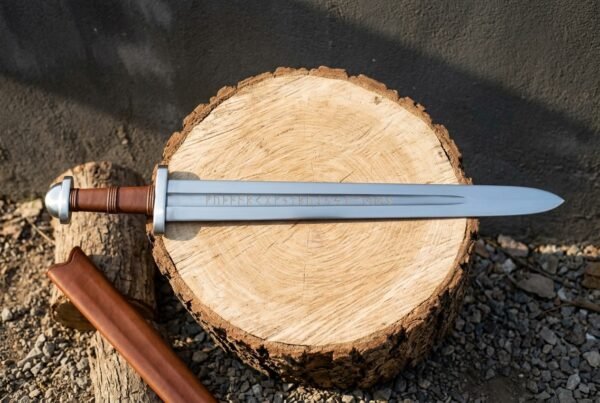
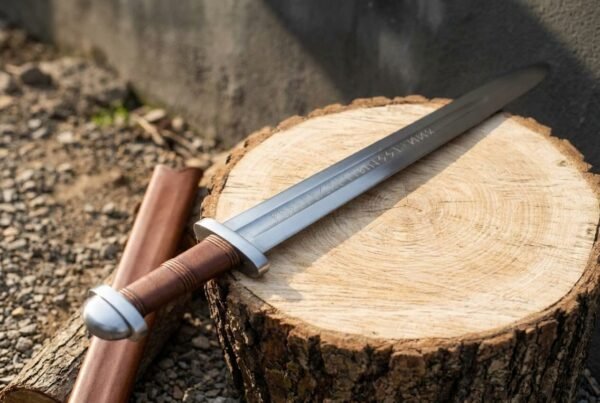
The Longkeel is a broad bladed Norse sword of the late viking age type, hilted in solid brass with a curved lower guard and a brazil nut pommel split by a groove across its crown. The grip is tan leather over a shaped core. A pair of ravens is etched into the flat of the blade where the scabbard throat would leave them showing, and the sword ships with a full tan leather scabbard.
The brazil nut pommel is the marker of a real change in how swords were built. Through the ninth and tenth centuries Norse pommels were assembled from a base bar and a separate lobed upper piece riveted on top, which is complicated and which leaves seams. By the eleventh century smiths were making the whole pommel as one solid mass with a curved crown, the shape antiquarians later named after the nut. It is stronger, quicker to fit and it hangs its weight closer to the hand.
Forged, ground, heat treated, hilted and sharpened in the Czech Republic. It ships with the fitted scabbard and a care card. If the Viking swords brought you here, the Norse arms are the obvious next stop.
Specifications
| Blade material | 1095 high carbon steel, hardened and tempered to 54 to 58 HRC |
|---|
| Blade length | Roughly 30 inches, broad profile with a wide shallow fuller |
|---|
| Overall length | Roughly 36 inches including grip and pommel |
|---|
| Grip | Roughly 4 inches, plain tan leather over a shaped wooden core |
|---|
| Guard | Solid brass lower guard, curved toward the blade and flared at the ends |
|---|
| Pommel | Solid brass brazil nut pommel with a stepped base and a grooved crown, peened over the tang |
|---|
| Etching | Twin ravens on the flat of the blade above the guard |
|---|
| Scabbard | Plain full length tan leather over a wooden core, hand stitched, no metal fittings |
|---|
| Included | Sword and fitted leather scabbard |
|---|
| SKU | RK-1717 |
|---|
How a Norse hilt is actually held together
There is no glue and no thread in this hilt, and that is not a stylistic choice. The tang is one continuous piece of the same bar the blade was forged from. It passes through the brass lower guard, through the shaped wooden grip core, through the base of the pommel and out of the crown. The last quarter inch is then heated and hammered over, spreading it into a rivet head that sits in a countersink. That single operation, the peen, squeezes every component between guard and pommel and puts the whole assembly permanently in compression.
It matters because a sword hilt lives under shock. A threaded pommel nut can back off, and glued components can creep with heat and humidity. A peened tang cannot loosen without the steel itself deforming. Every excavated viking hilt worth the name is built this way, and the archaeologists who study them can read the peen to tell how a sword was assembled and whether it was ever repaired. Jan Petersen built his whole 1919 typology of viking swords on hilt furniture for exactly this reason: the hilt is the part that carries the maker and the fashion.
The steel, the brass and the scabbard
The blade is 1095 high carbon steel, forged, normalised, quenched and tempered into the 54 to 58 HRC band. That is a working hardness rather than a showpiece one. It gives an edge that takes a stone easily and a blade that flexes and returns instead of taking a permanent bend. 1095 contains no chromium, so it is bright, it sharpens fast and it will rust if you leave it damp. A rag and a little oil is the whole maintenance programme.
Guard and pommel are solid brass, filed to shape, fitted to the tang and polished by hand. The flare on the ends of the guard is functional, giving the hand something to register against so the sword sits the same way every time you pick it up. The scabbard is full length tan leather formed over a carved wooden core and hand stitched down the back. The wood is what protects the edge and holds the mouth open. Leather alone would collapse and dull the blade every time it went in.
Engraving, runes and your own design
Use the rune converter on this page to turn a name, a date or a short phrase into Elder Futhark and we will cut it into the steel, the leather or the wood. If you would rather have a Viking pattern than a rune line, choose your own design in the engraving option above the add to cart button and tell us where it goes. Where a piece already carries an engraved design, your chosen engraving replaces it rather than sitting alongside it.
The wide shallow fuller on this blade is a natural channel for a rune line and takes a long one without crowding. The brass pommel crown will hold a short bindrune. The leather scabbard can be stamped along its length, which is a good option if you would rather leave the steel clean. If you want your own design instead of the ravens, it replaces them. Details are on the engraving page.
Handling and balance
This is a broad blade and it feels like one. The point of balance sits about four and a half inches ahead of the guard, further out than the Emberhilt, which makes the sword hit harder on a cut and take slightly more effort to recover. That is the correct trade for a wide profile blade of thirty inches. It wants to be swung from the shoulder and elbow rather than flicked from the wrist.
The four inch grip is a true single hand length, with the brass guard and the mass of the brazil nut pommel closing on the hand front and back. Understand what you are buying. This is a sharpened collector, display and dress reenactment sword built and balanced by hand. It is not sold for full contact sparring, blade on blade drills or hard target cutting, and it should never be used that way.
Care
Oil the blade every time you handle it. A polished 1095 flat will take a fingerprint and turn it into a permanent etch inside a week in a humid room, and humid summers taught us that lesson properly. Camellia oil, light machine oil or any purpose made blade oil works. Wipe, do not rub hard, and pay attention to the area just above the guard where hands rest. There is more on steel care.
Store the sword out of its scabbard. Leather is hygroscopic and will trap moisture against steel over months. Keep the scabbard fed with a neutral leather balm twice a year so it does not dry and crack at the mouth. The brass darkens to a warm patina on its own, which is what most collectors prefer. Brass polish brings it back to bright, applied on a cloth and kept off the leather and the blade.
Made in the Czech Republic
The work behind this piece happens in a Czech Republic workshop that has kept to the old methods. Steel is forged and heat treated by hand, the grind is taken down by eye rather than by machine, and the handle, fittings and sheath are cut and finished one at a time. Because of that, every piece carries small marks of the hand that made it.
Ransack Viking is a United States company. We import direct, check each piece when it reaches us, and ship from our Chicago, Illinois warehouse. Engraving is added here in the United States after arrival, so the piece you receive is finished to your order.
A note on handmade variation
This is hand made, not machine made and not bulk produced, so what arrives will not be a pixel for pixel copy of the photograph. Hammer texture and grind lines land where the hand puts them. The fuller is cut by eye, so its depth breathes very slightly along the length. Brass polishes to its own tone and no two pommels reflect light the same way.
Vegetable tanned leather is the biggest variable. Tan can come out light russet on one hide and deep amber on the next, and the grain is the record of the animal. Blade length, overall length, steel, hardness, hilt construction and scabbard build are identical every time. What changes is the character. There is more on that in how to hang a blade on a wall, and in why a full tang matters if you want the background.
Frequently asked questions
How is this different from your other viking sword
Mainly the hilt and the blade width. This one has a solid brazil nut pommel and a curved flared guard on a broader blade with a wide shallow fuller, so it balances further forward and cuts heavier. They are two distinct swords, not two photographs of one.
Is it sharp out of the box
Yes, keen along the full length and to the point. Treat it as sharp from the moment it is unwrapped.
Can I use it in a reenactment bout
Not in contact. It is correct in weight and profile for dress and display in a kit, but it is a sharpened sword and it is not built for blade on blade work.
Is the scabbard included
Yes. The full length tan leather scabbard over a carved wooden core ships with the sword and is fitted to that individual blade.
Can the pommel come loose
It cannot loosen without deforming the steel. The tang is peened over the pommel crown, which puts the whole hilt in compression rather than relying on a thread or an adhesive.
How long does shipping take
One to two weeks before it leaves us, because the blade is forged and the hilt fitted after you order. US shipping is free.
What is in the box
- One hand forged 1095 Norse sword with solid brass guard and brazil nut pommel
- One full length tan leather scabbard over a carved wooden core
- Care card covering oiling, storage and leather feeding
- Lifetime warranty against defects in forging, grind, heat treat and fittings
- Forged and finished in the Czech Republic
Explore the range
See the rest of the viking swords, the arming swords, the wider Norse arms, and the guides for more on hilt types and peened tangs.
If this one is not it
Another in the same line is the Emberhilt Viking sword, forged from 1095. Next along the rack is the Oathbright Viking sword, 30 inches overall. For a straight comparison, see the Knotfell Viking sword, 30 inches overall.
The Wyrmcoil broadsword covers the other half of the same kit. Pick the steel, the length and the fittings yourself on the custom Viking sword page.

I collect stuff like this and this sword is on another level. 1095 Steel blade holds a razor edge right out of the box. Will definitely order again for another gift.
Photos don’t do this sword justice at all. The wood handle feels amazing and the balance is perfect. Ordered from Ransack Viking before and the quality stays consistent every time. Even the small engravings are crisp and clean. You can tell it’s real Czech blacksmith work and shipping from the States made delivery painless. Highly recommend this one.
My whole family was impressed when I unboxed it. So worth it.