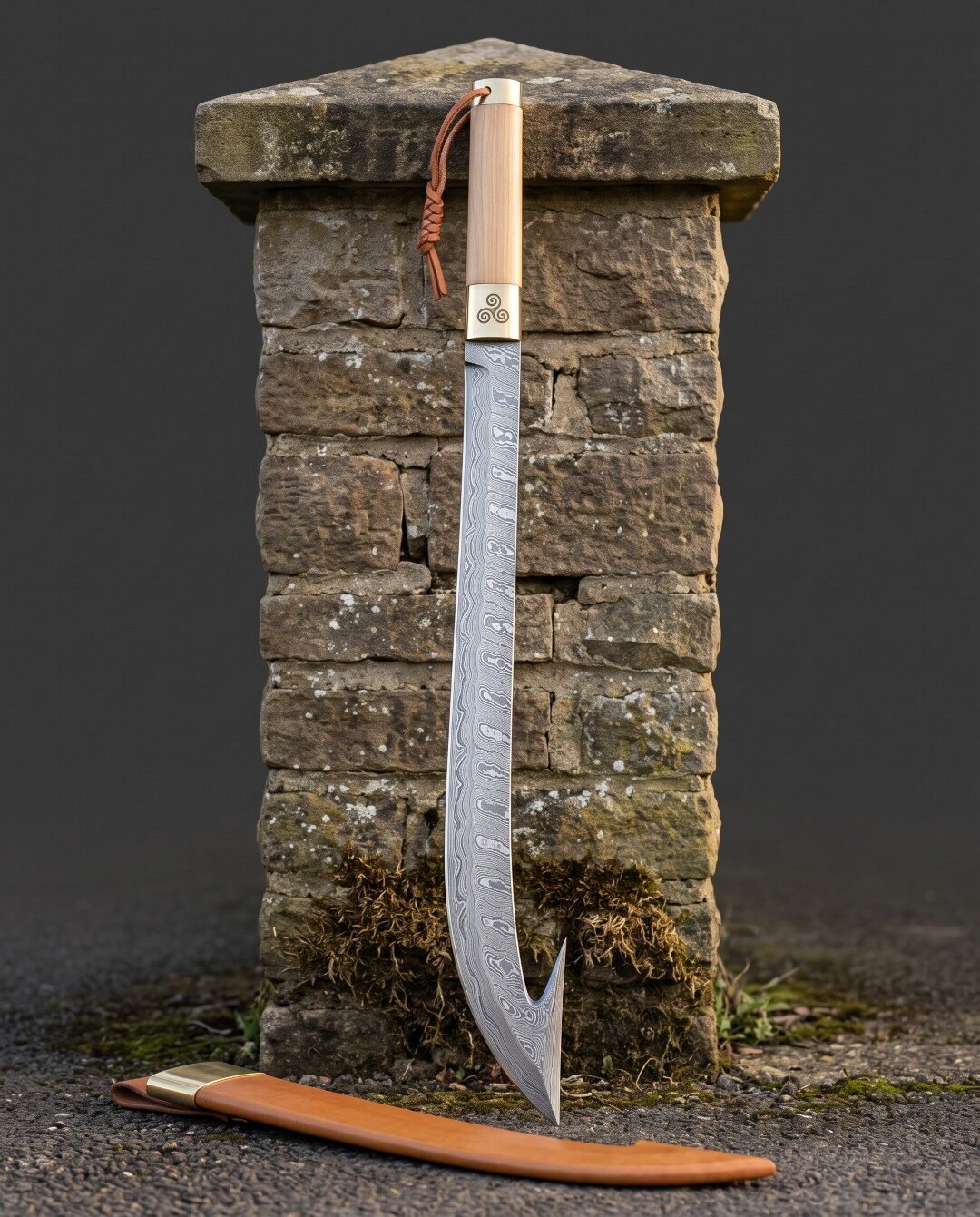
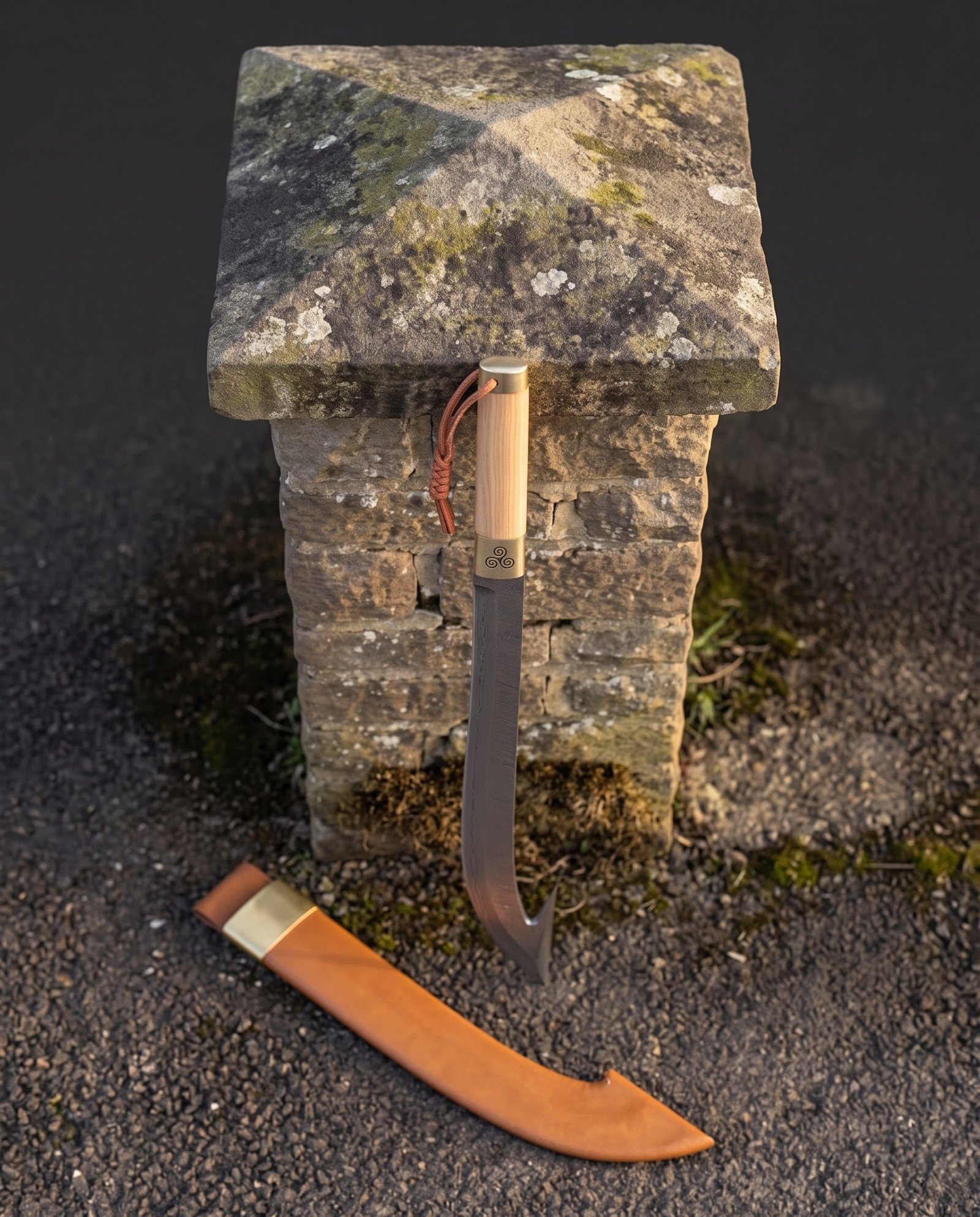
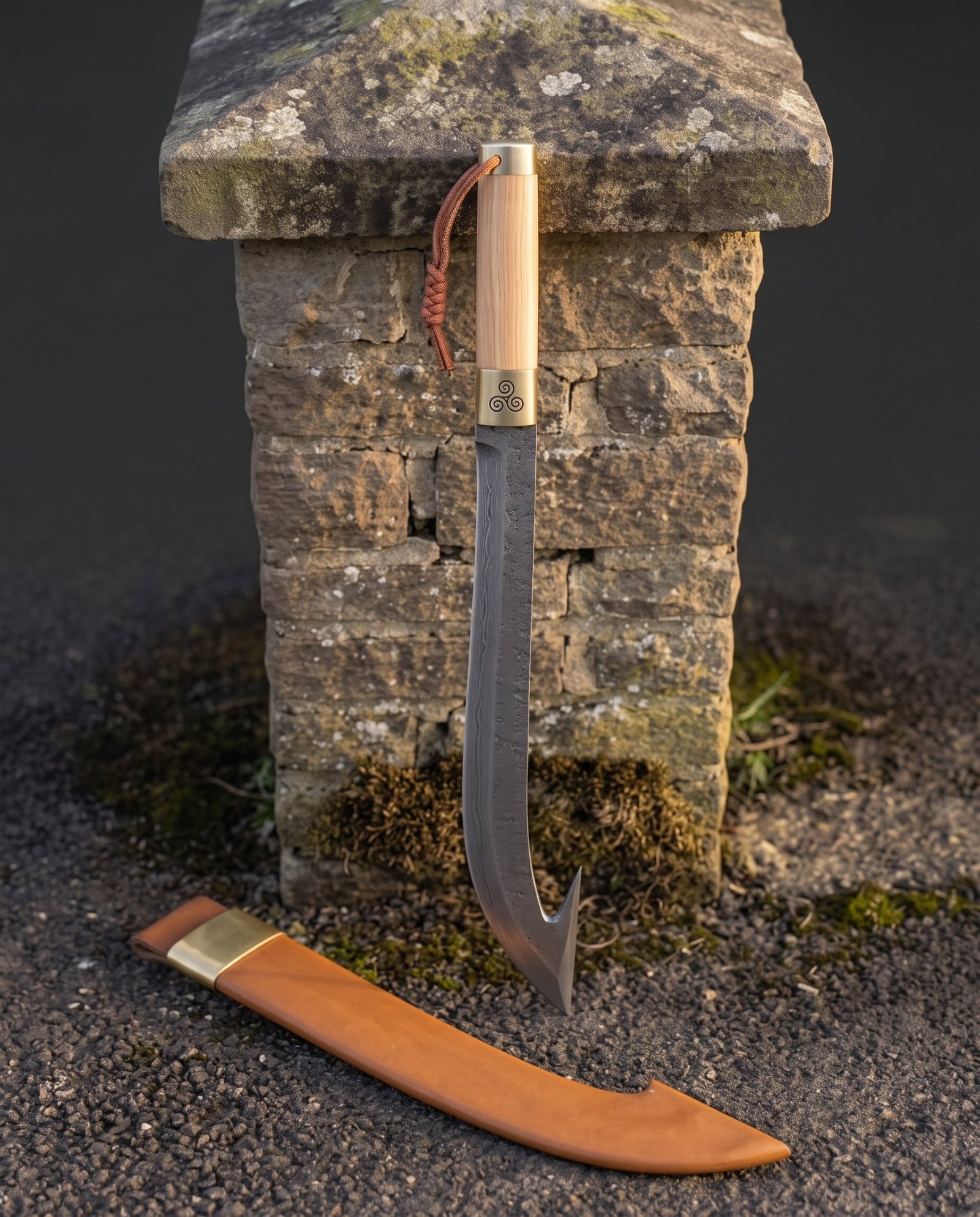
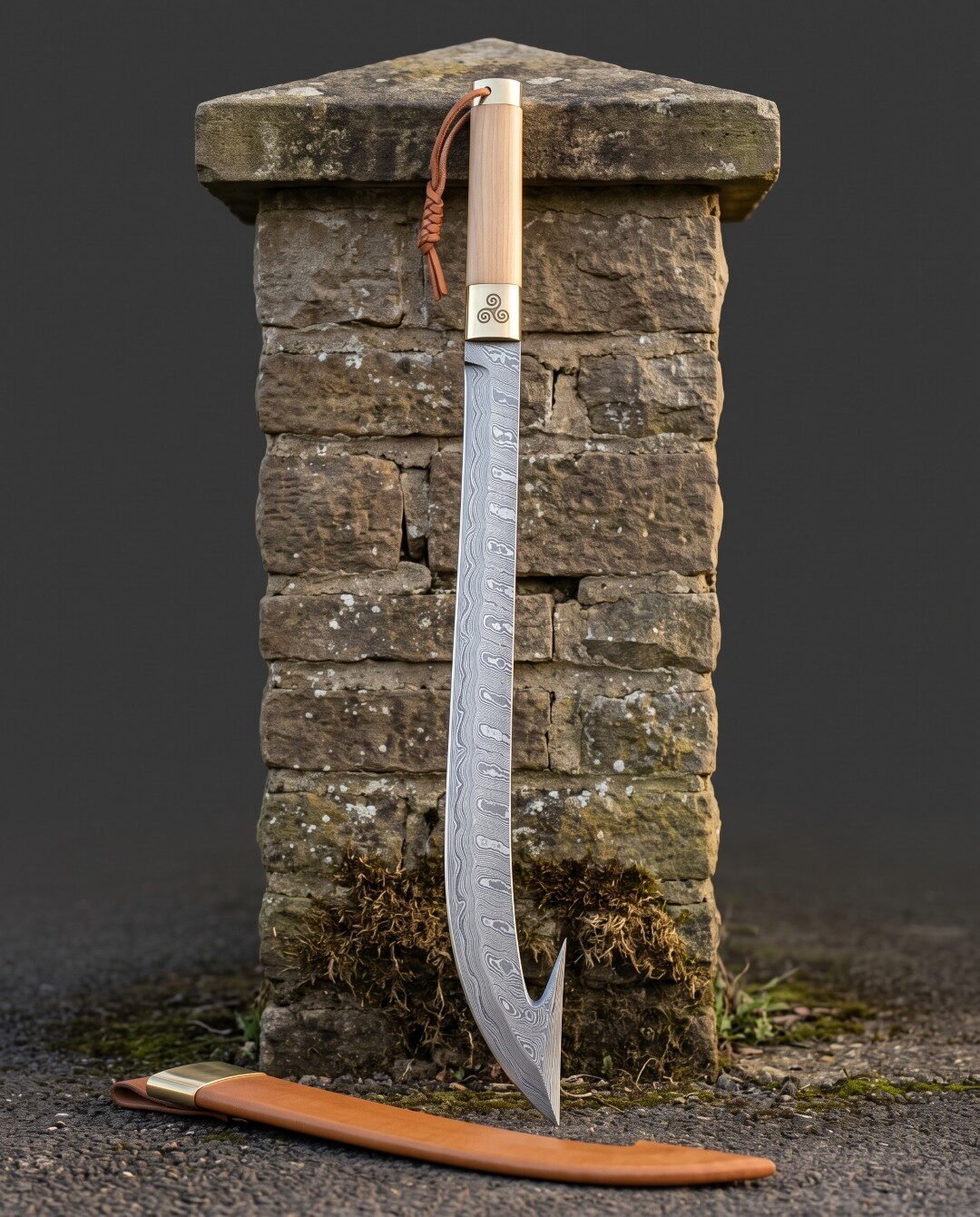
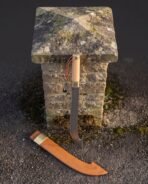
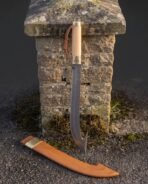
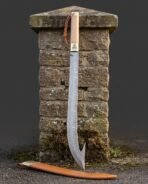
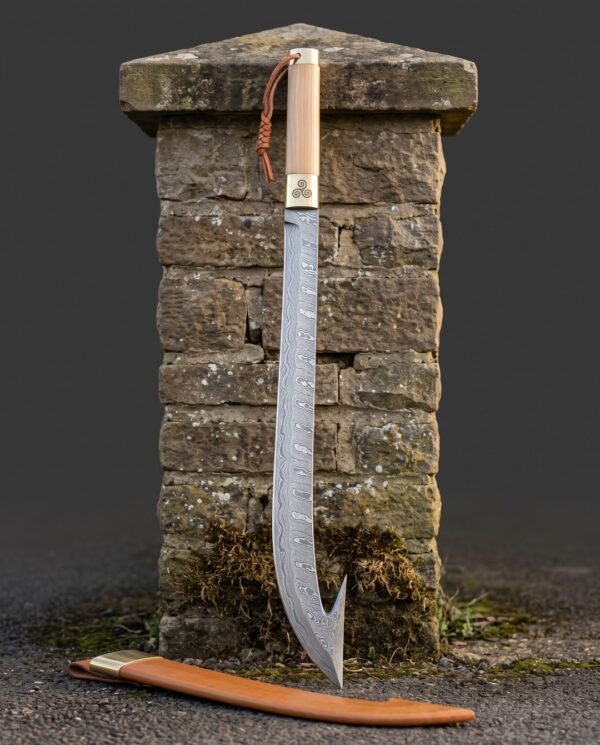
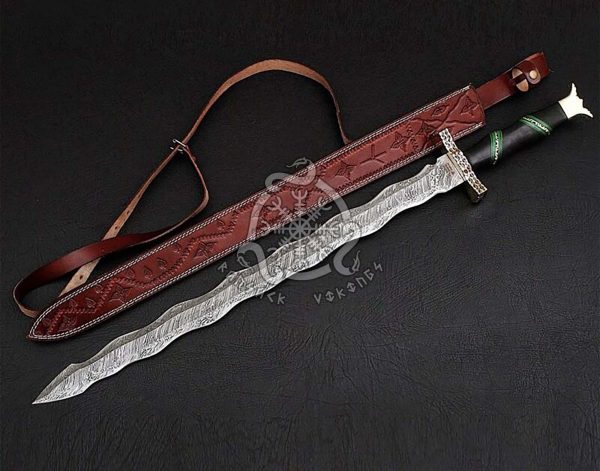
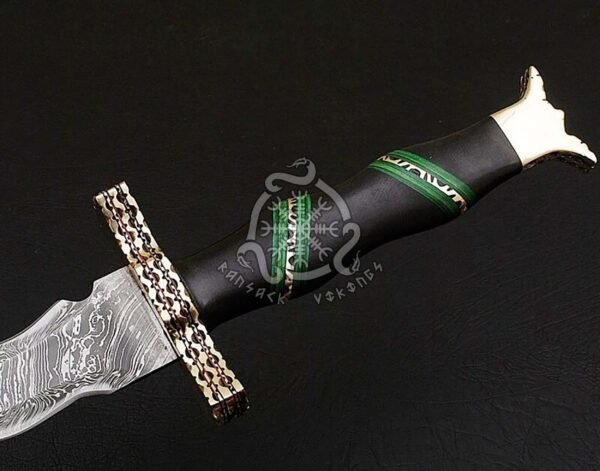
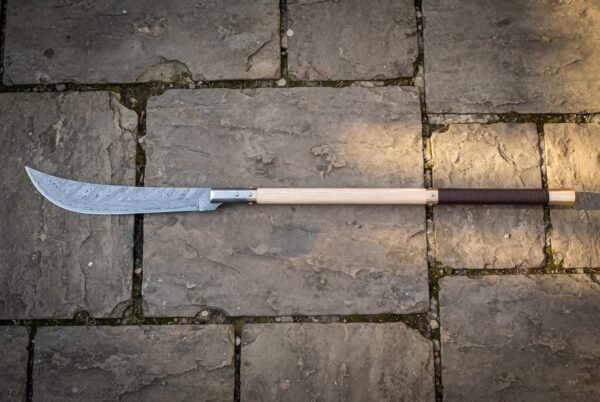
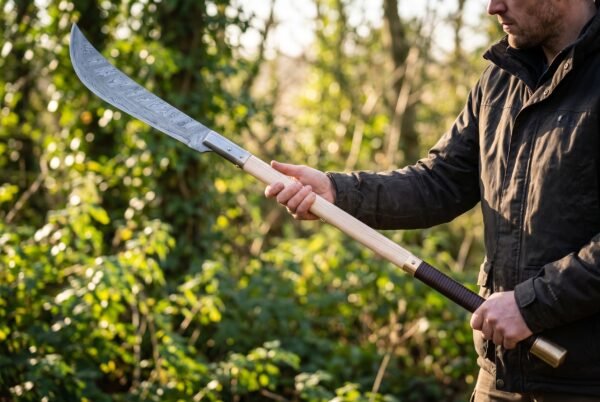
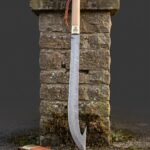
The Talonsweep is a Damascus sabre with a deep forward curve, a single edge along the outer sweep, and a barbed notch cut into the spine a few inches back from the point. There is no crossguard. The tang runs into a plain pale hardwood grip held by a brass ferrule that carries an engraved triskele, and a leather thong loops through the top of the handle. A tan leather scabbard with a brass throat comes with it.
Guardless sabres with a straight wooden handle and a heavily curved blade turn up independently in several places, because the same problem produces the same answer. If the sword is used with a big open swing rather than in a bind, a crossguard adds weight where it does you no good. Drop it, keep the grip long and simple, and let the curve do the work. The notch near the point belongs to the same family of thinking as the recurved tips on Chinese dao and the flared kukri profile, and it does two measurable things which are covered below. This one is forged, welded, ground, heat treated and fitted by hand in the Czech Republic, and it ships with the leather scabbard shown and our lifetime warranty against defects in forging, grind, heat treat and fittings.
Curved cutting blades run from the shamshir to the sabre, and the curved blades explained untangles the family. The triskele is the three legged spiral and it is older than the Norse use of it, which the symbols guide explains. Deeper curves of the same family sit in the scimitars.
Specifications
| Blade material | 1095 and 15N20 pattern welded Damascus |
|---|
| Hardness | 58 to 60 HRC |
|---|
| Pattern | Ladder style Damascus, a row of repeated rungs running down the middle of the blade |
|---|
| Overall length | About 36 inches |
|---|
| Blade length | About 26 inches measured along the curve |
|---|
| Blade type | Single edged with a deep forward curve and a barbed spine notch near the point |
|---|
| Handle | Plain pale hardwood, about 10 inches, with a brown leather wrist thong |
|---|
| Fittings | Brass ferrule engraved with a triskele and a brass end cap |
|---|
| Guard | None, guardless hilt |
|---|
| Finish | Acid etched and polished Damascus, oiled hardwood, polished brass |
|---|
| Scabbard | Tan leather shaped to the hook, with a brass throat |
|---|
| SKU | RK-1960 |
|---|
What the notch in the spine is doing
Cut a bite out of the back of a blade a few inches from the point and two things happen. The first is about weight. The tip of a curved sword is at the end of the longest lever on the whole sword, so a small amount of steel removed there has an outsized effect on how the sword swings. Taking a wedge out of the spine near the point pulls the balance back toward the hand and makes a heavy curved blade far quicker to start and stop than its length suggests.
The second is about what the hook does on the way through. On a drawing cut, the blade is not chopping straight in. It is sliding along its own edge while it presses. A notch turns the remaining forward section into a barb, so at the end of that slide the hook has to be pulled clear rather than simply lifted away. That is why hooks and recurves appear on billhooks, boarding cutlasses, dao and any number of agricultural blades where a stroke needs to catch and drag rather than release cleanly.
On a modern collector piece like this one the honest answer is that the notch is a shape with real roots rather than a feature you will ever put to work. It changes the balance, it looks unmistakable, and it is a genuine historical form rather than something invented for a catalogue.
The pattern in the steel
The blade is folded and forge welded from alternating layers of 1095 and 15N20, then drawn out to shape, ground, and etched in acid to reveal the layers. The 1095 goes dark under the etchant, the 15N20 stays bright because of the nickel in it, and the figure on this blade is a ladder style pattern, a row of repeated rungs running down the middle of the blade, with the outer layers following the sweep of the curve.
A ladder pattern is made by cutting or pressing grooves across the billet and forging it flat again, which pulls deeper layers up to the surface in regular bands. Heat treated together the two steels finish at 58 to 60 HRC.
The handle is plain hardwood left pale and oiled rather than stained. Wood on a guardless hilt takes a beating from sweat, so it is oiled to a finish that can be refreshed rather than lacquered to one that eventually chips. The triskele on the ferrule is a triple spiral, one of the oldest decorative motifs in Europe and cut into the kerbstones at Newgrange in Ireland something like five thousand years ago, long before any Norse or Celtic use of it.
Engraving, runes and your own design
Use the rune converter on this page to turn a name, a date or a short phrase into Elder Futhark and we will cut it into the steel or burn it into the wood. If you would rather have a Viking pattern than a rune line, choose your own design in the engraving option above the add to cart button and tell us where it goes. Where a piece already carries an engraved design, your chosen engraving replaces it rather than sitting alongside it. On the Talonsweep that means the triskele on the brass ferrule. We would usually suggest keeping the triskele and burning your rune line into the pale hardwood grip instead, where it shows beautifully against the light timber. Details on the engraving page.
Handling and balance
This sabre is meant to be swung, not fenced with. With no guard and a long straight grip, you can slide the hand up and down the handle to change the effective length, which is exactly how a long guardless blade is used. Two hands fit if you want them.
Even with the notch pulling weight back, the balance sits well forward, somewhere around six inches ahead of the ferrule. That is normal and desirable on a curved cutter. It means the sword carries momentum through a target rather than stopping in it. It also means it does not change direction quickly, so give it room. There is no guard at all, so nothing protects your hand. This is a sharp forged blade and not for sparring or reenactment. It must not be used in contact work against a person or another blade.
Care
Etched Damascus needs more care than a plain polished blade because the surface is very slightly textured and holds moisture and fingerprints. Wipe it down after every handling and keep a light film of mineral or camellia oil on it. Rust will appear first as freckling in the dark 1095 bands. If it does, do not attack it with abrasive, because that greys out the pattern. Oil it and work it gently with cork or a brass brush. Our full notes are in the steel care guide.
Give the hardwood grip a wipe of boiled linseed oil or a hard wax once or twice a year, more if you handle it often, and the wood will darken slowly and evenly. The brass ferrule takes a soft cloth and brass polish. Feed the scabbard leather twice a year and do not store the blade sheathed for months.
Damascus wants oil more than plain steel does, because the etch that shows the pattern also opens the surface, and caring for a Damascus pattern covers what to use.
Made in the Czech Republic
The work behind this piece happens in a Czech Republic workshop that has kept to the old methods. Steel is forged and heat treated by hand, the grind is taken down by eye rather than by machine, and the handle, fittings and sheath are cut and finished one at a time. Because of that, every piece carries small marks of the hand that made it.
Ransack Viking is a United States company. We import direct, check each piece when it reaches us, and ship from our Chicago, Illinois warehouse. Engraving is added here in the United States after arrival, so the piece you receive is finished to your order.
A note on handmade variation
This sabre is hand made and not machine made or bulk produced, so what arrives will not be a pixel for pixel copy of the photograph. Damascus cannot be repeated. The rungs are cut by hand and the curve pulls the layers around differently every time, so your blade will carry lines no other blade has. The grain and tone of the hardwood grip, the depth of the notch, the exact radius of the sweep and the colour of the scabbard hide all vary. The length, the steels, the heat treat and the construction do not.
Frequently asked questions
Is the Damascus pattern etched on or forged in
Forged in. The lines are alternating layers of 1095 and 15N20 welded into one billet. Acid only darkens one of the two steels so you can see what is already there.
Why is there no crossguard
Because the type never had one. A guardless hilt keeps weight off the hand end and lets you slide your grip along the handle, which is what a long swinging blade wants. It does mean nothing protects your hand, so handle it with that in mind.
Is the hook sharp
The notch itself is cut into the spine and left unsharpened. The edge along the outer curve is sharp, including the short section that forms the barb.
Can I use two hands on it
Yes. The grip is long enough for two hands and most people find it easier to control that way.
Will my blade look like the photograph
It will be the same shape and the same style of pattern, but the pattern itself will be unique to your blade. That is what forged Damascus is.
How long is the wait
One to two weeks of processing plus transit, free inside the United States. Engraved orders take slightly longer.
What is in the box
- Talonsweep hooked Damascus sabre in 1095 and 15N20 pattern welded steel
- Tan leather scabbard with brass throat
- Leather wrist thong fitted to the grip
- Care card and lifetime warranty against defects in forging, grind, heat treat and fittings
- Forged and finished in the Czech Republic
Explore the range
More in Damascus swords, swords and short swords, or read the guides on pattern welding and curved blade care.
If this one is not it
For a straight comparison, see the Serpentgleam arming sword, 36 inches overall. Worth putting side by side with this is the Vegcage shell hilt sword, pattern welded Damascus. In the same category sits the Brassflame flamberge sword, 27 inches overall.
From the same corner of the shop, there is the Runecrest sabre. Pick the steel, the length and the fittings yourself on the custom Viking sword page.
I collect stuff like this and this piece is on another level. Highly recommend this one.