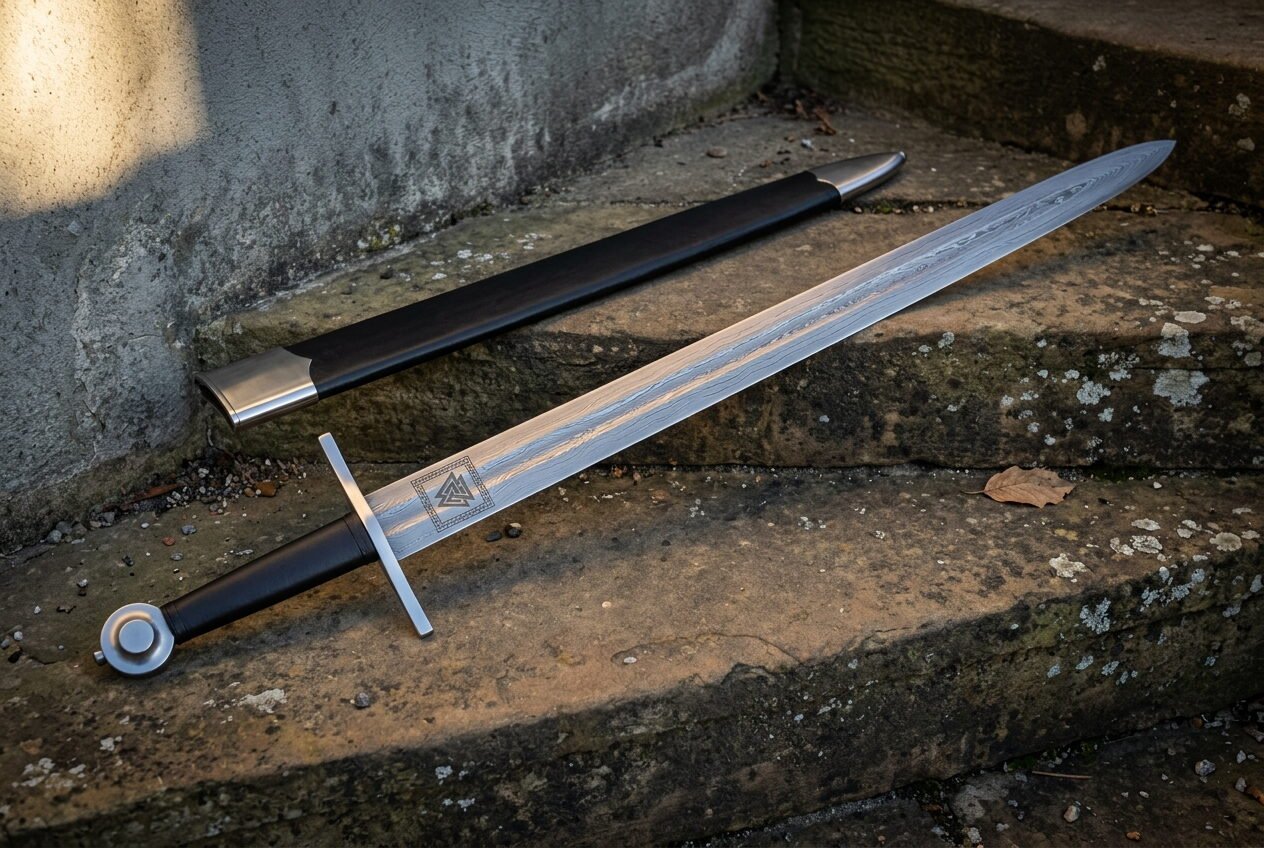
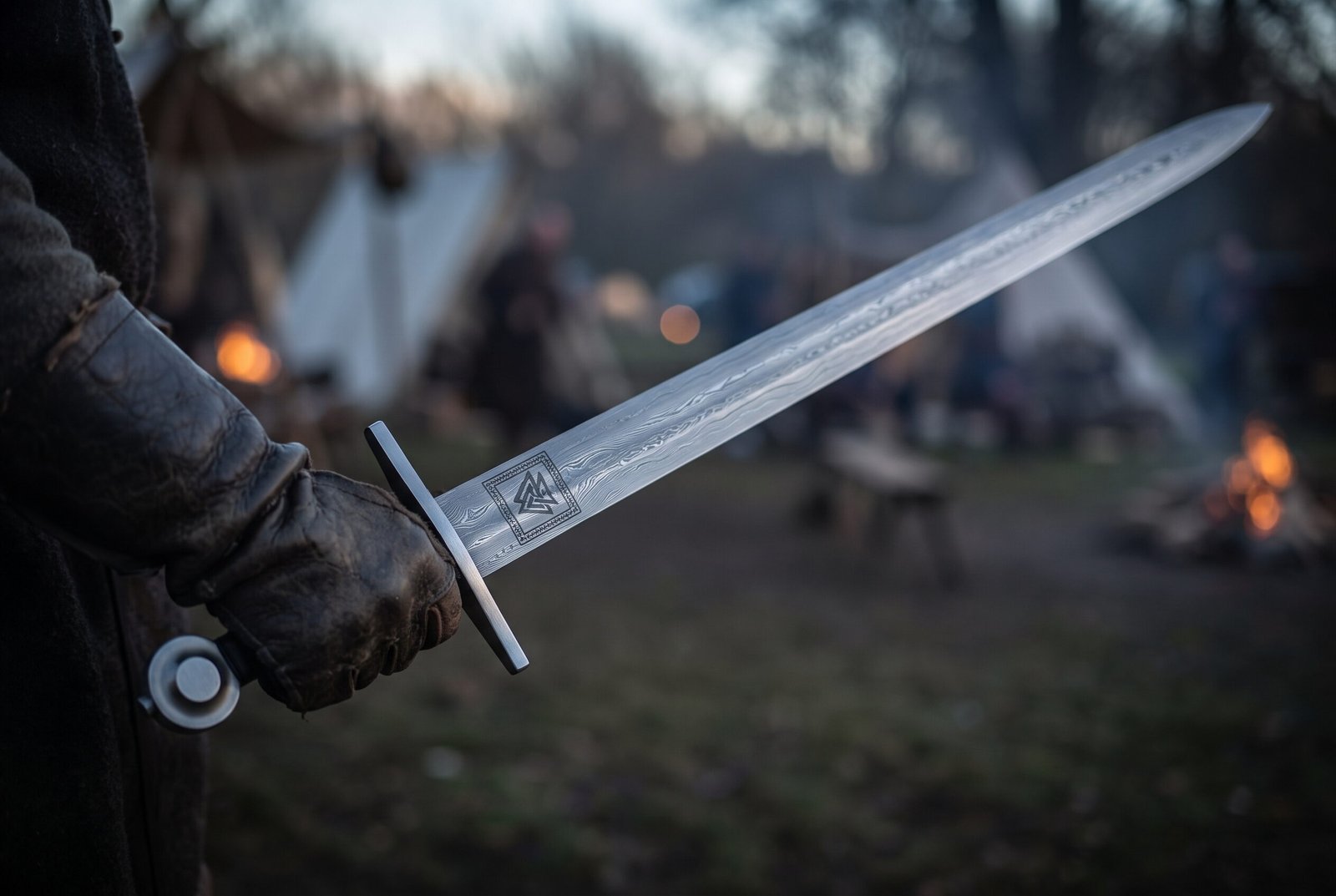
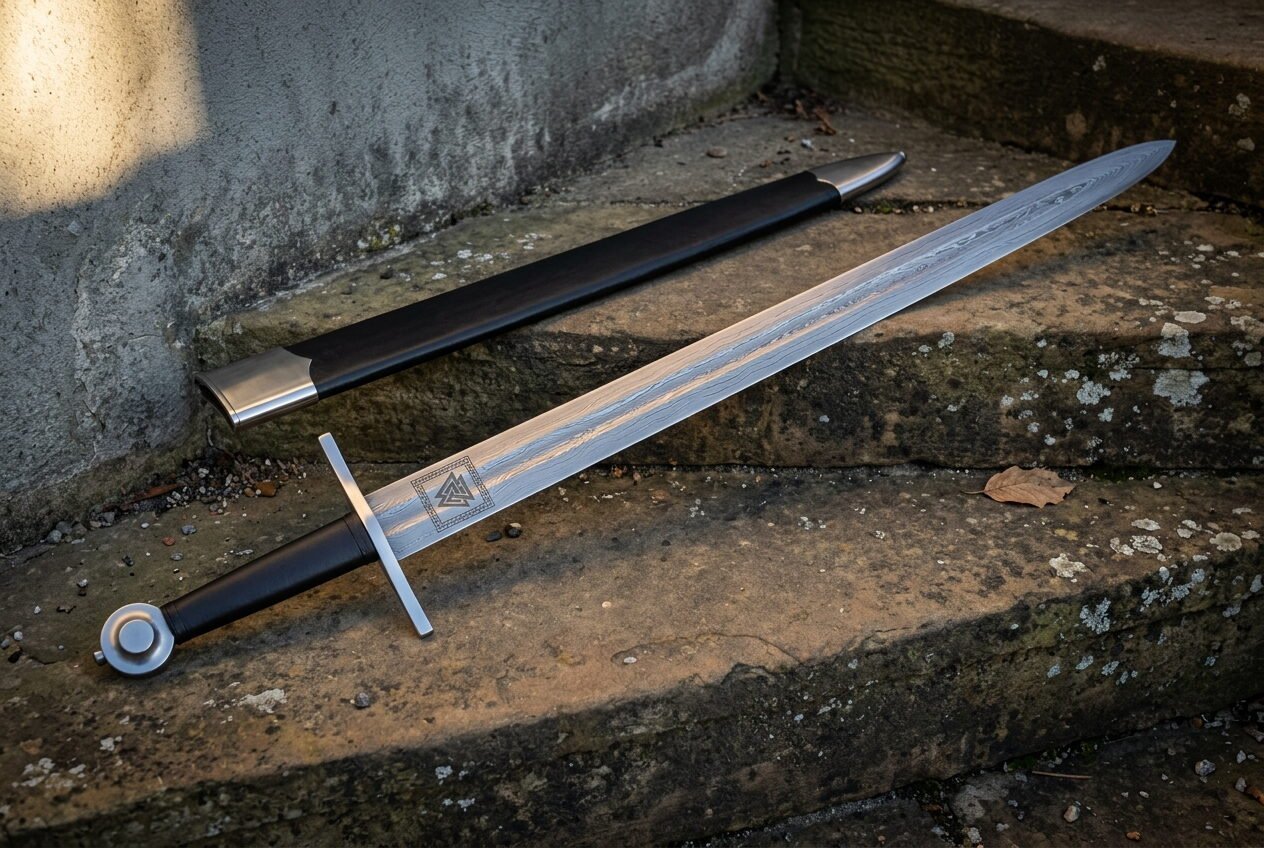
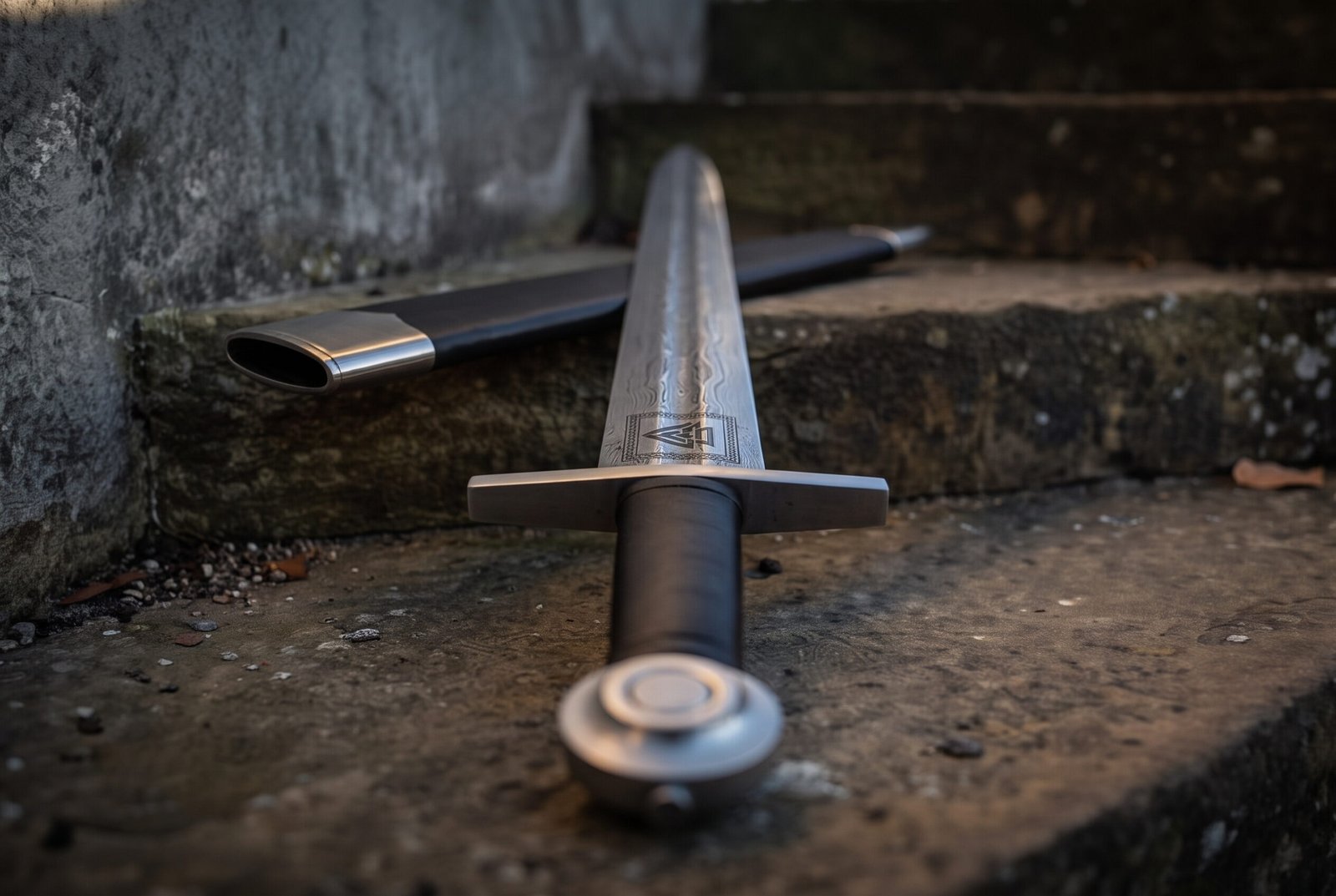
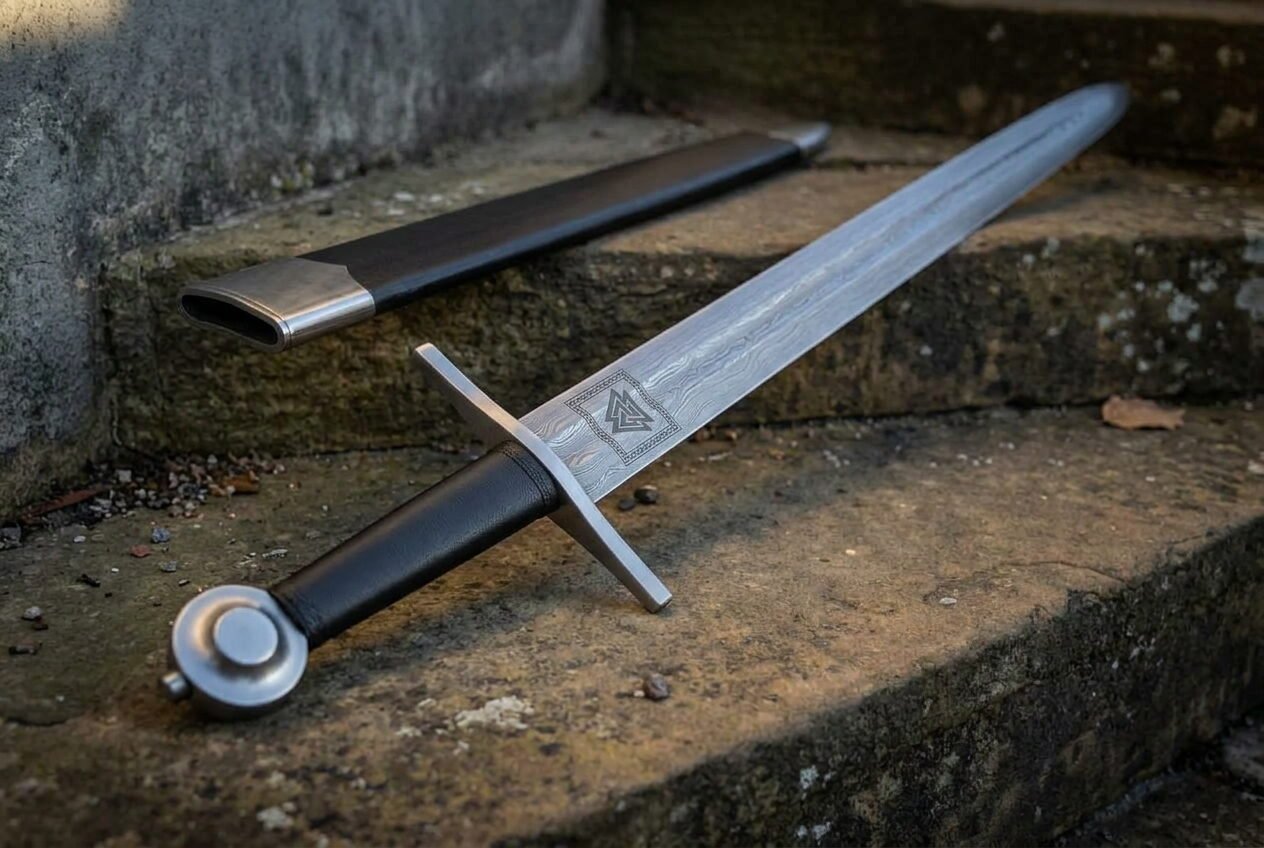
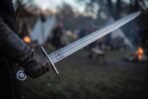
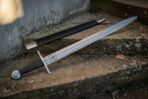
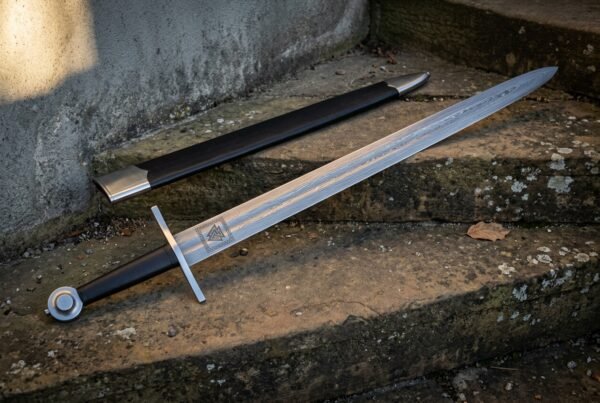
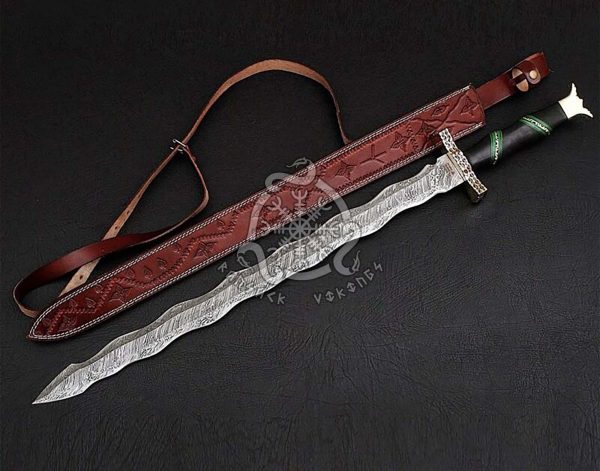
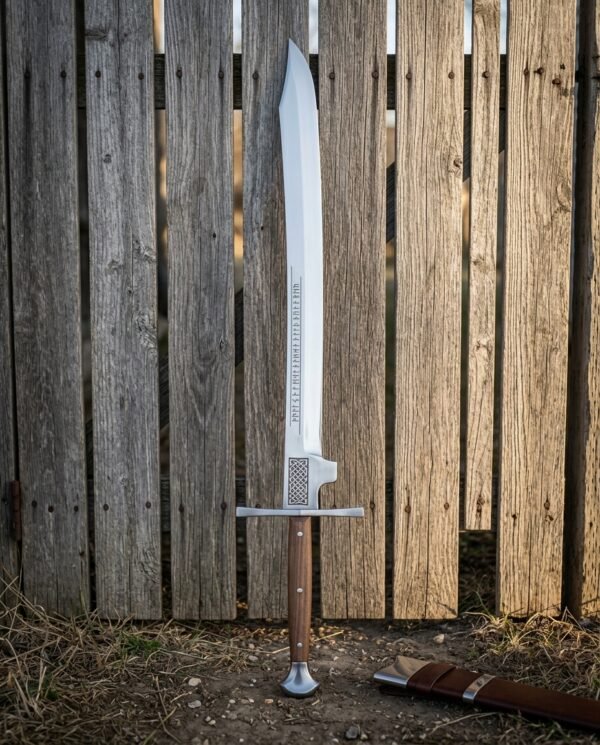
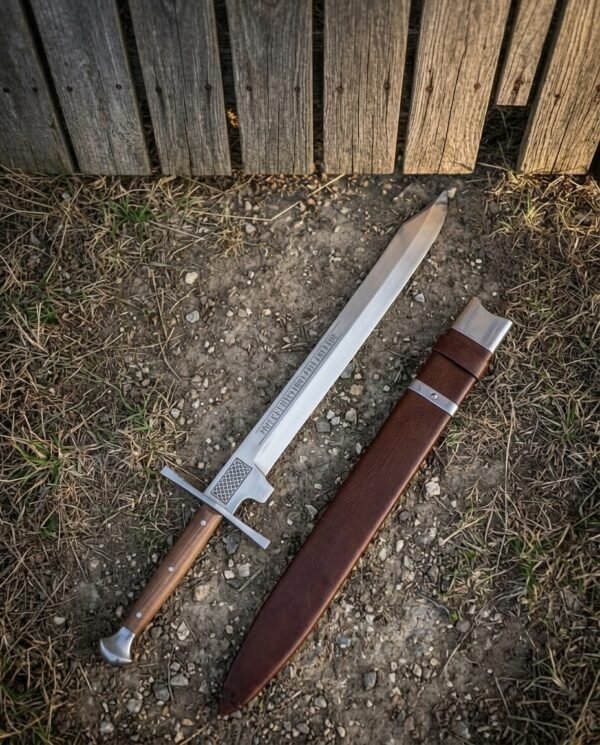
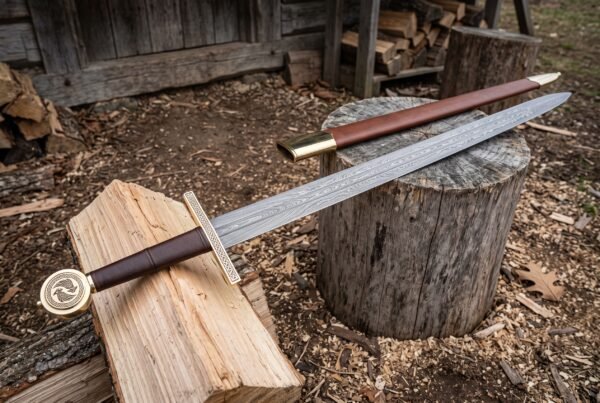
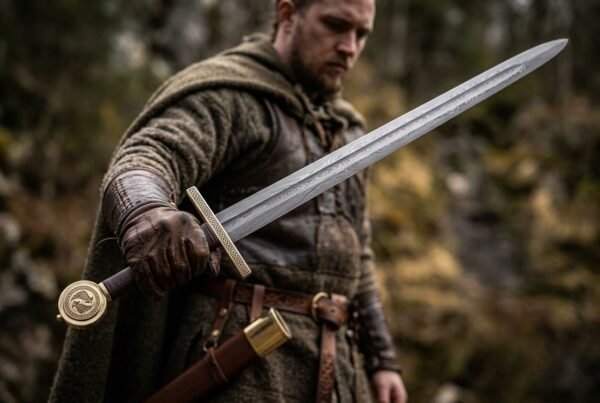
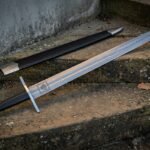
This is a hand and a half sword, a bastard sword, with a blade forge welded from 1095 and 15N20 and a Valknut etched into a bordered panel at the forte. The name is genuinely odd and the reason is worth knowing. It comes from the French epee batarde, and the sword is called a bastard because it belongs properly to neither family. It is too long in the grip to be an arming sword and too short in the blade to be a true two hander, and fifteenth century writers used the word with the same faint disapproval you would expect. What it actually was is the most useful sword anyone had made up to that point. Seven or eight inches of grip means you can fight it one handed from horseback or with a buckler, then bring the second hand on for a heavy blow or for the leverage needed to control an opponent in a bind. It survived because versatility beat specialisation.
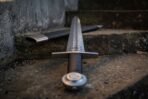
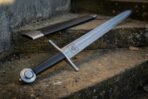
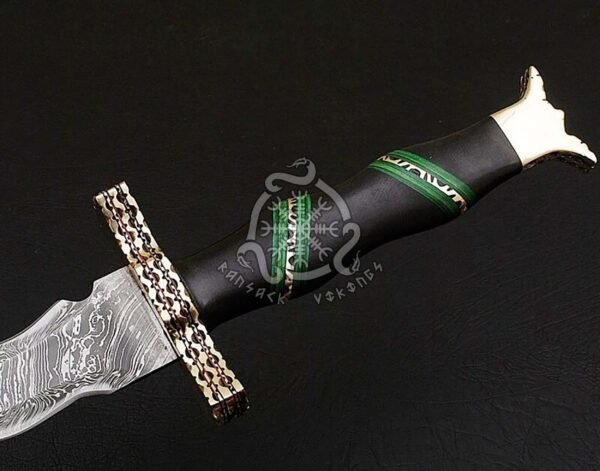
The billet is stacked, welded, drawn and etched by hand in the Czech Republic. The hilt is a long black leather grip between a straight steel cross and a turned steel wheel pommel. It ships in a black leather scabbard with a steel throat and a steel chape. Shipping inside the United States is free.
Specifications
| Steel | 1095 and 15N20 forge welded Damascus, hand etched flowing pattern |
|---|
| Hardness | 58 to 60 HRC |
|---|
| Overall length | 43 inches |
|---|
| Blade length | 33 inches |
|---|
| Grip length | 7.5 inches, hand and a half |
|---|
| Blade | Double edged, tapering to a point |
|---|
| Blade detail | Etched Valknut in a bordered panel at the forte |
|---|
| Grip | Smooth black leather over a shaped core |
|---|
| Guard | Straight polished steel cross |
|---|
| Pommel | Turned steel wheel pommel |
|---|
| Scabbard | Black leather with steel throat and steel chape |
|---|
| Tang | Full length, peened over the pommel |
|---|
| SKU | RK-1343 |
|---|
What the extra grip length actually changes
Adding three inches of grip to a sword does more than give the second hand somewhere to sit. It changes the mechanics of everything the sword does. With both hands on the hilt you are working a lever with two widely spaced points of contact, so a small pull from the pommel hand produces a large, fast movement at the point. That is what makes a hand and a half sword quick despite its length. It is also the basis of most of the techniques recorded in the German and Italian fencing manuals of the fourteenth and fifteenth centuries, where the pommel hand does the steering and the forward hand mostly holds position.
The second thing it changes is what happens when two blades meet and stop, what the manuals call the bind. One handed, whoever is stronger wins that contest. Two handed, leverage decides it, and the fencer who can wind their point around while keeping contact takes the exchange. That is why the German tradition attributed to Johannes Liechtenauer spends so much of its length on what to do after the blades cross rather than on the first blow. Finally, the long grip lets you slide the pommel hand right down behind the pommel for extra reach on a thrust, or take a half sword grip with the left hand on the blade itself for close work. None of that is available to a single handed sword.
Why Damascus and not stainless
The blade is a forge welded laminate of 1095 and 15N20. The 15N20 carries about two percent nickel, which resists the ferric chloride etch and stays bright while the 1095 beside it darkens, and that contrast is the pattern. It is carbon steel and behaves like it, taking a patina and rusting if you neglect it, and in exchange the folding refines the grain and the blade runs at 58 to 60 HRC with long edge life. Stainless steels get their corrosion resistance from a heavy chromium content, and at thirty three inches that costs the toughness a sword needs at the shoulder and the tang. Stainless also cannot be etched to a genuine pattern, so any stainless Damascus is a printed or stencilled surface. Read Damascus versus stainless for the detail.
The long grip and the wheel pommel
The grip is black leather over a shaped wooden core, split and fitted around the tang and glued closed, which is the medieval construction and remains the right one. On a hand and a half hilt the shaping matters more than it does on a single hand sword, because your two hands are doing different jobs. The forward section is fuller so it fills the leading hand, and the section behind it narrows slightly toward the pommel where the rear hand needs freedom to rotate rather than grip hard.
The wheel pommel is turned steel, peened over the tang so the whole hilt sits under compression, and on a sword this long it also acts as a hook for the rear hand. Because there is wood inside the grip, treat it as you would any wooden handle. Keep it dry, wipe it after handling, do not soak it and keep it out of hot cars and away from radiators, because it is movement in the core that eventually loosens a peened hilt. Our note on wooden handle care covers the routine, and a light leather balm on the wrap once a year keeps it supple.
Engraving, runes and your own design
Use the rune converter on this page to turn a name, a date or a short phrase into Elder Futhark and we will cut it into the steel or the handle. If you would rather have a Viking pattern than a rune line, choose your own design in the engraving option above the add to cart button and tell us whether it goes on the blade or the handle. Where a piece already carries an engraved design, your chosen engraving replaces it rather than sitting alongside it. On this sword the Valknut panel at the forte is the natural site and your design or rune line takes its place. For the record, the Valknut itself is genuinely old. It appears on the Gotland picture stones and on wood from the Oseberg ship burial, and it is generally read as an Odin symbol. Details on the engraving page.
Care and sharpening
Etching leaves a Damascus surface slightly open, so it needs more attention than plain steel. Dry the blade after handling, wipe it with light machine oil or a hard paste wax and do not leave fingerprints on it overnight in a humid room. Never store the sword sheathed for long stretches. Vegetable tanned leather holds moisture and tanning salts against steel, and a long blade left in a scabbard rusts from the inside where you will not notice until it matters. A haze lifts with a clean cloth and oil without harming the pattern, which runs through the blade. Read steel care first. To take the edge back, work a coarse then a fine stone at a shallow angle along the full length as set out in sharpening with a whetstone, then re oil.
Made in the Czech Republic
This is a handmade piece from the Czech Republic, made in a workshop that still forges, grinds and finishes by hand instead of stamping parts out. The smiths there have kept the older way of working, and the wood, horn and leather are shaped and fitted by hand as well. Two pieces of the same design will never be identical, and that is part of what you are buying.
Ransack Viking is a United States company. We handle the import ourselves, look over every piece when it lands and ship from our warehouse in Chicago, Illinois. Engraving is done in the United States after the piece arrives, so your design goes on before we send it out.
A note on handmade variation
This sword is hand forged. It is not machine made and it is not bulk produced, so what arrives will not be a pixel for pixel copy of the photograph. The Damascus figure is unique to the billet and differs from one face of the blade to the other. The tone of the black dye, the depth and crispness of the etched Valknut panel, the exact shaping of the grip and the way the polish reads in different light all vary because each one is worked by hand from natural materials. The dimensions, the steel and the build are the same every time. The character is not.
Frequently asked questions
What is the difference between a bastard sword and a longsword?
They overlap, and different sources draw the line in different places. In practice a bastard sword is the shorter end of the hand and a half family, with a grip of seven to eight inches and a blade you can still manage in one hand at need. A longsword is longer in both, and is meant to be used two handed most of the time. This one sits deliberately at the versatile end.
Can I really use it one handed?
Yes, at about three pounds it can be worked one handed for short periods, which is the whole point of the type. It is noticeably more comfortable and much more controllable with both hands on the hilt.
Is it sharp?
Yes, it ships with a keen working edge. Ask in the order notes for a blunt display or reenactment edge and we will leave a rounded quarter inch instead at no extra cost.
Can I spar or do historical fencing with it?
No. Sparring needs a purpose built blunt trainer with a flexible tip and a rolled edge, not a sharp Damascus blade. This one is for display, for collection and for soft target cutting against bottles, mats and noodles. Never make edge to edge contact and never throw it.
What does the Valknut mean?
Three interlocking triangles found on Gotland picture stones and on carved wood from the Oseberg ship burial, usually associated with Odin and with the slain. Nobody can tell you with certainty what it meant to the people who carved it, and anyone who claims otherwise is guessing.
How long does shipping take?
Free inside the United States. Fourteen to eighteen working days in the shop, then two to five days in transit, plus about a week for custom engraving.
What is in the box
- One hand forged 1095 and 15N20 Damascus bastard sword, 43 inches overall
- Black leather scabbard with steel throat and steel chape
- Light protective oil coat on the blade for transit
- Care and sharpening card for pattern welded steel
- Forged and finished in the Czech Republic
Explore the range
Browse the rest of the bastard swords, the two handed longswords, every pattern welded blade in Damascus swords and everything under swords. Background reading is in the guides.
Also in this part of the catalogue
Sitting beside it in the catalogue is the Valkcrest longsword, 46 inches overall. Another in the same line is the Brasswake arming sword, 37 inches overall. Next along the rack is the Mosscrown Viking sword, 38 inches overall.
Fitting out further, the Grimhook zweihander belongs with it. Or start from a blank sheet on the custom Viking sword page.
Our HEMA line includes the Vardholt blunt longsword for drills and sparring, and our tournament gear guide is the place to look next.

Middle of the road experience with this one. It’s fine but I expected a little more for the price. Neutral on this one overall. Ransack Viking is hit or miss it seems. This one landed in the middle.