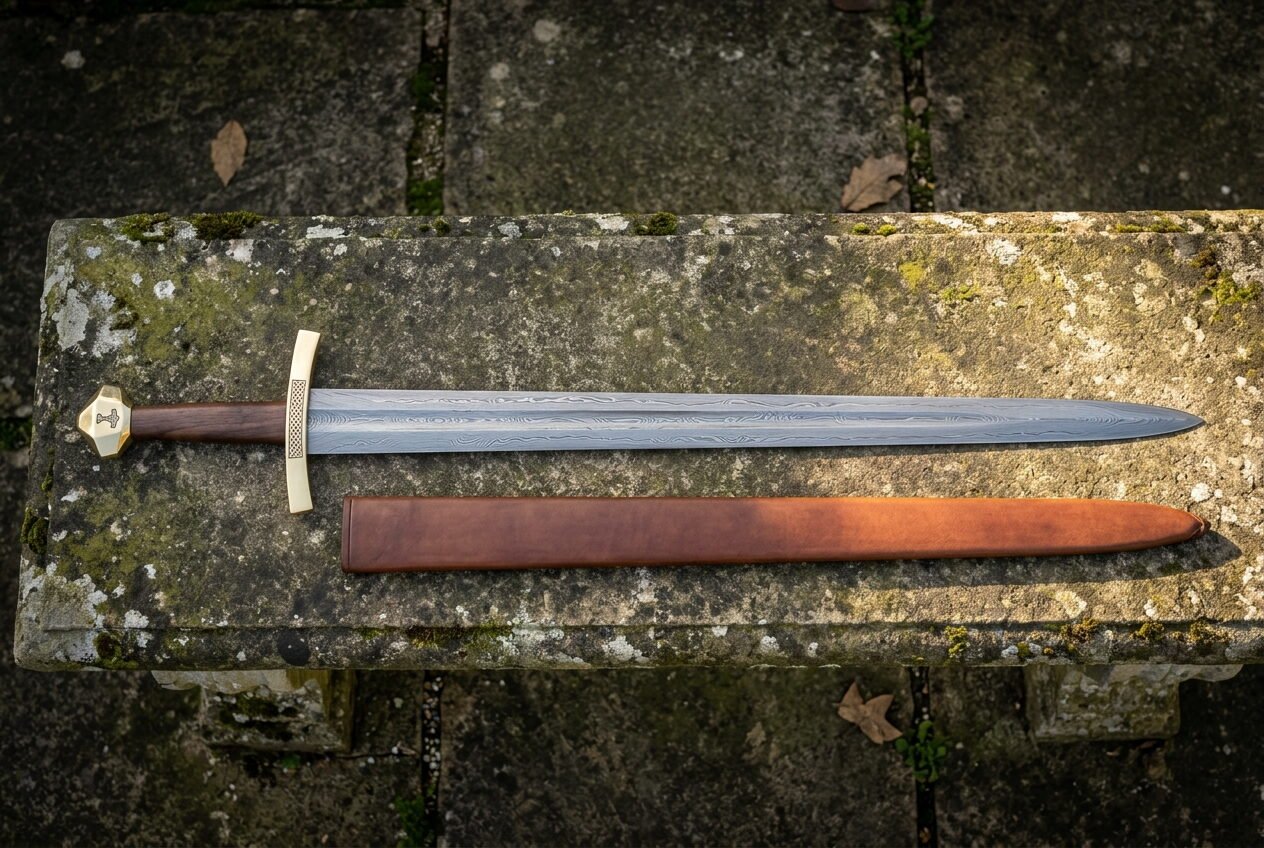
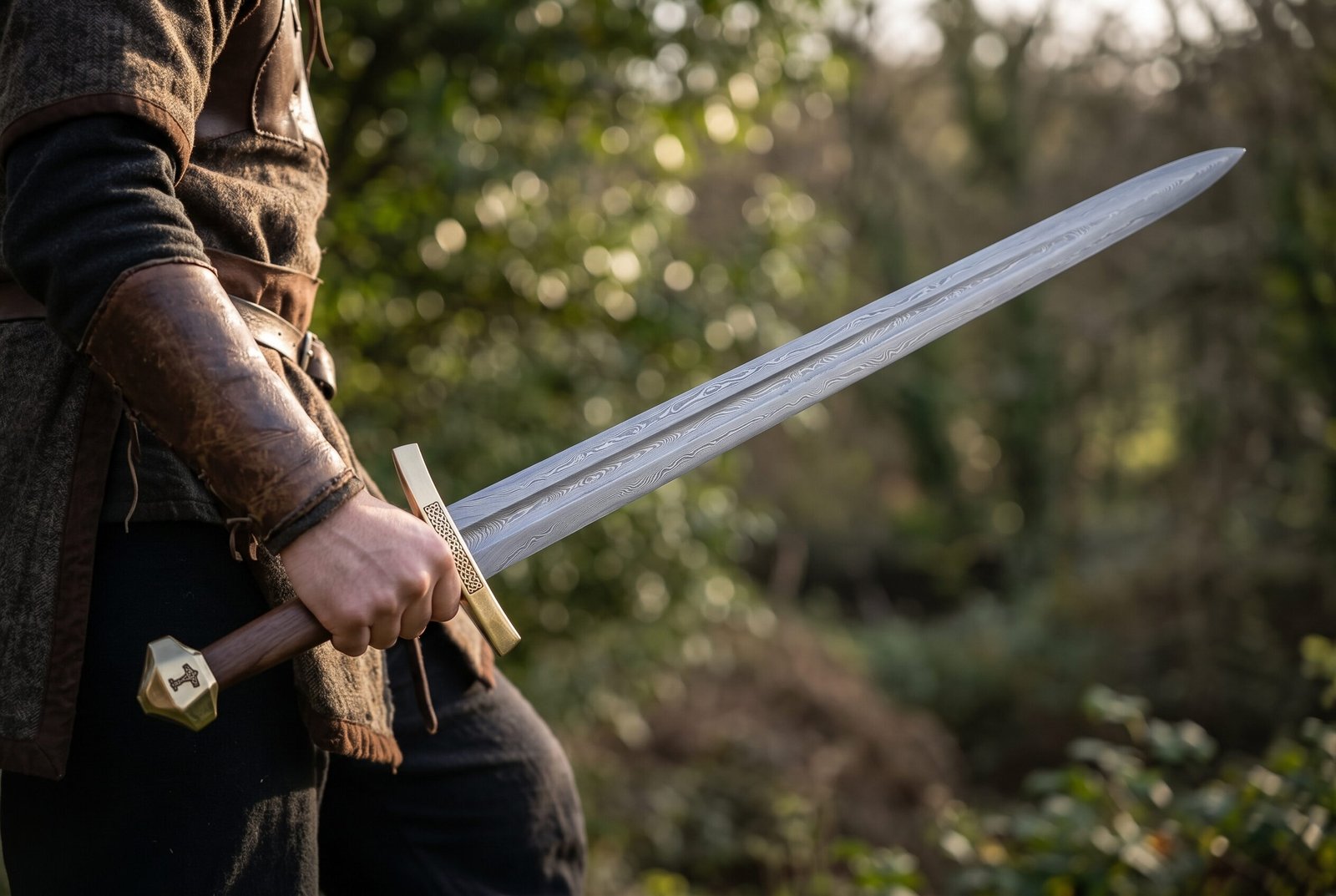
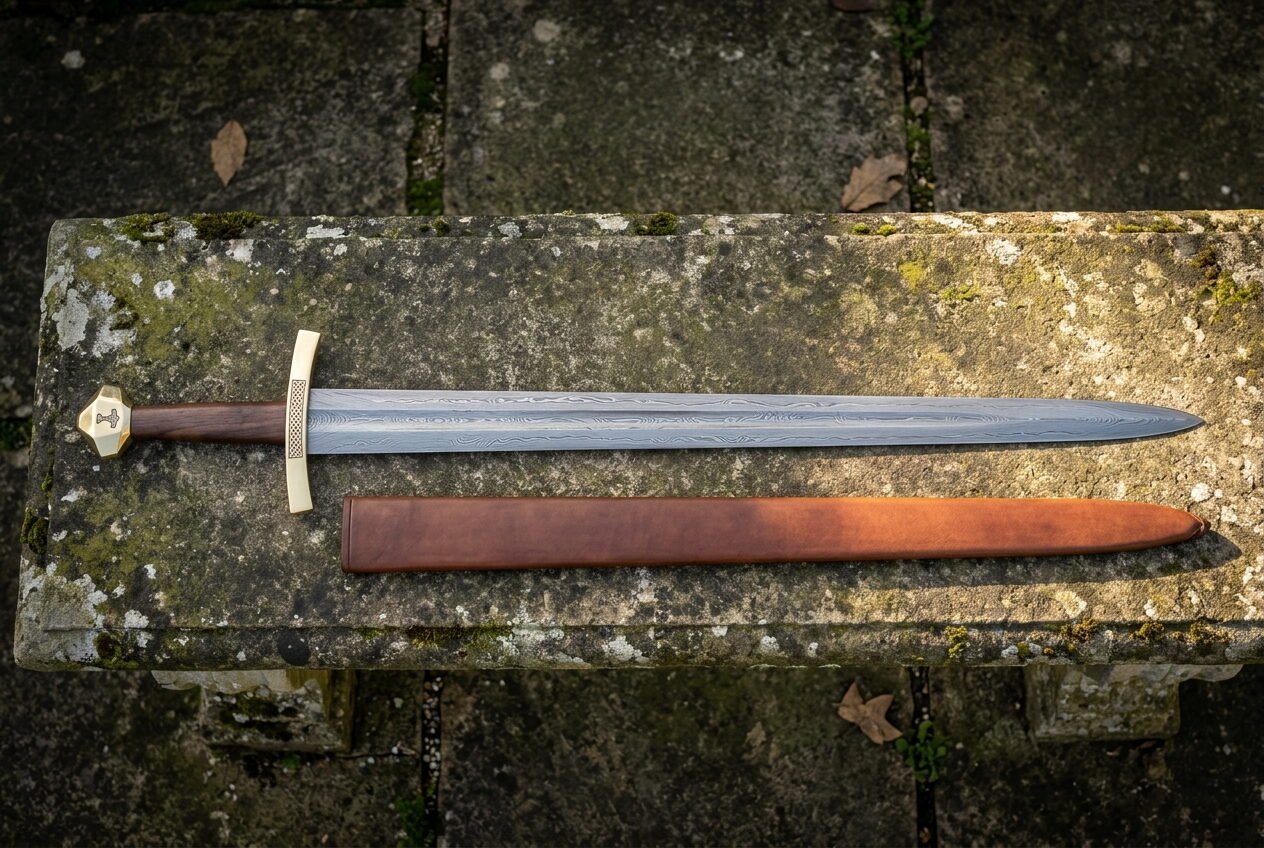
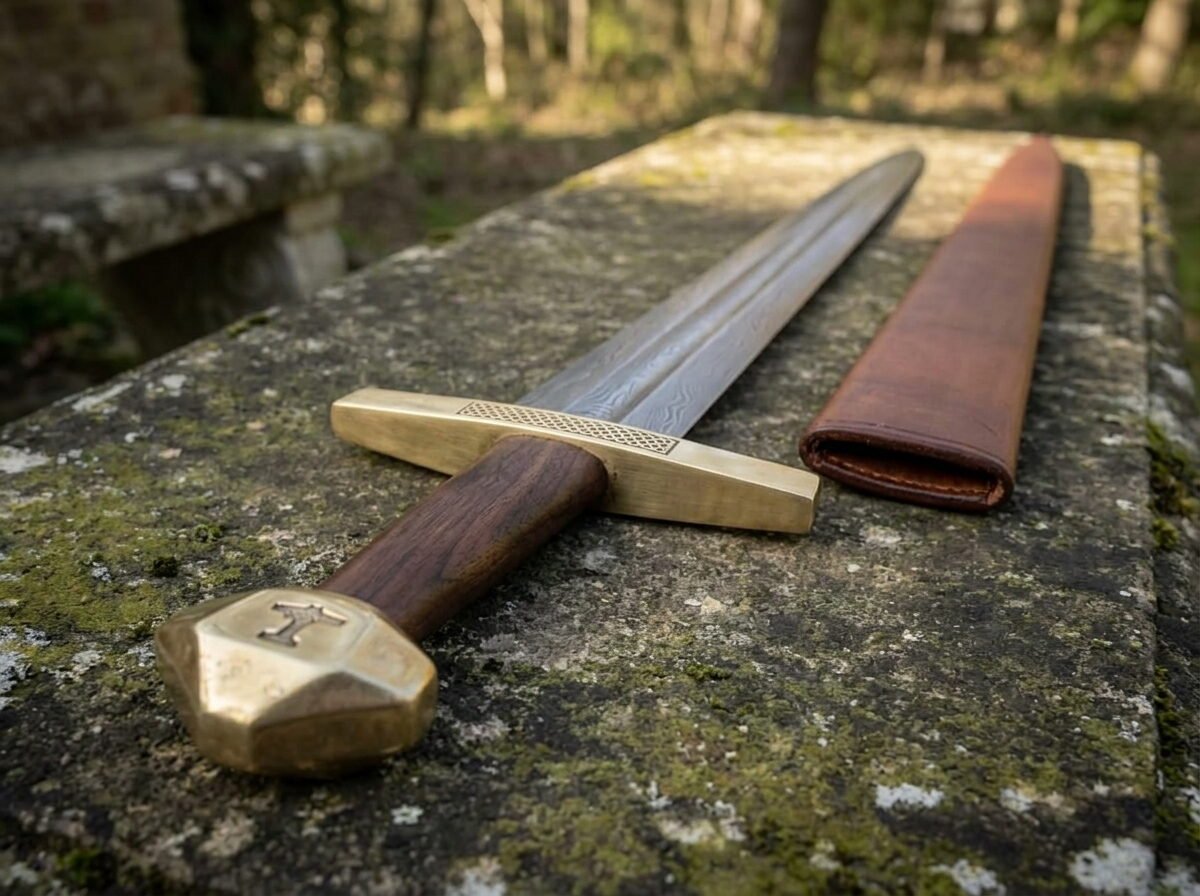
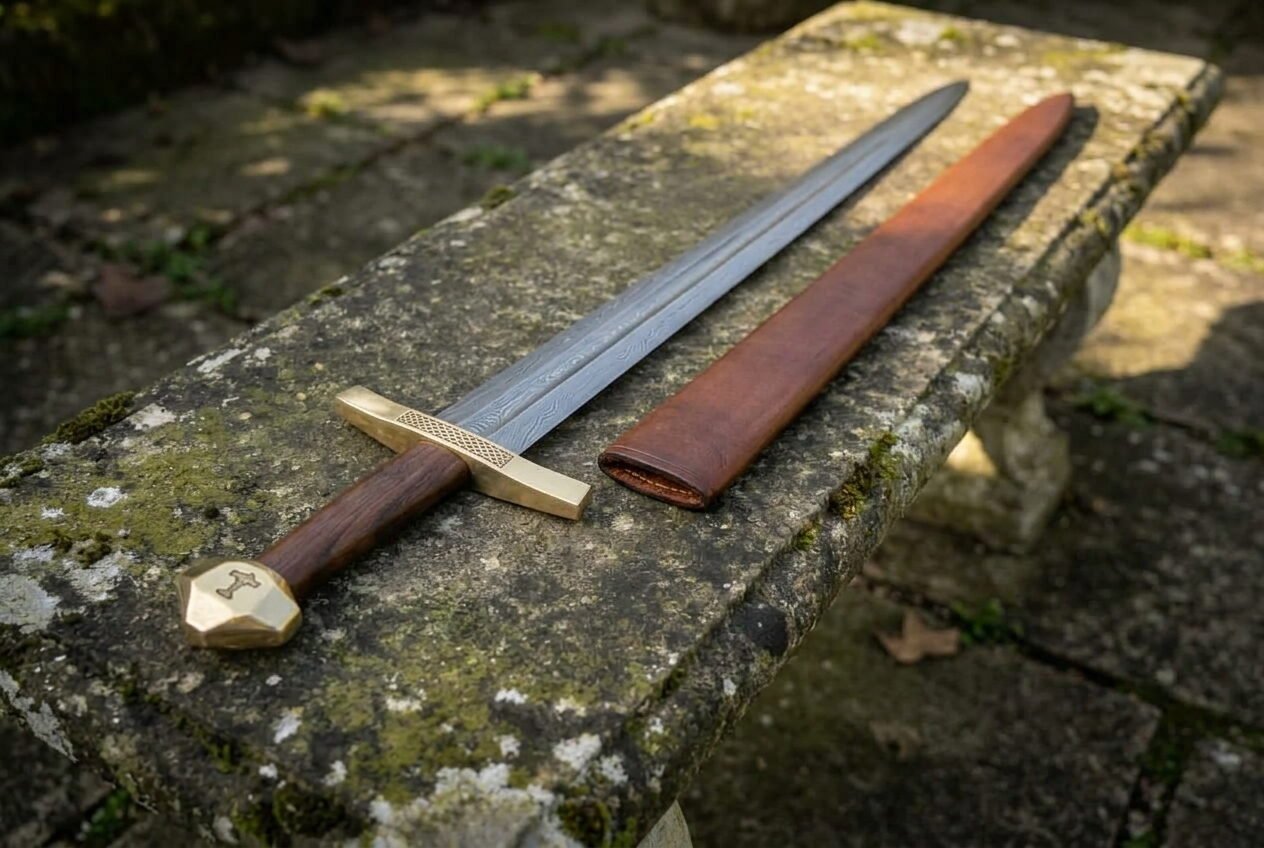
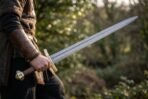
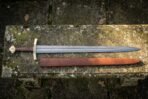
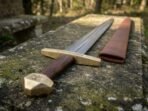
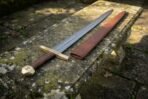
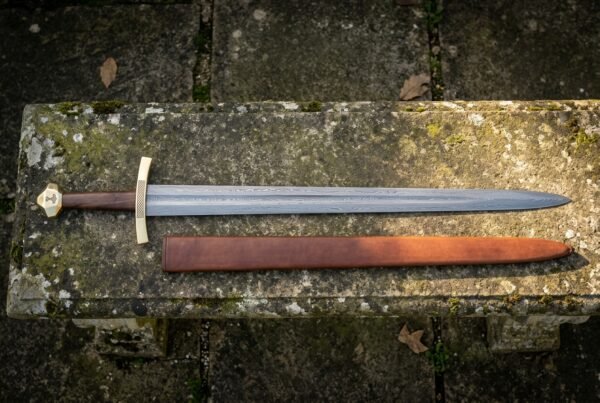
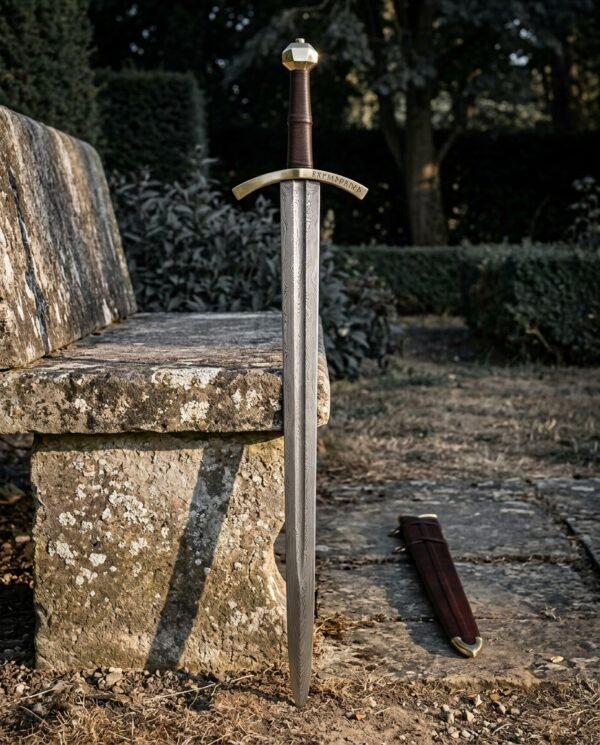
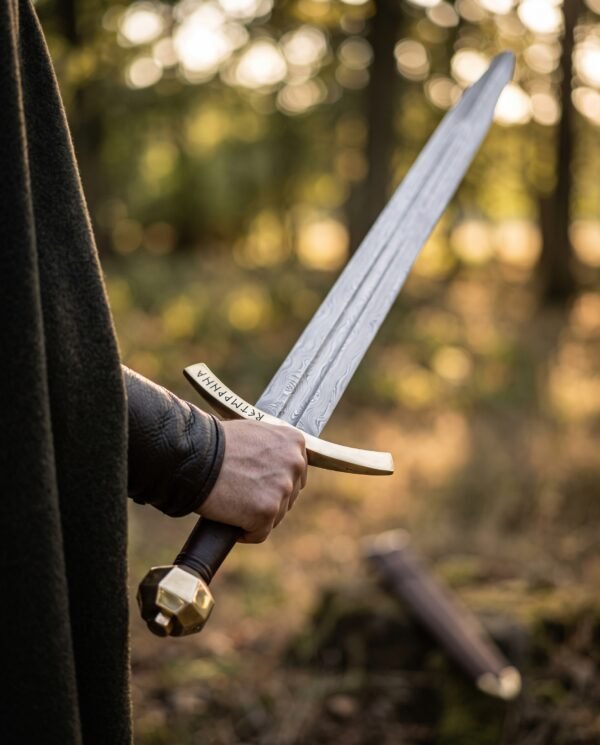
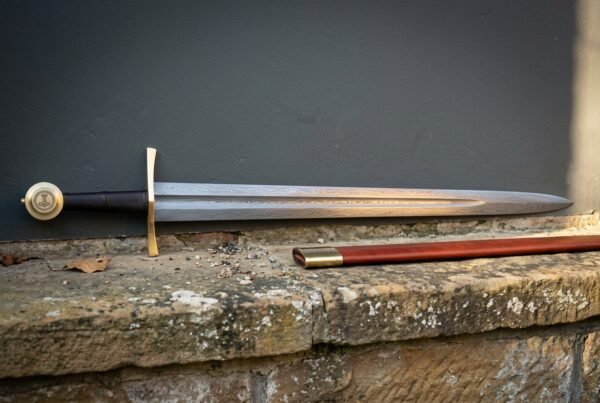
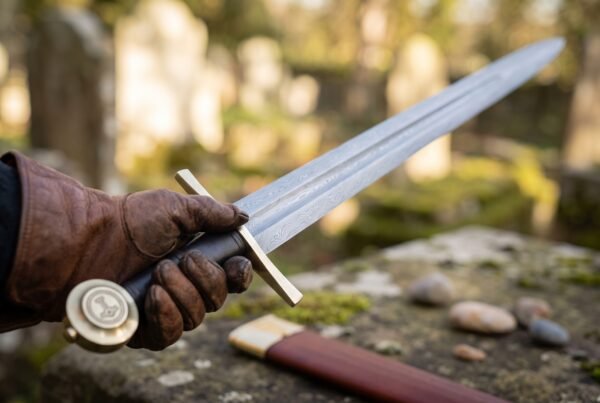
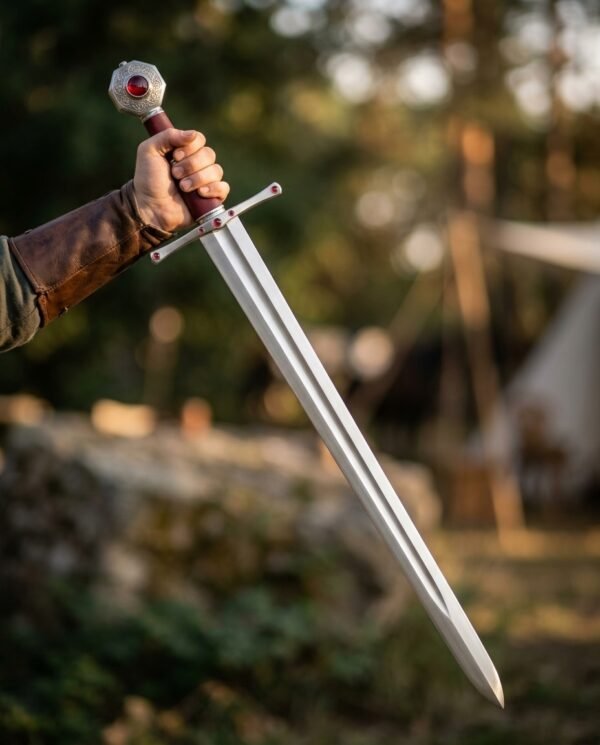
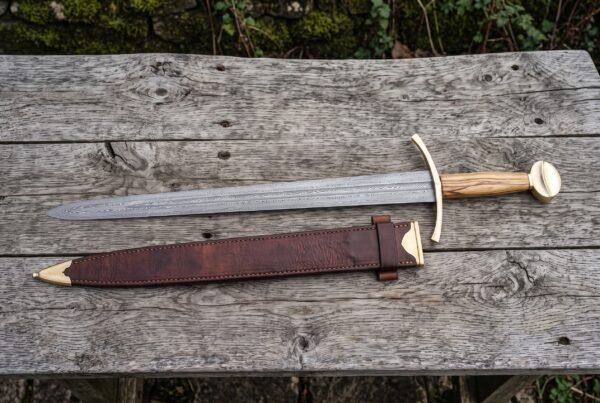
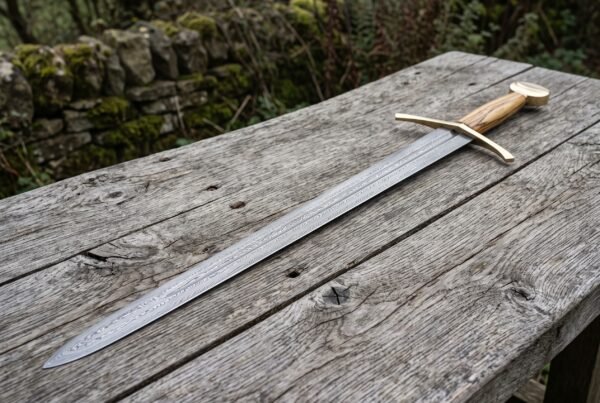
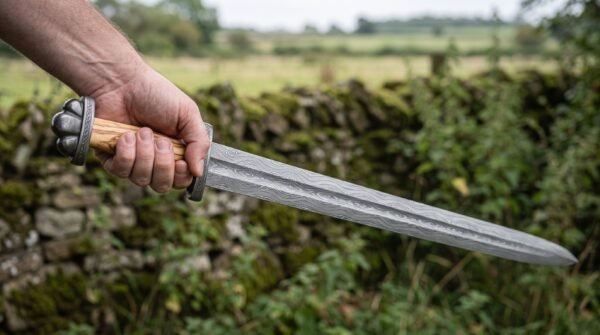
This is a single handed medieval sword with a blade forge welded from 1095 and 15N20, a rosewood grip, a brass cross and a faceted brass pommel carrying a cross emblem. The faceted pommel is the detail worth pausing on. Medieval pommels were not decorative afterthoughts and the shapes were not arbitrary. Oakeshott catalogued them as carefully as he catalogued blades, from the Viking derived brazil nut and tea cosy forms of the eleventh century through the flat wheel of the thirteenth to the multi lobed, faceted and scent stopper pommels of the fourteenth and fifteenth. Each one is a different answer to the same question: how do you get enough mass onto the end of the tang without making the sword ugly, uncomfortable or hard to draw. Faceting a pommel keeps the mass and breaks up the volume, so the sword balances properly without a slab of metal sitting against the wrist.
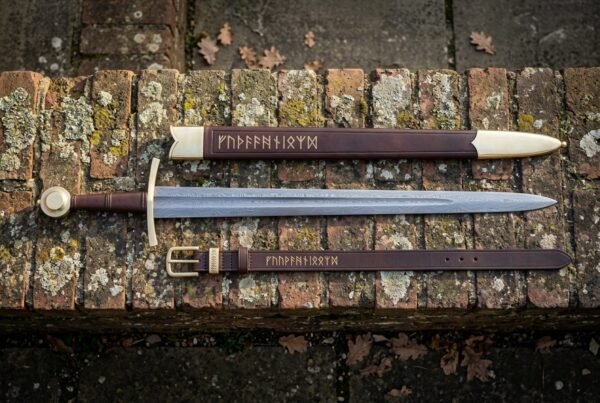
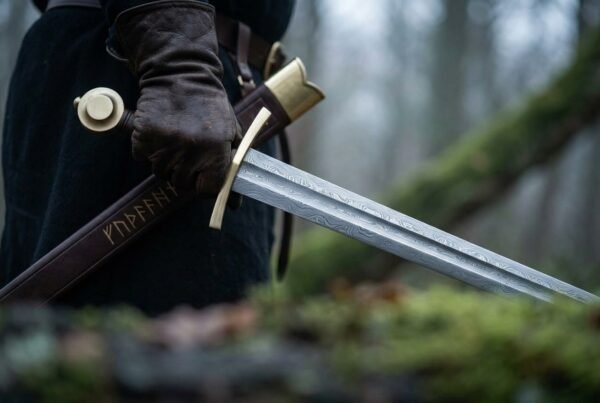
The billet is stacked, welded, drawn and etched by hand in the Czech Republic. The hilt is a turned rosewood grip set against an arched brass cross with an engraved knotwork panel, closed by a faceted brass pommel peened over the tang. It ships in a brown leather scabbard. Shipping inside the United States is free.
Specifications
| Item type | Medieval arming sword, double edged, single handed |
|---|
| Steel | 1095 and 15N20 forge welded Damascus, hand etched flowing pattern |
|---|
| Hardness | 58 to 60 HRC |
|---|
| Overall length | 37 inches |
|---|
| Blade length | 31 inches |
|---|
| Blade profile | Broad shouldered blade with an even taper to a reinforced point |
|---|
| Guard | Arched brass cross guard with an engraved knotwork panel |
|---|
| Handle | Turned rosewood grip |
|---|
| Pommel | Faceted brass pommel with a cross emblem |
|---|
| Tang | Full length, peened over the pommel |
|---|
| Scabbard | Brown leather |
|---|
| SKU | RK-1342 |
|---|
How a sword hilt is actually held together
A medieval hilt is not glued and it is not screwed. It is a stack of separate parts threaded onto the tang and locked by deforming the very end of the steel. On this sword the order is cross, grip, pommel, and once all three are on, the last quarter inch of tang is heated and hammered over the top of the pommel so that it spreads into a rivet head. That single operation puts the entire assembly under compression. Everything below it is squeezed together, and it stays squeezed for as long as nothing shrinks.
That is why the fit between grip and cross matters. The rosewood is shaped to seat squarely against the brass cross, so the load of the peening spreads across the end grain of the wood and the grip does not crush. It is also why we tell you to keep the grip out of hot cars and away from radiators. A hilt loosens when one part in the stack shrinks, and wood is always the part that shrinks first. Done properly the assembly outlives everybody, and that is how original swords in museum cases still have tight hilts eight hundred years later.
Why Damascus and not stainless
Our Damascus is a forge welded laminate of 1095 and 15N20, folded and rewelded to build the layer count. The nickel in the 15N20 resists the ferric chloride etch and stays bright while the 1095 beside it darkens, and that difference is the whole pattern. It is a carbon steel, so it takes a patina and will rust if it is neglected, and in exchange the folding refines the grain and the blade runs at 58 to 60 HRC with genuinely long edge life. Stainless steels rely on a heavy chromium content for corrosion resistance, and at thirty one inches that costs toughness in the shoulder and tang, which is where a sword failure is dangerous. Stainless also cannot be etched to a real pattern, so stainless Damascus is a printed surface. The argument in full is in Damascus versus stainless.
The rosewood grip
Rosewood is chosen here for three reasons. It is dense, so it holds a turned shape and a crisp shoulder against the brass cross without crushing under the peening. It is oily by nature, which makes it far more stable in changing humidity than an open grained wood and gives it a low sheen that improves rather than wears away with handling. And it has a deep reddish brown figure that sits well against brass, which is why it has been a first choice for hilt and handle work for centuries.
Care is simple. Wipe it with a dry cloth after handling and give it a thin coat of oil once or twice a year, worked in and wiped off rather than left to sit. Do not wash it, do not soak it and do not leave the sword in a hot car or against a radiator, because it is dimensional movement in the wood that eventually loosens a peened hilt. Our short guide to wooden handle care covers everything you need. The brass will dull to an antique gold on its own unless you polish it.
Engraving, runes and your own design
Use the rune converter on this page to turn a name, a date or a short phrase into Elder Futhark and we will cut it into the steel or the handle. If you would rather have a Viking pattern than a rune line, choose your own design in the engraving option above the add to cart button and tell us whether it goes on the blade or the handle. Where a piece already carries an engraved design, your chosen engraving replaces it rather than sitting alongside it. On this sword the faceted brass pommel already carries a cross emblem, and your chosen design replaces it. The rosewood grip will take a fine cut line if you would rather have the personalisation there. See the engraving page.
Care and sharpening
An etched Damascus surface is very slightly open, so it wants a little more care than plain steel. Dry the blade after handling and wipe it with light machine oil or a hard paste wax before it goes away. Do not leave a fingerprint on it overnight in a humid room. Never store the sword sheathed for long stretches, because vegetable tanned leather holds moisture and tanning salts against steel and rust starts inside the scabbard where you cannot see it. A haze can be lifted with a clean cloth and oil without harming the pattern, which runs through the blade rather than sitting on it. Read steel care, and when the edge needs work use a coarse then a fine stone at a shallow angle as set out in sharpening with a whetstone, then re oil.
Made in the Czech Republic
The work behind this piece happens in a Czech Republic workshop that has kept to the old methods. Steel is forged and heat treated by hand, the grind is taken down by eye rather than by machine, and the handle, fittings and sheath are cut and finished one at a time. Because of that, every piece carries small marks of the hand that made it.
Ransack Viking is a United States company. We import direct, check each piece when it reaches us, and ship from our Chicago, Illinois warehouse. Engraving is added here in the United States after arrival, so the piece you receive is finished to your order.
A note on handmade variation
This sword is hand forged. It is not machine made and it is not bulk produced, so what arrives will not be a pixel for pixel copy of the photograph. The Damascus figure is unique to the billet and differs from one face of the blade to the other. Rosewood varies enormously in colour and figure from board to board, brass settles to whatever patina the air gives it and the exact facets of the pommel are filed by hand. The dimensions, the steel and the build are the same every time. The character is not.
Frequently asked questions
Is the hilt going to come loose?
Not if you look after the wood. The tang is peened over the pommel so the whole hilt sits under compression, and a properly peened assembly stays tight for decades. What loosens a hilt is the wooden grip shrinking, which is caused by heat and dry air, so keep the sword out of hot cars and off radiator shelves.
Is the Damascus pattern genuine?
Yes. It is a forge welded stack of 1095 and 15N20 and the layers go right through the steel. The acid etch only develops contrast that is already in the metal.
Is the sword sharp?
Yes, it arrives with a keen working edge. Ask for a blunt display or reenactment edge in the order notes and we will leave a rounded quarter inch instead at no extra cost.
Can I cut with it?
Against soft targets, yes. Bottles, tatami and pool noodles are fine. Do not cut into steel, hardwood or bone, do not spar with it and never throw it. At 58 to 60 HRC the edge is hard and will chip if you abuse it.
What is the difference between this and a longsword?
Grip length and how it is used. This is a single hand sword with a grip of about four and a half inches, made to be carried at the hip and used with the other hand free. A longsword has a grip long enough for both hands, a longer blade and a completely different set of techniques behind it.
How long does shipping take?
Free inside the United States. Twelve to sixteen working days in the shop, then two to five days in transit, plus about a week if you order engraving.
What is in the box
- One hand forged 1095 and 15N20 Damascus medieval sword, 37 inches overall
- Brown leather scabbard
- Light protective oil coat on the blade for transit
- Care and sharpening card for pattern welded steel
- Forged and finished in the Czech Republic
Explore the range
Browse every pattern welded blade in Damascus swords, the rest of the arming swords, the two handed longswords and everything under swords. Background reading is in the guides.
Compare it with these
For a straight comparison, see the Knotwheel arming sword, pattern welded Damascus. Worth putting side by side with this is the Awecrown arming sword, 36 inches overall. In the same category sits the Pitchknot arming sword, 32 inches overall.
From the same corner of the shop, there is the Emberdusk Japanese sword. Pick the steel, the length and the fittings yourself on the custom Viking sword page.
If you would rather train with a sword than hang one up, the Mirlaug blunt arming sword suits club work, and our blunt versus sharp guide covers the choices.

Best sword I’ve ever owned. Leather sheath is thick and well stitched. Not the cheap stuff you usually get. Will definitely order again for another gift.