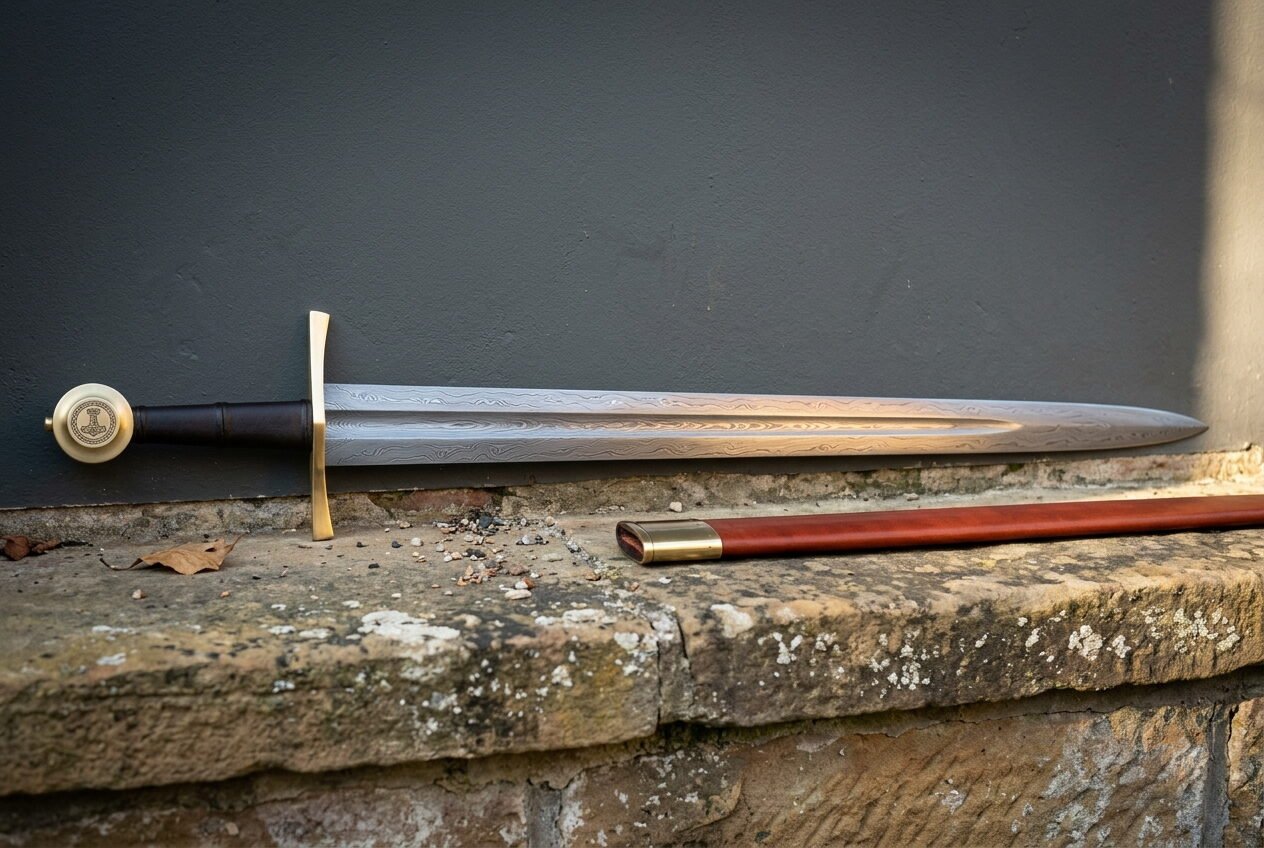
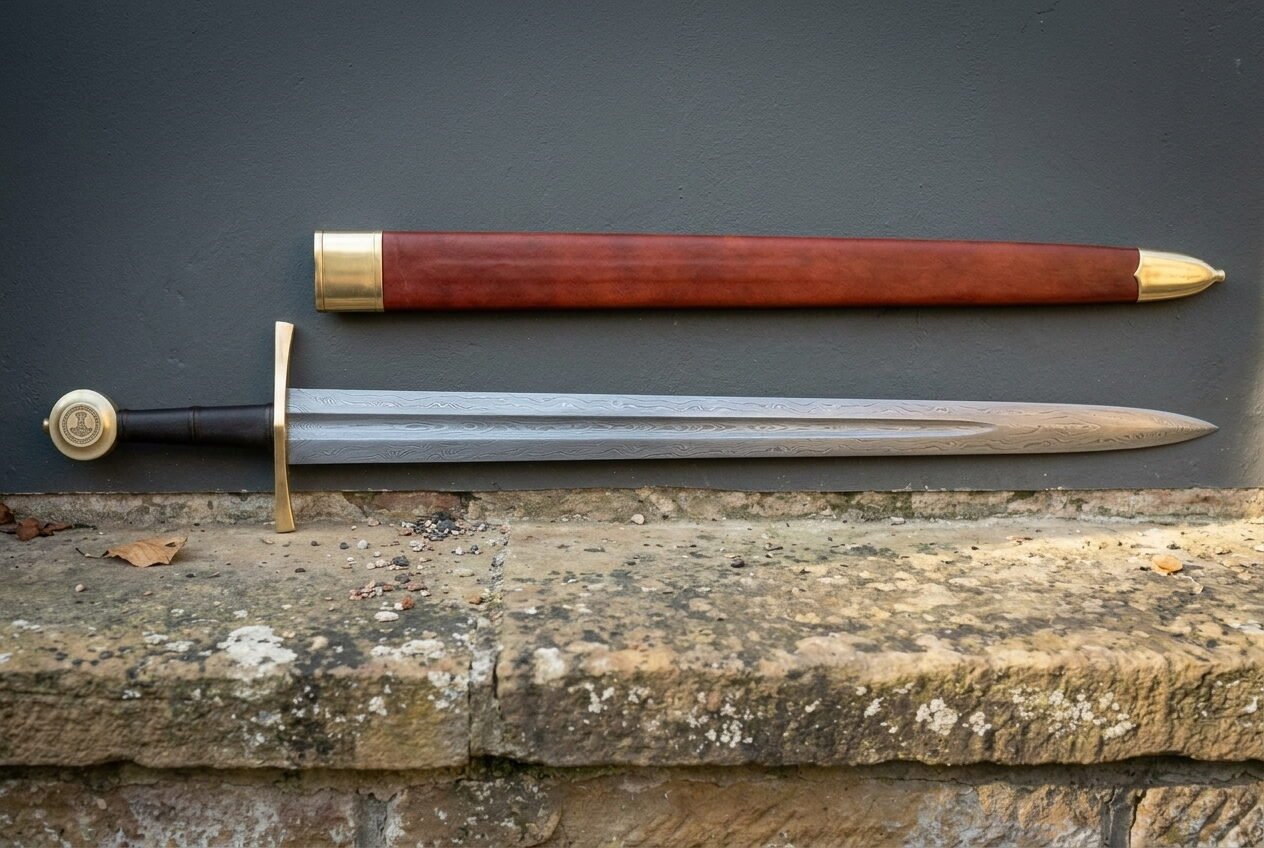
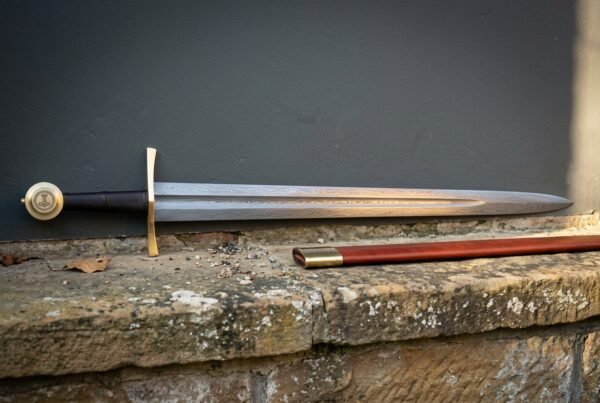
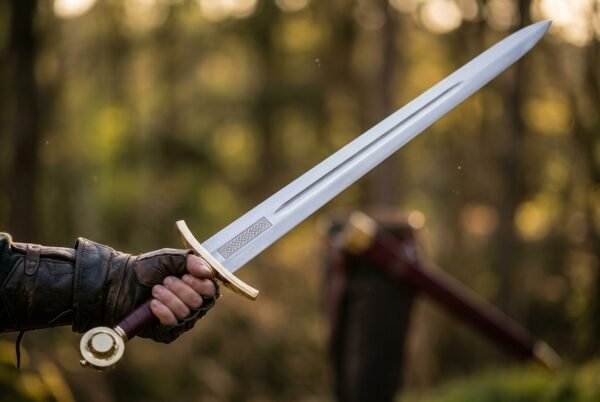
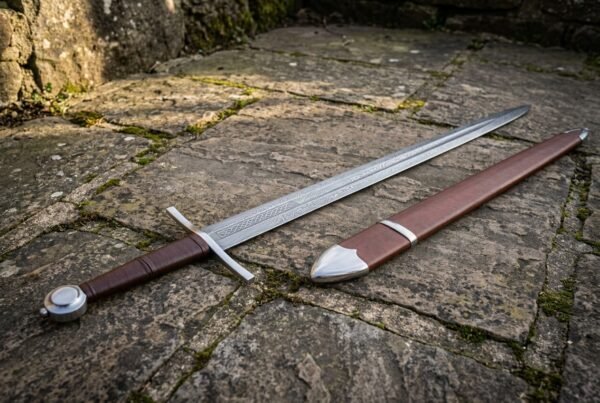
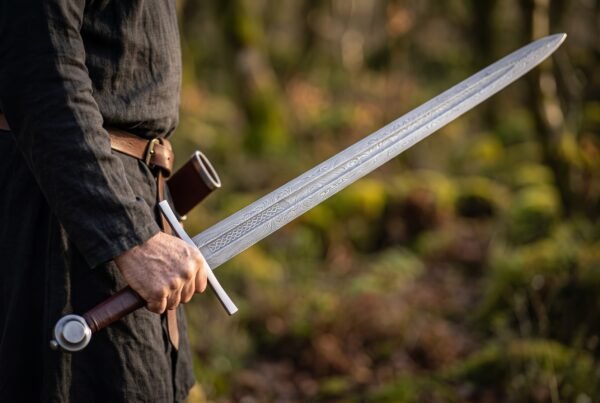
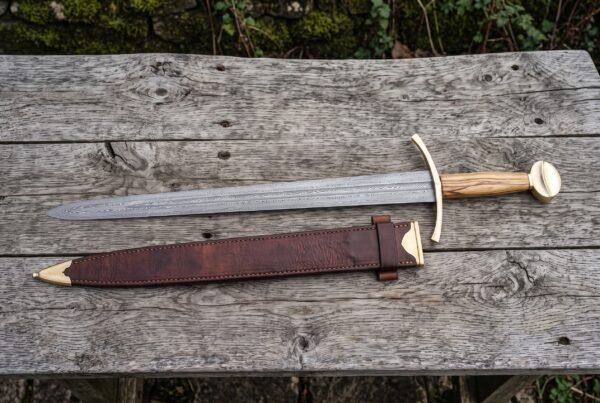
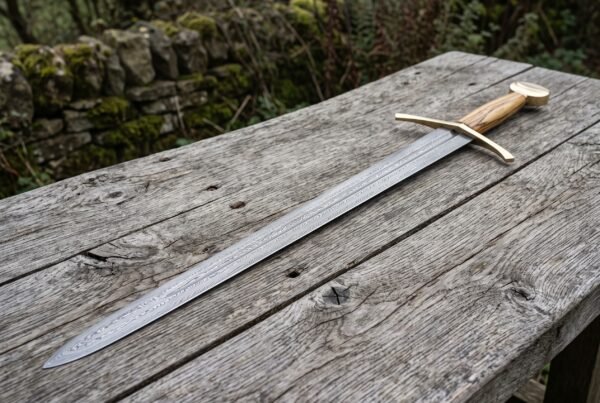
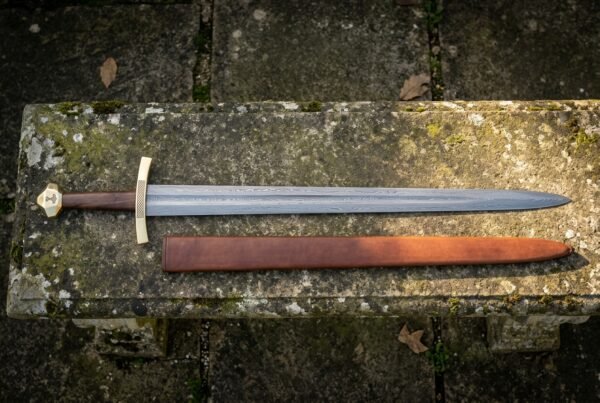
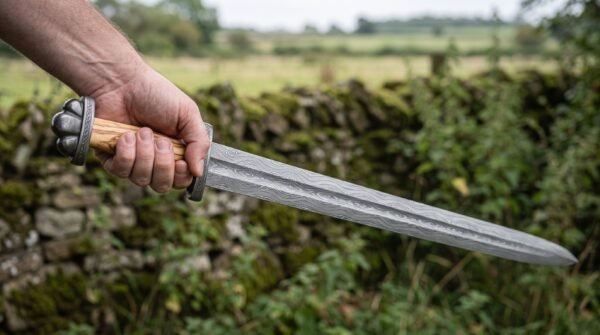
This is a broad single handed knightly sword with a blade forge welded from 1095 and 15N20 and a hilt built entirely in brass. The brass is the interesting part. Almost every reproduction sword on the market puts steel furniture on a steel blade, but the archaeology does not support that as the only option. Copper alloy pommels and guards turn up on Viking age and early medieval swords across Europe, sometimes gilded, sometimes inlaid with silver wire, and there is a straightforward reason a smith would choose them. Brass is roughly the same density as steel but far easier to cut, chase and engrave, which means a decorative pommel can be finished to a standard that would take days in steel. It also does not rust, so the parts of the sword handled most often stay sound while the blade is the thing you protect.
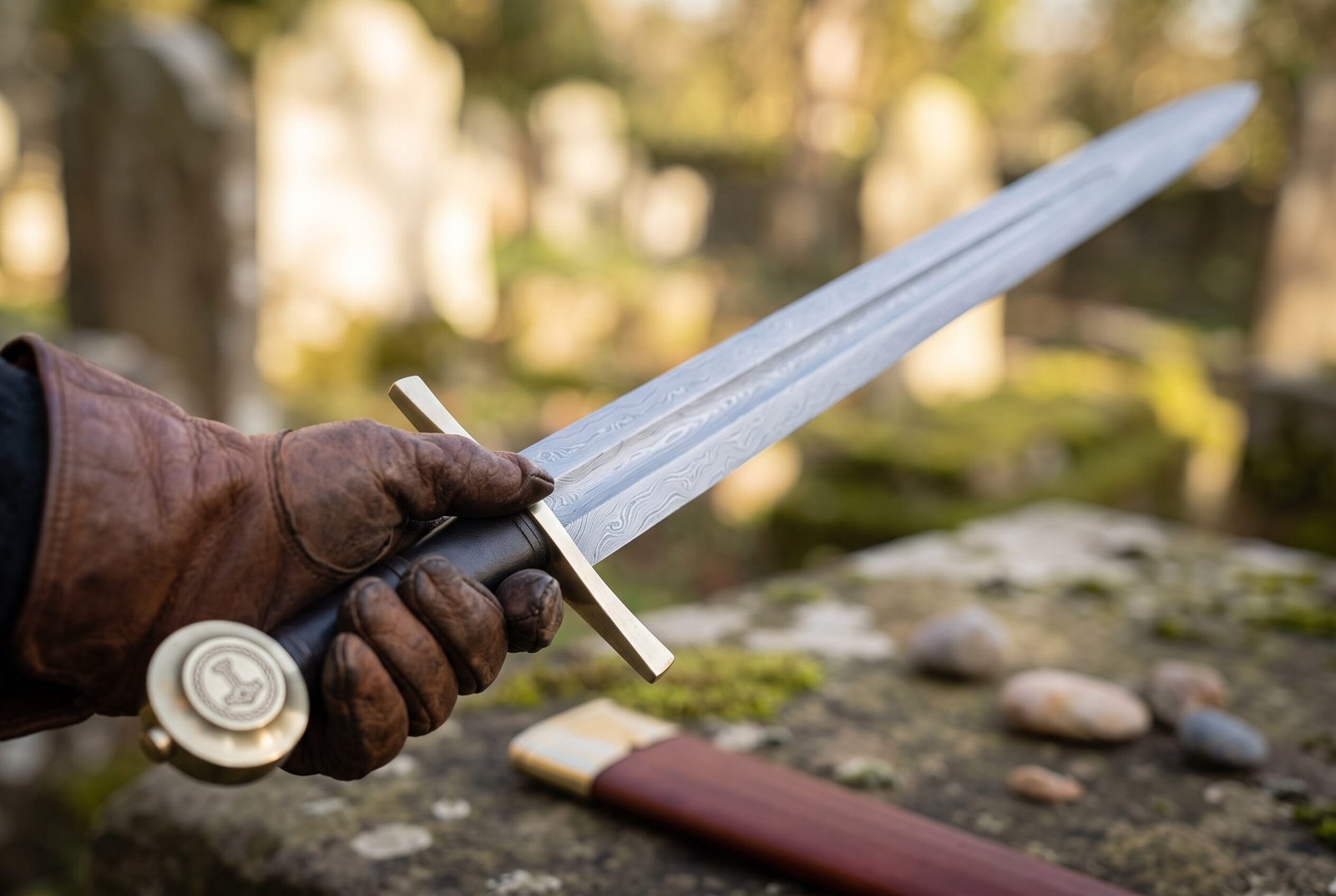
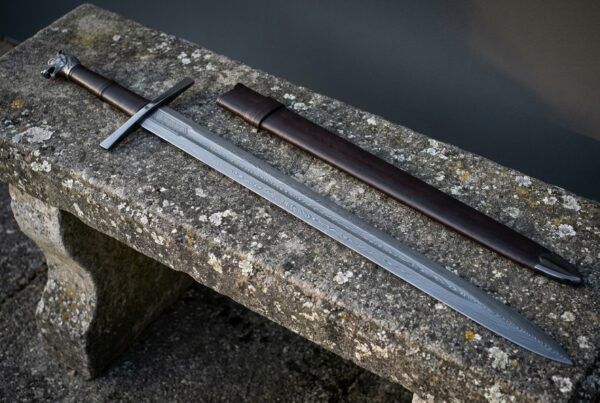
The billet is stacked, welded, drawn out and etched by hand in the Czech Republic, then ground, heat treated and fitted with a dark leather grip between a straight brass cross and a brass disc pommel carrying an engraved medallion. It ships in a russet leather scabbard with a heavy brass throat. Shipping inside the United States is free.
Specifications
| Steel | 1095 and 15N20 forge welded Damascus, hand etched flowing pattern |
|---|
| Hardness | 58 to 60 HRC |
|---|
| Overall length | 37 inches |
|---|
| Blade length | 31 inches |
|---|
| Blade profile | Broad evenly tapered double edged knightly blade with a long central fuller |
|---|
| Guard | Straight brass cross with squared ends |
|---|
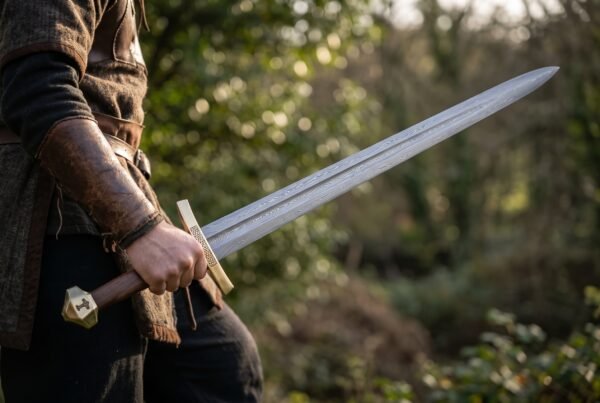
| Grip | Black leather wrapped over a wooden core, single hand length |
|---|
| Pommel | Brass disc with a raised medallion engraved with Thor’s hammer, peened over the tang |
|---|
| Scabbard | Russet leather with a brass throat and chape |
|---|
| Tang | Full length, peened over the pommel |
|---|
| SKU | RK-1340 |
|---|
What brass furniture does to the way a sword handles
The cross and pommel on a sword are not ornaments bolted on at the end. They are the counterweight system that decides where the balance point sits, and changing the material changes the sword. Brass has a density close to steel, so a brass pommel of the same size does very nearly the same job. What it lets you do is shape that mass more freely. The disc here carries a raised medallion and a recessed rim, both cut into the brass, and getting the same crispness in hardened steel would take far longer and cost more than the blade.
The cross is a straight brass bar, the classic knightly form. It stops an opposing blade running down yours well before it reaches your hand, and it sits flat against the body when the sword is worn. On this piece the bar is long, which suits the width of the blade. A broad cutting blade wants a broad guard, otherwise the sword looks and feels front heavy before you even lift it. With the brass disc on the tail, the balance settles about four inches ahead of the cross, which is where a single handed cutting sword should sit.
Why Damascus and not stainless
Our Damascus is a forge welded laminate of 1095 and 15N20, folded and rewelded until the layer count is where we want it. The 15N20 carries about two percent nickel, which resists the ferric chloride etch and stays bright, while the 1095 next to it darkens, and that difference is the pattern you can see. It is a carbon steel, so it takes a patina and will rust if you neglect it. In exchange the folding refines the grain and the blade runs at 58 to 60 HRC with genuinely long edge life. Stainless earns corrosion resistance through a heavy chromium content, which in a thirty one inch blade costs toughness at the shoulder and the tang, and stainless cannot be etched to a real pattern at all, so stainless Damascus is a printed or stencilled surface. The full argument is in Damascus versus stainless.
The leather grip and looking after the brass
Under the dark leather wrap is a shaped wooden core, split and fitted around the tang and glued closed. That is the medieval construction and it is still the right one. Wood shapes easily to a slight oval so your hand reads the edge alignment by feel, it damps the shock of a cut instead of transmitting it into the palm, and the leather over it handles sweat and wear. Because there is wood in there, keep the grip dry, keep it out of hot cars and away from radiators, and never submerge it. Our short guide to wooden handle care covers it, and a light leather balm on the wrap once a year keeps it supple.
The brass needs nothing. Left alone it will go to a soft antique gold within a few months of handling, which is how most owners prefer it and how it would have looked in period. If you want it bright, a small amount of metal polish on a soft cloth brings it back in a minute. Keep the polish off the blade, because the compounds in it are abrasive enough to dull an etched Damascus surface.
Engraving, runes and your own design
Use the rune converter on this page to turn a name, a date or a short phrase into Elder Futhark and we will cut it into the steel or the handle. If you would rather have a Viking pattern than a rune line, choose your own design in the engraving option above the add to cart button and tell us whether it goes on the blade or the handle. Where a piece already carries an engraved design, your chosen engraving replaces it rather than sitting alongside it. On this sword the brass takes engraving beautifully and we would normally recommend the pommel medallion or the face of the cross rather than the blade, because a cut line across the Damascus interrupts the figure. Details are on the engraving page.
Care and sharpening
An etched Damascus surface is slightly open, so it wants more attention than plain polished steel. Dry the blade after handling, wipe it with light machine oil or a hard paste wax, and do not leave a fingerprint on it overnight in a humid room. Never store the sword sheathed for long stretches, because vegetable tanned leather holds moisture and tanning salts against steel. If a haze appears, a clean cloth and oil will lift it without touching the pattern, which runs through the blade rather than sitting on the surface. Read steel care before the first outing. Sharpen with a coarse then a fine stone at a shallow angle following sharpening with a whetstone, then re oil, because a stone strips the protective film.
Made in the Czech Republic
This piece is made by hand in the Czech Republic, in a workshop that still works the old way. The steel is forged, ground, heat treated and finished by smiths who learned the trade from the people before them, and the wood, horn and leather are cut and fitted by hand rather than pressed out on a line. That is also why no two pieces come out exactly the same.
Ransack Viking is a United States company. We import these pieces ourselves, check every one when it lands and ship from our warehouse in Chicago, Illinois. Engraving is done here in the United States after the piece arrives, so your runes or your own design go on before it leaves for you.
A note on handmade variation
This sword is hand forged. It is not machine made and it is not bulk produced, so what arrives will not be a pixel for pixel copy of the photograph. The Damascus figure is unique to the billet and different on each face of the same blade. The colour the brass has settled to, the exact depth of the engraved medallion, the tone of the leather and the precise line of the cross all vary because each piece is worked by hand from natural materials. The dimensions, the steel and the build are the same every time. The character is not.
Frequently asked questions
Is the Damascus pattern real?
Yes. The blade is a forge welded stack of 1095 and 15N20 and the layers run right through the steel rather than sitting on the surface. Grinding into the blade would reveal the same pattern underneath. The acid only develops contrast that is already in the metal.
Will the brass tarnish?
Yes, and most owners let it. Brass dulls to a warm antique gold with handling, which suits the piece. A light metal polish brings it back bright whenever you want, but keep the polish away from the etched blade.
Is it sharp?
It arrives with a keen working edge. Ask in the order notes for a blunt display or reenactment edge and we will leave a rounded quarter inch instead at no extra charge.
Can I cut with it?
On soft targets, yes. Bottles, tatami and pool noodles are fine and a broad blade at this balance cuts them cleanly. Do not strike steel, hardwood or bone, do not spar with it and never throw it. At 58 to 60 HRC the edge is hard and will chip against anything harder than itself.
How does this compare with your steel arming swords?
Same class of sword and the same single handed geometry. The Damascus blade is harder, holds an edge longer and carries a forge welded pattern that takes several times the forge work of a plain blade, and the brass furniture is hand cut rather than turned from bar. That is what the price difference is.
How long does shipping take?
Free inside the United States. Twelve to sixteen working days in the shop, then two to five days in transit, plus about a week if you order engraving.
What is in the box
- One hand forged 1095 and 15N20 Damascus knightly arming sword, 37 inches overall
- Russet leather scabbard with brass throat
- Light protective oil coat on the blade for transit
- Care and sharpening card for pattern welded steel
- Forged and finished in the Czech Republic
Explore the range
Browse the rest of the arming swords, every pattern welded blade in Damascus swords, the two handed longswords and everything under swords. Background reading is in the guides.
Other pieces in this group
Also in this group is the Fanghowl arming sword, pattern welded Damascus. Sitting beside it in the catalogue is the Rootcrown arming sword, 37 inches overall. Another in the same line is the Serpentgleam arming sword, 36 inches overall.
For a different piece from the same family, look at the Rhinewarden Viking sword. Nothing here exactly right, build one to your own spec on the custom Viking sword page.
Want something you can actually fence with? The Haldvane blunt arming sword is blunt and made for it, and our first HEMA sword guide is worth a look before you buy.

This sword is fine. Just didn’t wow me. Blade edge needed some sharpening out of the box. Neutral on this one overall.
No regrets on this purchase at all. Edge retention has been great even after regular use. Shipping was fast and everything arrived well packaged.
Got this as a gift and now I want one for myself too. Even the small engravings are crisp and clean. This will be a family heirloom for sure. Nice touch that it ships from within the US even though it’s crafted in the Czech Republic.
Showed up right on time and looked even better than the photos. Weight and balance make it feel like a real functional piece not some cheap replica. This is my third order from Ransack Viking and they never disappoint. Even the small engravings are crisp and clean. Beyond happy with how this turned out.
Good quality sword for the price. Wood handle looks great though it’s a little smaller than I imagined. Blade quality is solid. Arrived a bit less sharp than expected but a few passes on a strop fixed it. Glad I made this purchase.
Perfect gift. Perfect quality. No complaints. Ordered from Ransack Viking before and the quality stays consistent every time.
My husband was speechless when he opened this. Even the small engravings are crisp and clean. This shop clearly takes pride in their work. I keep coming back to Ransack Viking because it’s always this good.
Five stars isn’t even enough honestly. If you’re on the fence just get it. You won’t regret it.
Photos don’t do this sword justice at all. Came in a nice gift box which made it feel even more special. Even the small engravings are crisp and clean. Already planning my next purchase from this shop.
Feels way more premium than the price suggests. Damascus blade holds a razor edge right out of the box. Fit and finish is museum quality. You can tell real craftsmen made this by hand. Couldn’t be happier with this.