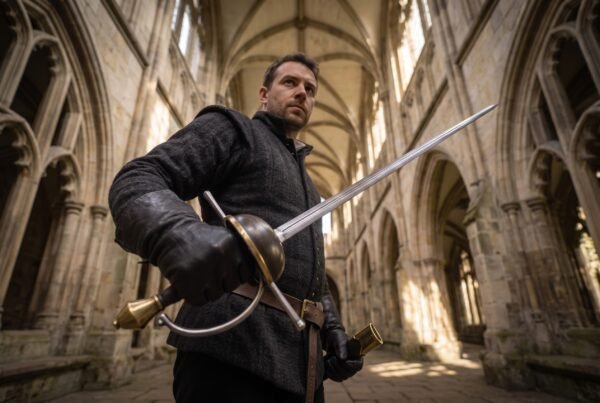
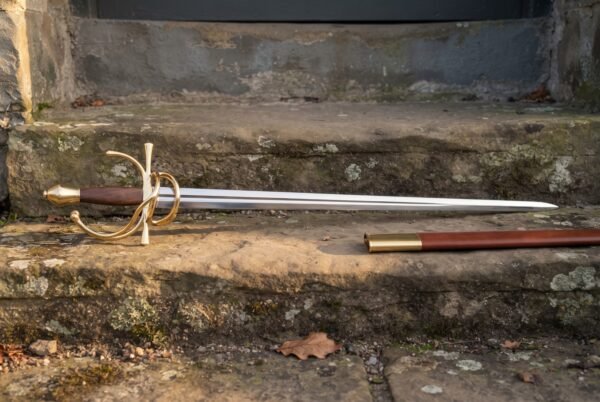
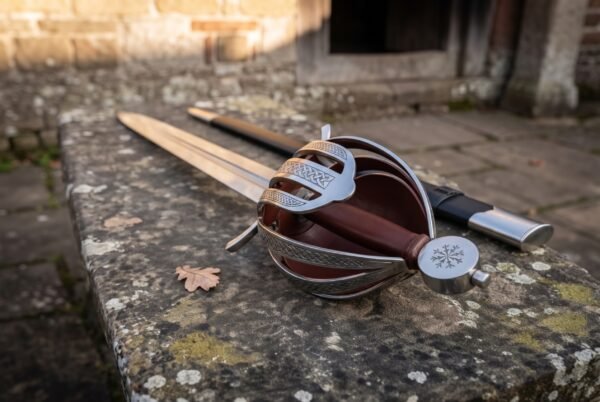
The Shellgrain is a hand forged Damascus Spanish rapier, a deep polished cup over a pattern welded blade. The cup hilt is the Spanish contribution to the rapier and it did not appear in isolation. It belongs to a school of fencing, La Verdadera Destreza, the true skill, which was unlike anything else being taught in Europe. Where the Italian masters wrote about lines and tempo, the Spanish masters wrote about geometry. Their students learned to move around an imaginary circle drawn on the ground between the two fighters, holding the sword arm extended and the body upright, controlling distance by walking arcs rather than by lunging in and out along a straight line.
That posture explains the sword. An extended arm puts the hand further forward than any other guard position, which makes it the most exposed target on the body, so the guard has to be absolute. A solid cup answers that completely where a cage of bars does not. The blade is stiff and held level rather than swung, so it needs section and stiffness far more than it needs a fine profile.
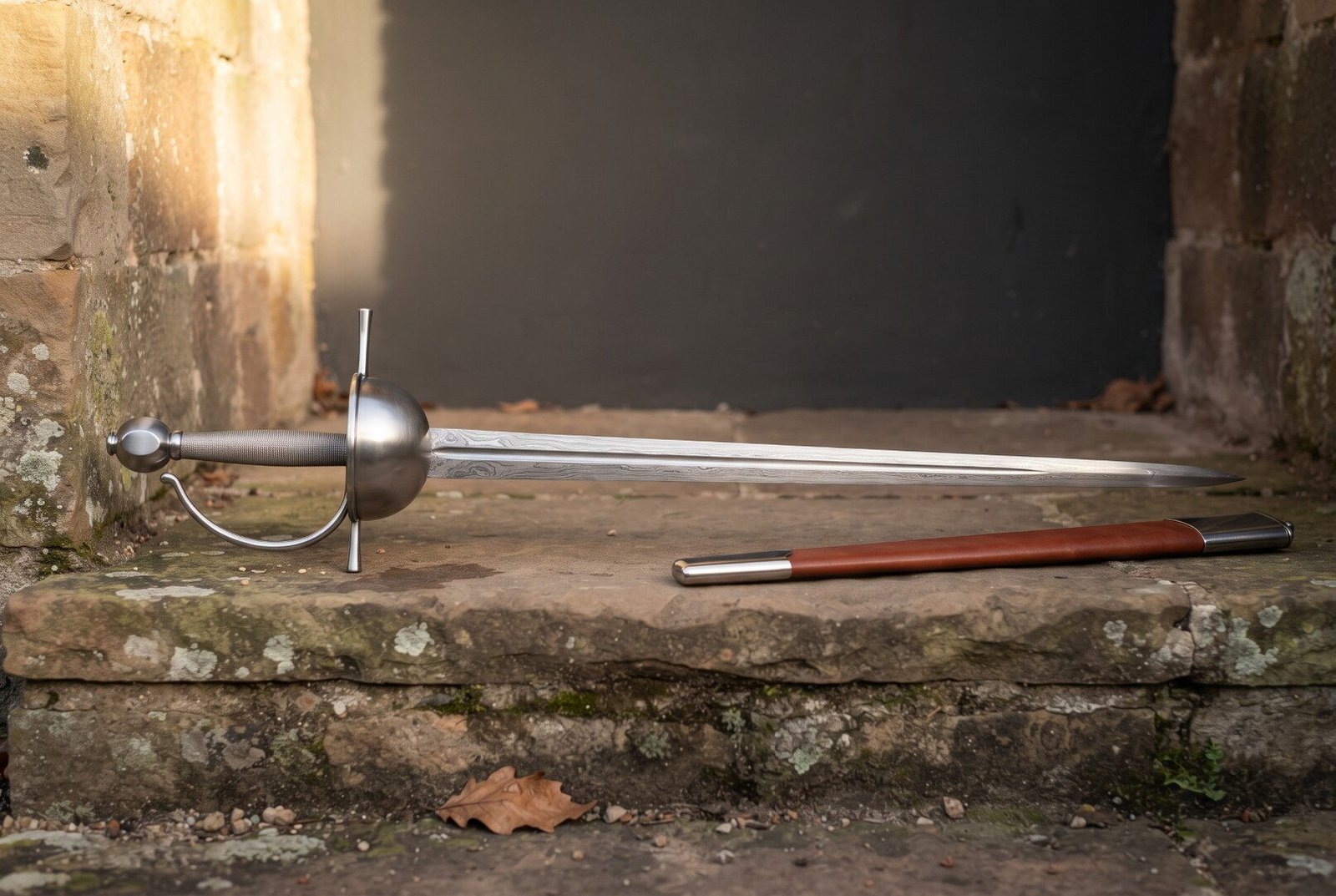
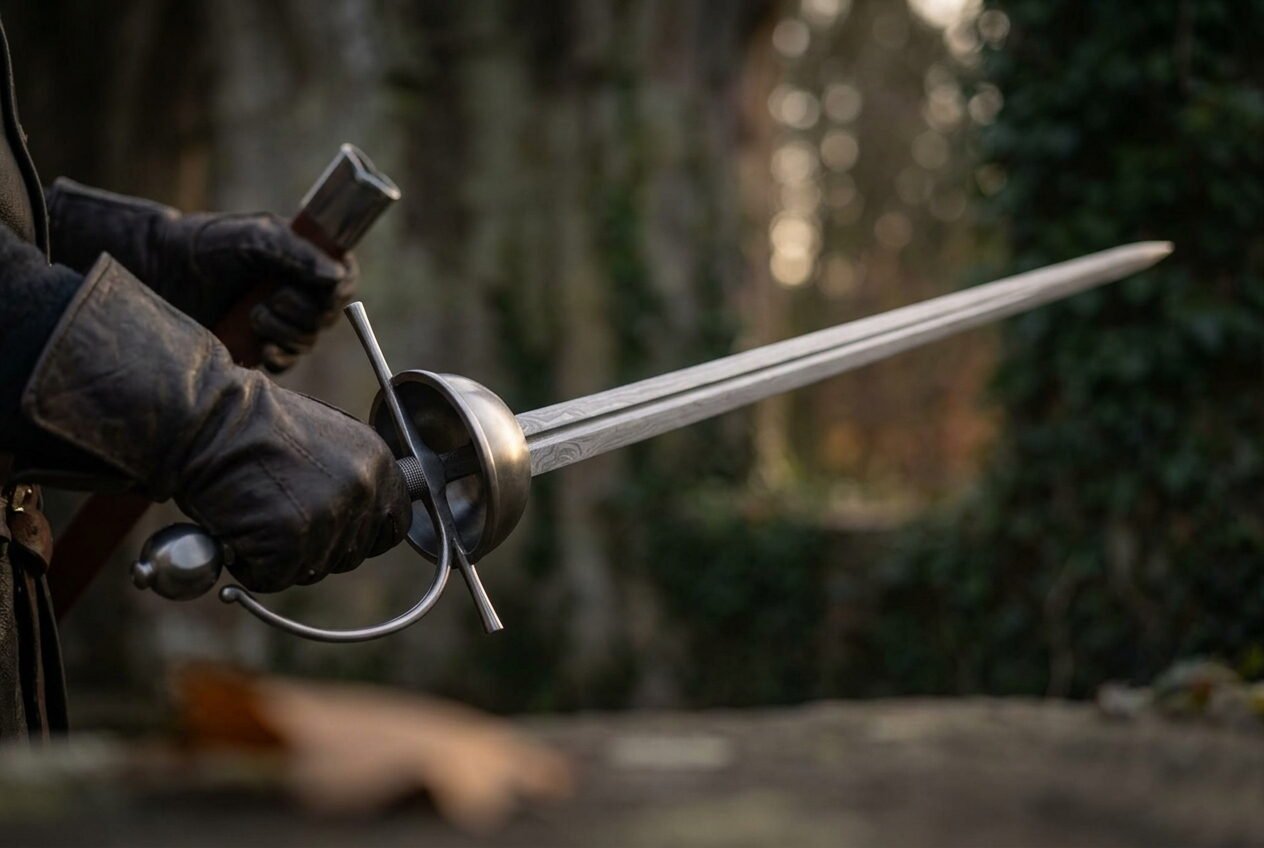
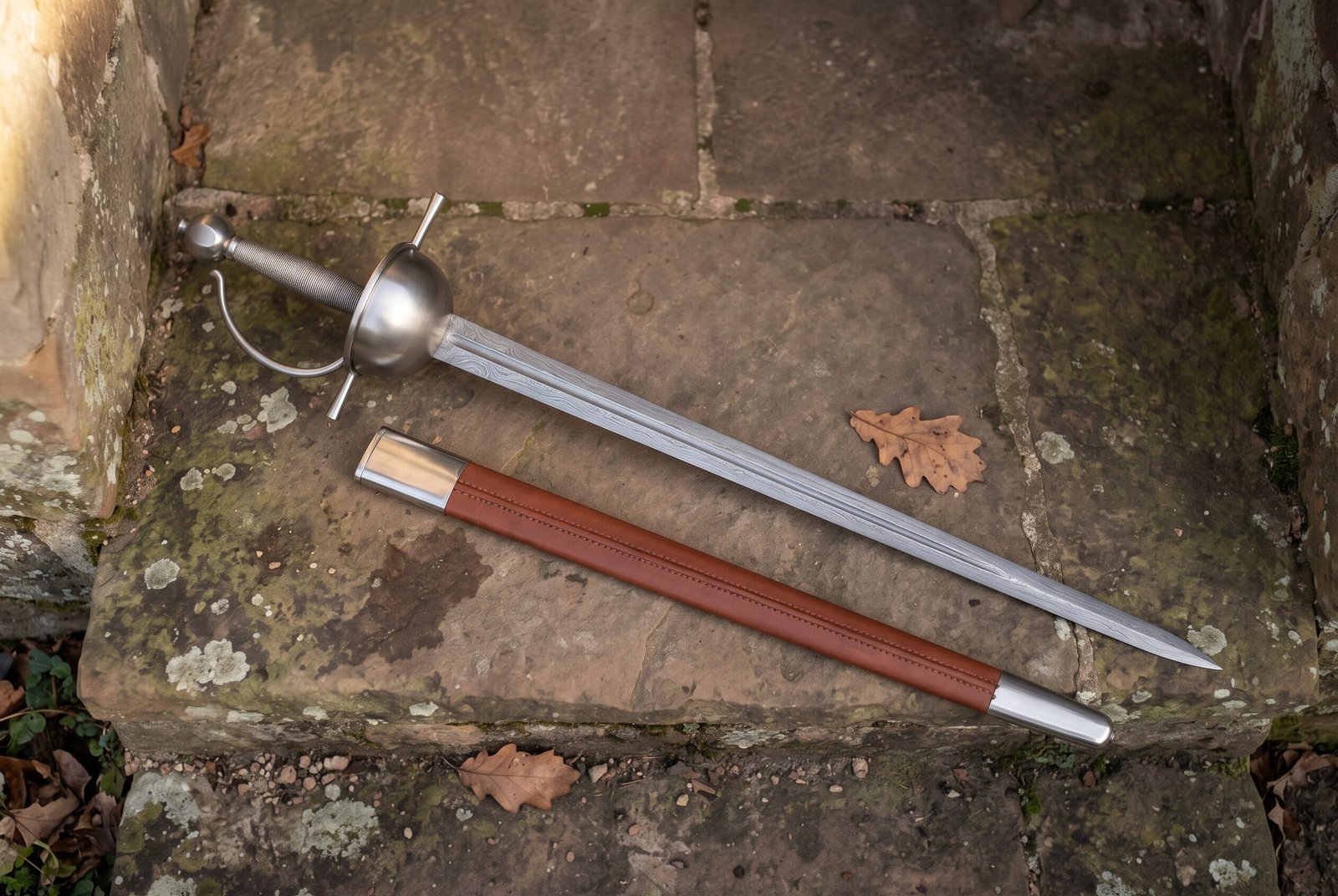
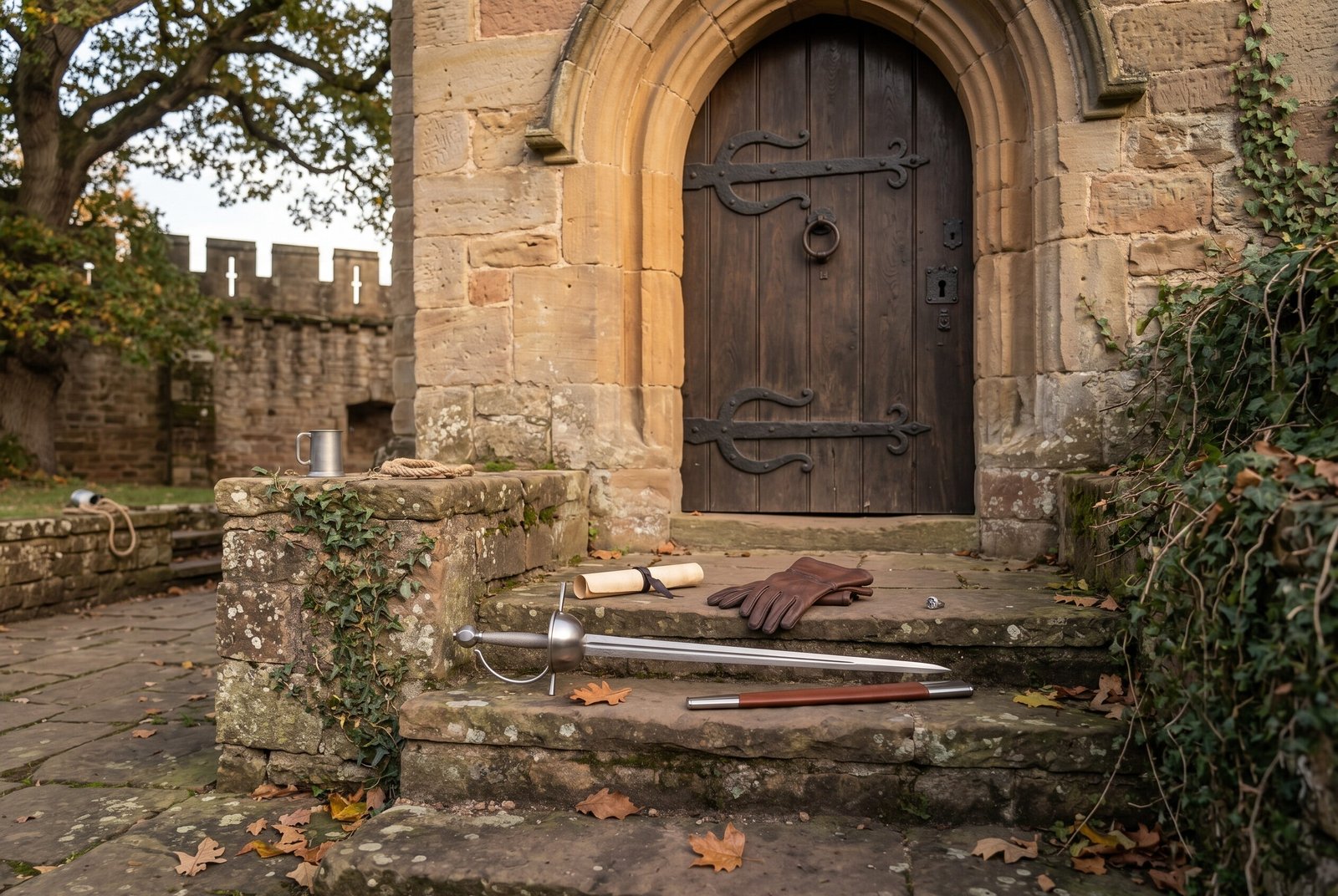
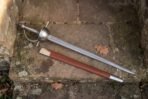
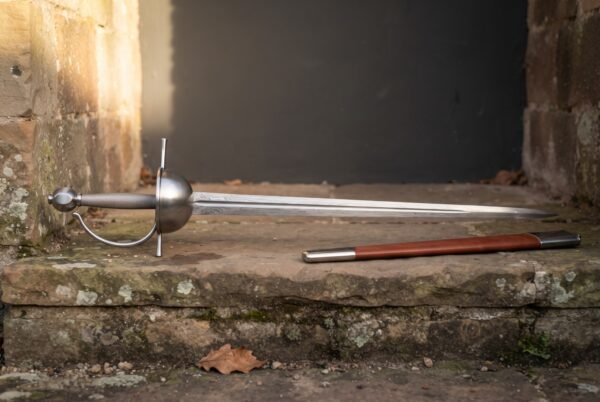
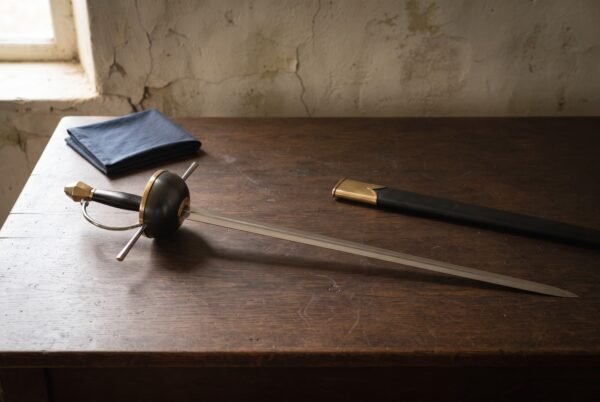
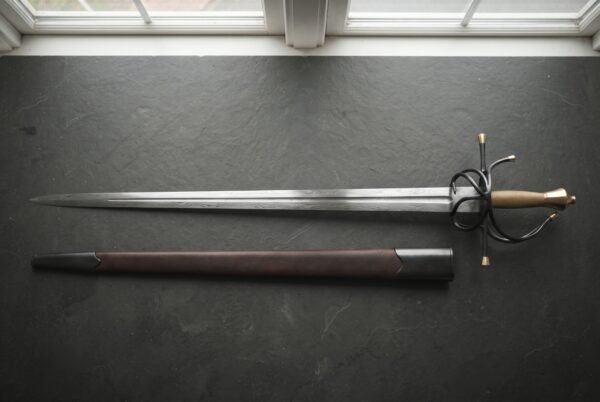
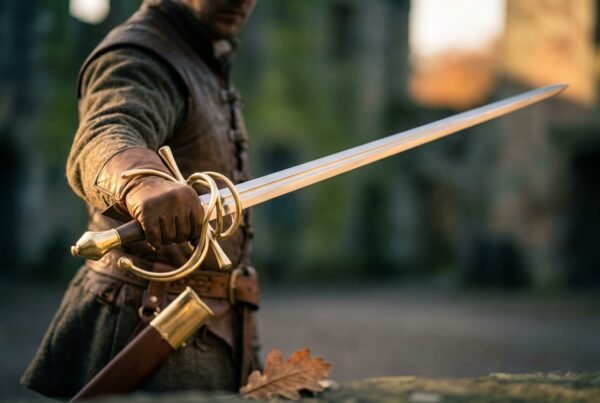
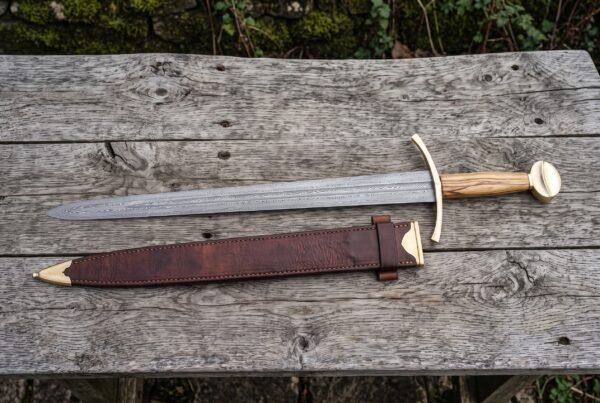
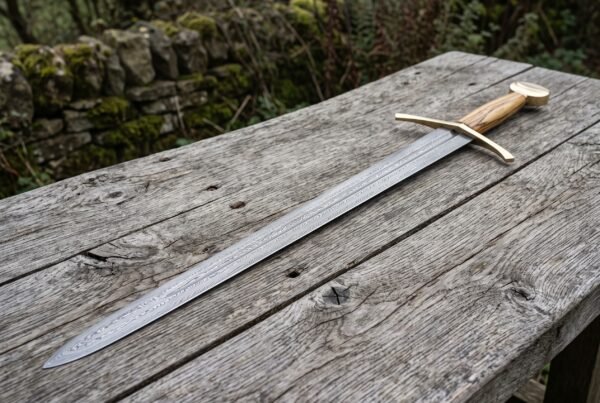
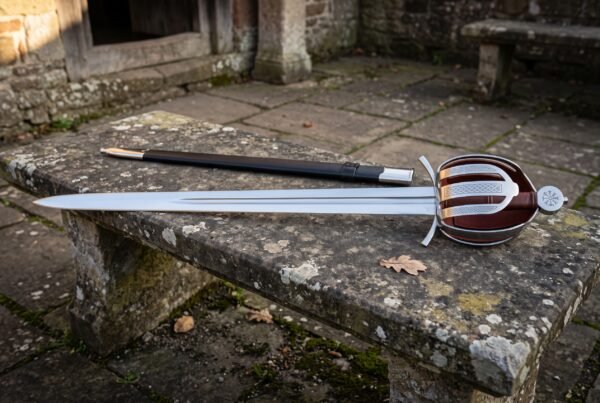
This one is forged and finished in the Czech Republic. The blade is Damascus, 1095 and 15N20 forge welded in hundreds of layers and etched to raise a flowing wood grain figure. The hilt is a deep polished steel cup with long straight quillons, a knuckle bow and a spherical pommel over a twisted wire grip. It ships with the fitted brown leather scabbard shown, mounted with a polished steel throat and chape.
Specifications
| Steel | Damascus, 1095 and 15N20 forge welded |
|---|
| Hardness | 58 to 60 HRC |
|---|
| Overall length | 45 inches |
|---|
| Blade length | 37.5 inches |
|---|
| Blade profile | Tapering double edge with a narrow fuller in the forte and an etched wood grain Damascus figure |
|---|
| Guard | Deep polished steel cup hilt with long straight quillons and a knuckle bow |
|---|
| Grip | Fine twisted steel wire wrap |
|---|
| Pommel | Spherical polished steel with a button |
|---|
| Scabbard | Brown leather with polished steel throat and chape |
|---|
| SKU | RK-1422 |
|---|
How a cup hilt is made, and why it costs what it does
A cup guard is the most demanding single component in the whole rapier family, and the reason is that it is raised rather than cast. Raising means starting with a flat disc of steel and hammering it, from the outside in, over a stake, until the flat becomes a bowl. Nothing is removed. The metal is moved, and moving it work hardens it, so the disc has to be annealed and allowed to cool several times during the process before it will take any more.
Doing that evenly is the skill. Hammer too hard in one area and the metal thins there, leaving a weak spot invisible from the outside until something strikes it. Hammer unevenly around the circumference and the rim goes out of round and the finished cup will not sit square on the blade. Every stage has to be worked in overlapping courses around the bowl so the metal flows uniformly, and a deep cup like this one takes several rounds of that.
Then it has to be polished, inside and out. The inside of a bowl is one of the more awkward surfaces to bring to a mirror, because you cannot get a flat wheel into it and every abrasive mark left behind is magnified by the curve. A cast cup can be made in a fraction of the time and it is heavier, duller and more brittle, and you can usually tell by looking at the rim. This one was raised.
Why Damascus and not stainless
The blade is a laminate of 1095 and 15N20, stacked and forge welded, drawn out, folded and welded again until the layers number in the hundreds. Both are simple high carbon steels that harden to a similar figure, so the blade behaves as a single homogeneous piece rather than as a stack. What makes the pattern visible is nickel. 15N20 carries about two percent, and nickel resists the acid used to finish the blade, so those layers stay bright while the 1095 darkens around them.
Functionally, the laminate resists crack propagation across its many interfaces, which lets us temper it slightly harder at 58 to 60 HRC without losing toughness. Stainless can do none of this. Its chromium content produces coarse carbides that are crack initiators in a long blade, so stainless swords are either soft enough to take a permanent bend or hard enough to snap. The trade with Damascus is rust, and the answer is oil. See Damascus versus stainless.
The wire grip inside the cup
The grip is bound in twisted steel wire. On a cup hilt this matters more than it might seem, because the hand sits inside the bowl with limited room to shift position, and the sword is steered through the thumb and forefinger rather than gripped. A ridged wire surface holds the edge orientation with almost no pressure, and unlike leather it will neither stretch nor absorb sweat. The winding is terminated at both ends so it cannot unravel.
Wire needs almost nothing from you. Wipe it occasionally and run a cloth with a drop of oil along the winding once or twice a year, because the grooves between turns will hold moisture if you let them and the wire itself is steel.
Engraving, runes and your own design
Use the rune converter on this page to turn a name, a date or a short phrase into Elder Futhark and we will cut it into the steel or the handle. If you would rather have a Viking pattern than a rune line, choose your own design in the engraving option above the add to cart button and tell us whether it goes on the blade or the handle. Where a piece already carries an engraved design, your chosen engraving replaces it rather than sitting alongside it. The Shellgrain has two exceptional panels: the outer face of the cup, which is the largest single engraving surface in this range, and the Damascus blade itself, where a cut goes through the etch and reads as bright steel against the pattern. See the engraving page.
Care and sharpening
Etched Damascus is very slightly textured and holds moisture more readily than a mirror polish, so wipe the blade after handling and work a thin film of mineral or camellia oil into the surface rather than simply across it. The polished cup needs the same treatment, particularly inside the bowl where dust settles and is difficult to reach once the sword is displayed. Never store the sword sheathed for months at a time. If the Damascus pattern ever clouds it can be re etched rather than polished away. The routine is on the steel care page.
The edges arrive sharp. To refresh them use a whetstone and follow the existing bevel with light passes. Stone work will cut through the etch along the bevel and leave a bright line, which is normal on Damascus and can be re etched if it bothers you. Take care at the point. See sharpening with a whetstone.
Made in the Czech Republic
This piece is made by hand in the Czech Republic, in a workshop that still works the old way. The steel is forged, ground, heat treated and finished by smiths who learned the trade from the people before them, and the wood, horn and leather are cut and fitted by hand rather than pressed out on a line. That is also why no two pieces come out exactly the same.
Ransack Viking is a United States company. We import these pieces ourselves, check every one when it lands and ship from our warehouse in Chicago, Illinois. Engraving is done here in the United States after the piece arrives, so your runes or your own design go on before it leaves for you.
A note on handmade variation
This piece is hand forged, not machine made or bulk produced, so what arrives will not be a pixel for pixel copy of the photograph. Damascus is never repeatable, because the figure depends on how that particular billet moved under the hammer and where the grinder cut through the layers. A raised cup is never twice the same depth or curve either. Add the tone of the brown leather, which varies across hides, and you have a sword that shares its dimensions with the one in the photograph and nothing else. The dimensions, the steel and the build are the same every time. The character is not.
Frequently asked questions
Is the Damascus pattern real
Yes. The blade is 1095 and 15N20 forge welded in hundreds of layers, and the pattern is the layer structure revealed by an acid etch. It runs through the whole thickness of the blade rather than sitting on the surface.
Is the cup cast or raised
Raised, which means hammered from a flat disc over a stake with annealing between stages. It is stronger, lighter and thinner walled than a cast cup, and it takes considerably longer to make.
Is the sword sharp
The edges arrive with a working sharpness and the point is a genuine point. It is a functional hardened sword rather than a decorative one.
Can I use it for fencing
No. This is a sharp sword, not a blunt trainer. Historical fencing needs purpose built blunt blades with rolled tips and full protective kit.
What is the difference between a Spanish rapier and an Italian one
Hilt and blade proportion, driven by two different fencing theories. The Spanish tradition favours the solid cup and a stiffer blade held on an extended arm. The Italian tradition favours the swept hilt of curved bars and a longer, more slender blade used with more body movement.
How long does shipping take
Free shipping in the United States. In stock pieces ship in a few days. It takes four to six weeks in the shop because of the billet and the raised cup, plus a few days for engraving.
What is in the box
- Shellgrain hand forged Damascus Spanish rapier in 1095 and 15N20
- Fitted brown leather scabbard with polished steel throat and chape
- Care card covering oiling, etch care and cup polish upkeep
- Elder Futhark rune engraving or your own Viking design if selected at checkout
- Forged and finished in the Czech Republic
Explore the range
Browse the rapiers, the Damascus swords, the short swords and the full sword range, or read the guides.
Other pieces in this group
Closest to this in the range is the Brasswake rapier, 43 inches overall. If this one is not quite right, there is the Bellcourt rapier, 5 inches overall. Also in this group is the Gildthorn rapier, 5 inches overall.
If you are putting a set together, the Runeglint arming sword sits alongside it. Nothing here exactly right, build one to your own spec on the design your own page.
If you want to spar rather than display, the Lindmoor smallsword is the blunt trainer built for it, and our smallswords and spadroons is worth a look.

Reviews
There are no reviews yet