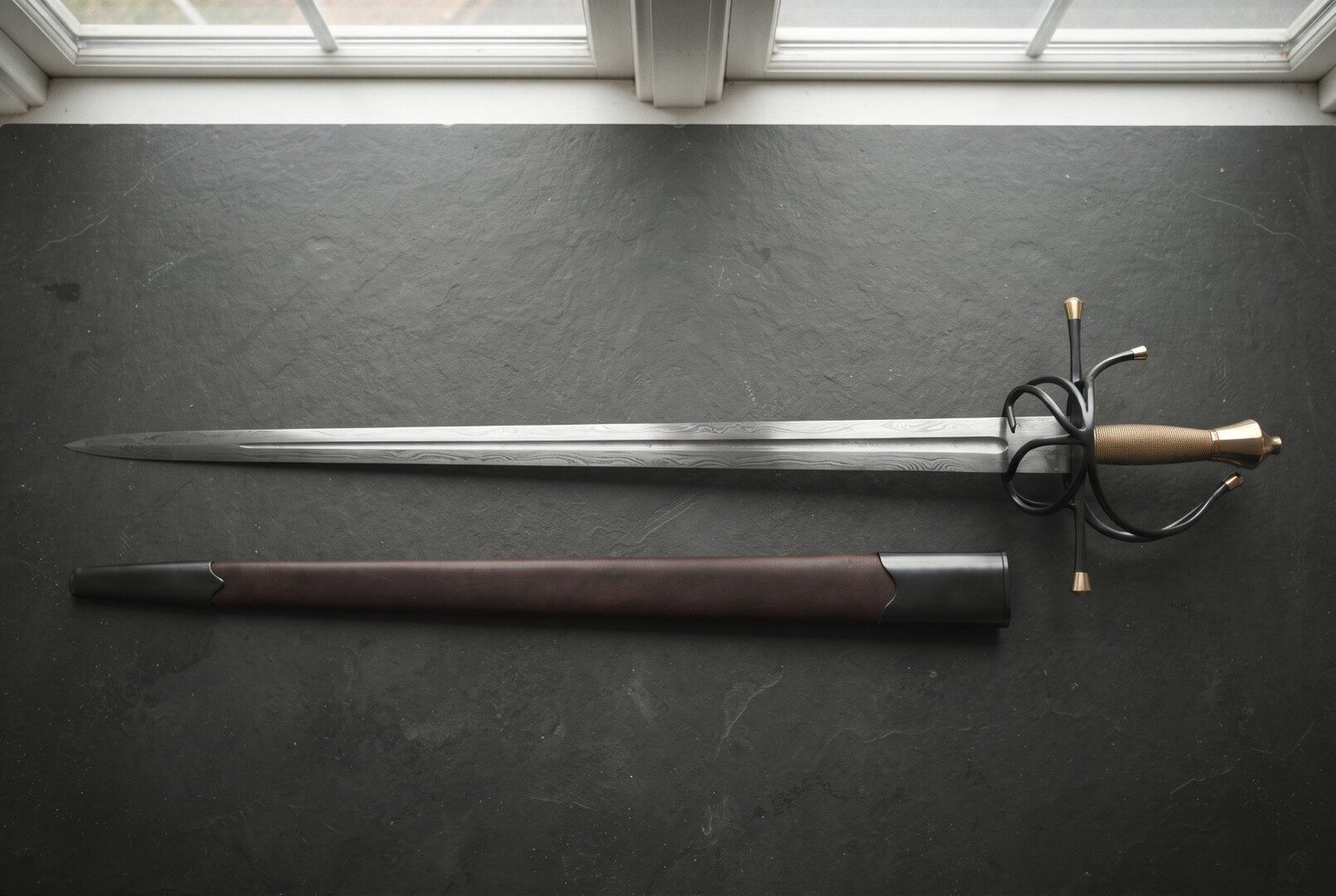
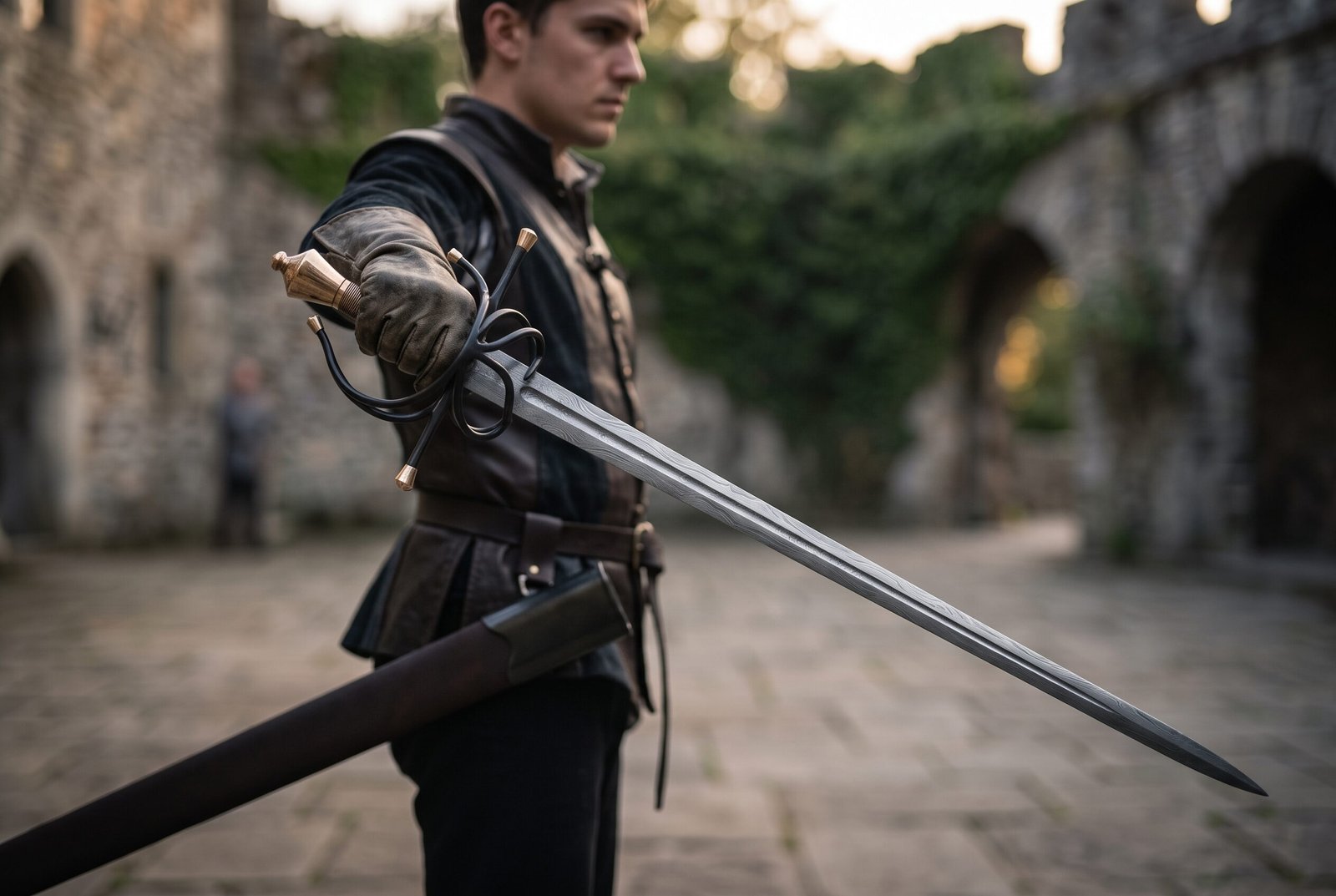
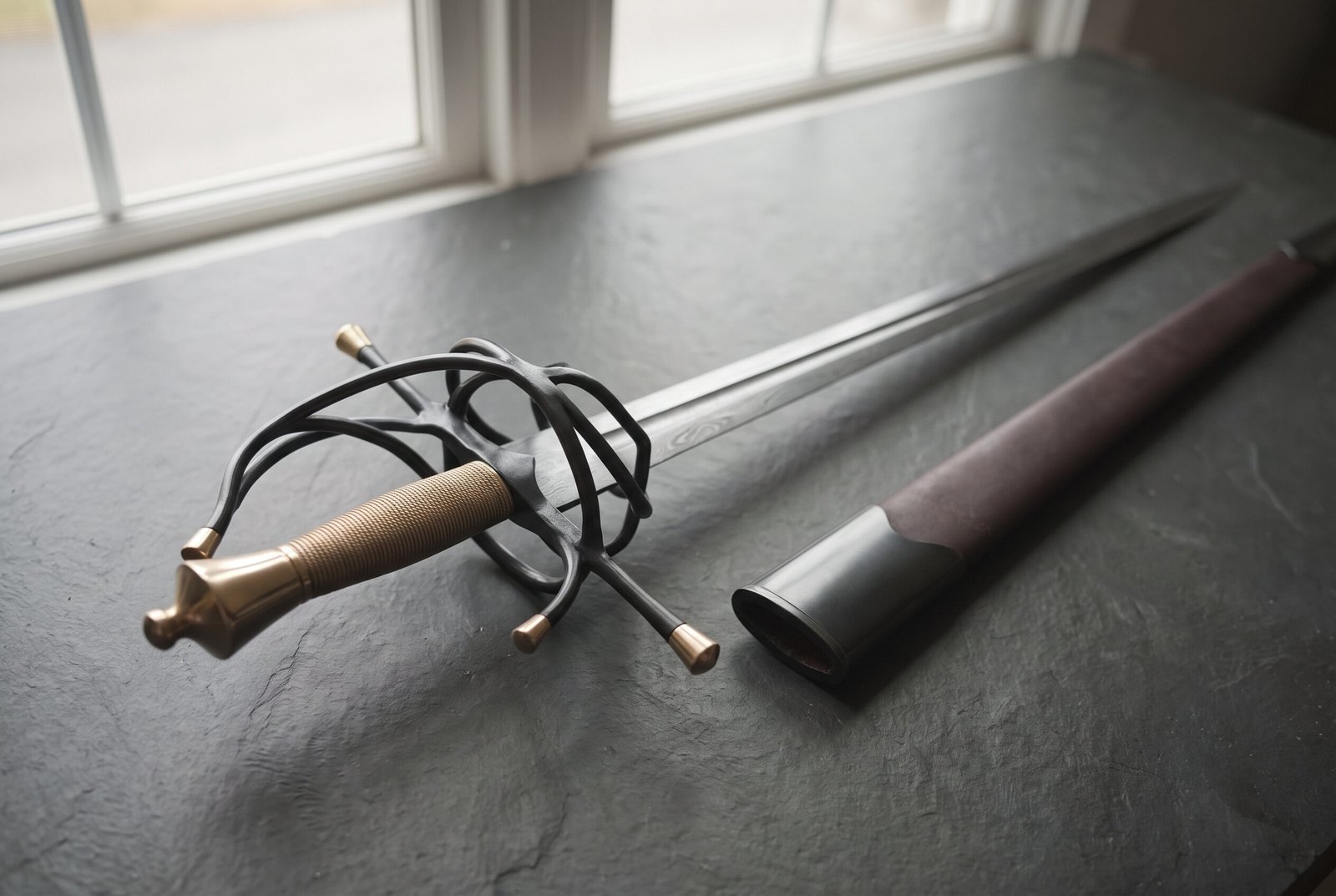
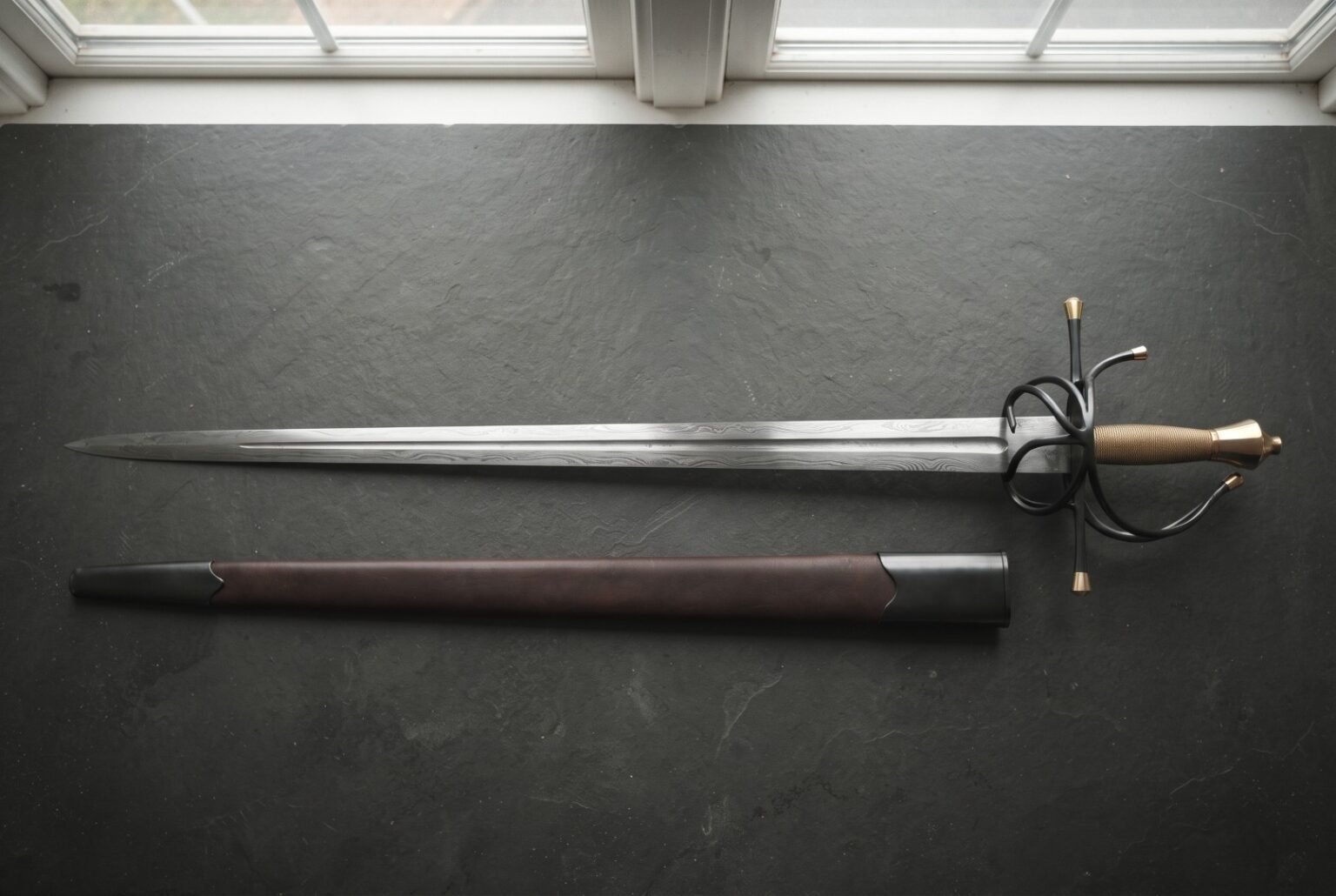
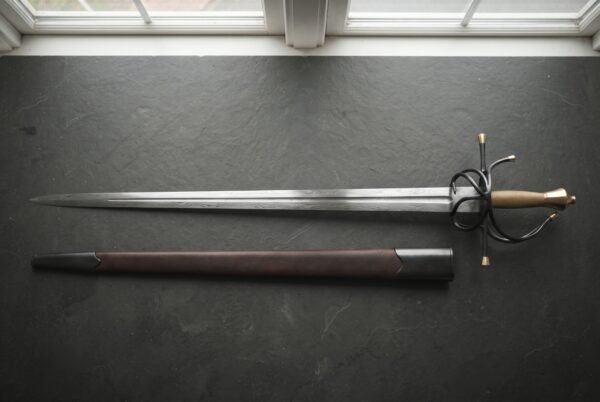
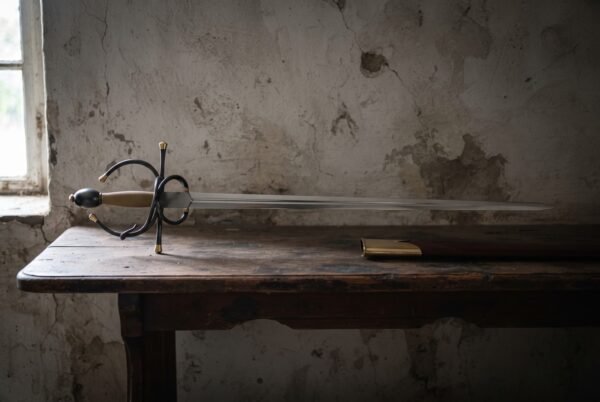
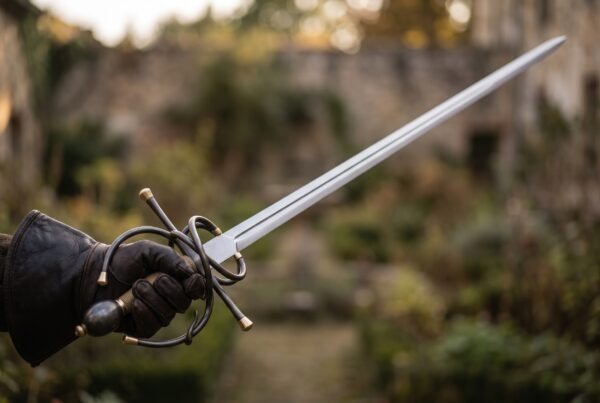
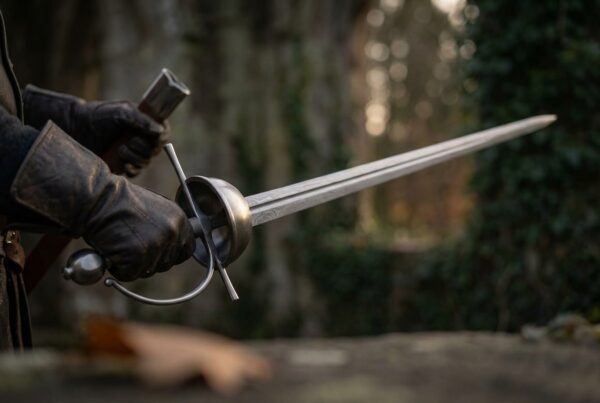
The Brasswake is a hand forged Damascus rapier, a long tapering cut and thrust blade in pattern welded steel hung on a blackened swept hilt with brass fittings. Pattern welded blades and rapiers do not usually appear together in the historical record, and there is a reason for that. By the time the rapier arrived, European smiths had reliable homogeneous steel and no longer needed to weld scraps of different quality together to make a serviceable blade. Pattern welding had been a solution to a supply problem in the migration period, not an aesthetic choice. What we are doing here is the aesthetic choice, made deliberately with modern steels, on a form that never historically carried it. It is an honest anachronism and it looks extraordinary.
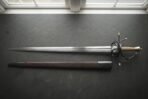
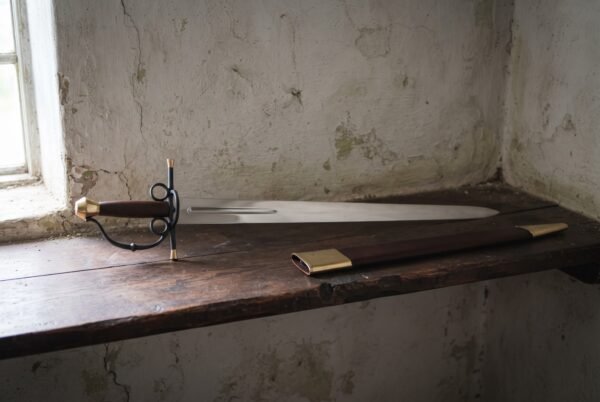
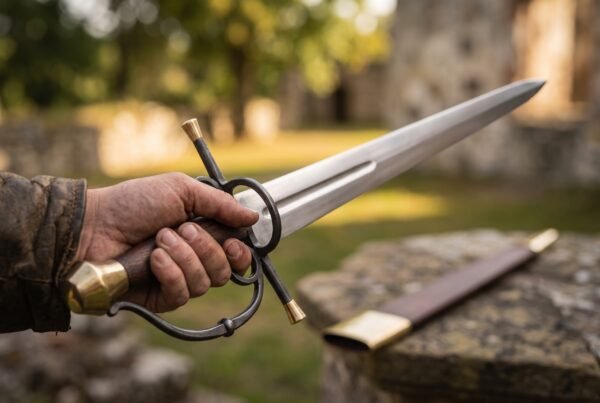
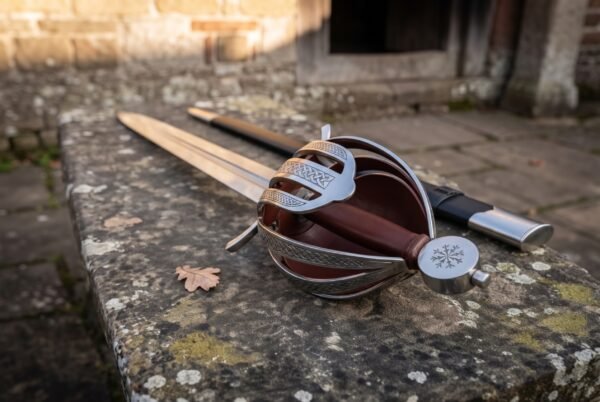
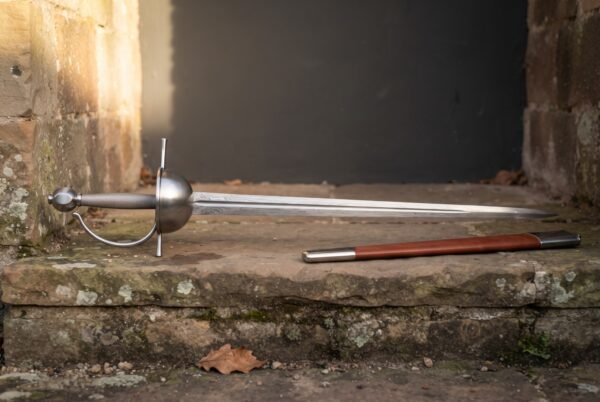
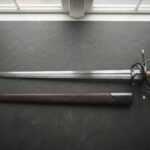
This one is forged and finished in the Czech Republic. The blade is Damascus, 1095 and 15N20 forge welded in hundreds of layers, ground to a long taper and etched so the grain flows from ricasso to point. The hilt is blackened steel, swept into loops and rings around the hand, finished with polished brass end caps on the bar ends and a brass ferrule at the grip, under a faceted brass pommel. The grip is wound in gold toned wire. It ships with the fitted oxblood leather scabbard shown, mounted with a blackened steel throat and chape.
Specifications
| Steel | Damascus, 1095 and 15N20 forge welded |
|---|
| Hardness | 58 to 60 HRC |
|---|
| Overall length | 43 inches |
|---|
| Blade length | 35.5 inches |
|---|
| Blade profile | Long tapering double edge with etched wood grain Damascus |
|---|
| Guard | Blackened steel swept hilt with knuckle bow, side rings, counter guards and straight quillons |
|---|
| Bar ends | Polished brass end caps |
|---|
| Grip | Gold toned wire wrap with a brass ferrule |
|---|
| Pommel | Faceted brass pommel with a tang button |
|---|
| Scabbard | Oxblood leather with blackened steel throat and chape |
|---|
| SKU | RK-1416 |
|---|
Why the Damascus grain runs the way it does
The pattern on a long blade is not applied to the surface and it is not random. It is a cross section, and understanding that changes how you look at every pattern welded blade you will ever see.
The billet starts as a stack of flat bars, 1095 alternating with 15N20, welded together into a solid block of neat parallel layers, like a deck of cards fused together. If you ground that block flat you would see stripes. What makes the wood grain figure appear is what happens next. The billet is drawn out under the hammer, folded, welded again, and drawn out further until the layer count multiplies into the hundreds and the layers are far thinner than a sheet of paper.
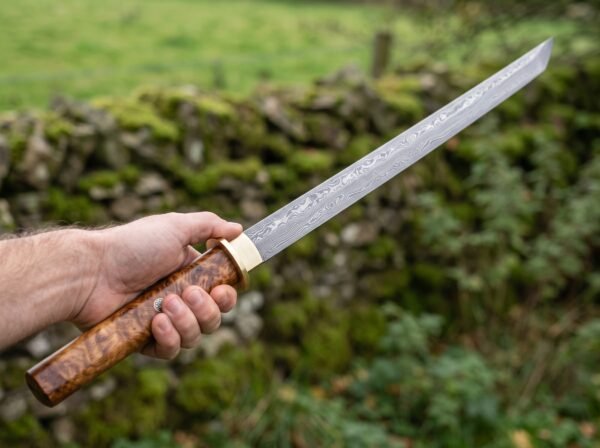
Then the blade is ground. The grinder cuts down through that stack at a shallow angle, and every layer it intersects appears on the surface as a line. Where the layers were pushed up slightly by the hammer, the grinder cuts deeper into the stack and the lines bunch together and swirl. Where they lie flat, the lines run long and straight. The tapering shape of a rapier blade means the grinder cuts through progressively more layers as it approaches the point, which is why the figure tightens and flows towards the tip on a blade like this. What you are looking at is a contour map of the inside of the steel.
The etch is what makes it visible. 15N20 contains about two percent nickel, and nickel resists the mild acid used to finish the blade, so those layers stay bright while the 1095 layers darken. The pattern is not a coating. If you ground a millimetre off this blade you would find a new but equally figured pattern underneath.
Why Damascus and not stainless
Beyond appearance, this blade is functionally better than a stainless one. Both steels in the laminate are simple high carbon alloys that harden deeply and evenly, and the finished blade at 58 to 60 HRC holds an edge notably longer than plain 1095 and springs back true from a flex. Stainless earns its rust resistance with a heavy chromium content, and that chromium forms coarse carbides through the metal that act as crack initiators in a long thin blade. Stainless swords are therefore left soft, where they take a permanent bend, or hardened, where they can snap.
The trade with Damascus is straightforward: it will rust if you leave it wet, and the etched surface is slightly textured so it holds moisture a little more readily than a mirror polish. Oil is the answer. See Damascus versus stainless for the full comparison.
The wire grip and the brass fittings
The grip is wound in gold toned wire and closed with a brass ferrule at the pommel. Wire is the correct binding for a rapier grip because the sword is steered lightly through thumb and forefinger rather than held in a fist, and a ridged surface maintains edge alignment with almost no pressure. The ferrule and the guard lock both ends of the winding, which is the difference between a wrap that lasts thirty years and one that unravels in three.
Brass appears on the bar ends as polished end caps. That is not only visual punctuation. Brass is denser than steel, so putting it at the extremities of the guard adds a little steadying mass exactly where it damps vibration best, and a capped end means there is no sharp bar end to catch on clothing or a hand. Leave the brass alone and it will darken into a warm patina. If you prefer it bright, use the mildest polish available and use very little.
Engraving, runes and your own design
Use the rune converter on this page to turn a name, a date or a short phrase into Elder Futhark and we will cut it into the steel or the handle. If you would rather have a Viking pattern than a rune line, choose your own design in the engraving option above the add to cart button and tell us whether it goes on the blade or the handle. Where a piece already carries an engraved design, your chosen engraving replaces it rather than sitting alongside it. On a Damascus blade an engraving cuts through the etched surface and reads as bright steel against the dark grain, which is a striking effect. The faceted brass pommel is the alternative panel and it takes fine detail more easily than hardened steel. See the engraving page.
Care and sharpening
Etched Damascus needs a little more attention than plain polished steel. The etch leaves a very slight texture that holds moisture, so wipe the blade down after handling and work a thin film of mineral or camellia oil into the surface rather than just wiping across it. Never store the sword wet, and do not leave it sheathed for months at a time, since leather holds moisture against steel. If the pattern ever looks flat, it can be re etched rather than polished out. Keep abrasives away from the blackened hilt. Full detail on the steel care page.
The edges arrive sharp. To refresh them, use a whetstone and follow the existing bevel with light even passes. Heavy stone work on a Damascus edge will cut through the etch along the bevel and leave a bright line, which is normal and can be re etched if it bothers you. See sharpening with a whetstone.
Made in the Czech Republic
The work behind this piece happens in a Czech Republic workshop that has kept to the old methods. Steel is forged and heat treated by hand, the grind is taken down by eye rather than by machine, and the handle, fittings and sheath are cut and finished one at a time. Because of that, every piece carries small marks of the hand that made it.
Ransack Viking is a United States company. We import direct, check each piece when it reaches us, and ship from our Chicago, Illinois warehouse. Engraving is added here in the United States after arrival, so the piece you receive is finished to your order.
A note on handmade variation
This piece is hand forged, not machine made or bulk produced, so what arrives will not be a pixel for pixel copy of the photograph. Damascus is the least repeatable material we work with. The figure depends entirely on how that individual billet moved under the hammer and where the grinder happened to cut through the layers, so the swirls, the density and the contrast will be unique to your blade. Add the hand blackening of the hilt, the filing of the brass and the dye take of the leather and no two are alike. The dimensions, the steel and the build are the same every time. The character is not.
Frequently asked questions
Is the Damascus pattern real or applied to the surface
Real. The blade is two steels forge welded in hundreds of layers and the pattern is that layer structure exposed by an acid etch. It runs all the way through the blade rather than sitting on top of it.
Is the sword sharp
Yes, it arrives with a working edge on both sides and a real point. It is a functional hardened blade rather than a decorative casting.
Can I cut with it
Light target cutting is reasonable given the blade is properly hardened, but this is a long slender rapier blade and it is not built to be a chopper. It is not intended for edge on edge sparring with another steel sword.
Can I have runes engraved on a Damascus blade
Yes. The cut goes through the etch and reads bright against the pattern, which most people prefer to engraving on plain steel. Use the rune converter or choose your own design.
What is the difference between a Damascus rapier and a plain steel one
Pattern, hardness and price. Damascus here is 1095 laminated with 15N20 and taken to 58 to 60 HRC, a touch harder than our plain 1095 blades at 54 to 58. It holds an edge slightly longer, it costs more because the billet is a job in itself, and it carries a pattern no plain blade can.
How long does shipping take
Free shipping in the United States. In stock pieces leave within a few days. A Damascus rapier takes four to six weeks in the shop, plus a few days for engraving.
What is in the box
- Brasswake hand forged Damascus rapier in 1095 and 15N20
- Fitted oxblood leather scabbard with blackened steel throat and chape
- Care card covering oiling, etch care, brass and blackened finishes
- Elder Futhark rune engraving or your own Viking design if selected at checkout
- Forged and finished in the Czech Republic
Explore the range
Browse the Damascus swords, the rapiers, the short swords and the full sword range, or read the guides.
Compare it with these
In the same category sits the Shellgrain rapier, 45 inches overall. A near match for this one is the Shieldring rapier, 5 inches overall. Closest to this in the range is the Duskbroad rapier, 38 inches overall.
Fitting out further, the Runemarch falchion belongs with it. Pick the steel, the length and the fittings yourself on the design your own page.
If sparring is on your mind, the Fenrholt rapier trainer is made for that job, and our HEMA rapier range is a useful next stop.


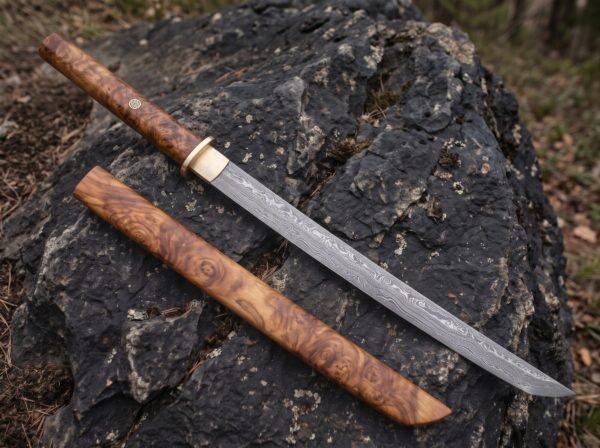
Got this as a birthday gift and the reaction was priceless. The wood handle feels amazing and the balance is perfect. Great buy overall.