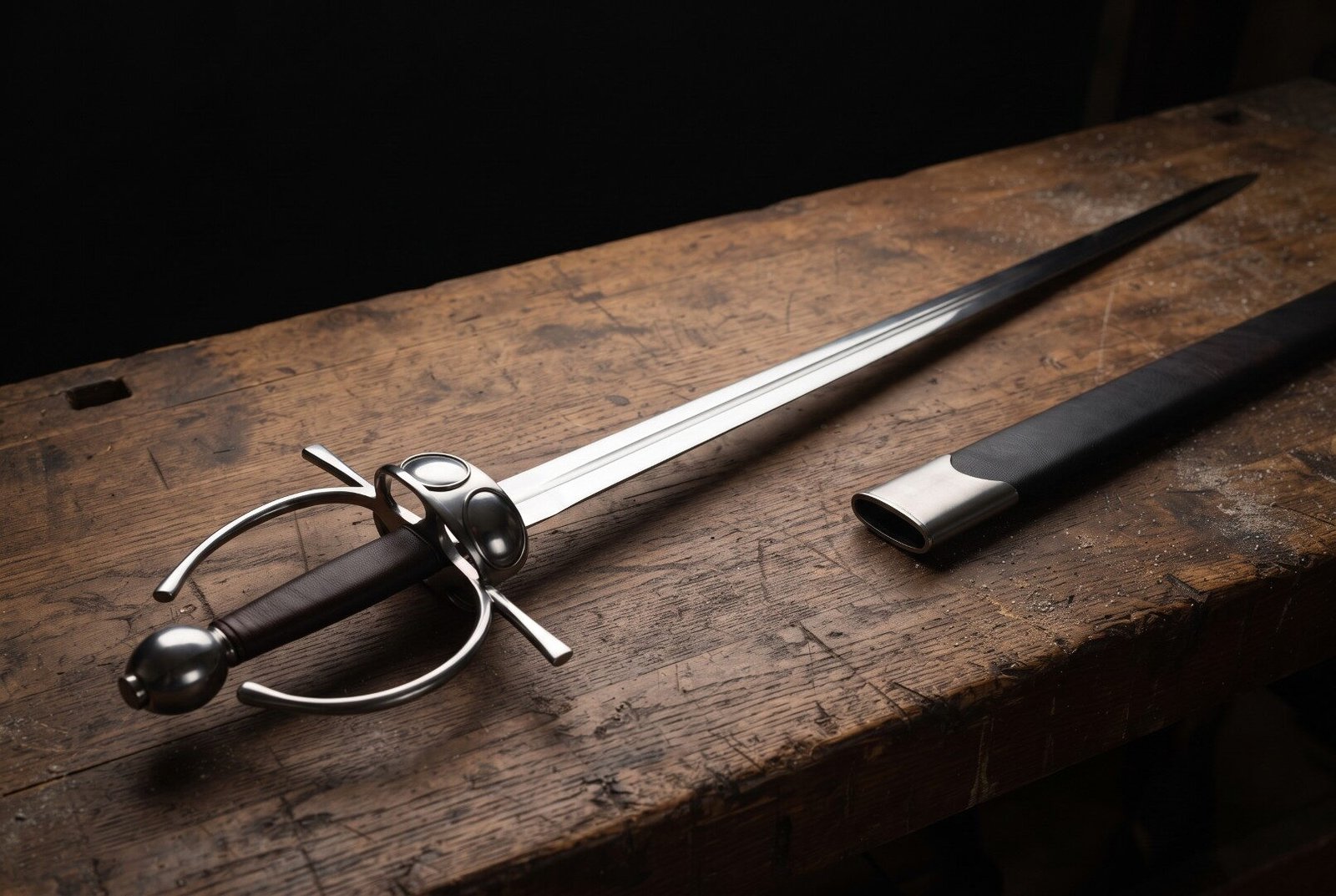
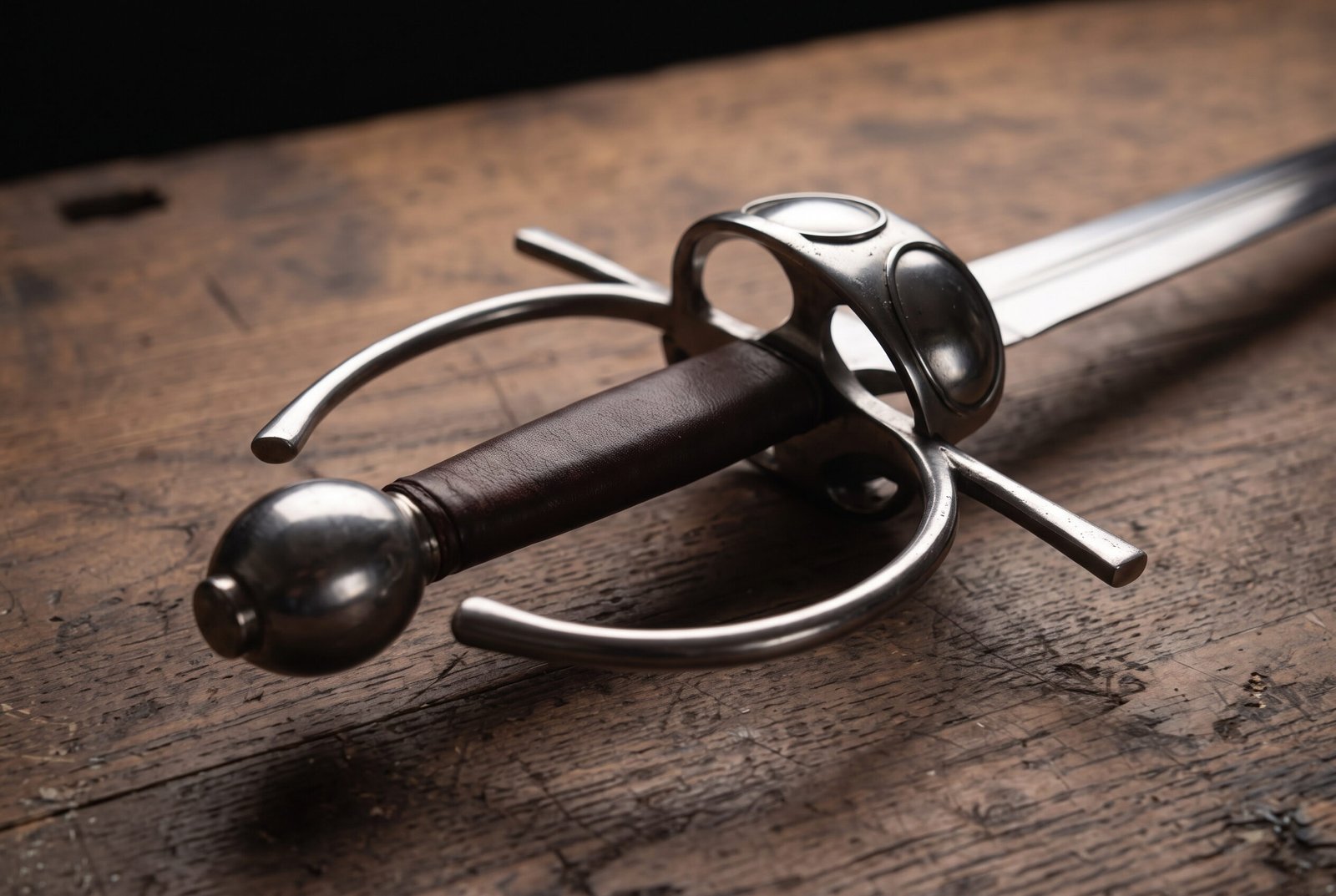
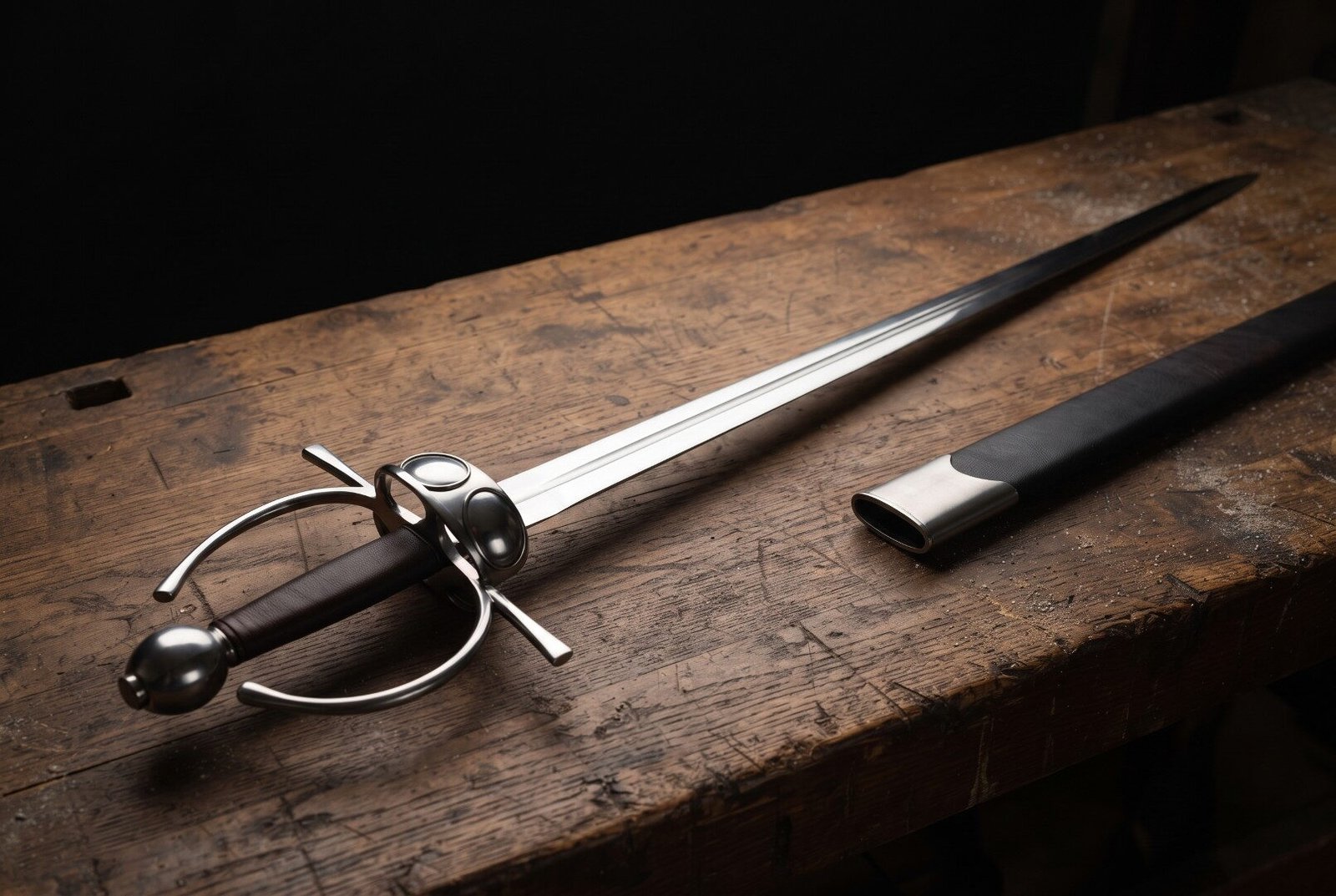
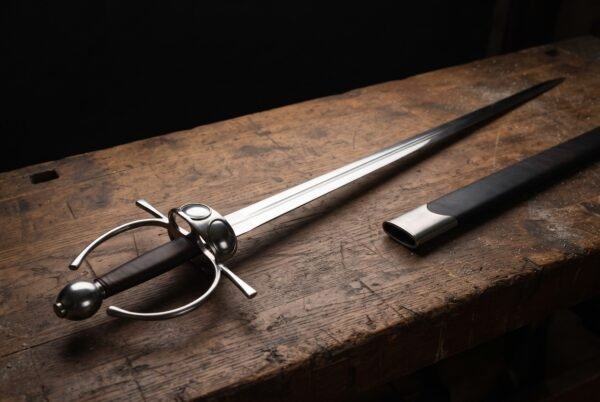
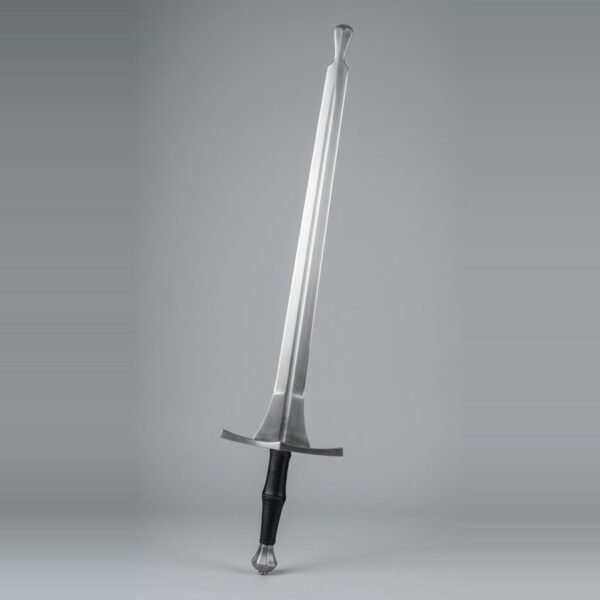
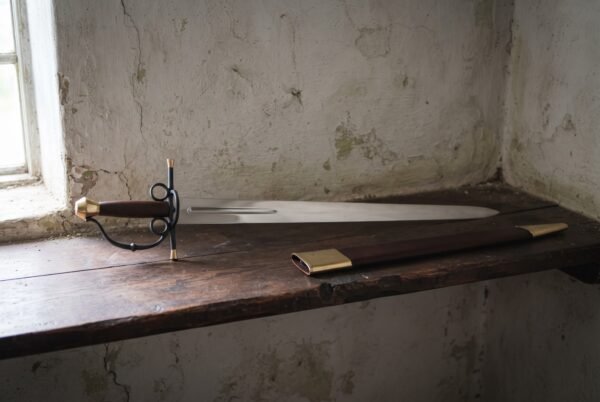
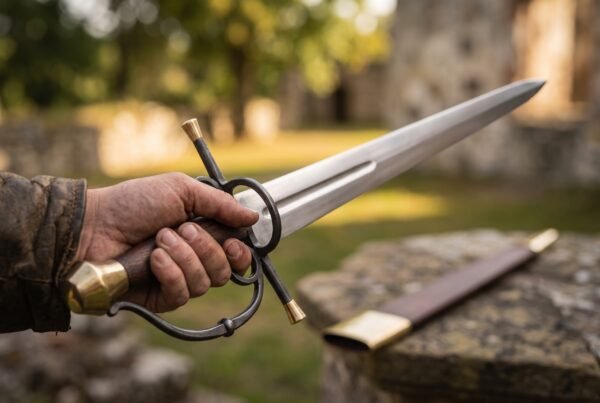
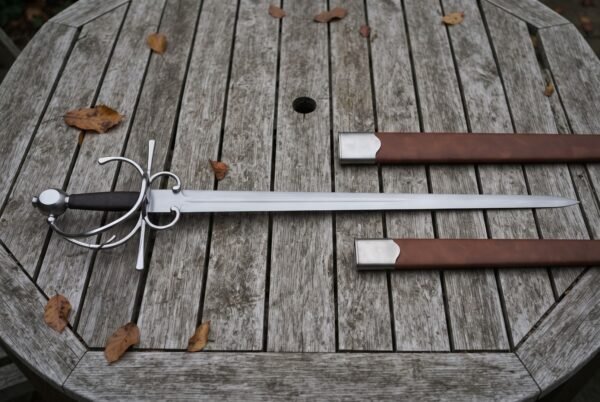
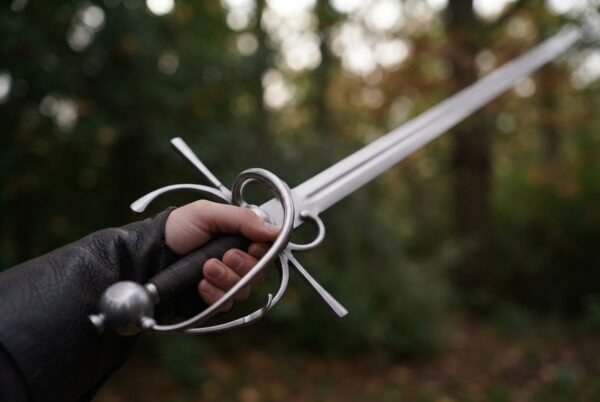
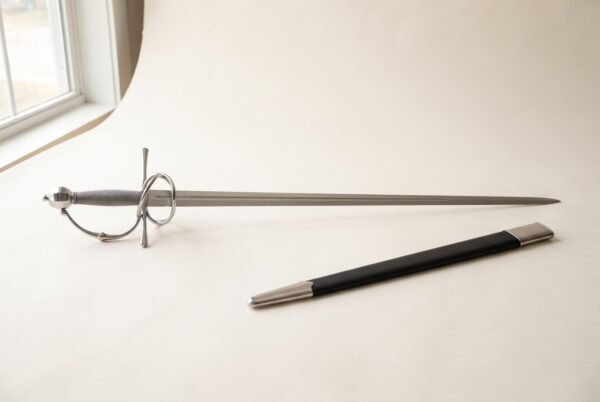
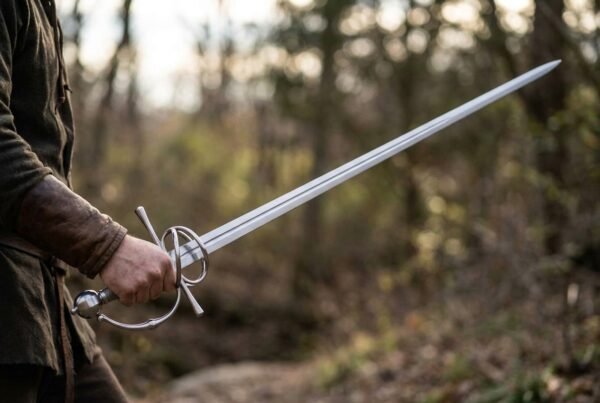
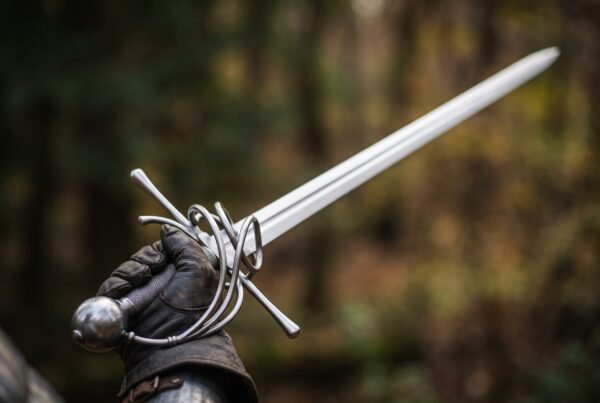
The Shieldring is a hand forged fencing sword built on a transitional hilt, the stage where the open side rings of the early sixteenth century started to be filled in with solid plate. Look at the guard and you can see the idea half finished. The rings are still rings, still bent from bar the old way, but each one now carries a dished oval shell across its opening. Fencing masters had worked out that a fine point could be threaded through an open ring, and armourers responded by plating the gaps rather than redesigning the hilt. Within two generations that instinct produced the full cup hilt. This is the sword in the middle of that argument, and it is one of the more interesting shapes in the whole family.
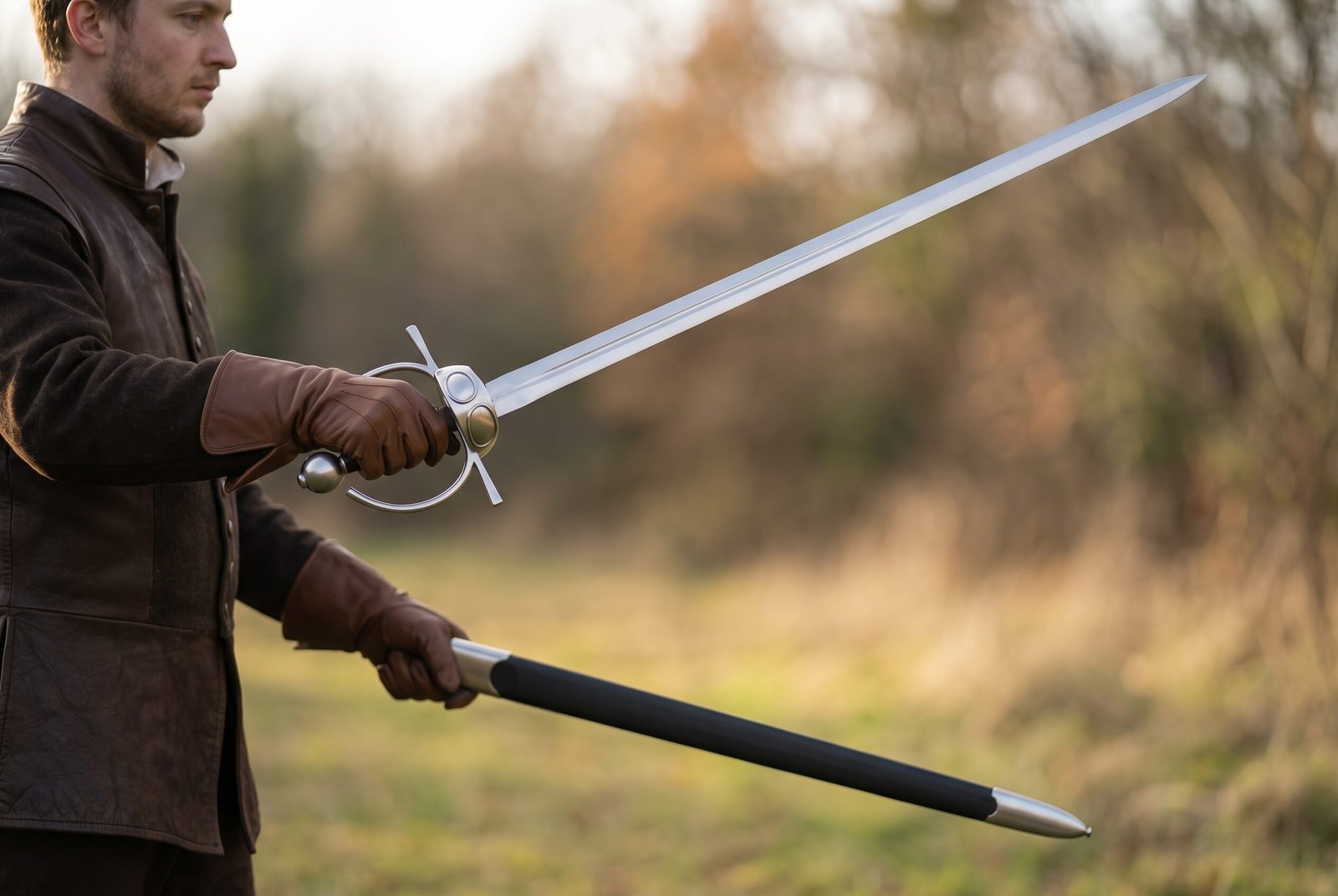
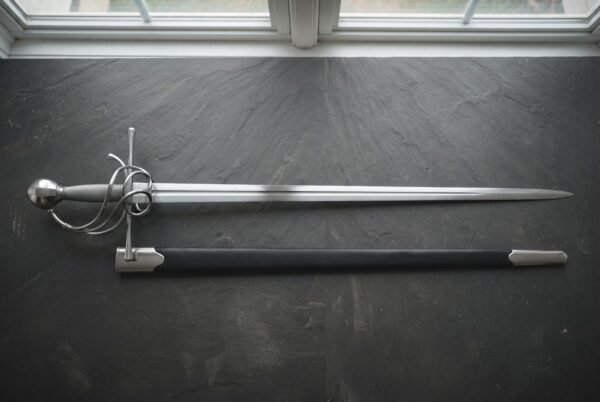
It is forged and finished in the Czech Republic. The blade is 1095 high carbon steel, hardened and tempered, ground broad with a long fuller and taken to a mirror polish. The hilt is polished steel with a knuckle bow, straight quillons and two solid shell plates set into the side rings. The grip is dark brown leather over a shaped wood core under a large egg shaped pommel. It ships with the fitted black leather scabbard shown, mounted with a polished steel throat and chape.
Specifications
| Steel | 1095 high carbon steel |
|---|
| Hardness | 54 to 58 HRC |
|---|
| Overall length | 39.5 inches |
|---|
| Blade length | 32.5 inches |
|---|
| Blade profile | Broad double edge with a fuller, mirror polished |
|---|
| Guard | Polished steel knuckle bow, straight quillons and side ring filled with solid dished shell plates |
|---|
| Grip | Dark brown leather over a wood core, steel ferrules at each end |
|---|
| Pommel | Large egg shaped polished steel pommel with button |
|---|
| Scabbard | Black leather with polished steel throat and chape |
|---|
| SKU | RK-1413 |
|---|
How a sword is balanced, and why the pommel is that big
Ask what a sword weighs and you learn very little. Ask where the weight is and you learn everything. Two swords of identical weight can feel completely different in the hand depending on how that mass is distributed along the length, and the numbers that describe it are the point of balance and the pivot points.
The point of balance is the easy one. Rest the sword across a finger and find where it sits level. On a cutting sword that point is typically five to seven inches ahead of the guard, because you want mass travelling into the target. On a pure thrusting rapier it can be two inches or less, because you want the point to change line without dragging the hand. This sword sits between them, around four inches out, which is exactly right for a blade that has to do both.
Pivot points are subtler and more useful. Hold the grip lightly and shake the sword sideways, and you will find a spot on the blade that barely moves while everything else swings around it. That is the pivot point corresponding to your hand position, and a well built sword places it near the part of the blade you want to strike with, so that a cut delivered there sends almost no shock back into the wrist. Move your hand and the pivot moves too. This is why a heavy pommel is not simply a lump of counterweight. Adding mass behind the hand shifts both the balance point and the pivot points at once, and getting the size of that pommel right is a matter of tuning rather than decoration.
Why 1095 high carbon steel and not stainless
Stainless steel earns its name through chromium, and chromium is the reason it makes a bad sword. It locks carbon into coarse hard carbides distributed through the metal, and every one of those is a small discontinuity where a crack can begin in a blade that flexes or takes a hit across the flat. The workaround is to leave stainless swords soft, which is why they bend and stay bent, or to harden them and accept that they can break.
1095 is close to plain iron and carbon. It hardens deeply, tempers to a figure you can rely on, and at 54 to 58 HRC gives a long blade a durable edge and genuine spring. It will rust if left wet or covered in fingerprints, which is the honest trade for that performance, and the remedy is a cloth and a little oil. The comparison is set out on Damascus versus stainless.
The leather grip over its wooden core
The grip is dark brown leather stretched over a shaped wooden core. It is worth saying plainly that wood is not a cost saving here. A solid steel grip would be heavier in exactly the wrong place, colder in the hand, and would ring like a bell every time the guard was struck. Wood is light, it can be carved to a waisted profile that indexes the hand without looking, and it damps vibration.
Because of that core, this grip needs the care any wooden handle needs. Avoid damp storage and avoid dry heat, both of which move wood and slacken the leather over it. Give the leather a light conditioner once or twice a year and wipe it with a barely damp cloth if it picks up dust. The routine is set out in wooden handle care.
Engraving, runes and your own design
Use the rune converter on this page to turn a name, a date or a short phrase into Elder Futhark and we will cut it into the steel or the handle. If you would rather have a Viking pattern than a rune line, choose your own design in the engraving option above the add to cart button and tell us whether it goes on the blade or the handle. Where a piece already carries an engraved design, your chosen engraving replaces it rather than sitting alongside it. The Shieldring is plain, and the two solid shell plates on the guard are unusually good engraving panels because they are flat, broad and sit where the eye lands first. See the engraving page.
Care and sharpening
Wipe the blade after handling and keep a thin film of mineral or camellia oil on it. Mirror polish records fingerprints permanently if they are left for a week or two, and the shell plates on this hilt are large enough that marks on them are obvious. Do not store the sword inside the scabbard for months, since leather holds a little moisture against steel. The full routine is on the steel care page.
The edges arrive sharp and functional. To bring them back, use a whetstone and follow the existing bevel with long even passes down each side, then strop. Keep the work off the fuller, which is a ground surface rather than an edge and does not want to be scratched. See sharpening with a whetstone.
Made in the Czech Republic
This is a handmade piece from the Czech Republic, made in a workshop that still forges, grinds and finishes by hand instead of stamping parts out. The smiths there have kept the older way of working, and the wood, horn and leather are shaped and fitted by hand as well. Two pieces of the same design will never be identical, and that is part of what you are buying.
Ransack Viking is a United States company. We handle the import ourselves, look over every piece when it lands and ship from our warehouse in Chicago, Illinois. Engraving is done in the United States after the piece arrives, so your design goes on before we send it out.
A note on handmade variation
This piece is hand forged. It is not machine made or bulk produced, so what arrives will not be a pixel for pixel copy of the photograph. The dish of each shell plate is worked by hand and no two curve identically, the rings are bent by eye, the brown leather varies in tone across hides and the polish reads differently depending on the light it is under. The dimensions, the steel and the build are the same every time. The character is not, and that is the difference between a forged sword and a stamped one.
Frequently asked questions
Can I fence with this sword
Not in the modern sense. It is a sharp functional sword, not a blunt trainer. Historical fencing needs purpose built blunts with rolled tips and proper protective equipment. This one is for collecting, display and careful handling.
Is it sharp when it arrives
Yes, with a working edge on both sides and a real point. Treat it as you would any sharp tool.
How heavy is it and does it feel heavy
Less than most people expect. The mass sits close to the hand because of the heavy egg shaped pommel, so it feels lighter and more controllable than the same weight would in a forward balanced sword.
Can I have runes engraved on the shell plates
Yes, and they are one of the better surfaces we work on. Use the rune converter for Elder Futhark or select your own design, and tell us which plate or surface you want it on.
What is the difference between this and a cup hilt rapier
This is the earlier idea. Cup hilts replace the rings entirely with a single deep bowl and pair it with a much longer, narrower thrusting blade. Here the rings survive and are simply plated over, and the blade is still broad enough to cut.
How long does shipping take
Free shipping in the United States. In stock pieces leave within a few days. It takes two to four weeks in the shop, and engraved work a few days longer.
What is in the box
- Shieldring hand forged 1095 high carbon steel fencing sword
- Fitted black leather scabbard with polished steel throat and chape
- Care card covering oiling, polish upkeep and leather care
- Elder Futhark rune engraving or your own Viking design if selected at checkout
- Forged and finished in the Czech Republic
Explore the range
See the rapiers, the short swords, the arming swords and the full sword range, or read the guides.
Worth a look beside this
Worth putting side by side with this is the Petalward rapier, 41 inches overall. In the same category sits the Oakflank rapier, 39 inches overall. A near match for this one is the Ebonguard rapier, 40 inches overall.
For a different piece from the same family, look at the Bramblehilt claymore. Or start from a blank sheet on the design your own page.
Training at a HEMA club? Look at the Corvalde rapier for drills and free play, and check our rapier versus sidesword guide as well.



Best shield I’ve ever owned.
It’s okay. Not great not bad.
Knew this shield was special the second I opened the box. Fit is excellent and the steel gauge feels genuinely protective. Padding and straps make it comfortable to wear for hours. 10/10 would buy again.