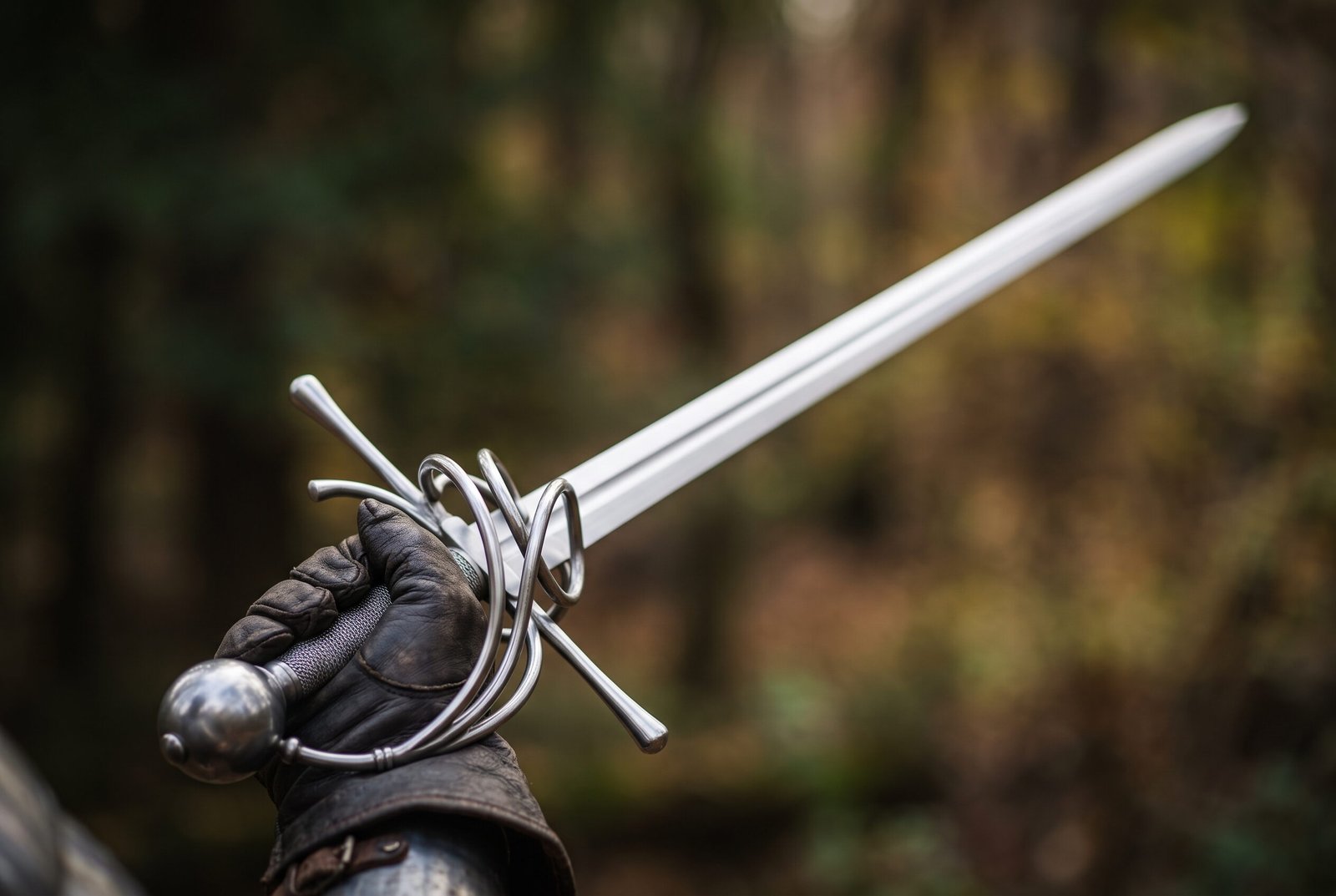
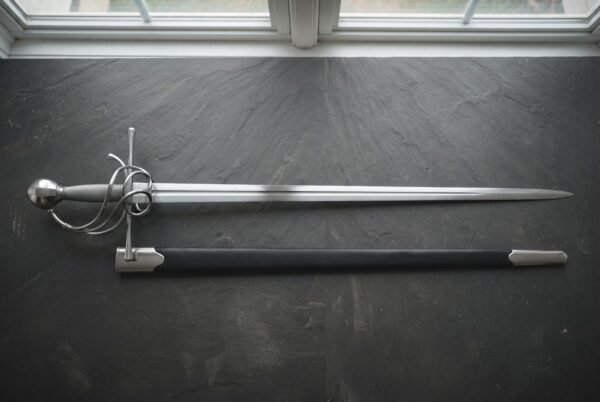
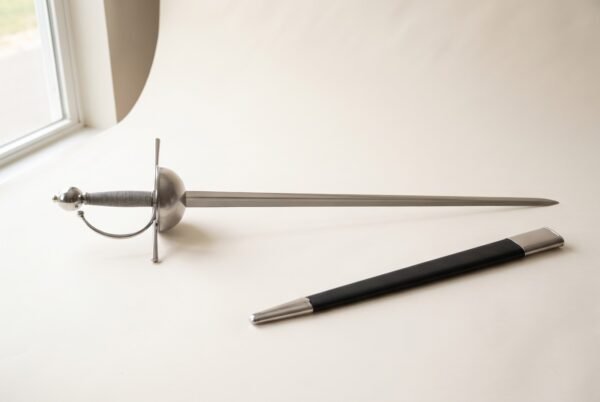
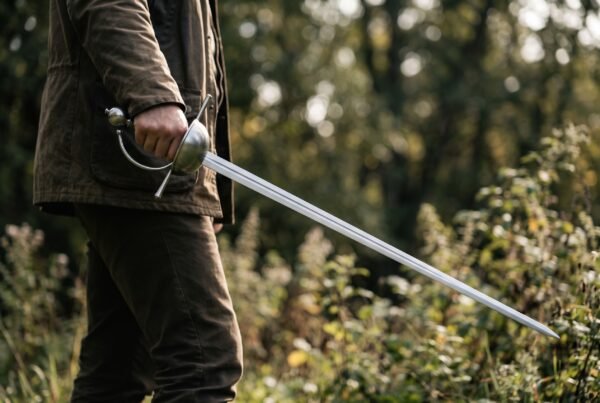
The Swiftcoil is a hand forged swept hilt rapier, the form most people picture when they hear the word rapier at all. Bars of steel leave the quillon block, curl outwards around the hand, cross one another and return, and the whole assembly looks like a piece of wrought ironwork that happens to be attached to a sword. It is not accidental that it looks that way. The men who made these hilts in Toledo, Milan and Solingen were working within a decorative tradition, but every curve in a good swept hilt has a job, and once you know how to read one you can tell a serious hilt from a theatrical one at a glance.
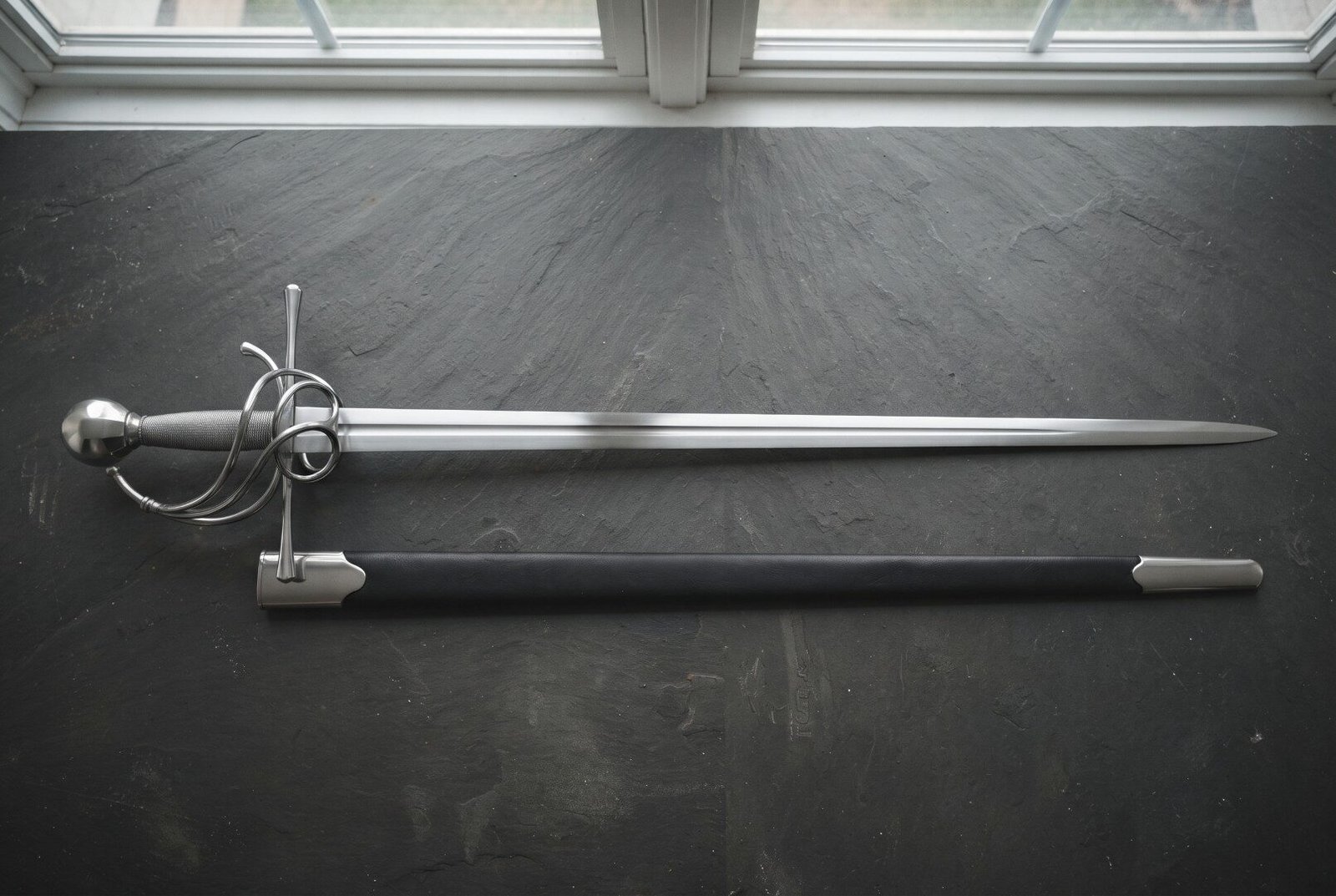
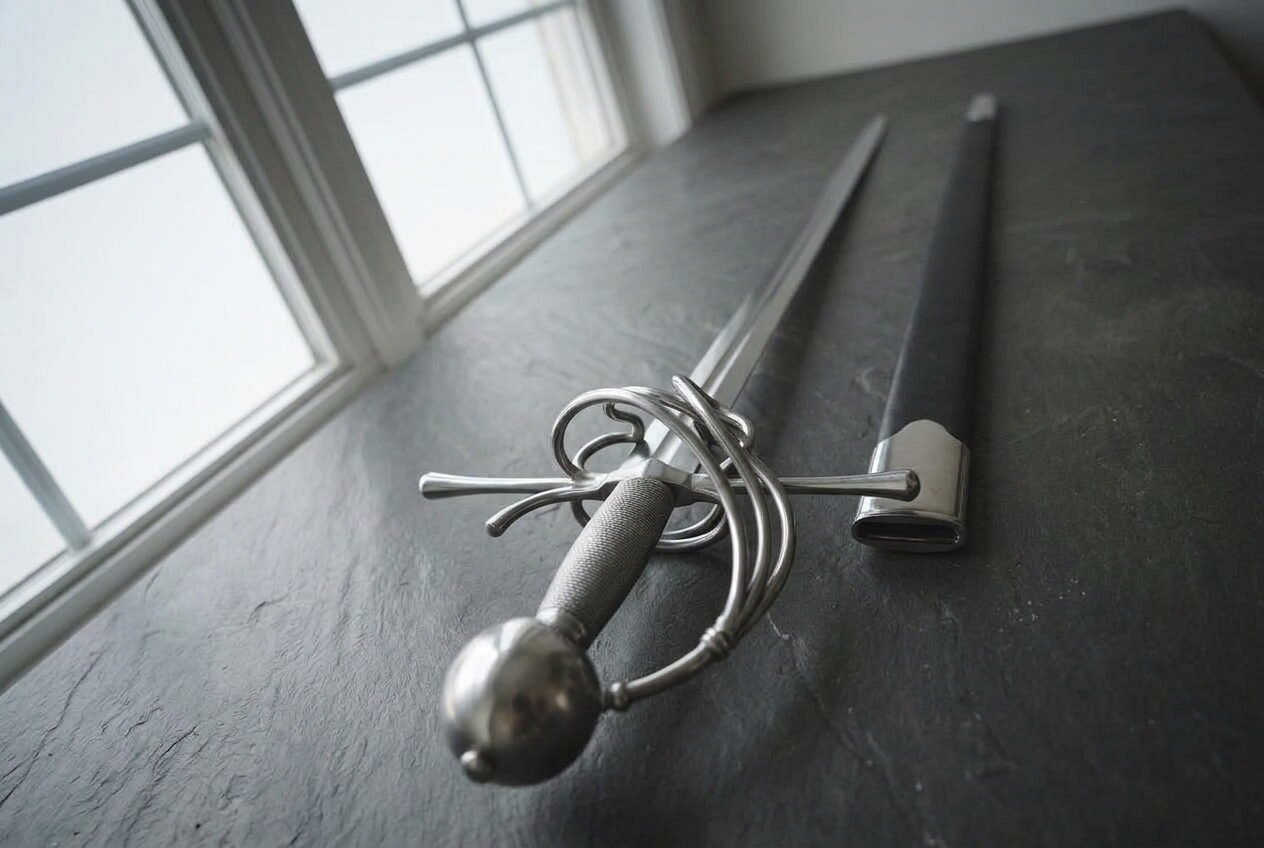
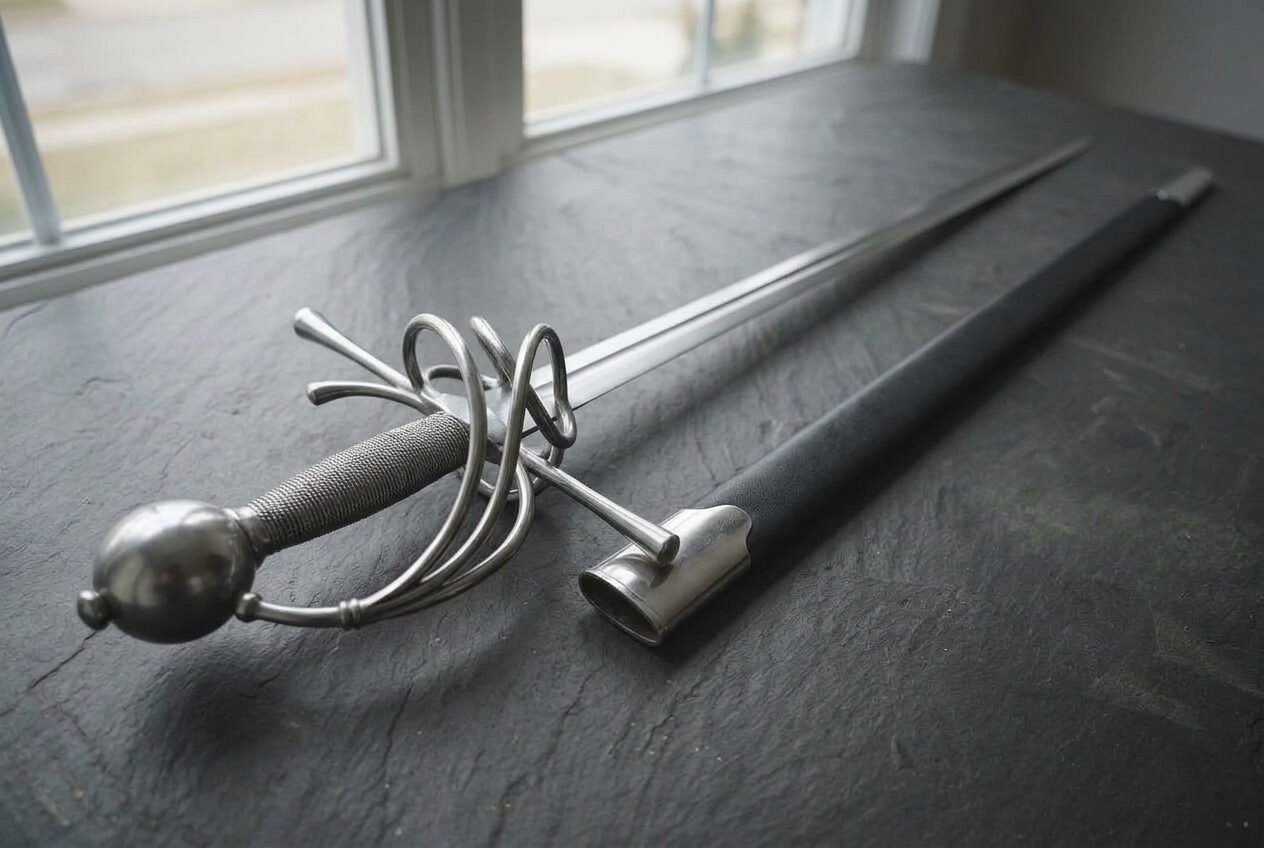
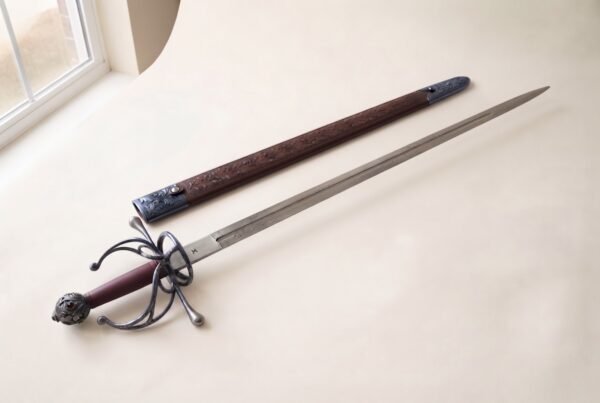
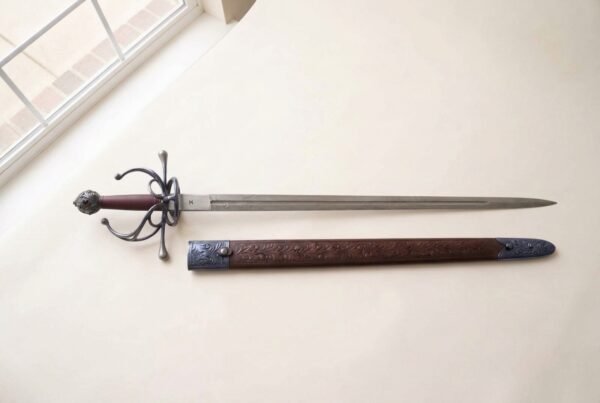
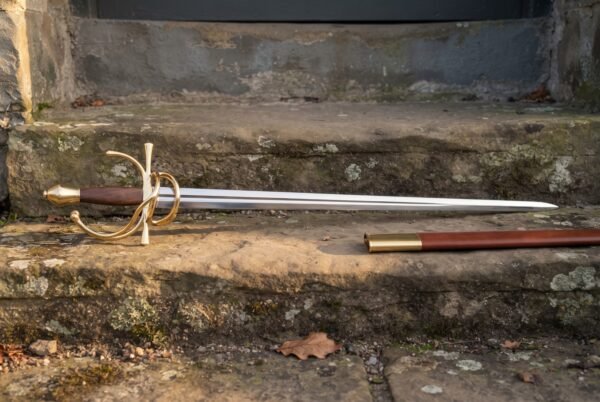
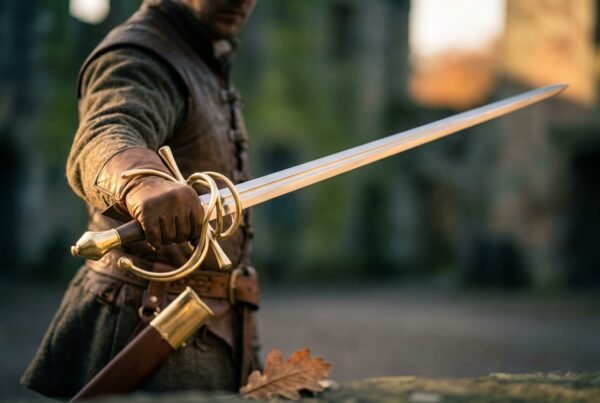
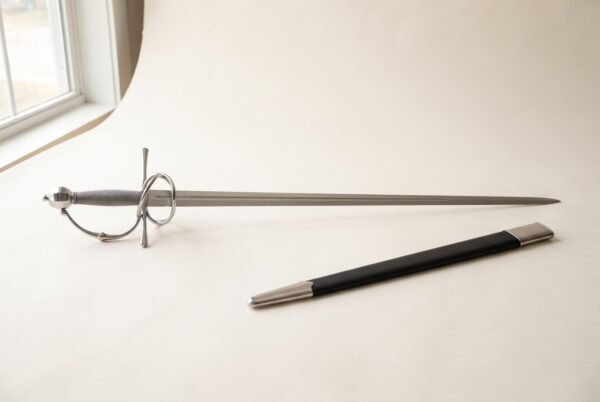
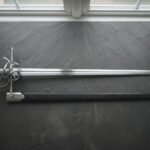
This one is forged and finished in the Czech Republic. The blade is 1095 high carbon steel, hardened, tempered, ground to a long even taper with a stiff section and taken to a mirror polish. The hilt is polished steel with a straight quillon, a side ring over the ricasso, a coiled counter guard sweeping beneath the hand and a knuckle bow closing the front. The grip is bound in twisted steel wire under a large spherical pommel. It ships with the fitted black leather scabbard shown, mounted with a polished steel throat and chape.
Specifications
| Steel | 1095 high carbon steel |
|---|
| Hardness | 54 to 58 HRC |
|---|
| Overall length | 45 inches |
|---|
| Blade length | 37.5 inches |
|---|
| Blade profile | Straight tapering thrusting blade, mirror polished |
|---|
| Guard | Polished steel swept hilt with side ring, coiled counter guard bars and knuckle bow |
|---|
| Quillons | Straight round section quillons with flared ends |
|---|
| Grip | Twisted steel wire wrap |
|---|
| Pommel | Large spherical polished steel pommel |
|---|
| Scabbard | Black leather with polished steel throat and chape |
|---|
| SKU | RK-1414 |
|---|
How to read a swept hilt
Every swept hilt is assembled from the same handful of parts, and once you can name them the whole family becomes legible. Start at the blade and work back. The quillon block is the solid mass of metal that everything else grows out of, sitting directly on the shoulders of the blade. From it, the quillons run straight out to either side, and they are the oldest part of the design, inherited unchanged from the medieval cross.
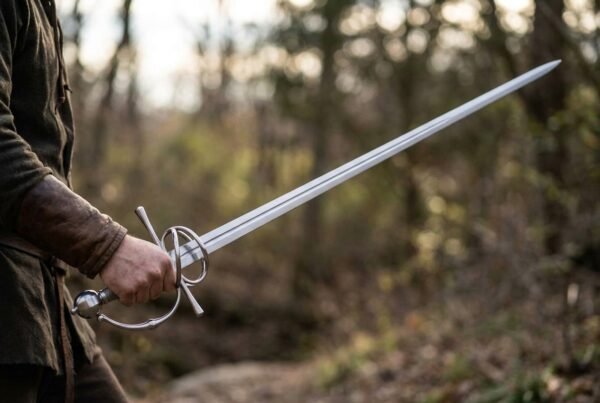
Forward of the block, two small arms curve towards the point and carry a ring between them. On this sword that is the large side ring you can see over the ricasso. Its job is to shield the forefinger, because the standard rapier grip hooks that finger over the block and onto the flat of the blade for control. Without the ring, the single most useful grip in rapier fencing would also be the fastest way to lose a finger.
Behind and beneath comes the counter guard, the coiled bar sweeping under the hand on the inside face. Thrusts do not only arrive from above. A point coming in low and rolling under the guard is a standard attack, and the counter guard is what closes that line. Finally the knuckle bow runs from the outer quillon down to the pommel and covers the front of the hand. Four elements, each answering a specific route an incoming point can take, and the elegance of the thing is that the answers happen to be curves.
A hilt built for looks rather than use gives itself away by leaving one of those routes open, or by making the bars so fine they would fold. The bars here are round in section and heavy enough to take a hit, which is what you want under the ornament.
Why 1095 high carbon steel and not stainless
A rapier blade of thirty seven inches asks for elasticity above everything. It has to bow under a thrust and come back dead straight, thousands of times, without taking a set. Stainless is the wrong choice for that. The chromium that resists rust also forms coarse carbides through the steel, and in a slender blade those act as crack initiators. Stainless swords are therefore left soft, in which case they bend permanently, or hardened, in which case they can snap without warning.
1095 is simple iron and carbon with almost nothing else in it. It hardens deeply, tempers to a predictable figure, and at 54 to 58 HRC combines a durable edge with the spring a long thin blade needs. It rusts if neglected. Wipe it, oil it, and the issue disappears. The longer comparison is at Damascus versus stainless.
The wire wrapped grip
The grip is wound in twisted steel wire over a shaped core rather than covered in leather. On a rapier that is the historically correct choice and the practical one. A rapier is held lightly, controlled through the thumb and forefinger, and a smooth grip lets the blade roll in the palm as the point changes line, which loses edge alignment. Twisted wire gives a positive, ridged surface that the fingers register against with almost no pressure.
Wire also lasts. Leather absorbs sweat, stretches, and eventually needs replacing on a sword that gets handled. A wire wrap will look the same in thirty years. It wants nothing more than an occasional wipe and a drop of oil worked along the winding with a cloth, since the grooves between turns will hold moisture if you let them.
Engraving, runes and your own design
Use the rune converter on this page to turn a name, a date or a short phrase into Elder Futhark and we will cut it into the steel or the handle. If you would rather have a Viking pattern than a rune line, choose your own design in the engraving option above the add to cart button and tell us whether it goes on the blade or the handle. Where a piece already carries an engraved design, your chosen engraving replaces it rather than sitting alongside it. The Swiftcoil is unornamented, which makes it one of the better blanks in this range for a personal inscription. The flat of the blade beneath the ricasso and the crown of the spherical pommel are the two obvious panels. See the engraving page.
Care and sharpening
Wipe the blade after handling. A fingerprint on a mirror polish is mildly acidic and will etch a permanent ghost into the surface within a week or two. Keep a thin film of mineral, camellia or light gun oil on the steel, and pay attention to the inside curves of the guard and the grooves of the wire wrap, both of which trap moisture and are easy to skip. Store the sword out of the scabbard if it is going to sit for months. Details on the steel care page.
Rapier edges are secondary to the point and arrive sharp enough to demand respect without being razored. To refresh them, use a whetstone, follow the bevel that is already on the blade, and work with light passes. Be careful at the tip, where it is very easy to round a fine point by pressing too hard. See sharpening with a whetstone.
Made in the Czech Republic
This piece is made by hand in the Czech Republic, in a workshop that still works the old way. The steel is forged, ground, heat treated and finished by smiths who learned the trade from the people before them, and the wood, horn and leather are cut and fitted by hand rather than pressed out on a line. That is also why no two pieces come out exactly the same.
Ransack Viking is a United States company. We import these pieces ourselves, check every one when it lands and ship from our warehouse in Chicago, Illinois. Engraving is done here in the United States after the piece arrives, so your runes or your own design go on before it leaves for you.
A note on handmade variation
This piece is hand forged, not machine made or bulk produced, so what arrives will not be a pixel for pixel copy of the photograph. Every bar in the guard is bent by hand against a form and by eye, so the exact arc of the coil and the spacing where the bars cross will differ slightly. The pitch of the wire wrap varies with the winding, and the polish reads differently under different light. The dimensions, the steel and the build are the same every time. The character is not.
Frequently asked questions
Is the swept hilt rapier sharp when it arrives
The edges arrive with a working sharpness and the point is genuinely pointed. A rapier is a thrusting sword first, so the tip is the part to be careful with.
Can I spar or fence with it
No. This is a sharp sword rather than a blunt trainer. Historical fencing requires purpose made blunt blades with rolled tips and proper protective gear. Use this for display, collection and careful handling.
Does the blade flex
Yes. A blade of this length and section has real spring and returns to straight. That is a sign of correct heat treatment rather than a defect.
Can I have runes engraved on it
Yes. Use the rune converter on this page for Elder Futhark, or choose your own design in the engraving option, and tell us whether it goes on the blade or the pommel.
What is the difference between a swept hilt and a cup hilt rapier
A swept hilt protects the hand with a cage of curved bars and leaves gaps between them. A cup hilt replaces the whole cage with one solid bowl, which is heavier and more protective but blocks more of your view of the opponent. The swept hilt came first and both were in use at the same time for decades.
How long does shipping take
Free shipping inside the United States. Stock pieces ship within a few days. It takes two to four weeks in the shop before it ships, plus a few days for engraving.
What is in the box
- Swiftcoil hand forged 1095 high carbon steel swept hilt rapier
- Fitted black leather scabbard with polished steel throat and chape
- Care card covering oiling, polish upkeep and wire grip care
- Elder Futhark rune engraving or your own Viking design if selected at checkout
- Forged and finished in the Czech Republic
Explore the range
Browse the rapiers, the short swords, the Damascus swords and the full sword range, or read the guides.
Other pieces in this group
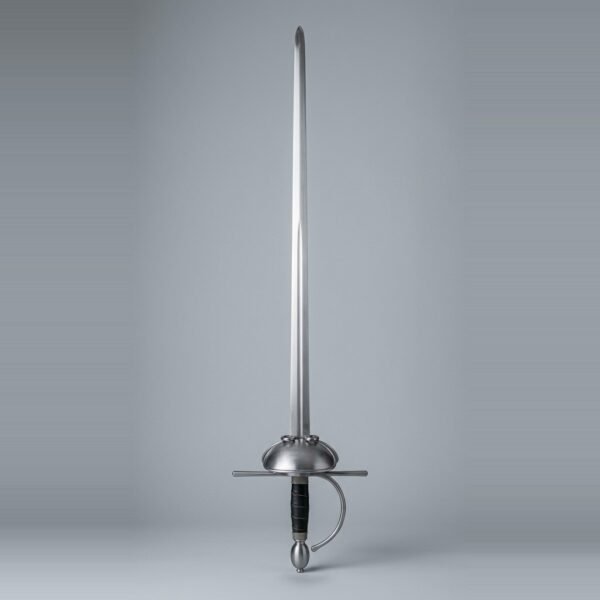
Another in the same line is the Nightgild rapier, 47 inches overall. Next along the rack is the Cupwarden rapier, 47 inches overall. For a straight comparison, see the Quickthorn rapier, 46 inches overall.
The Sunwake Viking sword covers the other half of the same kit. Nothing here exactly right, build one to your own spec on the design your own page.
For partner drills and sparring we carry the Lindmoor smallsword, and our smallswords and spadroons is a good place to start.



Reviews
There are no reviews yet