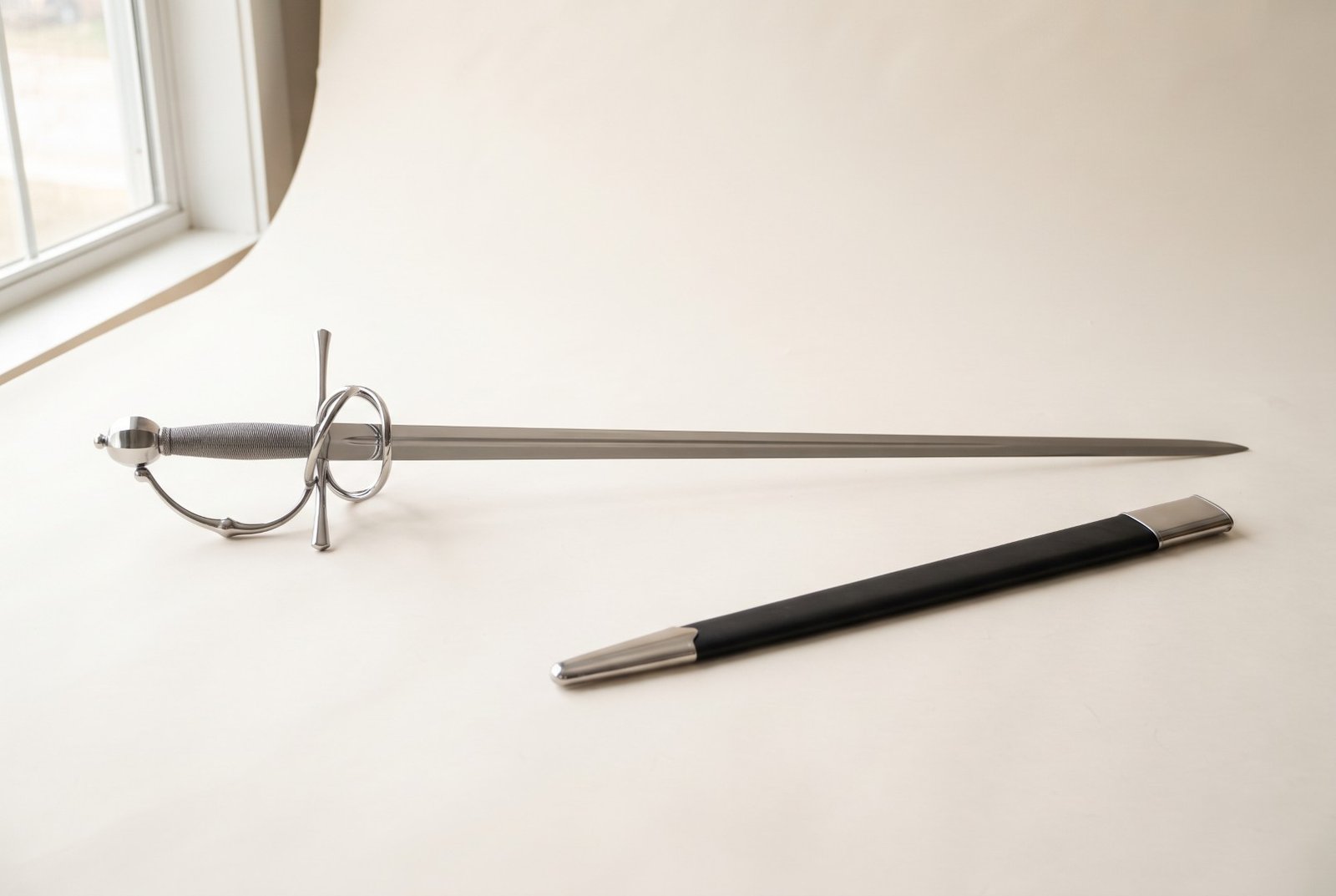
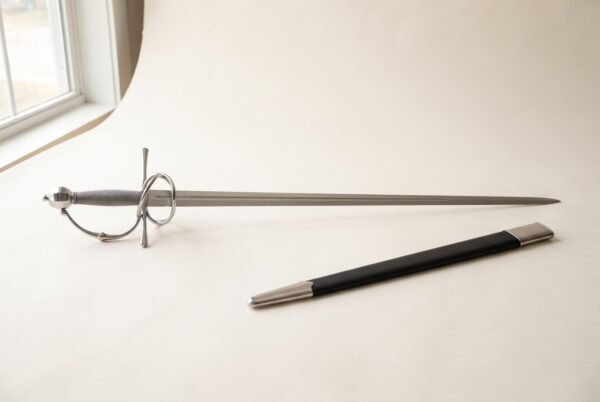
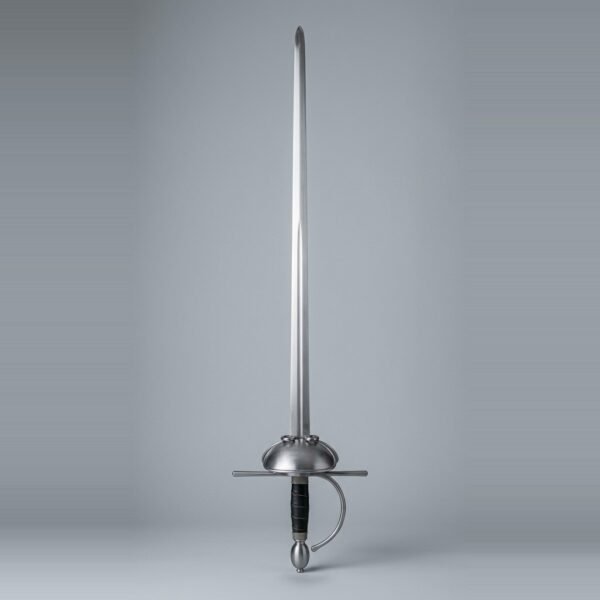
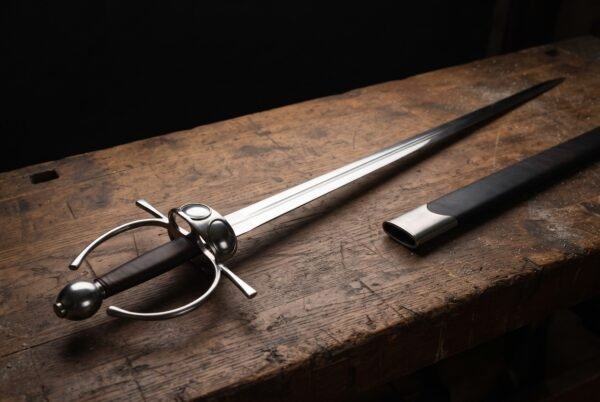
The Quickthorn is a hand forged rapier built on the earliest and cleanest form of the type, a straight quillon crossed by a pair of side rings with a knuckle bow closing the front of the hand. The rapier is usually imagined as a battlefield sword and it was almost never used as one. It was a civilian sword, worn in cities with ordinary clothes, and it existed because in the sixteenth century a gentleman was expected to be armed in the street and might have to settle a quarrel there. That civilian purpose shaped everything about it. Nobody who fights unarmoured needs a heavy cutting blade. What they need is reach, so that they can threaten before they can be threatened, and a point that arrives first.
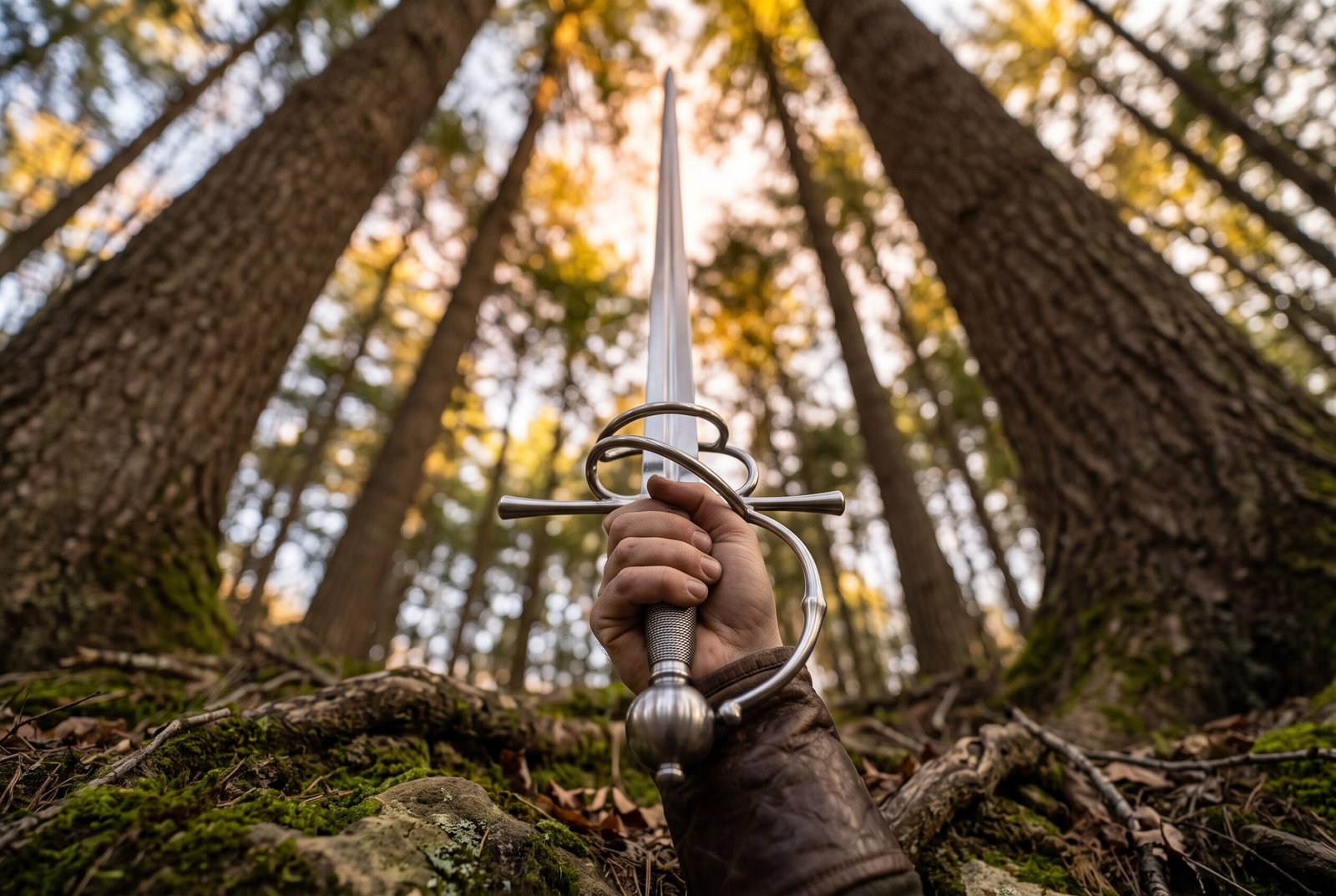
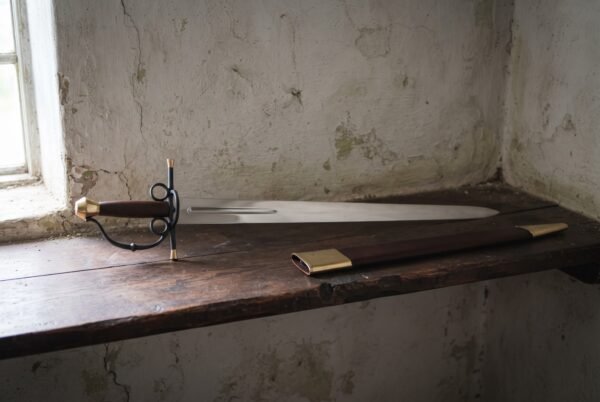
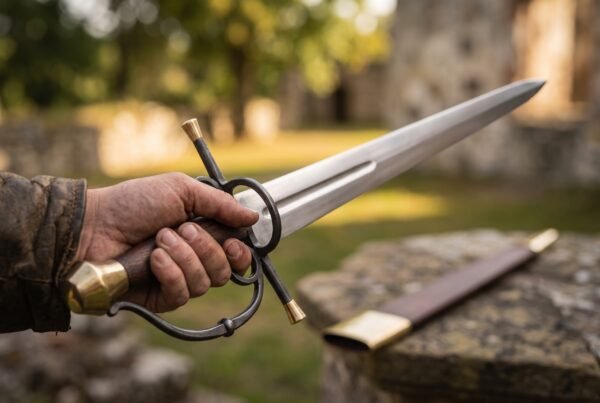
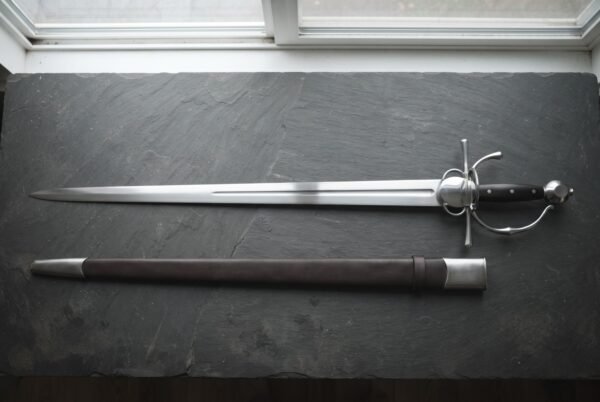
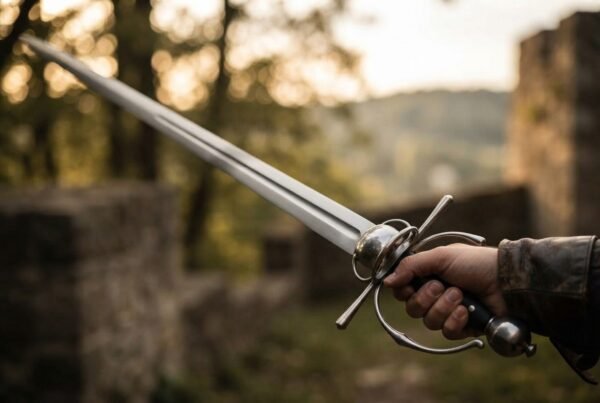
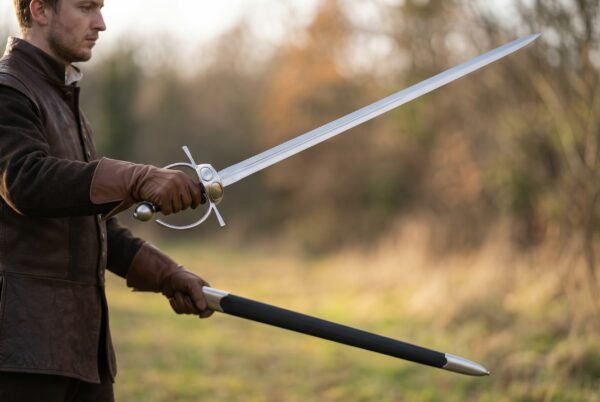
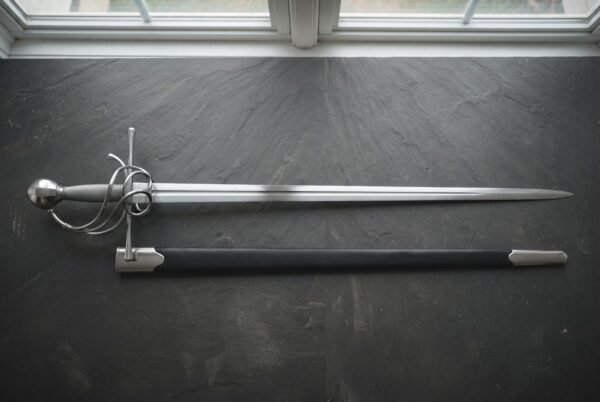
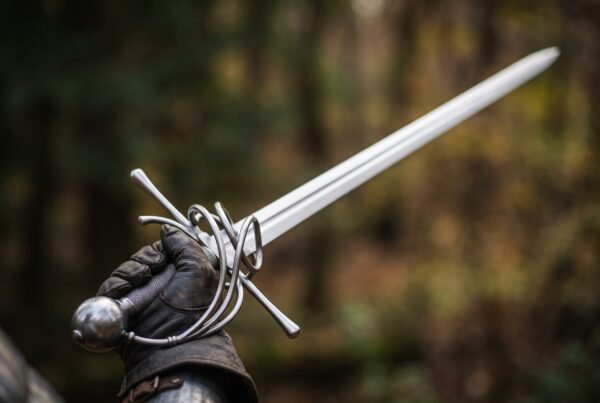
This one is forged and finished in the Czech Republic. The blade is 1095 high carbon steel, hardened, tempered, ground to a stiff diamond section that carries its thickness far down towards the point, and brought to a mirror polish. The hilt is polished steel with straight quillons, twin side rings over the ricasso, a knuckle bow and a ball pommel with a top button. The grip is wound in twisted steel wire. It ships with the fitted black leather scabbard shown, mounted with a polished steel throat and chape.
Specifications
| Steel | 1095 high carbon steel |
|---|
| Hardness | 54 to 58 HRC |
|---|
| Overall length | 46 inches |
|---|
| Blade length | 38.5 inches |
|---|
| Blade profile | Straight diamond section thrusting blade with a short central fuller at the ricasso, mirror polished |
|---|
| Guard | Polished steel straight quillons with flared tips, twin side rings over the ricasso and a knuckle bow |
|---|
| Grip | Twisted steel wire wrap |
|---|
| Pommel | Polished steel ball pommel with a top button |
|---|
| Scabbard | Black leather with polished steel throat and chape |
|---|
| SKU | RK-1409 |
|---|
Why a rapier blade is shaped the way it is
Pick this blade up and the first thing you notice is that it is stiff in a way a cutting sword is not. That comes from the cross section. Instead of two flat faces meeting at an edge, the blade is a diamond in section, with a raised central ridge running most of its length. A diamond puts material where a thrust loads the blade, along the spine, and it resists buckling far better than a flat section of the same weight. The blade also keeps its thickness much further towards the point than a cutting sword does, which is why the tip does not whip when it lands.
The second thing you notice is that the point of balance sits very close to the guard, no more than three or four inches out. A cutting sword wants mass forward so it carries energy into a target. A thrusting sword wants mass back, so the point can be moved a foot to one side and back again without dragging the wrist with it. The whole design is optimised for the tip changing line quickly and arriving in the same instant that the front foot lands.
The length is the third piece. Nearly forty inches of blade seems absurd until you understand the geometry of a duel with no armour and no shield. Whoever can touch first at full extension wins the exchange, and reach is the cheapest way to buy that. Contemporary complaints about rapier length are well documented. Elizabethan London had a legal limit on how long a sword could be worn in public, and the wardens at the city gates were authorised to break the point off anything over it.
Why 1095 high carbon steel and not stainless
A rapier asks more of its steel than almost any other sword, because a long narrow blade lives or dies on elasticity. It has to bend under a thrust and come back perfectly straight. Stainless will not do that reliably. The chromium that gives stainless its rust resistance forms hard carbides through the matrix, and in a slender blade those become the points where a bend turns into a break. Stainless replicas are therefore either left soft, in which case they take a permanent set the first time they flex, or hardened and liable to snap.
1095 is close to a pure iron and carbon alloy. It hardens through, it tempers predictably, and at 54 to 58 HRC it gives a rapier blade the combination that matters: enough hardness to hold a point and enough spring to return to true. The cost is that it will rust if left wet or fingerprinted. Wipe it and oil it and that problem disappears. The longer comparison is at Damascus versus stainless.
The wire wrapped grip and the side rings
The grip is bound in twisted steel wire over a shaped core. Wire binding was standard on rapiers for a practical reason. A rapier is held lightly, mostly in the thumb and forefinger, and a smooth leather grip lets the sword rotate against the palm as the point changes line. Wire gives a positive texture that keeps the edge alignment consistent without any real force from the hand, and it does not soften or stretch with sweat the way leather does. It also survives storage indefinitely.
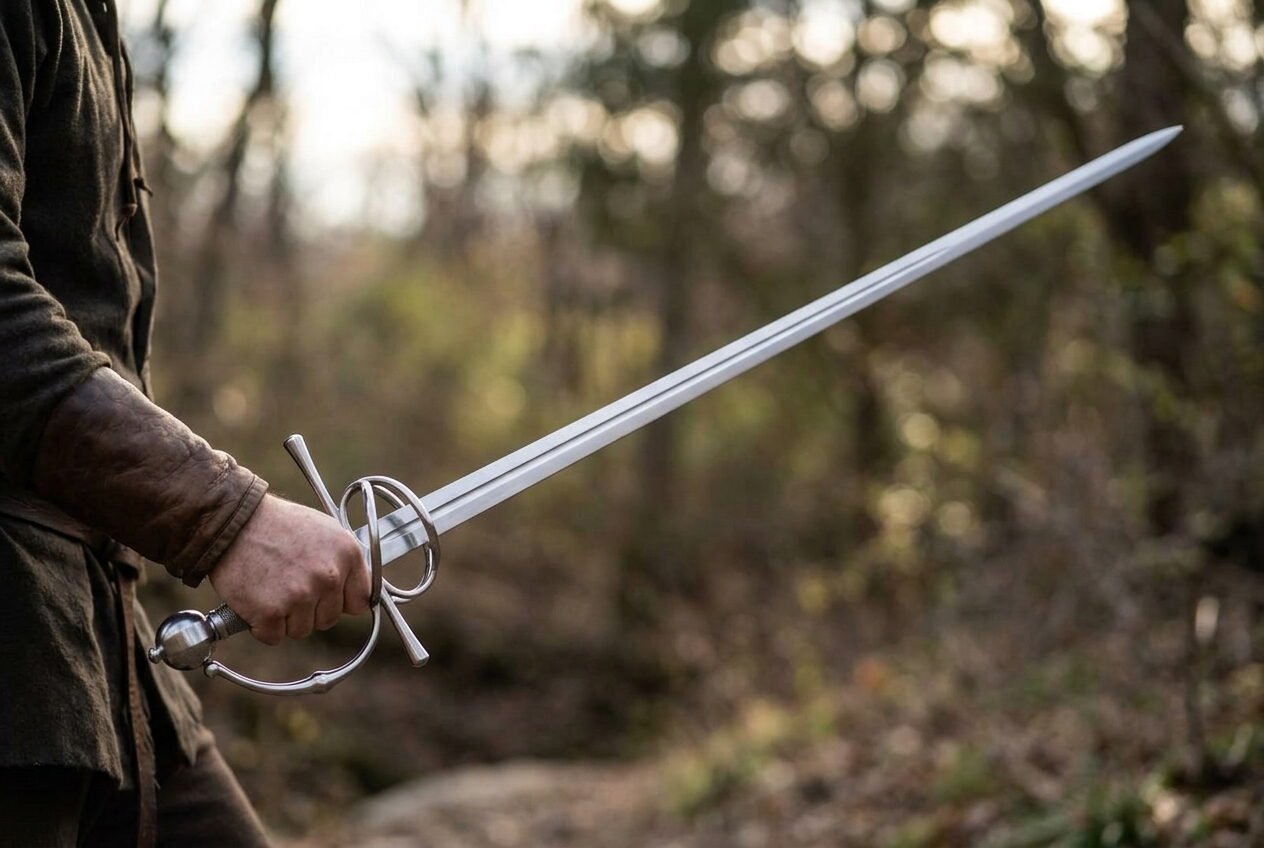
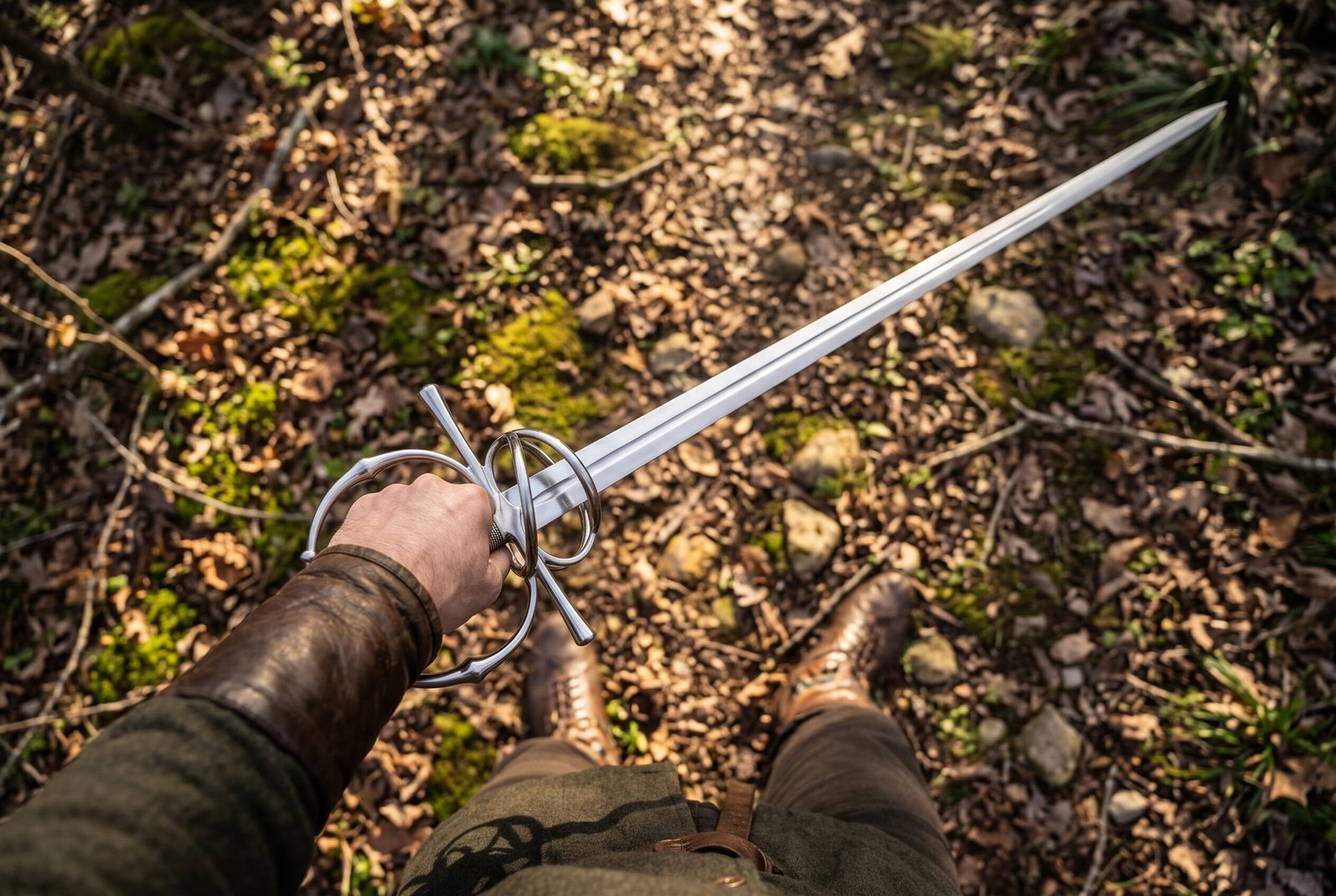
The twin rings sitting over the ricasso are what let you hook a finger over the quillon block, which is the standard rapier grip. That finger shortens the lever between the hand and the point and makes the tip far more controllable, but it also puts the finger outside the guard where a thrust can reach it. The rings close that route off. This is the simplest hilt that still permits the finger over grip, and it is where every more elaborate swept hilt started.
Engraving, runes and your own design
Use the rune converter on this page to turn a name, a date or a short phrase into Elder Futhark and we will cut it into the steel or the handle. If you would rather have a Viking pattern than a rune line, choose your own design in the engraving option above the add to cart button and tell us whether it goes on the blade or the handle. Where a piece already carries an engraved design, your chosen engraving replaces it rather than sitting alongside it. The Quickthorn is plain, so the natural panels are the flat of the blade just below the ricasso and the ball pommel. See the engraving page.
Care and sharpening
Mirror polished 1095 shows every fingerprint, and a fingerprint left for a week will etch a permanent ghost into the surface. Wipe the blade after handling and keep a thin film of mineral, camellia or light gun oil on it. Do not leave the sword stored in the scabbard for long periods, because leather holds moisture against steel. Pay a little attention to the inside of the rings, which collect dust that is easy to miss. The full routine is on the steel care page.
The edges on a rapier are secondary and arrive sharp enough to be respected without being razored. If you want to refresh them, use a whetstone and follow the existing bevel with long light passes. Take particular care near the point, where the section is thick and it is easy to blunt the tip by rounding it. See sharpening with a whetstone.
Made in the Czech Republic
This is a handmade piece from the Czech Republic, made in a workshop that still forges, grinds and finishes by hand instead of stamping parts out. The smiths there have kept the older way of working, and the wood, horn and leather are shaped and fitted by hand as well. Two pieces of the same design will never be identical, and that is part of what you are buying.
Ransack Viking is a United States company. We handle the import ourselves, look over every piece when it lands and ship from our warehouse in Chicago, Illinois. Engraving is done in the United States after the piece arrives, so your design goes on before we send it out.
A note on handmade variation
This piece is hand forged. It is not machine made or bulk produced, so what arrives will not be a pixel for pixel copy of the photograph. The exact curve of each ring, the pitch of the wire wrap, the profile of the ball pommel and the way the polish reads along the ridge of the blade will all vary a little, because each one is filed, wound and finished by hand. The dimensions, the steel and the build are the same every time. The character is not.
Frequently asked questions
Is this rapier sharp
The edges arrive with a working sharpness and the point is a real point. A rapier is primarily a thrusting sword, so the tip matters more than the edges, and it is finished accordingly. Treat the point with respect.
Can I fence or spar with it
No. This is a sharp functional sword, not a blunt training sword. Historical fencing requires purpose made blunts with rolled tips and appropriate protective kit. Use this for display, collection and careful handling.
Does the blade flex
Yes, a rapier blade of this length has noticeable spring and returns to straight. That is a property of properly tempered 1095 rather than a fault.
Can I have runes engraved on it
Yes. Use the rune converter on this page for Elder Futhark, or select your own design in the engraving option, and tell us whether it should go on the blade or the pommel.
What is the difference between a rapier and a side sword
A side sword keeps a broad double edge and cuts as well as it thrusts, and is usually a good deal shorter. A rapier narrows and lengthens the blade until cutting is almost incidental, buying reach and point control instead. This is a rapier.
How long does shipping take
Free shipping in the United States. In stock pieces leave within a few days. It takes two to four weeks in the shop before it ships, plus a few days for engraving.
What is in the box
- Quickthorn hand forged 1095 high carbon steel rapier
- Fitted black leather scabbard with polished steel throat and chape
- Care card covering oiling, polish upkeep and storage
- Elder Futhark rune engraving or your own Viking design if selected at checkout
- Forged and finished in the Czech Republic
Explore the range
See the rest of the rapiers, the short swords, the arming swords and the full sword range, or read the guides.
Also in this part of the catalogue
A near match for this one is the Swiftcoil rapier, 45 inches overall. Closest to this in the range is the Bellcourt rapier, 5 inches overall. If this one is not quite right, there is the Cupwarden rapier, 47 inches overall.
The Stonerune broadsword covers the other half of the same kit. Or start from a blank sheet on the design your own page.
For historical fencing rather than the wall, try the Fenrholt rapier trainer and see our rapier versus sidesword guide for the details.





Turned out better than I expected going in. Minor nitpicks aside, good quality piece.
Absolutely blown away by this sword. Edge retention has been great even after regular use. This will be a family heirloom for sure.
My whole family was impressed when I unboxed it. Weight and balance make it feel like a real functional piece not some cheap replica. Came in a nice gift box which made it feel even more special. Beyond happy with how this turned out.
No regrets on this purchase at all. Came in a nice gift box which made it feel even more special. I keep coming back to Ransack Viking because it’s always this good. Weight and balance make it feel like a real functional piece not some cheap replica. This will be a family heirloom for sure.
Best sword I’ve ever owned. Weight and balance make it feel like a real functional piece not some cheap replica. Beyond happy with how this turned out. It’s handmade in the Czech Republic but ships from a US warehouse so it arrived quicker than I expected.