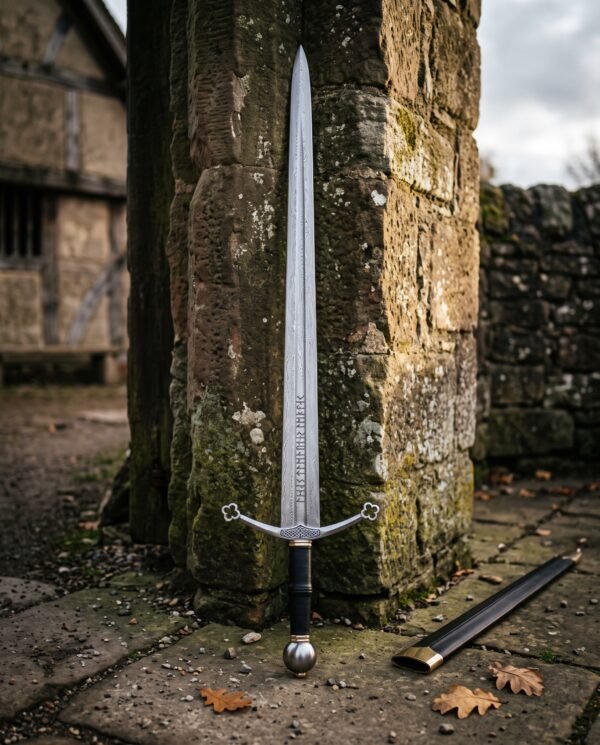
The Runegrain is a hand forged Damascus arming sword, the single handed knightly sword that stayed in service across Europe for the better part of four hundred years. What makes this one worth a second look is the inscription running up the flat of the blade. Inscribed blades are not a modern invention. Some of the most famous swords ever excavated, the Ulfberht group found across northern Europe, carry a maker name inlaid into the fuller in iron letters, and the best of them were made from crucible steel far purer than anything else available in the ninth century. Inscribing a blade was a claim about who made it and what it was worth, and it was carried on for centuries afterwards with mottoes, prayers and letter groups nobody has yet decoded.
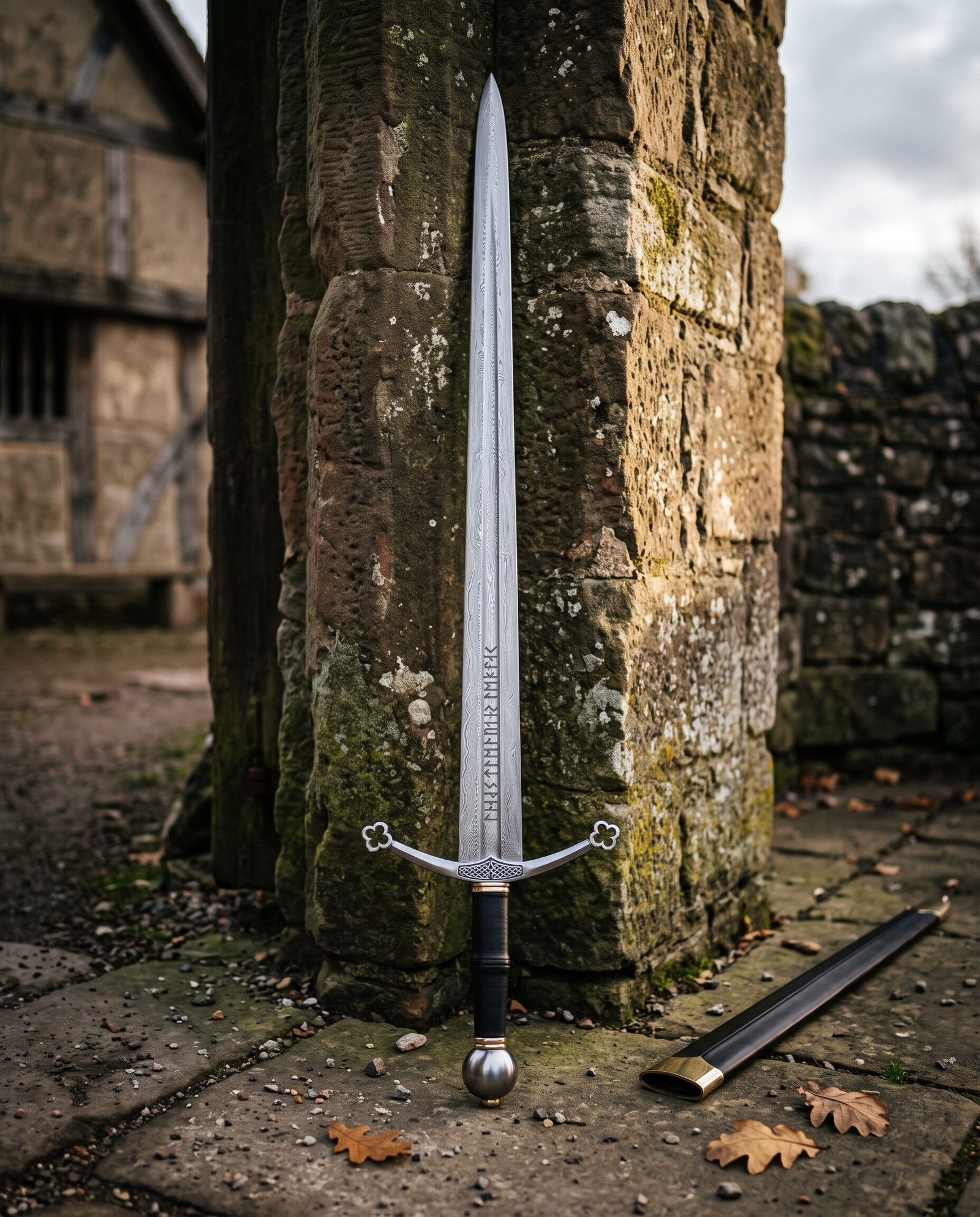
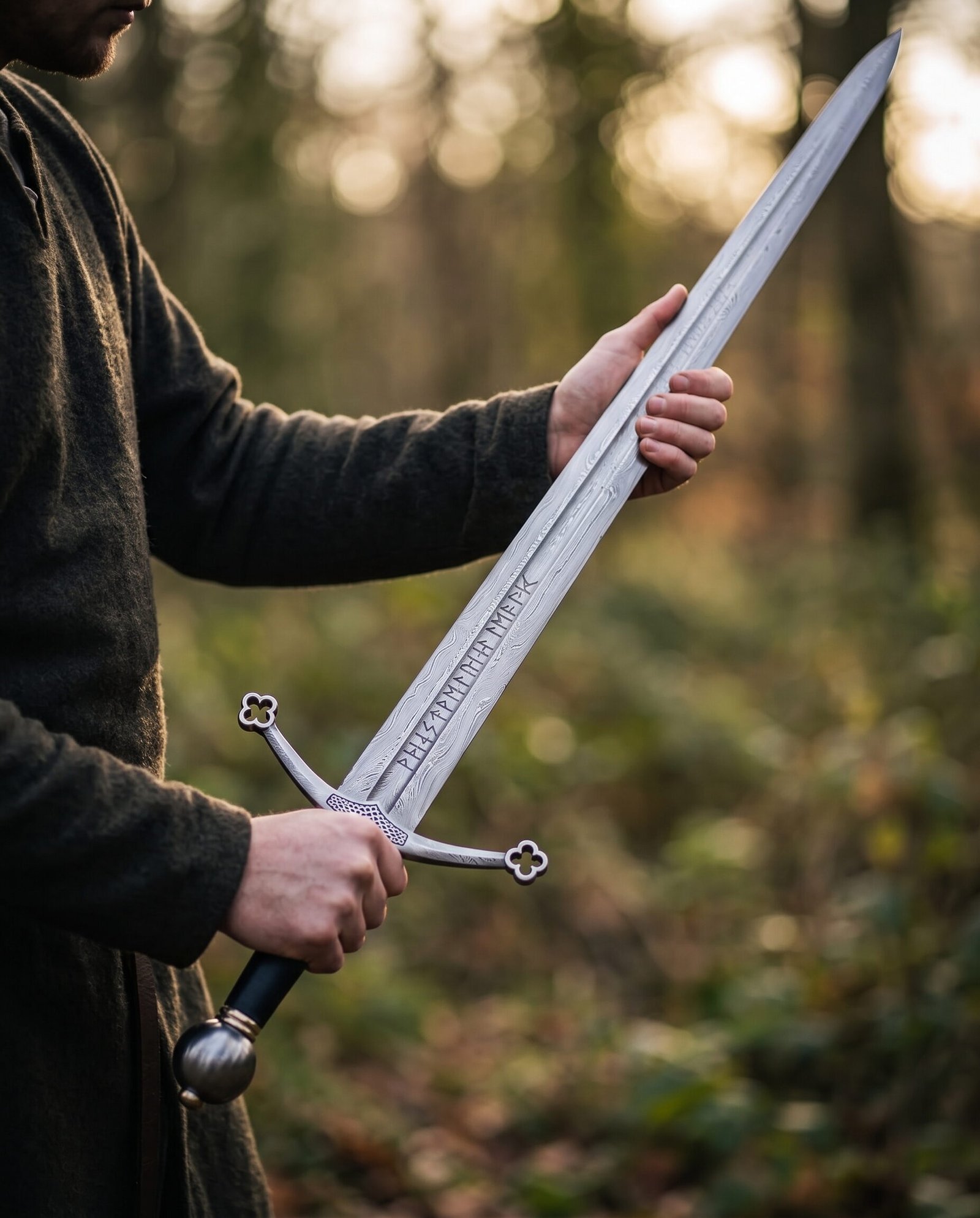
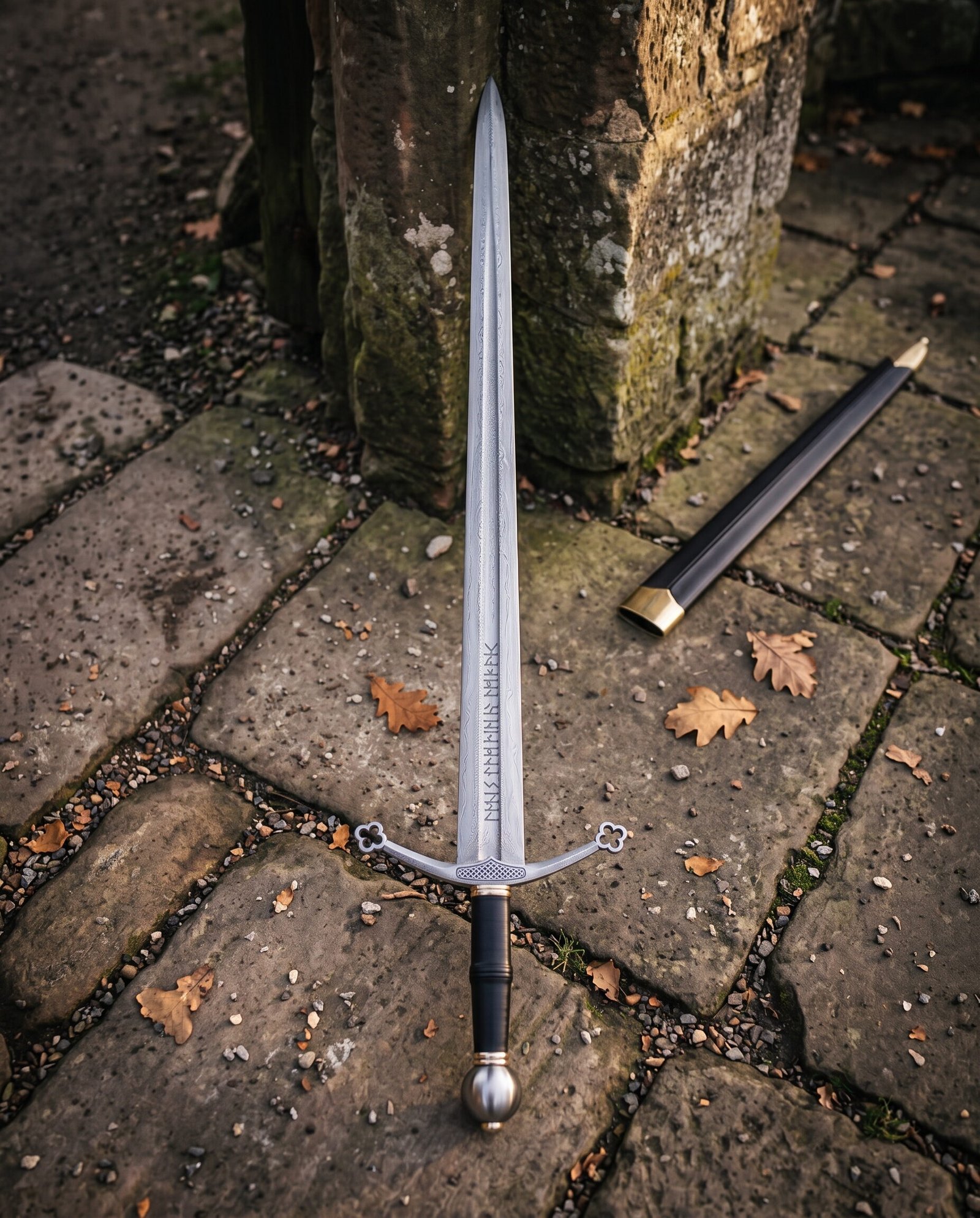
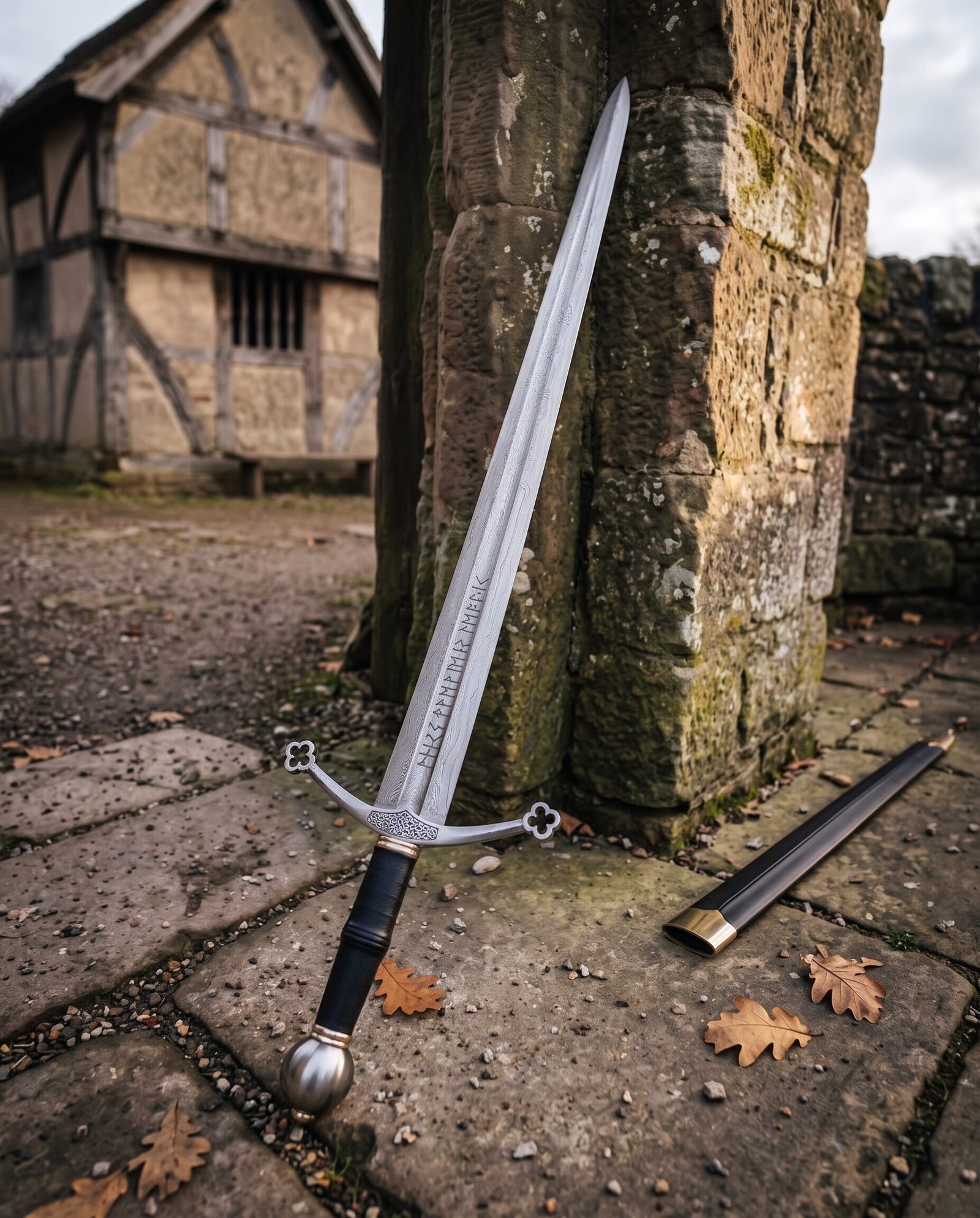
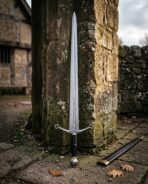
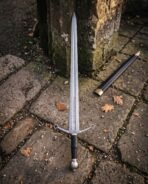
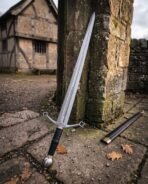
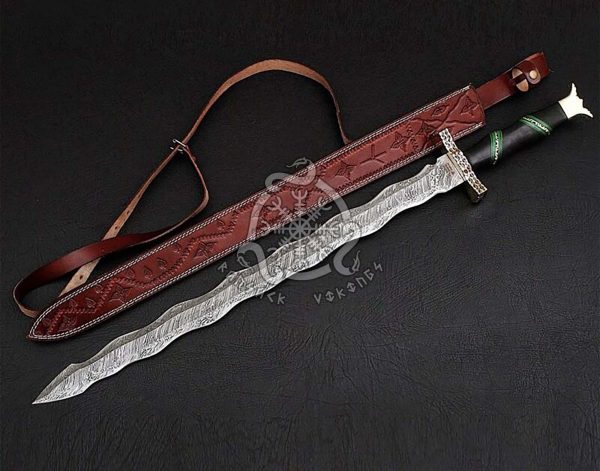
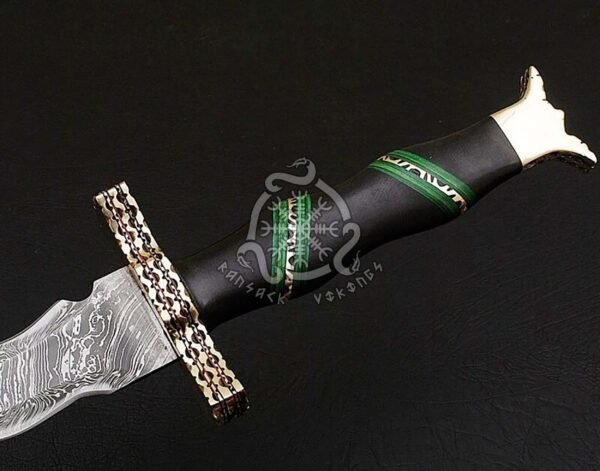
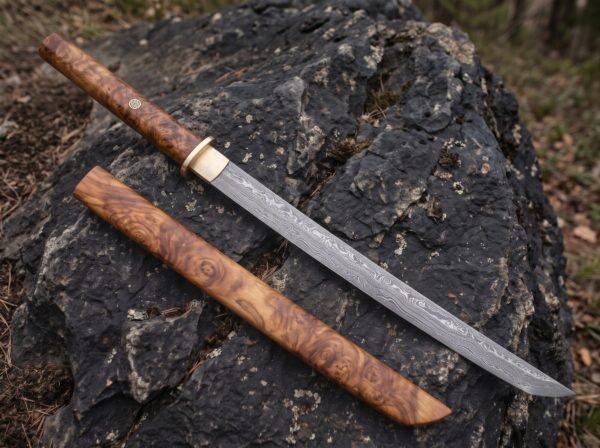
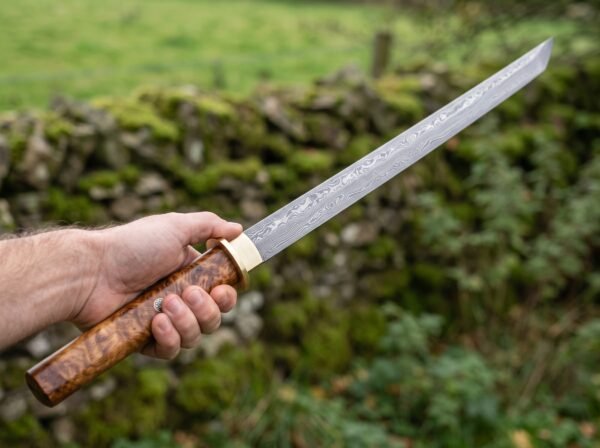
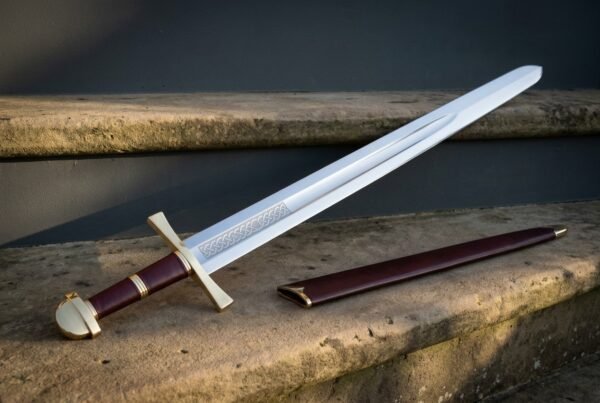
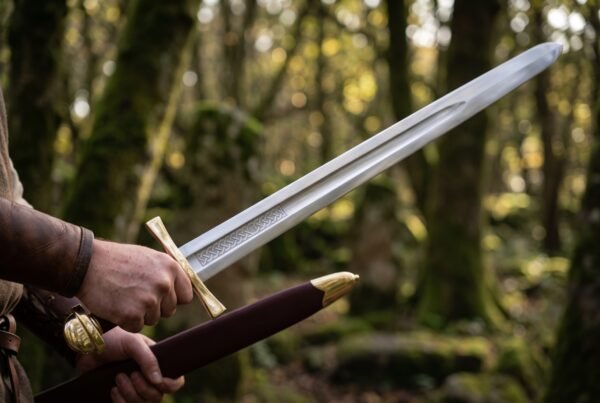
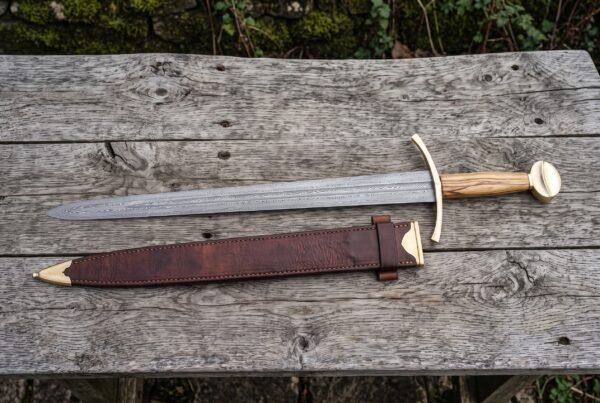
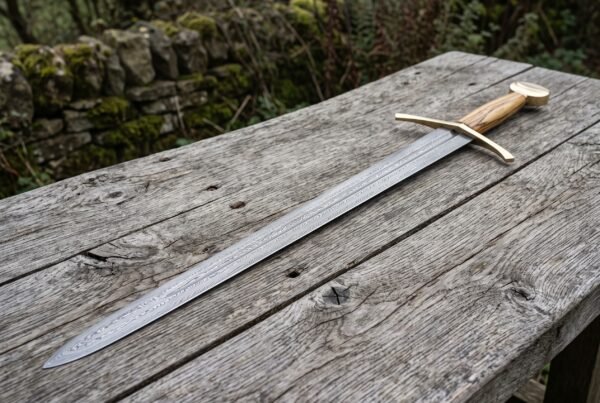
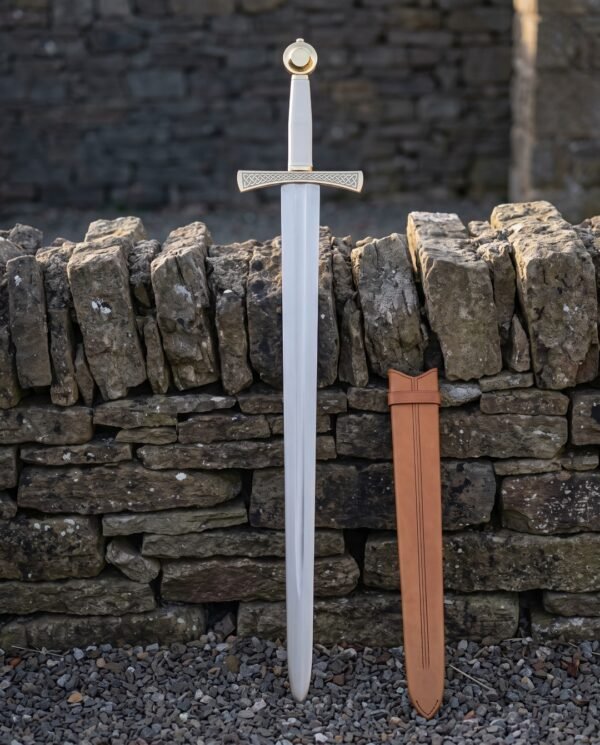
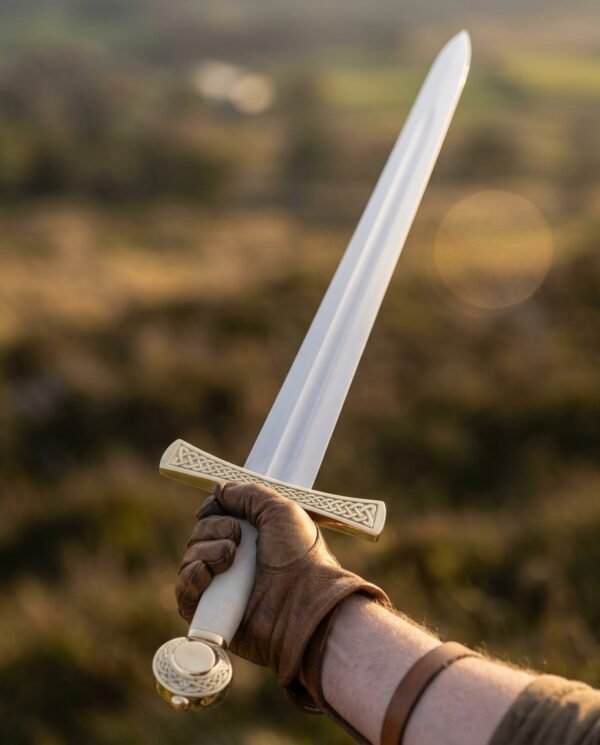
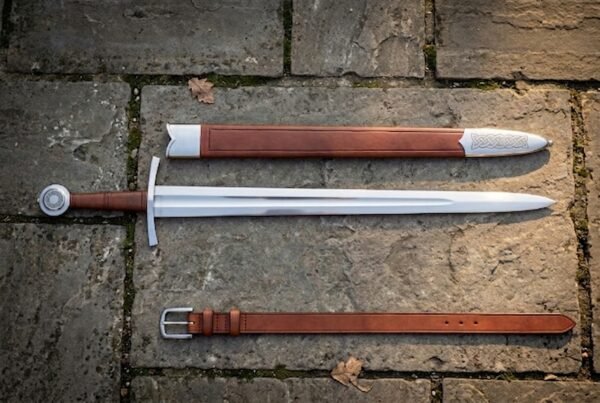
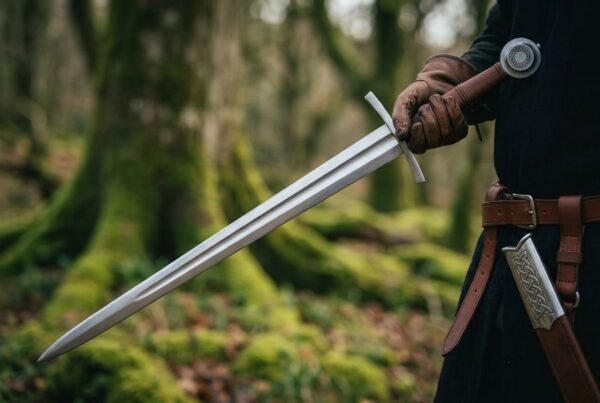
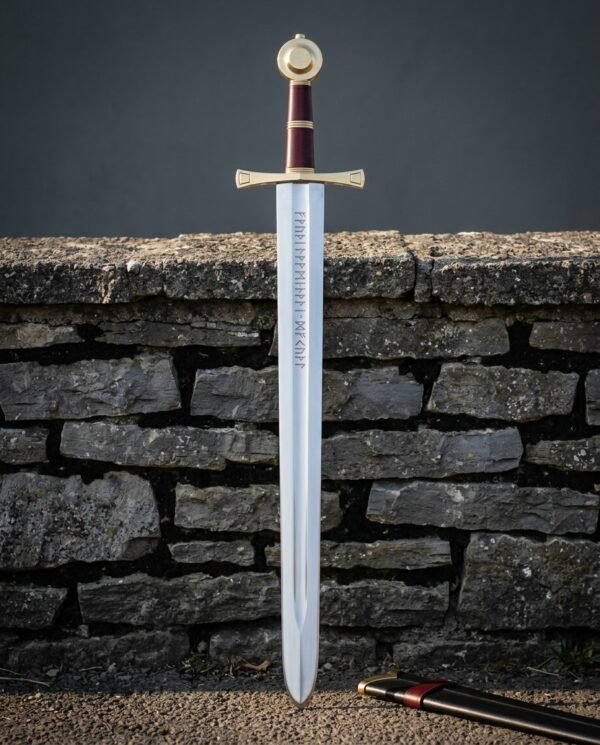
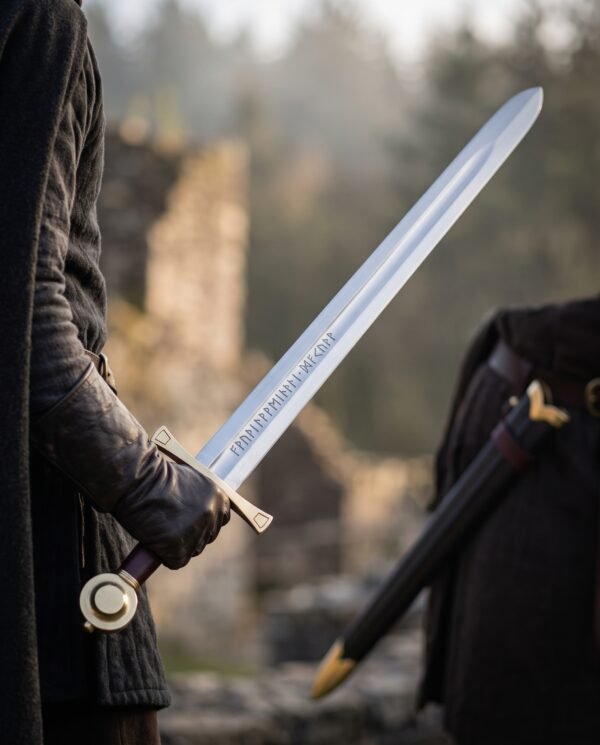
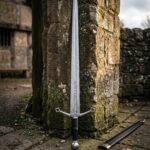
This sword is forged and finished in the Czech Republic. The blade is Damascus, 1095 and 15N20 forge welded in hundreds of alternating layers, etched to raise a tight wood grain figure, with an Elder Futhark line etched along the upper flat. The cross guard sweeps down towards the blade and finishes in quatrefoil terminals, with a knotwork engraved block where the guard meets the ricasso. The grip is black leather over a wood core with a brass ring at each end, capped by a large spherical brushed steel pommel. It ships with the fitted black leather scabbard shown, mounted with a brass throat and a brass tip.
Specifications
| Steel | Damascus, 1095 and 15N20 forge welded |
|---|
| Hardness | 58 to 60 HRC |
|---|
| Overall length | 37 inches |
|---|
| Blade length | 30.5 inches |
|---|
| Blade profile | Broad straight double edge with etched wood grain Damascus and an Elder Futhark rune line |
|---|
| Guard | Down curved steel cross with quatrefoil terminals and a knotwork engraved block |
|---|
| Grip | Black leather over a wood core with a raised band in the middle and a brass ring at each end |
|---|
| Pommel | Spherical brushed steel pommel with a brass end button |
|---|
| Scabbard | Black leather with a brass throat and a brass tip |
|---|
| SKU | RK-1408 |
|---|
What makes an arming sword an arming sword
The name is a description of where it was worn rather than what it does. An arming sword was the sword you had on you while armed, meaning while wearing armour and carrying a lance, a poleaxe or a shield. It was the sidearm, not the primary sword, and every dimension follows from that. A blade of thirty inches is long enough to reach past a shield but short enough to draw across the body while mounted. A single hand grip leaves the other hand free. A cross guard rather than a cage is correct here, because the hand is inside a gauntlet and needs nothing more than something to stop it sliding forward.
The blade profile is the interesting part. It tapers in width from the guard to the point and it also tapers in thickness, which is called distal taper. Width taper gives you a point that can find a gap in armour. Distal taper moves mass backwards towards the hand, so the sword accelerates and stops quickly instead of swinging like a bar. Get both tapers right and a sword weighing two and a half pounds handles like something much lighter. Get them wrong and the same weight feels dead. This is the single largest difference between a forged sword and a blade cut from flat stock.
The quatrefoil terminals on the guard are a late medieval touch. Rounding and widening the ends of the cross does two things: it stops a thrust sliding off the end of the quillon and past the hand, and it puts a small amount of weight out at the extremities where it steadies the sword in the bind. Decoration and function arriving at the same answer again.
Why Damascus and not stainless
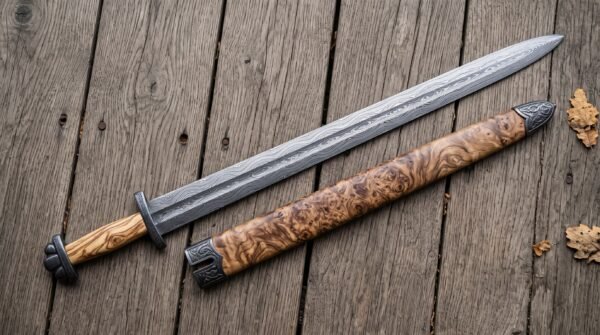
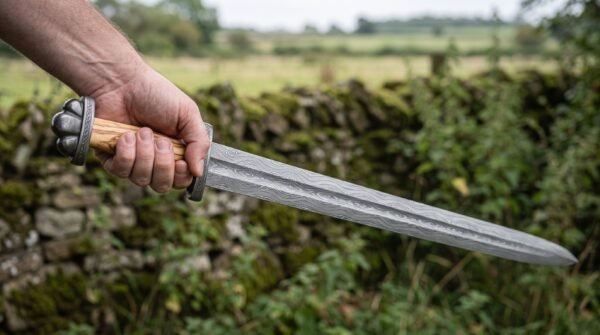
The blade is built from two steels rather than one. Bars of 1095 and 15N20 are stacked, welded together at yellow heat, drawn, folded and welded again until the layer count is in the hundreds. Both steels harden to a similar figure so the finished blade behaves as a single homogeneous piece, but 15N20 carries around two percent nickel and nickel shrugs off the acid used to finish the blade. Etch the polished surface and the nickel bearing layers stay bright while the 1095 darkens, and the internal structure of the steel becomes visible on the outside. The pattern is not applied. It is the steel.
Stainless offers none of that and costs you performance for the rust resistance. Its chromium carbides interrupt the matrix and make long blades either brittle or, if left soft to compensate, prone to bending permanently. A Damascus blade hardened to 58 to 60 HRC keeps its edge longer and springs back true. The trade is that it will rust when neglected. Oil it. The comparison is set out in Damascus versus stainless.
The grip, the brass rings and the pommel
The core is shaped wood, covered in black leather, with a brass ring at each end and a raised band in the middle of the wrap. The raised band gives the fingers something to register against, which keeps the hand from creeping forward under a heavy cut without you having to grip hard. Because there is wood under the leather, keep it out of damp basements, away from radiators and out of direct sun, all of which shrink a core and slacken the wrap. See wooden handle care for the routine.
The spherical pommel is heavy on purpose. On a single handed sword the pommel is the counterweight that pulls the balance point back to within a few inches of the guard, and the more blade you have out front the more mass you need behind the hand. A brushed rather than mirrored finish on the sphere is deliberate too, since a highly polished ball reflects like a mirror and reads as a bright blob in any photograph or display case.
Engraving, runes and your own design
Use the rune converter on this page to turn a name, a date or a short phrase into Elder Futhark and we will cut it into the steel or the handle. If you would rather have a Viking pattern than a rune line, choose your own design in the engraving option above the add to cart button and tell us whether it goes on the blade or the handle. Where a piece already carries an engraved design, your chosen engraving replaces it rather than sitting alongside it. That matters particularly on this sword, because the blade already carries a rune line. If you order your own inscription, yours takes the place of the one shown rather than being added below it. There is also the knotwork block at the guard, which can carry a design instead. See the engraving page.
Care and sharpening
An etched Damascus surface is very slightly textured, and texture holds moisture in a way a mirror polish does not. Wipe the blade after handling and keep a thin film of mineral or camellia oil on it, working it into the etched areas rather than just across them. Do not store the sword in the scabbard for months at a stretch, because leather retains a little moisture and holds it against the steel. If the pattern ever dulls it can be re etched rather than polished away. Full detail on the steel care page.
The edge arrives sharp and ready to use. To refresh it, use a whetstone and follow the existing bevel with long even passes down the full length of each side, then strop. Do not take a power tool to a hardened blade, since the heat will ruin the temper faster than you can see it happening. The method is in sharpening with a whetstone.
Made in the Czech Republic
The work behind this piece happens in a Czech Republic workshop that has kept to the old methods. Steel is forged and heat treated by hand, the grind is taken down by eye rather than by machine, and the handle, fittings and sheath are cut and finished one at a time. Because of that, every piece carries small marks of the hand that made it.
Ransack Viking is a United States company. We import direct, check each piece when it reaches us, and ship from our Chicago, Illinois warehouse. Engraving is added here in the United States after arrival, so the piece you receive is finished to your order.
A note on handmade variation
This piece is hand forged, not machine made or bulk produced, so what arrives will not be a pixel for pixel copy of the photograph. Damascus is the least repeatable thing we make. The swirl, spacing and contrast of the grain depend on how that particular billet moved under the hammer, and no two behave the same way. Add to that the tone of the leather, the exact depth of the engraved knotwork and the way the quatrefoils are filed, and you get a sword that is unmistakably the same model and unmistakably its own object. The dimensions, the steel and the build are the same every time. The character is not.
Frequently asked questions
What do the runes on the blade say
The line shown is Elder Futhark lettering used as a decorative inscription. If you want a specific meaning, use the rune converter on this page and we will etch your own words in place of it.
Is the sword sharp when it arrives
Yes, with a working edge. Not a razor edge, which would chip on first contact with anything hard. You can take it further on a stone if you prefer.
Can this be used for cutting practice
It is a functional hardened blade, so light cutting on bottles or a rolled mat is reasonable. It is not built for edge on edge sparring against another steel sword, and we do not recommend that.
Will the Damascus pattern on mine match the photograph
No, and it cannot. Every billet patterns differently. The style of the figure will be the same tight wood grain, but the specific swirls will be unique to your blade.
What is the difference between an arming sword and a longsword
Grip length and how it is used. An arming sword has a single hand grip and was carried alongside a shield or a second blade. A longsword has a grip long enough for both hands and a longer blade to match, and it is a primary sword rather than a sidearm.
How long does shipping take
Free shipping inside the United States. In stock pieces go out within a few days. Damascus takes three to five weeks in the shop, and engraved work a little longer.
What is in the box
- Runegrain hand forged Damascus arming sword in 1095 and 15N20
- Fitted dark leather scabbard with brass throat
- Care card covering oiling, etch care and storage
- Elder Futhark rune engraving or your own Viking design if selected at checkout
- Forged and finished in the Czech Republic
Explore the range
Browse the arming swords, the Damascus swords, the Viking swords and the full sword range, or read the guides.
Compare it with these
Also in this group is the Cloverhilt arming sword. Sitting beside it in the catalogue is the Wheelbraid arming sword, 36 inches overall. Another in the same line is the Knotcrown arming sword, pattern welded Damascus.
For a different piece from the same family, look at the Stormcairn bastard sword. Pick the steel, the length and the fittings yourself on the custom Viking sword page.
Want something you can actually fence with? The Skelvard sidesword is blunt and made for it, and our HEMA sidesword range is worth a look before you buy.


Perfect gift. Perfect quality. No complaints. Weight and balance make it feel like a real functional piece not some cheap replica. Already planning my next purchase from this shop.
Perfect gift. Perfect quality. No complaints. Damascus blade holds a razor edge right out of the box. Highly recommend this one.
Feels way more premium than the price suggests. Nice touch that it ships from within the US even though it’s crafted in the Czech Republic. Came in a nice gift box which made it feel even more special. Love it. Ordered from Ransack Viking before and the quality stays consistent every time.