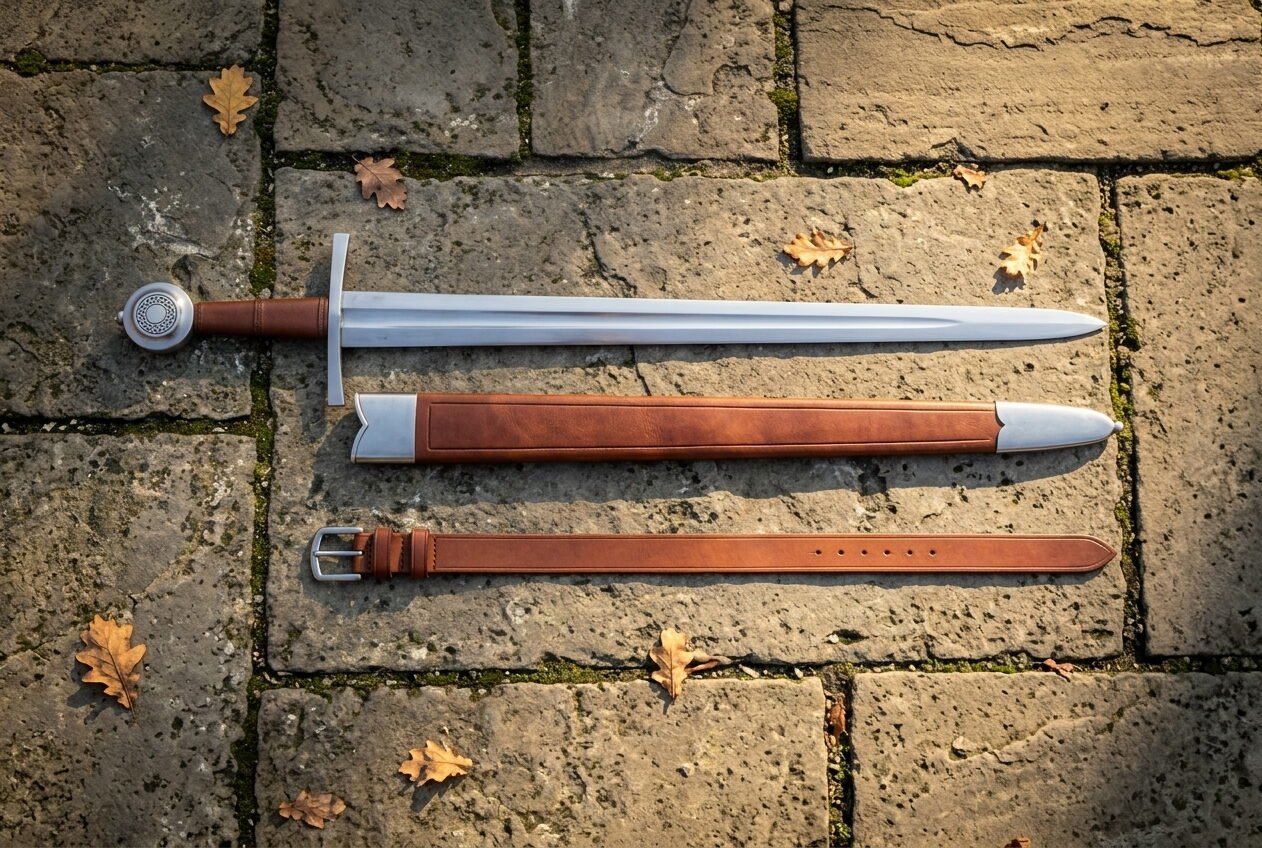
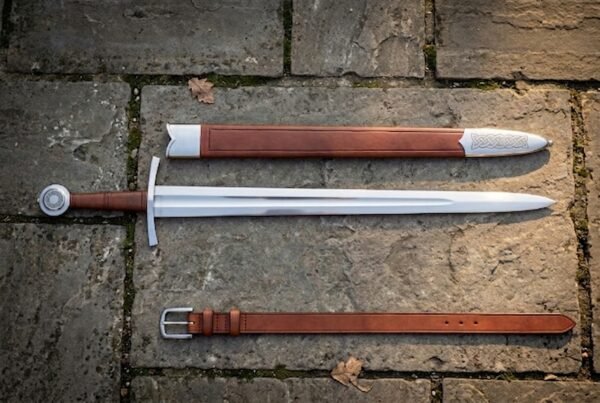
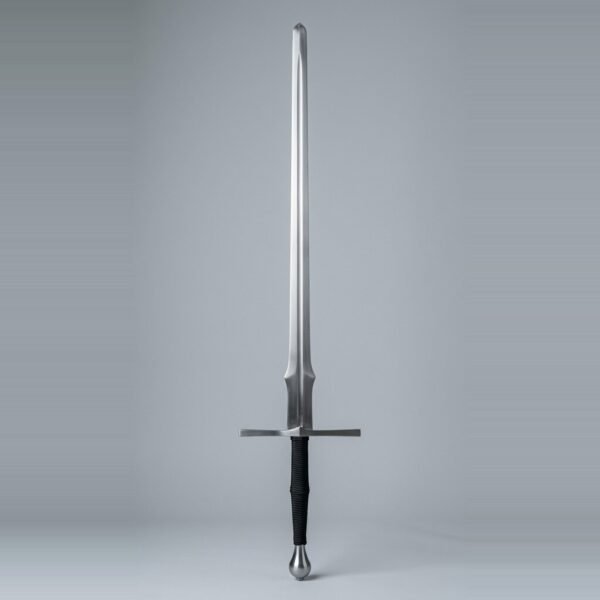
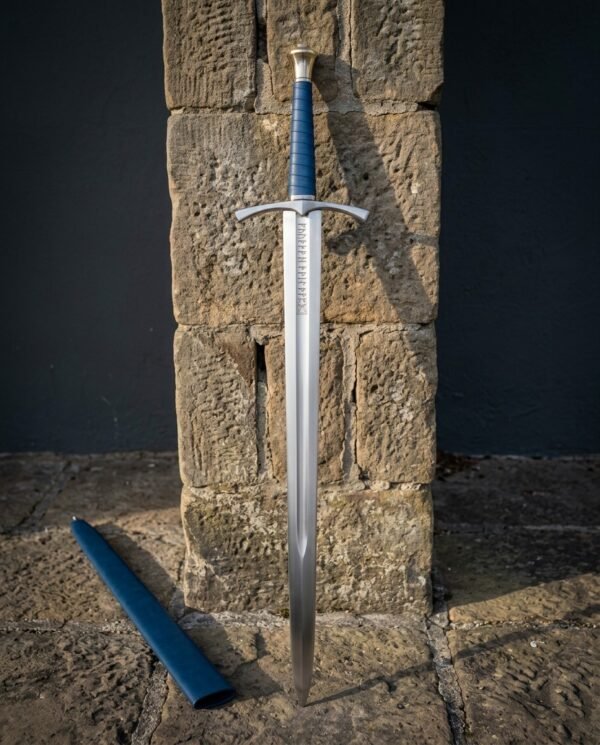
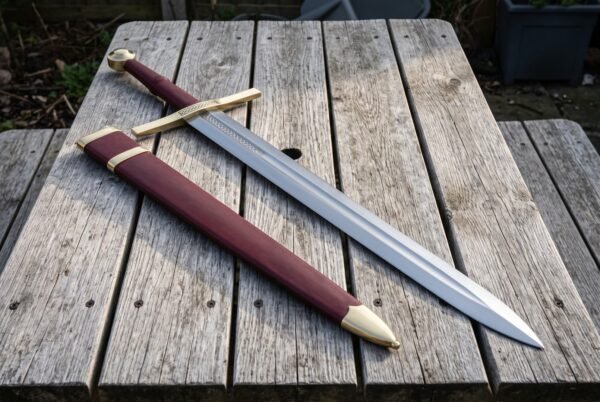
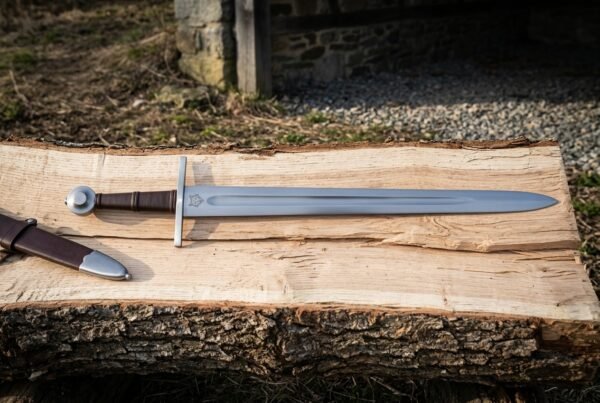
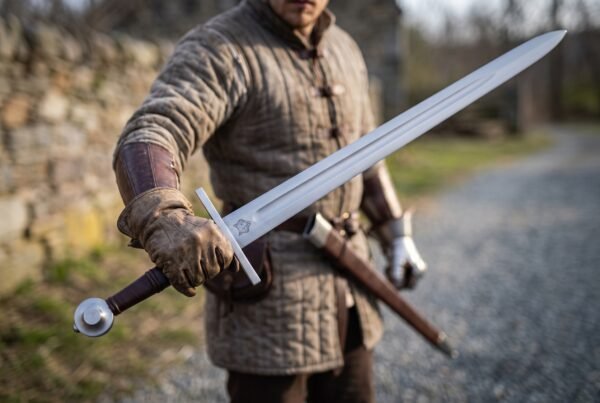
This is a single handed knightly arming sword supplied as a complete rig, blade, scabbard and belt together, built on the Oakeshott type XII pattern. Ewart Oakeshott set out that typology in 1960 and it is still how museums and collectors talk about medieval blades. A type XII is broad and flat at the shoulder, tapers evenly along its length, and carries a fuller running roughly two thirds of the way to the point. It is the everyday sword of the twelfth to the mid fourteenth century, the one hanging at a knight’s hip while the lance or the poleaxe did the heavy work. The detail people miss is that the sword was almost never what a man fought with first. It was the sidearm, worn at all times because it could be worn at all times, which is why the belt matters as much as the blade. A sword you cannot carry is a sword you leave behind.
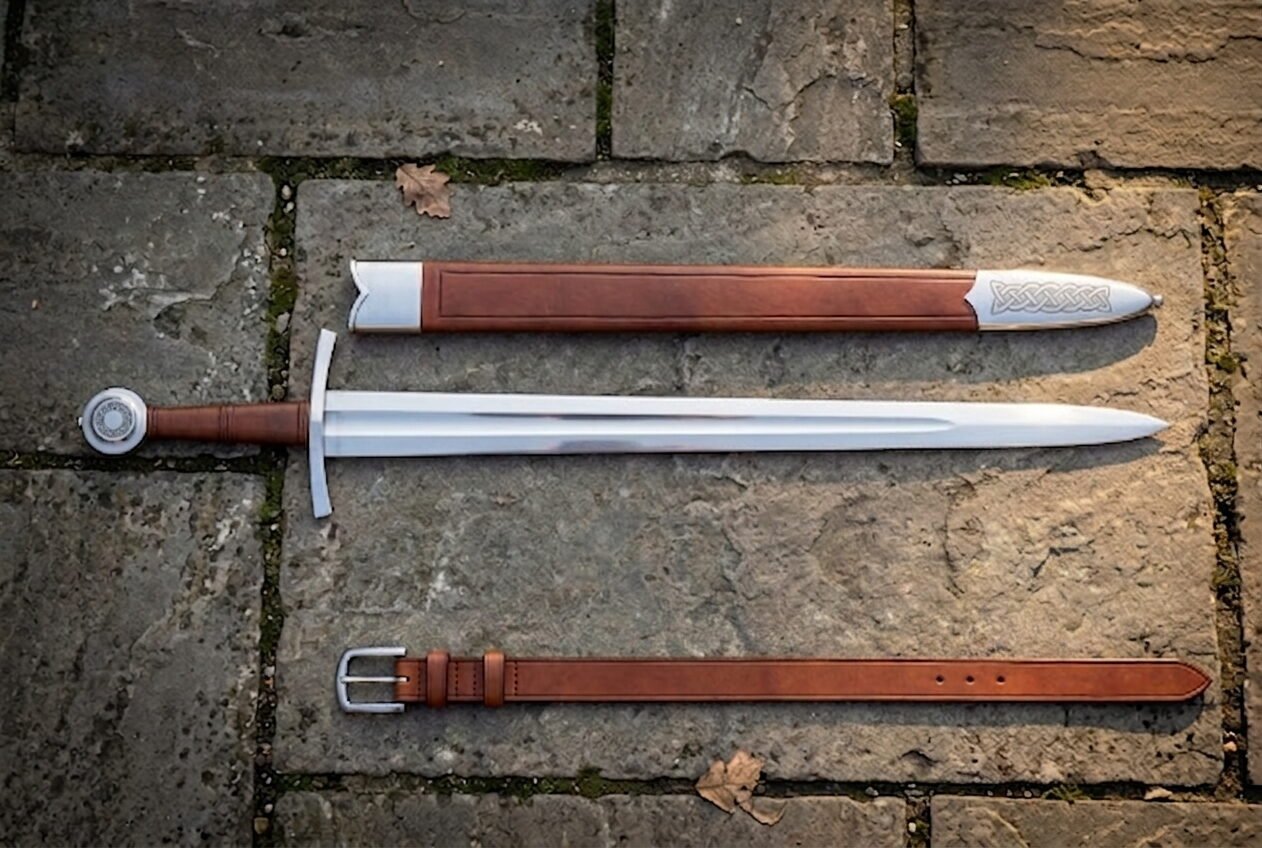
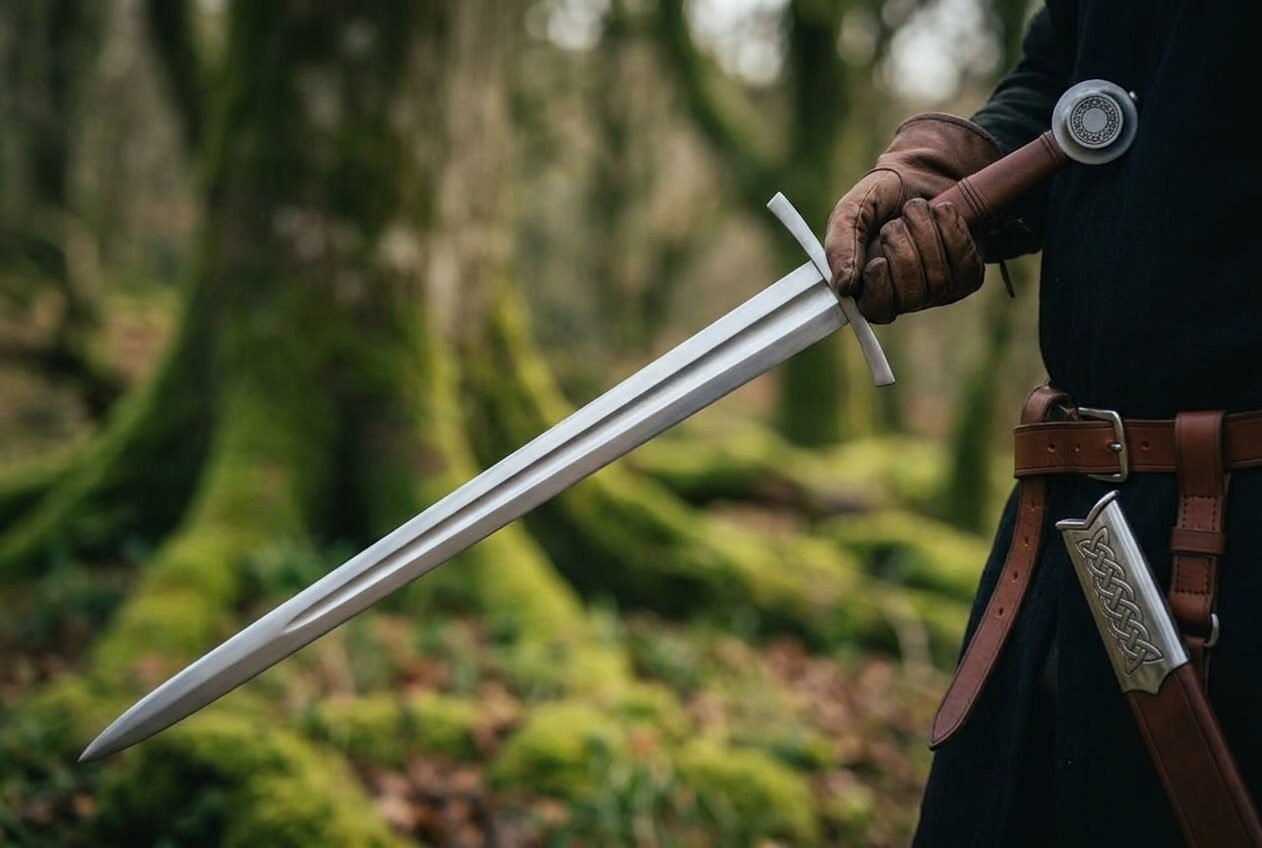
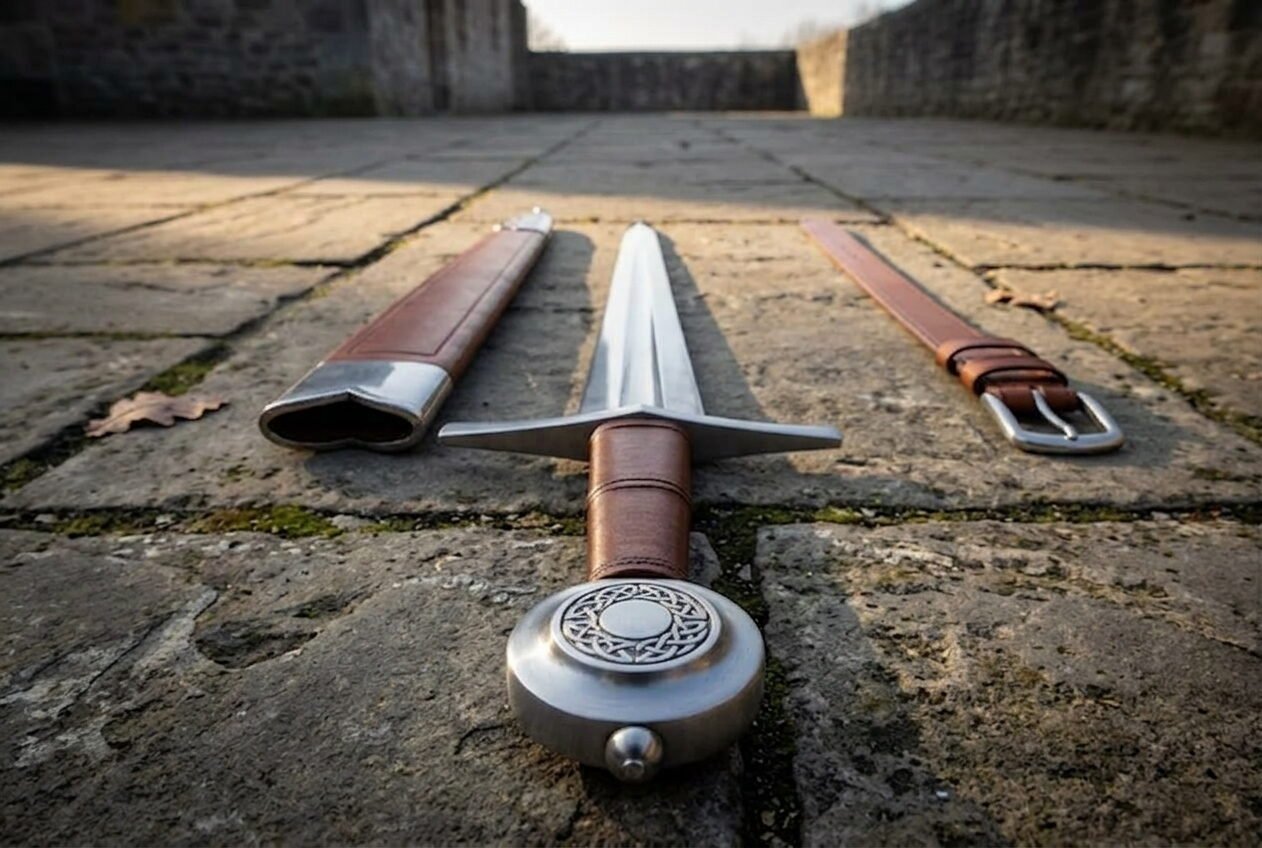
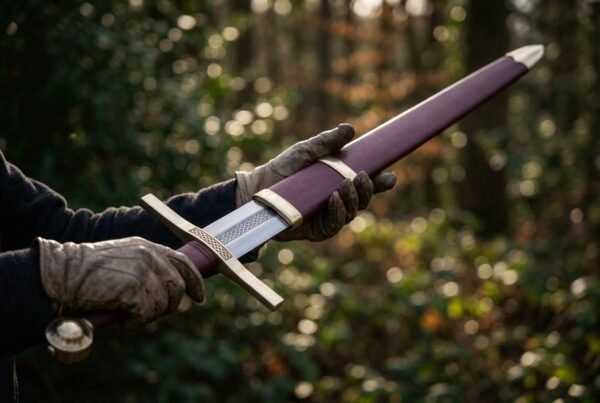
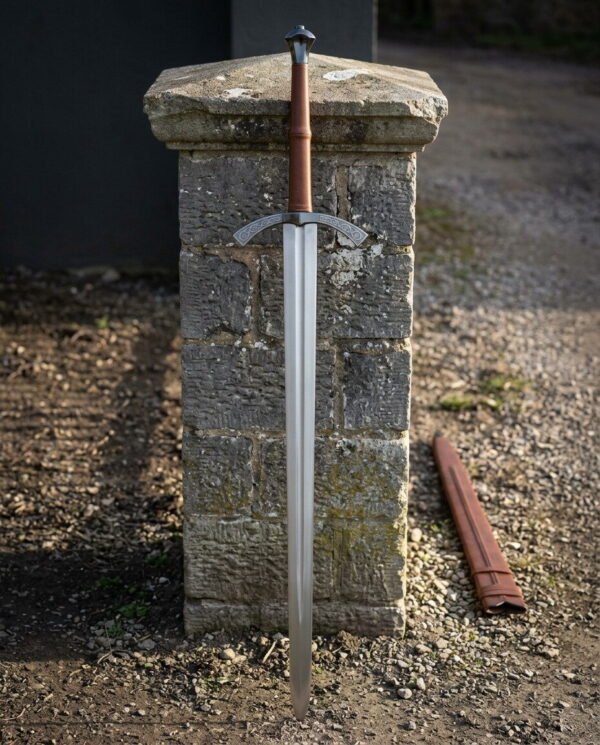
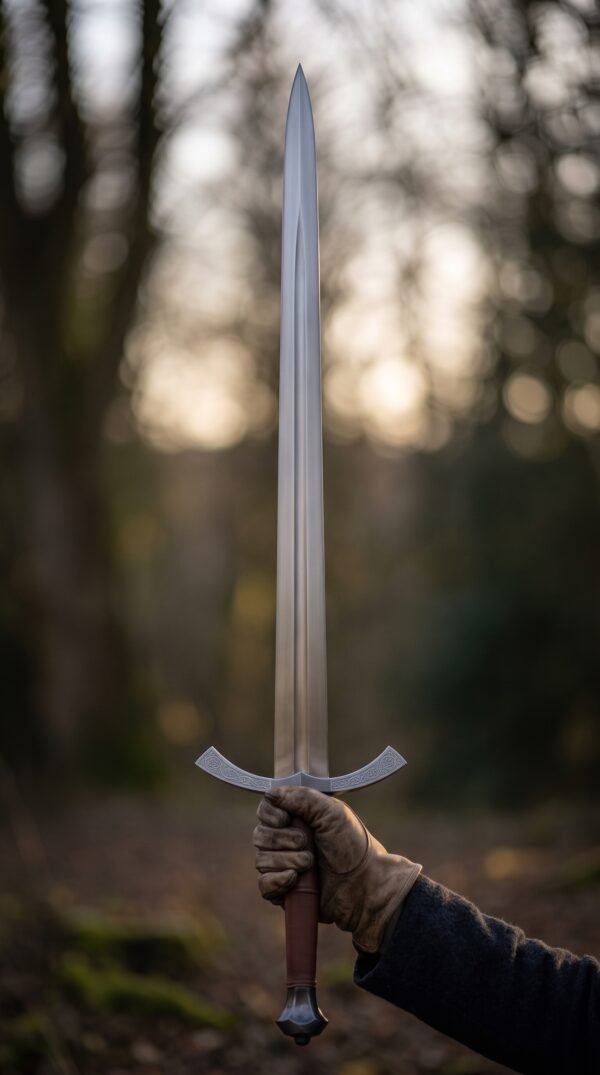
Everything here is forged, ground, hardened and fitted by hand in the Czech Republic, and the leatherwork is cut and stitched in the same building. The blade is 1095 high carbon steel, mirror polished with a wide central fuller. The hilt is a russet leather grip between a straight steel cross and a steel disc pommel with a knotwork engraved face. It ships with a tan leather scabbard with a steel throat and a knotwork engraved steel chape, plus a matching tan belt with a steel buckle. Shipping inside the United States is free.
Specifications
| Steel | 1095 high carbon steel, hand forged and mirror polished |
|---|
| Hardness | 54 to 58 HRC |
|---|
| Overall length | 36 inches |
|---|
| Blade length | 30 inches |
|---|
| Blade profile | Oakeshott type XII, broad at the shoulder with a wide central fuller |
|---|
| Guard | Straight steel cross |
|---|
| Grip | Russet leather wrap over a wooden core, with raised ribs |
|---|
| Pommel | Steel disc pommel with a knotwork engraved face inside a raised rim |
|---|
| Scabbard | Tan leather with a plain steel throat and a knotwork engraved steel chape ending in a ball tip |
|---|
| Belt | Matching tan leather, steel buckle, adjustable to about 44 inches |
|---|
| Tang | Full length, peened over the pommel |
|---|
| SKU | RK-1335 |
|---|
What the fuller is actually for
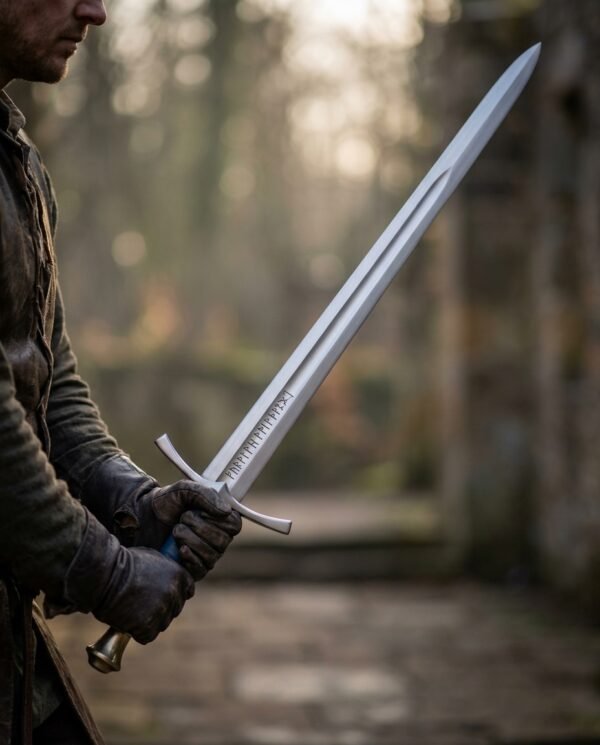
People still call it a blood groove, and it is not. A fuller is a structural feature. Forging a shallow channel down the centre of a blade moves steel outward toward the edges rather than removing it, so you end up with a cross section that behaves like an I beam. You keep the stiffness in the plane where the sword is loaded during a cut and you lose weight in the plane where stiffness does nothing. On a thirty inch type XII blade the fuller takes out something like a fifth of the mass without a meaningful loss of rigidity. That is the difference between a sword you can hold at guard for a long engagement and one that pulls your arm down after a minute.
The fuller also tells you something about how the sword was made. On this blade it runs from just below the cross to about two thirds of the way to the point, then stops, and the last third is a stiff diamond section. That is the classic type XII arrangement: light and lively through the cutting section, rigid where the point has to be pushed into something. Later types push the fuller shorter and shorter as swords got more thrust oriented against plate armour, until by the fifteenth century many blades have no fuller at all.
Why 1095 high carbon steel and not stainless
1095 carries about nine tenths of one percent carbon and very little else, and that plainness is a virtue in a sword. It forges cleanly, quenches predictably and tempers back into the range a long blade needs. We take this one to 54 to 58 HRC, deliberately softer than a knife, because a sword must bend under a bad edge alignment and spring back instead of snapping. Stainless steels buy corrosion resistance with a heavy chromium content, and at thirty inches that chromium costs toughness exactly at the shoulder and tang where a break would be dangerous. Carbon steel will patina and will rust if left wet, and that is a fair exchange. The full comparison is in Damascus versus stainless.
The grip, the scabbard and the belt
The grip is a leather wrap over a shaped wooden core, which is how medieval grips were built. The core takes the tang and the shape, the leather takes the sweat and the wear, and the combination is comfortable through a long session where a bare metal grip is not. The disc pommel is steel with a knotwork engraved face inside a raised rim, and its job is counterweight. Take it off and the sword becomes tip heavy and slow to recover between cuts.
The scabbard is a wooden core lined and covered in tan leather, with a steel throat at the mouth and a steel chape engraved with knotwork at the tip. It is not a slip cover. A proper core protects the edge and holds the blade without pressure. The belt is cut from the same hide, adjusts to about a forty four inch waist and takes a standard sword suspension. Give the leather a light dressing of balm once or twice a year and keep it out of the sun. Do not store the sword inside the scabbard, for reasons set out in the care section below.
Engraving, runes and your own design
Use the rune converter on this page to turn a name, a date or a short phrase into Elder Futhark and we will cut it into the steel or the handle. If you would rather have a Viking pattern than a rune line, choose your own design in the engraving option above the add to cart button and tell us whether it goes on the blade or the handle. Where a piece already carries an engraved design, your chosen engraving replaces it rather than sitting alongside it. On this rig the fuller is a natural home for a rune line, and we can also cut a name or a date into the belt leather at no extra charge if you ask. See the engraving page.
Care and sharpening
Dry the blade after handling and wipe it with light machine oil or a hard paste wax. A mirror polish shows a fingerprint etch faster than any other finish, and skin oil is acidic. Do not leave the sword sheathed for months, because vegetable tanned leather holds moisture and tanning salts against steel and will bloom rust along the blade. Hang the sword or lay it on a rack and use the scabbard for carrying. Our page on steel care applies to plain carbon steel as well as pattern welded. When the edge dulls, take it back with a coarse then a fine stone at a shallow angle worked from the cross toward the point, as described in sharpening with a whetstone, then re oil.
Made in the Czech Republic
This is a handmade piece from the Czech Republic, made in a workshop that still forges, grinds and finishes by hand instead of stamping parts out. The smiths there have kept the older way of working, and the wood, horn and leather are shaped and fitted by hand as well. Two pieces of the same design will never be identical, and that is part of what you are buying.
Ransack Viking is a United States company. We handle the import ourselves, look over every piece when it lands and ship from our warehouse in Chicago, Illinois. Engraving is done in the United States after the piece arrives, so your design goes on before we send it out.
A note on handmade variation
This sword is hand forged. It is not machine made and it is not bulk produced, so what arrives will not be a pixel for pixel copy of the photograph. Leather is a natural material and takes dye differently from hide to hide, so the exact tan of the scabbard and belt will vary. The depth of the polish, the precise line of the fuller and the grain of the grip wrap vary too, because each piece is worked by hand. The dimensions, the steel and the build are the same every time. The character is not, and that is what separates a forged sword from a stamped one.
Frequently asked questions
Does the belt actually carry the sword?
Yes. The belt is full thickness harness leather with a steel buckle and it is built to take the weight of the scabbard and blade, not just to look right in a photograph. It adjusts to roughly a forty four inch waist.
Is the sword sharp?
It arrives with a working edge. If you want it blunt for reenactment, stage or display use, say so in the order notes and we will leave a rounded quarter inch edge at no extra cost.
Can I spar with it?
No. This is a sharp single handed sword, not a blunt federschwert. It is fine for soft target cutting against bottles, mats and noodles. Do not use it edge to edge against another blade, do not cut hardwood or bone and never throw it.
What is the difference between this and a longsword?
Grip length and intended use. An arming sword like this has a single hand grip of about four inches and was carried with a shield. A longsword has a grip long enough for both hands and appears later, as plate armour spread and shields shrank. This sword is quicker in one hand and cannot be gripped with two.
Will mine look like the photograph?
The shape, size and fittings will. The exact tone of the leather and the way the polish catches the light will not, because both come from natural materials worked by hand.
How long does shipping take?
Free inside the United States. Ten to fourteen working days in the shop for a full rig, then two to five days in transit, plus about a week if you order engraving.
What is in the box
- One hand forged 1095 high carbon steel type XII arming sword, 36 inches overall
- Tan leather scabbard with steel throat and engraved steel chape
- Matching tan leather sword belt with steel buckle
- Light protective oil coat on the blade for transit
- Care and sharpening card
- Forged and finished in the Czech Republic
Explore the range
Browse the rest of the arming swords, our scabbards and sheaths, the two handed longswords and everything under swords. Background reading is in the guides.
Also in this part of the catalogue
Worth putting side by side with this is the Quillhide sheath. In the same category sits the Edgekeep sheath. A near match for this one is the Runegird sheath, 36 inches overall.
For a different piece from the same family, look at the Emberfall blacksmith tool. Or start from a blank sheet on the design your own page.
Training at a HEMA club? Look at the Faskvar blunt arming sword for drills and free play, and check our HEMA arming swords as well.


Reviews
There are no reviews yet